
Up to this point, we have talked about how students demonstrate relative advantage in the admissions process. Before moving forward, it is worth clarifying what that really means.
At this stage, we are still operating within what I would call the defensive layer of an application. In other words, even when a student performs very well here, the result is usually that they appear clearly qualified and stronger than many other applicants. That matters. It gives the student a solid foundation. But on its own, it does not always create the kind of impact that makes an admissions office feel that this student is uniquely compelling.
A strong academic record, rigorous coursework, and a proven ability to perform at a high level all help build that defensive foundation. Once that foundation is in place, students then begin to show how they stand out within the same competitive pool. That is where relative advantage starts to become visible. And as I have said many times, this is not only about major awards or headline-level accomplishments. Smaller pieces, when accumulated consistently and presented in a coherent way, also help create real distinction.
But today, I want to move into the next stage—the part that often makes the biggest difference in highly selective admissions. This is the stage where a student begins to show an unexpected side of themselves, or what I would call their specialness.
Why Diverse Experience Matters
When students participate in many different kinds of experiences, they naturally collect fragmented pieces of knowledge. One experience teaches them one kind of perspective. Another gives them a different framework. Another introduces a new problem, community, or way of thinking.
The important shift happens when those separate fragments begin to connect.

When isolated experiences become connected ideas, students begin to demonstrate integrative thinking. And that is one of the reasons colleges value students with a broad range of experiences. Diversity of experience creates more opportunities for intellectual connection, and those connections often lead to more mature and original thinking.
This is why colleges are often drawn to applicants who have explored different fields, environments, and responsibilities. Broad experience does not automatically make a student special, but it increases the likelihood that the student can think in a more layered and sophisticated way.
Still, diverse experience alone is not enough.
A student can appear “well-rounded” without being memorable. A student can have a long list of activities without leaving a clear impression. To become truly compelling, there has to be one additional layer beyond diversity itself.
That is the point I want to focus on here.
The Missing Piece in a Strong Applicant Profile
Let’s look at a real type of student example.
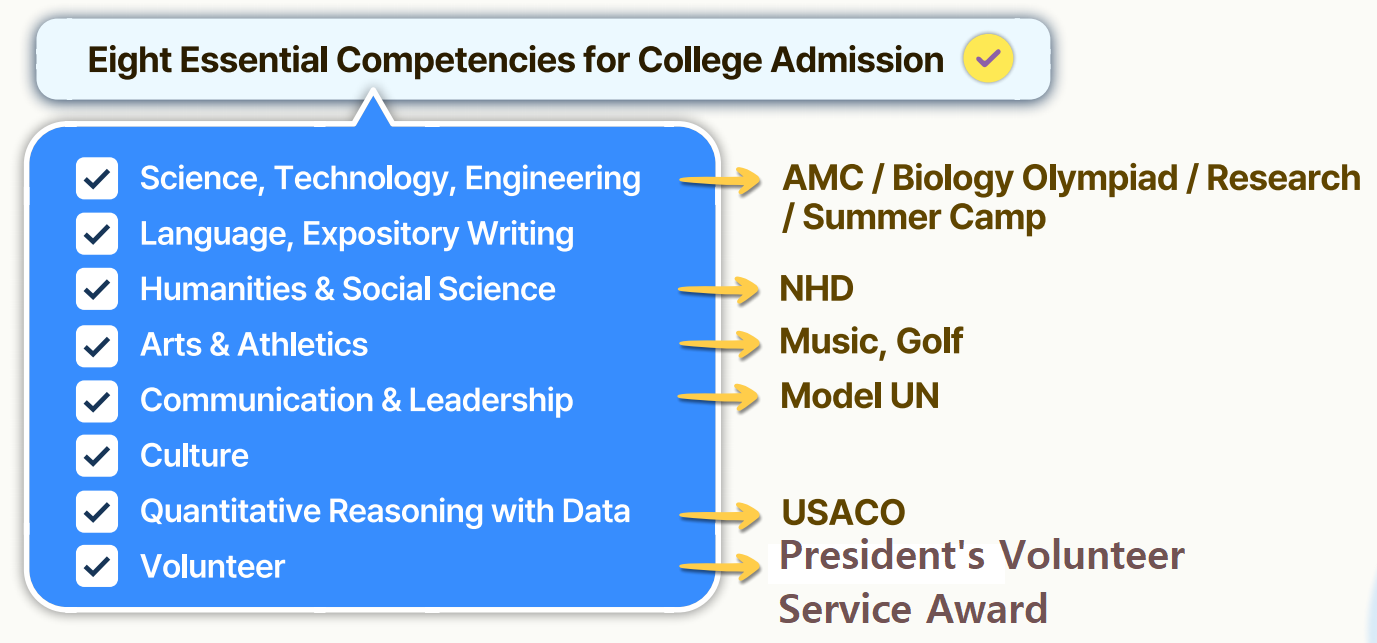
This student is male, STEM-oriented, and also a strong violist. At first glance, you might imagine a very typical high-achieving profile. A student like this might take advanced AP courses, compete in math or science contests, build coding skills, pursue research, and attend selective summer programs. To soften a profile that feels too narrowly STEM-focused, he might also participate in music, Model UN, National History Day, or volunteer work.
On paper, that already sounds strong.
But that is not yet the kind of “unexpected side” I mean.
Adding unrelated activities for the sake of variety is not the same as building depth. A student does not become more interesting simply because they have one activity in science, one in music, one in service, and one in writing. Real distinctiveness requires more than scattered breadth.
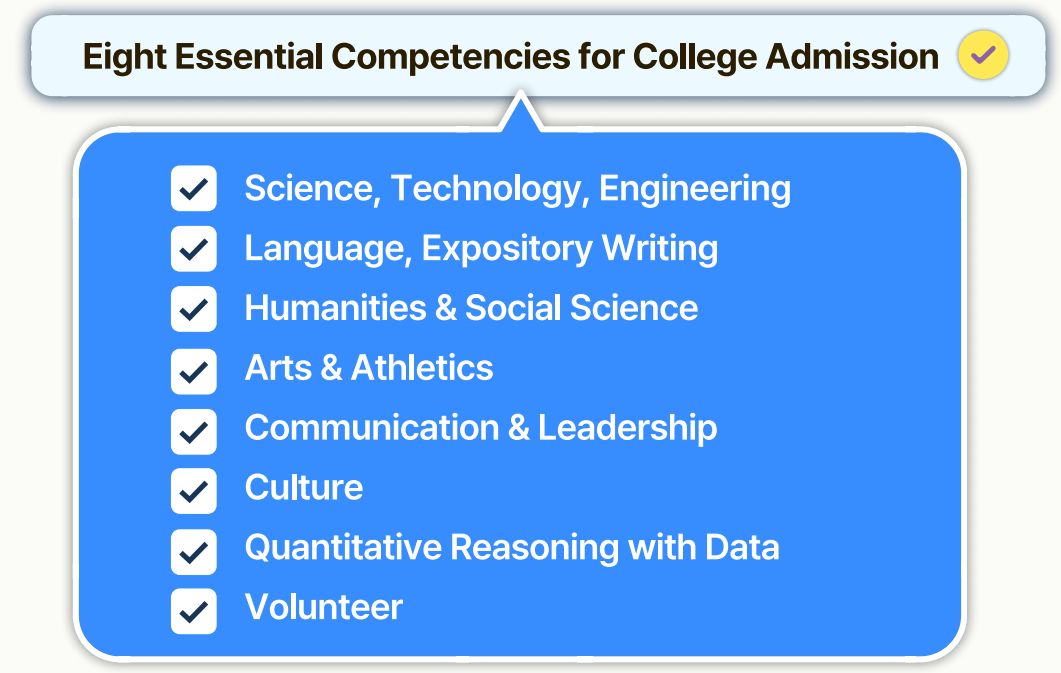
When I evaluate student activities, I often think across eight broad categories:
- Science / Technology / Engineering
- Language / Writing
- Humanities / Social Science
- Music / Arts
- Communication / Leadership
- Multicultural Exposure
- Quantitative Reasoning / Data
- Community / Volunteer Work
If a student has meaningful exposure across many of these areas, then yes, they begin to show real diversity. That already suggests the possibility of integrative thinking. But even then, the profile can still feel unfinished if the student has not tied those experiences together in a meaningful way.
What This Student Actually Did
Now let’s look at what this student actually did.
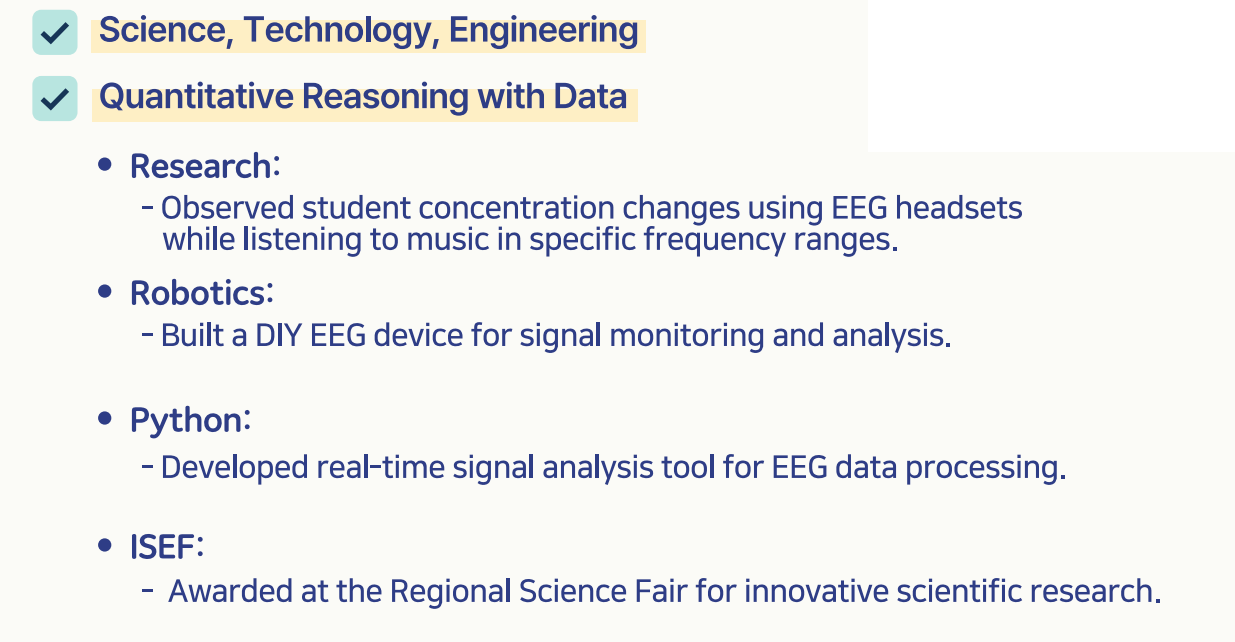
In STEM and data-related work, he conducted research on the relationship between music frequency and concentration, using brainwave measurements to study the connection. This was not random. It directly linked his strength in music to a practical research question. He built the measurement device through his school robotics club and used Python to automate portions of the data collection process. He received recognition at the ISEF Regional Science Fair, though he did not advance beyond that level.
In language and writing, he earned a Silver Key in the Scholastic Art & Writing Awards and was also shortlisted for the John Locke Essay Competition. At school, he was involved not only in robotics but also served as vice president of the Writing Club. Since serious orchestra students often have limited time for a large number of extracurriculars, he focused on only a few activities rather than spreading himself too thin.
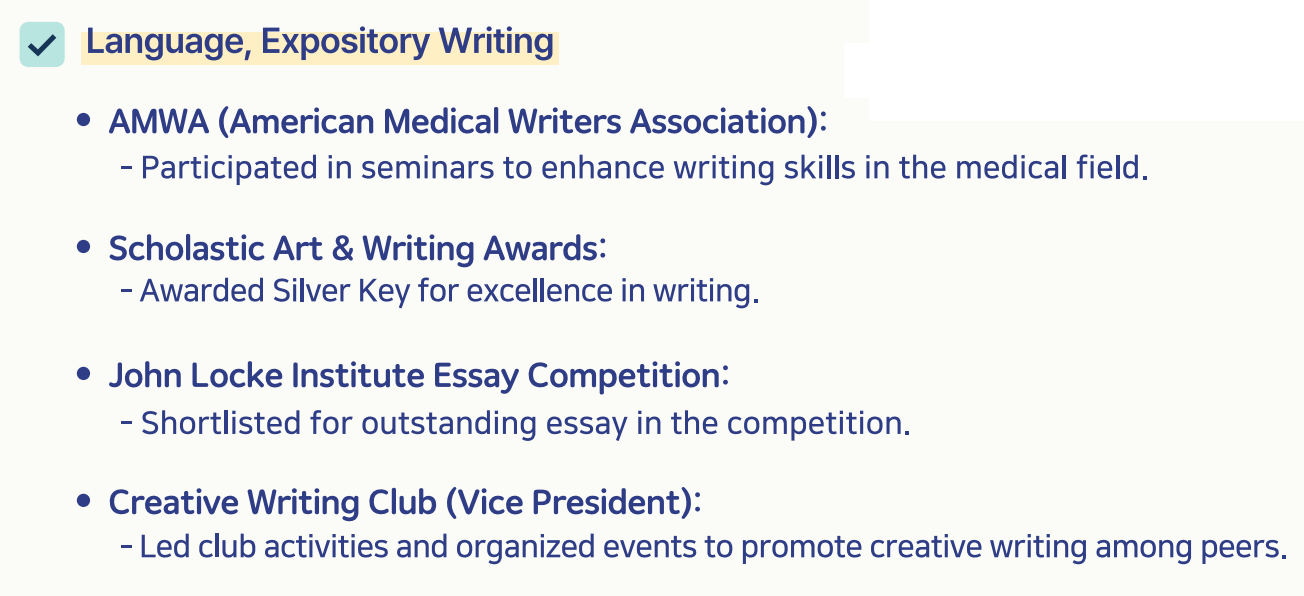
His interests also extended into neuroscience and psychology. Because of that, he actively reached out to medical communities, attended related seminars, and explored ways to engage with the field through medical writing rather than through formal publication. Humanities and social science, however, remained a weaker area in his profile.
In music, he ranked at a high level in MTNA state competition and served as first chair in both his school symphonic orchestra and chamber orchestra. Interestingly, he had originally played violin, but after recognizing that there was an exceptionally strong violinist in his school, he strategically switched to viola in order to create a better path toward leadership within the orchestra.
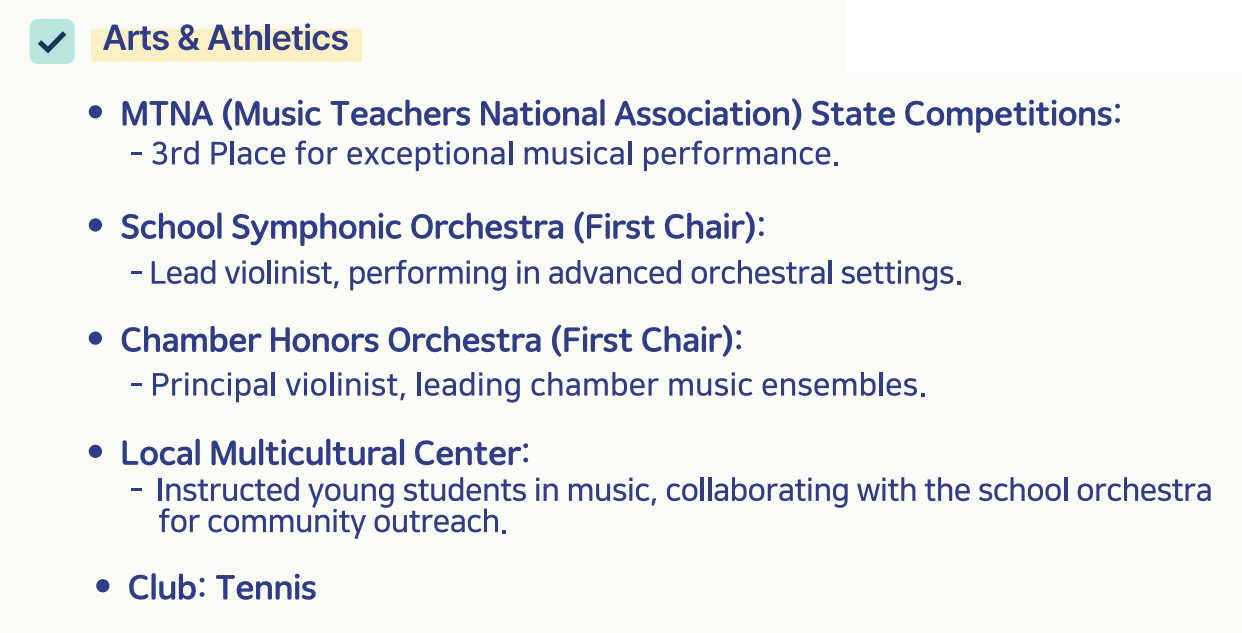
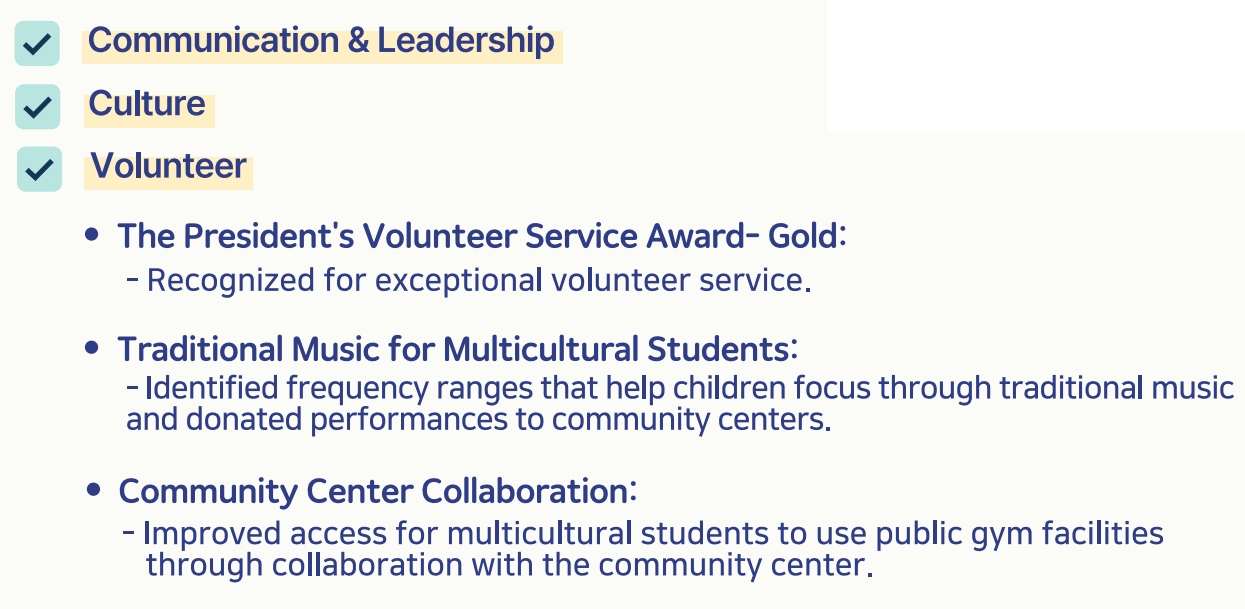
In leadership, multicultural engagement, and service, he worked with a local multicultural center to provide instruments and music lessons to children. He consistently led sessions introducing younger students to classical music. He also organized a children’s book donation drive, and he used his music-and-concentration program with younger students in a way that combined research and service. His community work eventually earned him the Presidential Volunteer Service Award.
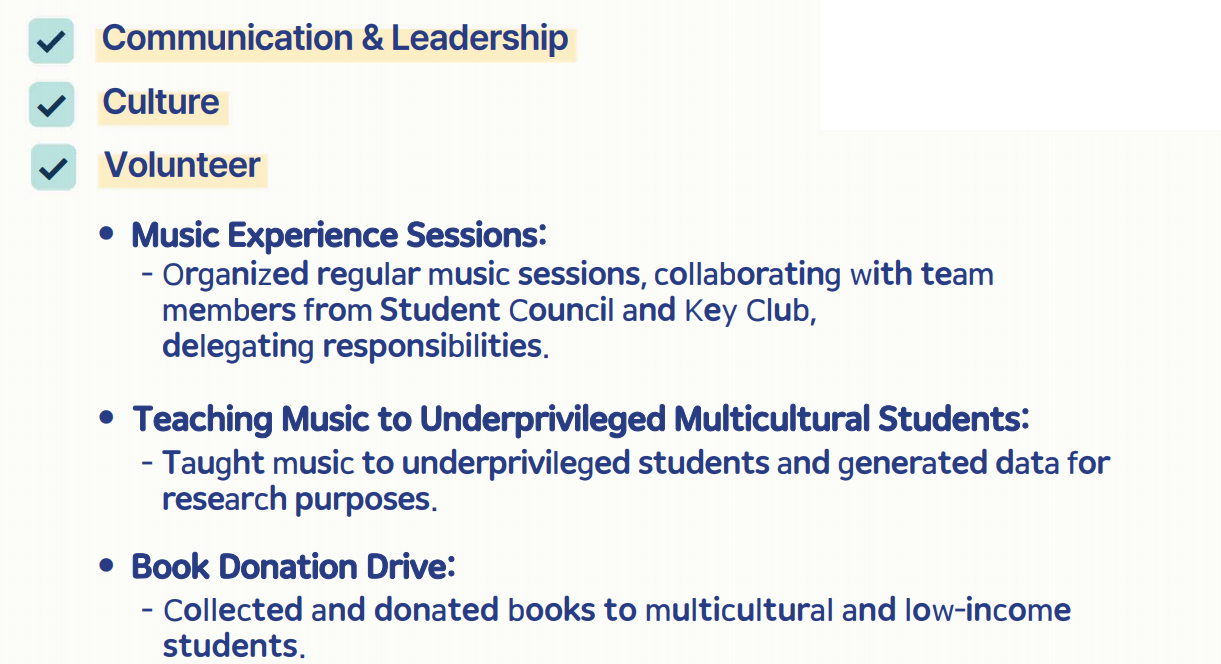
He went even further by selecting and recording traditional songs from different cultures that could help children focus, then sharing those recordings with children from multicultural families. He also worked with the local community to help secure a safe, usable space where children could gather, play, and participate in educational activities. Outside of this, he played tennis recreationally, though not at the varsity level.
What Actually Made Him Stand Out
If we stop at the surface level, this student simply looks like someone with strong and varied activities.
But that description misses the real point.
The key difference is that his activities did not exist as separate achievements. They all converged toward one purpose: supporting the after-school learning and development of children from low-income and multicultural families.
His research was not just science research. It became a way to think about concentration and learning support.
His music was not just talent. It became a tool for service and educational access.
His writing was not just an award category. It became a way to express and expand his concern for the community he cared about.
His volunteer work was not generic service. It became the place where his academic interests, artistic strengths, and sense of purpose all came together.
That is what transforms a student from “impressive” to genuinely memorable.
What “Specialness” Really Means in Admissions
This is what I mean by the third stage of application building: specialness.
Specialness does not come from adding one unusual activity to an otherwise predictable profile. It does not come from trying to look random or eclectic on purpose. And it certainly does not come from artificially forcing unrelated activities into a single sentence.
Instead, it comes from two things happening at the same time.
First, the student develops enough breadth of experience to show the potential for integrative thinking.
Second, the student demonstrates that those experiences are not random. They are all moving toward one meaningful purpose.
That second part is critical.
A student with many activities may look busy. A student whose activities converge under one purpose looks intentional, thoughtful, and authentic.
And that difference is enormous in highly selective admissions.
Admissions readers are not simply asking, “What did this student do?” They are also asking, “What does all of this add up to?” When a profile answers that question clearly, it becomes far more powerful.
The Framework Students Should Use
So if students want to evaluate whether their profile is becoming truly compelling, they should ask themselves two questions:
Do I have enough range in my experiences to show breadth and integrative potential?
And do those experiences ultimately converge toward one meaningful purpose?
That is where real distinction begins.
A long list of activities can make a student look accomplished.
But a profile built around a clear purpose makes a student feel coherent, intentional, and memorable.
And in top-tier college admissions, that difference matters.
academic
