
Hello, this is A ONE INSTITUTE.
Today, I want to share an update on the 2024 John Locke Essay Competition, one of the writing competitions I talk about most often.
On August 14, U.S. time, students who received awards were notified. But this year, before the awards process moved forward, a new step was suddenly added—something that had not existed in previous years.
So what exactly was added, and what does it tell us about where current admissions and academic competition trends are headed? Let’s take a closer look.
If you have not already, it may also help to review our earlier post and video explaining the John Locke Essay Competition in more detail.

The John Locke Essay Competition is a highly rigorous writing competition that places a strong emphasis on research ability. This is not just about writing well. Students are expected to build a thoughtful, well-researched argument and use appropriate citations effectively. That is one of the core reasons the competition is taken seriously.
The prompts themselves are also quite deep. Students choose one topic from among several prompts across seven categories:
Philosophy, Politics, Economics, History, Law, Psychology, and Theology
Let’s briefly look at the kinds of questions students are asked in each category.
1. Philosophy
The philosophy prompts deal with weighty questions about moral duty, animal rights, and the nature of good and evil.
- Q1. What moral obligations do we have to people who are alive now, and do we have different obligations to people in the future? What implications would your answer have for policymaking?
- Q2. Why should we treat non-human animals well? Is it because they have rights, because they have interests related to life and welfare, because both are true, or because neither is true?
- Q3. “If civilians are the main target of an attack, then the cause is irrelevant. It is terrorism, and it is evil.” Is this claim correct?
2. Politics
The politics category explores political ethics, democracy, and a range of issues relevant to contemporary society.
- Q1. Should politicians be punished when they lie?
- Q2. Edmund Burke praised the wisdom of “unlettered men.” In a democracy, are the votes of the illiterate more likely to protect a country from the mistaken views of the literate, or are the votes of the literate more likely to protect it from the mistaken views of the illiterate?
- Q3. Diversity is fashionable, but is it actually valuable?
3. Economics
The economics prompts focus on practical, real-world issues, from the behavior of charitable versus for-profit institutions to questions about higher education.
- Q1. What kinds of behavior does the hope of profit encourage? Are those behaviors, overall, better or worse than the behavior we would expect if all enterprises were run by charities or governments?
- Q2. What effect would the UK government’s proposal to impose VAT on school fees have on socioeconomic mobility?
- Q3. Should Oxford lower admissions standards for the children of major donors?
4. History
The history category asks students to think about how ideas and historical figures have shaped the modern world.
- Q1. Bertrand Russell said, “Hitler is an outcome of Rousseau; Roosevelt and Churchill are outcomes of Locke.” To what extent was he right?
(Rousseau prioritized the interests of the community as a whole, while Locke emphasized individual rights.) - Q2. Should people feel ashamed of their nation’s history, or proud of it?
- Q3. Who did the most to expand human freedom in history?
5. Law
The law category addresses legal judgment in both personal and international contexts.
- Q1. How much harm may one person inflict on another in defense of private property?
- Q2. “Use every man after his desert, and who should ’scape whipping?” Should the law treat criminals better than they deserve?
- Q3. Is Vladimir Putin a war criminal?
6. Psychology
The psychology prompts explore the human mind and human behavior.
- Q1. Is objectivity entirely in the mind?
- Q2. Eleanor Roosevelt said, “No one can make you feel inferior without your consent.” Was she right?
- Q3. What is self-deceit?
7. Theology
The theology category raises foundational questions about religion and God.
- Q1. Is atheism implausible?
- Q2. Why would the creator of trillions of galaxies care whether you have sex with your boyfriend or eat bacon for breakfast?
- Q3. Why pray?
Students selected one of these prompts and submitted their essays. Then, on August 14, students who made the shortlist received a congratulatory email.
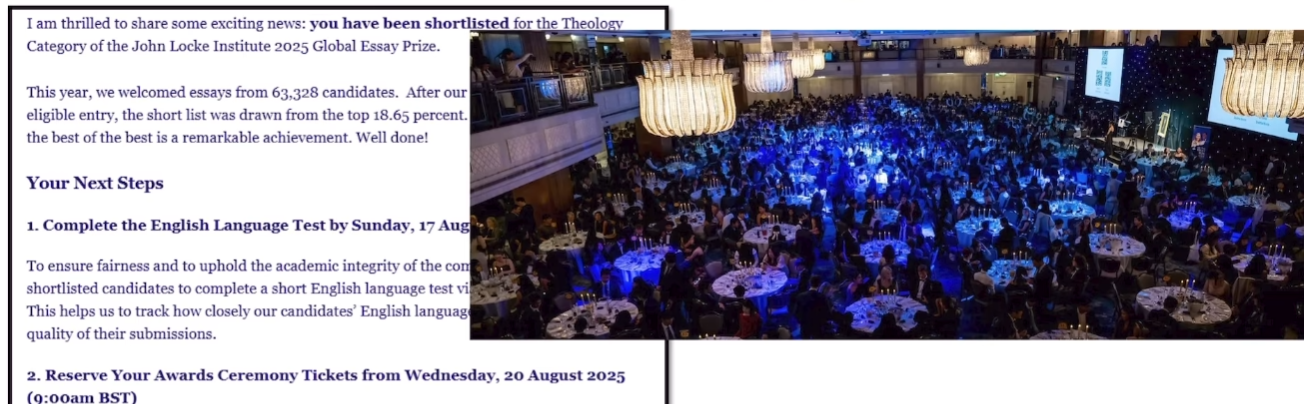
This year, a record-breaking 63,328 students applied, and 18.65%, or about 11,810 students, made the shortlist.
In the email, under the section titled “Your Next Steps,” there was a newly added requirement that had not appeared in previous years.
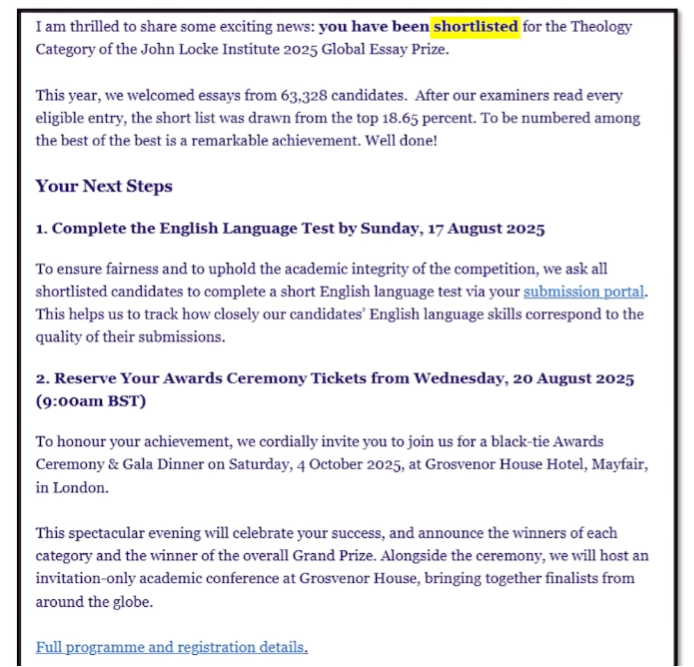
That requirement was an English Language Test.
Students had to complete the test between Thursday, August 14, when the email was sent, and Sunday, August 17.
This test was introduced to prevent students from submitting essays that relied too heavily on AI or outside help. In other words, the organizers wanted to verify whether the level of the submitted essay genuinely matched the student’s own ability.
If the test result differed significantly from the level of the submitted work, the student could lose shortlist status.
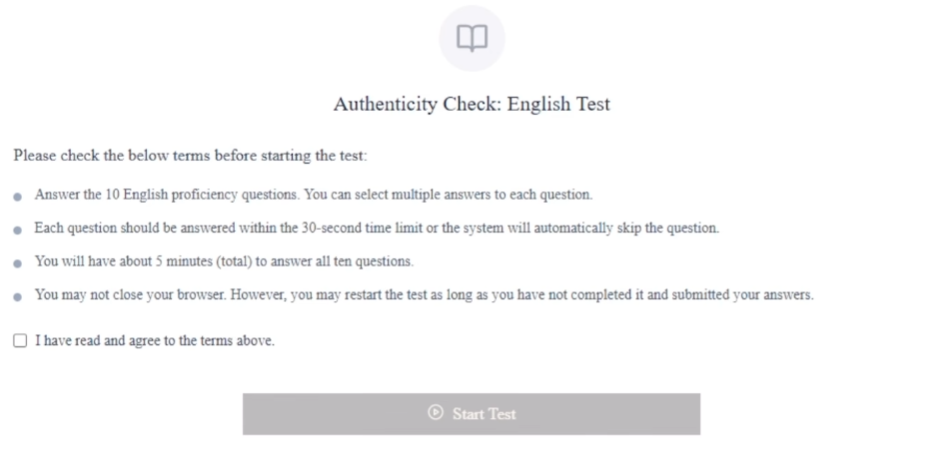
The test itself was quite simple in format: 10 questions, each designed to be answered in about 30 seconds, with the full test completed in 5 minutes.
Students had to pass this step in order to remain on the shortlist and receive an invitation to the awards ceremony in the UK.
At the ceremony, students may receive distinctions such as Commendation or High Commendation, and winners are also announced by category, along with the overall Grand Prize Winner.
Receiving an award at this level can become a major spike in the college admissions process.
How AI Is Changing Academic Competitions and Admissions
This shift is not limited to the John Locke Essay Competition.
As more students rely on AI tools, we can expect similar verification steps to be added in other competitions and in the college admissions process as well.
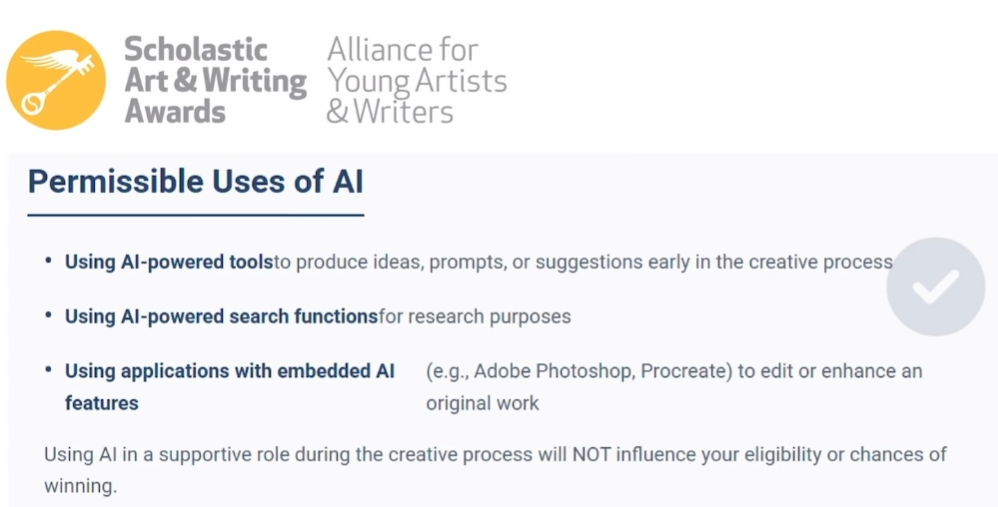
For example, Scholastic Art & Writing does allow limited use of AI-based tools in certain stages. Students may use AI to brainstorm ideas, support research, or assist with programs like Photoshop.
However, the rules make one thing absolutely clear: the final submitted work cannot be an AI-generated creative product.
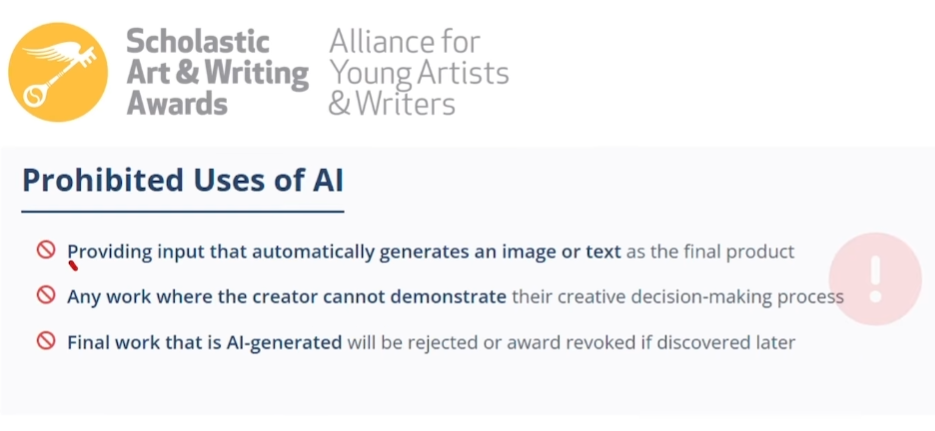
If AI use is detected, all awards can be revoked.
The same principle applies to the Common App.
If a student is found to have used AI to write an application essay, the Common App has an obligation to report that to every college the student applied to. In addition, the student may be barred from using the Common App again.
That is why students should never use AI to write their Common App essays.
Some literary competitions are even stricter. In some cases, if AI was involved in even a very small portion of the work, the student can be disqualified immediately.
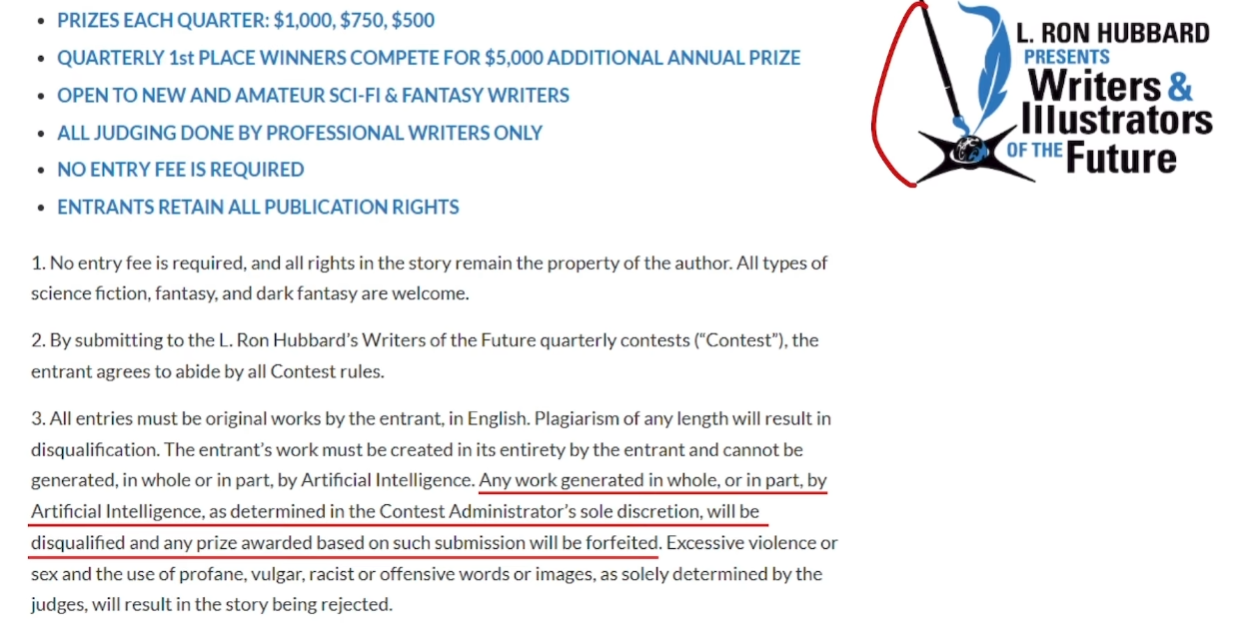
Because of this trend, many high schools are moving away from take-home typed essays and requiring students to write in class, by hand, so that schools can better evaluate the student’s actual writing ability.
There has also been movement on the admissions side.
Duke University, for example, has officially announced that it will no longer include the essay in its numerical rating process. In other words, it is reducing the weight of the essay.
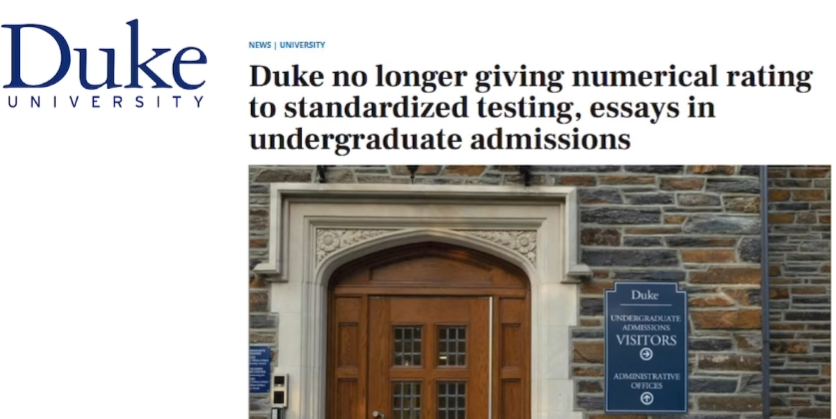
Duke is the most explicit example so far, but it is widely understood that other colleges are also considering reducing the role of essays in evaluation.
So whether students are submitting a personal statement, writing an in-class school essay, or entering a writing competition, they need to approach AI use with real caution.
AI detection tools have become much more sophisticated, and the environment is increasingly strict. Even minor detection can lead to serious consequences.
At the same time, interviews and additional testing are being used more frequently to confirm whether a student’s actual writing ability matches the level of the submitted work.
Given these changes, students should not count on shortcuts.
Even if AI is used in a limited way for support, the final work must be rewritten in the student’s own language, shaped by the student’s own thinking, and produced as genuine student work.
That is the standard students should keep in mind—whether they are submitting essays for school, for competitions, or for college applications.
We hope this was helpful, and we’ll be back with more useful information in the next post.
If you are preparing for the Digital SAT, we also recommend checking out ett-test.com, where you can find video explanations for problems you may not be able to find elsewhere.
Thank you.
writing competition
EC
Extracurricular
