
College interview season has begun for students applying to selective U.S. universities. Some applicants are already receiving invitations, while others are wondering whether not receiving one means their chances of admission have decreased.
Not receiving a college interview invitation does not mean rejection, and receiving one does not guarantee admission. Interviews are usually conducted by alumni volunteers, and their purpose is to provide additional information about applicants beyond what appears in their written applications.
However, the meaning of an interview invitation, the selection process, and the way interview reports are evaluated can differ significantly among universities.
Understanding these differences is essential. Students should know when invitations arrive, who conducts interviews, what interviewers want to learn, and how to prepare for a conversation that may contribute to the final admissions decision.
To explain the process, we will focus primarily on Yale University, which has provided unusually detailed explanations of its admissions interviews, while comparing its practices with those of Harvard, Stanford, MIT, Princeton, Dartmouth, Duke, Georgetown, and other institutions.
When Do College Interview Invitations Arrive?
For the 2026–2027 admissions cycle, students who submitted Early Decision (ED) or Early Action (EA) applications around November 1 are entering the main interview period.
Yale provides a particularly useful example.
In its November 5, 2026, admissions update, Yale explained that it had already begun inviting some Early Action and QuestBridge applicants to interviews.
The university also clarified that invitations are not sent only once.
Some applicants receive interview requests after an initial application review. Others may be invited after a more detailed reading of their applications, while additional interviews can be requested during admissions committee meetings.
Yale's admissions committee meetings are scheduled to begin on November 30, with Early Action decisions expected in mid-December.
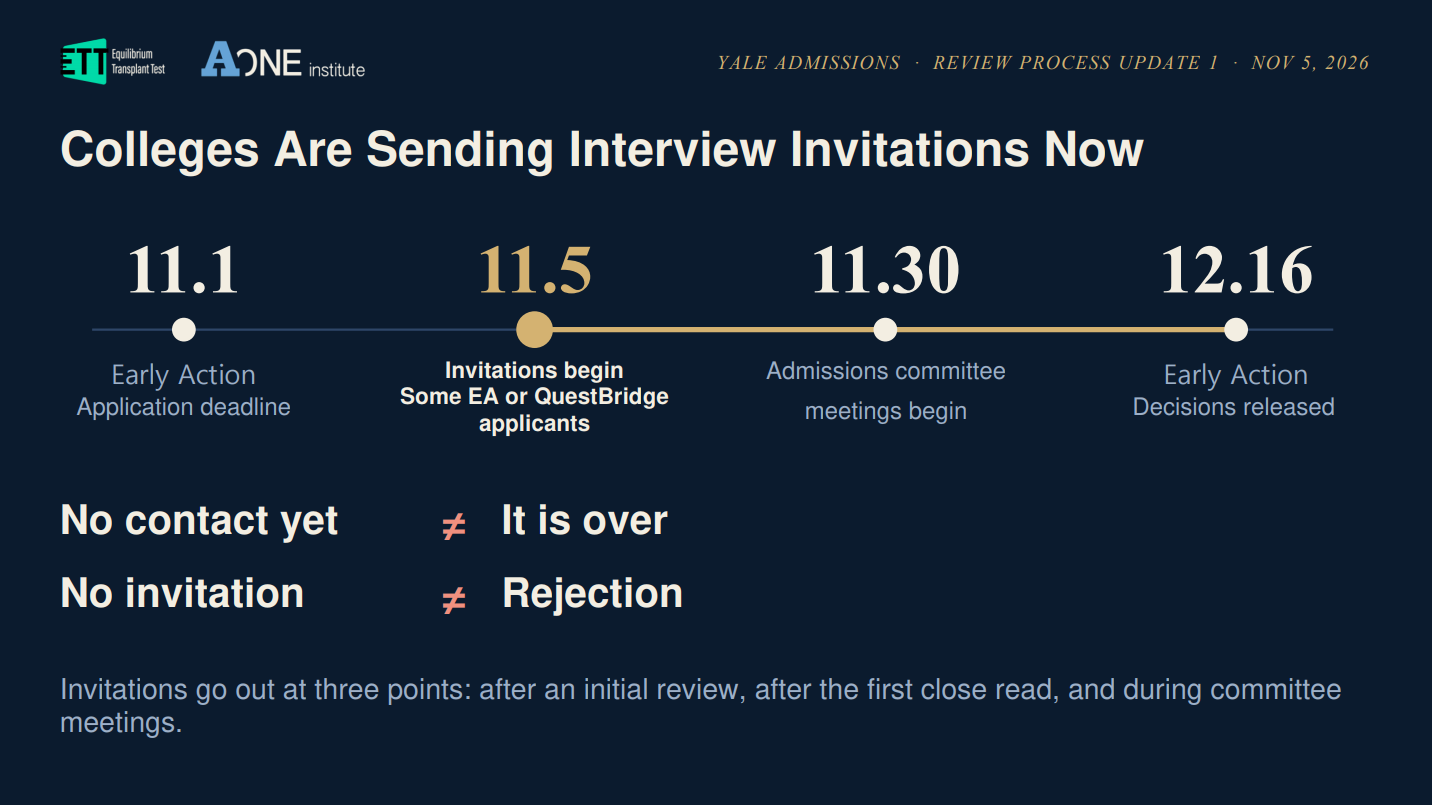
This means an applicant who has not received an invitation in early November should not assume that the opportunity has passed.
An interview request may arrive later in the process.
More importantly, students can be admitted without receiving an interview at all.
The timing of invitations depends on the university, application round, availability of interviewers, and institution-specific policies.
College Interview Timeline: Early Decision, Early Action, and Regular Decision
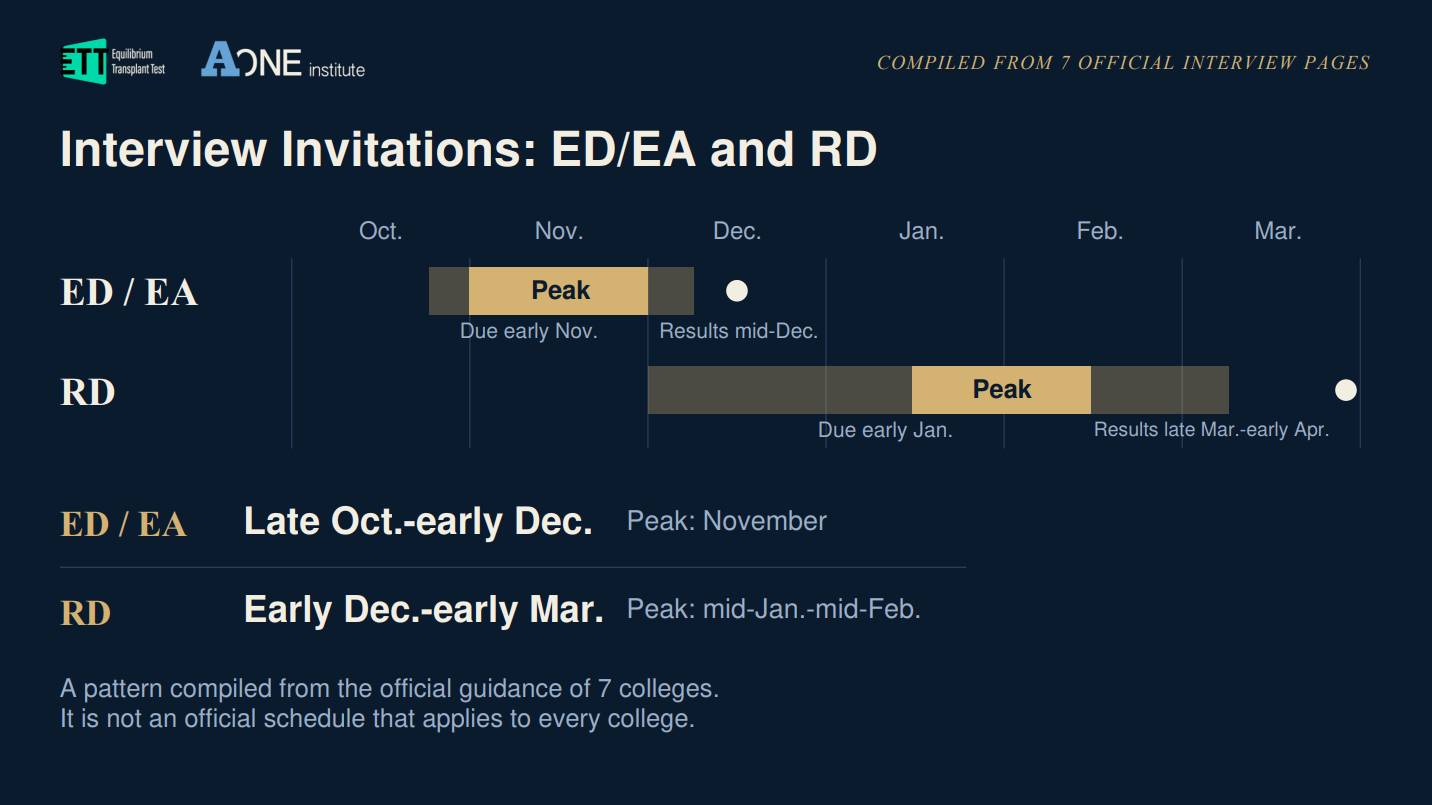
Although universities follow different schedules, interviews generally concentrate around particular periods.
For Early Decision and Early Action applicants, most interviews occur between late October and early December, with November being particularly important.
For Regular Decision applicants, interviews generally begin after applications are submitted and often continue through January and February.
Some institutions schedule interviews into early March.
A general timeline looks like this:
| Application round | Typical interview period | Decision release |
|---|---|---|
| Early Decision / Early Action | Late October–early December | Usually mid-December |
| Regular Decision | December–early March | Usually late March–early April |
These are broad patterns, not deadlines that apply uniformly to every institution.
The timing also differs among individual universities.
Yale generally conducts Early Action interviews from November into early December, while its Regular Decision interviews typically occur between January and early March.
Harvard can begin interviews as early as October.
Stanford generally conducts Restrictive Early Action interviews during the first few weeks of November and Regular Decision interviews from mid-January through mid-February.
MIT conducts most Early Action interviews in November and most Regular Action interviews in January.
Dartmouth schedules Early Decision interviews around November, with Regular Decision interviews generally continuing from December through mid-February.
Duke begins Early Decision interviews in late October and continues them through early November, while Regular Decision interviews occur from early December through late February.
Georgetown begins assigning interviews as early as September and continues the process into February.
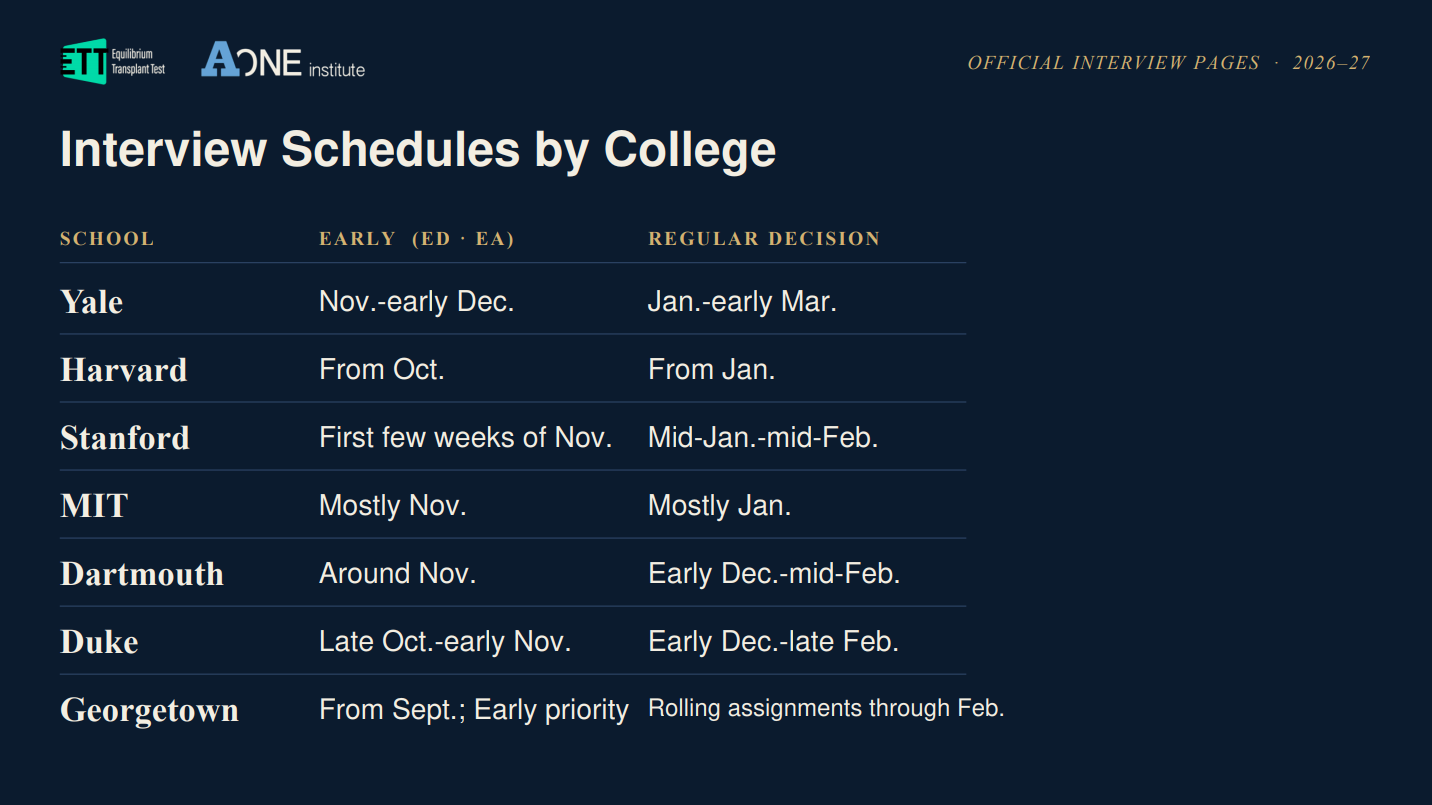
The important point is that students should not compare their interview timing directly with another applicant's experience at a different university.
Even applicants to the same institution may receive invitations at different stages.
What Should You Do When an Interview Invitation Arrives?
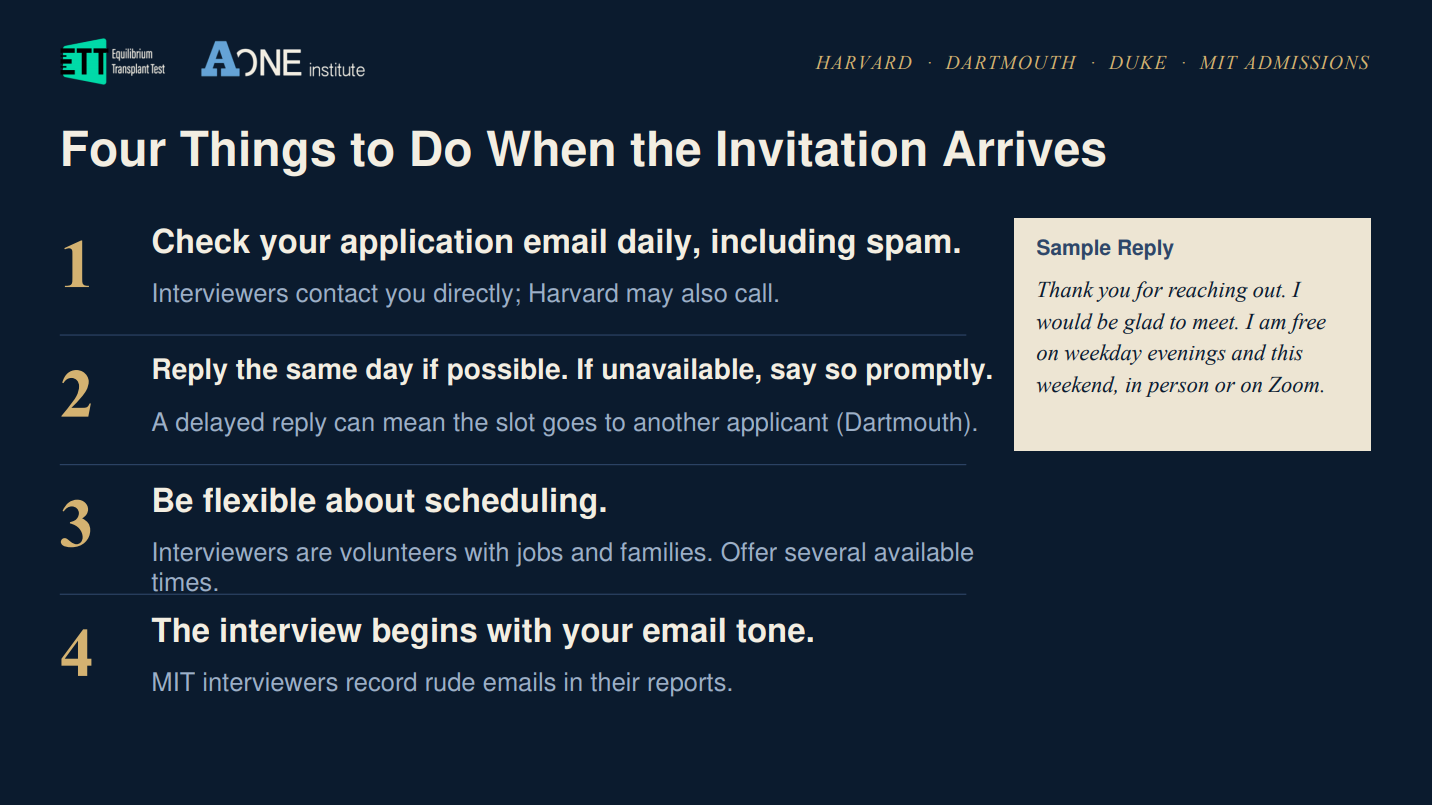
Students should begin monitoring their communication channels immediately after submitting applications.
At many universities, the interview invitation does not come directly from an admissions officer.
Instead, an alumni interviewer contacts the applicant using the email address or phone number listed in the application.
That message may come from an unfamiliar personal email address.
It could even be filtered into the spam folder.
Students should therefore check their main inbox, spam or junk folder, phone messages, and voicemail regularly.
Respond as Quickly as Possible
When an invitation arrives, it is advisable to respond the same day whenever possible.
Alumni interviewers are volunteers who have professional and personal responsibilities.
They may be coordinating interviews with several applicants within a limited period.
A delayed response can make scheduling more difficult or result in the loss of an available time slot.
Students should not assume that interviewers can accommodate every preferred time.
Offer Several Available Times
Instead of replying that only one particular time is possible, students should provide multiple options.
For example, they might explain that they are available on several weekday evenings and during the weekend.
The objective is to make scheduling convenient for the interviewer.
Treat the Email as the Beginning of the Interview
Professional communication begins before the conversation itself.
A polite greeting, clear availability, appreciation for the invitation, and a respectful closing create a positive first interaction.
A short message is sufficient.
There is no need to write an elaborate email, but students should not overlook basic courtesy.
In fact, an interviewer's impression can begin with how the applicant responds to the original invitation.
Who Actually Conducts College Admissions Interviews?
Many students imagine that they will meet directly with an admissions officer or a member of the university's admissions committee.
That is generally not how these interviews work.
The number of applicants at selective universities is far too large for a small admissions staff to interview everyone individually.
Instead, many institutions rely on alumni volunteers.
These alumni donate their time to speak with prospective students.
They are usually not paid for conducting the interviews.
Some meet students in person, while others conduct conversations through video conferencing or telephone calls.
Universities maintain substantial alumni interviewing networks.
Examples described in the institutional materials include:
| University | Approximate interviewer network |
|---|---|
| Yale | 3,200 alumni across regional committees |
| Harvard | About 10,000 alumni volunteers |
| Princeton | More than 7,000 alumni interviewers |
| Georgetown | More than 7,500 alumni volunteers |
| MIT | More than 3,500 Educational Counselors |
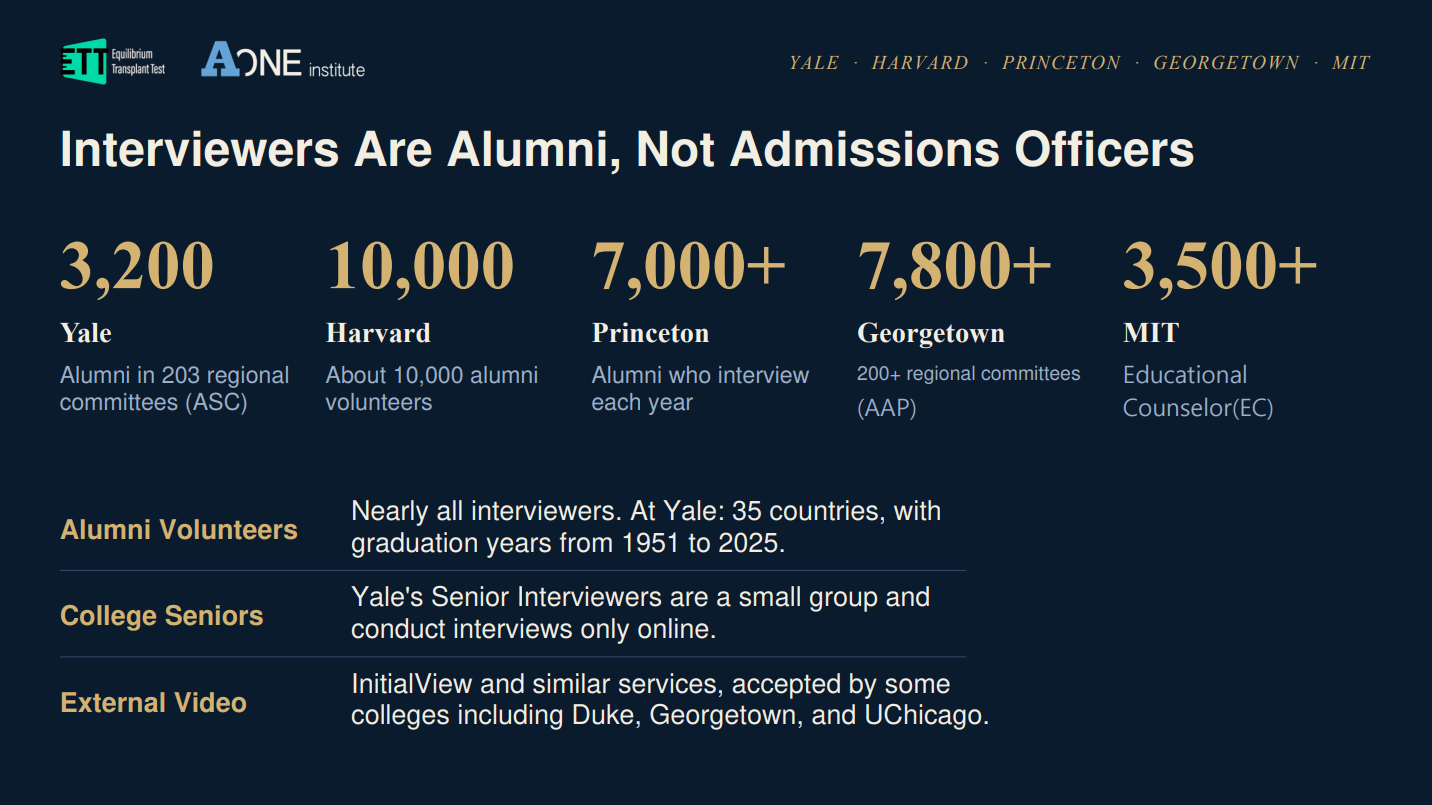
Yale also uses a small group of current college seniors, known as Senior Interviewers, who conduct virtual interviews.
Some universities accept interviews or personal introductions through external services, such as InitialView, for certain applicants.
These alternatives have their own institutional rules and should not automatically be treated as equivalent to alumni interviews.
Nevertheless, alumni volunteers remain central to the interviewing process at many selective universities.
Why Do Alumni Volunteer to Interview Applicants?
The motivations of alumni interviewers are worth understanding.
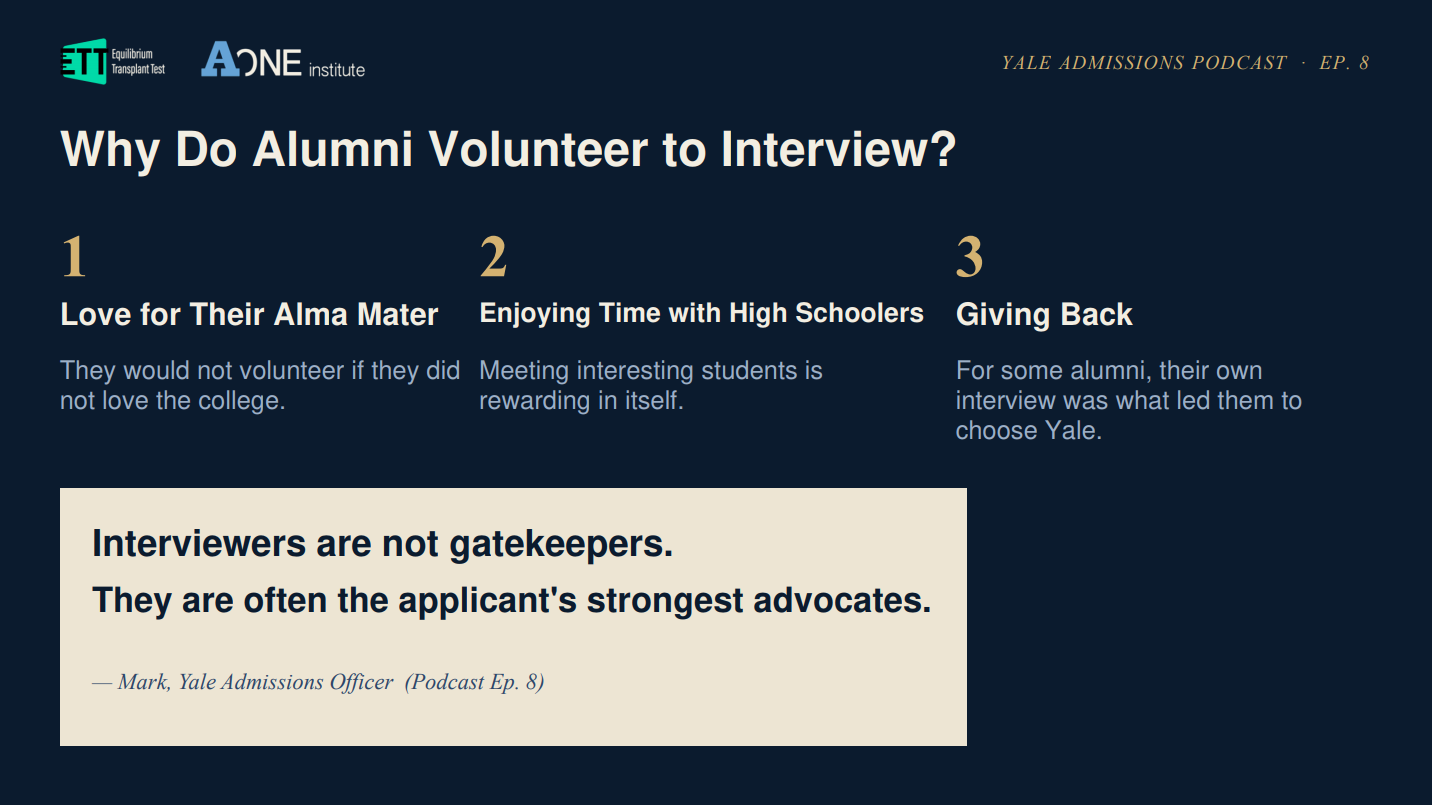
Many volunteers have strong personal connections to their universities.
They enjoy meeting students, discussing academic interests, and sharing experiences from their college years.
Some remember their own admissions interviews as meaningful experiences that influenced their choice of university.
Others simply want to give something back to the institution that played an important role in their lives.
This helps explain the atmosphere students should expect.
Alumni interviewers are generally not there to intimidate applicants or create an unnecessarily stressful examination.
In fact, many genuinely want the students they meet to succeed.
Yale admissions officers have described interviewers as people who can become strong advocates for applicants.
This does not mean every interview will produce a positive evaluation.
However, it does mean students should approach the conversation as an opportunity to engage with someone interested in learning about them.
The interviewer is not simply a gatekeeper standing between the applicant and admission.
How Much Does the Interviewer Know About Your Application?
Students sometimes assume that their interviewer has already reviewed their essays, academic records, extracurricular activities, and recommendations.
At many universities, that assumption is incorrect.
Institutions often deliberately limit the information provided to alumni interviewers.
The purpose is to allow the conversation to develop without the interviewer relying heavily on the written application.
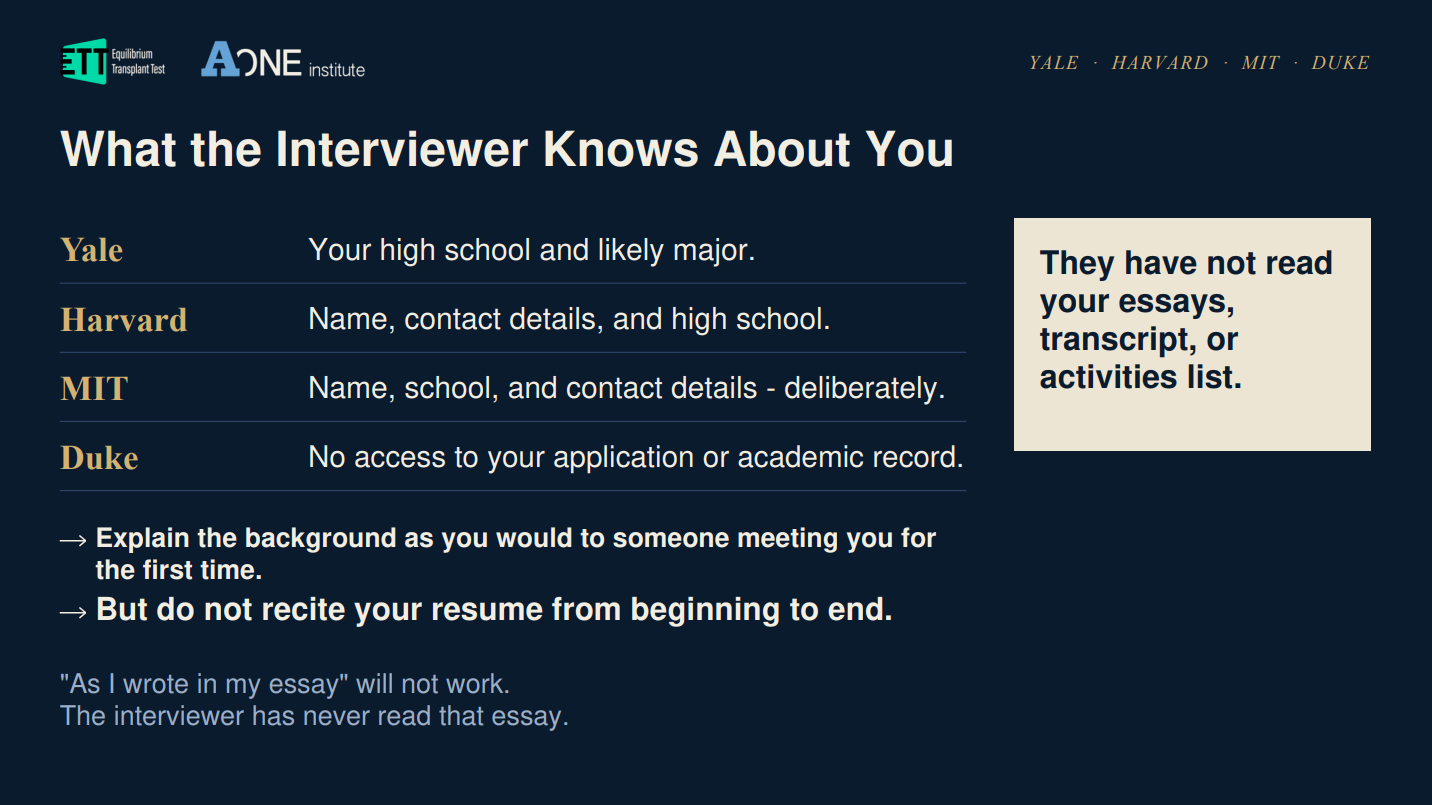
For example, Yale interviewers may receive information about an applicant's high school and likely academic interests.
Harvard interviewers generally receive basic identifying and contact information.
MIT Educational Counselors also receive limited information.
Duke explicitly states that its alumni interviewers do not have access to applicants' applications or academic records.
This has an important implication for preparation.
Students should explain their experiences as though they are speaking to someone meeting them for the first time.
They should not assume that the interviewer already understands the research project mentioned in their application or the significance of a particular extracurricular achievement.
At the same time, students should not begin the interview by reciting their entire résumé.
The goal is to explain enough background for the conversation to become meaningful.
Students must learn to introduce unfamiliar experiences clearly, respond to questions, and develop a natural discussion.
Why Do Some Students Receive Interviews While Others Do Not?
Universities do not all assign interviews using the same method.
The process can be divided into four broad categories.
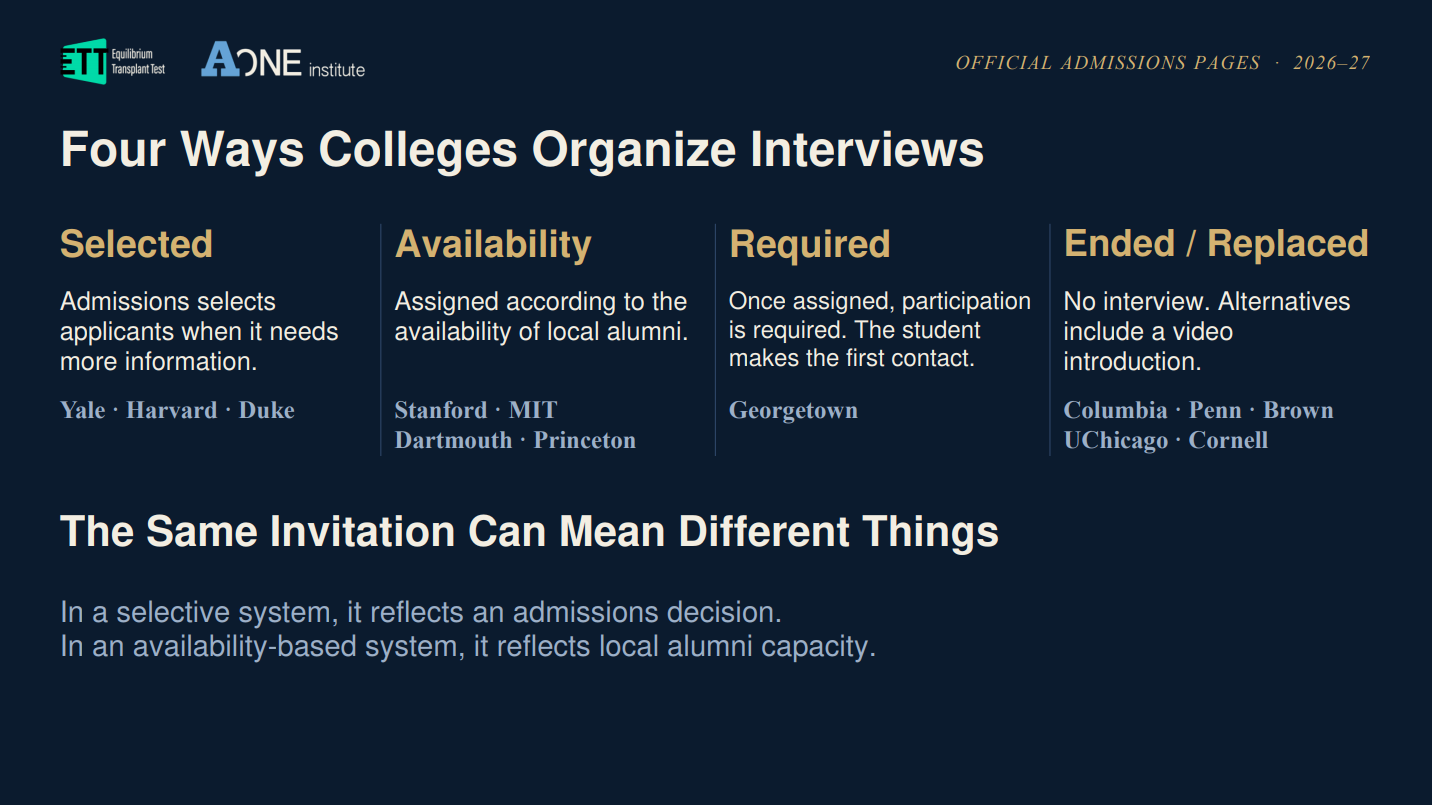
1. Selective Interviews
Some universities prioritize applicants for whom additional information would be useful.
Yale and Duke explicitly describe using interviews in this way.
Harvard's process also allows the admissions committee to request additional information through interviews, although alumni availability remains a factor.
In such systems, an invitation may indicate that the admissions office wants to learn more about the applicant.
It does not necessarily mean that the applicant has advanced to a special admissions round or is likely to be admitted.
2. Availability-Based Interviews
Other universities place greater emphasis on the availability of alumni interviewers.
Stanford, MIT, Princeton, and Dartmouth provide examples of systems in which geographic coverage and volunteer capacity influence whether an applicant receives an interview.
A student living in an area with many alumni volunteers may have a greater chance of receiving an invitation than someone in an area with limited coverage.
That difference does not indicate anything about the students' academic qualifications.
3. Interviews Required When Assigned
Georgetown follows a different approach.
The university aims to provide alumni interviews to applicants broadly, and students are required to complete the interview when one is assigned.
Georgetown also expects the applicant to initiate contact after receiving the interviewer's information.
This is different from the usual process in which the alumnus contacts the student first.
4. Universities That Have Eliminated or Replaced Interviews
Some universities have stopped conducting traditional alumni admissions interviews.
Columbia, Penn, Brown, UChicago, and Cornell have adopted different approaches that do not rely on the same evaluative alumni interview model.
Some offer optional video introductions or other opportunities to communicate with the university.
The important distinction is that an interview invitation does not mean the same thing at every university.
Students should understand the policy of the institution to which they applied before interpreting whether an invitation is significant.
Does Receiving a Yale Interview Mean You Are More Likely to Be Admitted?
Yale provides a particularly interesting example because its interview practices have changed considerably over time.
During the 2020–2021 admissions cycle, Yale had more than 35,000 applicants and conducted approximately 18,000 interviews.
That meant roughly half of its applicants received interviews.
By the 2025–2026 cycle, the number of applicants had increased to more than 50,000, while the number of interviews had fallen to approximately 8,050.
The ratio had declined to roughly one interview for every six applicants.
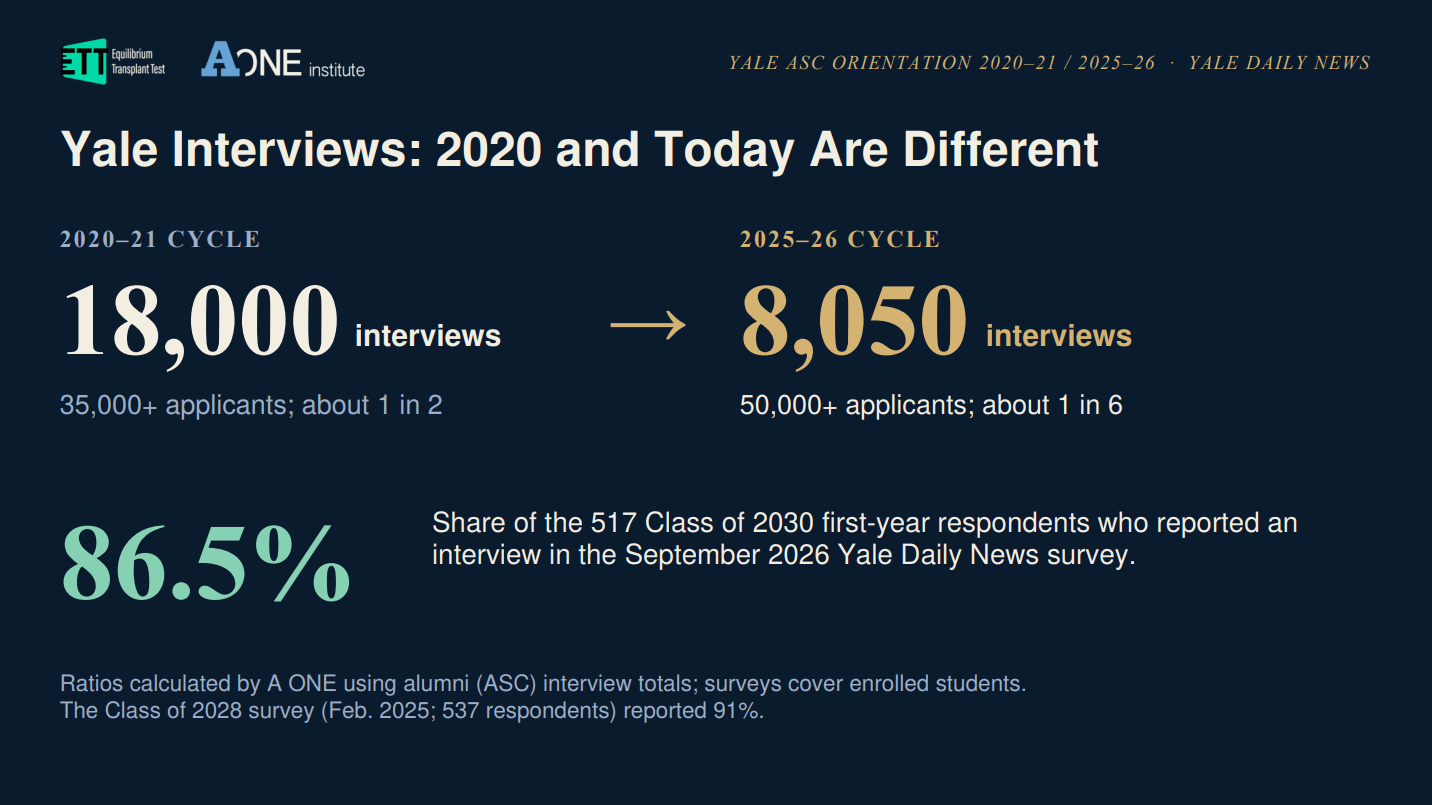
This change is important because Yale has become more selective about how it allocates interview resources.
However, another set of numbers makes the situation particularly interesting.
In September 2026, the Yale Daily News surveyed incoming first-year students in the Class of 2030.
The survey received 517 responses.
According to the reported survey results, 86.5% of respondents indicated that they had participated in an admissions interview.
A previous survey of the Class of 2028, reported in February 2025, found that approximately 91% of respondents had been interviewed.
These figures raise an obvious question.
If only a relatively small proportion of applicants receive interviews, why do such large proportions of surveyed enrolled students report having completed one?
One possible explanation is Yale's selective interview system.
The university prioritizes interviews when admissions officers believe additional information may be valuable.
Applicants receiving these interviews may therefore differ from the overall applicant pool.
However, these figures do not establish the acceptance rate of interviewed applicants.
The surveys represent enrolled students who responded, not a random sample of the entire applicant pool.
Students who receive interviews may also differ from other applicants in ways unrelated to the interviews themselves.
It would therefore be incorrect to conclude that receiving an interview causes a student's admissions probability to increase to 86.5%.
Still, the contrast between the overall interviewing rate and the reported interview experiences of enrolled students is worth examining.
It supports taking Yale's selective interview process seriously without interpreting the invitation as a promise of admission.
What If You Never Receive an Interview Invitation?
The official position of several universities is clear.
Applicants who are not offered interviews are not automatically disadvantaged.
Yale explicitly states that students can be admitted without an interview.
Harvard considers applications complete even when no interview takes place.
Stanford acknowledges that many admitted students were not interviewed.
MIT states that interviews are waived when an Educational Counselor is unavailable and that such waivers do not negatively affect applications.
Duke also states that not receiving an interview does not hurt an applicant's admissions chances.
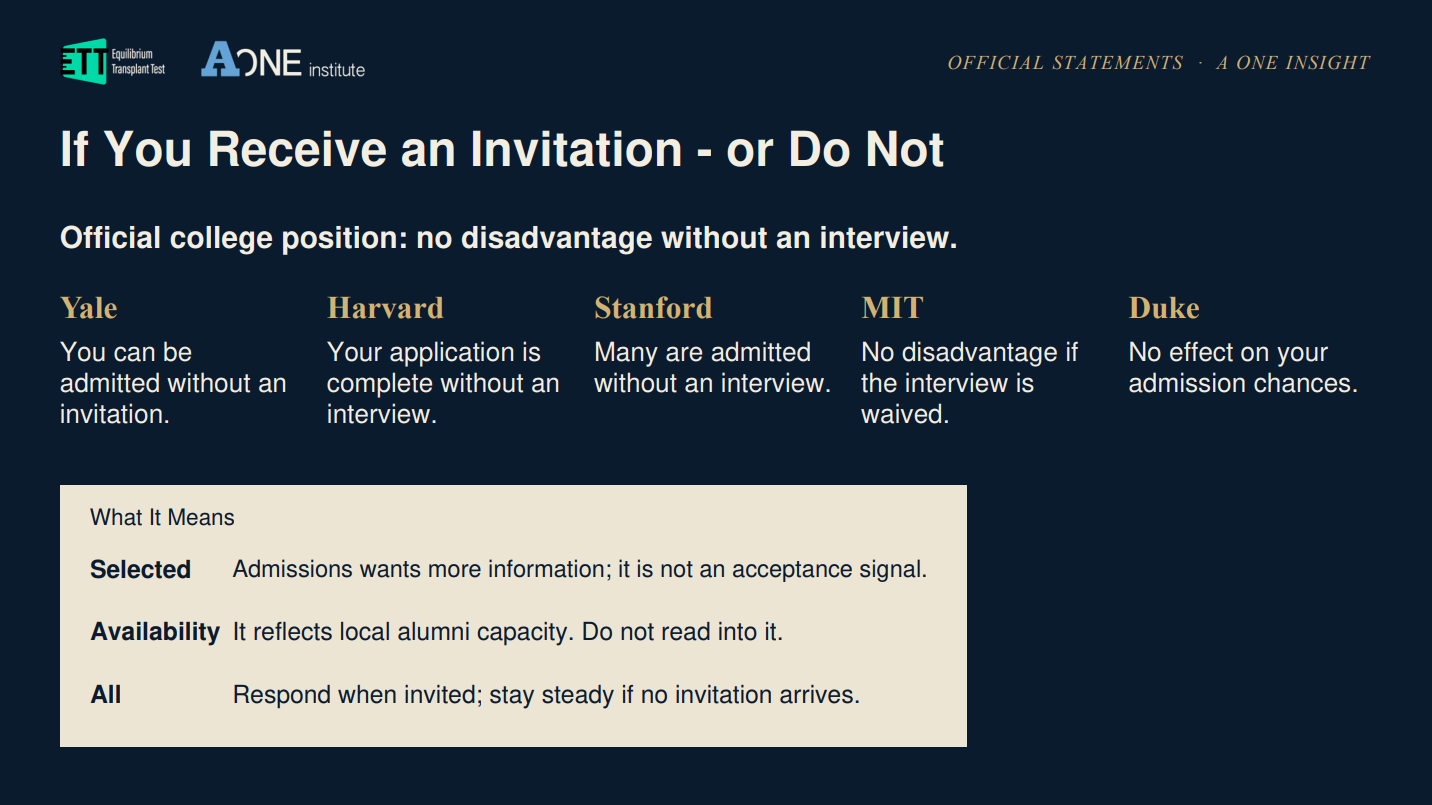
The practical interpretation is straightforward.
Students should not become overly concerned if they have not received an invitation.
At universities where interview availability depends on local alumni capacity, the absence of an interview may have little to do with the applicant's qualifications.
At universities such as Yale, an invitation may reflect the admissions office's desire for additional information.
But even there, students can be admitted without being interviewed.
An interview report may contribute positively or negatively to the overall evaluation.
A particularly strong conversation might reinforce favorable impressions.
An unexpectedly weak conversation might create some reservations.
That does not make the interview the decisive factor in admission.
It is one part of a larger evaluation process.
What Is a College Interview Actually Like?
Many students have an unrealistic image of college admissions interviews.
Movies and television dramas sometimes portray them as intimidating meetings in formal offices, where an admissions dean asks difficult questions and immediately determines whether a student will be admitted.
Real alumni interviews are usually very different.
A student might meet an alumnus at a local coffee shop, library, or another public location.
Some interviews take place over Zoom or another video platform.
Yale admissions officers have even noted that Panera Bread is among the most common locations appearing in their interview reports.
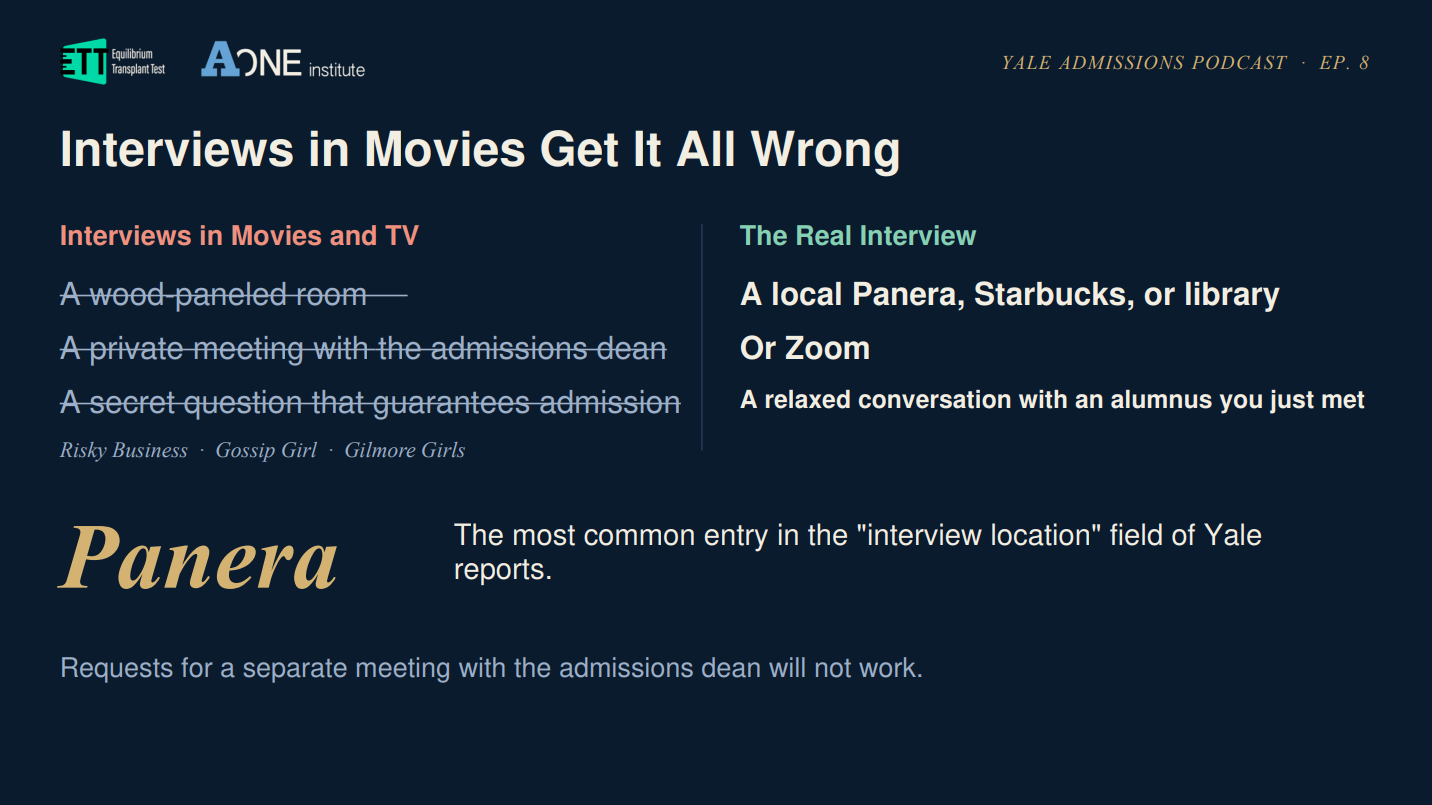
The atmosphere is generally closer to a conversation between two people meeting for the first time than a formal oral examination.
The interviewer wants to learn who the student is, what interests them, and how they think.
The student has an opportunity to explain their experiences and ask questions about the university.
The interview is not supposed to resemble a high-pressure job interview or an academic test.
How Long Do College Interviews Last?
Most alumni interviews last approximately 30–45 minutes, although the length varies by institution.
Yale advises applicants to expect around 30–60 minutes.
Stanford interviews generally last approximately 40 minutes.
MIT interviews typically last about an hour but can be shorter or considerably longer.
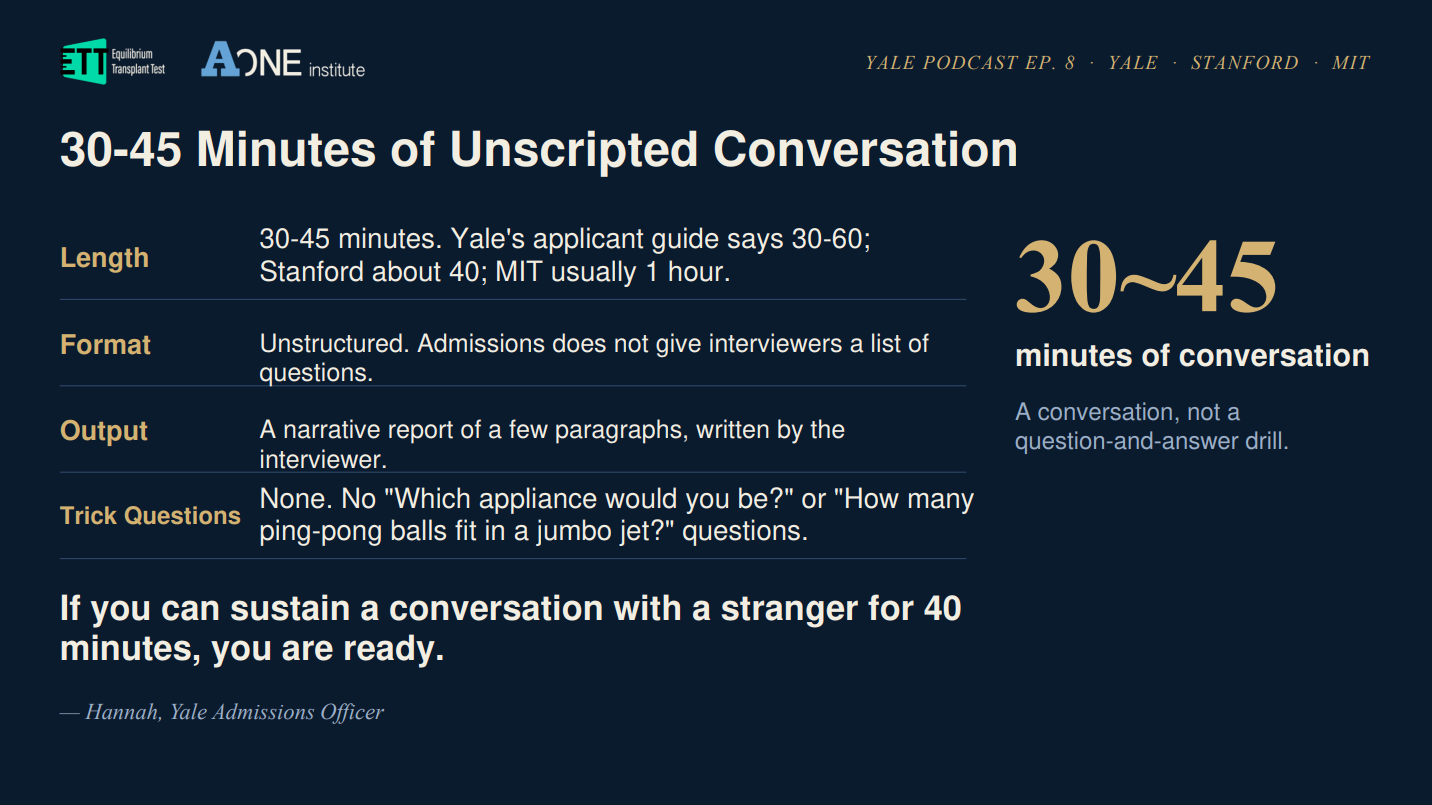
There is usually no fixed script that every interviewer must follow.
The discussion may move naturally among academic interests, extracurricular experiences, personal background, school life, and future plans.
Interviewers are generally not expected to ask unusual trick questions.
Students do not need to prepare answers about which household appliance best represents their personality or how many ping-pong balls could fit inside a large aircraft.
The more important skill is the ability to sustain an interesting conversation with someone unfamiliar.
That may sound simple, but it requires preparation.
Students need to understand their own experiences well enough to discuss them naturally without memorizing an artificial script.
What Questions Do Yale Interviewers Commonly Ask?
Yale admissions officers have shared examples of questions students may encounter.
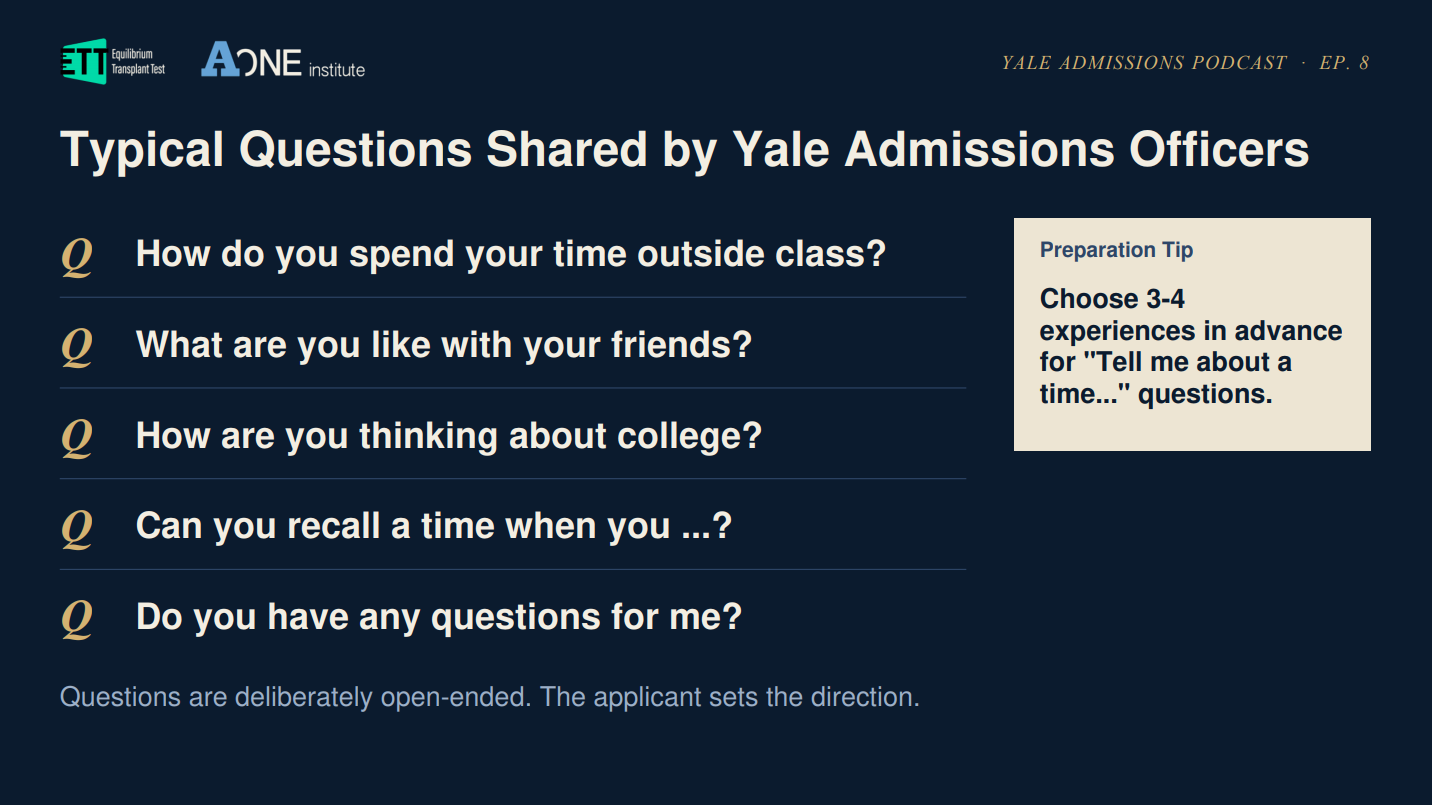
These include:
-
How do you spend your time outside class?
-
What are you like with your friends?
-
How are you thinking about college?
-
Can you recall a time when you experienced a particular challenge or situation?
-
Do you have any questions for me?
The questions are deliberately open-ended.
They allow students to decide which experiences are meaningful enough to discuss.
Consider the question about how a student spends time outside class.
The interviewer is not simply requesting a list of extracurricular activities.
They want to understand what genuinely interests the student.
What does the student choose to do when there is no grade attached?
Which activities have become personally meaningful?
What motivates the student to continue?
Another interesting question asks what the student is like with friends.
This may initially seem unrelated to college admissions.
However, universities are not selecting students based only on academic performance.
They are building a community.
An interviewer may therefore want to understand how the student interacts with other people.
Can the interviewer imagine this student studying, living, collaborating, and participating in campus life with other undergraduates?
That image can be valuable.
Why Should Students Explain Their Experiences Rather Than Just Their Achievements?
When discussing academic projects or extracurricular activities, students often focus on results.
They describe winning a competition, receiving an award, completing research, or becoming the leader of an organization.
Those accomplishments can be important.
However, much of that information is already included in the application.
The interview should reveal something more.
What motivated the student to begin the activity?
What problems appeared during the process?
How did the student make decisions?
What changed as the experience developed?
What did they learn?
The distinction becomes especially important when describing research.
Simply stating that a research project produced a successful result tells the interviewer relatively little about the student's thinking.
Describing how a hypothesis developed, how an unexpected result changed the experiment, or why the student chose one method over another can reveal far more.
The interview is an opportunity to make the process behind the achievement visible.
What Questions Do Other Universities Ask?
Dartmouth provides examples that closely resemble Yale's approach.
Its suggested topics include classes, teachers, favorite and least favorite subjects, and academic interests.
Students may be asked which project, paper, or experiment makes them especially proud.
They may also discuss future academic plans, career interests, important extracurricular activities, and how teachers or friends would describe them.
Another question asks students to imagine their ideal college experience.
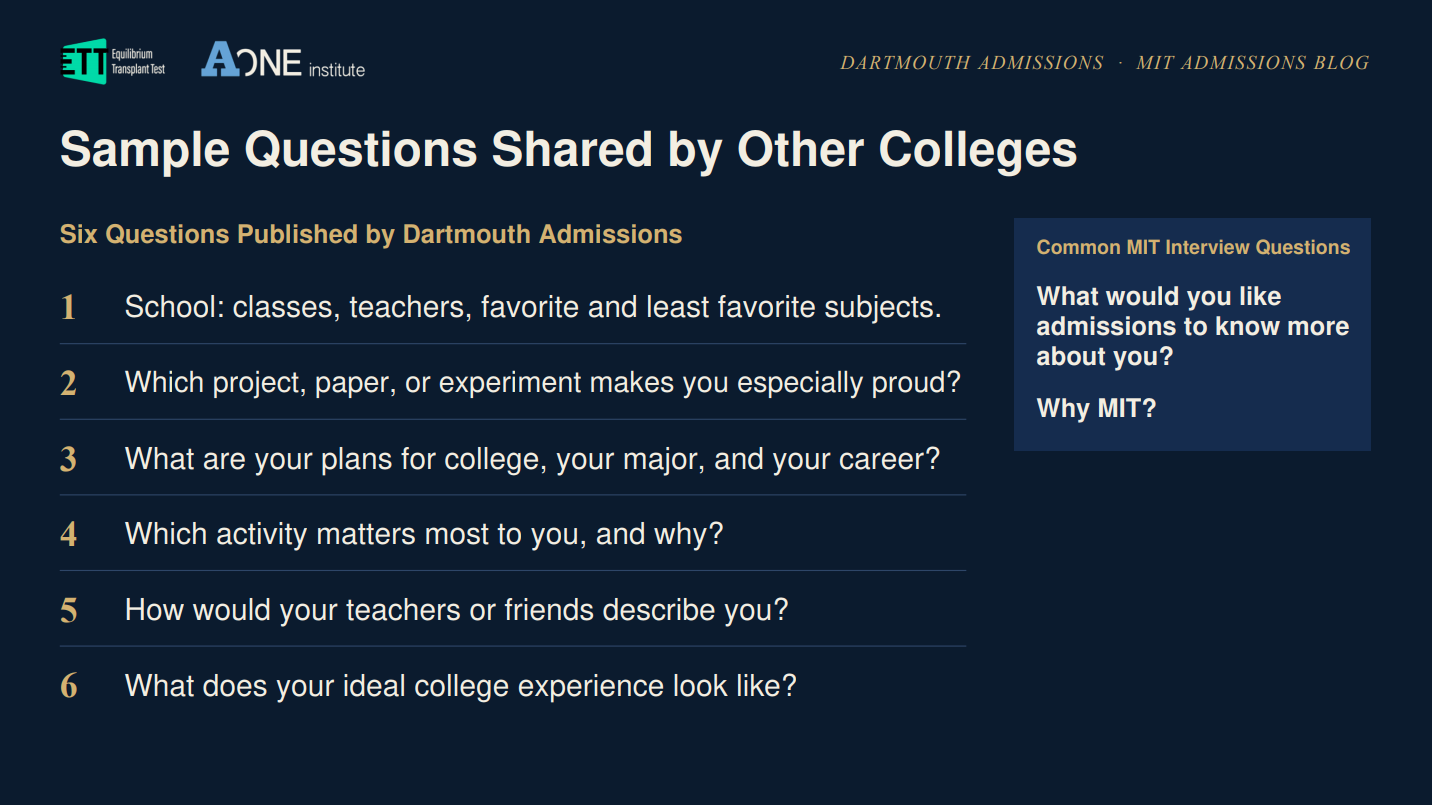
MIT encourages applicants to think about what they would like admissions officers to know beyond the written application.
Students should also be prepared to explain why they are interested in MIT.
Although the wording differs, the underlying interests are similar.
Universities want to understand intellectual curiosity, motivation, personal development, and the ways students relate to others.
These are not questions that can be answered effectively by memorizing a résumé.
Students should be able to connect their activities to genuine experiences and future interests.
What Should You Ask When the Interviewer Says, "Do You Have Any Questions for Me?"
This is one of the most important moments in the interview.
Many interviewers conclude by asking whether the student has any questions.
A student who simply answers, "No, I don't have any," misses an opportunity to develop the conversation.
Students should prepare two or three thoughtful questions in advance.
However, the questions should not be limited to information easily available on the university's website.
Asking whether Yale offers a biology major or whether undergraduates can participate in research is unlikely to produce a particularly meaningful exchange.
Those are questions students can answer through basic research.
Instead, ask the alumnus about their own experiences.
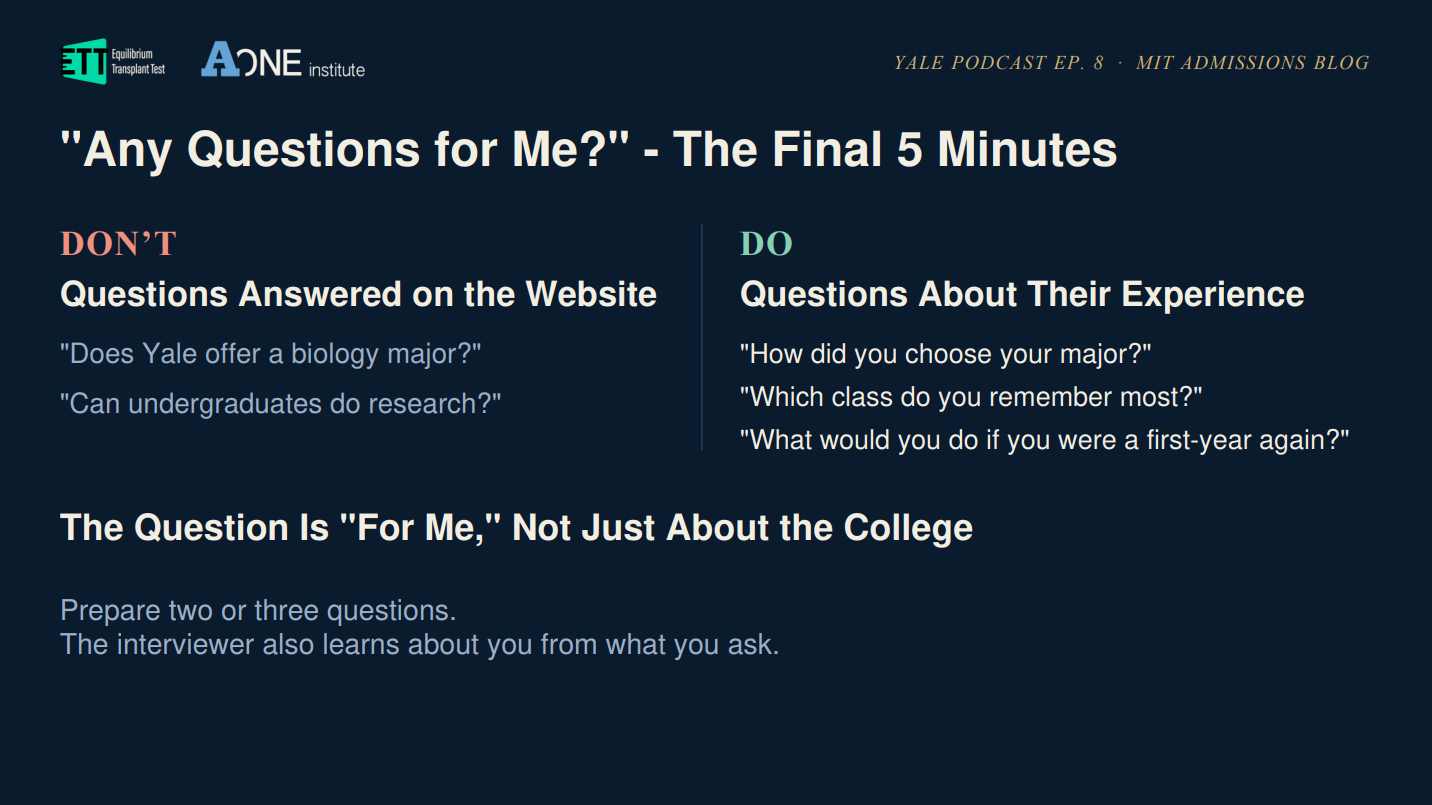
For example:
-
How did you decide on your major?
-
Which class do you remember most vividly?
-
What would you do differently if you could begin your first year again?
-
Which college experience influenced your career direction?
-
What was the most challenging part of transitioning from college to professional life?
These questions invite the interviewer to share personal experiences.
They also create opportunities for students to learn things that may not appear in admissions materials.
The point is to have a genuine conversation with the person sitting across from you.
Do You Need an Interviewer With Similar Academic Interests?
Students sometimes assume they will be matched with an alumnus who studied the same subject they intend to pursue.
That is not necessarily how alumni interviews are assigned.
Universities must consider geographic location and interviewer availability.
A student interested in biology might be interviewed by an alumnus who studied history or works in finance.
A prospective physics major might meet someone with little technical knowledge of physics.
This should not be viewed as a disadvantage.
In fact, being able to explain a complicated personal interest to someone unfamiliar with the subject is itself a valuable communication skill.
A successful conversation does not require the interviewer and applicant to have identical academic backgrounds.
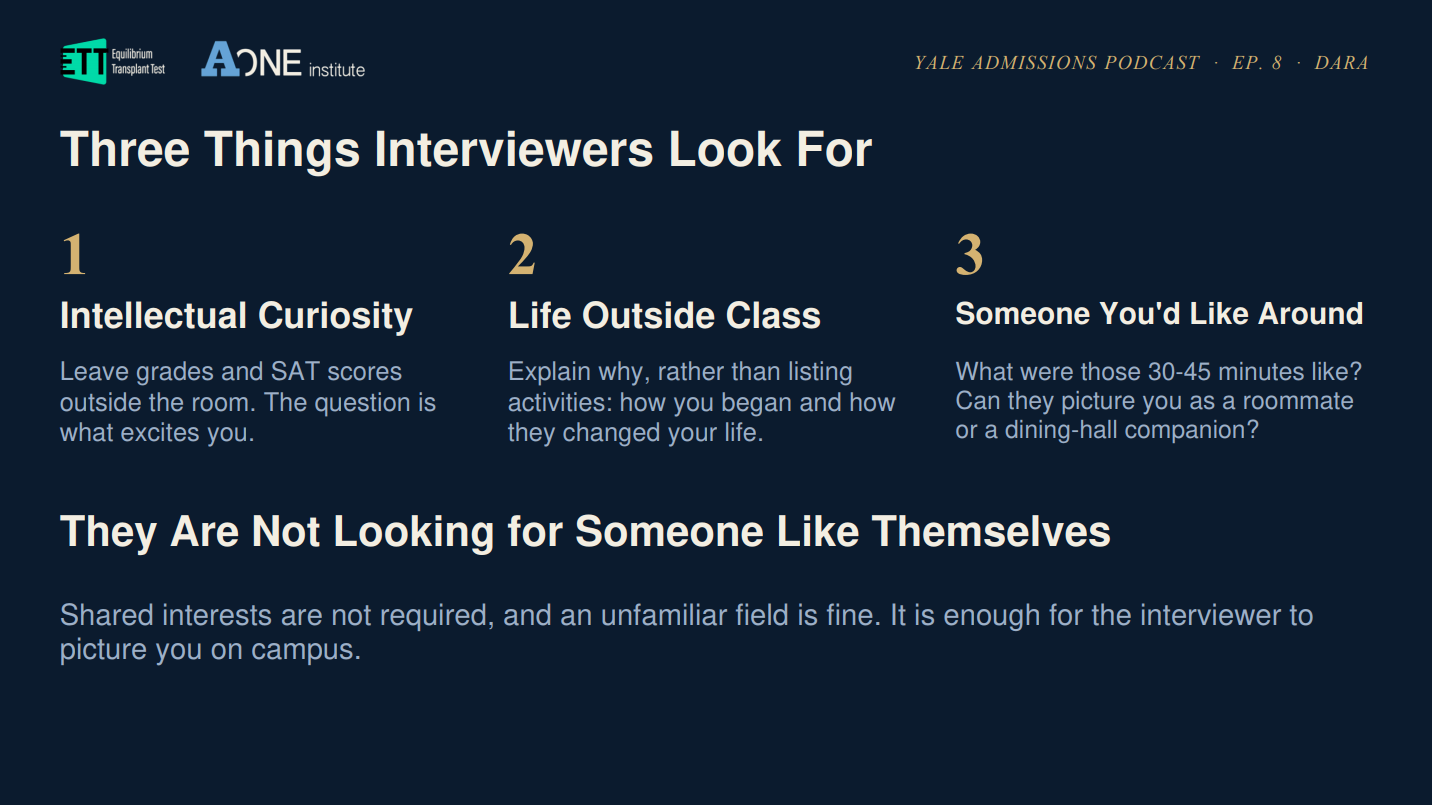
The objective is to make the interviewer interested in learning more.
Students should explain their academic interests clearly enough that someone from another field can understand why the subject matters to them.
They should also demonstrate curiosity about the other person's experiences.
One of the strongest outcomes is when the interviewer can genuinely imagine the applicant becoming part of the university community.
This does not mean the student must appear exceptionally outgoing or have the same personality as the interviewer.
It means the interaction provides a believable sense of who the student would be on campus.
What Are the Seven Qualities Yale Interviewers Are Asked to Observe?
Yale's interviewer-training materials identify seven broad areas that help alumni describe applicants.
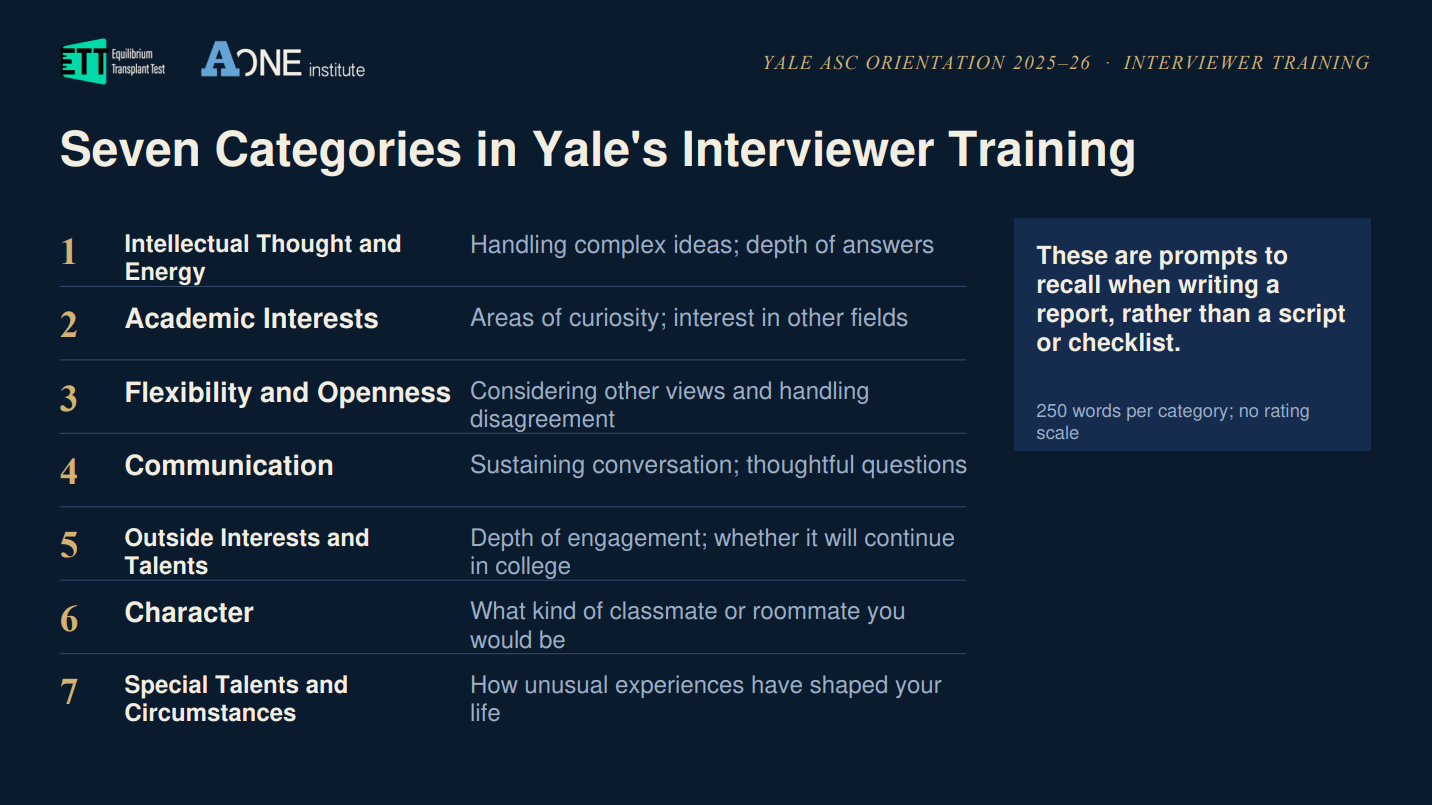
1. Intellectual Thought and Energy
How does the student approach complicated ideas?
Can they explain their thinking in depth?
Do they appear genuinely engaged when discussing an intellectual question?
2. Academic Interests
What subjects attract the student's attention?
Can they explain why those areas are interesting?
Do they demonstrate curiosity beyond completing school assignments?
3. Flexibility and Openness
How does the student respond to different perspectives?
Can they consider an argument that challenges their original assumptions?
Are they able to discuss disagreements thoughtfully?
4. Communication
Can the student sustain a meaningful conversation?
Do they listen carefully?
Can they explain complex ideas clearly and ask thoughtful follow-up questions?
5. Outside Interests and Talents
What matters to the student outside academic coursework?
How deeply have they pursued those interests?
Might those interests continue in college?
6. Character
What kind of classmate, roommate, or community member might the student become?
Do their responses reveal consideration for other people?
7. Special Talents and Circumstances
Are there unusual experiences or individual circumstances that help explain the student's background, development, or achievements?
These areas are intended to guide the interviewer's narrative observations.
They should not be treated as seven questions that every student must answer separately.
Instead, students should understand the qualities that a natural conversation can reveal.
What Do Harvard Interviewers Look For?
Harvard interview guidance points in a similar direction.
Materials describing its alumni interviewer training distinguish between academic information already available in the application and personal qualities that can emerge during conversation.
Interviewers may explore academic interests, extracurricular activities, intellectual curiosity, openness to different viewpoints, and the ability to reflect on experiences.
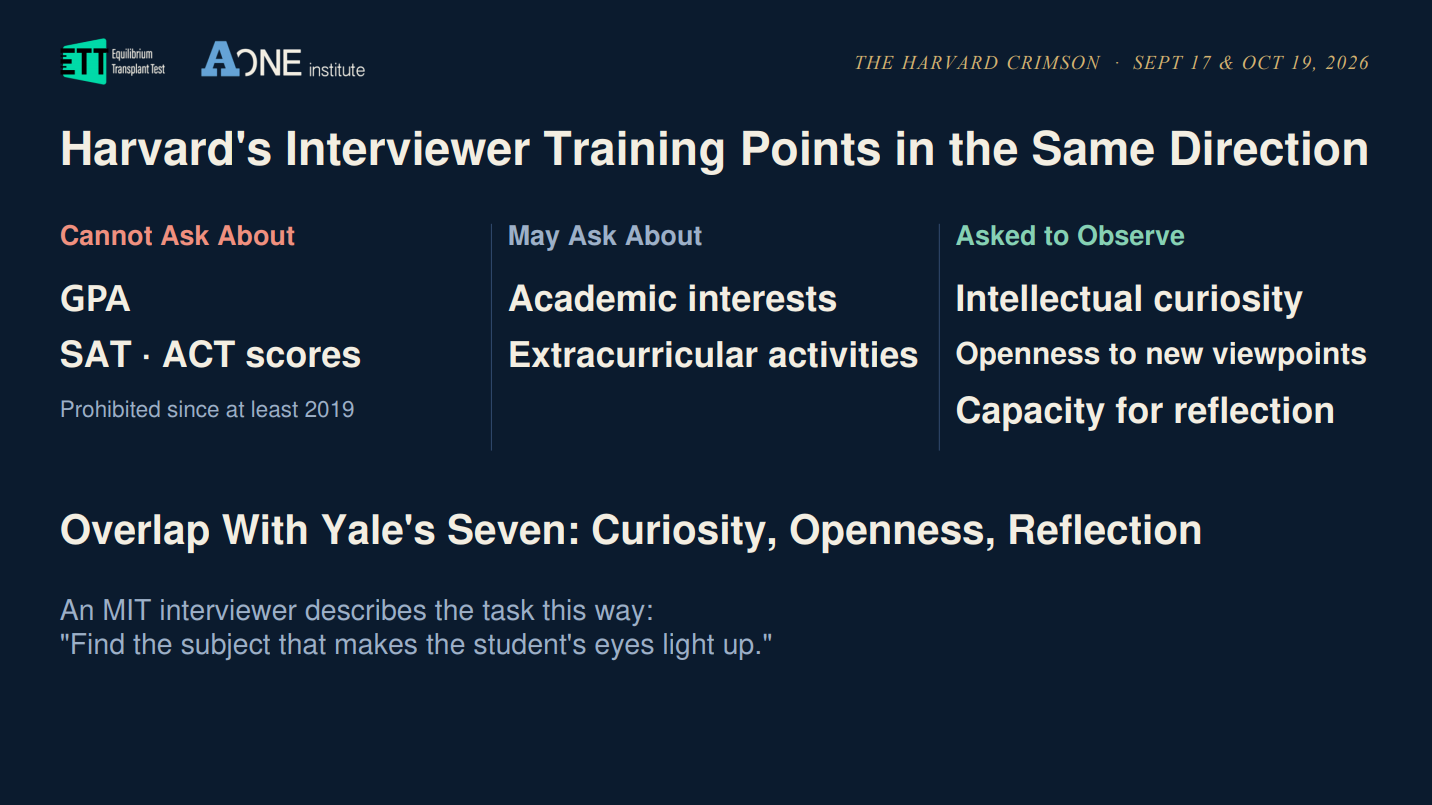
Students should not expect the interview to revolve around their GPA or SAT and ACT scores.
The admissions office already has access to the academic records submitted with the application.
The interviewer can contribute something different.
How does the student describe an experience?
What excites them?
Can they explain why an activity matters?
How do they respond when another person asks a question they had not anticipated?
These observations may help admissions officers understand the student beyond the written materials.
Why Should Your Answers Give Interviewers Something Worth Writing Down?
After the interview, the alumnus generally submits a written report.
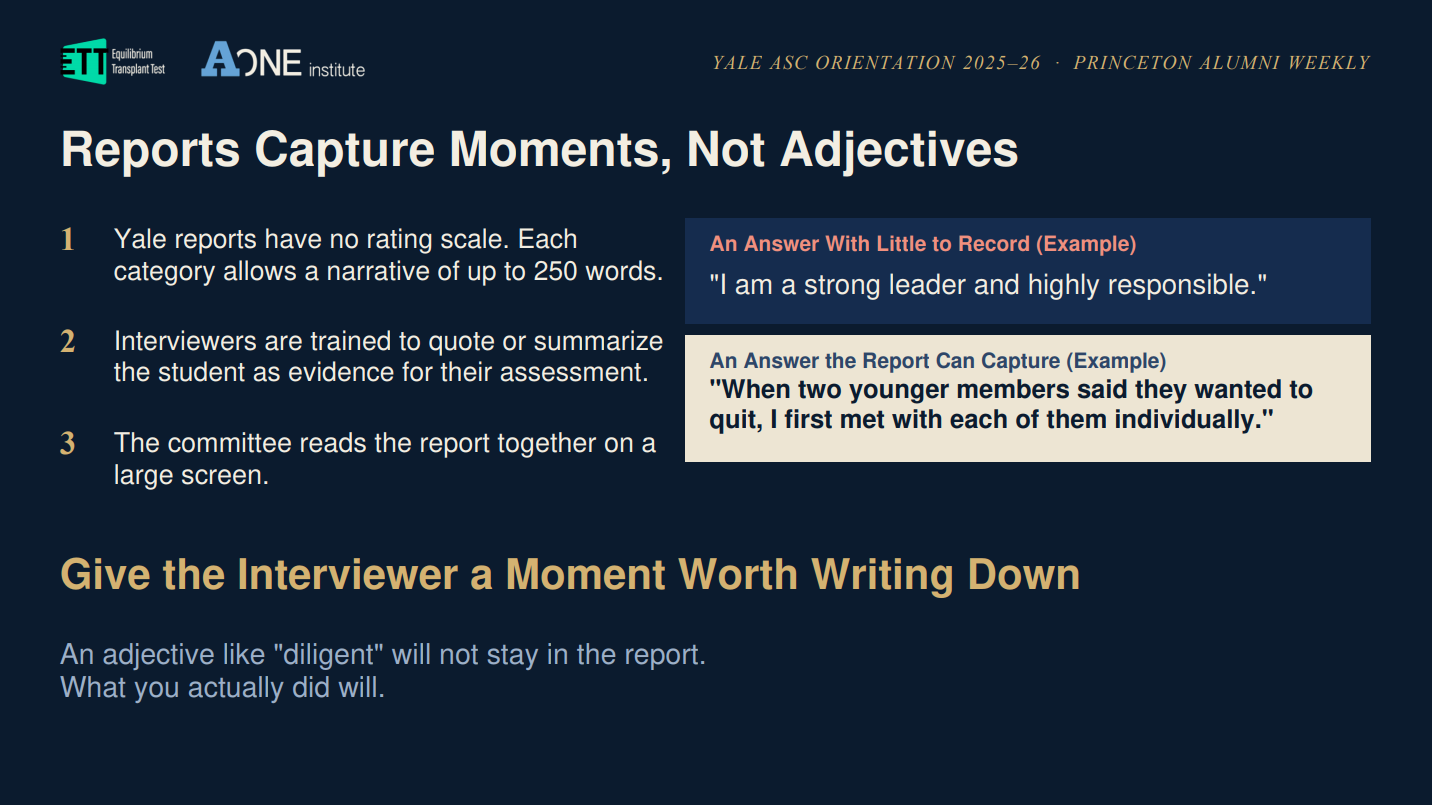
At Yale, the report is primarily narrative rather than a simple numerical score.
Interviewers are encouraged to describe their observations and include details that support their impressions.
This creates an important preparation principle.
A student who says, "I am a strong leader and a responsible person," has offered an opinion about themselves.
But the interviewer has little specific evidence to describe.
Now consider a student who explains how two younger club members considered quitting, how the student spoke with each of them, and what the student changed afterward.
That answer provides a concrete situation.
The interviewer can remember the event and explain what it revealed about the student's leadership.
The difference is not simply that one answer is longer.
It is that one provides evidence.
Interview reports are more useful when they contain experiences, observations, and meaningful details rather than generic descriptions.
Students should therefore prepare stories that reveal their qualities through actual decisions and actions.
The goal is to create a memorable conversation, not to manufacture impressive statements.
What Should Students Avoid During College Interviews?
Yale admissions officers have discussed several behaviors that can make an interview less effective.
Many of the recommendations are surprisingly simple.
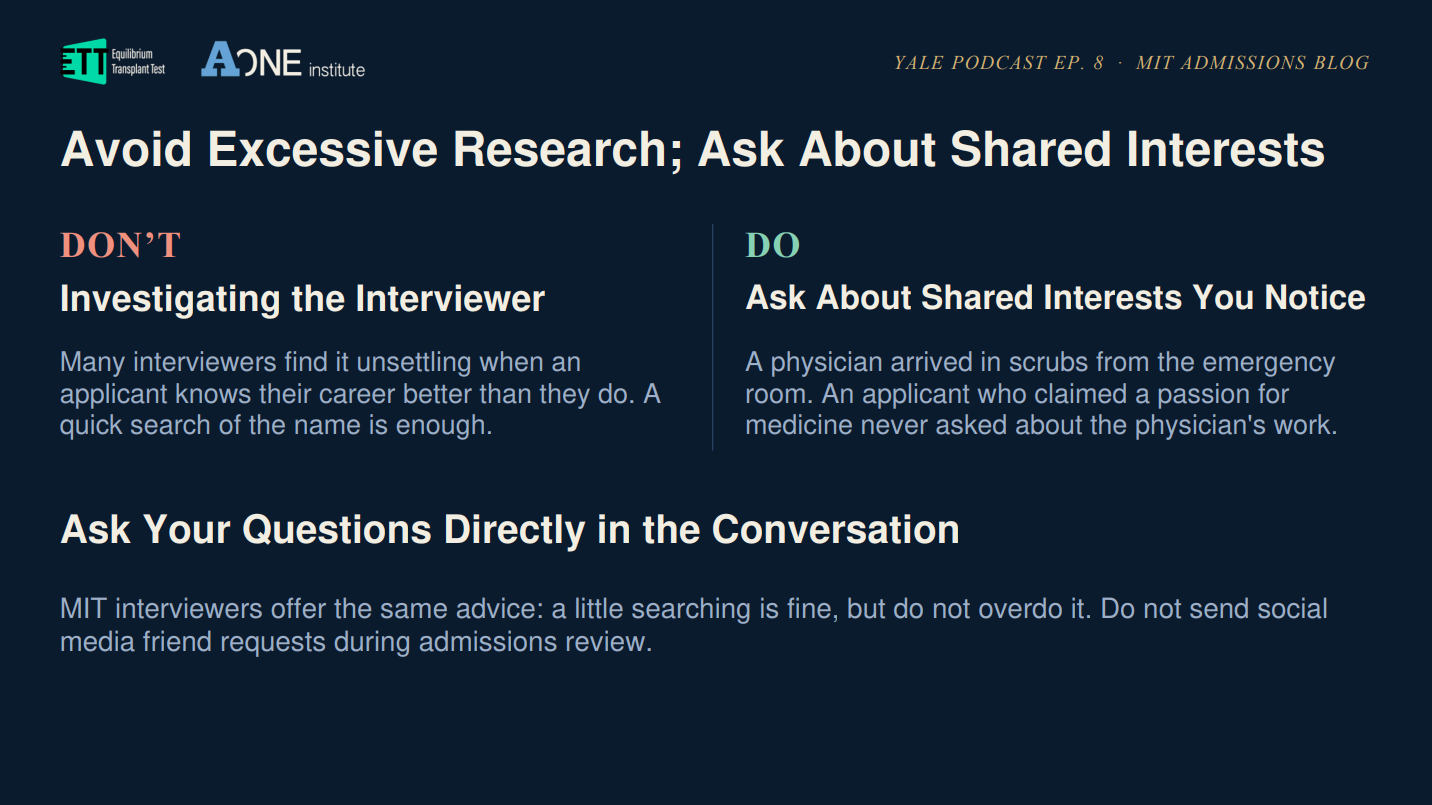
Don't Research the Interviewer Excessively
Some students believe they should investigate the interviewer's background extensively before the meeting.
A basic search to recognize the person's name and professional background may be reasonable.
However, memorizing detailed employment history, searching through personal social media accounts, or reciting information about the interviewer's career can create an uncomfortable impression.
Yale admissions officers have described interview reports in which alumni felt unsettled because applicants seemed to know an excessive amount about them.
Preparation should help students hold a natural conversation.
It should not resemble an investigation into someone's private life.
Do Ask About Genuine Shared Interests
There is a difference between excessive research and showing sincere interest during the conversation.
For example, Yale admissions officers described a situation involving an applicant interested in medicine.
The interviewer arrived wearing medical scrubs after working in an emergency department.
Despite the applicant's stated interest in medicine, the student never asked about the interviewer's professional experience.
That was a missed opportunity.
When a natural connection appears during the conversation, students should explore it.
The objective is not to make every discussion about the interviewer.
It is to demonstrate genuine curiosity and respond naturally to the opportunities the conversation provides.
Students should also avoid sending social media friend requests or trying to create unnecessary personal contact during admissions review.
Questions should generally be addressed during the interview itself.
What Should You Wear and Bring to a College Interview?
Students do not need to dress as though they are attending a formal corporate job interview.
At many universities, ordinary, neat school-appropriate clothing is sufficient.
A full business suit is generally unnecessary.
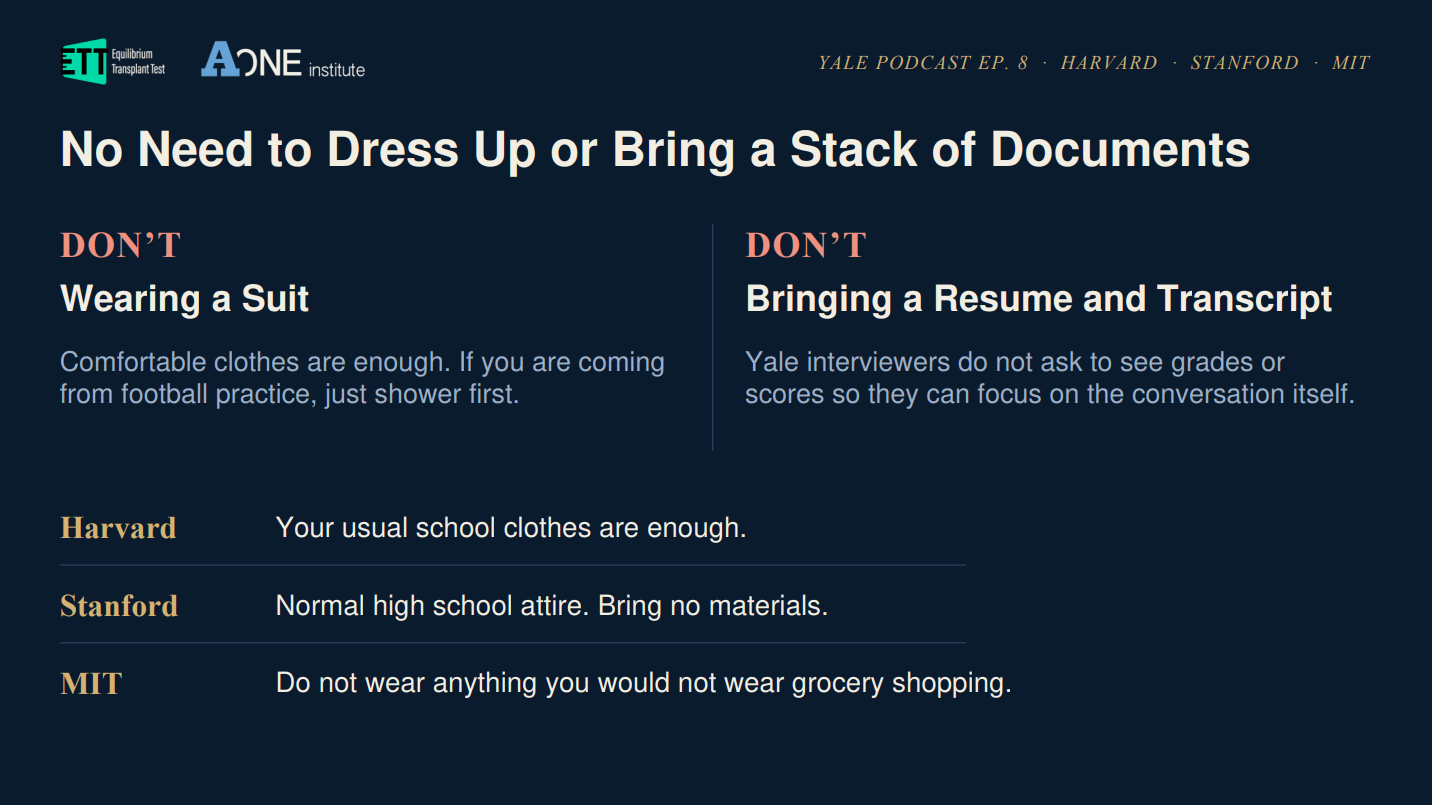
Some institutions also discourage students from bringing unnecessary documents.
Yale, for example, does not expect applicants to provide résumés or transcripts to alumni interviewers.
Stanford explicitly instructs applicants not to bring or share résumés, transcripts, test scores, or application materials.
Other institutions have different rules.
The safest approach is to read the university's specific interview instructions before the meeting.
How Should Students Prepare for Virtual Interviews?
A virtual interview may feel less formal, but technical problems and distractions can interfere with the conversation.
Students should test their camera, microphone, speakers, and internet connection beforehand.
Using a computer rather than a phone may make the experience more stable and comfortable.
The room should be quiet, and the background should be reasonably tidy.
Notifications should be turned off.
If headphones or earphones reduce echo, students should use them.
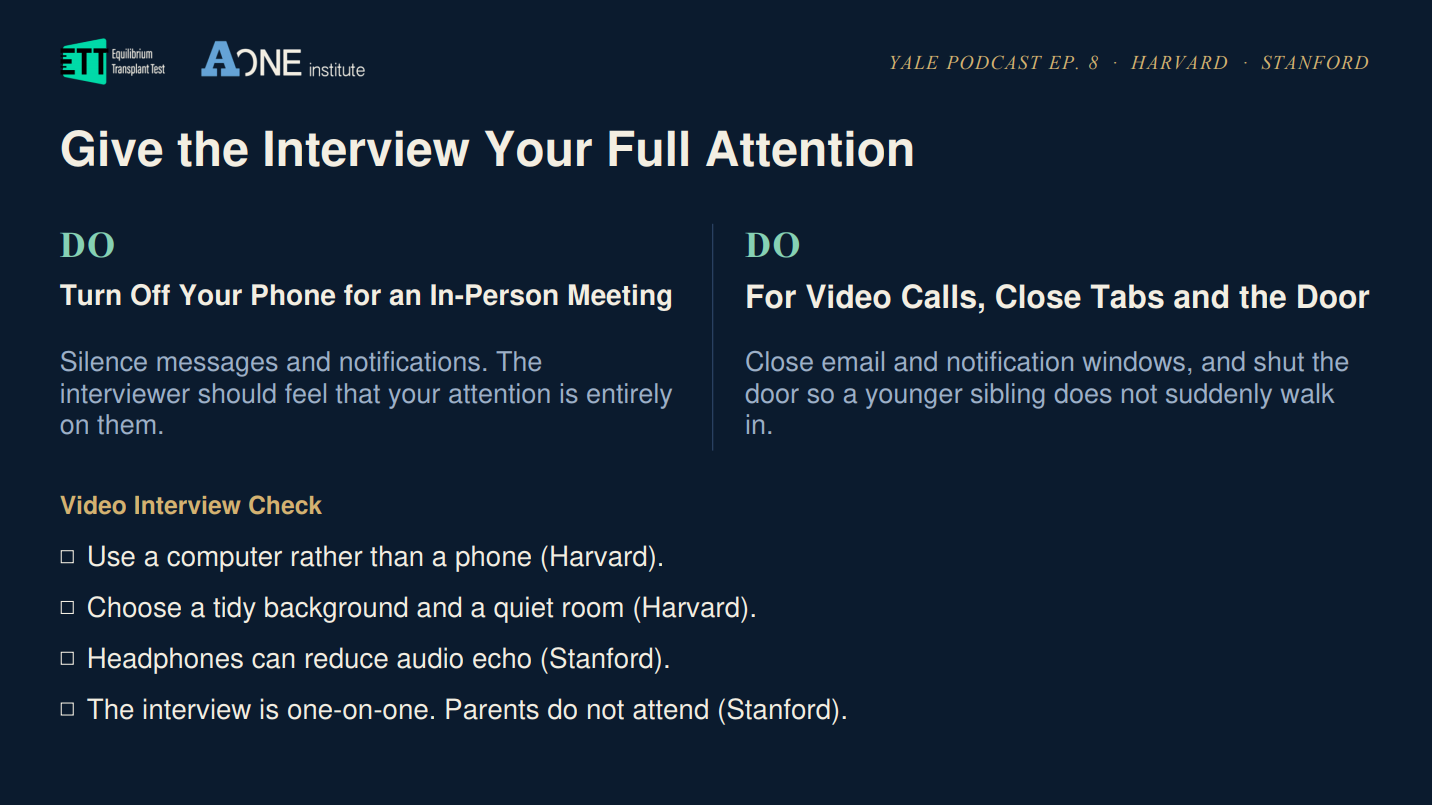
For in-person interviews, students should silence their phones completely.
For video interviews, they should close unrelated tabs and prevent interruptions.
Parents should not participate in the interview or provide answers from outside the camera's view.
These interviews are intended to be one-on-one conversations between the applicant and interviewer.
An applicant who can discuss complex academic interests but cannot remain focused during the conversation may create an unnecessary negative impression.
Basic preparation prevents avoidable distractions.
Don't Turn the Interview Into a List of Achievements
One of the most common mistakes is using the interview as an opportunity to repeat every accomplishment from the application.
A student may explain that they won a competition, completed a research project, served as club president, and participated in several programs.
All of that may be accurate.
But a list of accomplishments does not necessarily reveal much about the student.
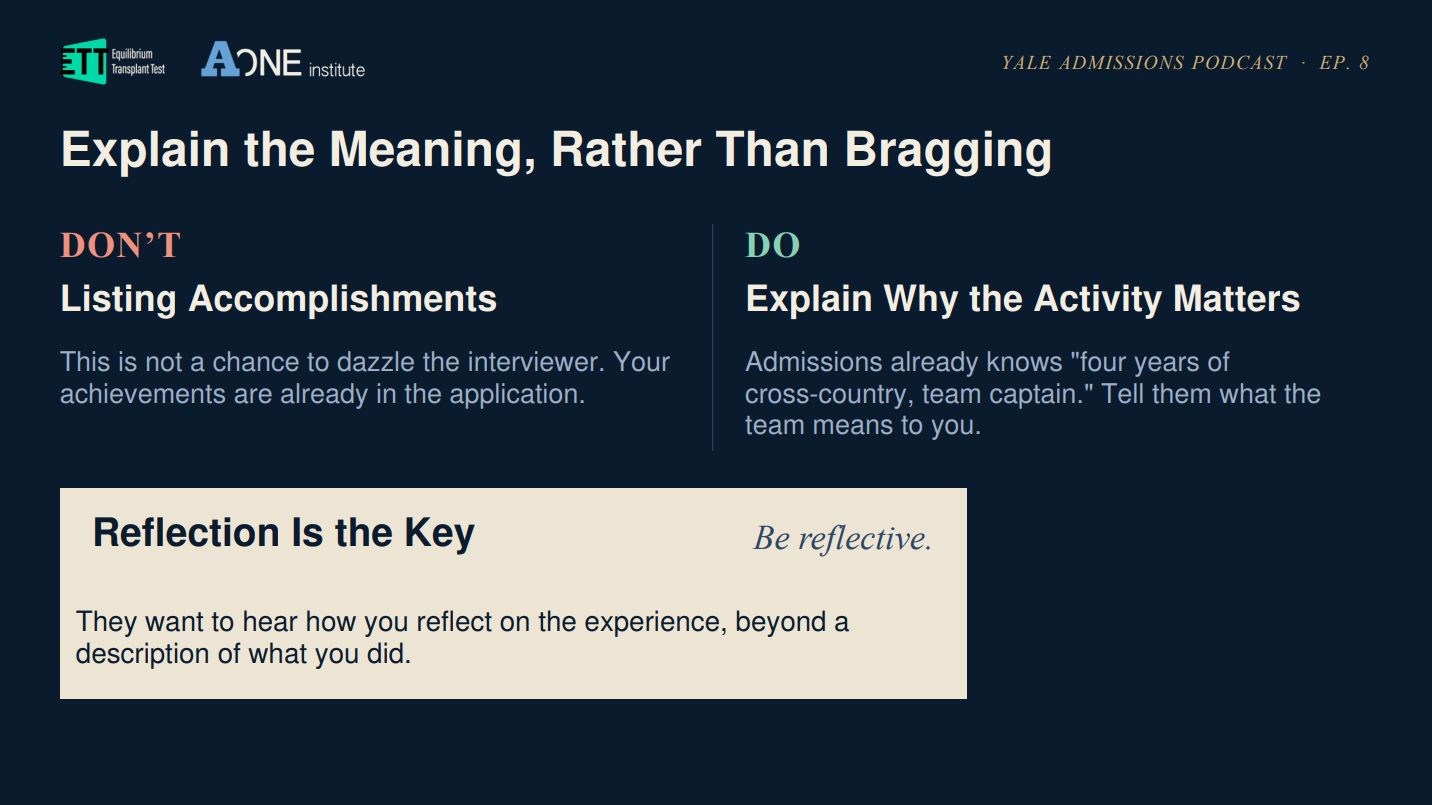
Consider a student who spent four years on a cross-country team and eventually became captain.
The admissions office can already read those facts in the Activities section.
What the interviewer may not know is why the team became important to the student.
Was there a moment when the student's understanding of teamwork changed?
Did the student struggle with a particular responsibility?
What did they learn from working with younger teammates?
Why did they continue participating?
The interview should help explain the meaning behind the activity.
Students who focus on experiences, motivations, and reflection can provide information that complements the written application.
How Personal Should Your Answers Be?
Students do not need to share every private experience or discuss matters that make them uncomfortable.
A personal conversation does not require unrestricted disclosure.
Students can choose which experiences best explain who they are.
They should be honest, thoughtful, and comfortable with the level of detail they share.
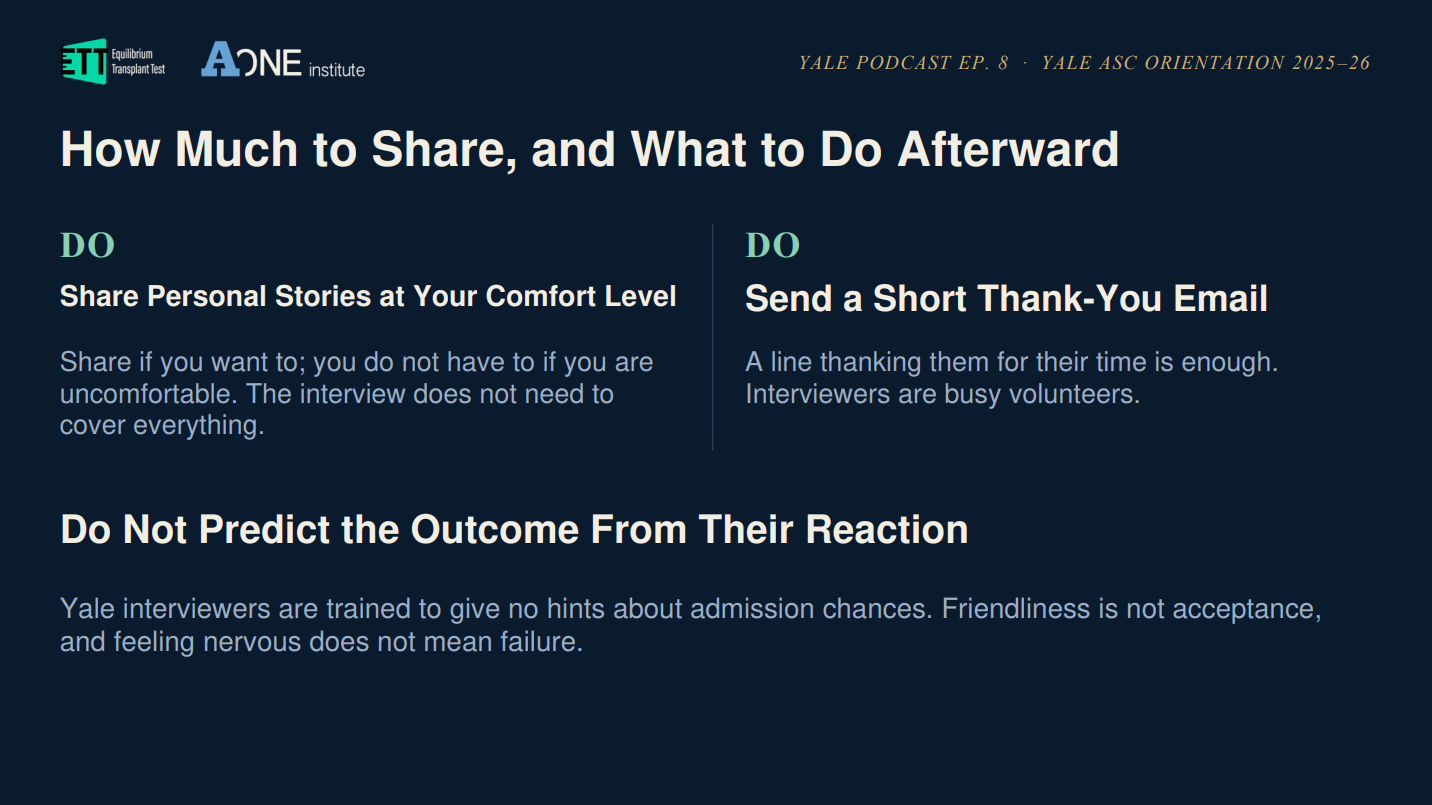
After the interview, it is appropriate to send a brief thank-you email.
A short message expressing appreciation for the interviewer's time and conversation is sufficient.
Students should not use the message to continue asking for favors or repeatedly contact the interviewer.
There is another important warning.
Do not try to predict admission results from how friendly the interviewer seemed.
Many alumni interviewers are warm, supportive, and encouraging.
An interview that ends with laughter or positive comments does not mean the student will be admitted.
Similarly, a conversation that feels less energetic than expected does not automatically indicate rejection.
A recurring observation from admissions preparation is that students often leave interviews feeling extremely confident because the interviewer was friendly.
That reaction is understandable, but friendliness is part of the conversational environment, not an admissions decision.
How Are College Interview Reports Used in Admissions Decisions?
The interview itself is only one stage in the process.
After the conversation, the interviewer submits a written report to the university.
Admissions officers can then consider that report alongside the student's application materials.
At Yale, the process generally follows this sequence:
-
The student submits the application.
-
Selected applicants receive interview invitations.
-
The interview takes place.
-
The interviewer prepares a narrative report.
-
Admissions officers review the report with the application.
-
The information may be discussed during committee deliberations.
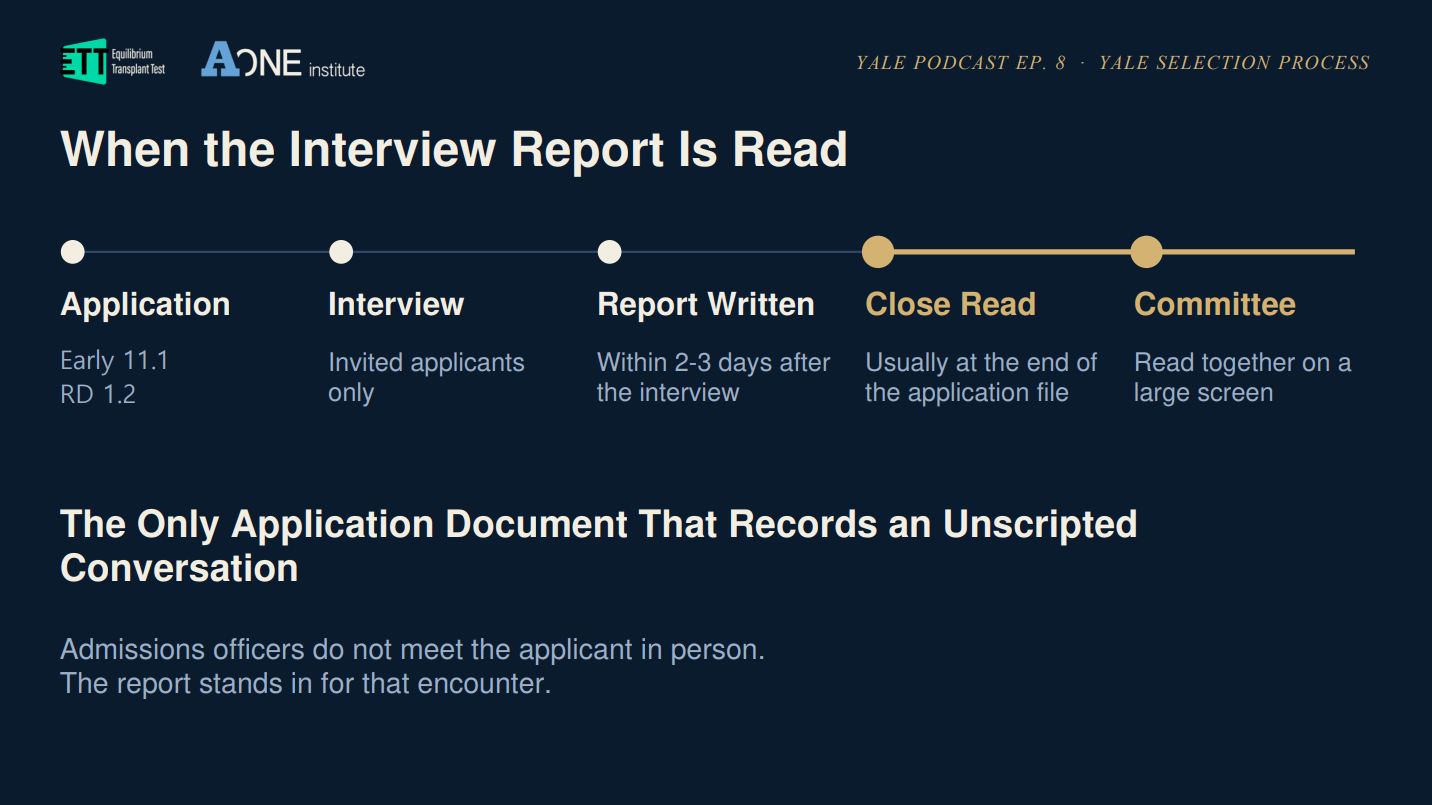
The report can provide something that the written application cannot always capture.
It reflects an unscripted conversation with a person who was not previously familiar with the applicant's essays, recommendations, and activities.
This makes the interview a potentially useful independent perspective.
However, the report should not be viewed as a separate admissions examination that determines the final result.
Its value comes from how it contributes to the overall understanding of the student.
Why Should Your Interview Reinforce Your Essays and Recommendations?
This is one of the most important concepts in the entire interview process.
Yale admissions officer Mark Dunn has explained the relationship among essays, recommendation letters, and interview reports using a concept from physics: constructive interference.
In wave physics, waves with matching phases can reinforce one another, producing a greater combined effect.
A similar idea can be applied to college admissions.
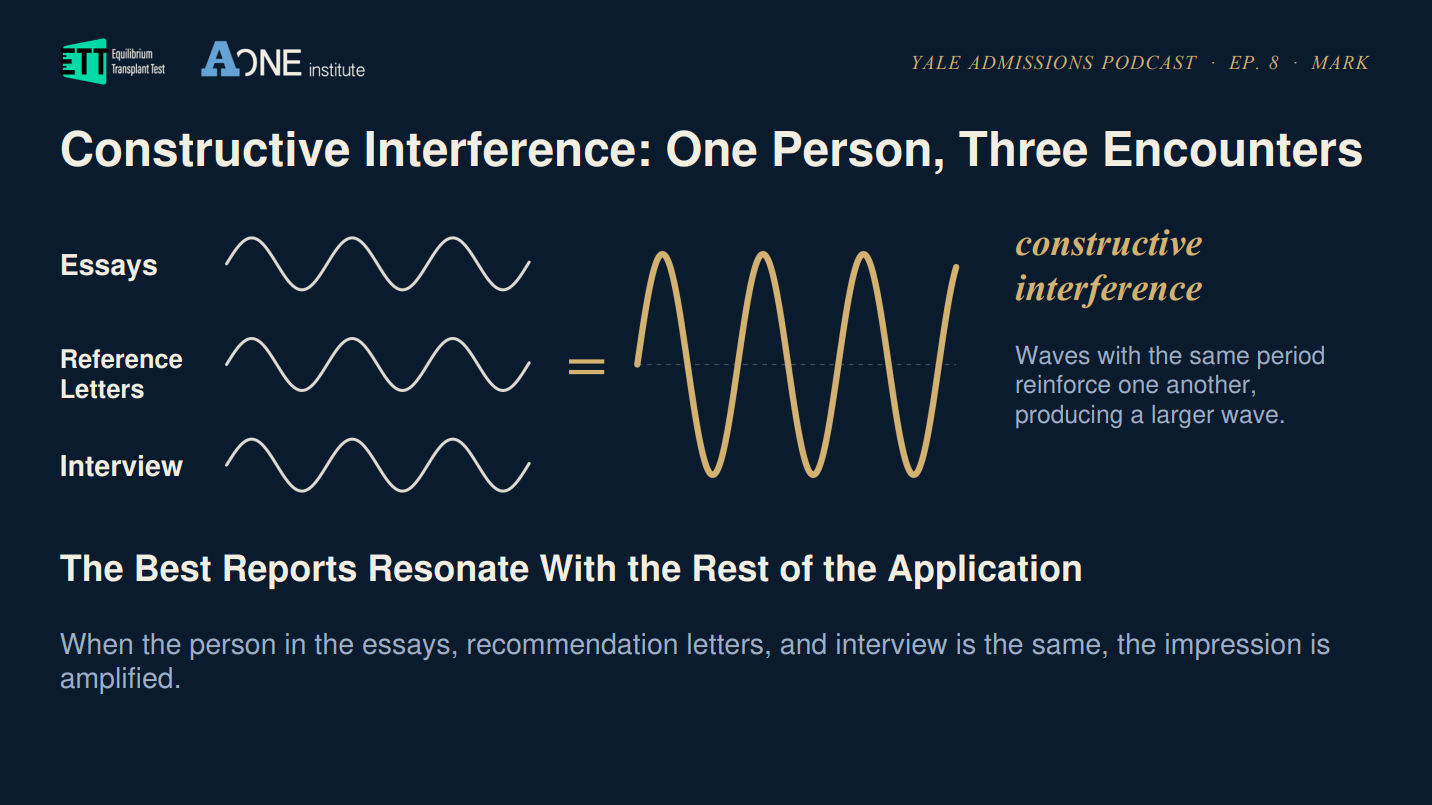
Imagine that an admissions officer reads a student's personal essay and develops an impression of someone who is intellectually curious and willing to explore unfamiliar ideas.
The teacher recommendations describe similar qualities through classroom observations.
Then the interviewer submits a report describing a student who spoke enthusiastically about an independent project and thoughtfully considered alternative explanations.
These different sources reinforce one another.
The person described in the essay resembles the person observed by teachers and the person encountered during the interview.
The overall impression becomes more coherent and convincing.
Now consider the opposite situation.
Suppose an essay presents a thoughtful, reflective student, but the interview reveals someone unable to explain the experiences described in the application.
The contrast could create questions.
The issue is not that students must repeat exactly the same stories in every application component.
It is that the underlying person should feel consistent.
The strongest interview does not invent a new version of the applicant. It reinforces the person already visible in the application.
That consistency can make the different parts of the admissions file work together more effectively.
What Additional Information Can Interview Reports Provide?
An interview report can contribute several types of information.
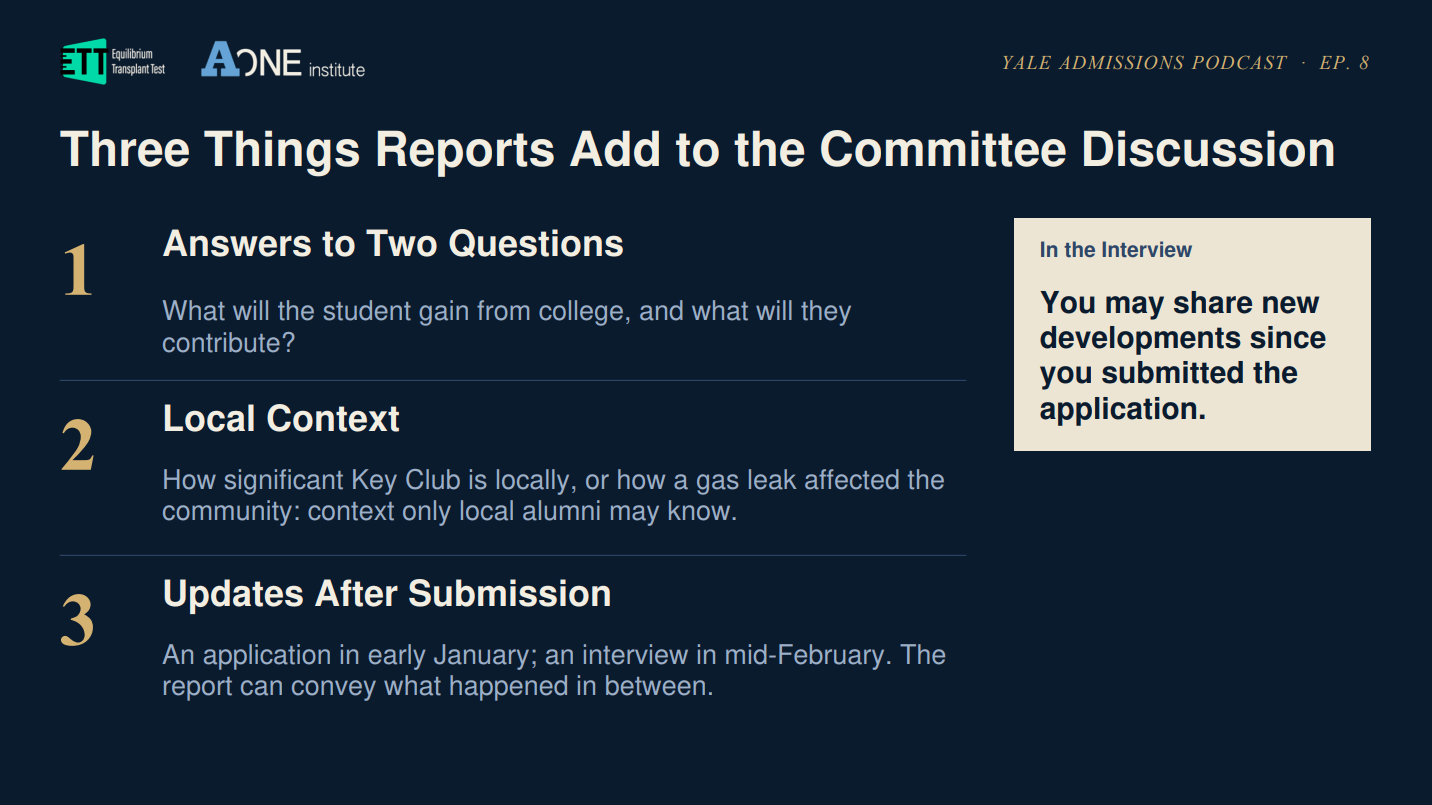
1. What Will the Student Gain From and Contribute to College?
Admissions officers want to understand how students may use the university's opportunities.
They also want to consider what the students might contribute to the campus community.
A conversation can provide insight into those questions.
2. Local Context
Alumni interviewers may understand local circumstances that are not immediately obvious from an application.
For example, the significance of a particular school club may differ among communities.
A local environmental event, public safety incident, or regional challenge may also provide context for a student's activities.
An interviewer familiar with the area may help explain these circumstances.
3. Updates After Application Submission
A student may submit an application in January and participate in an interview several weeks later.
During that time, an important project may develop or the student may gain new experiences.
The interview can provide an opportunity to discuss those developments.
These additional details can help the admissions committee understand the applicant more fully.
Can One Interview Determine Whether You Get Accepted?
A single interview report generally does not determine admission or rejection.
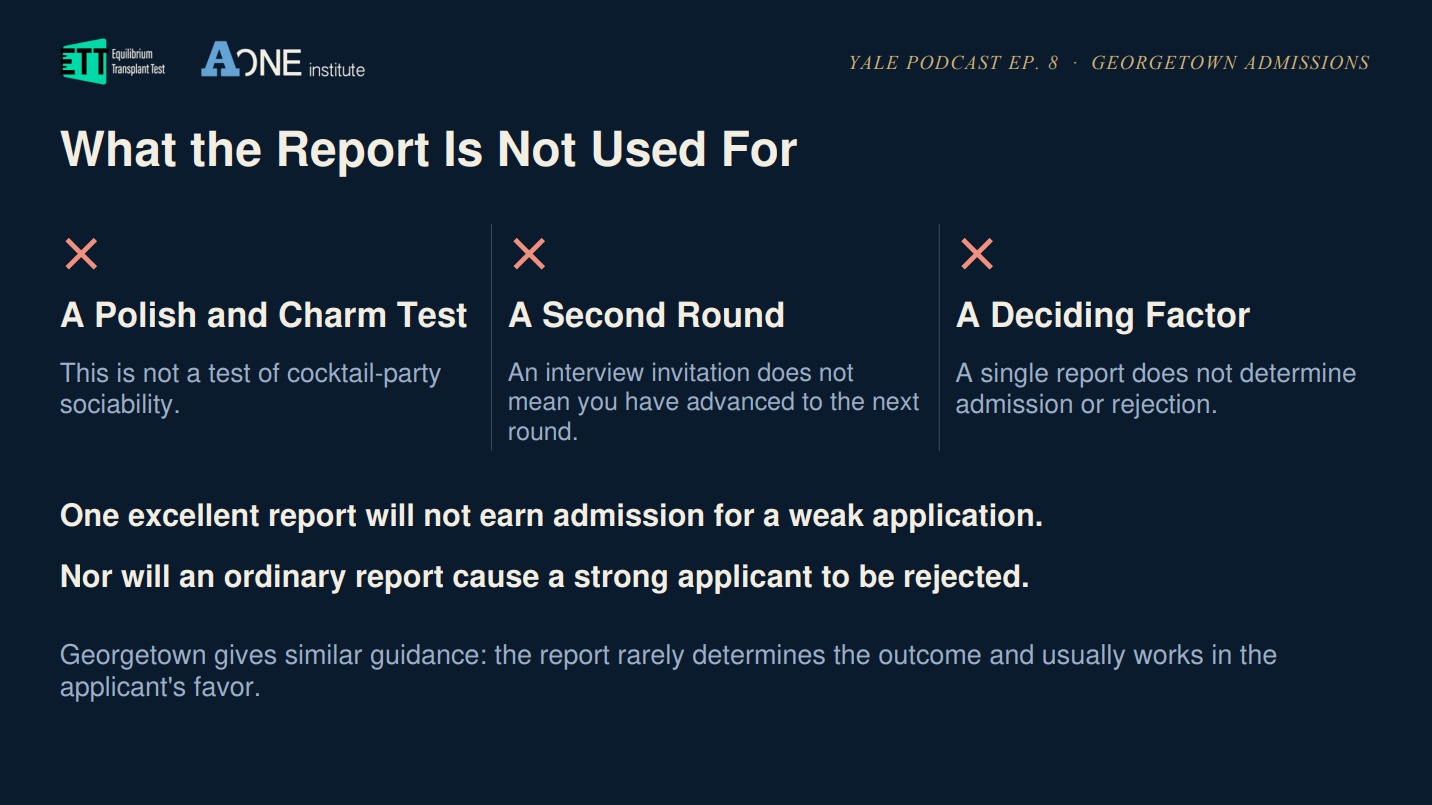
An exceptional interview is unlikely to compensate for an application that otherwise falls substantially below the institution's admissions expectations.
Similarly, an ordinary interview does not automatically undermine an otherwise strong application.
The interview is part of a holistic review process.
The report may reinforce an existing impression, provide additional context, or occasionally raise concerns.
That is why applicants should approach interviews seriously without treating them as their only opportunity to gain admission.
It is also why consistency matters.
Yale, Dartmouth, and Princeton have all described ways in which alumni conversations can add to an application by providing another perspective on the student.
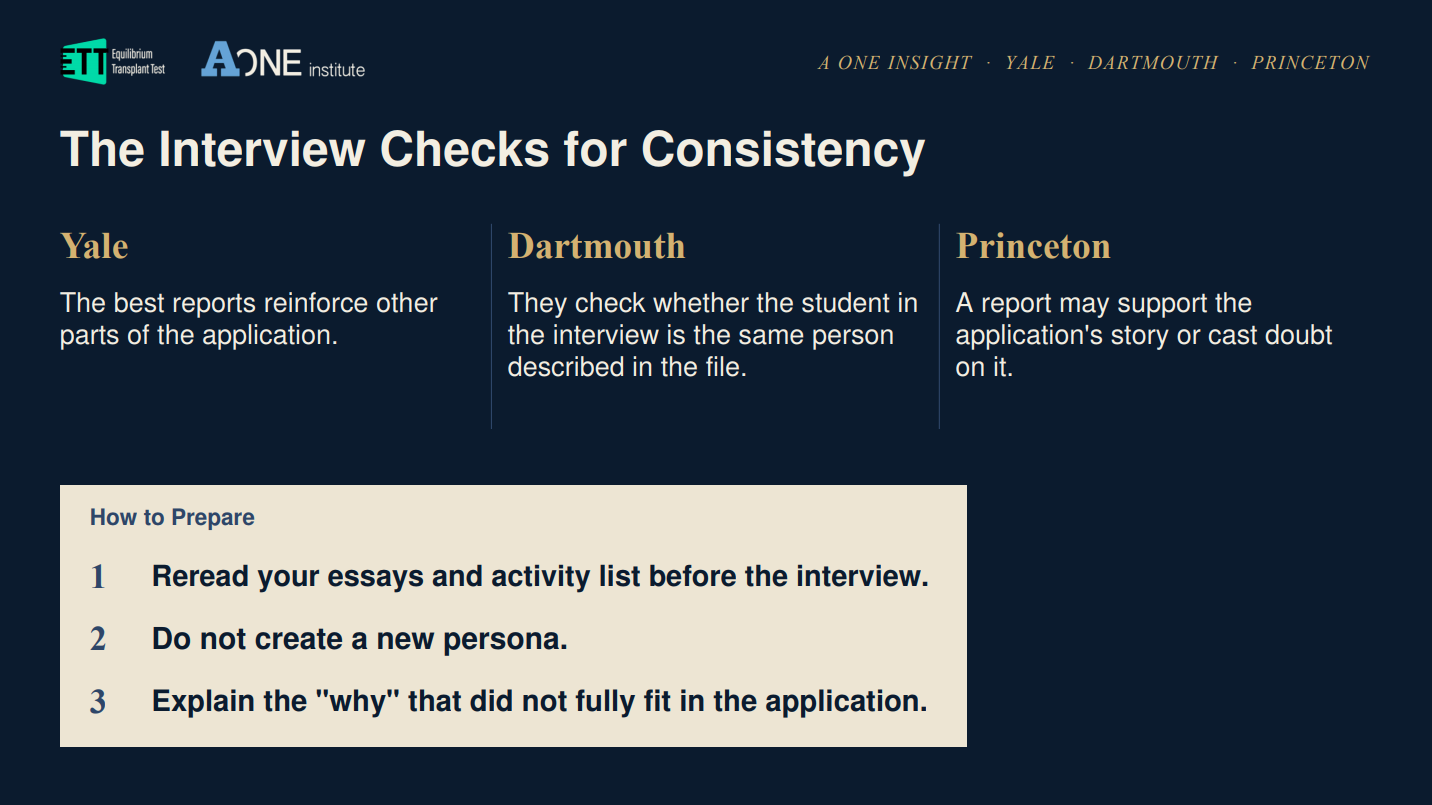
Before an interview, students should reread their essays and activities list.
They should remind themselves why they selected particular experiences and how those experiences connect with their academic interests.
They should not create a new personality or rehearse claims that differ from their written application.
Instead, they should be prepared to explain the motivations, decisions, and reflections that could not fully fit within the word limits of their essays.
Do College Interview Rules Differ by University?
Although many interview principles are similar, individual universities have different expectations.
One example is whether applicants should bring a résumé.
| University | Résumé guidance |
|---|---|
| Yale | Generally unnecessary; interviewers do not request it |
| Stanford | Do not bring or share a résumé, transcript, or test scores |
| MIT | An activities-only résumé may be acceptable, but is not required |
| Dartmouth | A brief résumé or activities list may be helpful, but is optional |
| Harvard | Follow the interviewer's instructions if a pre-interview form is requested |
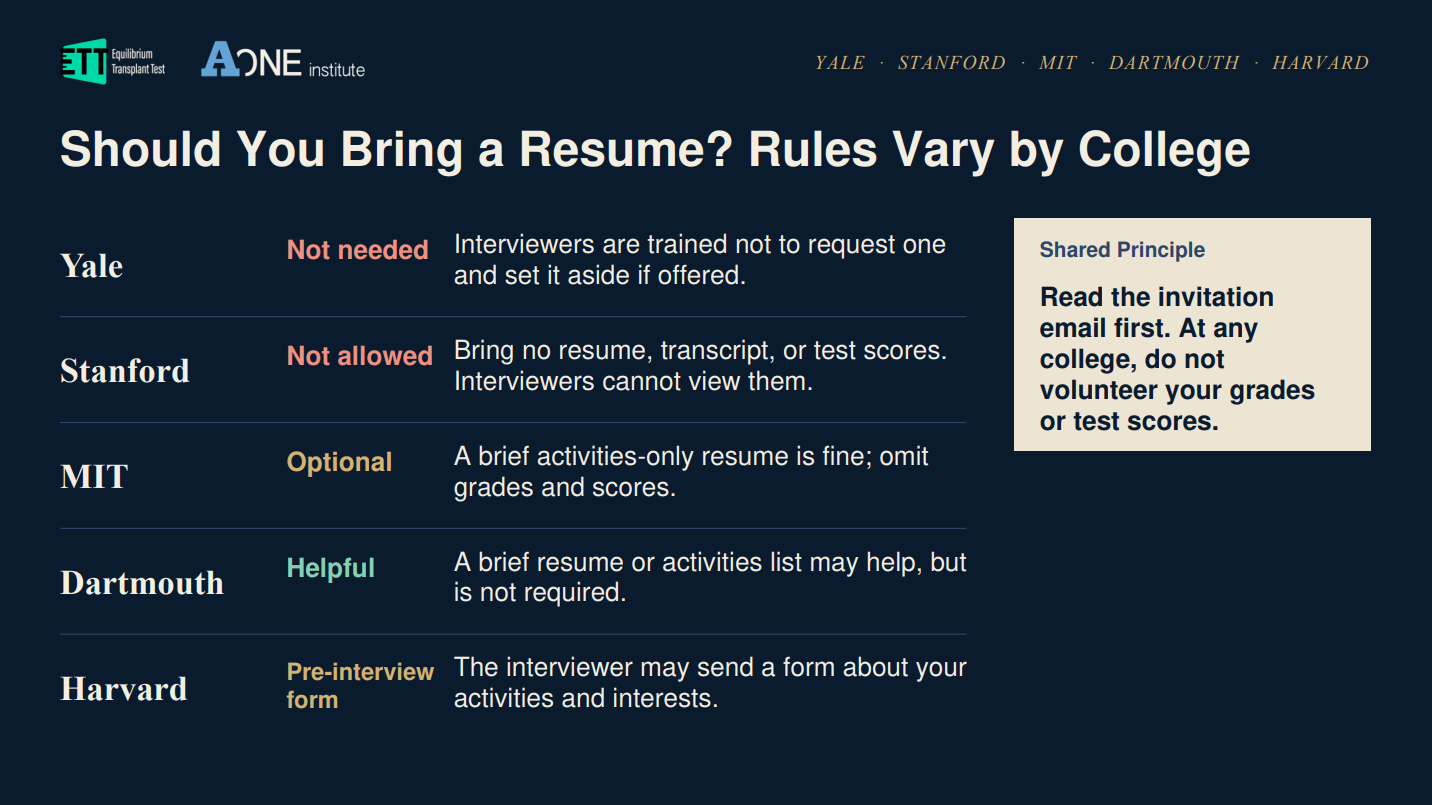
Students should not assume that materials permitted by one university are appropriate at another.
The interview invitation and official admissions instructions should take priority.
Other institution-specific rules are equally important.
Georgetown expects students to initiate contact with their assigned interviewer.
Princeton allows applicants to opt out of an interview without an admissions penalty.
Duke asks applicants interested in an interview to indicate that preference in its application supplement and conducts interviews virtually or by phone.
Stanford asks students to report an interviewer assignment if they already know the interviewer personally. Recording the interview is not permitted.
MIT generally prefers in-person interviews when practical, although virtual arrangements may be possible. It also prohibits recording or using automated note-taking tools during interviews.
Dartmouth likewise prohibits recording.
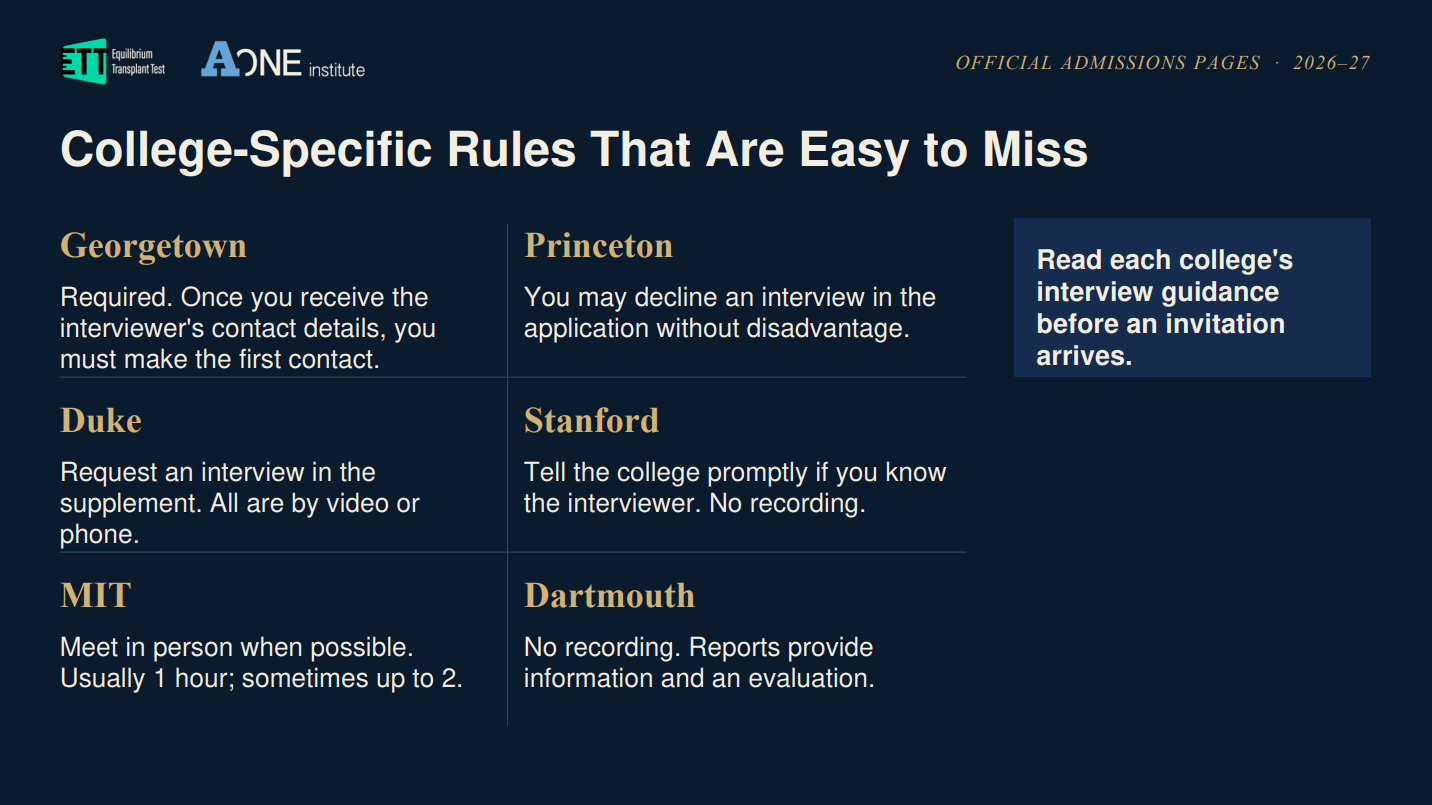
These differences may seem minor, but applicants should become familiar with them before an invitation arrives.
What If a University No Longer Conducts Alumni Interviews?
Some selective universities have eliminated traditional alumni admissions interviews.
That does not necessarily mean they have lost interest in understanding applicants beyond written essays.
Instead, some have introduced optional personal video submissions or other forms of communication.
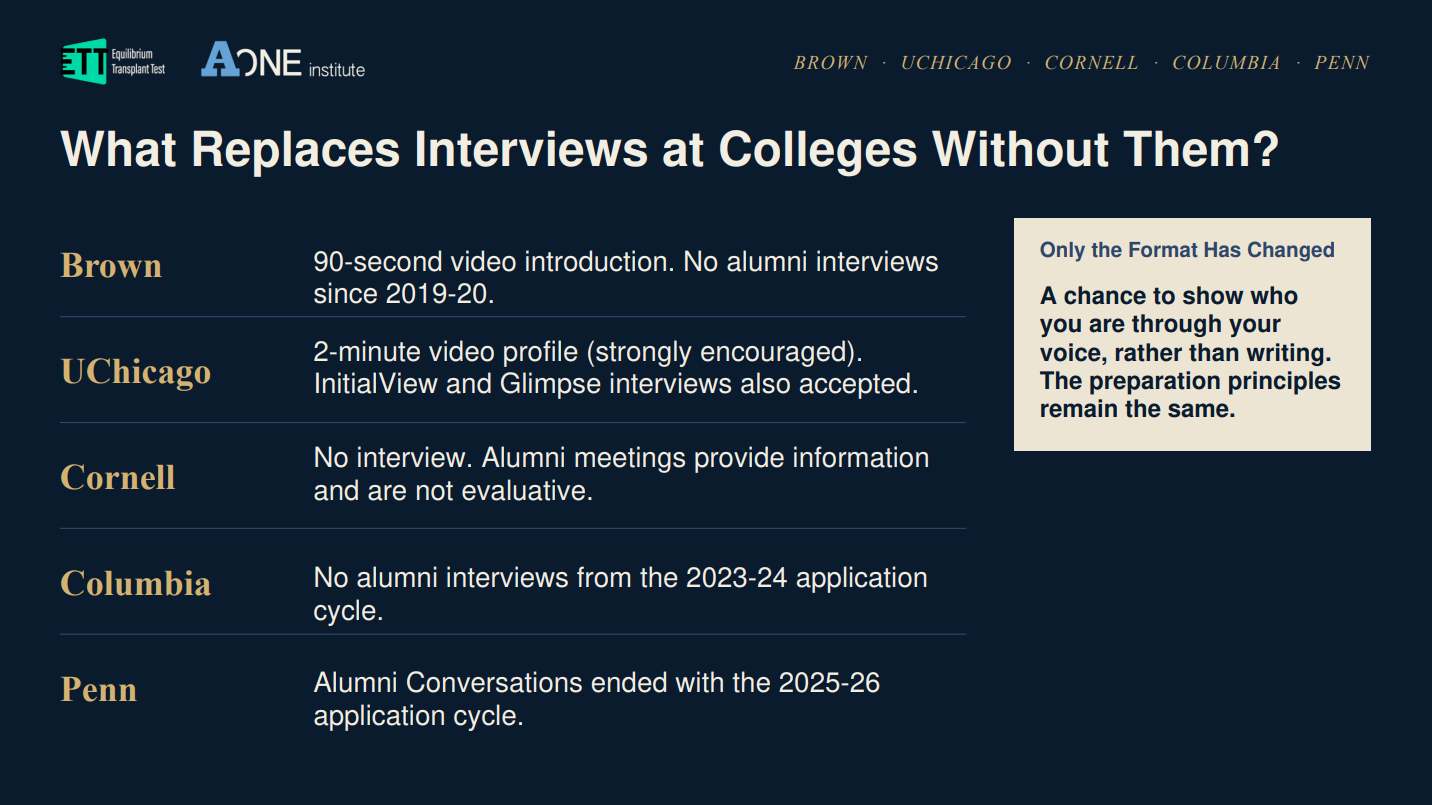
Brown no longer conducts alumni admissions interviews and instead encourages applicants to submit a personal video introduction of up to 90 seconds.
UChicago offers an optional video profile, allowing students to communicate directly through their own voice and personality.
Cornell no longer uses conventional alumni admissions conversations as an evaluative component in the same way as institutions such as Yale. Its alumni interactions are primarily informational, subject to program-specific exceptions.
Columbia discontinued its traditional alumni interview program beginning with the 2023–2024 admissions cycle.
Penn ended its alumni admissions conversations beginning with the 2025–2026 application cycle, redirecting alumni engagement toward welcoming and mentoring students after admission.
The formats differ, but the underlying objective remains familiar.
Universities want to understand the people behind their applications.
Whether that information comes from an alumni interview, an optional personal video, or another application component, students should be able to communicate their interests and experiences authentically.
College Interview Checklist: Before, During, and After
The preparation process can be organized into three stages.
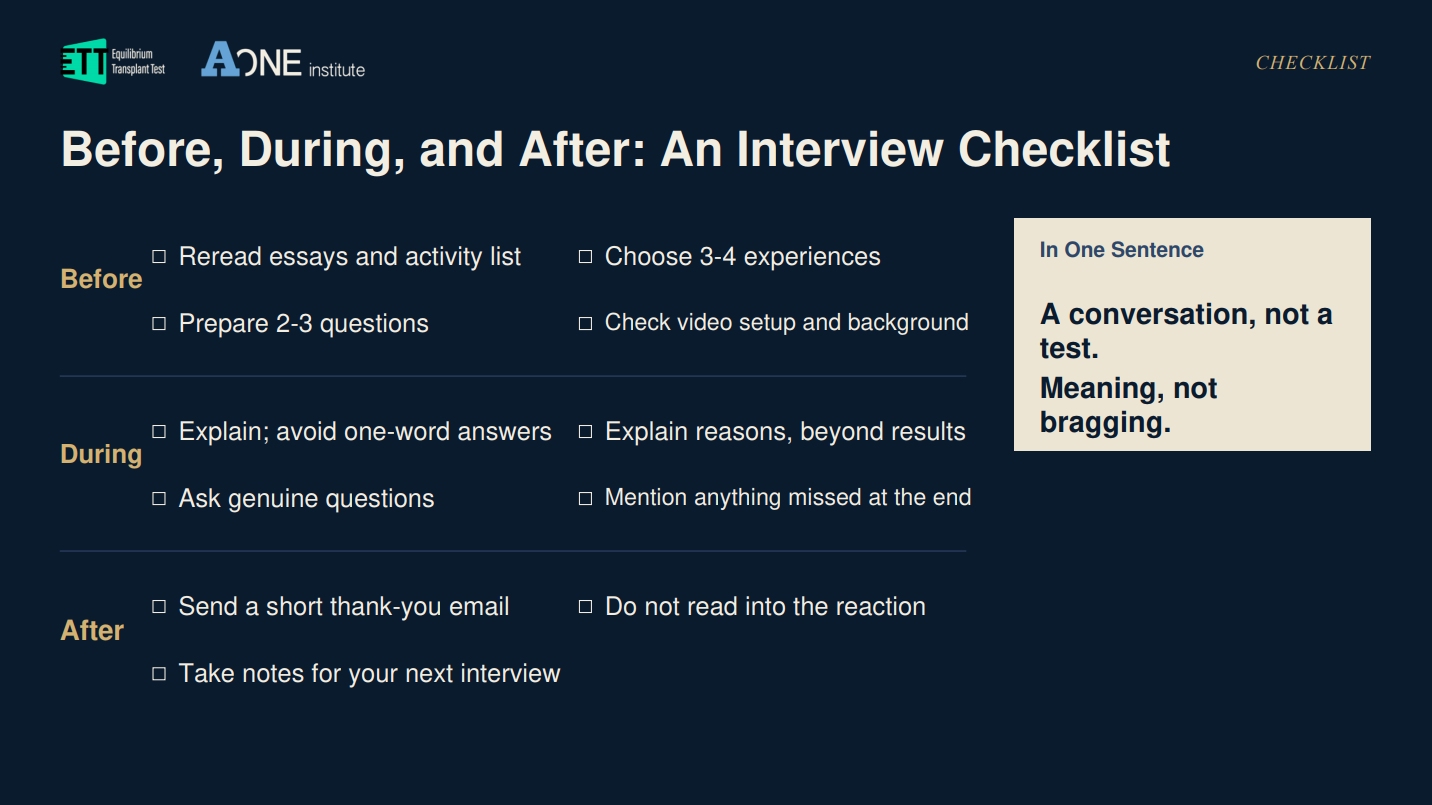
Before the Interview
-
Reread your essays and Activities section.
-
Select three or four meaningful personal experiences to discuss.
-
Prepare two or three thoughtful questions for the interviewer.
-
Confirm the meeting time and location.
-
Test the camera, microphone, and internet connection if meeting virtually.
-
Review any institution-specific interview instructions.
The most important preparation is understanding the experiences students have already described in their applications.
They should know not only what they accomplished, but why the experience mattered.
During the Interview
Avoid giving only one-word answers.
Explain your reasoning, motivations, and experiences.
When discussing accomplishments, focus on the process rather than simply listing results.
Listen carefully to the interviewer and respond to what the other person actually says.
A good conversation involves mutual engagement.
Students should not spend the entire interview silently preparing their next statement while ignoring the interviewer's response.
If something important has not been discussed by the end, students may politely introduce it before concluding.
However, the information should fit naturally into the conversation.
After the Interview
Send a short thank-you email.
Do not interpret the interviewer's friendliness, enthusiasm, or closing remarks as a prediction of admission.
If additional interviews remain, write a few private notes about the experience.
Which questions were difficult?
Which stories communicated your interests effectively?
Where did you struggle to explain an unfamiliar activity?
These observations can help improve preparation for the next conversation.
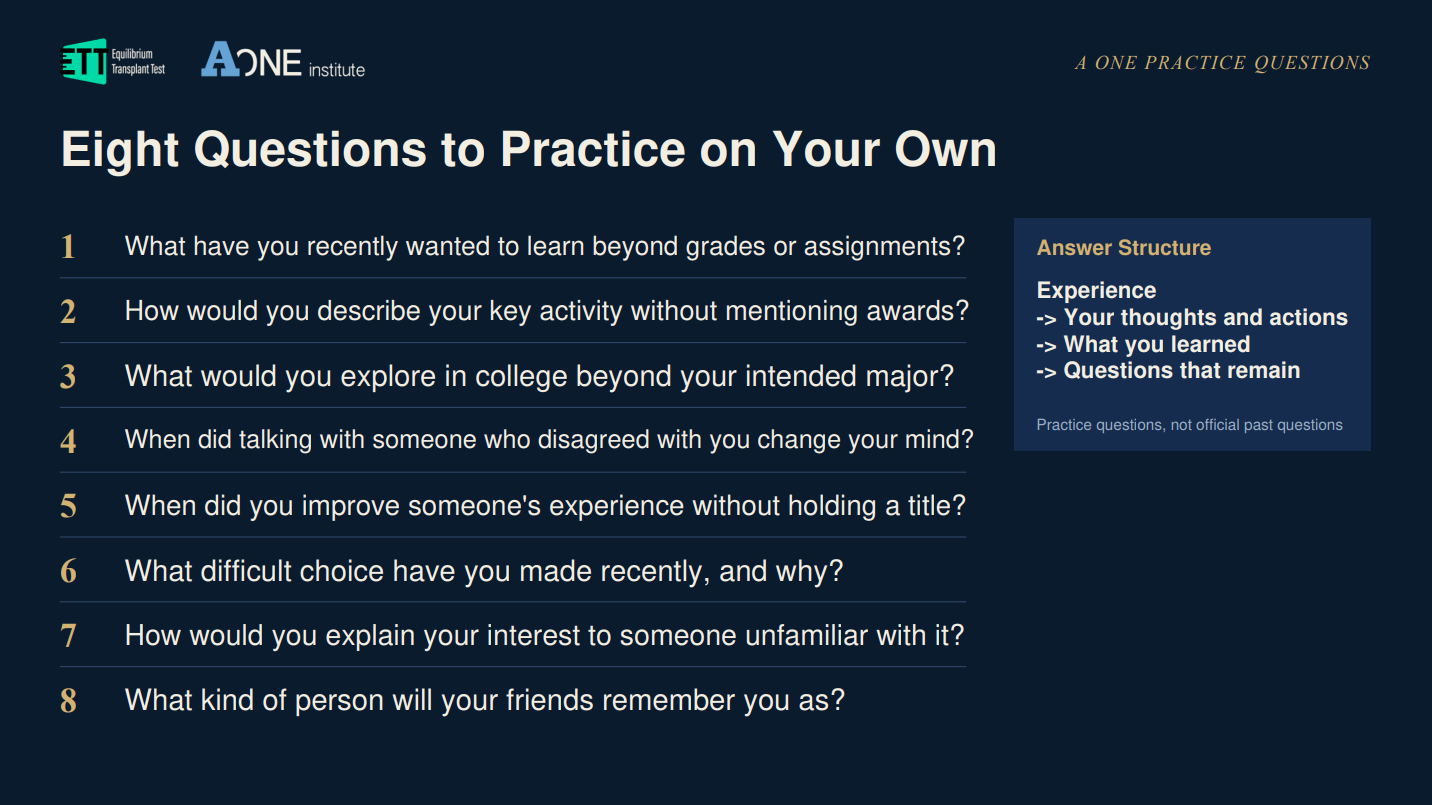
Eight College Interview Questions to Practice on Your Own
Students do not need to memorize long answers.
However, practicing a manageable set of questions can help them organize their experiences and develop confidence.
-
What have you recently wanted to learn beyond grades or school assignments?
-
How would you describe your most important activity without mentioning awards?
-
What would you like to explore in college beyond your intended major?
-
When did a conversation with someone who disagreed with you change your thinking?
-
When did you improve someone else's experience without holding a formal leadership title?
-
What difficult decision have you made recently, and why did you make it?
-
How would you explain your academic interests to someone unfamiliar with the subject?
-
What kind of person do you think your friends will remember you as?
These are preparation questions, not an official list of questions previously used by a particular university.
A useful way to organize an answer is:
Experience → Your thinking and actions → What you learned → Questions that remain
Students do not need to deliver every answer in exactly this structure.
However, preparing around real experiences helps prevent answers from becoming generic descriptions of personality.
What Is the Most Important Goal of a College Interview?
A college interview is not primarily an opportunity to impress an alumnus with a long list of achievements.
Nor is it a test of whether a student can memorize polished answers to predictable questions.
The most important objective is to help another person understand who the student is.
The interviewer should leave with a clearer impression of the applicant's academic interests, intellectual curiosity, character, relationships, and personal development.
Ideally, the conversation provides details that an admissions officer would not necessarily discover through grades or activity descriptions alone.
A student who can explain a complicated research project clearly, respond thoughtfully to a different perspective, and show genuine curiosity about another person's experiences may leave a more meaningful impression than someone who simply repeats a carefully prepared résumé.
The interviewer does not need to share the student's major or professional interests.
They need to understand why those interests matter to the student.
The report should also reinforce the person already visible in the essays and recommendation letters.
That is what makes consistency so important.
A successful college interview helps admissions officers see the same authentic student from another perspective—and gives them a reason to imagine that student contributing meaningfully to their campus.
Students who have not received an invitation should not become discouraged.
Students who have received one should take the opportunity seriously.
And students who have completed an interview should avoid treating a friendly conversation as a guarantee of admission.
Prepare thoughtfully, explain real experiences, listen carefully, and focus on having a meaningful conversation.
A ONE Institute
A ONE Institute supports students preparing for selective U.S. universities through academic planning, essay consulting, extracurricular development, research guidance, Olympiad preparation, and college admissions advising.
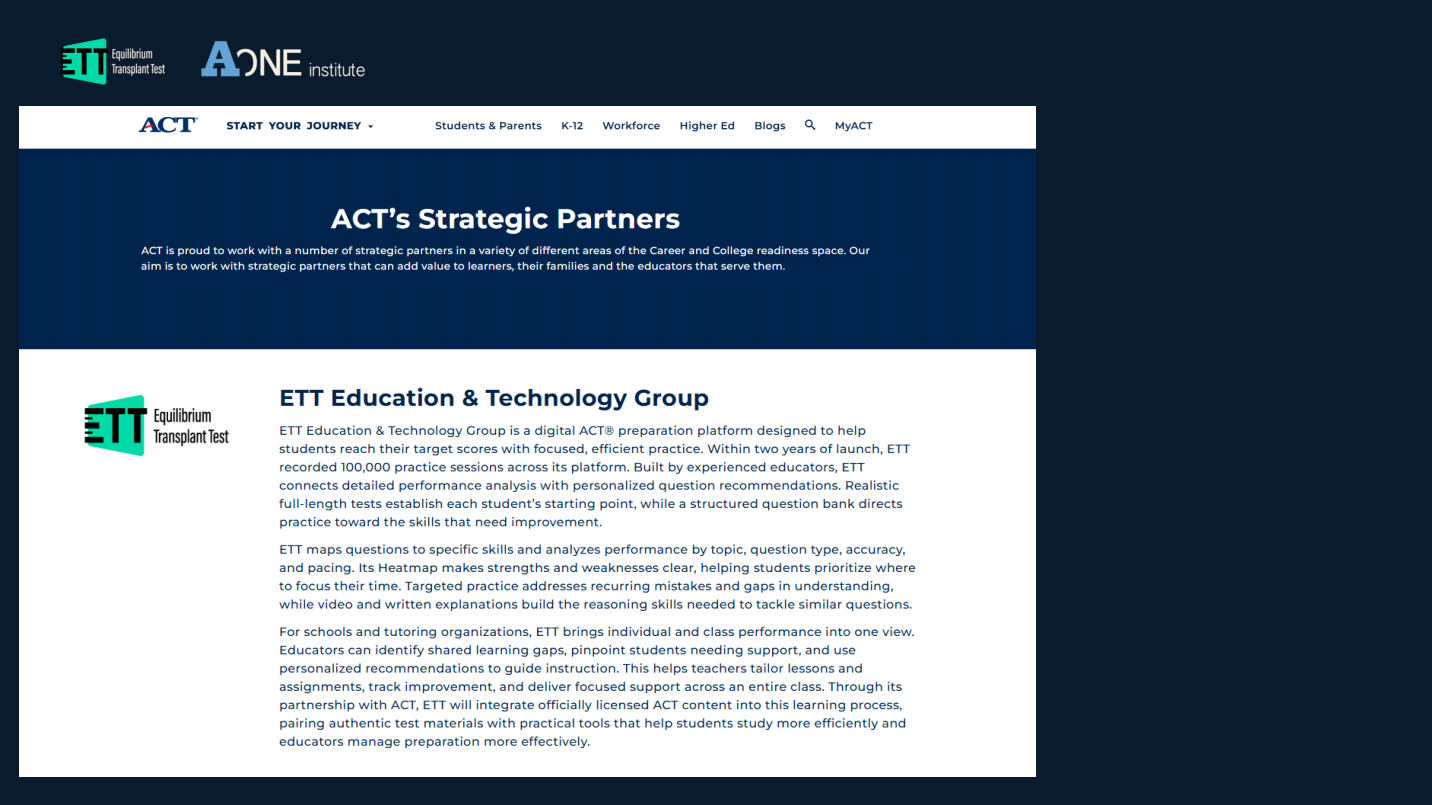
College interview preparation focuses on helping students communicate their genuine experiences, explain the reasoning behind their achievements, and maintain consistency with their written applications.
For college admissions guidance and academic program inquiries, contact [email protected].
College Interviews
College Admissions Interview
Yale Interview
Harvard Interview
MIT Interview
Stanford Interview
College Interview Preparation
College Admissions 2027
