
American college admissions are changing, and students preparing for selective universities need to understand what may happen next. As pressure to eliminate legacy admissions continues, universities face a difficult question: How can they preserve the advantages of long-standing alumni relationships while responding to demands for a fairer admissions process?
The answer may lie in Demonstrated Interest (DI), new Early Decision pathways, and university-sponsored summer programs. These developments suggest that colleges may increasingly look for alternative ways to identify students who are genuinely interested in attending and who can contribute to their institutional goals.
Understanding this shift could change how students approach college admissions and extracurricular planning over the next several years.
What Are Legacy Admissions and ALDC?
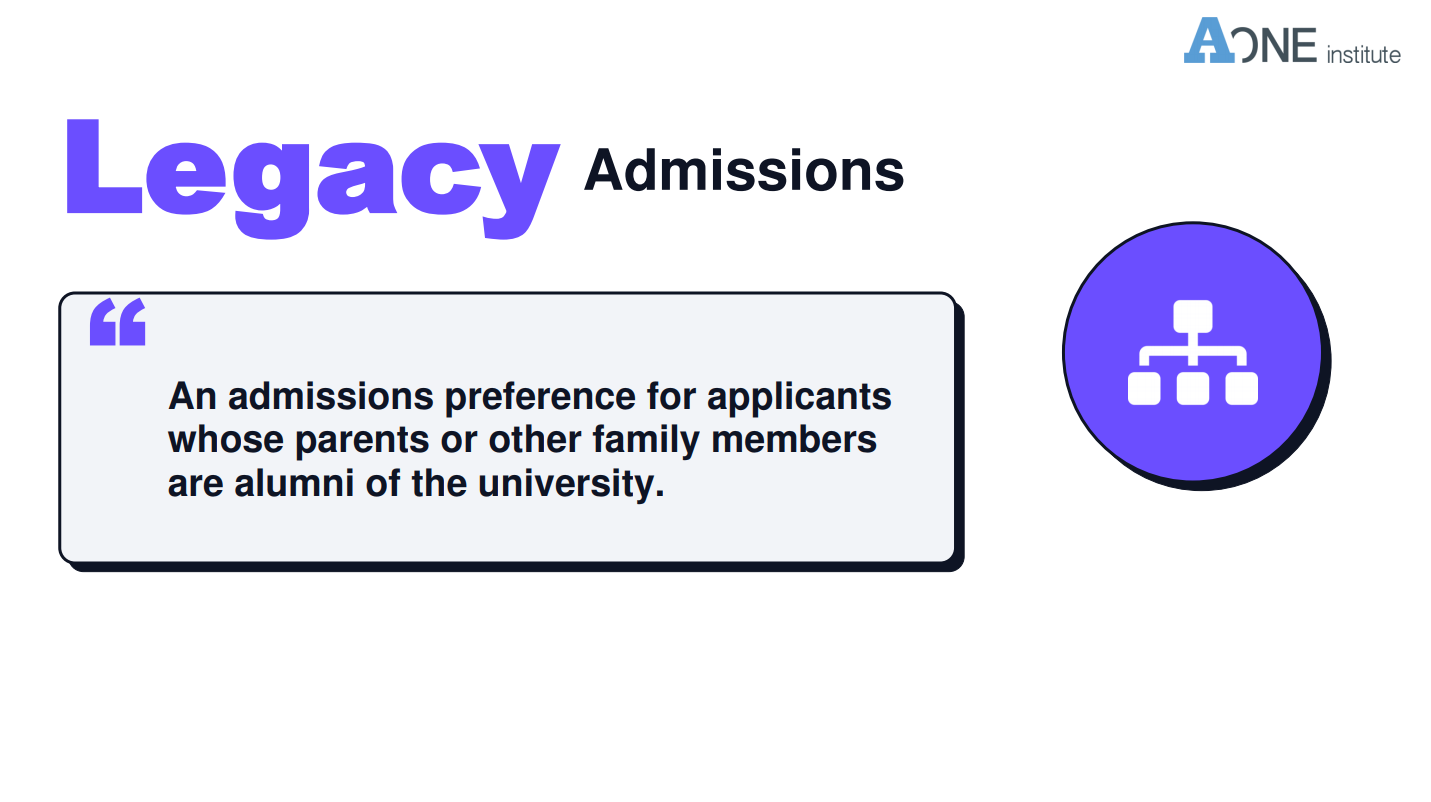
Legacy admissions is a practice in which a university gives preferential consideration to applicants whose parents or other family members previously attended that institution.
For example, a student whose parent graduated from a particular university may receive additional consideration during the admissions process because of that family connection.
Legacy status does not guarantee admission, but it may provide an advantage at institutions that continue to consider it.
There is also a broader category known as ALDC, which includes four types of applicants who may receive special institutional consideration.
-
A — Athletes: Students recruited to represent the university in athletics.
-
L — Legacies: Applicants with family connections to university alumni.
-
D — Dean's or Director's Interest List: Applicants receiving special institutional attention, including some connected to donors.
-
C — Children of Faculty and Staff: Applicants whose parents work at the institution.
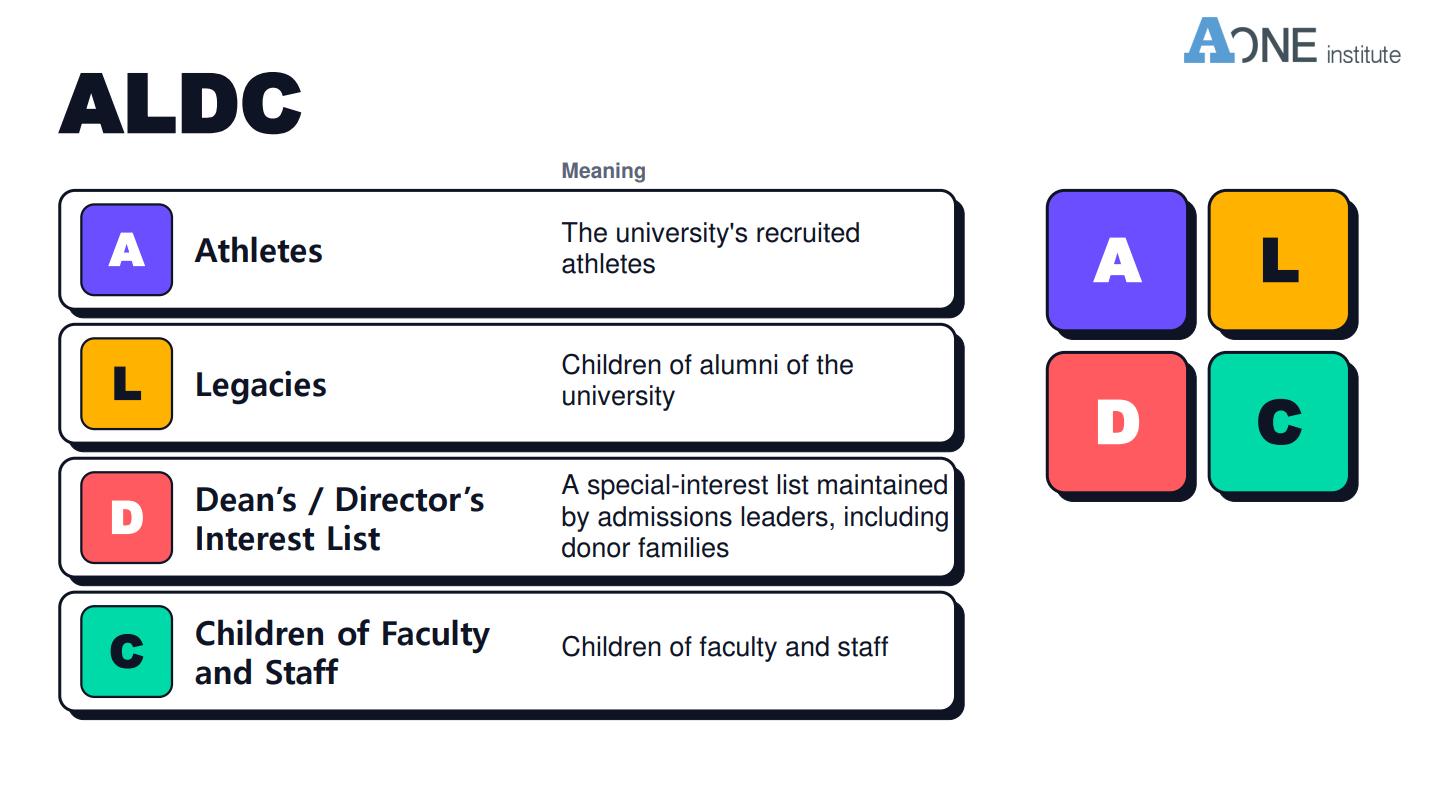
The ALDC framework illustrates that universities have historically considered factors beyond grades, test scores, and extracurricular achievements.
Among these categories, legacy admissions has faced particularly strong public and political criticism.
Why Is the Government Pressuring Universities to Eliminate Legacy Admissions?
Legacy admissions has been criticized for giving advantages to students based on family relationships rather than individual qualifications.
The controversy intensified in 2023.
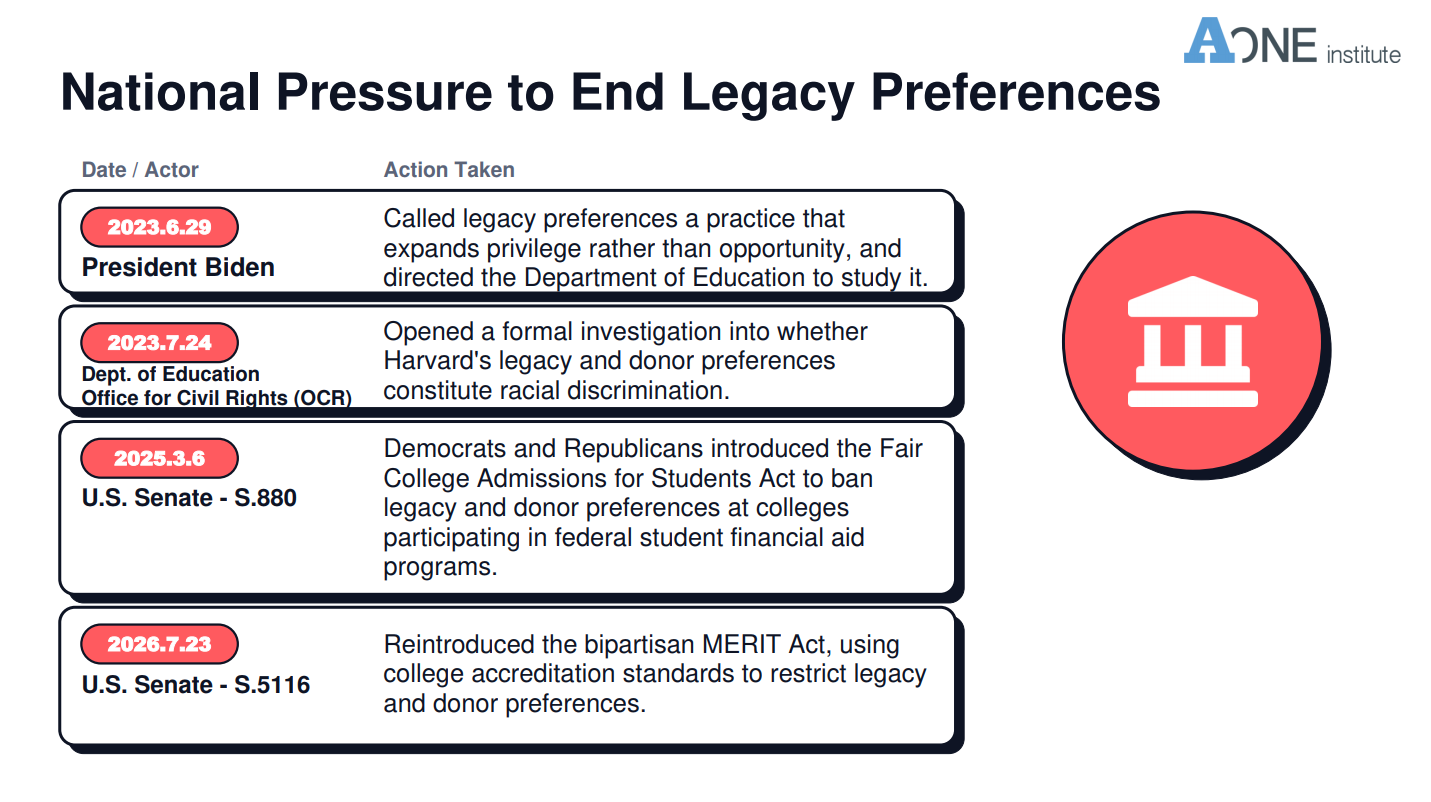
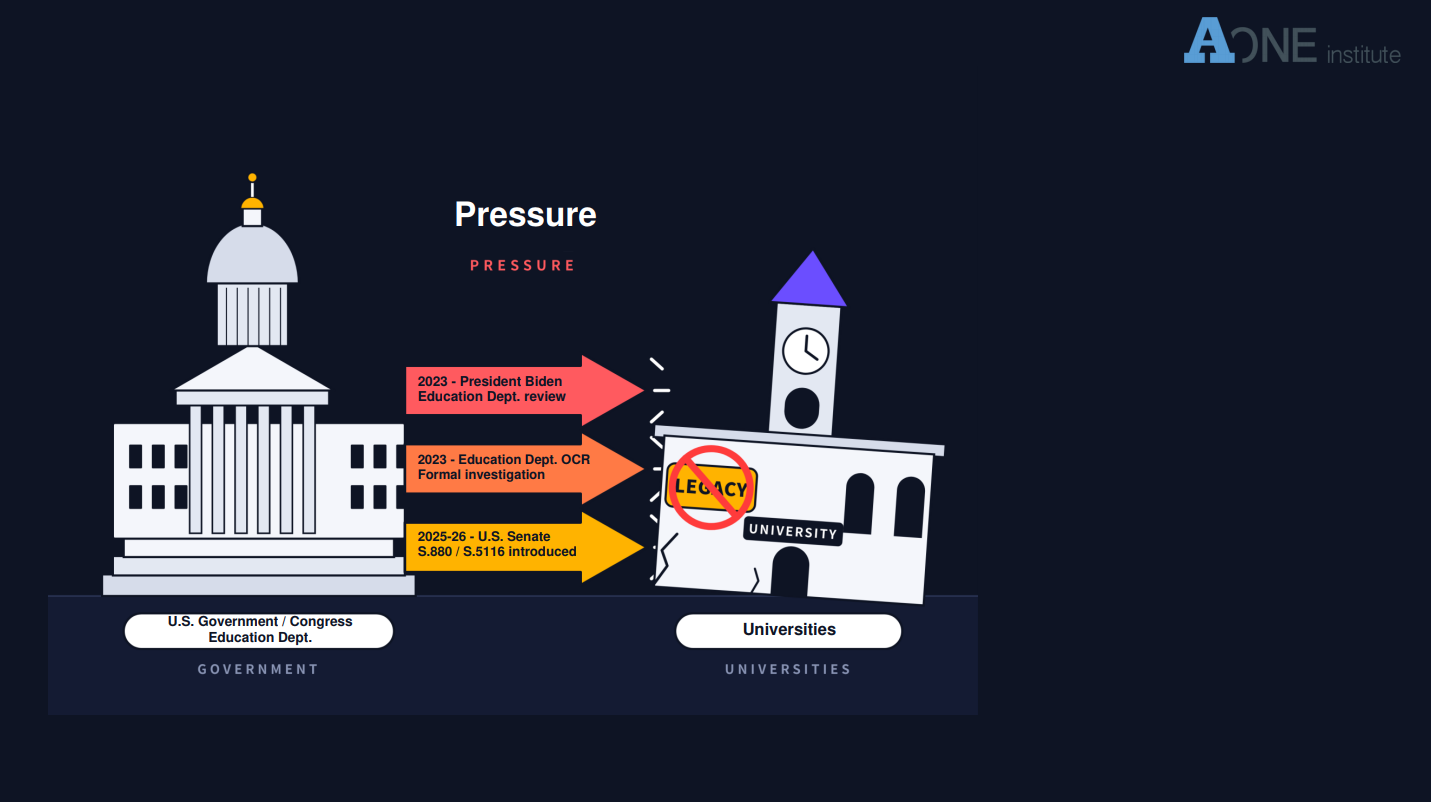
On June 29, 2023, President Joe Biden publicly questioned legacy preferences and directed the Department of Education to examine practices that could reinforce unequal access to higher education.
On July 24, 2023, the Department of Education's Office for Civil Rights opened an investigation into Harvard University's preferences for applicants with alumni and donor connections.
The issue also reached Congress.
On March 6, 2025, Democratic and Republican senators introduced the Fair College Admissions for Students Act, which sought to restrict legacy and donor preferences at institutions participating in federal student financial aid programs.
Another bipartisan effort followed in July 2026 with the MERIT Act, which proposed using accreditation standards to limit preferential treatment based on alumni or donor relationships.
The bipartisan nature of these proposals is especially important.
American politics is often divided along party lines, making bipartisan legislation a meaningful indication that an issue has attracted concern across the political spectrum.
Of course, bipartisan support does not guarantee that a bill will become law.
Nevertheless, repeated legislative efforts suggest that universities may face continued pressure to reconsider legacy admissions.
Even if a nationwide prohibition is not immediately enacted, universities must consider how public criticism, legislative proposals, and changing expectations could affect their future admissions policies.
Some institutions have already moved away from legacy preferences.
Others have continued to defend them.
Which Universities Have Eliminated Legacy Preferences?
Several universities stopped considering legacy status long before the recent political debate.
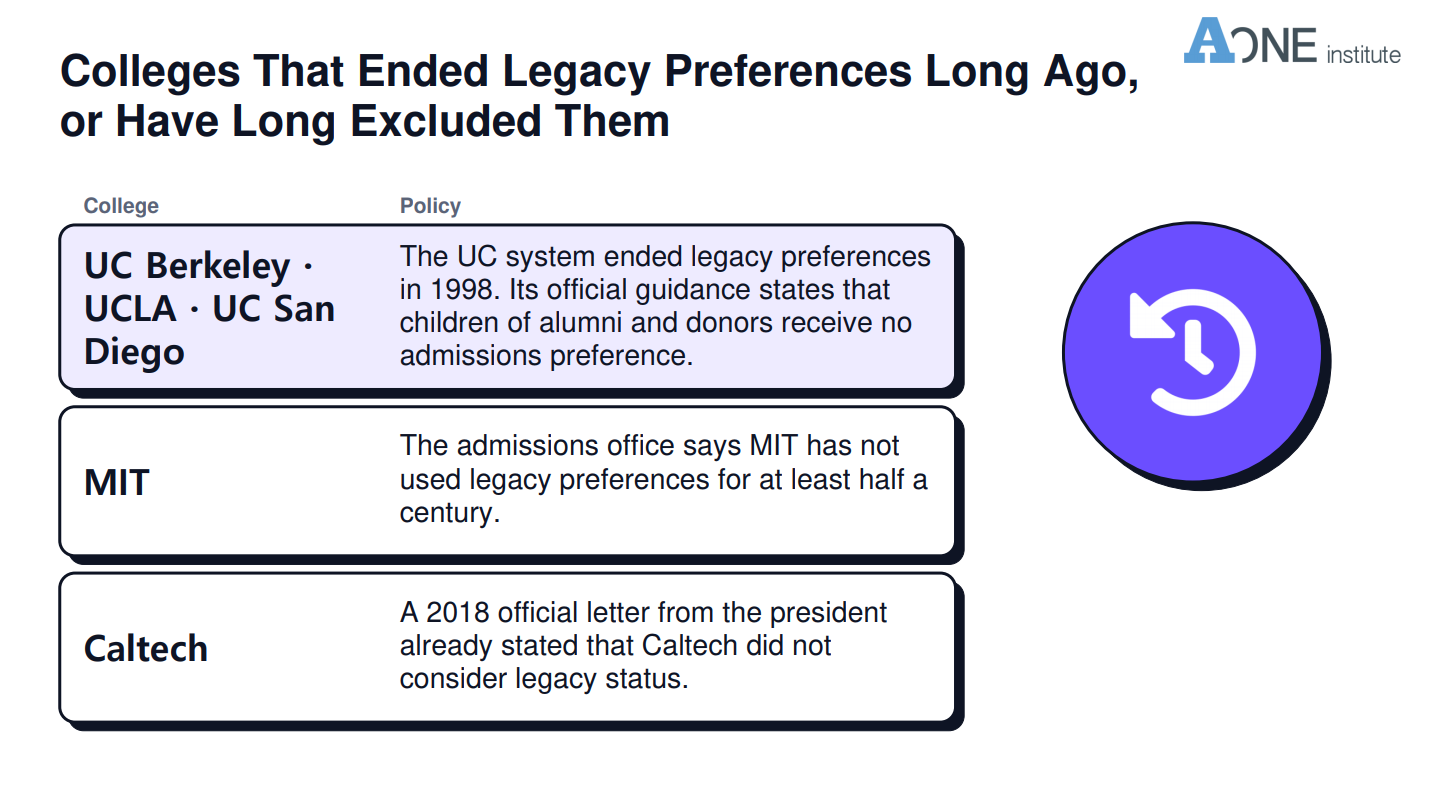
The University of California system eliminated legacy preferences in 1998.
MIT has stated that it has not considered legacy relationships in undergraduate admissions for at least half a century.
Caltech has also maintained a policy of not considering legacy status.
Other institutions eliminated legacy preferences more recently.
Johns Hopkins began phasing out legacy consideration in 2014 and formally ended the practice in 2019.
Carnegie Mellon subsequently removed legacy consideration.
The University of Michigan announced the elimination of legacy preferences in 2023.
The University of Virginia stopped considering legacy status following Virginia's 2024 legislation prohibiting legacy preferences at public universities.
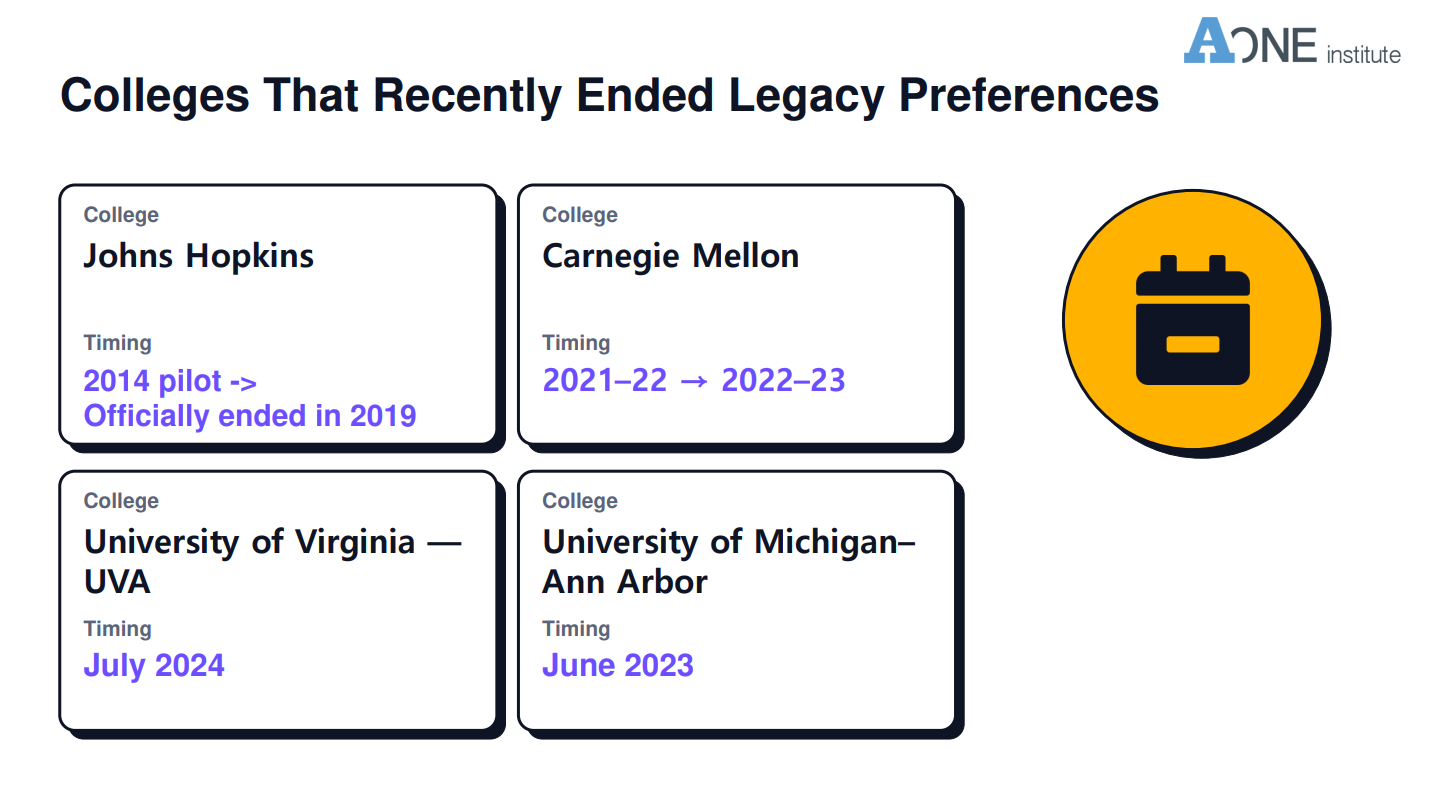
These changes demonstrate that legacy preferences are increasingly being questioned, even at academically prestigious institutions.
However, the movement has not been universal.
Some of the most recognizable universities in the United States have continued to consider legacy connections.
Why Do Some Top Universities Still Maintain Legacy Preferences?
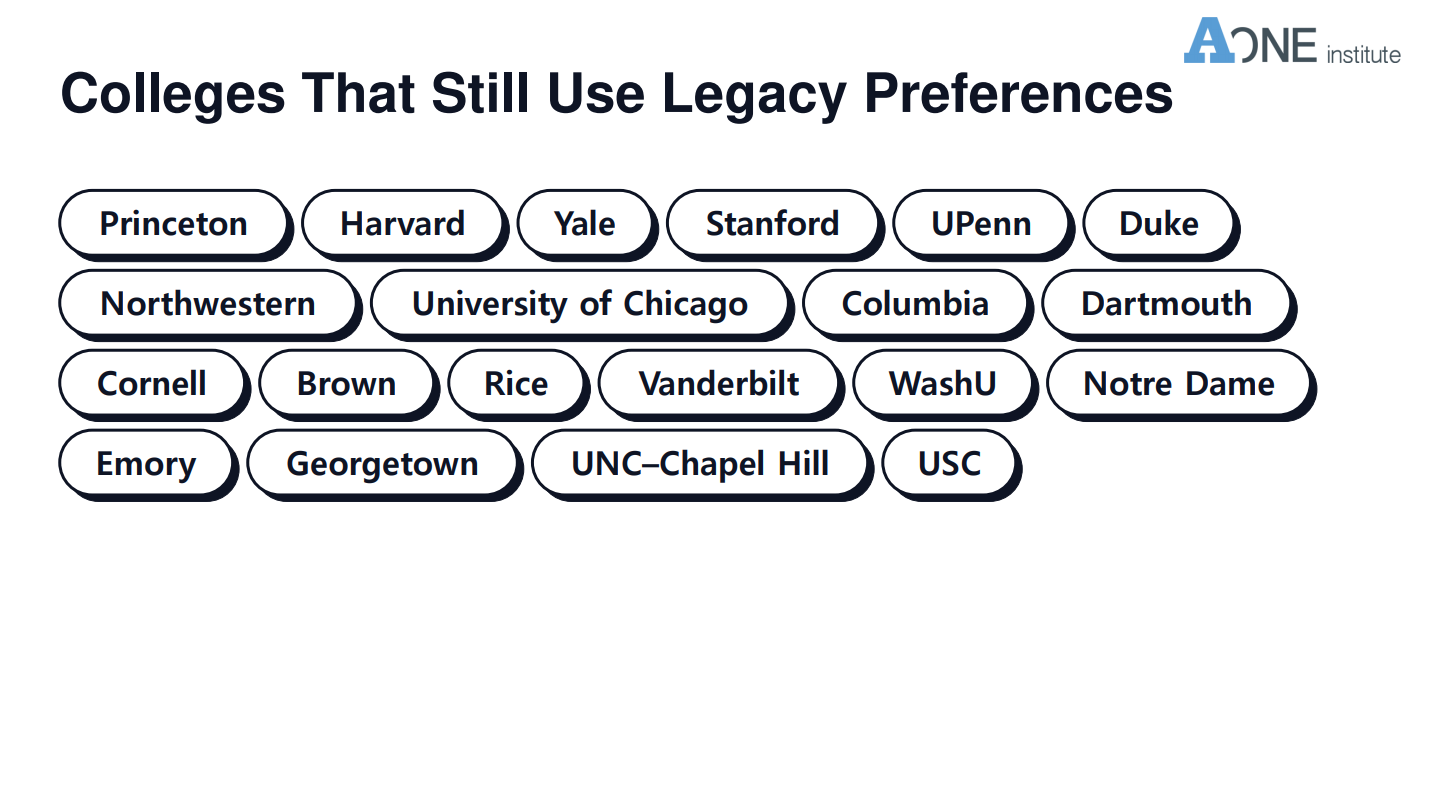
Universities such as Harvard, Princeton, Yale, Stanford, and several other selective private institutions have historically maintained legacy preferences.
Because policies can change, students should confirm each institution's current position rather than assuming every university follows the same practice.
Why would universities continue using a policy that faces so much criticism?
The answer becomes clearer when we consider what legacy preferences may provide from the university's perspective.
First, alumni relationships are important institutional assets.
Graduates maintain connections with their universities through events, professional networks, mentoring, and financial contributions.
These connections help universities preserve a sense of community across generations.
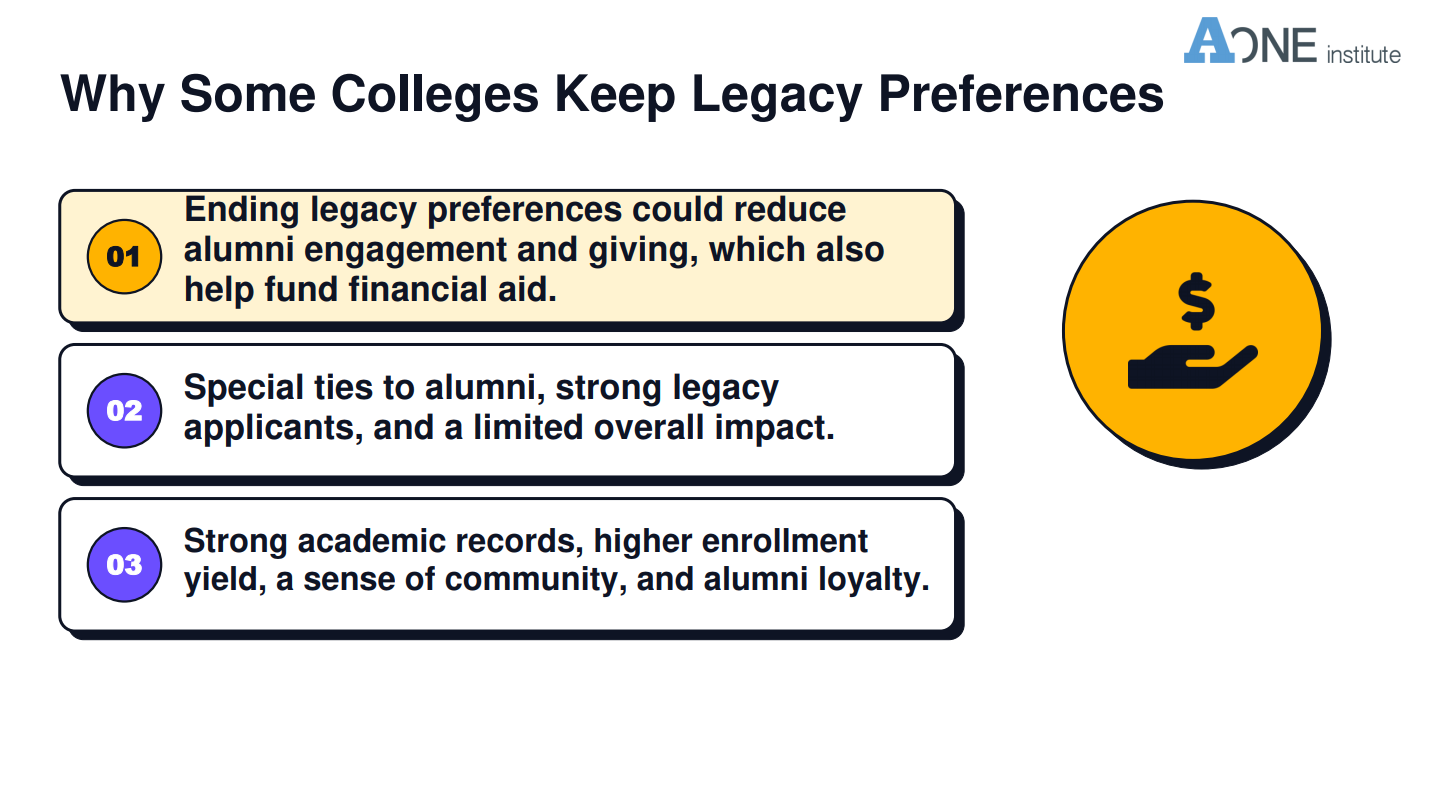
Second, alumni donations can contribute to scholarships, research, academic programs, and institutional operations.
If universities eliminate legacy preferences, some administrators may worry that alumni engagement and charitable giving could decline.
Third, legacy applicants may be perceived as having a particularly strong connection to the institution.
A student whose family has attended the same university may already be familiar with its academic environment, traditions, and community.
Universities may also view such applicants as more likely to enroll if admitted.
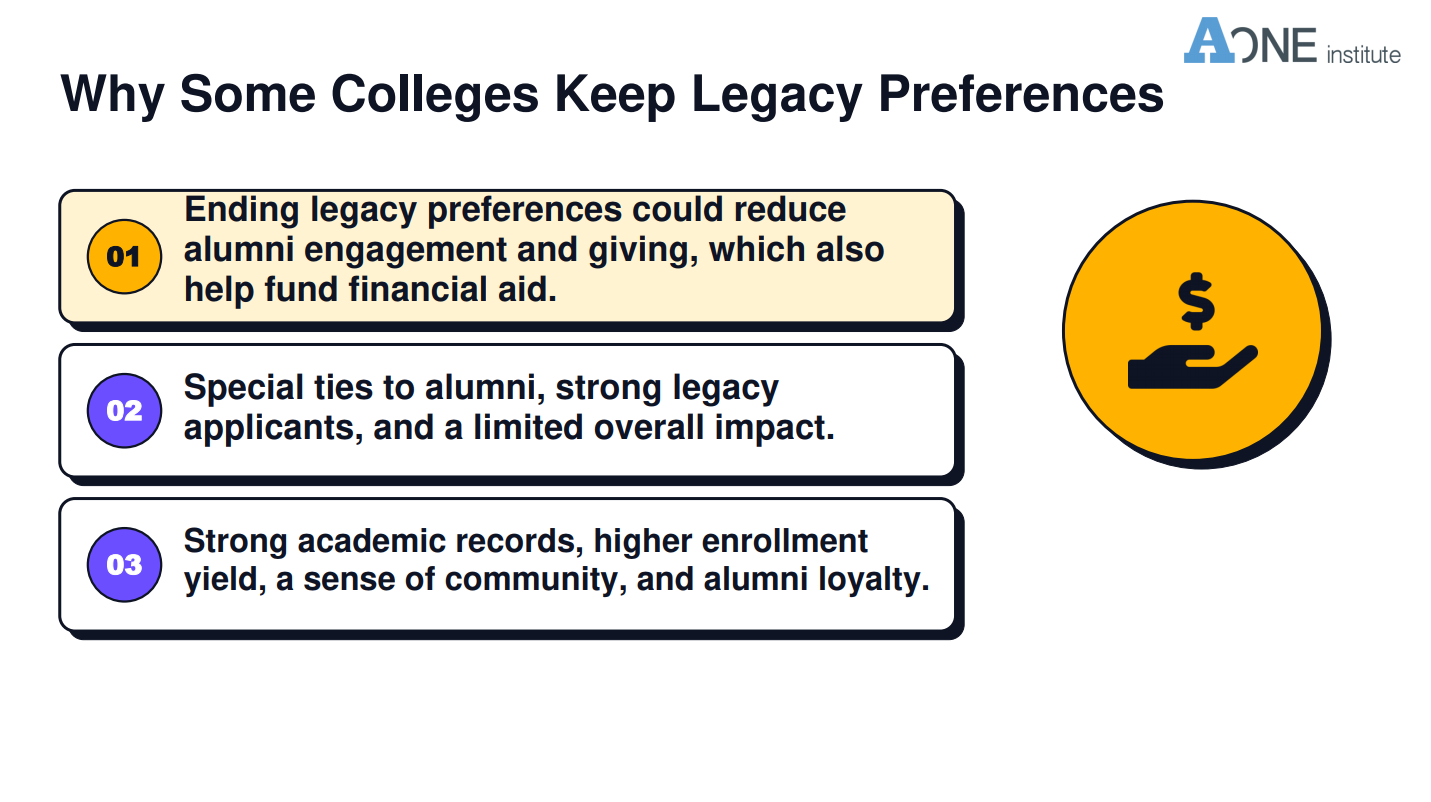
Some defenders of legacy admissions also point to the academic qualifications of legacy applicants, their enrollment rates, and their connection to the university community.
These arguments do not establish that all legacy students have stronger academic records or that family connections are reliable measures of individual merit.
However, they help explain why certain institutions remain reluctant to abandon the practice.
The issue becomes particularly interesting when we examine what universities might lose if legacy preferences disappear.
The Two Advantages Universities May Want to Preserve: Interest and Money
The government continues to pressure universities to reduce or eliminate legacy preferences.
Yet some institutions continue to maintain them.
Why?
A useful way to interpret the situation is to reduce the potential institutional advantages of legacy admissions to two major factors.
Interest and money.
The first is interest.
Universities want students who genuinely want to attend.
Students with established family connections may already know the university well and may be more likely to enroll if admitted.
From an enrollment-management perspective, that commitment is valuable.
The second is money.
Strong alumni relationships can support fundraising, institutional development, and long-term financial stability.
These two advantages help explain why eliminating legacy preferences may be more complicated than simply removing one admissions consideration.

Now consider the problem from a university's perspective.
If political pressure forces an institution to reduce legacy preferences, it may still want to preserve the advantages associated with those relationships.
The university still needs students who genuinely want to enroll.
It still needs reliable sources of financial support.
And it still needs ways to build lasting relationships with prospective students and alumni.
This leads to an important possibility.
Universities may gradually replace some of the functions associated with legacy admissions through alternative forms of student engagement and enrollment strategy.
They may not openly describe these changes as replacements for legacy preferences.
Nevertheless, when we examine recent admissions policies, several developments appear consistent with this possibility.
One of the clearest examples is Demonstrated Interest.
What Is Demonstrated Interest in College Admissions?
Demonstrated Interest, or DI, refers to actions through which students show that they are genuinely interested in attending a particular university.
Instead of simply saying that a school is their first choice, students demonstrate interest through direct engagement.
Examples include visiting campus, attending information sessions, communicating with admissions representatives, and participating in university events.
Not every university evaluates demonstrated interest.
Some schools explicitly state that they do not consider it.
However, Washington University in St. Louis recently made a notable change.
Why Is WashU Beginning to Consider Demonstrated Interest?
Starting with students applying for fall 2027 admission, WashU began considering demonstrated interest as part of its application review process.
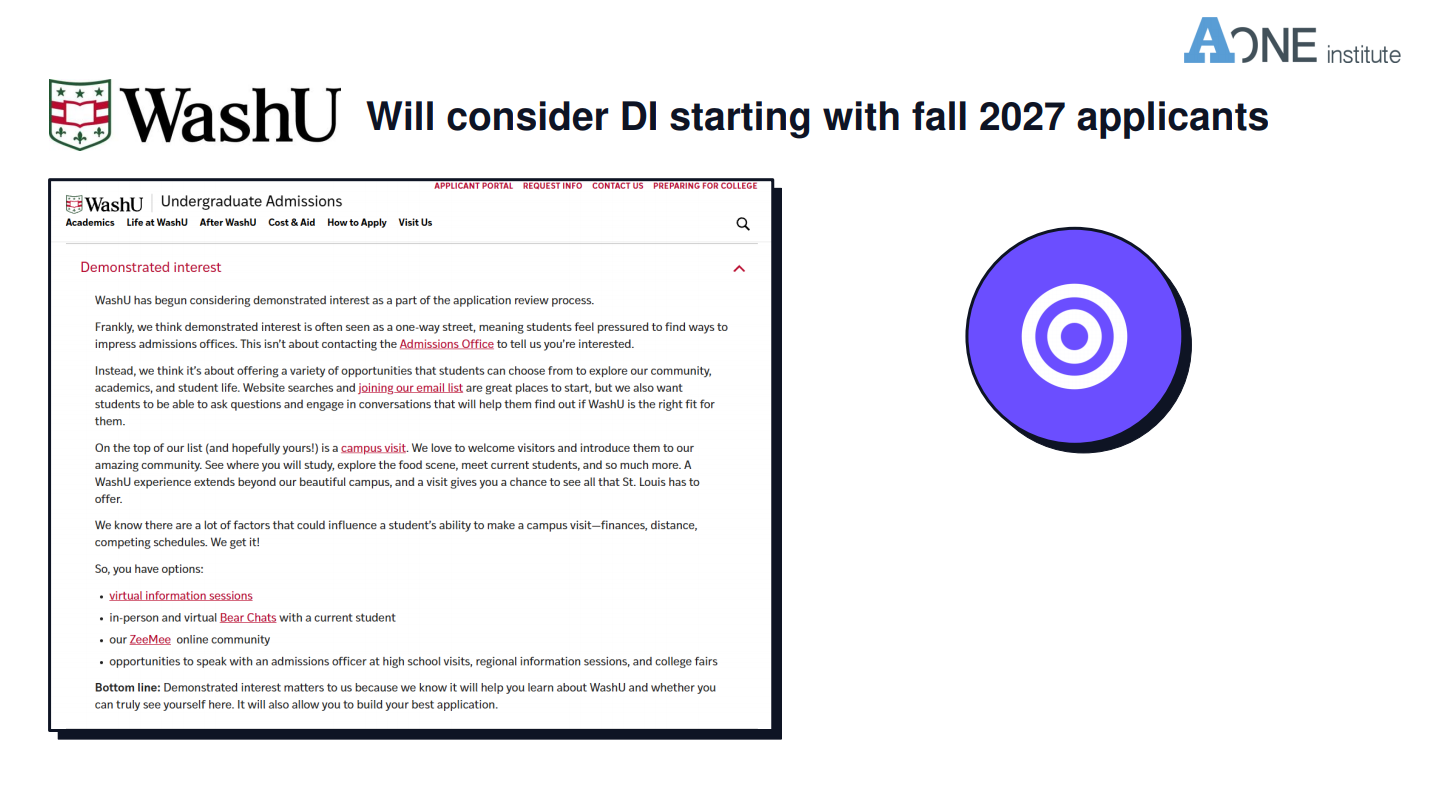
The university encourages prospective students to explore its academic environment and community through activities such as:
-
Joining its email list and reviewing university information.
-
Visiting campus.
-
Attending virtual information sessions.
-
Participating in conversations with current students.
-
Joining official online student communities.
-
Meeting admissions representatives at high schools, regional events, and college fairs.
WashU explains that these experiences help students determine whether the university is the right fit.
The university also makes clear that demonstrated interest is only a small part of its overall application evaluation.
Still, the change itself is significant.
A selective university has explicitly decided to consider the ways students engage with its community.
Viewed alongside the growing pressure against legacy admissions, this raises an interesting question.
Could demonstrated interest become an increasingly important alternative to the presumed institutional connection once associated with legacy applicants?
The possibility deserves attention.
Instead of relying on family history to indicate a student's attachment to the university, institutions may increasingly examine what students actually do to explore and connect with the school.
WashU's decision does not prove that demonstrated interest was introduced to replace legacy preferences.
But it illustrates how universities can formally recognize student engagement as part of admissions evaluation.
Another university has taken an even more unusual approach.
UChicago's ED0: A New Connection Between Summer Programs and College Admissions
The University of Chicago has introduced a special admission pathway known as Summer Student Early Notification (SSEN).
It is commonly referred to as ED0.
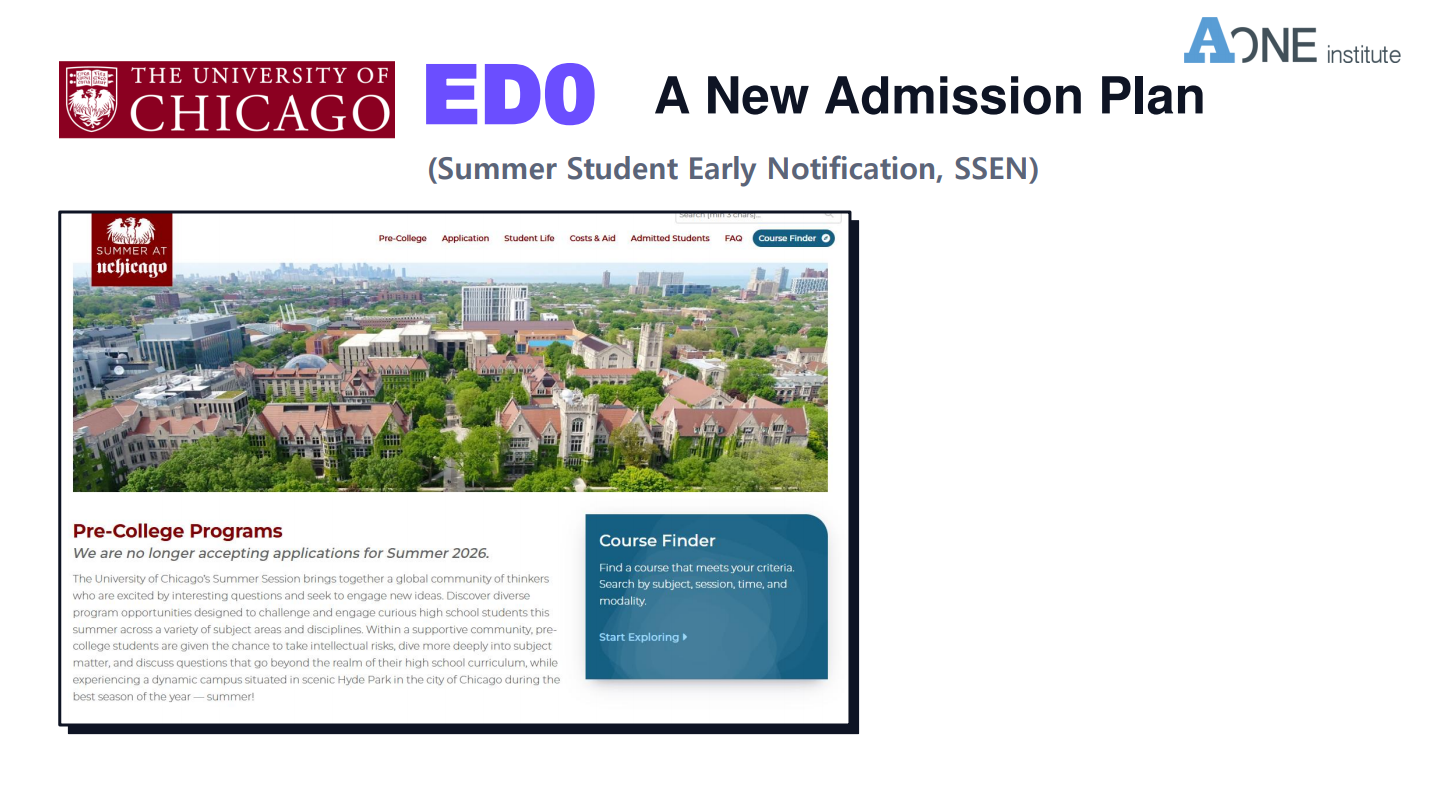
This option is available to students who participated in eligible UChicago Pre-College Summer Session programs or designated partner programs and are applying during their final year of high school.
Eligible students may apply between September 1 and October 15.
They can receive an admissions decision approximately three weeks after completing their application, or before November 1.
This is earlier than the standard decision timeline for many Early Decision applicants.
The program is also binding.
Students admitted through SSEN are expected to enroll under the applicable Early Decision agreement.
The significance is not simply that UChicago offers another early admission option.
The university has created a formal connection between participation in certain summer programs and access to a special undergraduate application pathway.
Previously, summer programs were often treated as educational experiences separate from undergraduate admissions.
Now, students who have participated in qualifying programs may receive an additional opportunity to apply earlier.
Of course, participation does not guarantee admission.
The student must still submit an application and undergo the university's admissions evaluation.
However, the connection between summer participation and admissions eligibility is meaningful.
Students who attend a university's programs may develop greater familiarity with its academic environment and community.
They may also become more certain that the university is their first choice.
From the university's perspective, these students have already established a relationship with the institution.
The program therefore creates a potential advantage for both sides.
Students receive earlier notification, while the university has an opportunity to evaluate applicants who have already demonstrated substantial engagement.
This raises another possibility.
If UChicago can successfully connect pre-college participation with an early admission pathway, why wouldn't other universities consider developing similar options?
Will Universities Gradually Replace Legacy Preferences With New Forms of Engagement?
Legacy admissions is unlikely to disappear from every university immediately.
Some institutions may continue to value the alumni relationships and traditions associated with the practice.
However, continued political pressure may encourage universities to demonstrate that they are reducing their reliance on legacy preferences.
At the same time, they still need ways to identify students who are committed to attending.
One likely direction is to expand opportunities for students to demonstrate genuine interest.
These opportunities already exist in many forms.
Students can participate in official campus tours, open houses, major-specific academic events, online information sessions, webinars, and college fairs.
They can also communicate with current students and admissions representatives.
Summer programs and pre-college experiences provide another way for students to become familiar with an institution.
And among application options, binding Early Decision can be one of the clearest signals that a university is the student's first choice.
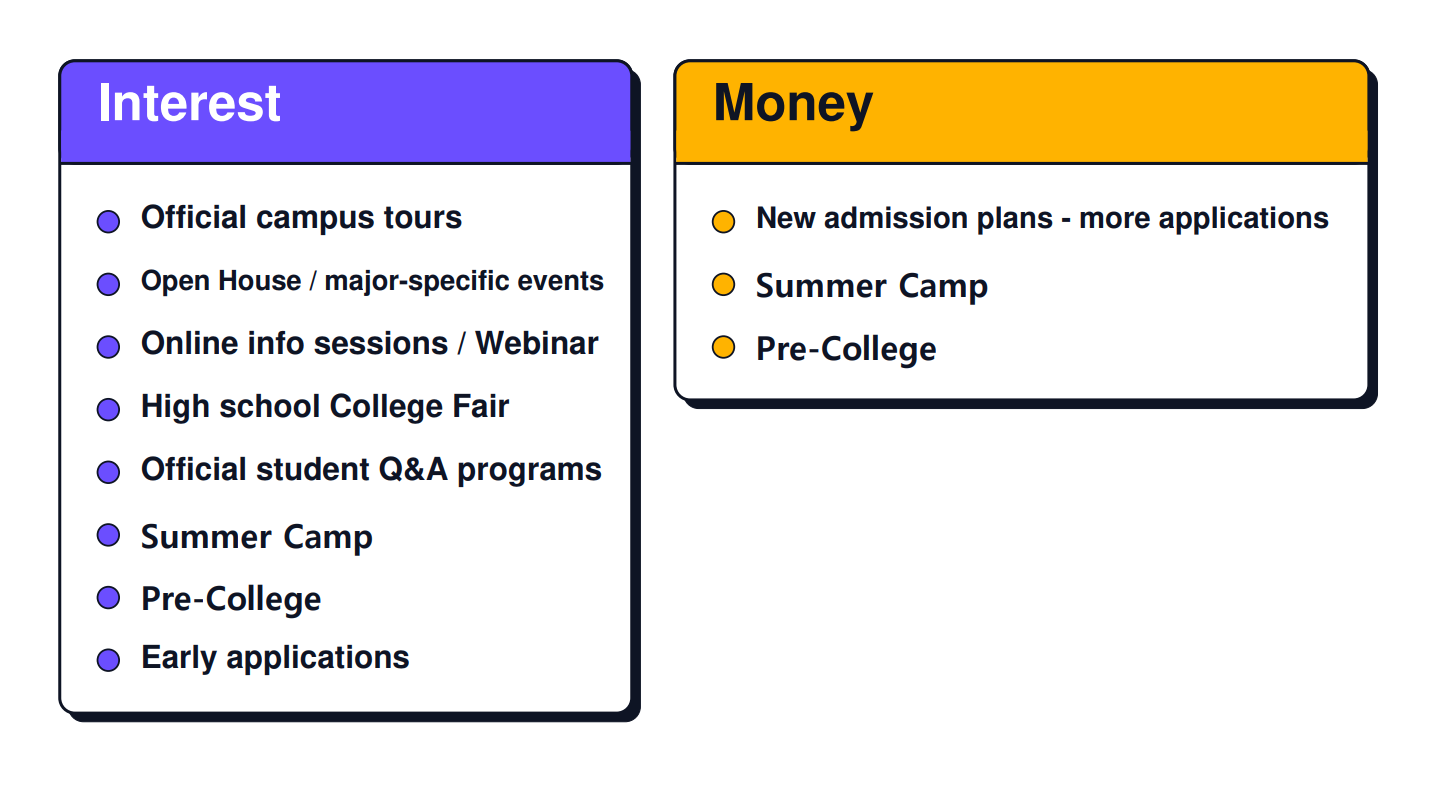
These forms of engagement do not necessarily provide the same admissions benefit.
Their significance depends on each university's policies.
However, together they reveal several ways universities can build stronger connections with prospective students.
The financial side of the equation is also worth examining.
Universities have recently introduced new admission plans, expanded existing early application options, and continued developing summer and pre-college programs.
These changes may offer benefits beyond the immediate educational experience.
Why Are Universities Introducing More Early Admission Options?
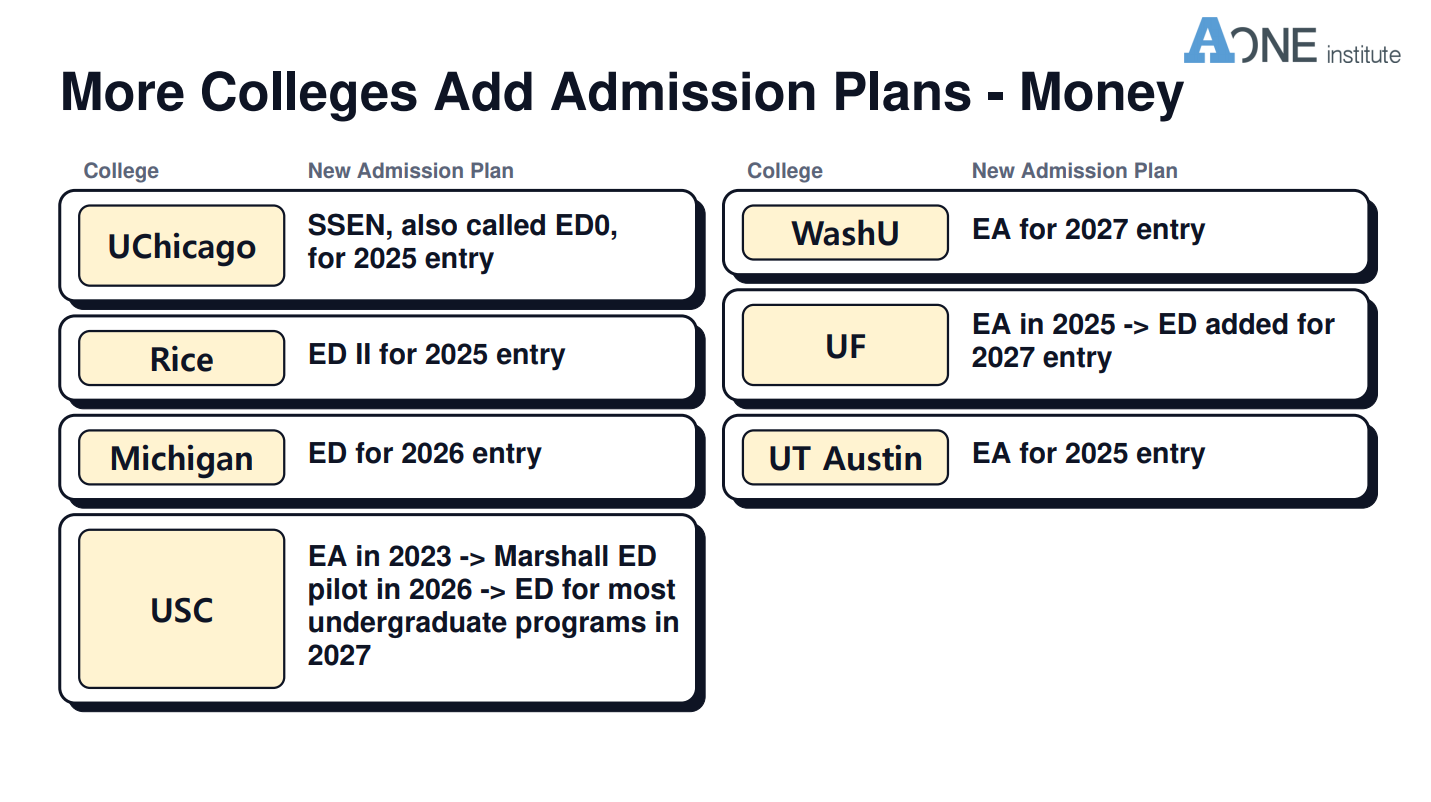
Several institutions have recently expanded their undergraduate application pathways.
Examples include:
| University | Admission plan development |
|---|---|
| UChicago | Summer Student Early Notification (SSEN), also called ED0 |
| Rice University | Added Early Decision II for the 2025 entering class |
| University of Michigan | Introduced Early Decision for fall 2026 applicants |
| USC | Expanded Early Decision to most undergraduate programs for fall 2027 applicants |
| WashU | Added Early Action for fall 2027 applicants |
| University of Florida | Added a binding Early Decision option |
| UT Austin | Introduced Early Action beginning with the 2024–2025 application cycle |
The official reasons for these changes differ.
Some universities want to give students more flexibility.
Others want to provide earlier decisions or make enrollment planning more predictable.
But additional admission pathways may also create institutional benefits.
Early Decision can help universities identify students who have made a strong enrollment commitment.
A larger number of application options may encourage additional students to apply.
Where application fees are charged, more applications may generate additional revenue, although fee waivers and administrative costs affect the actual financial impact.
A larger applicant pool may also reduce a university's reported acceptance rate if the number of available seats remains relatively stable.
Lower acceptance rates are sometimes interpreted by the public as indicators of greater selectivity.
There is therefore a potential relationship between application strategy, enrollment management, institutional reputation, and finances.
None of this means that universities introduce new application plans exclusively to make money.
However, financial considerations may be more important than they initially appear.
The same reasoning becomes particularly interesting when applied to summer programs.
Do Summer Programs Actually Help Students Get Into Top Universities?
For many years, students and parents have been warned not to assume that attending an expensive university summer program improves their chances of admission.
That warning remains valid.
Stanford, for example, explicitly states that attending Stanford Summer Session does not guarantee or increase a student's chances of admission to its undergraduate programs.
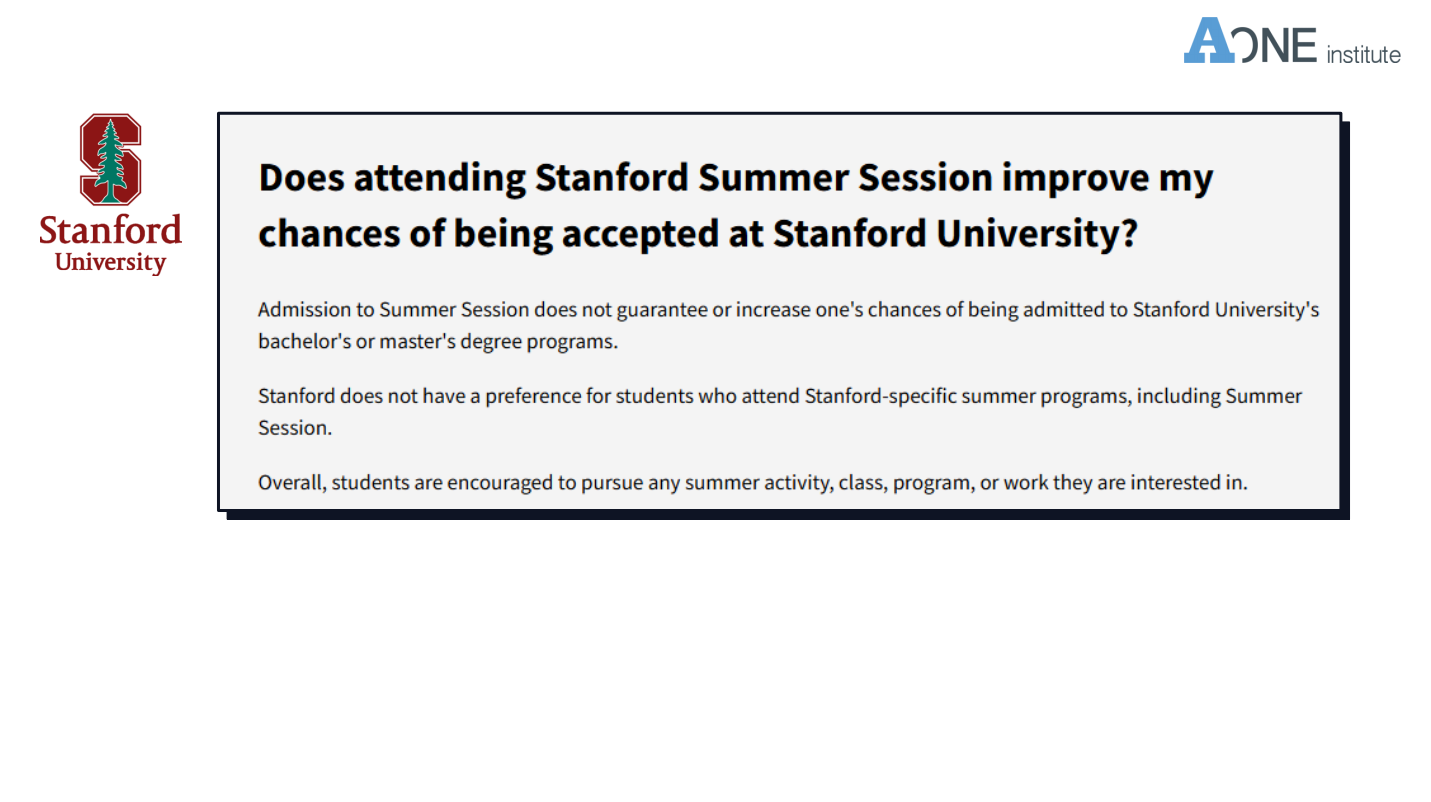
Other universities have communicated similar cautions.
The distinction between a highly selective academic program and a general paid pre-college experience is important.
Some summer programs require strong academic performance, competitive applications, recommendations, advanced coursework, or meaningful research experience.
Others are primarily designed to provide academic enrichment for students who meet general eligibility requirements and can pay the tuition.
Simply attending a program at a prestigious university does not automatically make the experience an outstanding extracurricular achievement.
Nevertheless, the changing admissions environment raises a new question.
Could summer programs become more strategically important as universities face growing pressure to reduce legacy preferences?
Why Summer Programs May Become More Important Than Before
Consider the two institutional priorities discussed earlier.
Interest and money.
Summer programs may serve both purposes.
A student who applies to a university-sponsored summer program is taking a concrete step toward engaging with that institution.
If the student attends, they may become familiar with its academic environment, campus, faculty, and community.
That experience can help the student determine whether the university is a suitable choice.
It can also establish a relationship between the student and the institution before the undergraduate application process begins.
From the financial perspective, paid summer programs may provide universities with additional sources of revenue.
They also create opportunities to communicate with prospective students and their families.
The combination is particularly interesting because it resembles the two advantages traditionally associated with legacy relationships.
A university wants prospective students who are familiar with the institution and genuinely interested in attending.
It also needs sufficient financial resources to support its operations.
As universities face pressure to reduce legacy preferences, summer programs may become increasingly attractive as part of a broader student-engagement strategy.
There is another possible consideration.
A student who performs well academically and participates in a substantial paid university program may appear to have both strong academic preparation and a demonstrated willingness to invest in exploring that institution.
Whether universities would treat such participation as a financial indicator in undergraduate admissions is another matter.
At need-blind institutions, a student's ability to pay is not supposed to determine admission decisions, and there is no established evidence that attending an expensive program improves admission chances because the family may be able to pay full tuition.
That distinction should not be ignored.
Still, summer programs can combine educational engagement, institutional familiarity, and financial activity in ways that other extracurricular experiences do not.
This creates a plausible reason why universities may devote greater attention to summer programs as their admissions strategies evolve.
UChicago's SSEN pathway makes the possibility especially interesting.
WashU's new demonstrated interest policy provides another signal that student engagement is receiving explicit attention.
Together, these changes suggest a potential direction worth monitoring.
Will Other Universities Introduce Their Own ED0 Programs?
UChicago has already demonstrated that participation in a qualifying pre-college program can provide eligibility for a distinct undergraduate application pathway.
Over the next two to three years, other universities may experiment with similar arrangements.
They may not use the name ED0.
Some may create different early application options.
Others may establish programs connecting high school academic experiences with opportunities to engage more directly with undergraduate admissions.
The precise outcome is uncertain.
However, once a successful model exists, it becomes easier for other institutions to consider variations.
This is why changes in university summer programs should be monitored alongside changes in undergraduate admissions policies.
The two areas may become more closely connected than students previously expected.
Should Students Start Applying to More Summer Programs?
The first priority should still be academically rigorous and highly selective summer opportunities.
Programs offering advanced coursework, meaningful research, competitive selection, and substantial intellectual challenges remain valuable.
Many excellent programs also provide scholarships, financial assistance, or funded participation.
Those opportunities should continue to receive strong consideration.
However, the possibility that universities may increasingly emphasize student engagement suggests that paid university-affiliated programs should not automatically be dismissed.
This represents a shift in how summer planning may need to be approached.
Previously, families were often advised to avoid assigning admissions value to paid pre-college programs.
That remains appropriate when a program offers little academic substance and no recognized admissions benefit.
But there may now be reasons to consider certain programs more seriously.
A student genuinely interested in a university could benefit from experiencing its academic environment, developing stronger institutional familiarity, and participating in opportunities that align with the student's academic interests.
If the institution also has a formal demonstrated interest policy or a special application pathway connected to program participation, those details become relevant to the decision.
The recommendation is not to spend money simply to appear interested.
It is to consider whether one or two carefully selected programs could provide meaningful academic experience and worthwhile engagement with universities the student genuinely hopes to attend.
How Should Students Evaluate Summer Programs by Tier?
Summer programs can be organized by academic intensity, selectivity, and educational purpose.
One useful internal classification separates programs into three tiers.
[Insert PDF Page 21 – Summer Program Tier Distribution by Field]
| Tier | General characteristics | Number of programs |
|---|---|---|
| Tier 1 | Highly selective and academically intensive programs | 30 |
| Tier 2 | Advanced programs offering substantial academic depth | 51 |
| Tier 3 | Coursework, exploration, and skill-building programs | 30 |
| Total | 111 |
Nine additional programs on hold are excluded from this classification.
These tiers are an internal evaluation framework rather than official rankings issued by universities.
They also do not mean that every Tier 1 program is free or that Tier 3 programs are inappropriate for academically strong students.
The best choice depends on the student's academic background, interests, preparation, and goals.
With that distinction in mind, the following programs provide a starting point for further research.
Mathematics Summer Programs
Students with strong mathematical interests can begin by examining programs known for demanding coursework and advanced problem-solving.
Examples in Tier 1 include:
-
Ross Mathematics Program
-
Stanford University Mathematics Camp (SUMaC)
-
Program in Mathematics for Young Scientists (PROMYS)
-
Canada/USA Mathcamp
-
MathILy
-
Hampshire College Summer Studies in Mathematics (HCSSiM)
Tier 2 examples include AwesomeMath, MathPath, MIT MathROOTS, and other specialized mathematics programs.
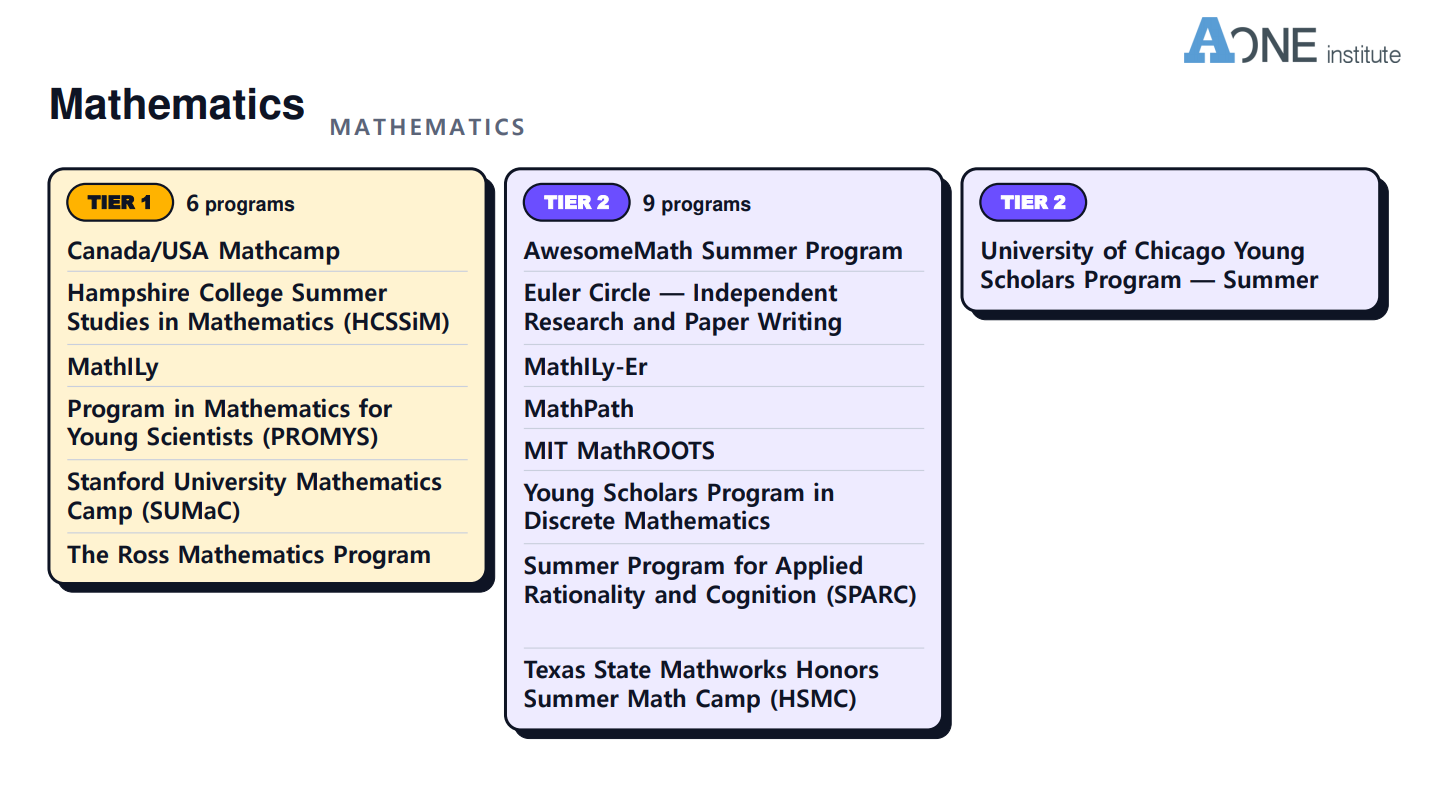
These programs vary in structure, selectivity, cost, and academic expectations.
Students should review each program's curriculum and admission requirements before deciding where to apply.
Science and Research Summer Programs
Students interested in science and research have a wide range of options.
Examples in Tier 1 include:
-
Research Science Institute (RSI)
-
Rockefeller Summer Science Research Program (SSRP)
-
Simons Summer Research Program
-
Stanford Institutes of Medicine Summer Research Program (SIMR)
-
Summer Science Program (SSP)
-
Governor's School in the Sciences
-
Anson L. Clark Scholars Program
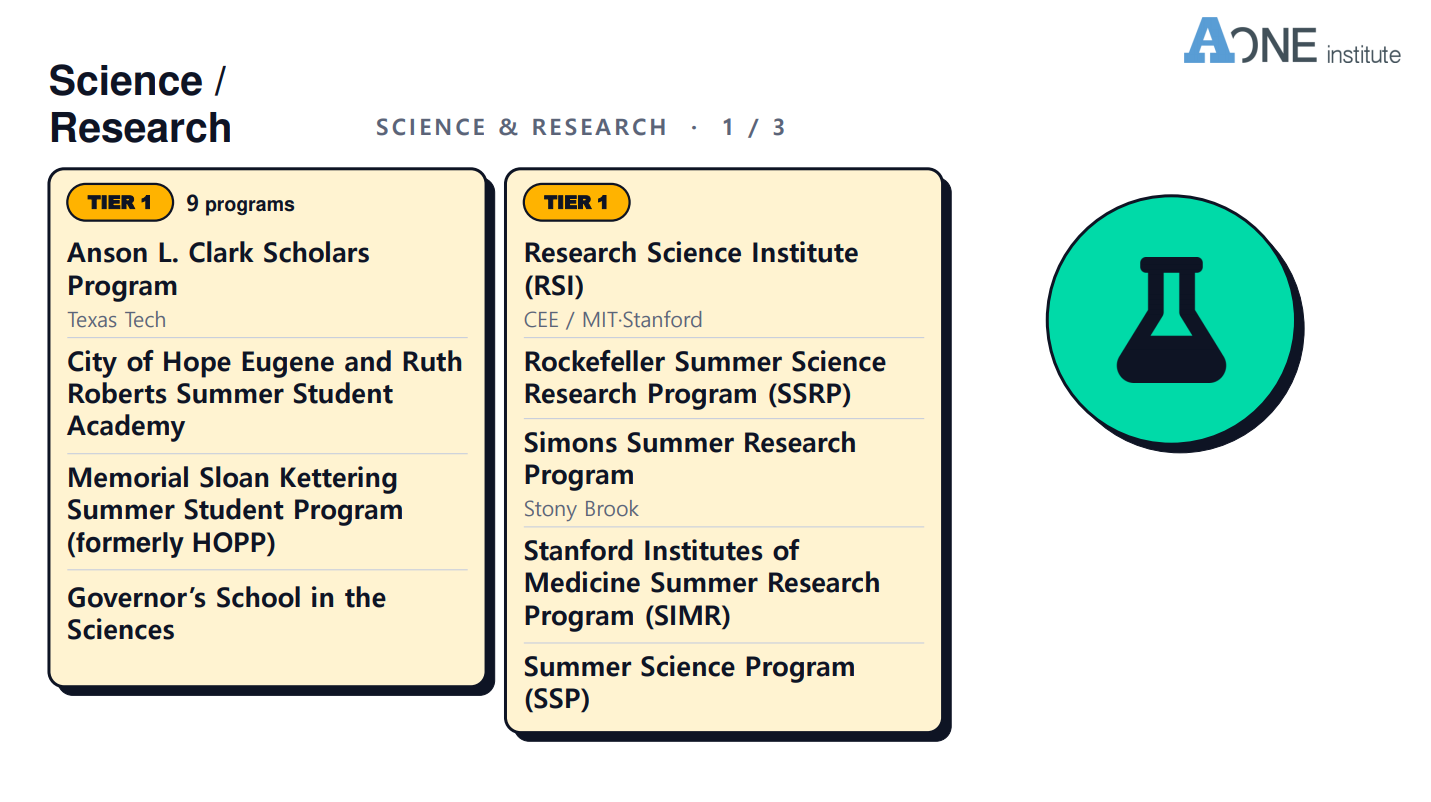
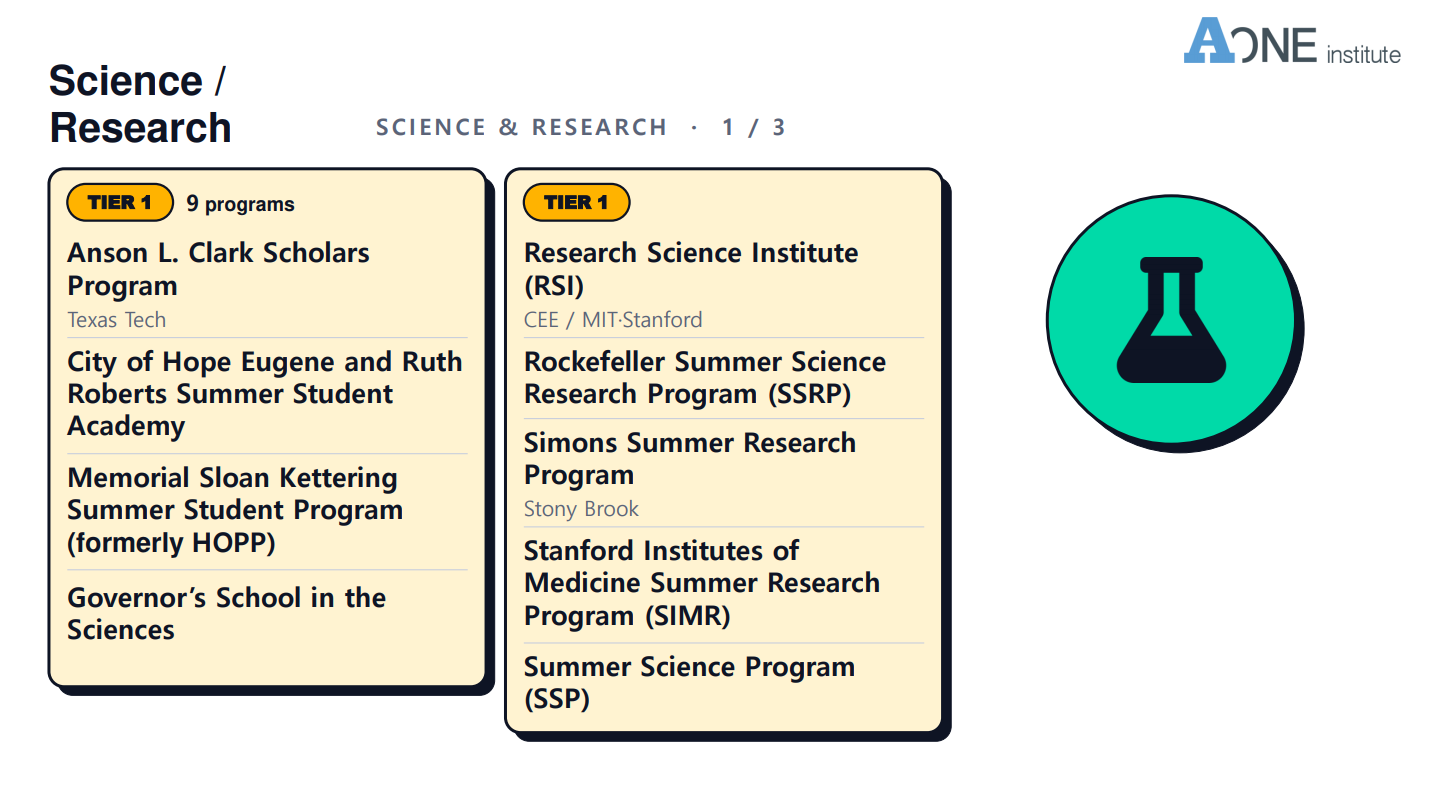
Tier 2 includes programs associated with Boston University, Broad Institute, Fred Hutch, George Mason University, UC Davis, Rutgers, and other research institutions.
Additional opportunities include the UC Santa Barbara Research Mentorship Program, UC Santa Cruz Science Internship Program, and programs associated with the University of Iowa and other institutions.
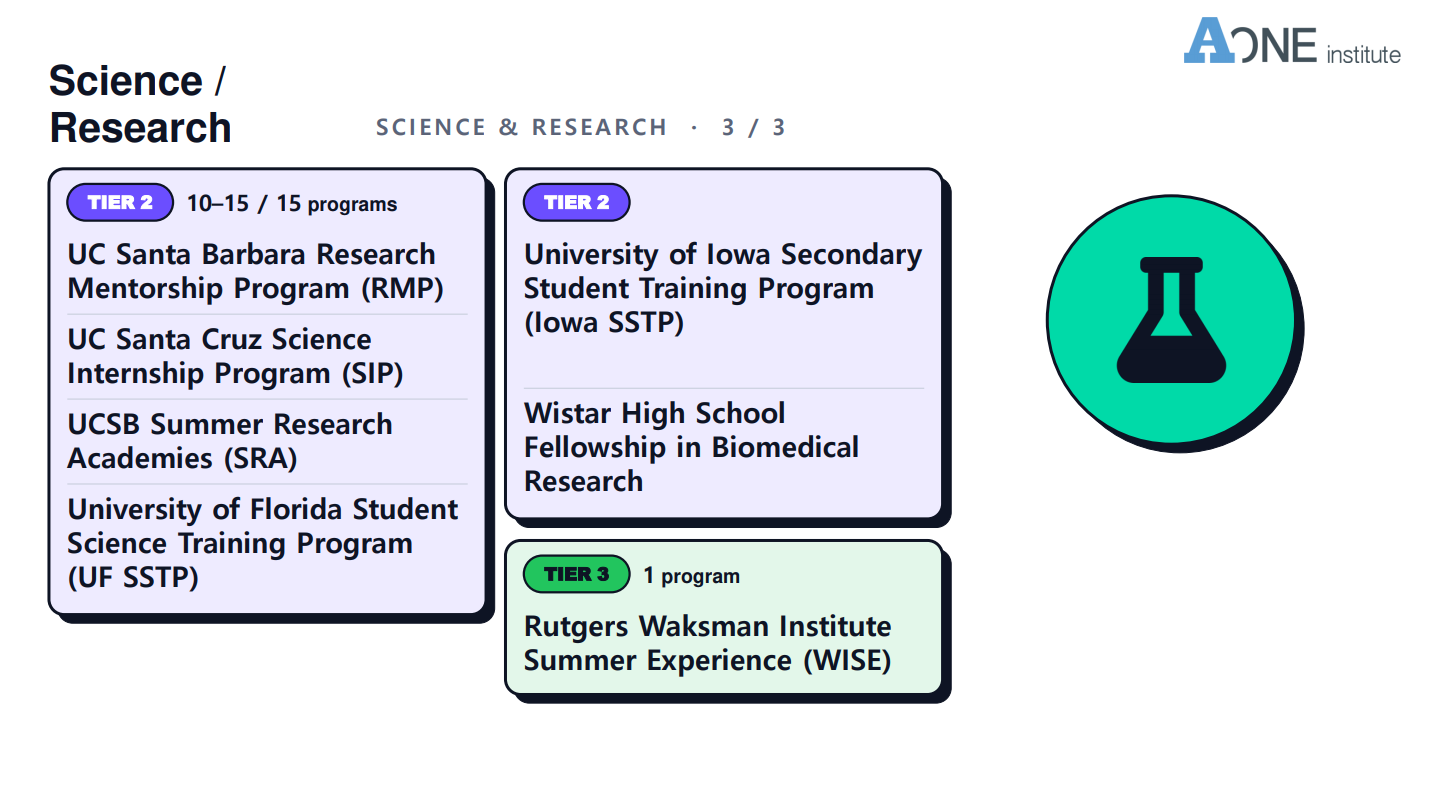
When evaluating research programs, students should consider the actual research responsibilities, mentorship structure, academic expectations, and selection criteria.
Engineering and STEM Summer Programs
Engineering-focused students can examine programs emphasizing applied science, technical problem-solving, and research.
Tier 1 examples include:
-
Carnegie Mellon Summer Academy for Math and Science (SAMS)
-
MIT Beaver Works Summer Institute (BWSI)
-
MITES Summer
-
New Jersey Governor's School of Engineering & Technology
Tier 2 includes COSMOS, Engineering Summer Academy at Penn, Cooper Union Summer STEM, and NASA-funded SEES.
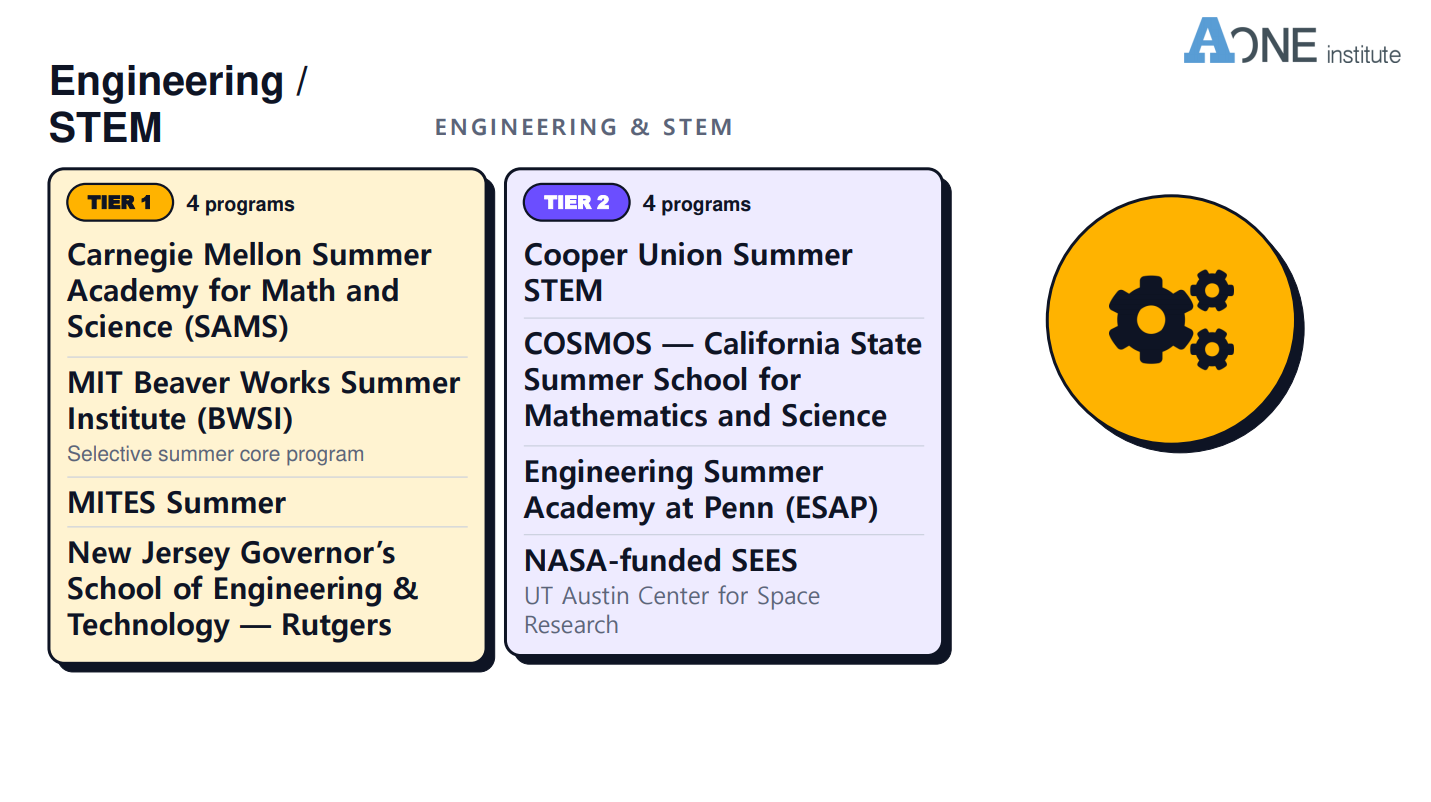
Students should check whether the programs match their intended engineering interests and whether they satisfy the academic prerequisites.
Computer Science and AI Summer Programs
Students interested in computer science or artificial intelligence can explore:
-
Carnegie Mellon AI Scholars
-
Carnegie Mellon CS Scholars
-
Stanford AI4ALL
-
Wolfram High School Summer Research Program
-
Girls Who Code Pathways
-
Kode With Klossy
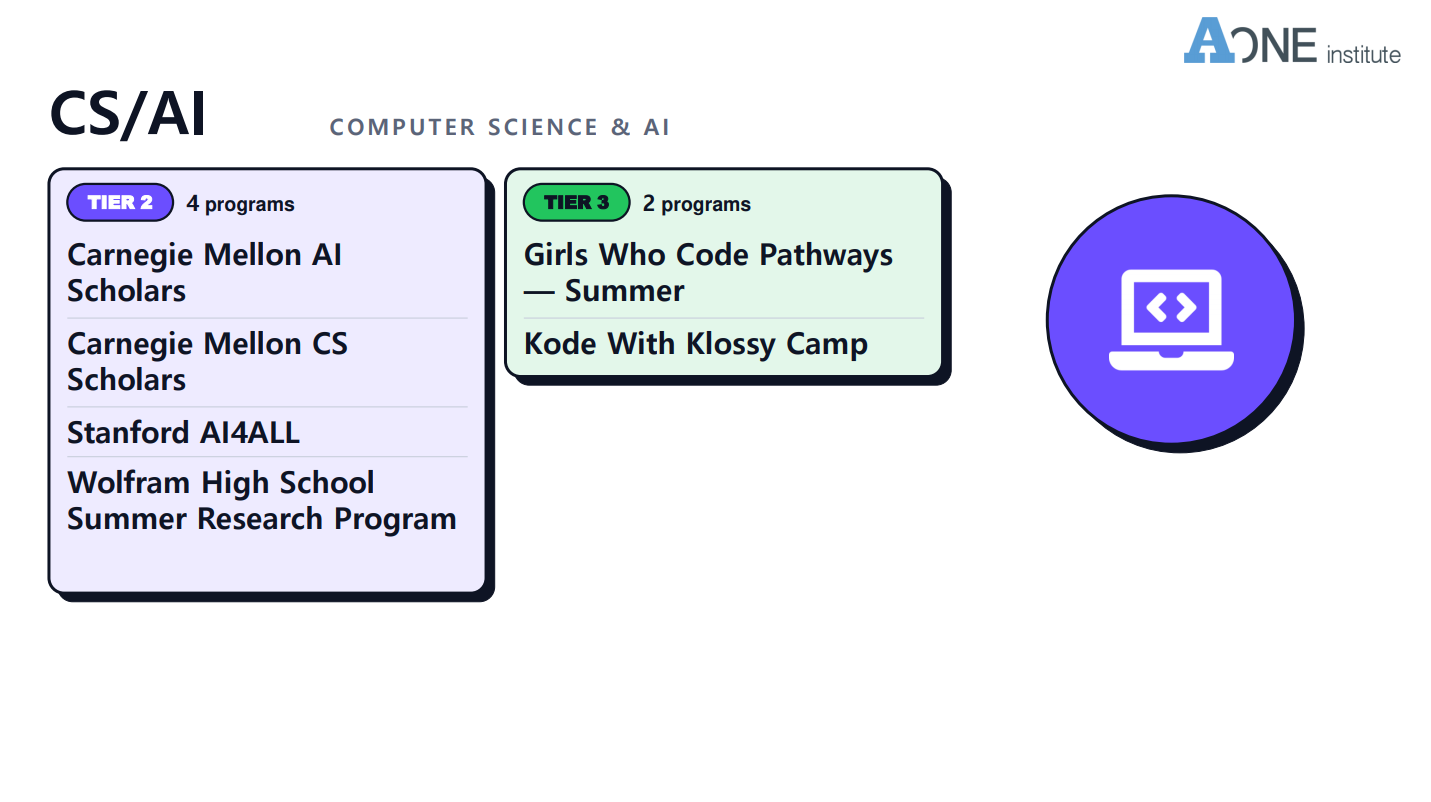
Some programs emphasize foundational technical skills, while others focus on advanced topics or research experiences.
The most suitable program depends on the student's current level and academic direction.
Humanities and Leadership Summer Programs
Humanities and leadership opportunities should not be overlooked.
Examples include:
-
LEDA Scholars Summer Institute
-
National Security Language Initiative for Youth (NSLI-Y)
-
University of Notre Dame Leadership Seminars
-
Camp Rising Sun
-
Yale Young Global Scholars
-
USC Bovard Scholars
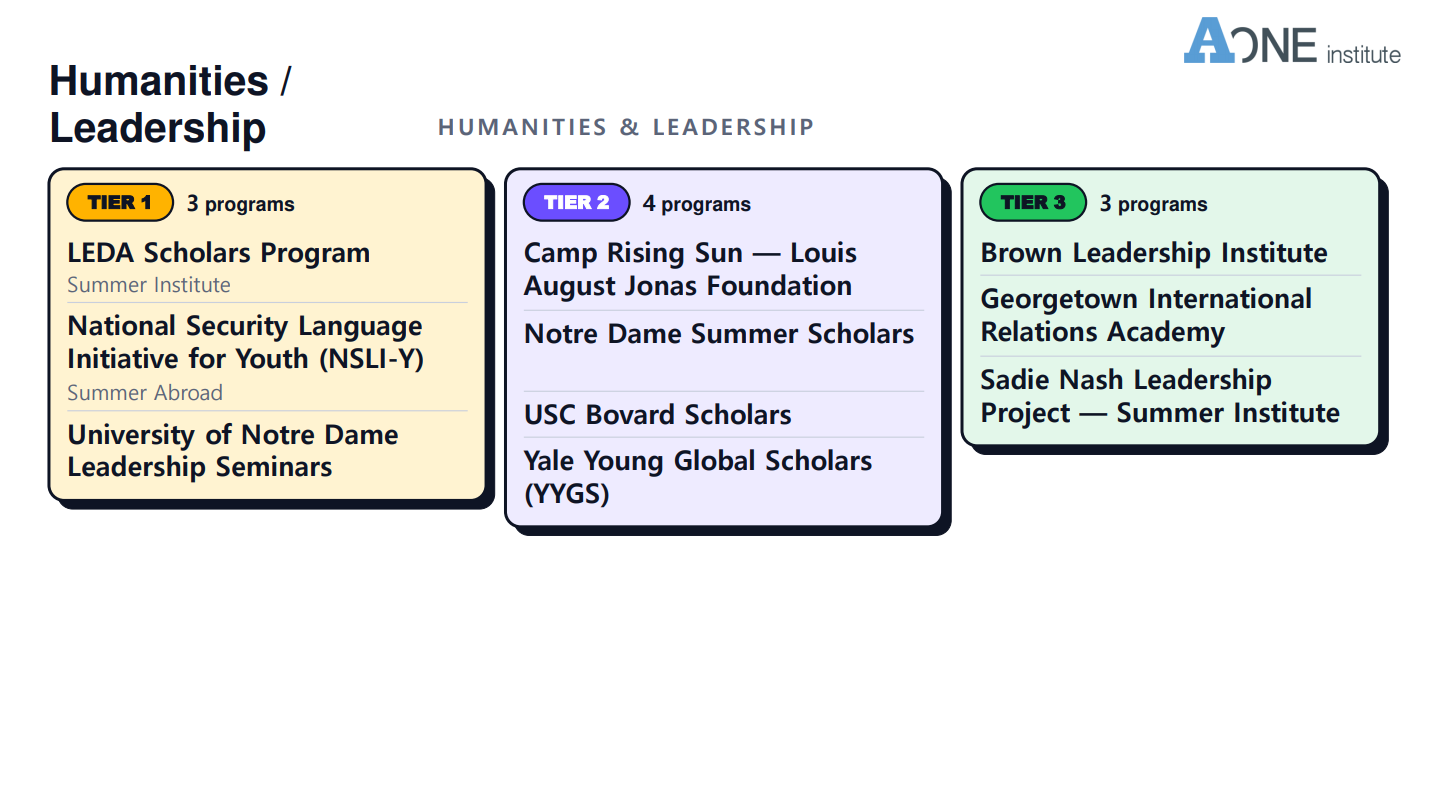
These programs offer different forms of intellectual exploration, leadership development, and community engagement.
Students should examine which experiences genuinely support their interests.
Business and Economics Summer Programs
Students interested in economics, business, and entrepreneurship can consider programs such as:
-
Penn Management & Technology Summer Institute
-
Economics for Leaders
-
LaunchX Entrepreneurship Program
-
Wharton Leadership in the Business World
-
Babson Academy Summer Study
-
Wharton Essentials of Entrepreneurship
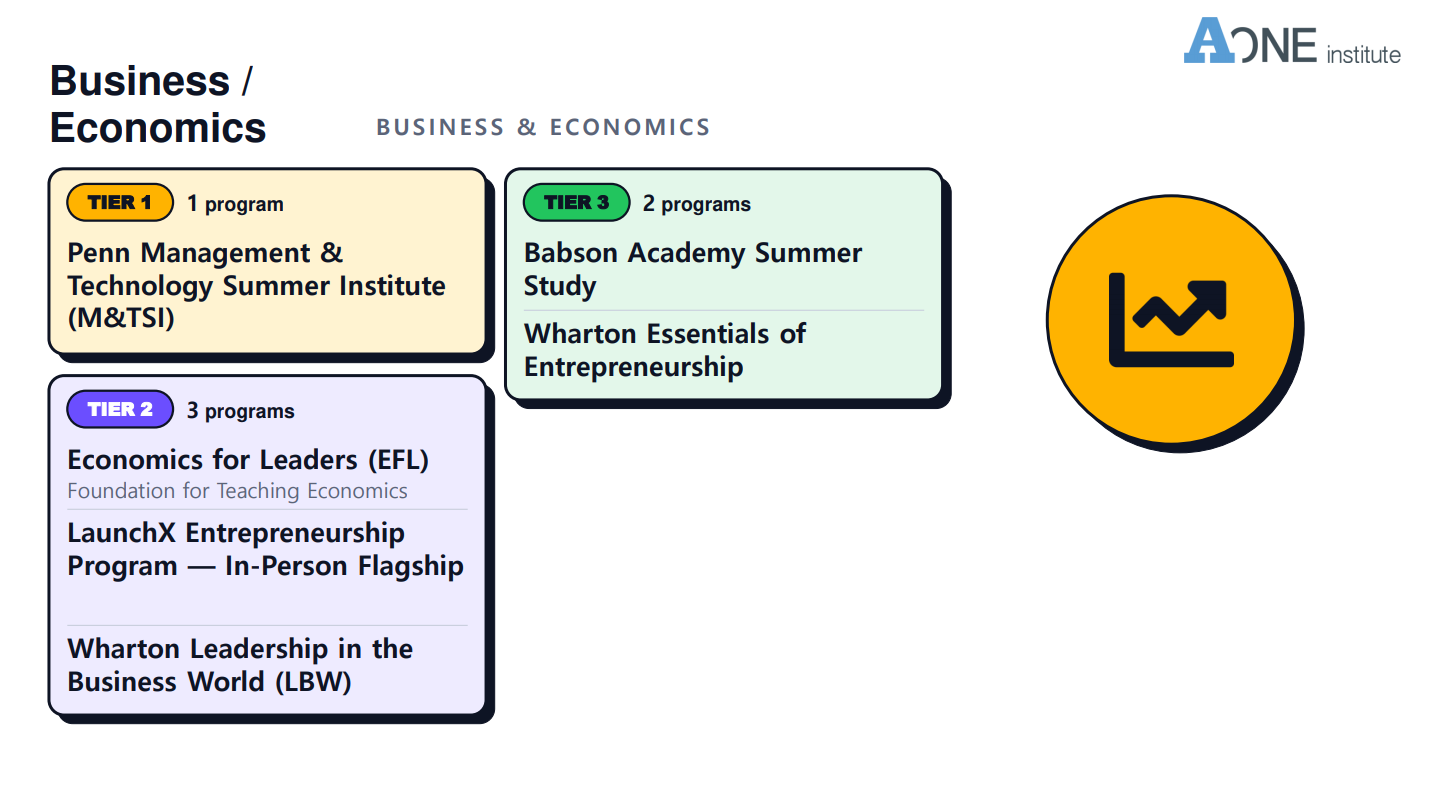
Students should review the curriculum and determine whether the program focuses on academic economics, entrepreneurship, leadership, or practical business development.
Writing and Journalism Summer Programs
Writing and journalism opportunities include:
-
Princeton Summer Journalism Program
-
Iowa Young Writers' Studio
-
AAJA JCamp
-
The Adroit Journal Summer Mentorship Program
-
Kenyon Review Young Writers Workshops
-
Sewanee Young Writers' Conference
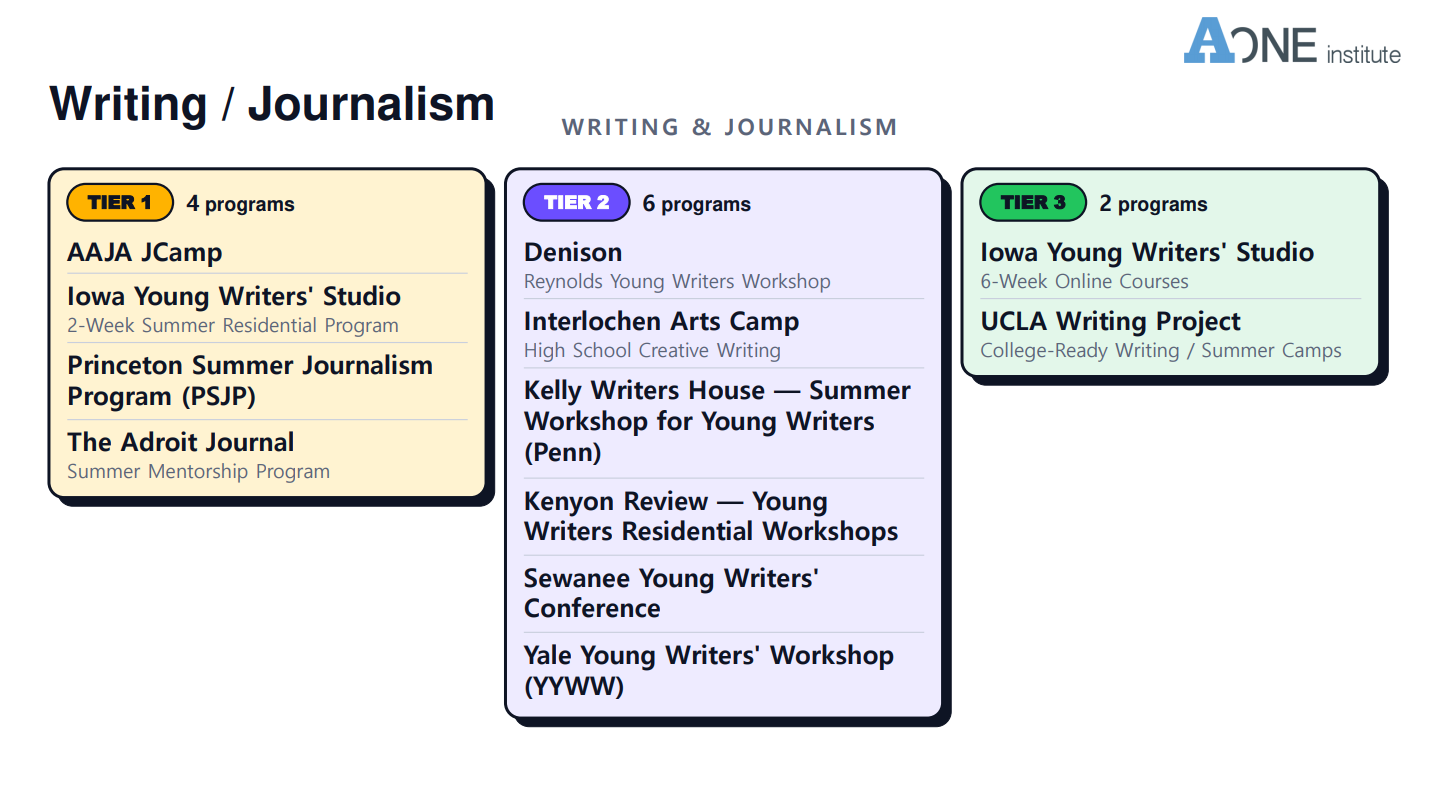
These programs can help students develop writing skills, receive feedback, and engage with specialized forms of creative or journalistic work.
Arts and Music Summer Programs
Students pursuing arts and music can explore opportunities such as Carnegie Hall's National Youth Orchestra programs, Juilliard Summer Dance Intensive, Boston University Tanglewood Institute, and various university-based arts programs.
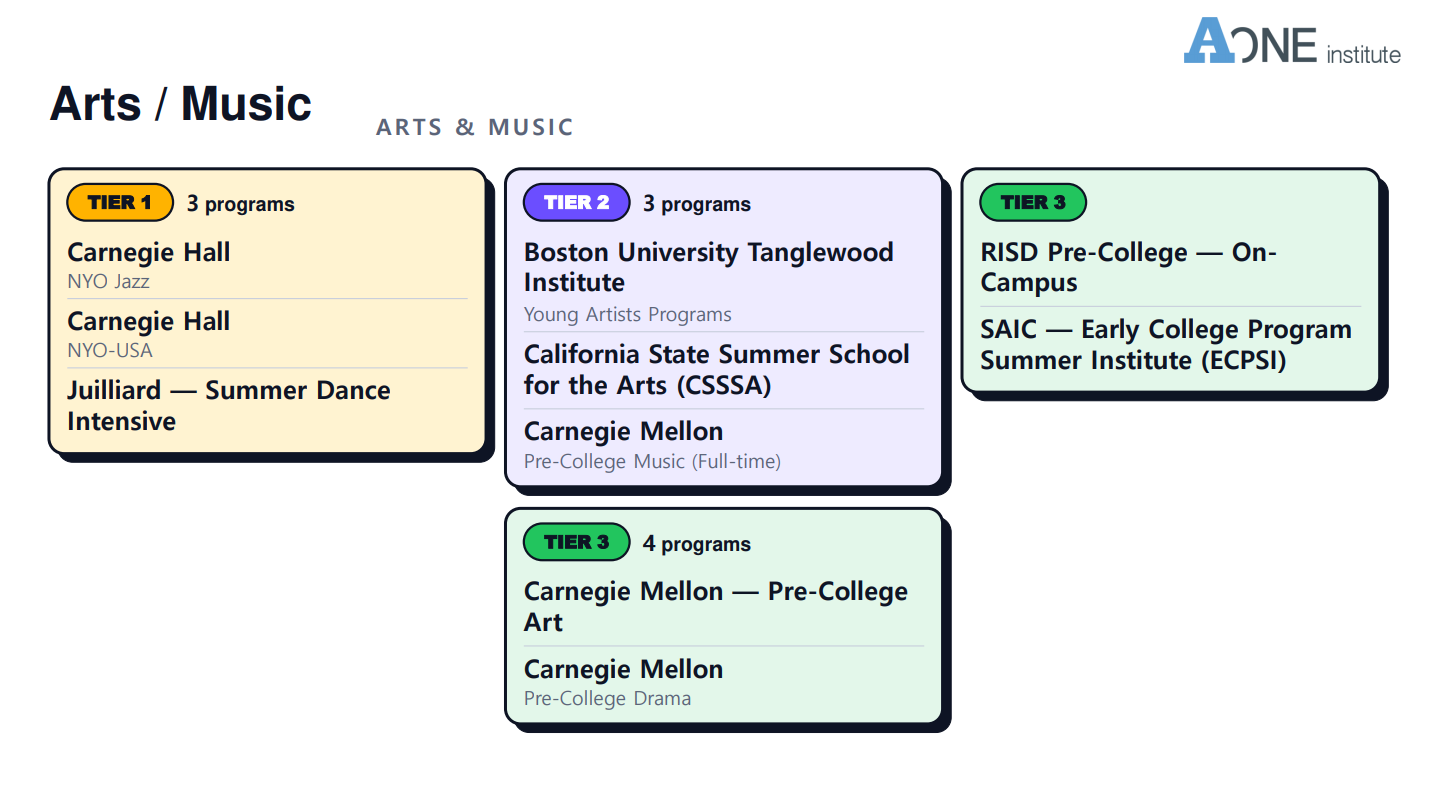
Selection should depend on the student's artistic discipline, existing training, and the nature of the program.
Additional Summer Programs Worth Exploring
Summer opportunities extend well beyond mathematics, science, and engineering.
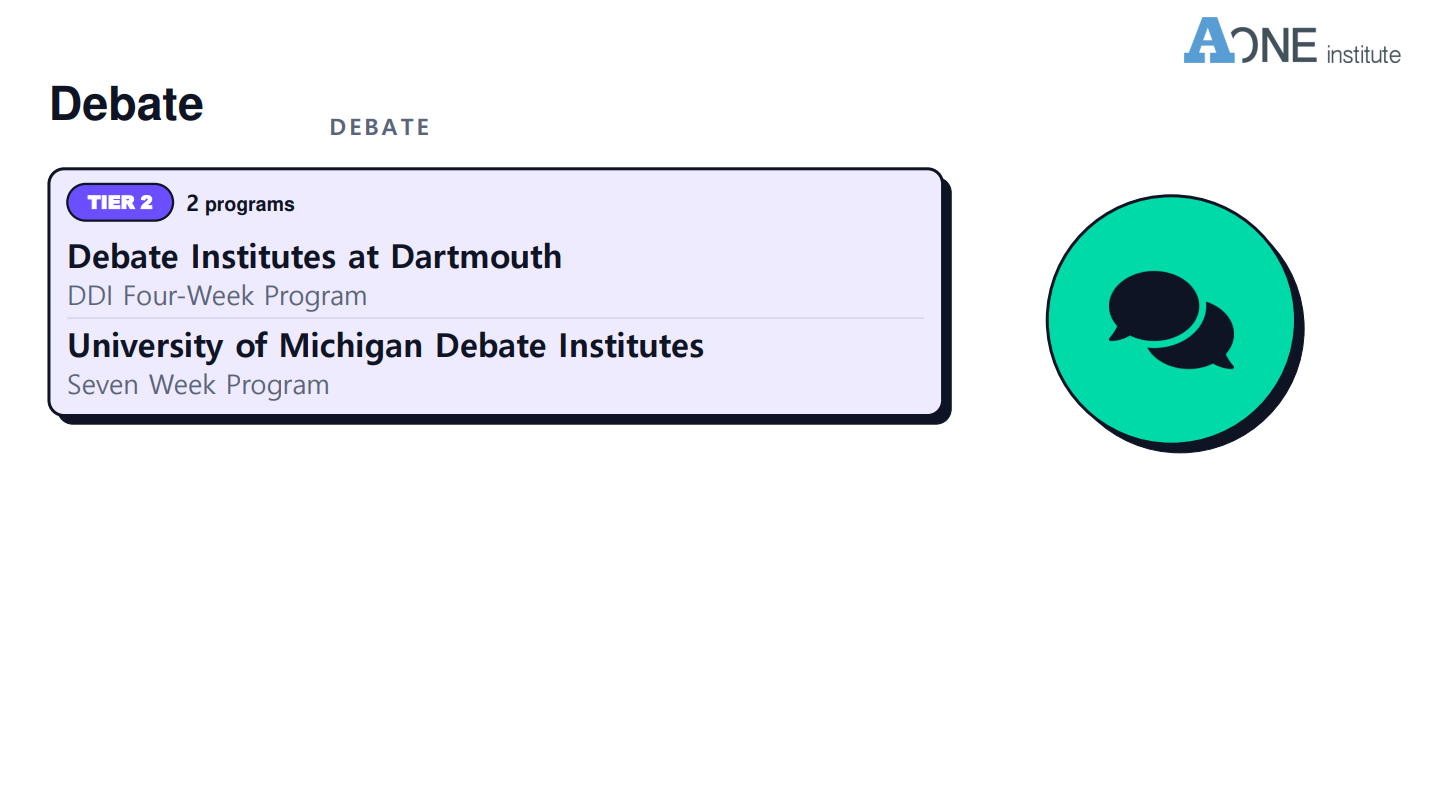
Debate: Debate Institutes at Dartmouth and University of Michigan Debate Institutes.
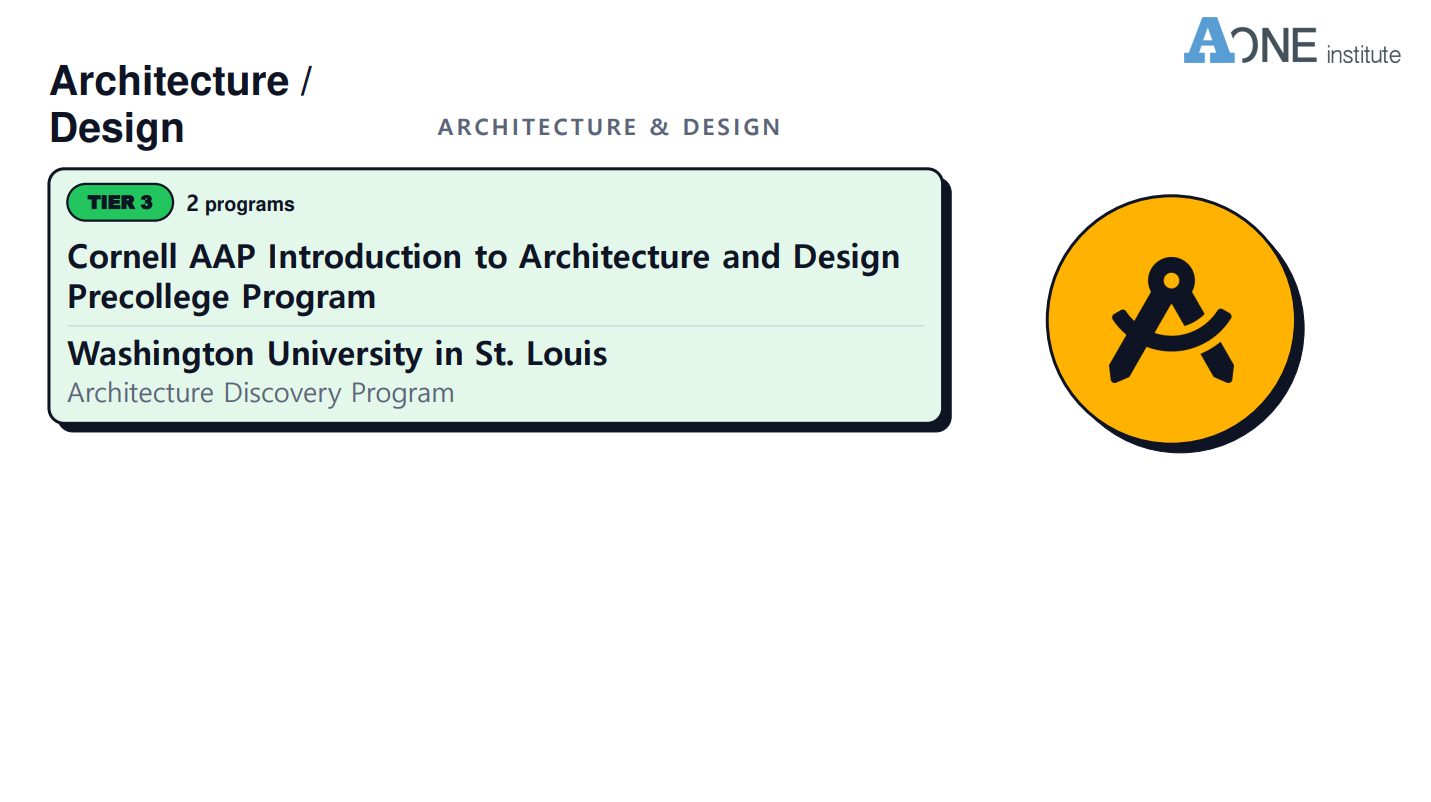
Architecture and Design: Cornell Introduction to Architecture and Design and Washington University in St. Louis Architecture Discovery Program.
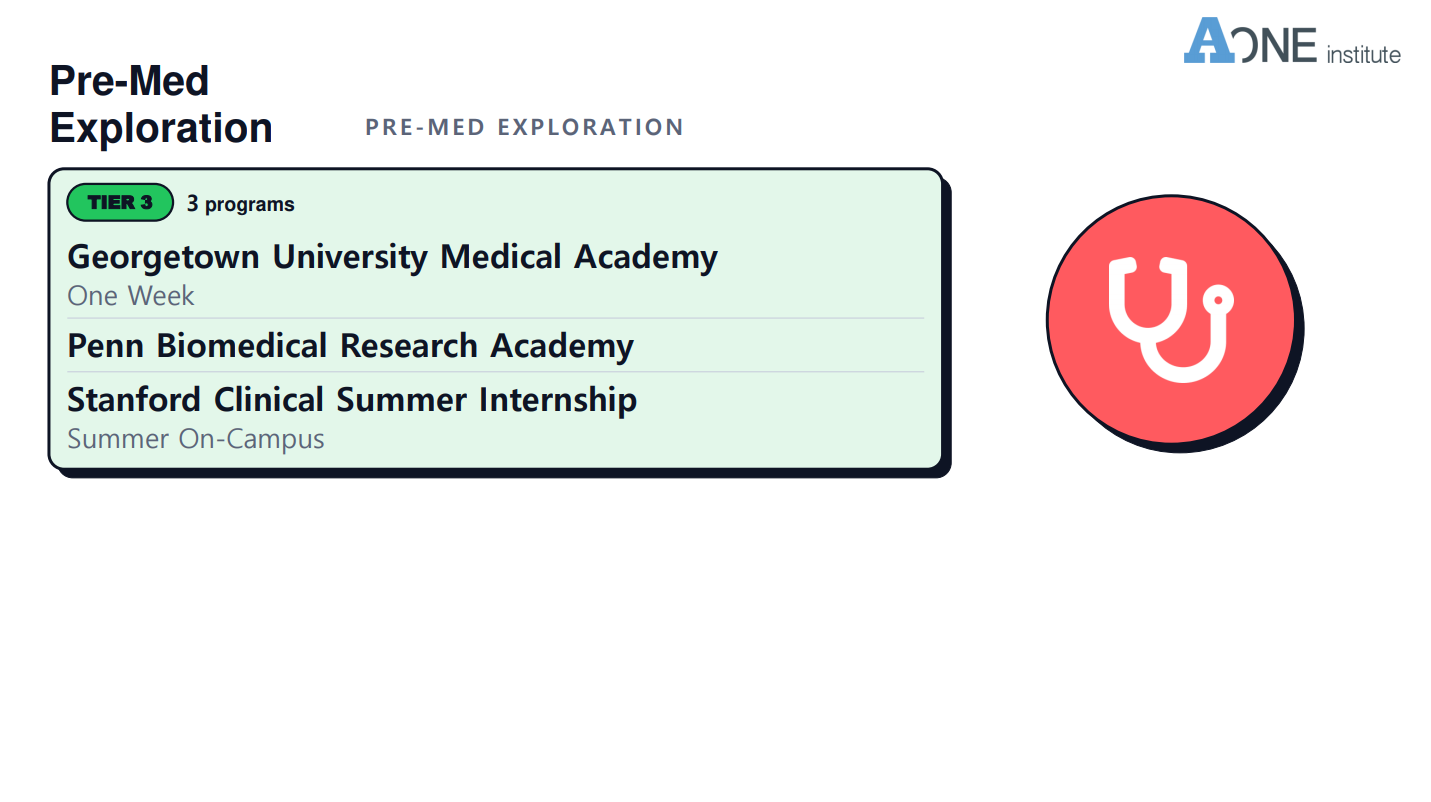
Pre-Med Exploration: Georgetown Medical Academy, Penn Biomedical Research Academy, and Stanford Clinical Summer Internship.
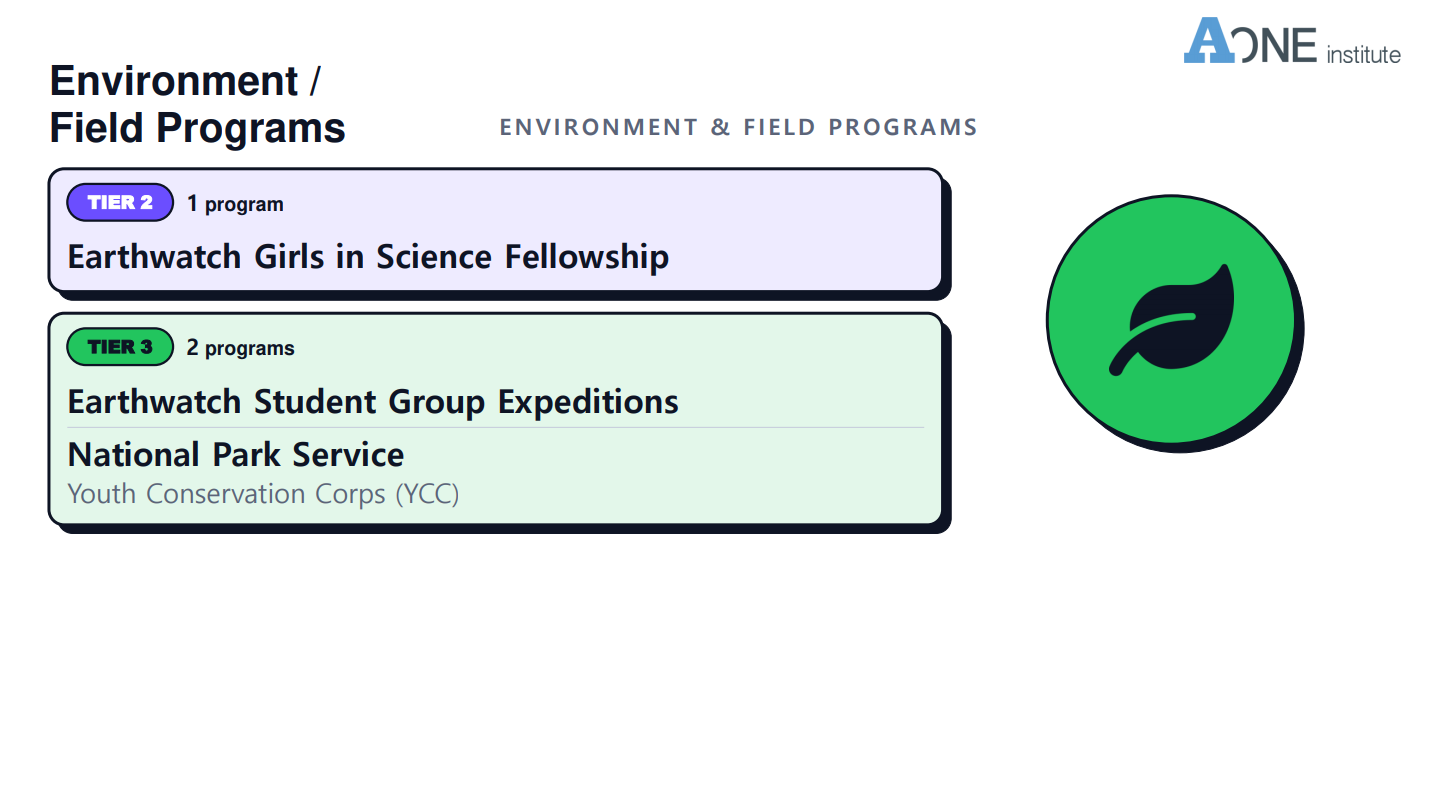
Environment and Field Programs: Earthwatch programs and the National Park Service Youth Conservation Corps.
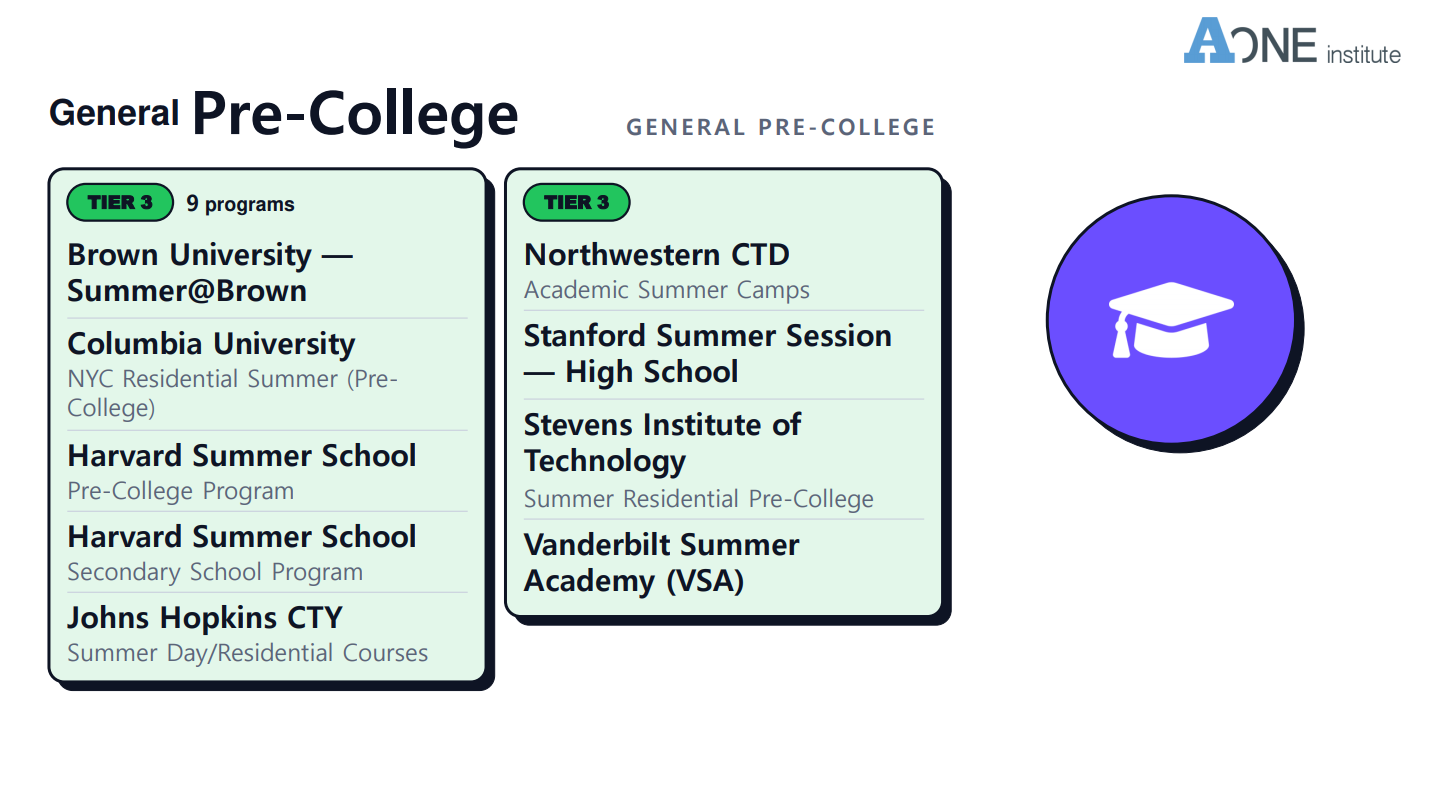
General Pre-College Programs: Opportunities offered by Brown, Columbia, Harvard, Johns Hopkins, Northwestern, Stanford, Stevens Institute of Technology, Vanderbilt, and other universities.
Program availability, cost, eligibility, and format can change from year to year.
Students should verify current requirements directly before applying.
What Do Students Need to Prepare for Competitive Summer Programs?
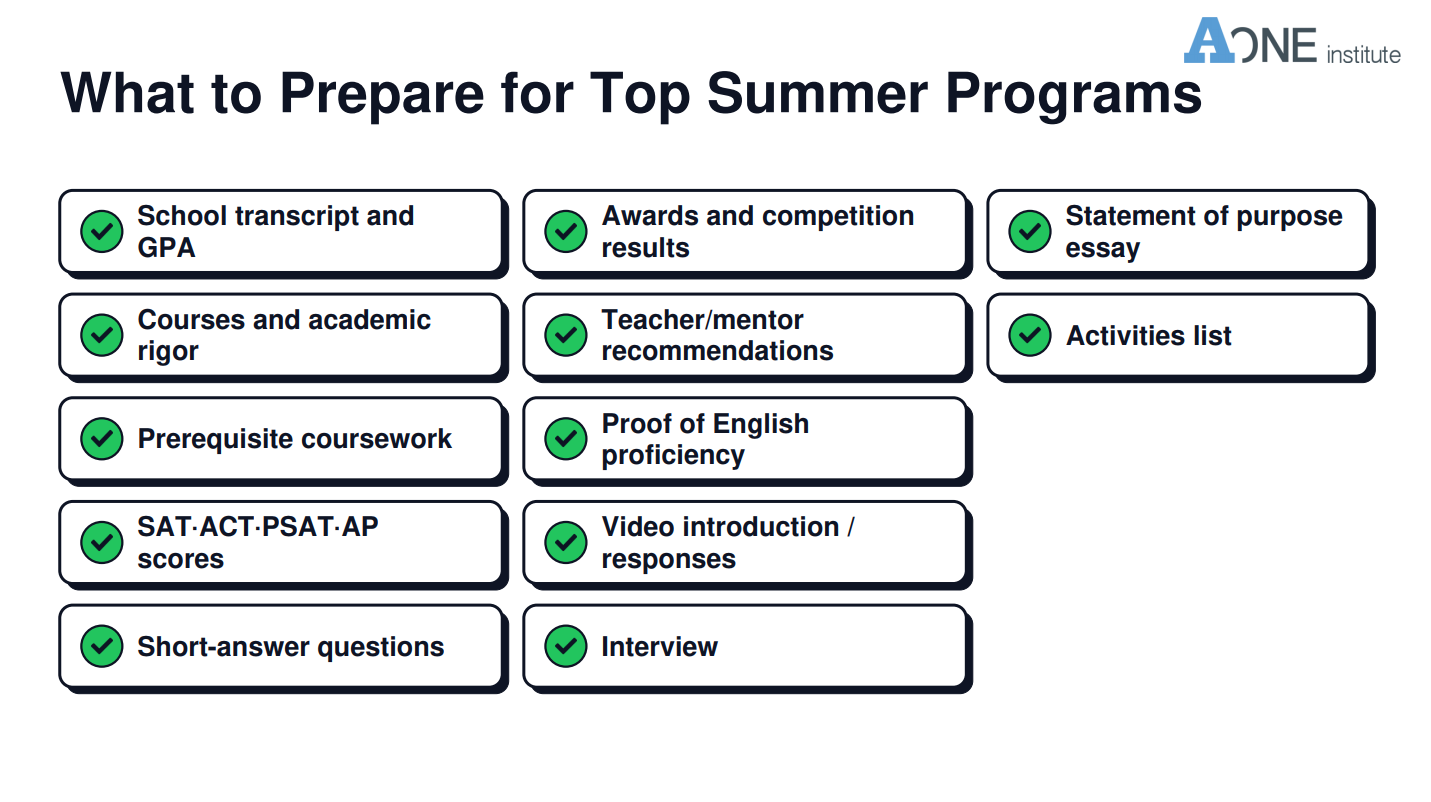
Highly selective summer programs can require application materials similar to those used in undergraduate college admissions.
Students should begin preparing early.
Academic Records and Course Rigor
Many programs require transcripts and strong academic performance.
The difficulty of the student's coursework may also matter.
Certain programs require prior completion of advanced mathematics or science courses.
A student applying to a specialized science program, for example, may need to demonstrate preparation through Honors, AP, or equivalent coursework.
Strong grades alone may not satisfy every prerequisite.
Standardized Test Scores and Competition Results
Some programs request or consider SAT, ACT, PSAT, or AP scores.
Others may evaluate students through competition results, prior research, or subject-specific academic achievements.
Strong performance in relevant competitions can support an application, although requirements differ among programs.
Teacher Recommendations and English Proficiency
Many competitive programs request recommendations from teachers or mentors.
Students should prepare these requests early rather than waiting until the deadline approaches.
Some programs also require proof of English proficiency, video introductions, or interviews.
Application Essays and Activities Lists
Two components deserve particular attention.
The first is the application essay or statement of purpose.
A strong essay should explain why the student wants to participate and how the program connects with their academic interests.
For research-focused programs, applicants may need to discuss previous projects, scientific questions, or research interests.
A general statement about enjoying science or mathematics may not demonstrate sufficient preparation.
The second is the activities list.
Students should organize their academic experiences, competitions, research, leadership roles, and other relevant accomplishments.
The objective is to show how previous experiences connect with the program they are applying to.
In many ways, preparing these materials resembles preparing the Activities section and essays for undergraduate college applications.
Students must explain both what they have accomplished and why the experience is meaningful.
When Should Students Start Preparing?
Some highly competitive programs close applications in December or January, while others accept applications later.
Because deadlines and requirements vary, students should confirm the schedule for every program on their list.
Preparing transcripts, recommendations, academic prerequisites, and essays can take considerable time.
Students interested in research-intensive programs should begin even earlier if they need additional academic preparation.
How Should Students Respond to These Changes in College Admissions?
Legacy admissions is under growing pressure.
Universities are reconsidering how they identify students with strong institutional connections.
WashU has begun considering demonstrated interest.
UChicago has linked eligible summer participation to a special binding early admission option.
Other universities have expanded their Early Decision or Early Action pathways.
These developments may appear unrelated at first.
But when viewed through the institutional priorities of interest and financial sustainability, a broader pattern begins to emerge.
Universities need students who genuinely want to attend.
They also need stable financial resources and effective enrollment strategies.
As legacy preferences become more controversial, institutions may increasingly explore alternative ways to achieve these objectives.
Summer programs are especially interesting because they can serve several purposes simultaneously.
They provide academic experiences, create relationships with prospective students, and may generate institutional revenue.
They can also give students direct exposure to a university before undergraduate applications begin.
It is therefore reasonable to expect that university-sponsored summer programs may receive greater strategic attention in the coming years.
Other institutions may also experiment with application options resembling UChicago's ED0 model within the next two to three years.
That outcome is not guaranteed, but the possibility is significant enough to prepare for.
Students should continue prioritizing academically demanding, selective programs that offer meaningful educational experiences.
At the same time, certain paid university-sponsored programs may deserve more consideration than they received in the past, particularly when they align with a student's academic interests and the university's actual engagement or admissions policies.
The key is to recognize these developments early rather than waiting until new practices become widespread.
College admissions strategies should evolve as the universities themselves change.
Students who understand those changes can make more informed choices about demonstrated interest, early applications, summer programs, and long-term academic preparation.
A ONE Institute
A ONE Institute provides individualized guidance for U.S. college admissions, summer program applications, academic planning, research, Olympiad preparation, writing competitions, and advanced coursework.
Students preparing for competitive summer programs can receive support with program selection, application essays, activities lists, and academic preparation.
For summer program and college admissions inquiries, contact [email protected].
College Admission
Pre-College Programs
Summer Programs
College Admissions 2027
ED0
Early Decision
Legacy Admissions
