
Students preparing for competitive university admissions and future careers need more than strong grades and technical knowledge. They also need the ability to evaluate complex situations, compare possible outcomes, anticipate risks, and make rational decisions. Discrete mathematics is one valuable way to develop the structured thinking behind these abilities.
As artificial intelligence takes on more tasks, the importance of human judgment may become even greater. Students will need to understand not only how to use AI, but also how to evaluate its decisions and take responsibility for the results.
To understand why this matters, consider a situation that a high school student might encounter while organizing a school event.
A Simple T-Shirt Order That Requires a Difficult Decision
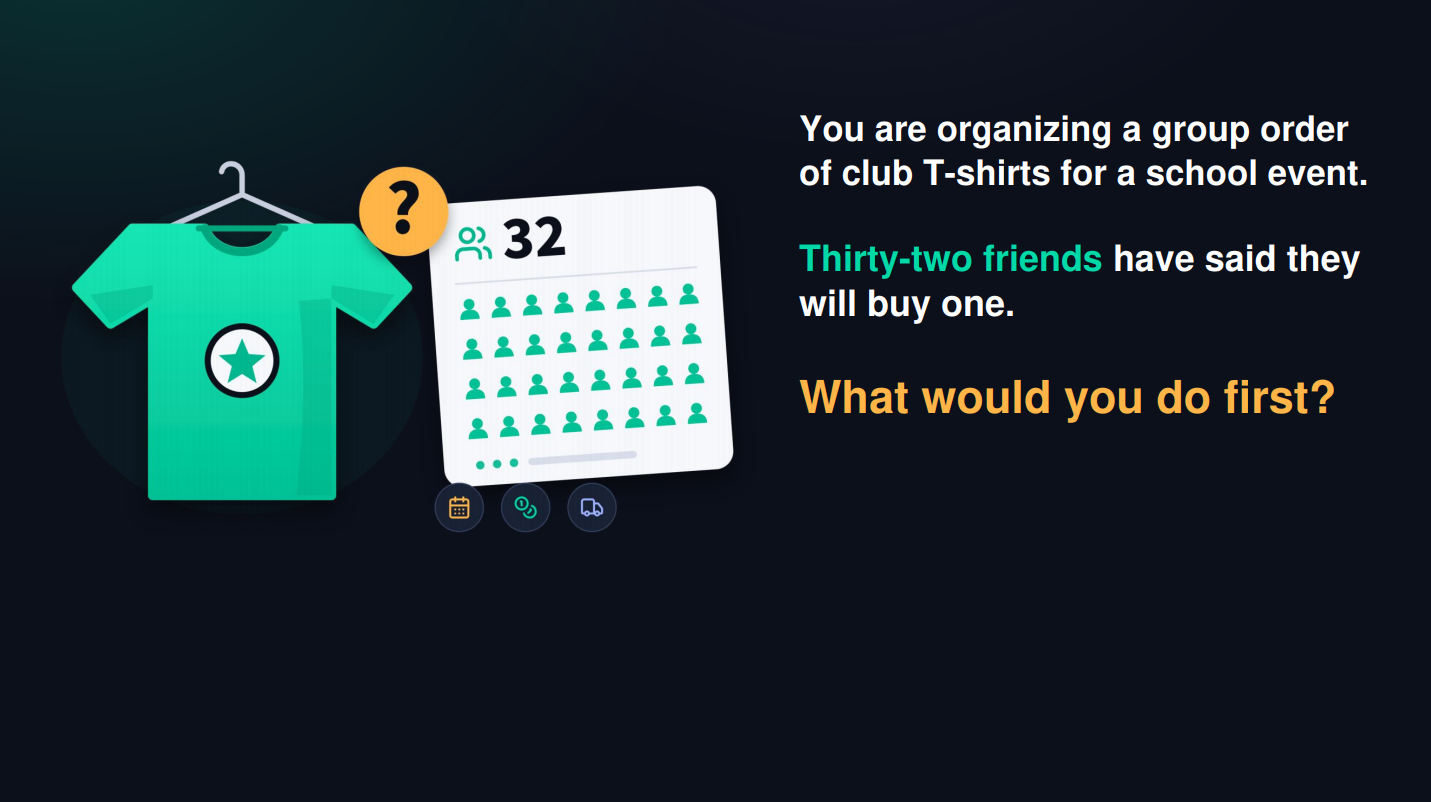
Imagine that a student is responsible for organizing a group order of club T-shirts for an upcoming school event.
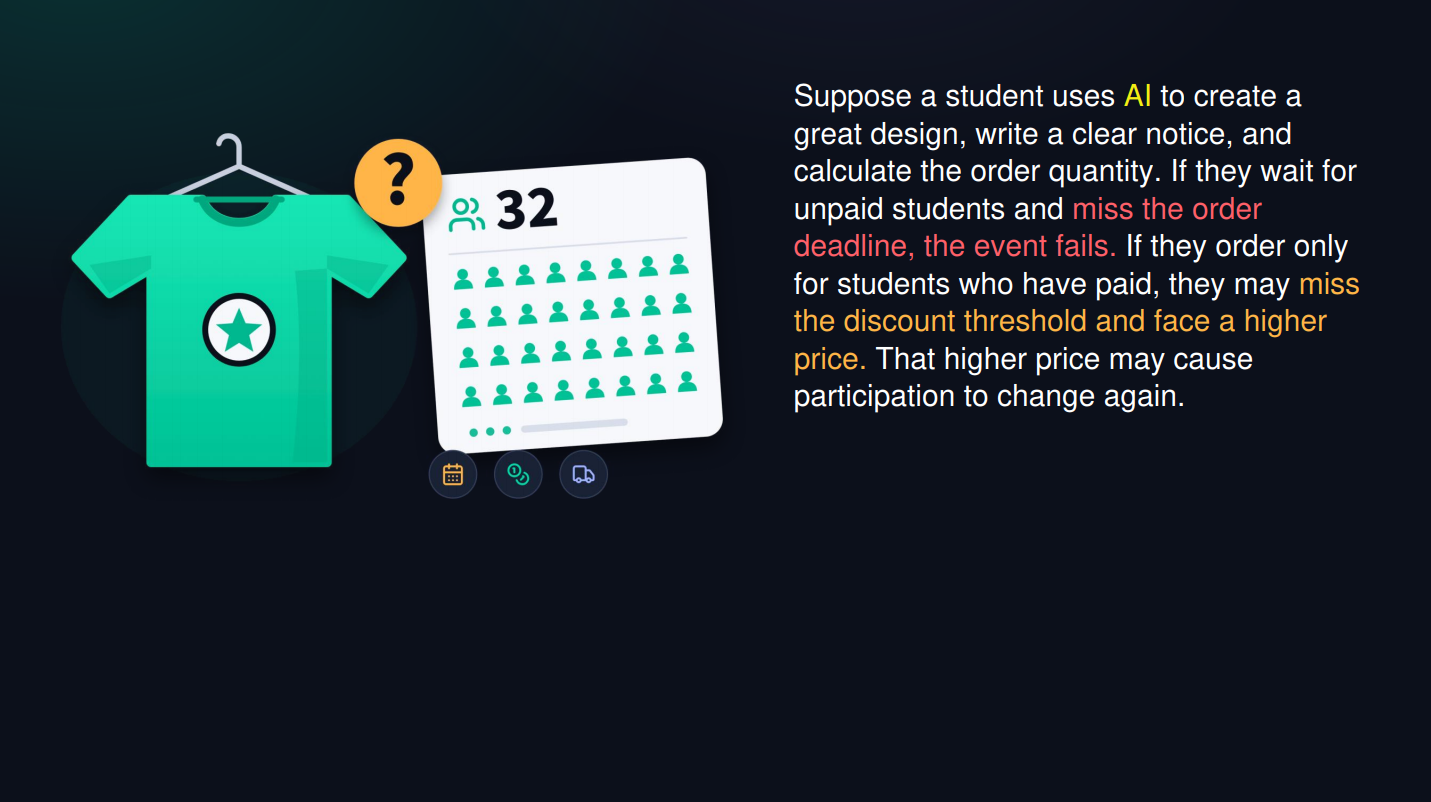
Thirty-two students have expressed interest in purchasing a shirt.
What should the student do first?
At first glance, the task seems simple. Collect the money, order the shirts, and distribute them before the event.
However, making a responsible decision requires examining the actual circumstances.
The student faces the following conditions:
| Condition | Current situation |
|---|---|
| Students interested in purchasing | 32 |
| Students who have already paid | 24 |
| Price for 30 or more shirts | $20 per shirt |
| Price for fewer than 30 shirts | $24 per shirt |
| Time remaining until the event | 10 days |
| Production and delivery | 7 days after order confirmation |
| Order changes | No changes or cancellations once production begins |
These conditions create several possible risks.
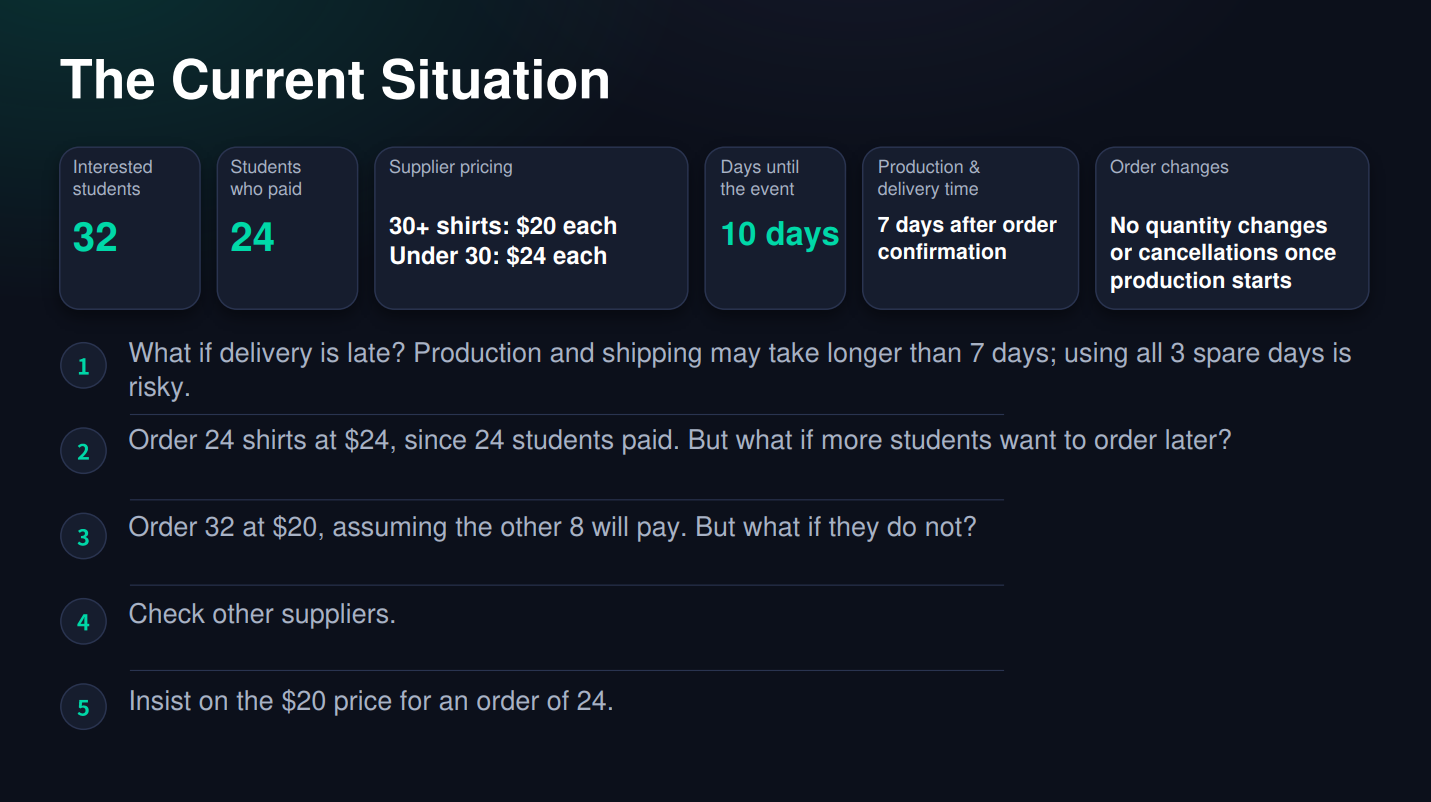
The student could wait for everyone to pay before placing the order. However, if production and shipping take longer than expected, the shirts might not arrive before the event.
The student could order only 24 shirts because only 24 students have paid. But what happens if additional students pay later and still expect to receive their shirts?
Another option is to order all 32 shirts immediately to secure the $20 price.
This seems attractive because all 32 students have already expressed interest. However, expressing interest is not the same as making a payment.
If the remaining eight students never pay, the organizer could be left responsible for the financial shortfall.
The student could also search for another supplier or negotiate with the current supplier to obtain the $20 price for fewer than 30 shirts.
There are multiple possible decisions, and each one carries different consequences.
Students who are simply waiting to receive their shirts may not recognize how much responsibility the organizer has assumed.
That is often the challenge of leadership.
The person responsible for a decision must consider circumstances and consequences that other participants may never notice.
How Can the Student Make a More Rational Decision?
Start by comparing the actual costs.
If the student orders all 32 shirts at $20 each, the total cost will be:
32 × $20 = $640
If the student orders only 24 shirts at $24 each, the cost will be:
24 × $24 = $576
The difference is $64.
Suppose the 24 students who have already paid each contributed $24, producing a total of $576.
Ordering all 32 shirts would require an additional $64 before any outstanding payments arrive.
If the organizer repeatedly covers such shortfalls with personal money, the responsibility can become financially burdensome.
A better decision requires examining another possibility.
What if the student orders exactly 30 shirts?
At the discounted price:
30 × $20 = $600
Compared with the $576 already collected, the initial shortfall is only:
$600 − $576 = $24
That is a much smaller amount than the $64 required to order all 32 shirts.
Now consider the remaining time.
The event is 10 days away, and production and delivery are expected to take seven days. The student has a maximum scheduling margin of three days, assuming the supplier's estimate is accurate.
One possible strategy is to announce that students have one additional day to complete their payments.
The organizer can make the deadline explicit and explain that only the first 30 paid orders will be accepted.
After that deadline, the student could order 30 shirts at the discounted price, provided the remaining funding risk is acceptable.
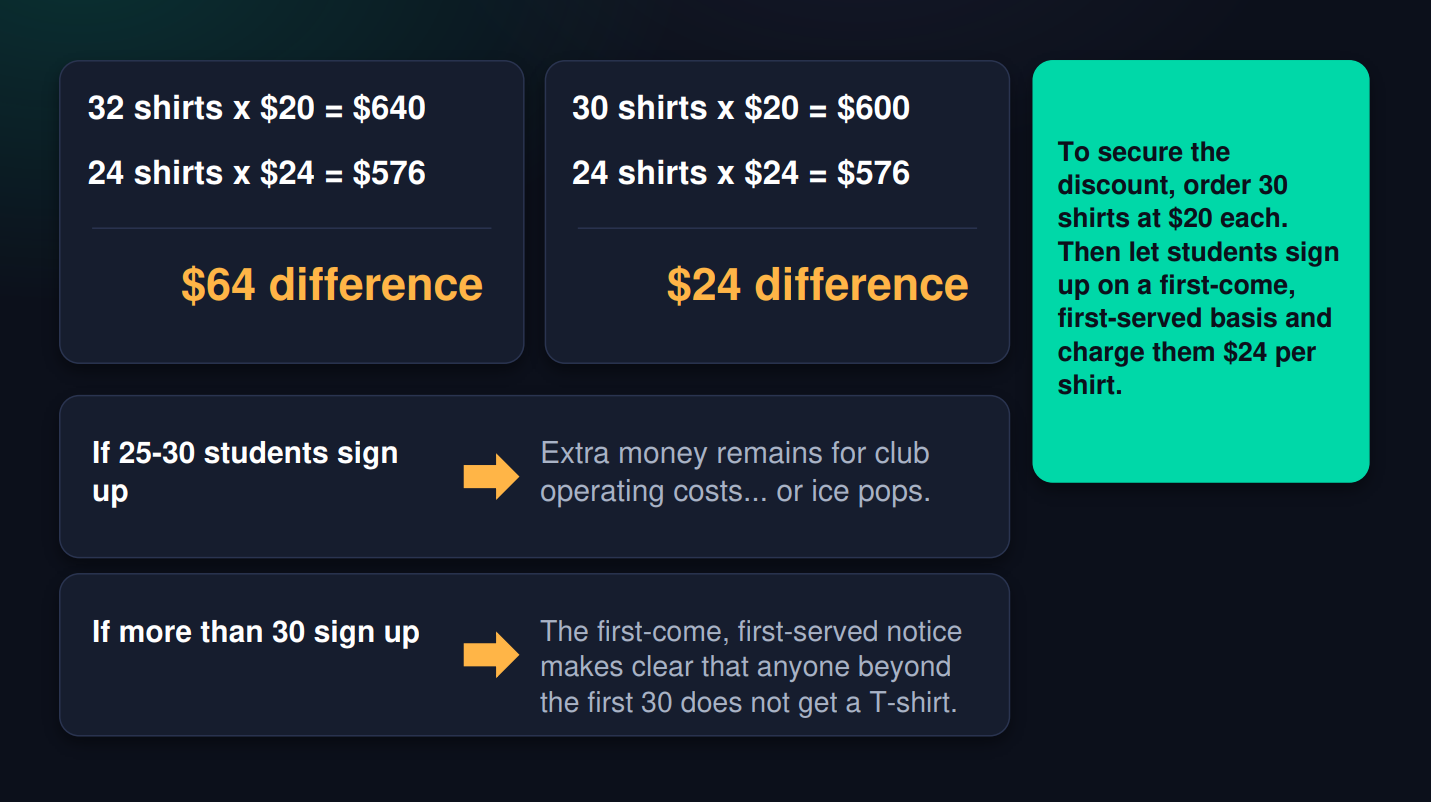
If 25 students pay $24 each, the collected amount becomes $600.
The order breaks even.
If between 26 and 30 students pay, additional money remains after the $600 purchase.
That surplus could be used for club operating expenses or even a small treat for the group.
If more than 30 students want shirts, the announced first-come, first-served limit makes it clear that the organizer cannot accommodate everyone.
Of course, this strategy is not completely risk-free.
If only the original 24 students pay, the organizer still faces a $24 shortfall. The student must therefore decide whether that possibility is acceptable or whether another arrangement is needed.
The purpose of this example is not to establish one universally correct purchasing strategy.
It is to demonstrate a way of thinking.
Rather than immediately choosing between ordering 24 or 32 shirts, the student identifies another option by considering pricing thresholds, available funds, deadlines, and possible outcomes.
The quality of the decision improves when the situation is examined systematically.
What Makes a Decision Rational?
A ONE Institute views rational decision-making as a process that begins by identifying possible outcomes and reducing the risk of serious problems.
A good decision should account for more than the most likely scenario.
It should also consider less obvious situations that could cause the original plan to fail.
In the T-shirt example, several variables interact with one another.
The order quantity affects the price per shirt.
The number of students who pay affects the available budget.
The payment deadline affects the production schedule.
A delayed order increases the risk of late delivery.
A change in participation can alter the financial outcome.
These are not independent questions.
Changing one condition may affect several others.
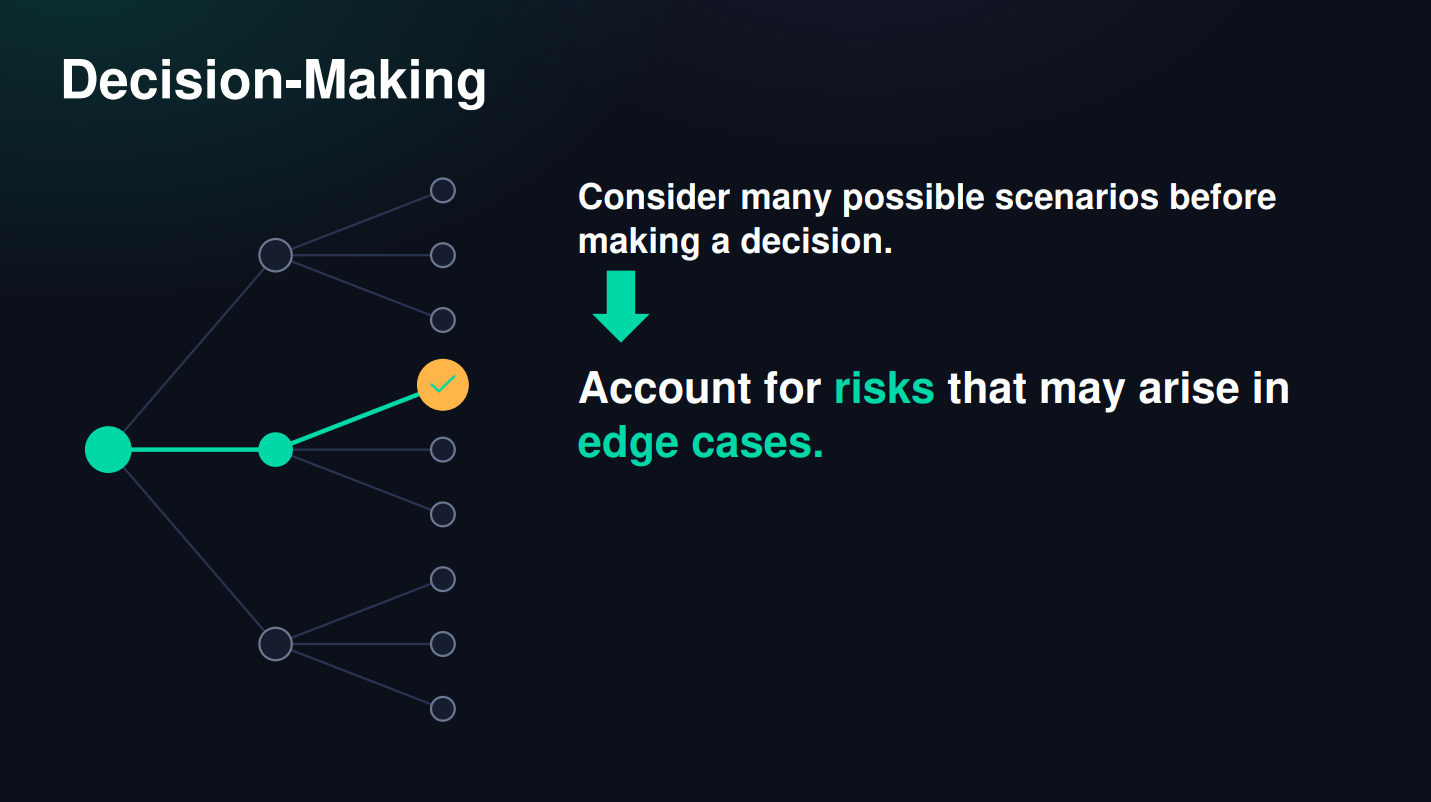
To evaluate the situation effectively, the student needs to organize the possible scenarios and understand their relationships.
This is especially important when considering edge cases—less common situations near the boundaries of the original assumptions.
What if the final payment arrives just after the deadline?
What if the supplier needs an additional day?
What if exactly 25 students pay?
What if 31 students want shirts but only 30 are available?
The organizer may not need a complicated mathematical formula to answer each question, but considering these possibilities in a structured way can prevent avoidable mistakes.
Gray Rhinos and Black Swans: Why Risk Matters
Two concepts commonly used in discussions of financial and organizational risk are the Gray Rhino and the Black Swan.
A Gray Rhino represents a significant, recognizable threat that is sufficiently visible or predictable but may still be neglected.
A Black Swan describes a rare, highly consequential event that lies outside ordinary expectations and is difficult to predict.

For example, suppose inflation continues rising while economic growth struggles to keep pace.
Businesses and investors may recognize the possibility of economic difficulty in advance.
Because the warning signs are visible, they have an opportunity to prepare for unfavorable conditions.
This resembles the Gray Rhino concept.
Now consider the severe disruption experienced during the COVID-19 pandemic.
For many organizations, the scale and timing of the disruption were unexpected, exposing weaknesses in their preparations.
The pandemic is sometimes discussed through the Black Swan framework, although the broader possibility of a pandemic had been identified by experts beforehand.
The distinction remains useful.
Some risks have recognizable warning signs.
Others are difficult to anticipate in their specific form or timing.
Rational decision-making requires recognizing foreseeable threats while also building enough flexibility to respond when unexpected events occur.
This returns us to the T-shirt example.
The possibility of late payment is visible.
The possibility of delayed shipping is also visible.
The organizer may not know exactly which problem will occur, but considering both possibilities creates an opportunity to reduce the consequences.
A ONE Institute believes this habit of considering multiple outcomes is an important part of developing sound judgment.
Why AI Could Make Rational Decision-Making More Important
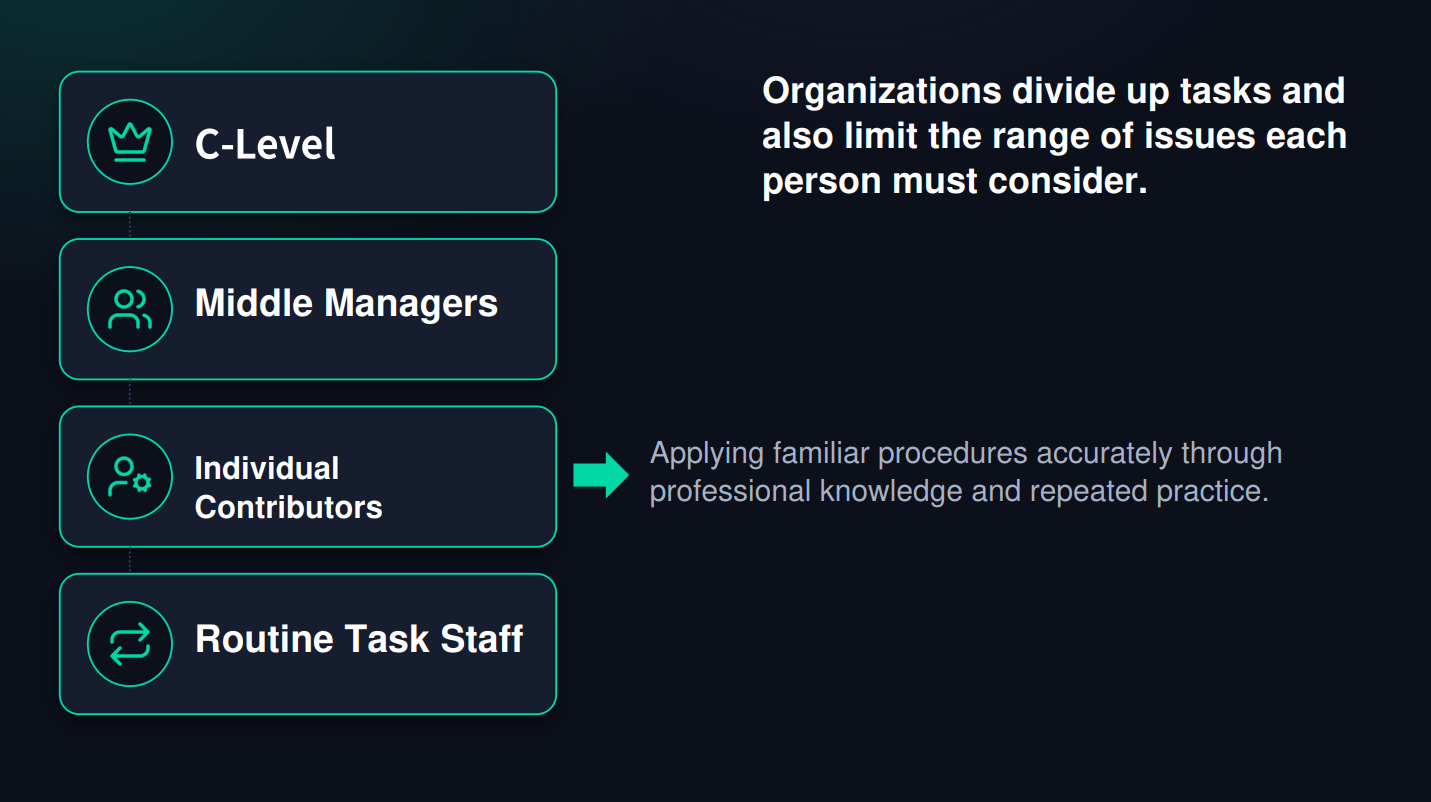
To understand the connection between rational decisions and future professional skills, consider how organizations traditionally divide responsibilities.
A simplified company structure might include four levels:
-
C-level executives who establish organizational direction.
-
Middle managers who coordinate work and make intermediate decisions.
-
Individual contributors who carry out specialized professional tasks.
-
Employees responsible for standardized and repetitive operations.

In this structure, responsibilities are distributed among different people.
Senior leadership establishes objectives.
Middle managers divide those objectives into assignments and coordinate implementation.
Individual contributors focus on specialized tasks within their areas of responsibility.
This division of labor also limits the range of decisions each person must handle independently.
An employee can often become highly effective by mastering professional knowledge, developing skills through repeated practice, and applying established procedures accurately.
However, AI is creating opportunities to reorganize some of these responsibilities.
Repetitive tasks may increasingly be automated.
Routine reporting may require less manual work.
Some coordination and intermediate decisions may be supported or performed by AI systems.
If organizations adopt these capabilities extensively, certain layers of work may become less necessary, and the responsibilities of individual contributors may expand.
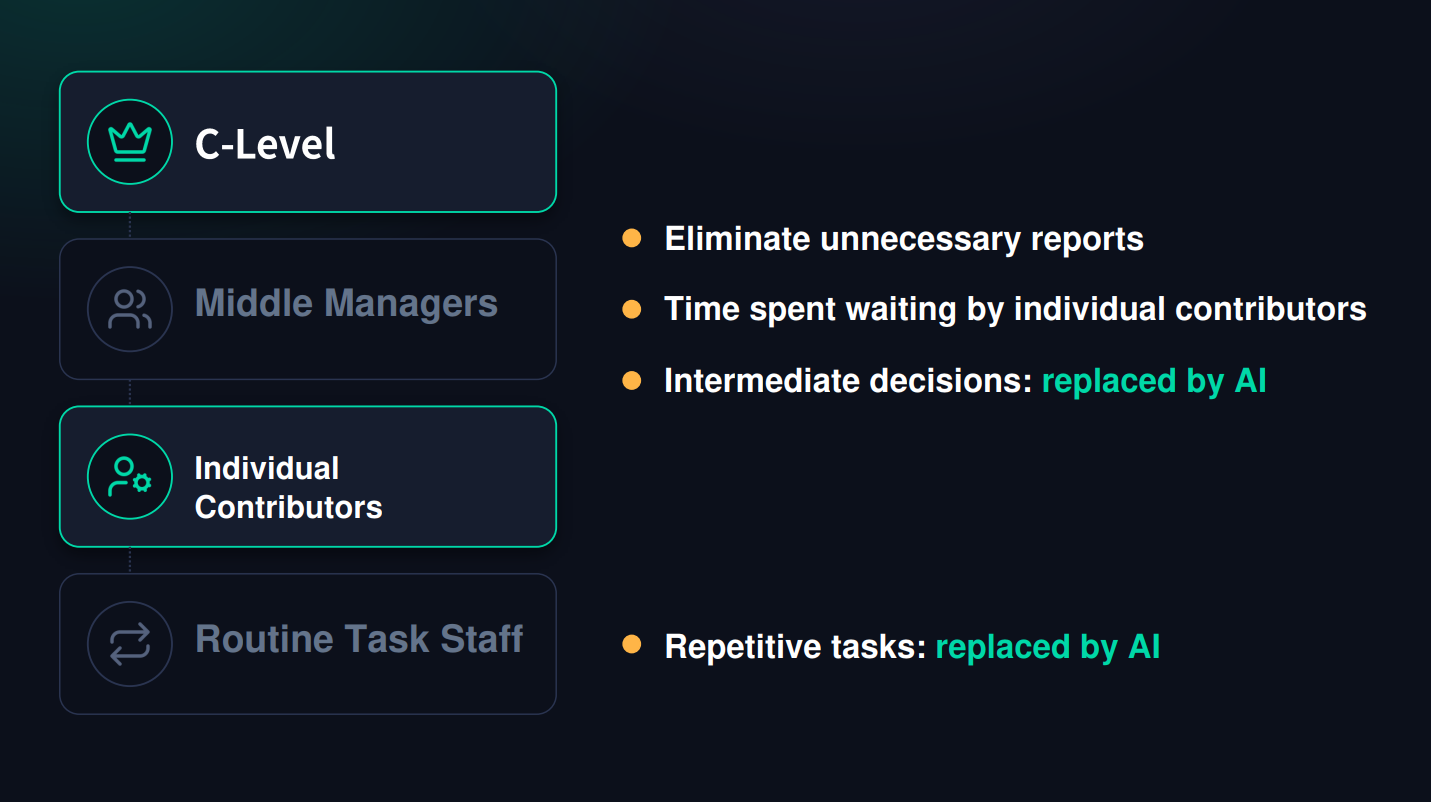
This is a possible direction of organizational change, not a prediction that every company will eliminate middle managers or routine-work positions.
The more important question concerns the employees who remain responsible for completing the work.
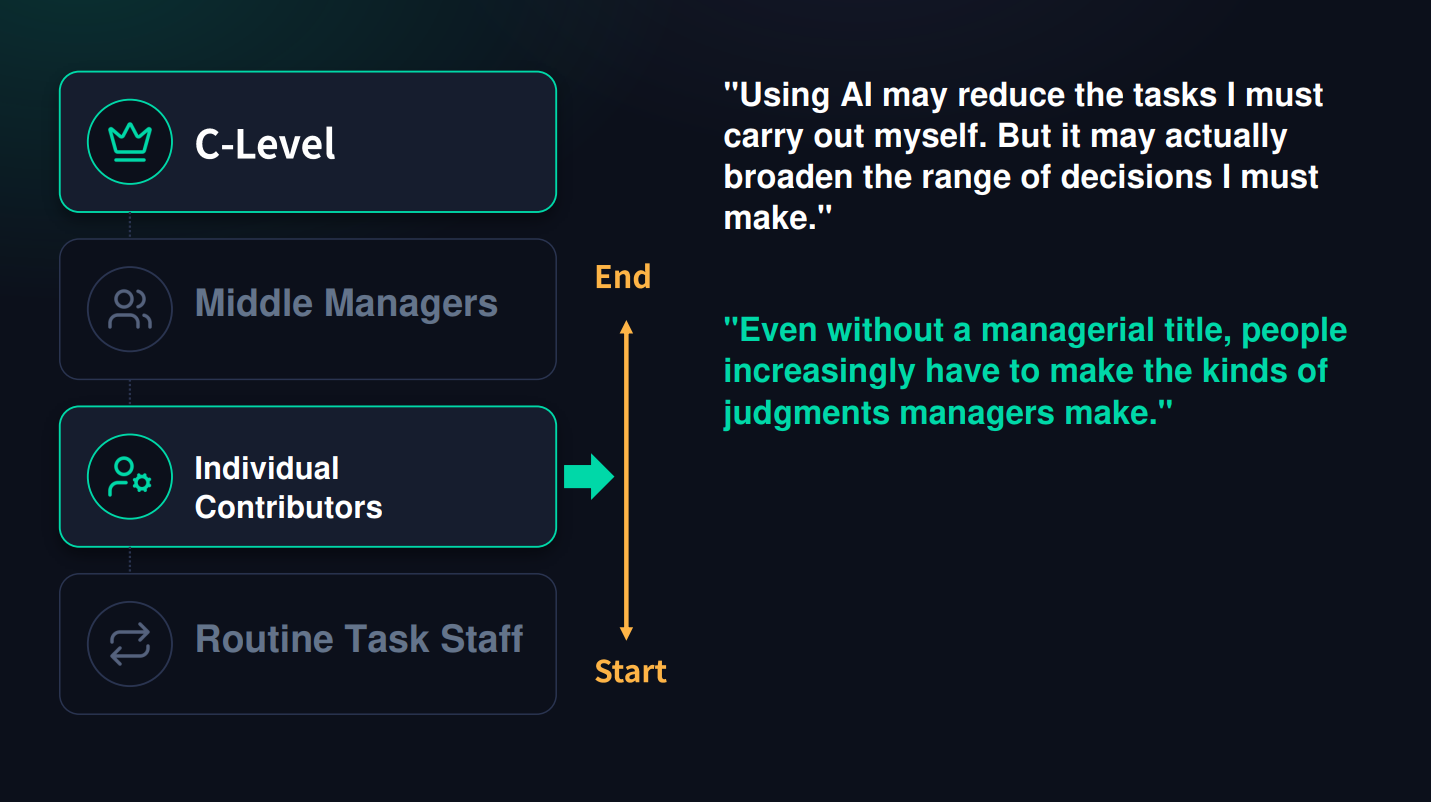
AI may reduce the number of individual tasks they must perform manually.
However, it may also increase the range of decisions they must evaluate.
An employee who previously handled one specialized task may become responsible for coordinating AI-generated work across several stages of a project.
Even without holding a management title, that person may need to exercise judgment traditionally associated with management.
This is why end-to-end responsibility matters.
A person may need to understand the initial problem, select an approach, supervise execution, evaluate results, and make corrections.
AI can assist with each stage.
But assistance does not eliminate the need to make decisions.
Instead, the ability to evaluate a larger number of connected decisions may become increasingly important.
Why AI Cannot Automatically Take Responsibility for Every Decision
Return to the student organizing the T-shirt order.
AI could help create an attractive T-shirt design.
It could write the payment announcement.
It could calculate the order costs and compare supplier options.
It might even help organize a list of students who have paid.
But those capabilities do not automatically resolve the organizer's responsibility.
Should the student wait for more payments?
Should the student order 24 shirts at a higher unit price?
Should the student order 30 shirts and accept the remaining financial risk?
What happens if participation changes after the announcement?
AI can help evaluate these questions and recommend options.
However, the organizer still needs to understand the conditions, verify the information, and make or approve the decisions for which they are responsible.
That requires comparing possibilities and understanding how each action changes the situation.
And this is where an important area of mathematics becomes relevant.
What Does Mathematics Have to Do With Rational Decision-Making?
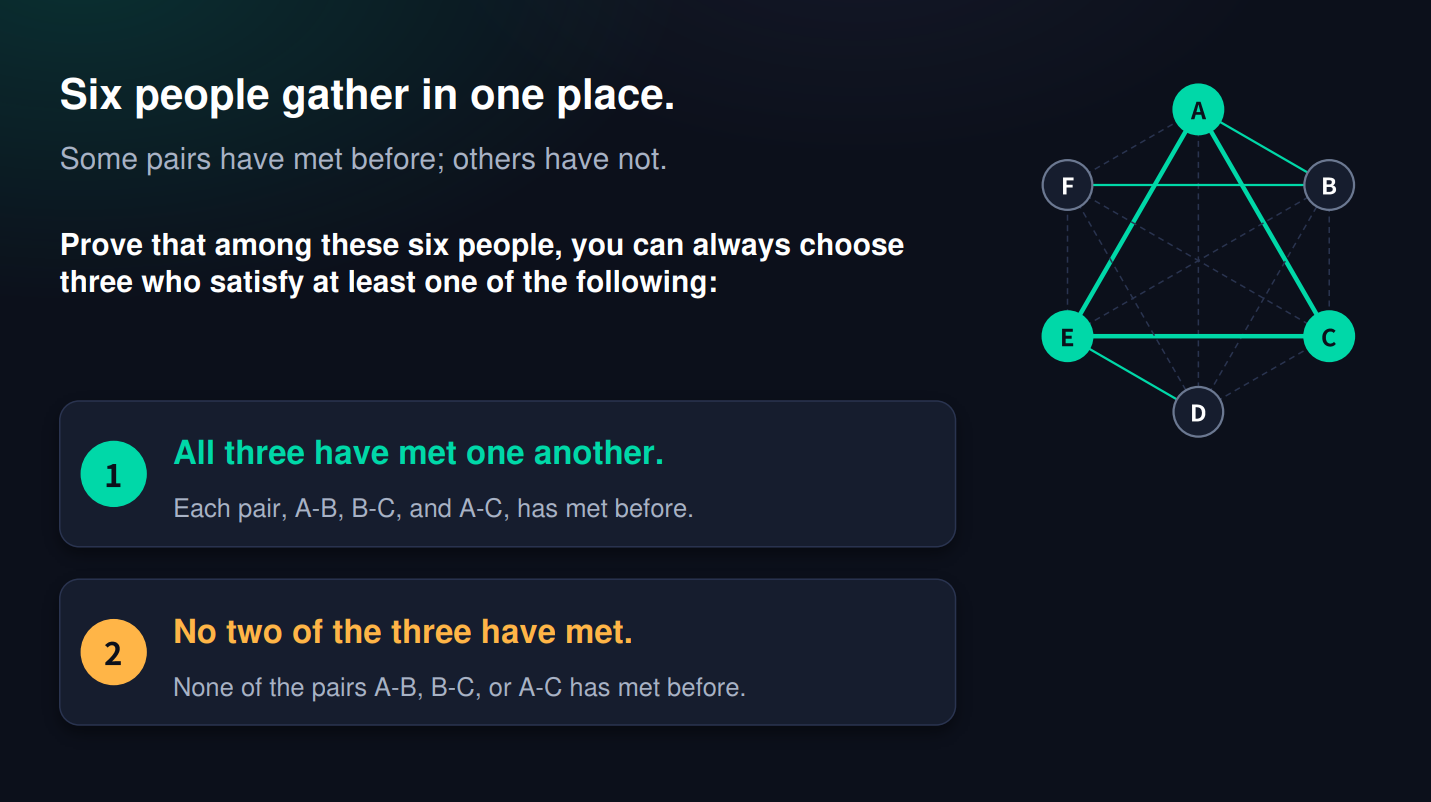
Consider a mathematical problem involving six people.
Some pairs of people have met before, while others have not.
The problem asks us to prove that, among any six people, it is always possible to select three people who satisfy at least one of two conditions:
-
All three have met one another.
-
None of the three have met one another.
At first glance, this may look like a question about social relationships.
However, it is a mathematical problem involving classification, relationships, and logical reasoning.
The challenge is not to examine only one arrangement of six people.
It is to demonstrate that the conclusion holds regardless of how the relationships are arranged.
Solving such a problem requires systematically organizing possibilities and establishing why every possible situation must satisfy the required condition.
The problem is a classic example from Ramsey theory, an area closely connected to combinatorics and graph theory.
Rather than working through the complete proof here, consider what the problem asks students to do.
They must identify relevant conditions, divide possibilities into meaningful cases, and reach a conclusion that accounts for all of them.
That is closely related to the type of thinking required when evaluating complicated decisions.
Now consider a second problem that allows us to see this method more clearly.
A Gift Exchange Problem: How Many Arrangements Are Possible?
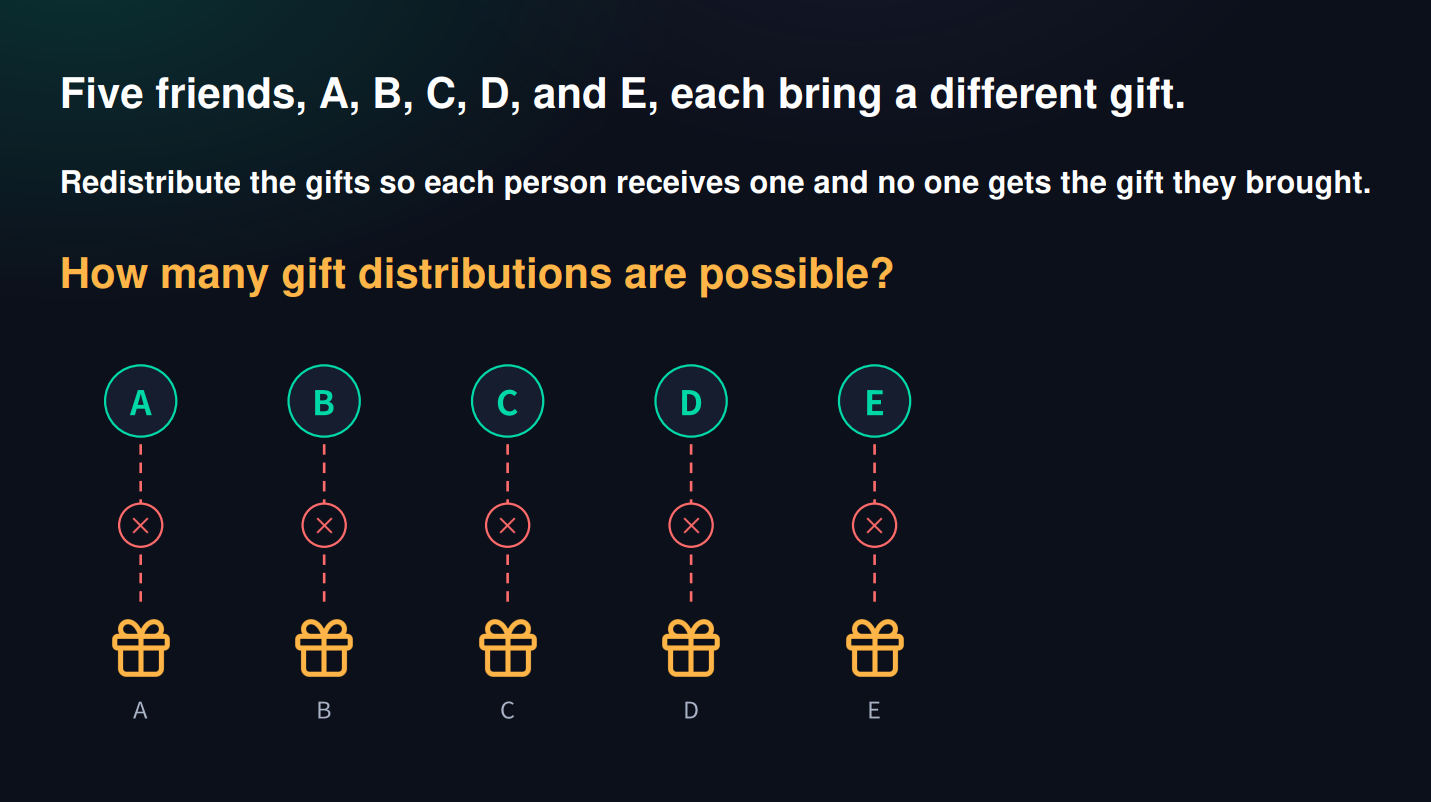
Five friends—A, B, C, D, and E—each bring a different gift.
They decide to redistribute the gifts so that everyone receives exactly one gift.
However, there is one important rule.
No one may receive the gift they originally brought.
How many different gift distributions are possible?
We could try to list every possible arrangement.
But a more structured approach is to divide the possibilities into separate cases.
Case 1: All Five Friends Participate in One Exchange Cycle
Suppose the gifts circulate among all five people without forming a smaller group that exchanges gifts separately.
For example:
A gives to B.
B gives to C.
C gives to D.
D gives to E.
E gives to A.
To count these arrangements, keep A fixed as the starting point.
There are four possible choices for the next recipient.
After that, there are three choices for the next person, followed by two choices and then one.
The final connection returns to A.
Therefore:
4 × 3 × 2 × 1 = 24
There are 24 possible five-person exchange cycles.
Case 2: Two Friends Exchange Gifts, and the Other Three Form a Cycle
Now suppose two people exchange gifts with each other.
For example, A and B exchange gifts.
The remaining three students must redistribute their gifts without receiving their own gifts.
They can form a three-person cycle in two possible directions.
First, we determine how many ways to select the pair that exchanges gifts.
There are five students, and we need to choose two.
[
\binom{5}{2}=\frac{5\times4}{2}=10
]
There are 10 possible pairs.
For each pair, the other three students can form two different exchange cycles.
Therefore:
10 × 2 = 20
There are 20 arrangements of this type.
What About the Remaining Cases?
We have considered one cycle containing all five participants and a combination of a two-person cycle and a three-person cycle.
Could other arrangements exist?
Because no one may receive their own gift, a cycle cannot contain only one person.
With five participants, the only possible ways to divide everyone into cycles of length at least two are:
-
One cycle of five.
-
One cycle of two and one cycle of three.
This means the cases already considered cover every valid arrangement.
Adding them gives:
[
24+20=\boxed{44}
]
There are exactly 44 valid ways to redistribute the five gifts.
The important part of this example is not simply the answer.
It is the method used to reach it.
Instead of counting arrangements randomly, we divided the possibilities into categories.
We identified which cases were possible.
We avoided counting the same arrangement more than once.
And we determined that no additional cases needed to be considered.
This process is a form of structured mathematical reasoning.
What Is Combinatorics?
The mathematical field illustrated by the gift exchange problem is combinatorics.
Combinatorics studies ways of counting, selecting, arranging, and organizing objects under particular conditions.
It is useful whenever a problem involves multiple possible configurations or choices.
The gift exchange problem illustrates how combinatorial reasoning can transform a complicated collection of possibilities into a manageable set of cases.
However, combinatorics is only one part of a broader mathematical field that A ONE Institute believes students should study seriously.
That field is Discrete Mathematics.
What Is Discrete Mathematics, and What Should Students Study?
Discrete mathematics studies mathematical structures involving distinct objects, logical relationships, and countable possibilities.
For the purposes of this discussion, it can be organized into five major areas.
| Area | Core concepts | Example |
|---|---|---|
| Logic & Foundations | Logic, proof, sets, relations, functions | Proving that all possible cases have been considered |
| Combinatorics | Counting, selections, arrangements, combinatorial identities | Gift exchanges and the pigeonhole principle |
| Graphs & Algorithms | Relationships, connectivity, algorithms, state transitions | Six-person relationship problem and task dependencies |
| Number Theory | Integers, primes, divisibility, remainders | Classifying possibilities using parity or remainders |
| Discrete Probability | Conditional probability, random variables, expected value | Evaluating probabilities and average outcomes |
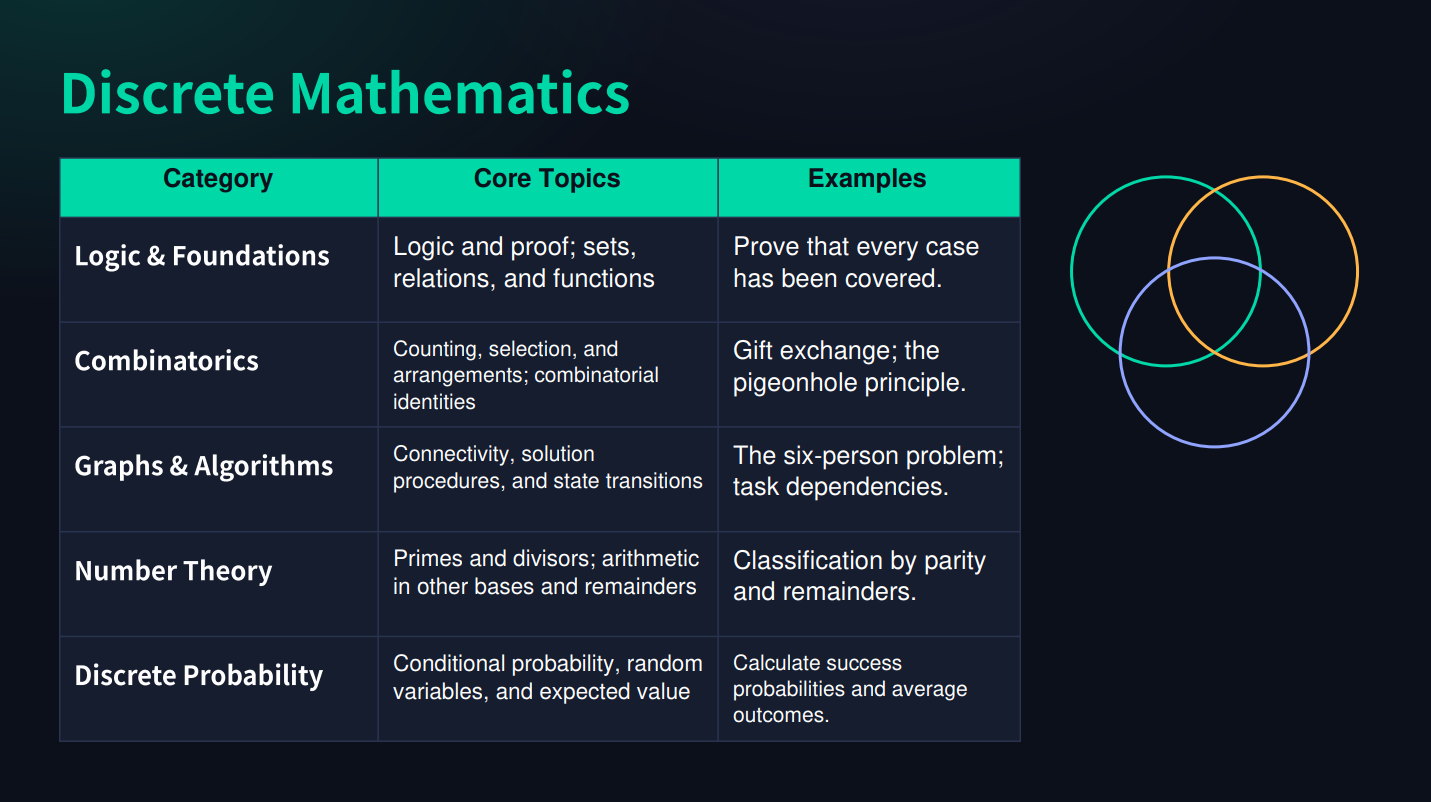
This is a useful instructional classification rather than an exhaustive list of every subject included in discrete mathematics.
The connection to decision-making becomes clearer when we examine what each area teaches.
Logic helps students evaluate whether the necessary conditions have been satisfied.
Combinatorics helps organize large numbers of possible choices.
Graph theory helps represent relationships and dependencies.
Number theory develops structured reasoning about mathematical conditions.
Discrete probability provides methods for evaluating uncertain outcomes.
Not every real-world decision is a discrete mathematics problem, and people can certainly develop good judgment without formally studying the subject.
Nevertheless, the mathematical habits developed through these areas can support the systematic evaluation of complicated situations.
This becomes particularly interesting when we examine how modern AI agents work.
What Does Meta's Muse Have to Do With Discrete Mathematics?
In September 2026, Meta introduced Muse, a personal AI agent designed to help users complete tasks rather than simply answer questions.
Unlike a conventional chatbot that primarily generates responses, an AI agent can carry out sequences of actions using tools and connected applications.
For example, Muse is designed to assist with activities such as organizing tasks, arranging appointments, researching options, and completing certain transactions.
Some actions require the user's approval before proceeding.

Meta's AI organization, led by Alexandr Wang, has positioned Muse within the rapidly developing market for personal AI agents.
The competition in this field has become intense.
After Muse's introduction, Wang posted the statement:
"Muse absolutely crushes Insect."
The wording was a competitive reference to Instinct, another personal AI assistant that had attracted attention in the technology industry.
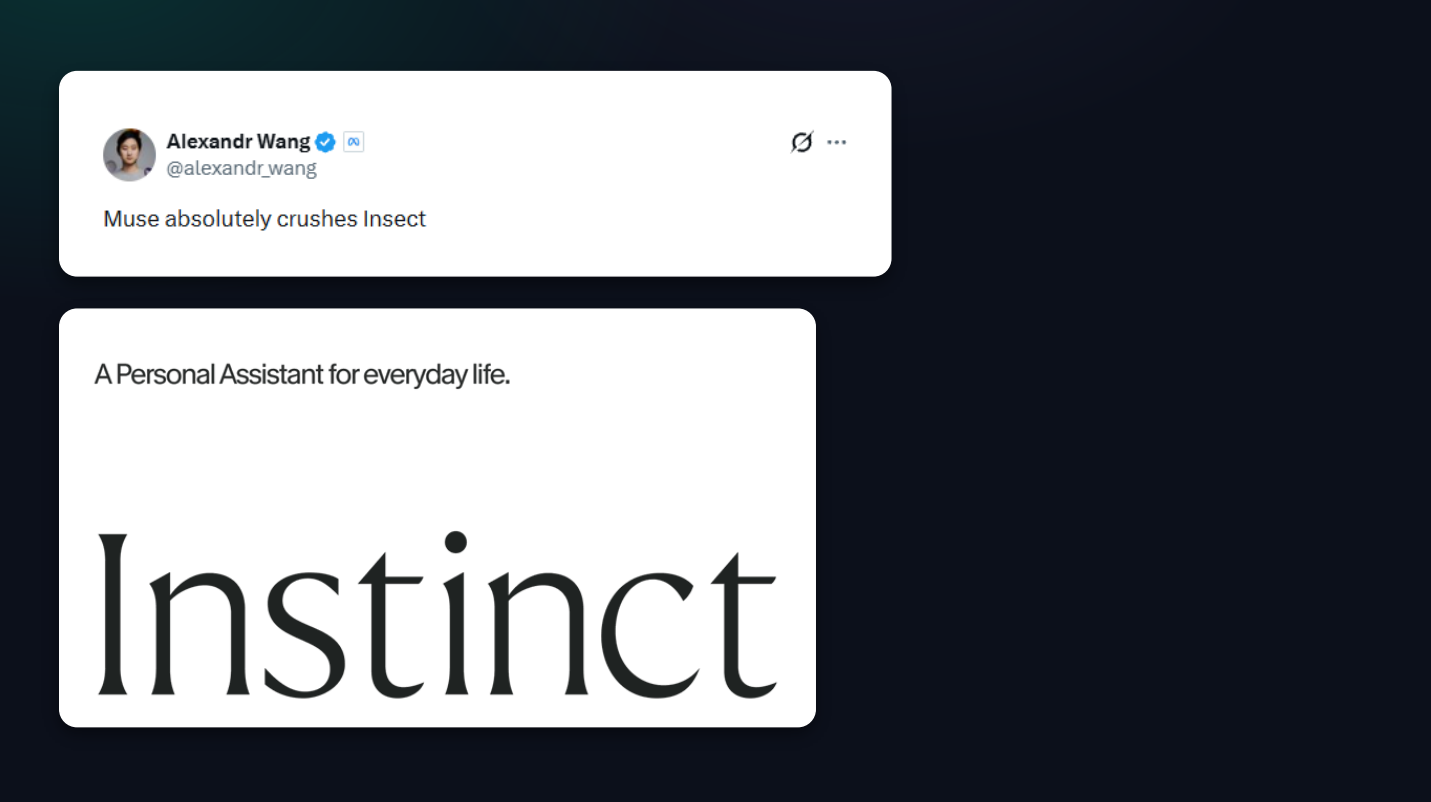
The statement reflects competition between AI companies rather than independently verified evidence that one product is superior to another.
For students, however, the more interesting issue is not which AI agent wins the competition.
A ONE Institute believes students should aspire to understand and eventually build systems like these, rather than limiting themselves to being users of the technology.
And to understand how such systems operate, we need to examine their underlying decision-making structure.
How Does an AI Agent Make Decisions?
An AI agent can be understood through a sequence of actions.
First, it identifies the current situation.
Next, it chooses an appropriate action.
It then uses an available tool to carry out that action.
After receiving the result, it evaluates what happened.
If necessary, it revises the plan and chooses another action.
The general process looks like this:
Understand the situation → Choose an action → Use a tool → Check the result → Revise the plan
The process may repeat several times before the task is complete.
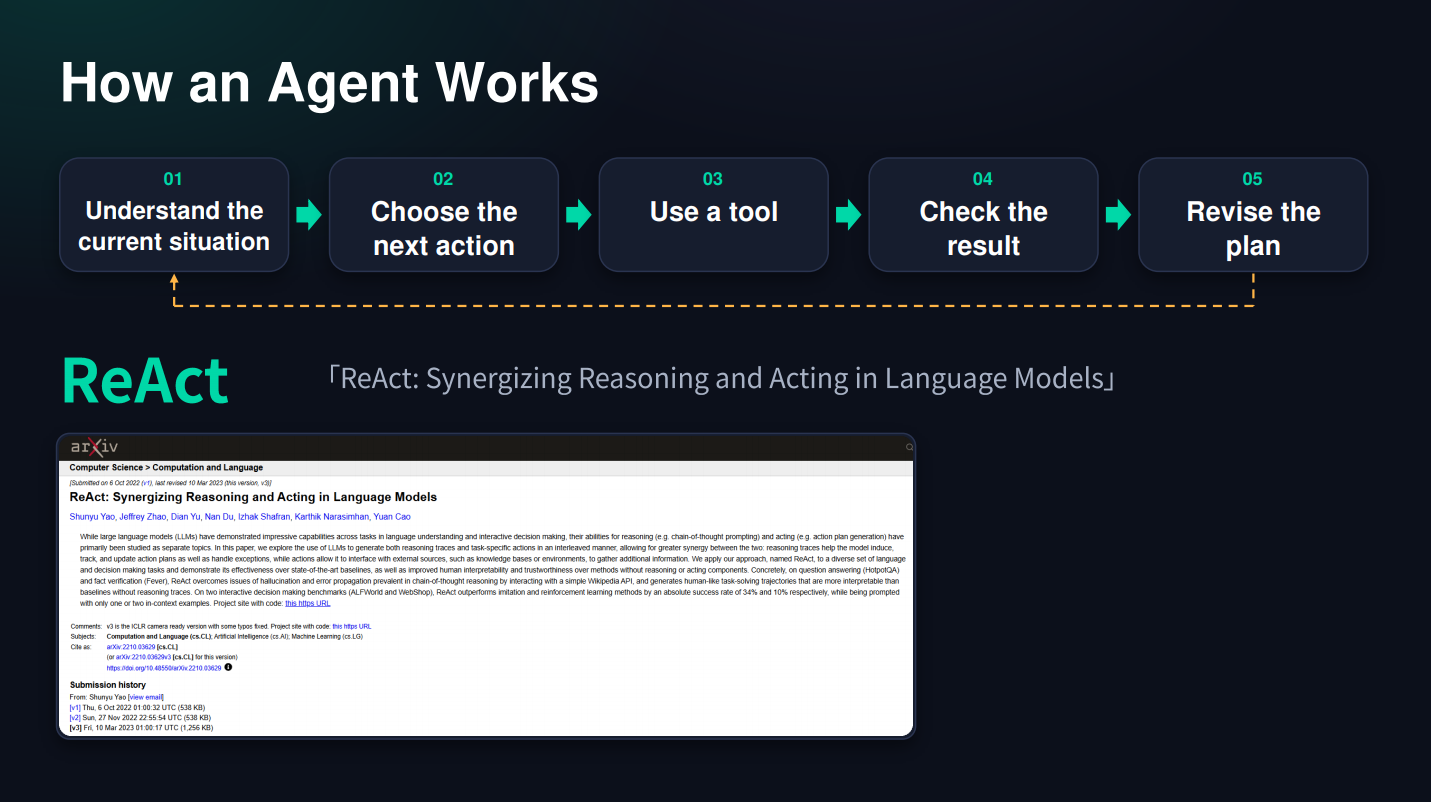
This general pattern is related to a research framework known as ReAct, which stands for Reasoning and Acting.
In a 2023 research paper titled ReAct: Synergizing Reasoning and Acting in Language Models, researchers affiliated with Princeton University and Google explored how language models can combine reasoning with actions performed in an external environment.
Rather than treating reasoning and action as entirely separate processes, the research investigated how models could use observations from their actions to update subsequent reasoning.
For example, an AI agent might choose an action, obtain new information, and revise its next step based on that information.
Such systems may also maintain information about previous actions and results so that later decisions can account for what has already occurred.
This does not mean every AI agent implements the original ReAct framework or uses the same form of memory.
The important principle is the interaction between planning, action, feedback, and revision.
Students who understand structured reasoning can better appreciate what such systems are attempting to accomplish.
How Discrete Mathematics Connects to AI Agent Decisions
Consider an AI agent helping a user make a restaurant reservation.
The task seems simple.
Find a restaurant and book a table.
But an actual reservation may involve several conditions.
The agent needs to know the requested date and time, number of guests, budget, and other preferences.
It must examine which restaurants satisfy those requirements.
It may need to check availability before attempting a reservation.
It must distinguish between a reservation request and a confirmed booking.
It may also need the user's approval before completing an action.
These requirements connect to several mathematical ideas.
Logic: Which Conditions Must Be Satisfied?
Before making a reservation, the agent must determine whether the requested constraints have been met.
A restaurant might fit the budget but not accommodate the requested party size.
Another restaurant might have the right seating capacity but no reservation at the desired time.
The agent needs to evaluate the relevant conditions together.
Graphs: Which Tasks Depend on Other Tasks?
Some actions cannot occur until other information is available.
For example, the attendee list may need to be confirmed before the final party size is known.
The party size may then affect the available reservation options.
These dependencies can be represented using relationships between tasks.
States and Transitions: What Has Actually Happened?
The agent must distinguish among different reservation states.
A reservation might be requested, confirmed, unsuccessful, or unavailable.
Those states are not interchangeable.
A system that confuses a request with a confirmation could incorrectly tell the user that the booking is complete.
Combinatorics and Search: Which Options Are Valid?
An agent may need to consider combinations of dates, times, restaurants, and party sizes.
Instead of evaluating every imaginable combination without direction, it can eliminate choices that violate known constraints.
This narrows the search to valid possibilities.
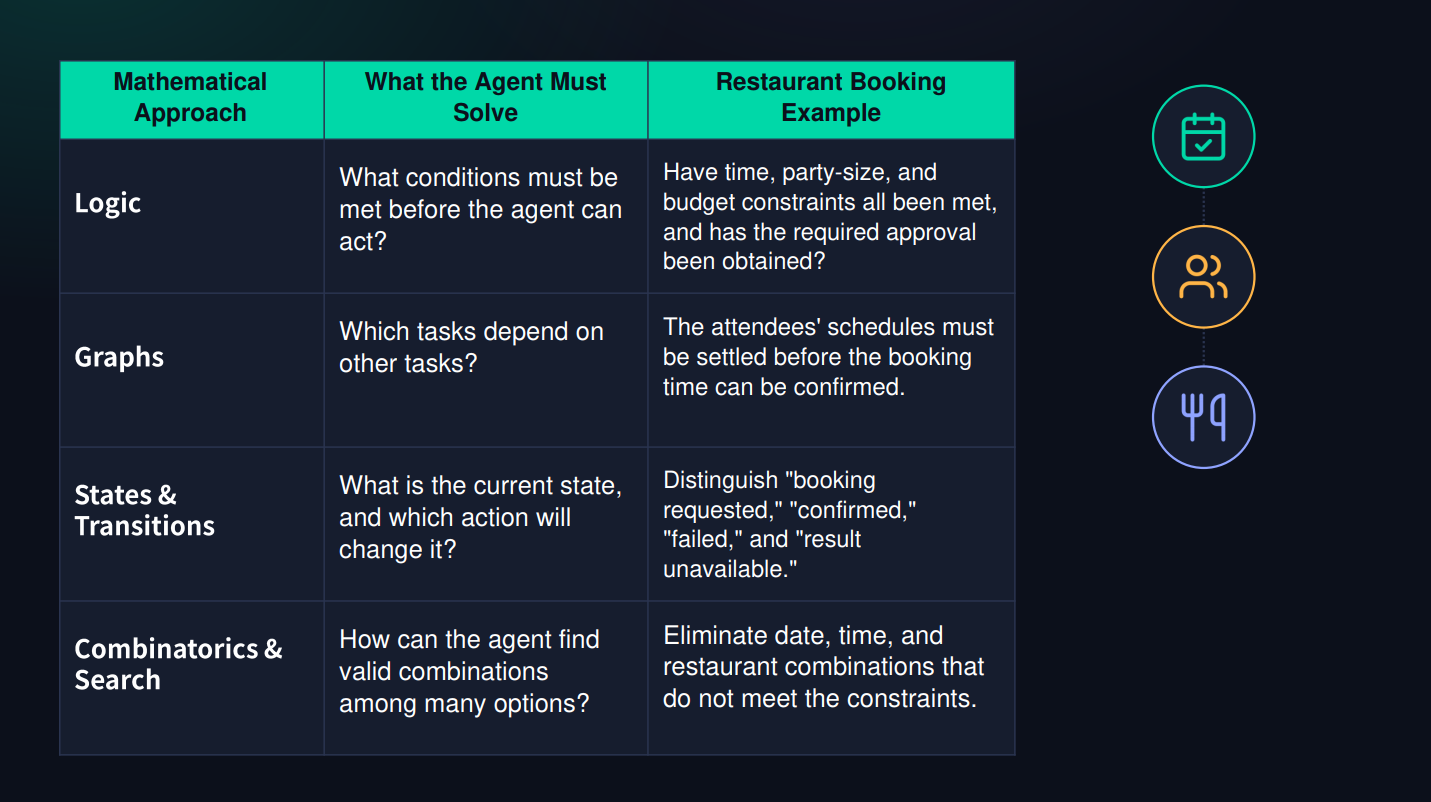
The connection is important.
Logic, graphs, state transitions, and combinatorial search provide mathematical tools for organizing conditions, dependencies, possibilities, and actions.
These concepts do not fully explain every part of a modern AI agent.
AI systems also rely on machine learning, statistical methods, optimization, software engineering, and many other technologies.
However, discrete mathematics provides a valuable foundation for understanding important parts of how complex computational systems are structured.
Why Discrete Mathematics Matters Beyond AI
The importance of structured decision-making is not limited to technology companies.
Similar reasoning appears across many professional fields.
In medicine, professionals must evaluate conditions, possible interventions, risks, and outcomes.
In construction, projects involve sequences of tasks, resource constraints, and dependencies.
In logistics, decisions depend on routes, schedules, available capacity, and changing conditions.
In finance, professionals evaluate probabilities, constraints, and possible losses.
In law, arguments depend on logical relationships, conditions, and the interpretation of evidence.
Education, consulting, manufacturing, and engineering also involve complex decisions that must be organized and evaluated.
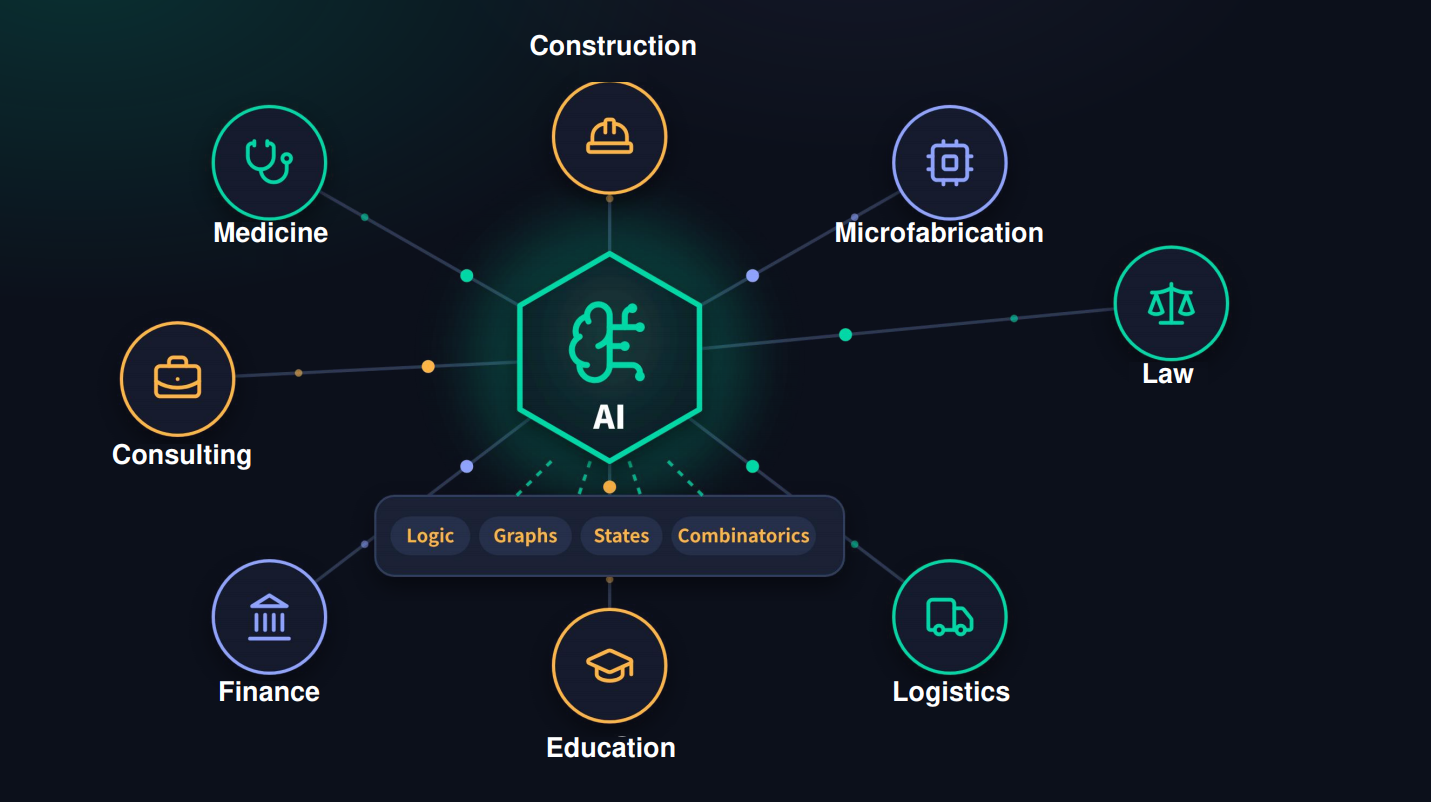
The connection does not mean all these professions are built exclusively on discrete mathematics.
Rather, discrete mathematics teaches forms of reasoning that can be useful across different settings.
Students can develop the habit of identifying conditions before acting.
They can learn to separate complicated situations into smaller cases.
They can practice recognizing dependencies between actions.
They can also become more comfortable comparing multiple possibilities without overlooking important constraints.
A ONE Institute believes these habits can be valuable whether students eventually start their own businesses, work within established organizations, conduct research, or develop AI technologies.
Should Students Study Discrete Mathematics Even If They Are Not Preparing for Math Competitions?
Yes. Students can benefit from studying discrete mathematics even if they have no intention of competing in AMC or other mathematics competitions.
Competition mathematics can certainly provide opportunities to develop advanced problem-solving ability.
However, the value of discrete mathematics is broader than competition preparation.
Its concepts can help students organize complex problems, examine possibilities systematically, and understand how logical and computational systems function.
There are people who become excellent decision-makers primarily through experience without studying formal discrete mathematics.
Studying the subject is not the only path to rational thinking.
Nevertheless, mathematical training offers a structured way to practice these skills deliberately.
Students repeatedly encounter problems requiring them to identify relevant conditions, classify possibilities, recognize relationships, and justify conclusions.
These habits can carry over into academic work, professional responsibilities, and the development of technologies that depend on structured reasoning.
The significance becomes even greater when we consider the expanding use of AI.
Students entering the workforce may increasingly be responsible for evaluating work completed by intelligent systems.
They will need to decide which actions are appropriate, determine whether the results satisfy the original requirements, and identify what should happen next.
A strong foundation in discrete mathematics can help students understand the reasoning structures involved.
The Real Reason Students Should Study Discrete Mathematics Intensively
The message is not that every student must become a mathematician.
Nor is it that studying discrete mathematics guarantees admission to a top university or professional success.
The point is that students should develop the ability to think through complicated situations rather than relying exclusively on someone else—or an AI system—to organize the decisions for them.
The T-shirt example demonstrated how a seemingly simple activity can involve budgets, deadlines, uncertain participation, and multiple possible outcomes.
The mathematical examples showed how dividing possibilities into meaningful categories makes difficult problems easier to analyze.
The AI agent examples illustrated how logic, dependencies, states, and search procedures appear in computational decision-making.
All of these examples lead to one conclusion.
As AI becomes increasingly capable of performing tasks, students may need an even stronger ability to understand, evaluate, and take responsibility for decisions.
Discrete mathematics is an important subject for developing that kind of structured thinking.
A ONE Institute therefore encourages students to study it seriously, whether or not they are preparing for AMC, Olympiads, or other mathematics competitions.
The goal is not simply to solve more mathematical problems.
It is to develop reasoning skills that students can continue using as they encounter more complicated academic, technological, and professional challenges.
A ONE Institute supports students preparing for advanced academic work, mathematics competitions, Olympiads, research programs, and U.S. college admissions through live online instruction. Our approach emphasizes building the underlying reasoning and problem-solving abilities students need to apply their knowledge beyond individual examinations.
For academic programs and class inquiries, contact [email protected].
Problem-Solving Skills
STEM Education
Advanced Mathematics
Discrete Mathematics
Rational Decision-Making
College Preparation
