
For high school seniors preparing to submit their college applications, the final review of a personal statement or supplemental essay should go beyond correcting grammar and polishing sentences. The most important question is whether the essay reveals who the student is, how their perspective has changed, and what they have learned from their experiences.
In the 2026–2027 admissions cycle, several universities have clarified their policies on artificial intelligence and revised their supplemental essay requirements. However, one fundamental expectation remains: an essay should communicate something meaningful about the person behind the academic achievements and extracurricular activities.
A ONE Institute recommends reviewing college essays from the perspective of an admissions officer rather than focusing only on whether the student or parents are satisfied with the writing.
Do Colleges Use AI to Read and Evaluate Application Essays?
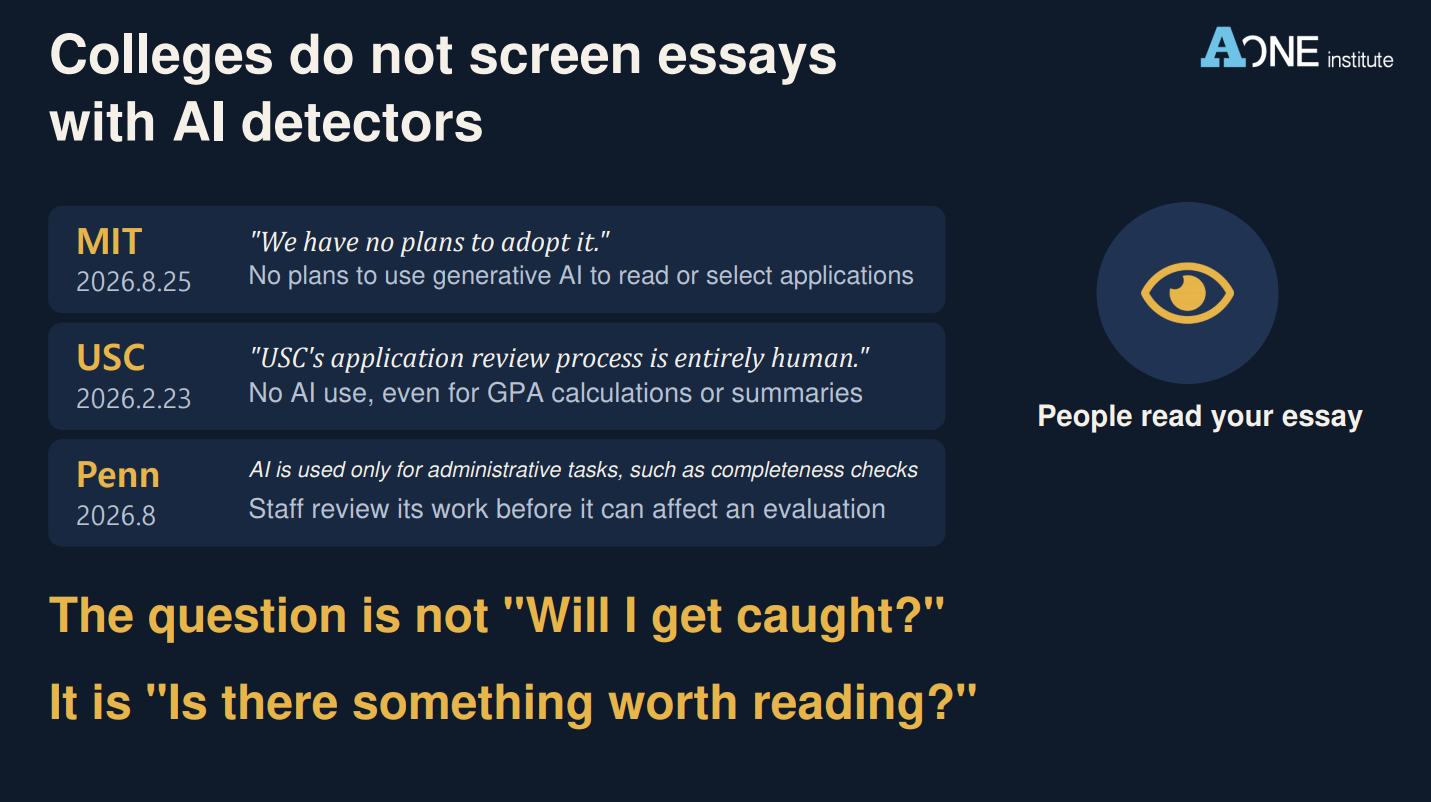
Several universities have explicitly confirmed that human admissions officers remain responsible for evaluating applications, even as artificial intelligence becomes more widely available.
For example, MIT stated on August 25, 2026, that it had no plans to adopt generative AI for reading or selecting applicants.
USC took a similar position in February 2026. Its admissions office explained that application review is conducted by people rather than AI systems. USC also stated that it does not use generative AI to calculate applicants' GPAs or summarize their applications.
The University of Pennsylvania has a slightly different approach.
Penn permits limited AI assistance with administrative tasks, such as checking application completeness and interpreting academic records. However, staff members review and confirm the results before they can affect an applicant's file. Admissions evaluations and decisions remain the responsibility of the admissions team.
These statements do not establish that every university follows the same procedures. Nor do they prove that no institution uses AI-detection software.
What they demonstrate is that several universities continue to emphasize human judgment when evaluating applicants.
For students, this changes the question they should be asking.
Instead of concentrating on whether an AI detector might flag an essay, students should consider whether their writing contains something genuinely worth reading.
Does the essay reveal a real experience?
Can the reader understand the student's thinking?
Does the writing communicate a perspective that belongs to the student rather than a collection of polished but generic statements?
Those questions are more useful during the final review.
What Do Penn and Princeton Say About Using AI to Write Essays?
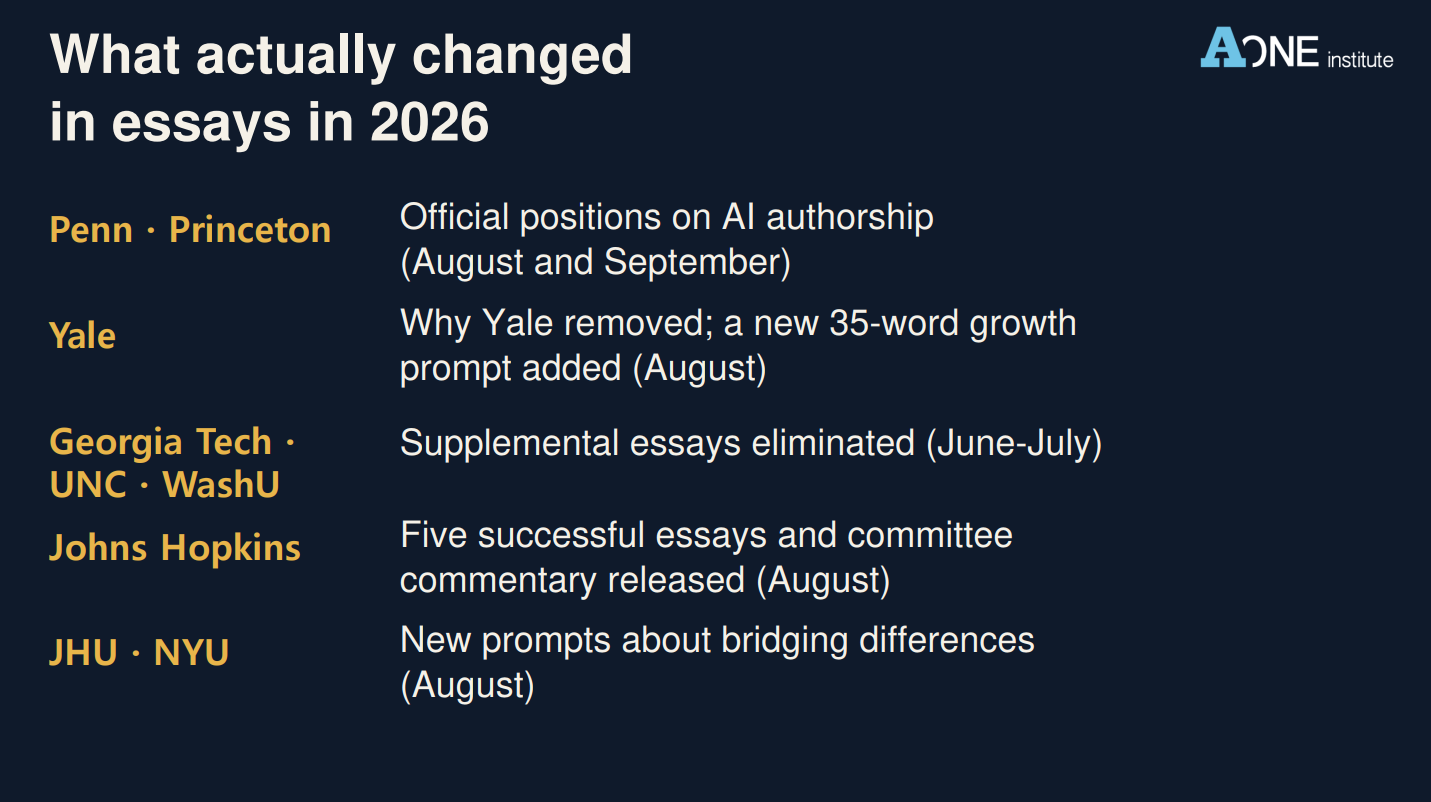
Penn and Princeton have also emphasized the importance of maintaining the student's own ideas and voice.
Penn explains that students may receive help organizing their thoughts, checking grammar, or proofreading their writing. Such assistance can come from parents, teachers, counselors, or AI tools.
However, students must not submit AI-generated responses as their own writing or present invented experiences and accomplishments.
Princeton similarly encourages students to write their own essays rather than rely on AI-generated compositions. The university emphasizes authenticity over perfection.
The important distinction is between using technology to support the writing process and allowing technology to replace the student's authorship.
Students should check each university's current policies before submitting because the permitted forms of assistance are not necessarily identical across institutions.
What Changed in College Essays for the 2026–2027 Admissions Cycle?
Several universities made changes to their application essays for students applying in fall 2026.
One notable example is Yale.
Yale removed its traditional "Why Yale" question after determining that many responses were not providing meaningful new information about applicants.
Students frequently filled the space with descriptions of Yale's programs, professors, laboratories, and campus opportunities.
However, those descriptions often demonstrated more about the university than about the person applying.
Yale concluded that the question was not consistently producing the information admissions officers wanted.
Instead, the university introduced a short question asking students to identify one aspect of themselves they hope to develop during college.
This allows students to discuss their potential for growth rather than simply demonstrating how much information they have collected about Yale.
Other institutions also changed their supplemental writing requirements.
Georgia Tech removed its school-specific short-answer essay for the 2026–2027 cycle, while UNC-Chapel Hill eliminated its two general short-answer supplemental questions.
Washington University in St. Louis removed its optional writing supplement. However, WashU still requires a 250-word response about the applicant's academic interests, in addition to the general application essay.
These distinctions matter because students must check the actual requirements of each institution.
Johns Hopkins also provided useful guidance by publishing five essays from admitted students, accompanied by admissions commentary explaining what made those essays effective.
NYU's 2026–2027 optional supplemental essay, meanwhile, focuses on students who can build bridges between different people, perspectives, or groups.
The question encourages students to examine their experiences with differences and explain what they learned about helping people understand or work with one another.
What Has Not Changed About College Admissions Essays?
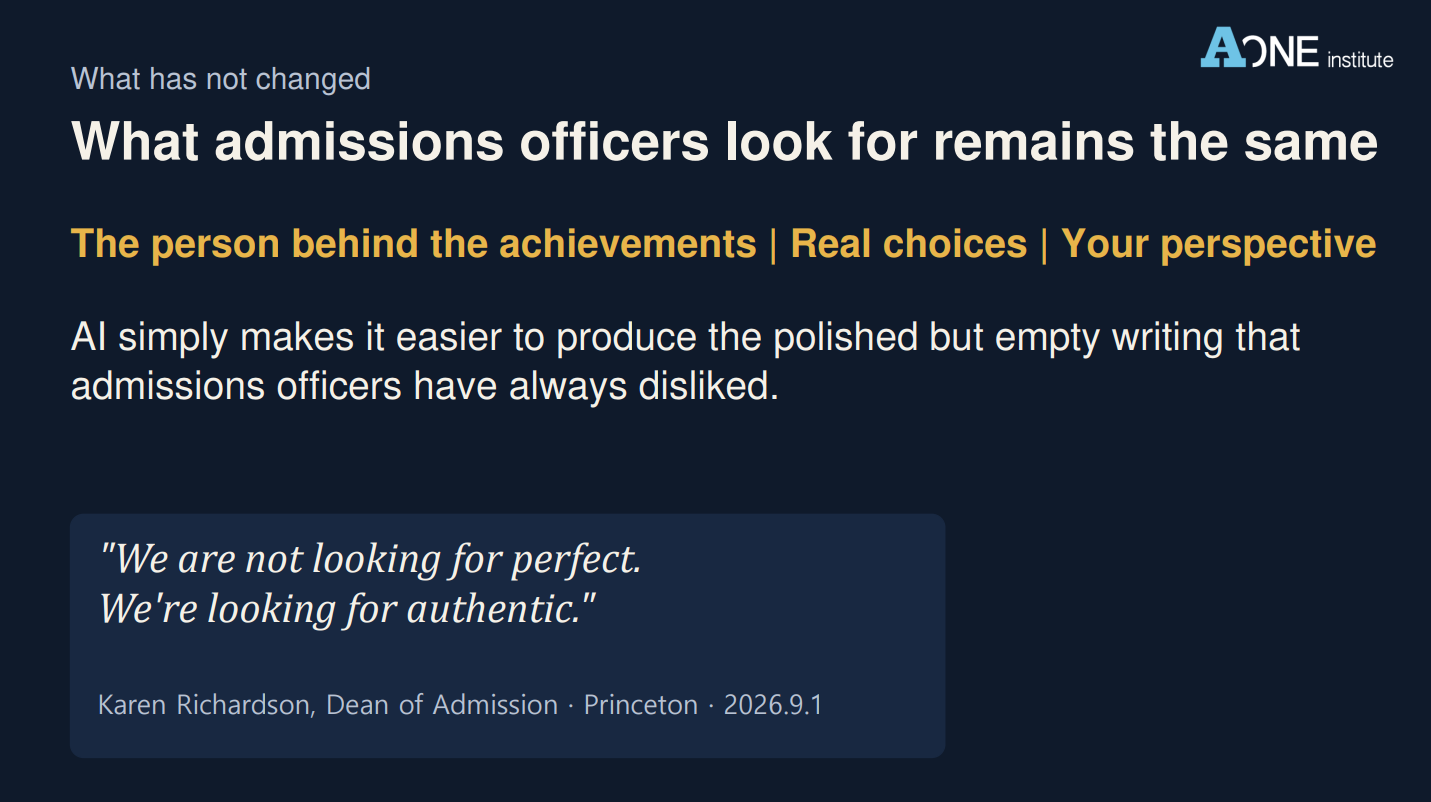
Although essay requirements and AI policies continue to evolve, the underlying purpose of college essays has not fundamentally changed.
Admissions officers want to understand the person behind the application.
Academic performance and extracurricular achievements are already documented elsewhere.
The essay offers an opportunity to explain the decisions, motivations, relationships, and perspectives that those records cannot fully communicate.
A student might have won a competition, led a club, or completed an advanced research project.
Those achievements are important, but the essay should help readers understand the student who experienced them.
What choices did the student make?
How did their thinking change?
What did they learn about themselves or other people?
These questions become especially important when AI makes it easy to produce sophisticated writing that may contain very little personal substance.
Princeton's Dean of Admission, Karen Richardson, emphasized in September 2026 that the university values authenticity rather than perfection.
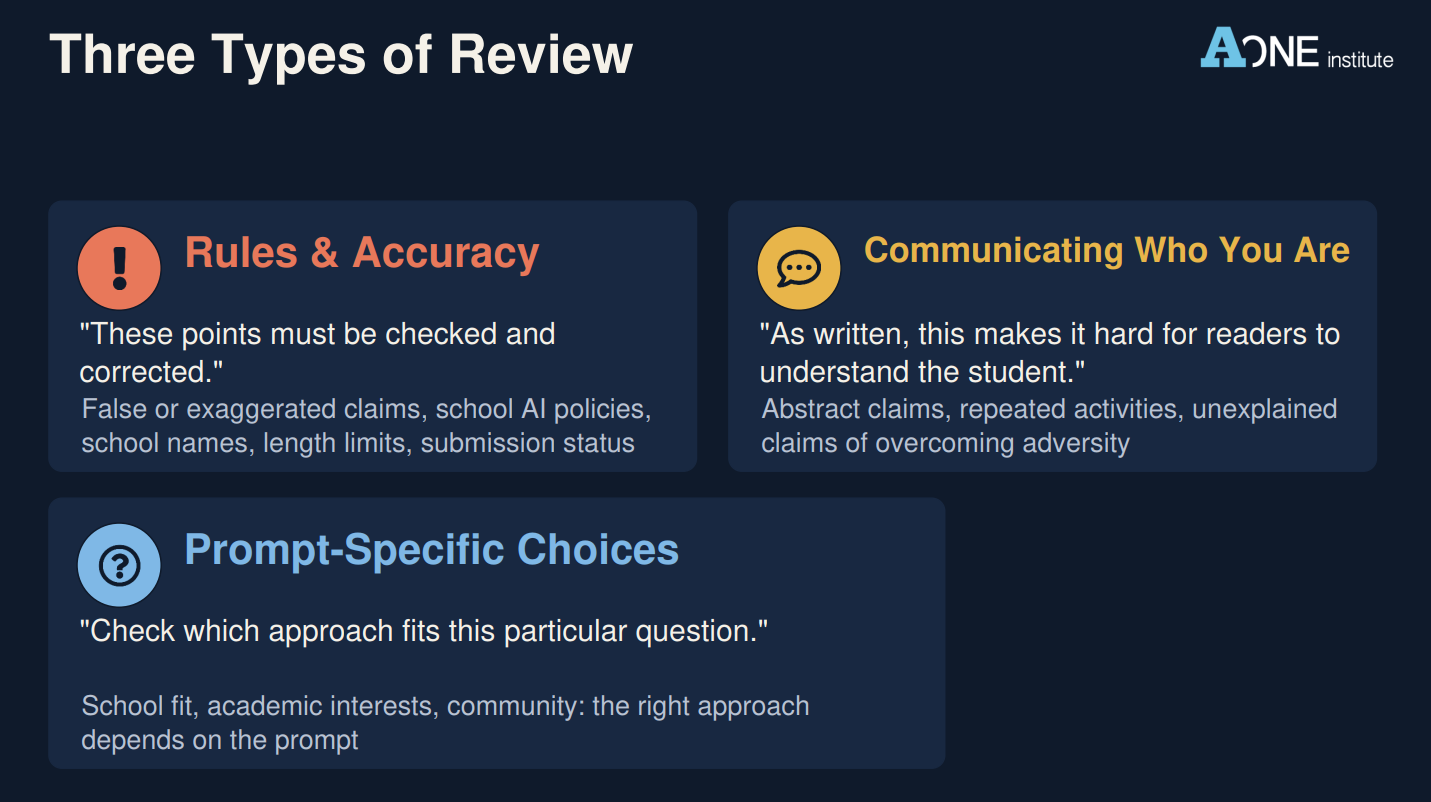
A ONE Institute therefore recommends approaching the final essay review through three areas.
First, check rules and accuracy. The essay should comply with each university's requirements, including word limits, honesty standards, and AI-use policies.
Second, examine how effectively the essay communicates the student's actual experiences and personal qualities.
Third, confirm that the essay's approach matches the specific question being asked. A personal statement, an academic-interest essay, and a school-specific supplemental response do not necessarily serve the same purpose.
Basic compliance is essential, but it is only the starting point.
The following three warning signs address the substance of the writing itself.
Warning Sign 1: Does Your Essay Claim Personal Growth Without Showing It?
Consider the following sentence:
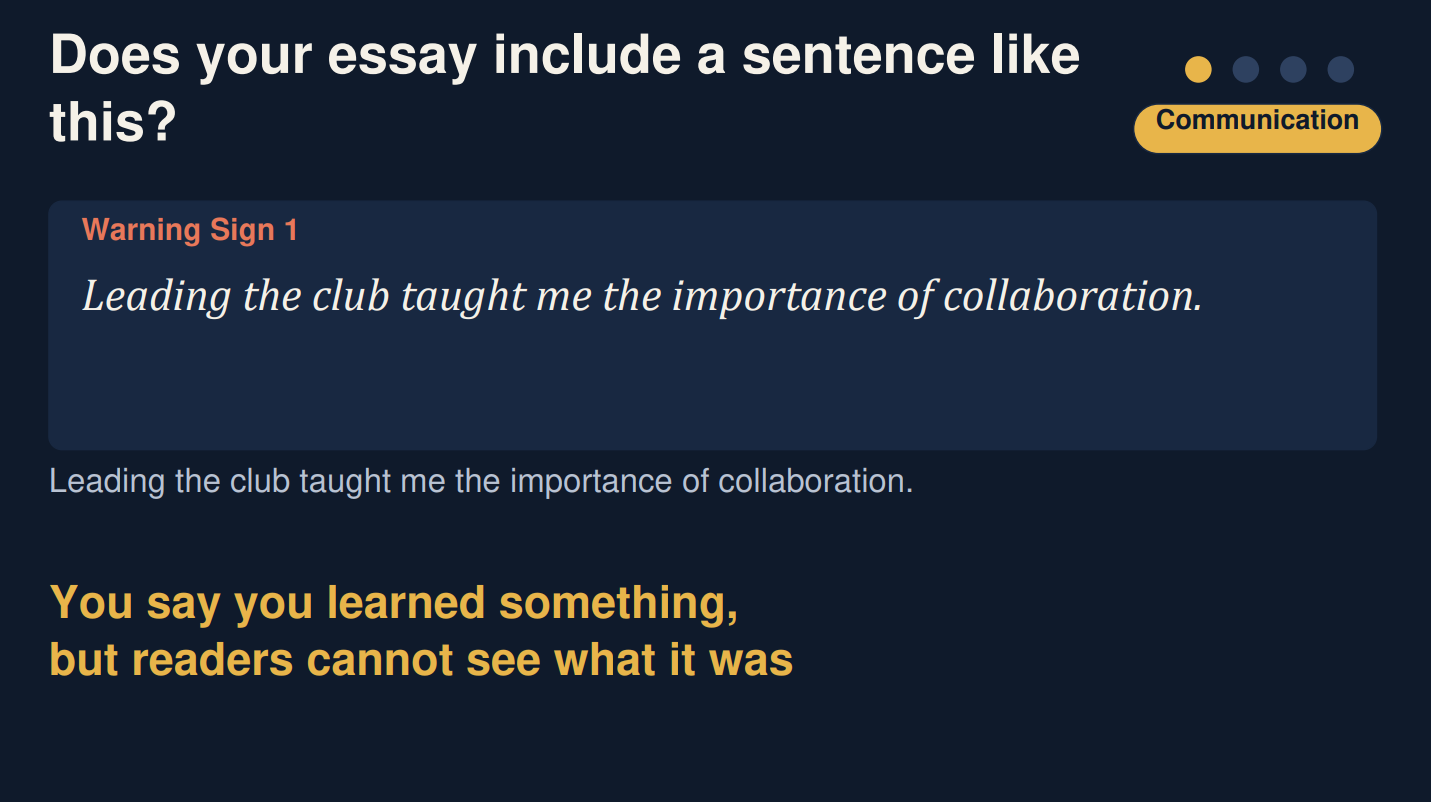
Leading the club taught me the importance of collaboration.
At first glance, it seems like a reasonable sentence.
The student participated in an activity, gained leadership experience, and learned something about working with others.
But there is a problem.
The reader still does not know what the student actually learned.
Simply stating that collaboration is important does not show how the student's understanding developed.
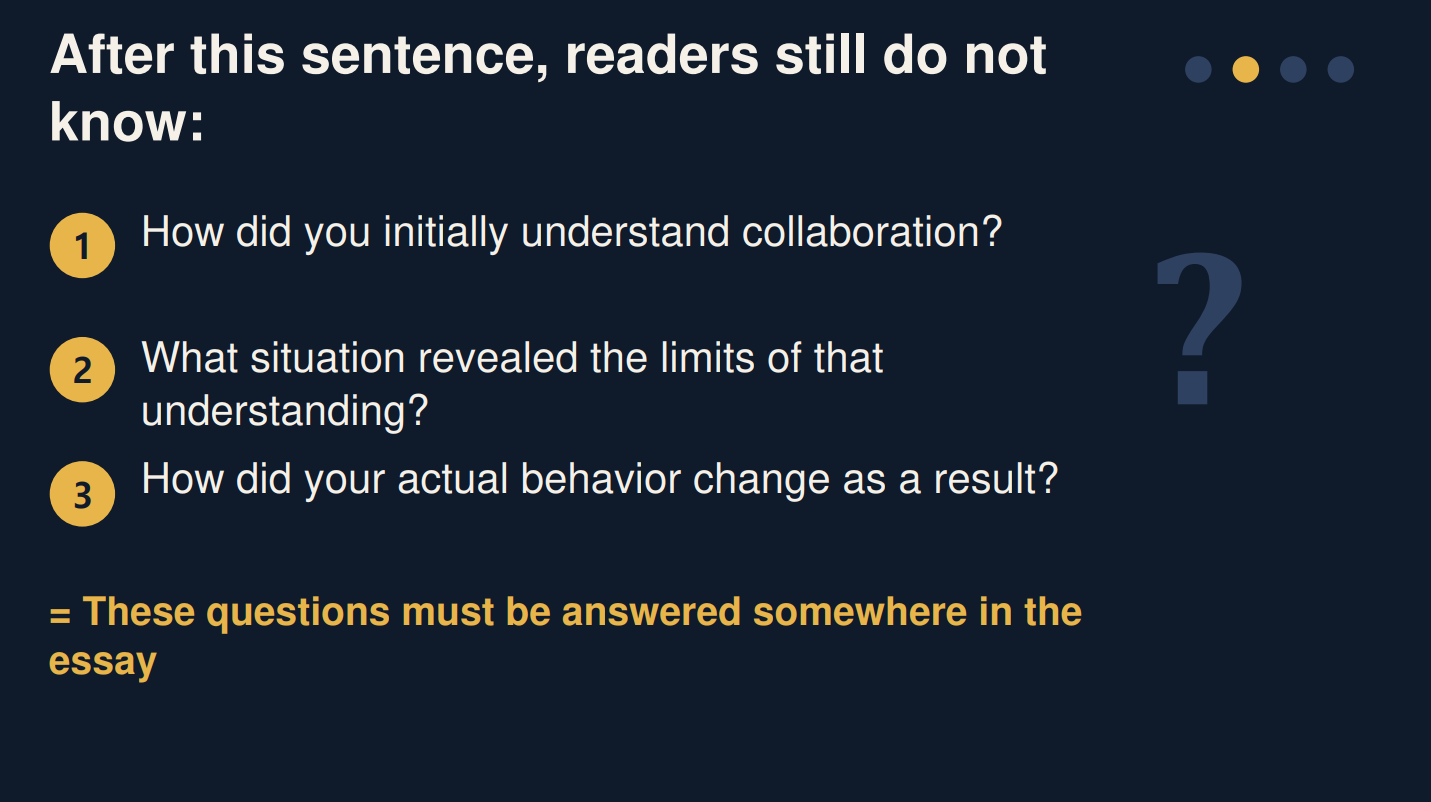
To make the experience meaningful, the student should be able to answer three questions.
-
How did I understand collaboration before this experience?
-
What happened that challenged my original understanding?
-
How did my behavior change afterward?
These three elements create a clearer narrative.
The essay begins with the student's original thinking, introduces an experience that challenges that perspective, and then demonstrates how the student acts differently.
This approach is consistent with advice from several admissions offices.
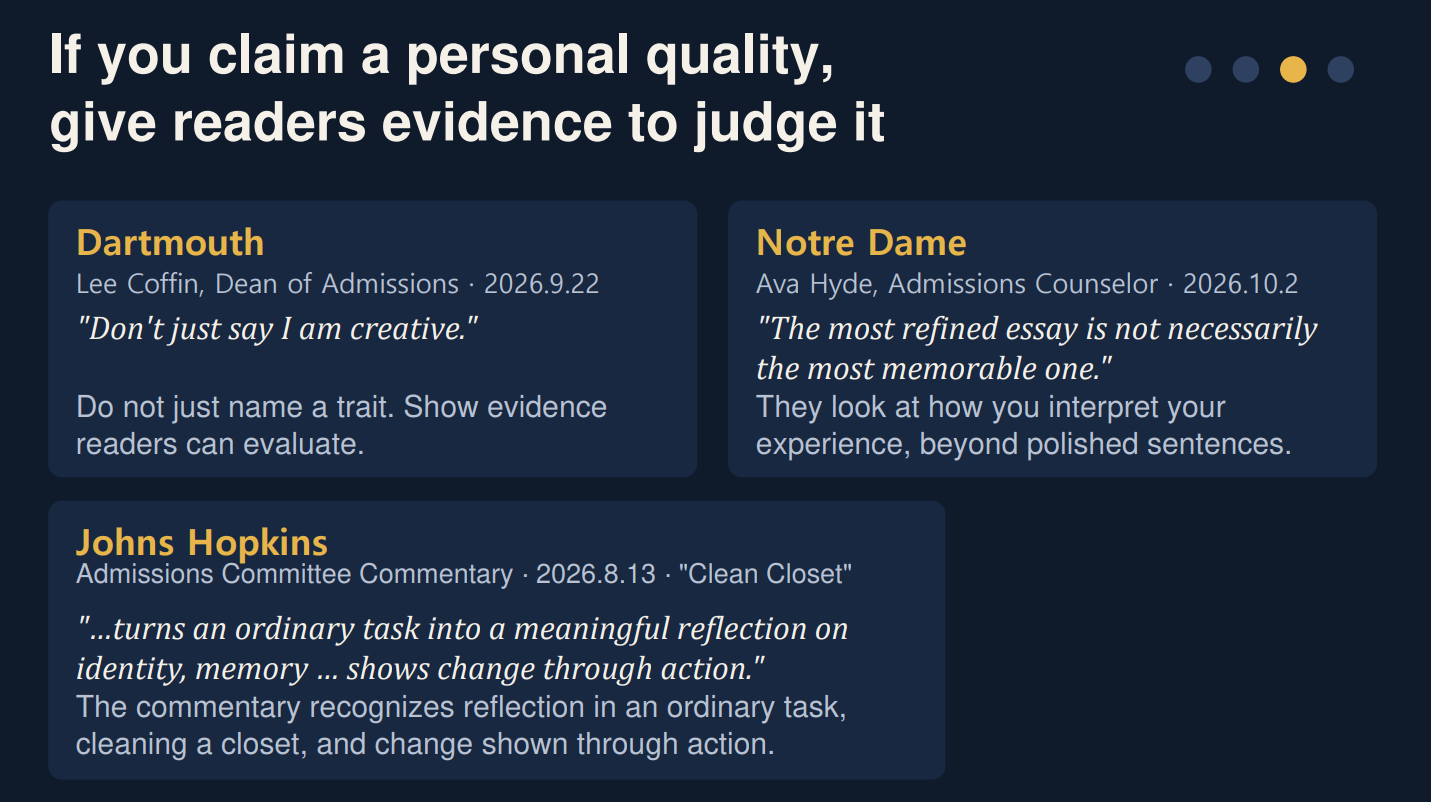
During a September 2026 conversation, Dartmouth's Dean of Admissions, Lee Coffin, emphasized that students should provide evidence of their qualities instead of merely naming those qualities.
For instance, saying "I am creative" is less informative than describing an experience that allows the reader to recognize creativity independently.
Notre Dame expressed a similar perspective in October 2026.
Admissions counselor Ava Hyde explained that the most refined essay is not necessarily the most memorable. The substance of the student's interpretation and reflection can matter more than stylistic polish.
Johns Hopkins provided another example through an admitted student's essay about cleaning out a closet.
Although organizing a closet is an ordinary activity, the essay uses that experience to reflect on identity, memory, and personal change.
The student's growth emerges through the story and subsequent actions rather than through a simple declaration.
How Can You Show a Change in Perspective?
Consider a hypothetical example involving a student who leads a club.
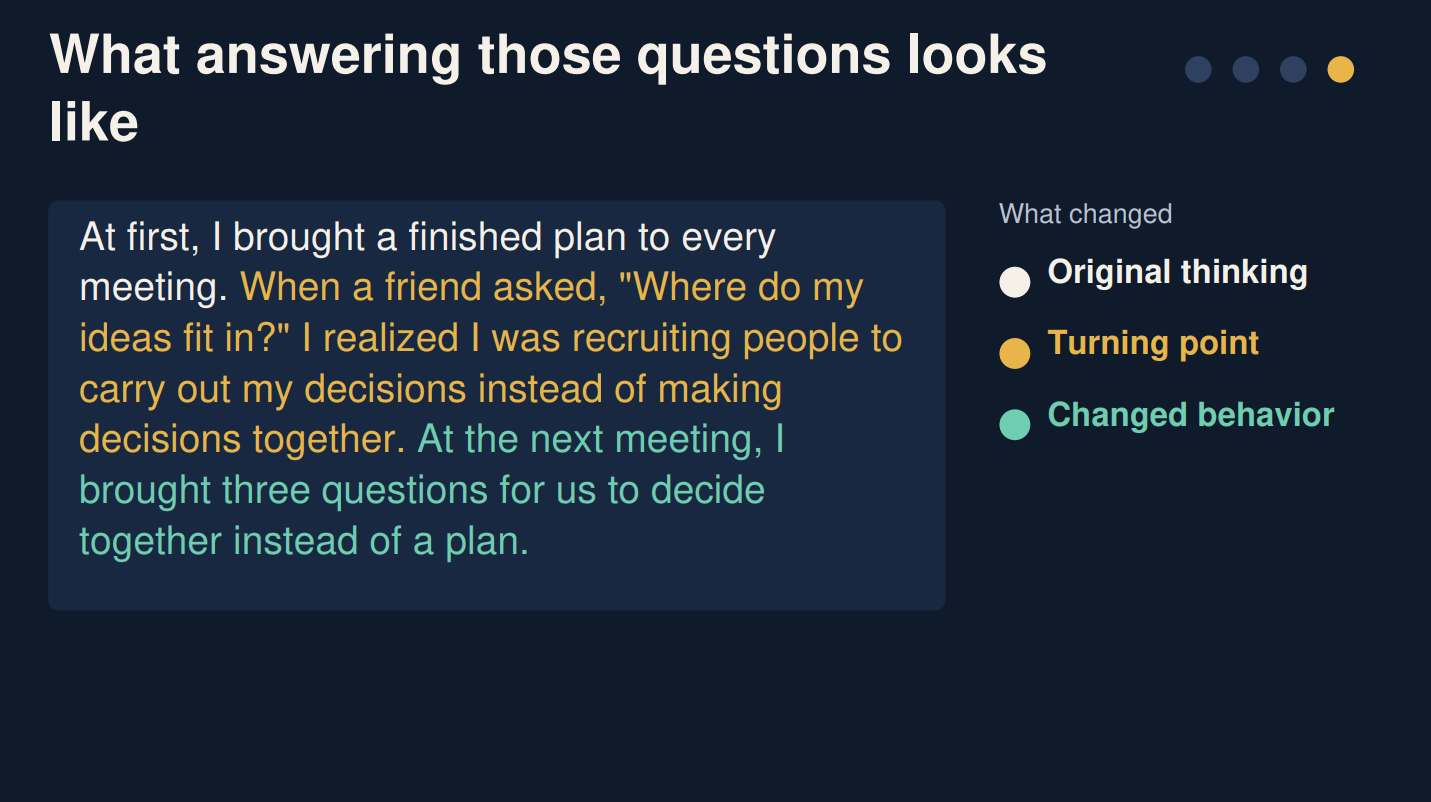
Initially, the student brings a fully developed plan to every meeting.
The student believes that good leadership means preparing everything in advance and giving others clear instructions.
Then, during one meeting, another student asks:
"Where do my ideas fit in?"
That question causes the club leader to reconsider their approach.
The student recognizes that they have been asking members to carry out decisions rather than involving them in making those decisions.
At the next meeting, the leader changes their behavior.
Instead of arriving with a completed plan, the student brings three questions for the group to discuss and decide together.
The difference is significant.
The essay no longer simply tells readers that collaboration matters.
It shows the student's original belief, the experience that challenged it, and the specific action that followed.
Readers can understand how the student's definition of leadership changed.
This is the type of narrative A ONE Institute recommends checking for during the final essay review.
A statement about learning becomes much more convincing when the experience behind that learning is visible.
Warning Sign 2: Does Your Essay Repeat Your Activities List?
Another common problem occurs when students use their essays to repeat accomplishments already described in the Activities section.
Consider this example:
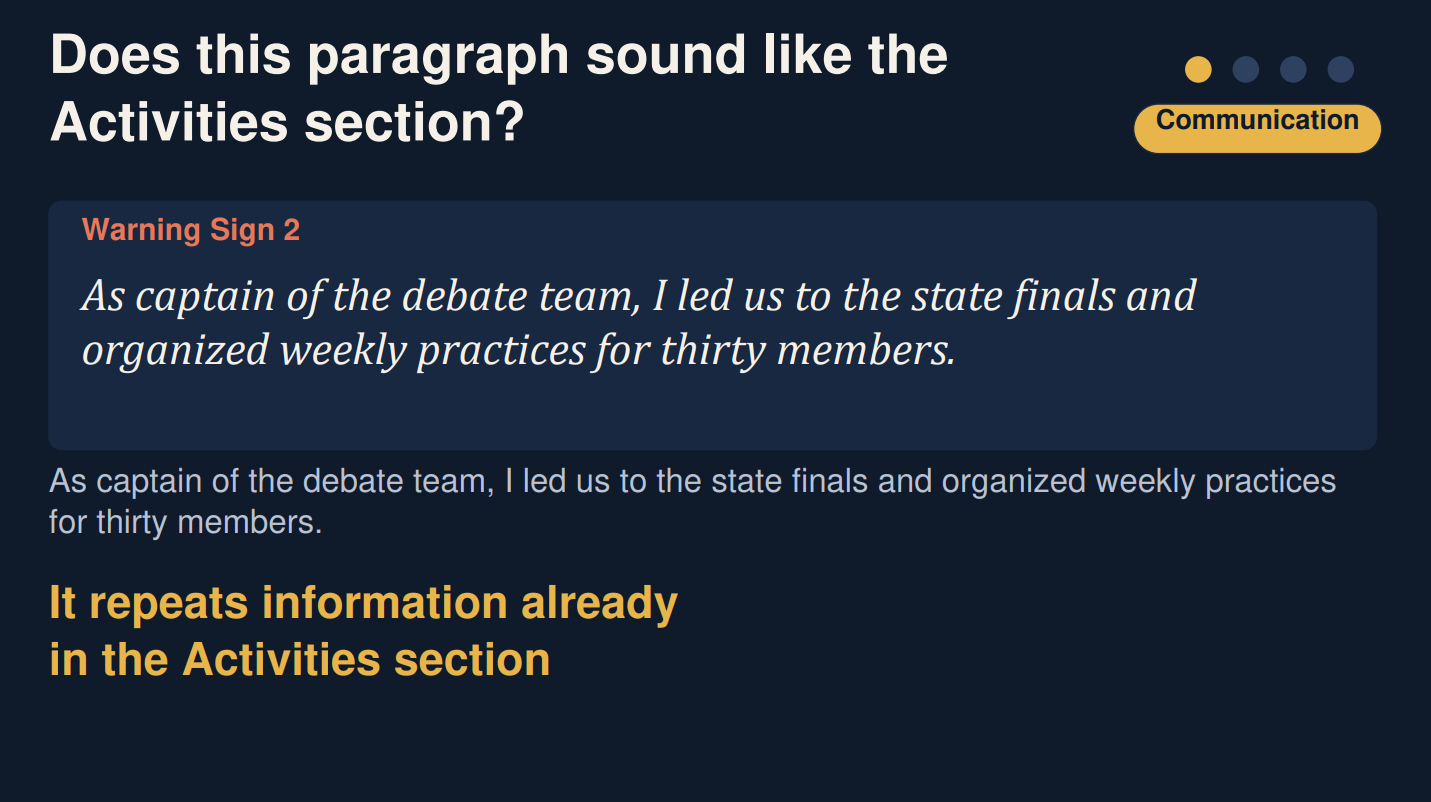
As captain of the debate team, I led us to the state finals and organized weekly practices for thirty members.
The sentence communicates a genuine accomplishment.
It identifies a leadership role, a competitive result, and the scale of the student's responsibility.
However, that information may already appear in the Activities section of the Common Application.
If the essay simply repeats the same information in longer sentences, it may not contribute much to the reader's understanding of the student.
When writing about an extracurricular activity, students should consider what the essay can communicate beyond the activity description.
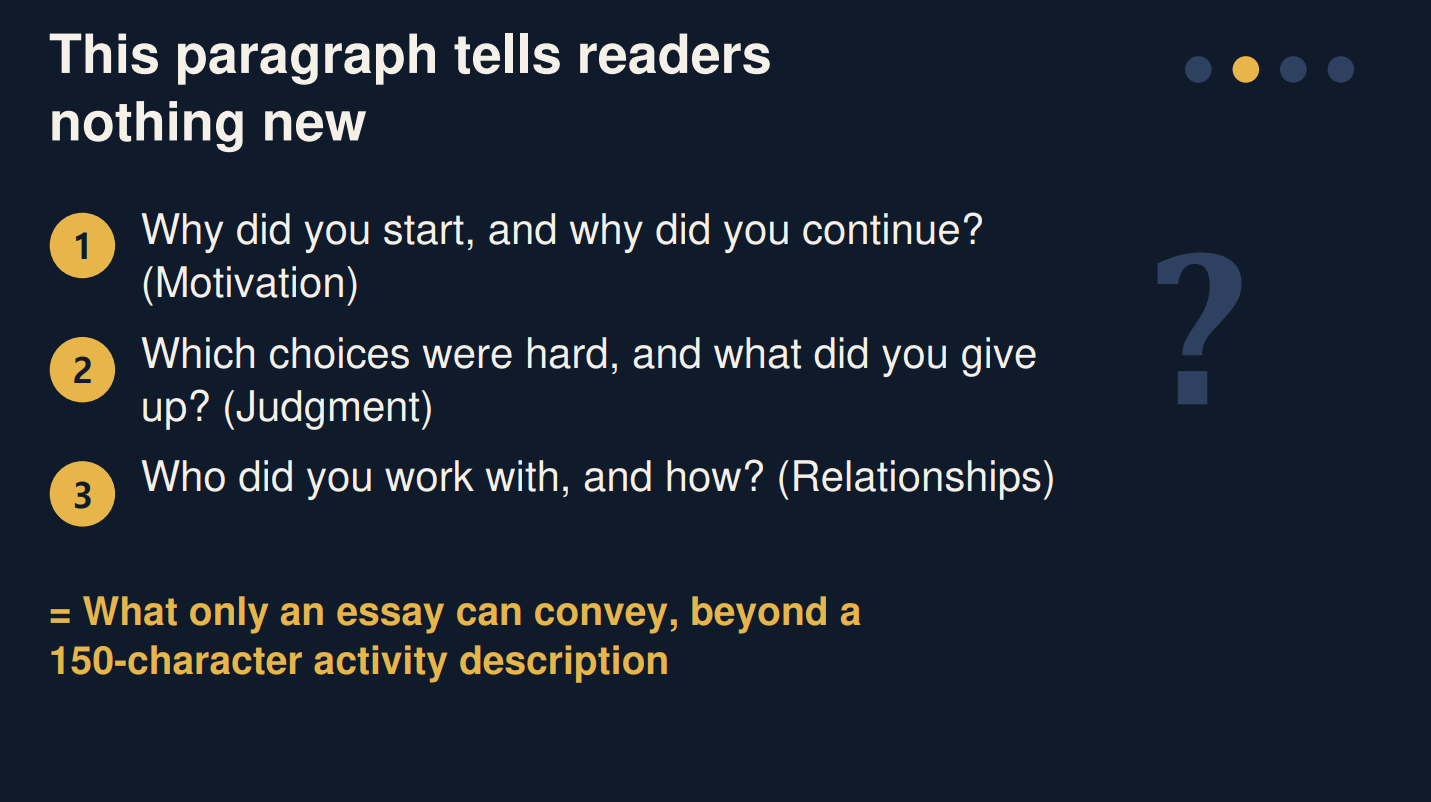
Why did the student become involved?
What motivated them to continue?
Which decisions were difficult?
What did they sacrifice or reconsider?
How did their relationships with other people influence their thinking?
Those details often provide the personal context that a short activity description cannot capture.
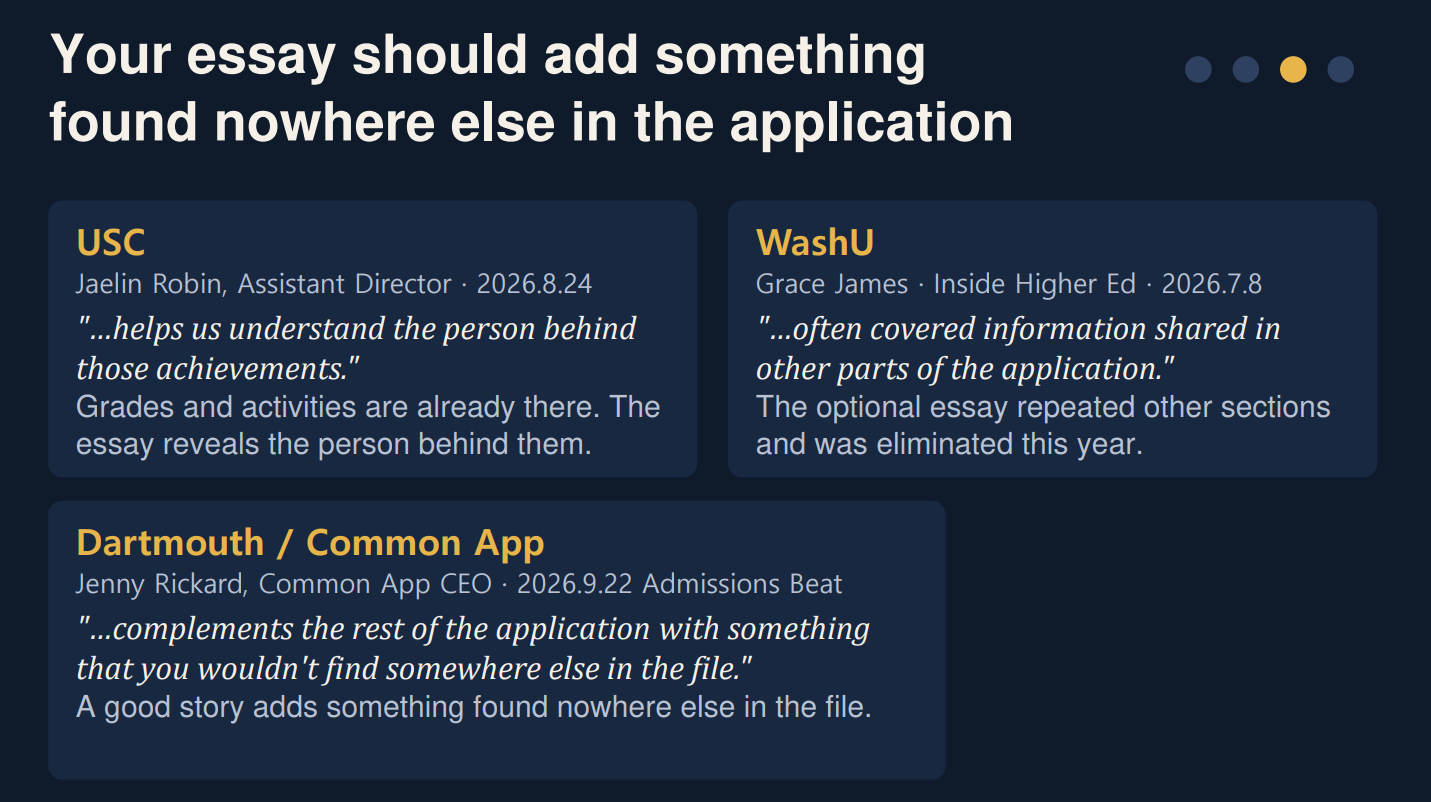
USC explained in August 2026 that application essays help admissions officers understand the person behind the student's achievements.
WashU's decision to remove its optional writing supplement also reflected concerns that the additional response frequently repeated information appearing elsewhere in the application.
Dartmouth Dean Lee Coffin and Common App CEO Jenny Rickard similarly emphasized the importance of telling a story that adds something readers would not find elsewhere in the application.
The objective is not necessarily to avoid writing about an extracurricular activity.
It is to reveal a dimension of that experience that the Activities section cannot adequately communicate.
How Can a Debate Team Achievement Become a Personal Story?
Return to the example of the debate team captain.
Instead of beginning with the team's competitive achievements, the student might describe an early leadership decision.
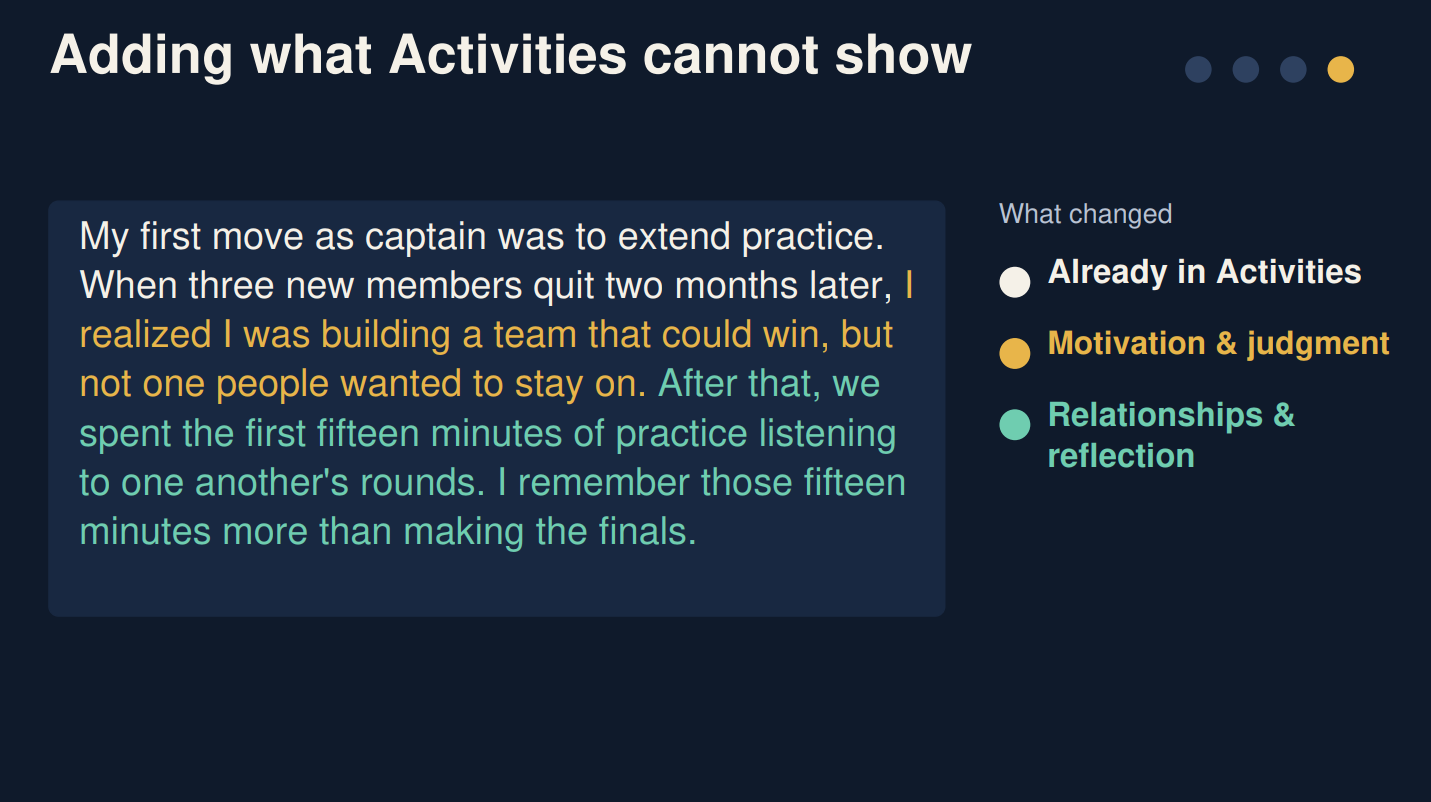
After becoming captain, the student's first response is to increase practice hours.
The goal is to improve the team's performance.
However, several new members eventually leave the team.
The captain begins to question whether the increased workload is creating the kind of team they intended to build.
The student realizes that they have focused on creating a team that can win rather than a team that members want to remain part of.
This leads to another decision.
The captain changes the first 15 minutes of practice into a period when team members listen to one another's debate rounds.
Instead of immediately emphasizing performance, the team creates space for members to understand and support one another.
The competitive result may still be meaningful, but the essay can now communicate something different.
It reveals the student's initial motivation, an unexpected problem, a change in judgment, and a new approach to leadership.
The original example concludes by suggesting that those 15 minutes became more memorable than reaching the finals.
That reflection can be effective if it genuinely represents the student's experience.
However, students should never invent or exaggerate their feelings simply to make an essay sound more meaningful.
The strongest version of this story is the one that accurately reflects what the student actually experienced.
This is why A ONE Institute recommends reviewing whether an essay includes a genuine narrative of motivation, judgment, relationships, and personal interpretation.
An activity description may explain what the student accomplished.
The essay should explain more about who the student became through the experience.
Warning Sign 3: Does Your Adversity Essay Spend Too Much Time Describing the Problem?
Many students choose to write about challenges, setbacks, or difficult experiences.
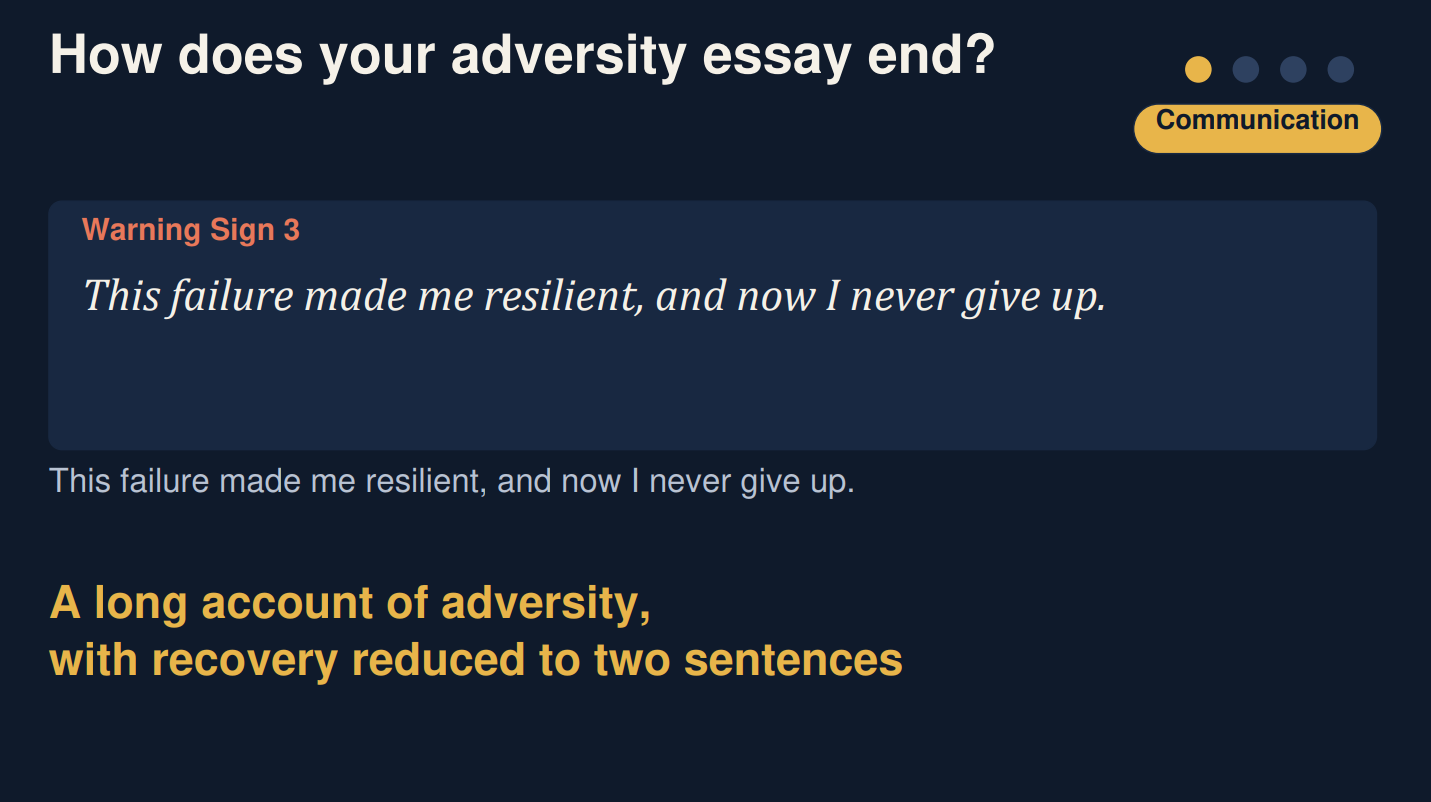
However, adversity essays can become unbalanced when most of the writing describes how difficult the situation was, while the response or learning is reduced to only a few sentences.
Consider a conclusion such as:
This failure made me resilient, and now I never give up.
The statement expresses a positive quality.
But it does not explain how the student responded to the difficulty.
The reader may understand the problem without understanding the person who experienced it.
A ONE Institute recommends examining the events between the original difficulty and the final reflection.
What did the student actually do?
Was there a particular event that changed their perspective?
Did another person offer assistance?
Did the student find a new strategy or resource?
How does the student respond to similar situations now?
And importantly, what remains difficult?
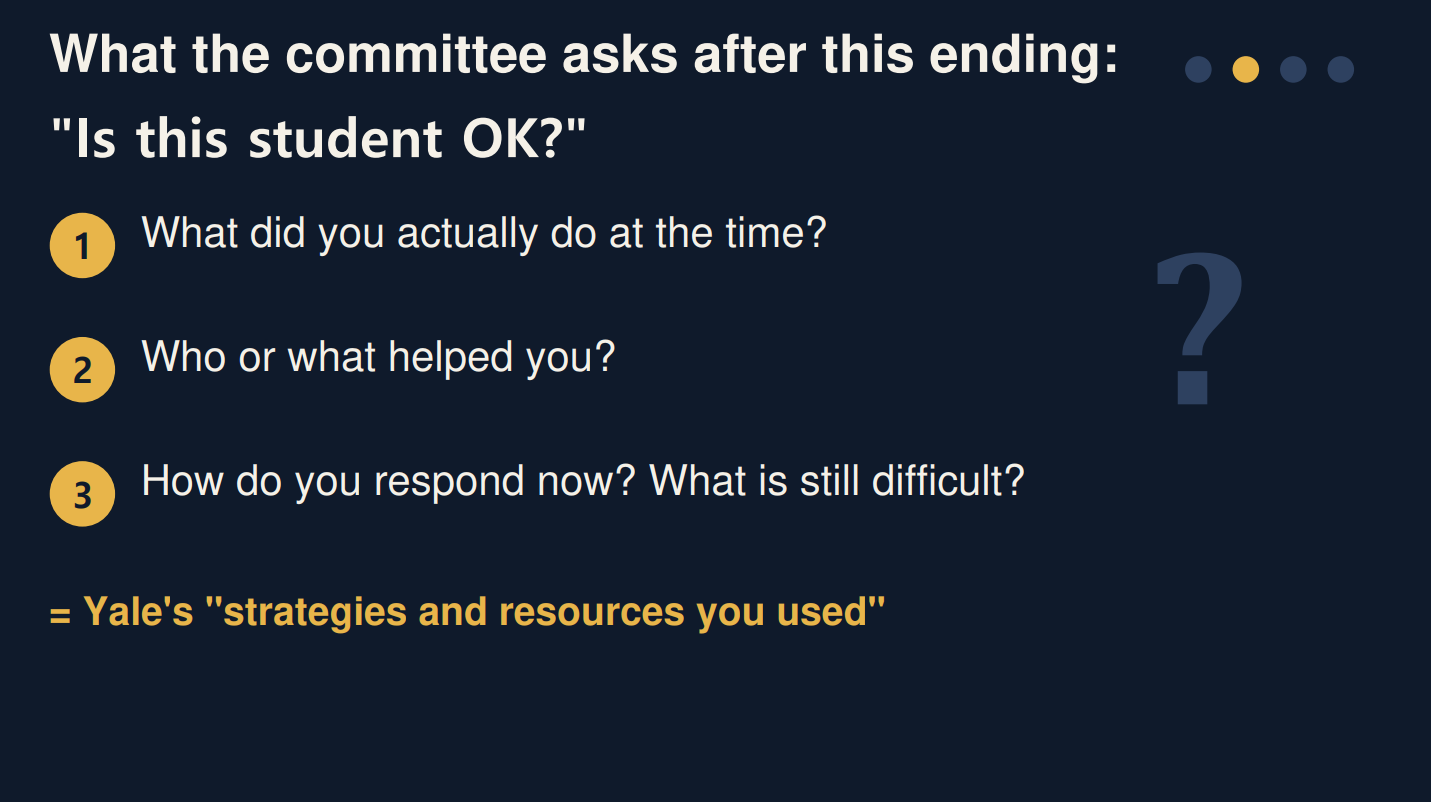
These details often reveal more about the student than a dramatic description of the original setback.
Does an Adversity Essay Need a Perfect Resolution?
No. Students do not need to present themselves as having completely resolved every challenge.
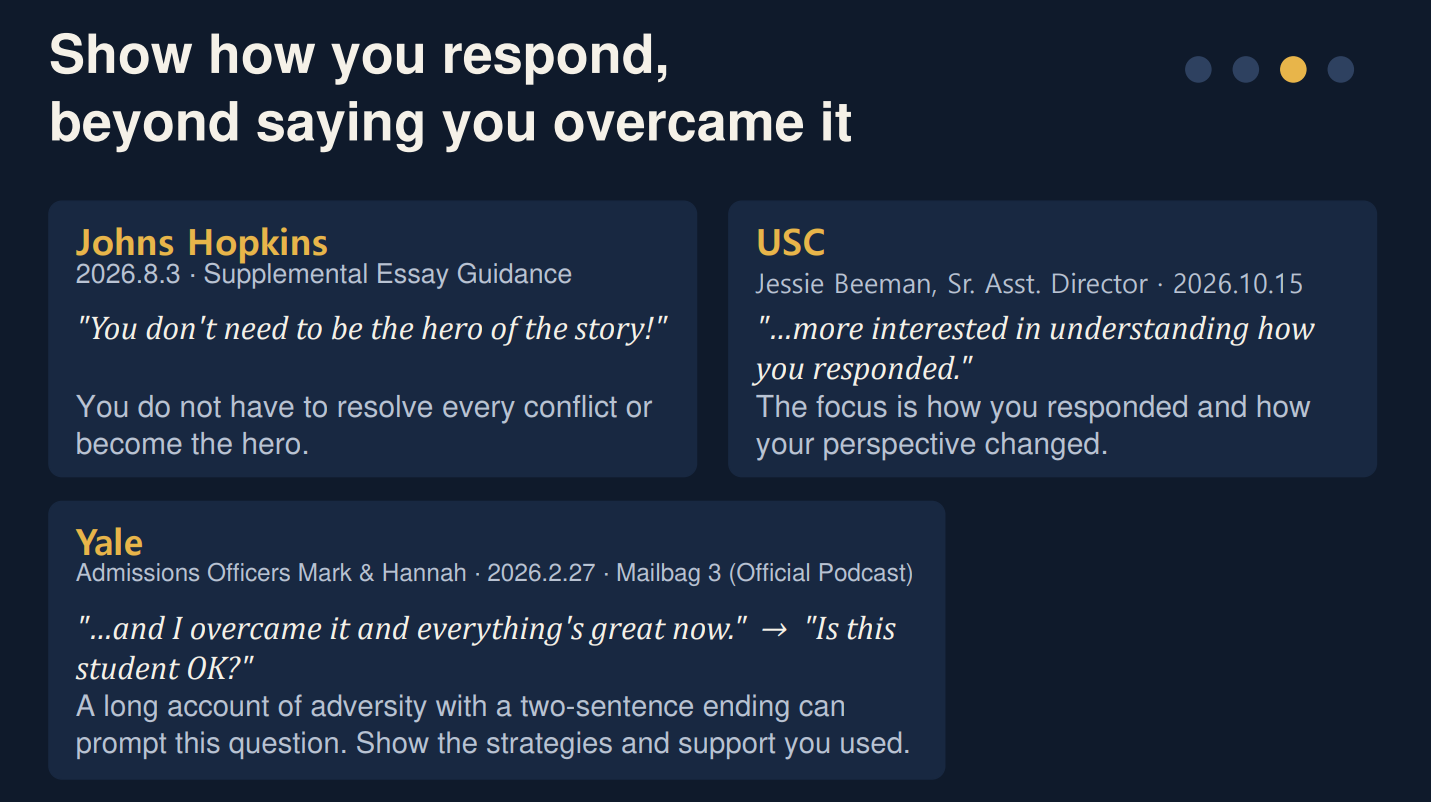
Johns Hopkins explained in its August 2026 supplemental essay guidance that students do not need to become the heroes of their stories or resolve every disagreement.
The university emphasizes thoughtful engagement, reflection, and growth.
Yale has also discussed the importance of explaining how students are currently managing challenges.
In a February 2026 admissions podcast, Yale officers described situations in which an essay spends considerable time explaining a serious difficulty and then abruptly concludes that everything has been overcome.
Such an ending may leave readers uncertain about how the student actually worked through the experience.
The admissions officers emphasized explaining the strategies, support systems, and resources that helped.
USC's October 2026 guidance offers a related perspective.
The university encourages students writing about sensitive experiences to focus not only on what happened, but also on how they responded, what they learned, and how their perspective changed.
The purpose is not to manufacture an inspirational ending.
Students may still be dealing with certain challenges.
They can acknowledge that reality while explaining their present perspective and the actions they have taken.
How Can an Adversity Essay Show an Ongoing Process?
Consider an example involving a student whose scientific experiment failed.
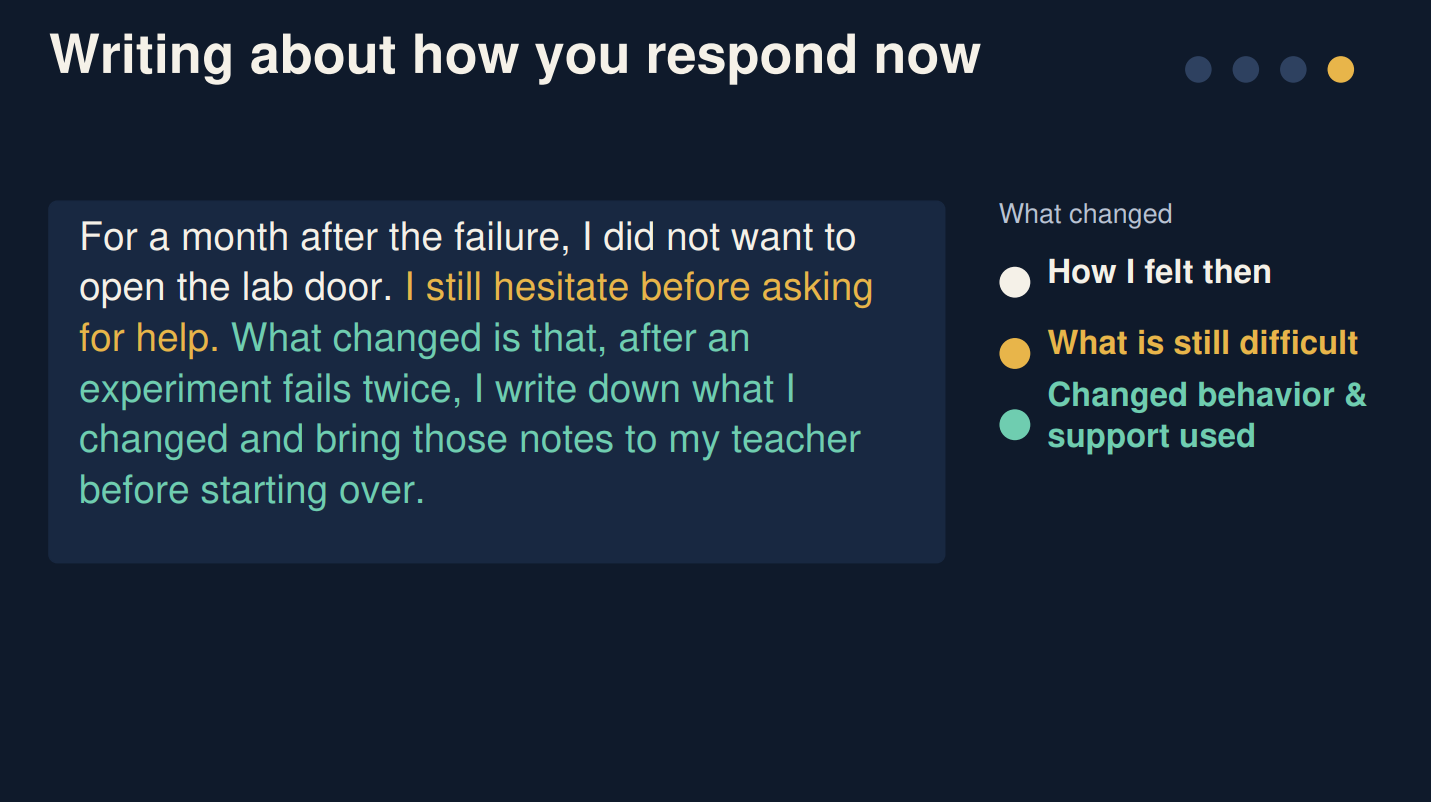
For a month after the failure, the student feels reluctant to return to the laboratory.
The difficulty does not disappear immediately.
The student may still hesitate to ask for help.
However, the student's approach gradually changes.
When an experiment fails repeatedly, the student begins recording what was changed between attempts.
The student then brings those notes to a teacher before beginning another experiment.
This example does not describe a dramatic victory.
The student has not suddenly become someone who never experiences uncertainty or frustration.
Instead, the essay reveals a more specific change.
The student begins responding to failure differently.
The reader can understand what was difficult, what remains challenging, what the student did, and how the student used available support.
That is much more informative than simply claiming to have become resilient.
For students reviewing adversity essays, A ONE Institute recommends checking whether the narrative includes these meaningful details.
Should Students Write an Essay That Pleases Their Parents or Admissions Officers?
Students and parents sometimes become overly focused on whether they personally like the finished essay.
A parent may prefer an essay that emphasizes the student's accomplishments.
A student may feel uncomfortable when an essay discusses uncertainty, mistakes, or changes in perspective rather than achievements.
However, the purpose of a college admissions essay is not simply to create a piece of writing that sounds impressive to the family.
The essay should communicate information that helps admissions officers understand the applicant.
This may require students to reveal aspects of themselves that are not immediately visible through grades, awards, and leadership positions.
An essay that focuses on reflection and personal change is not necessarily weaker because it mentions fewer achievements.
In many situations, the student's accomplishments are already documented elsewhere in the application.
The essay can serve a different purpose.
Students should therefore consider whether their writing allows readers to understand the person behind those accomplishments.
The most useful question is not simply whether the writing sounds polished.
It is whether the narrative provides meaningful evidence of the student's motivation, judgment, relationships, and personal development.
How Can a Personal Perspective Make an Essay More Meaningful?
Once an essay has a clear narrative structure, students can take the final review one step further.
They should examine whether the lesson or change in perspective is genuinely their own.
For example, a student might conclude that an experience taught them the importance of maintaining a regular schedule.
That realization may be sincere.
However, it is also a relatively common conclusion.
To develop a more meaningful reflection, the student should consider what the experience actually changed about their understanding.
Did it challenge an assumption they previously held?
Did it reveal something unexpected about themselves or another person?
Did the experience lead them to make a different decision?
Does their current perspective contain an insight that comes specifically from what they experienced?
A ONE Institute encourages students to develop a distinctive but well-grounded personal interpretation rather than relying on a familiar moral lesson.
Distinctiveness should not mean forcing an unusual or exaggerated conclusion.
It should come from thinking carefully about the actual experience.
Students sometimes spend considerable time trying to combine short sentences into longer, more sophisticated ones.
Others focus heavily on avoiding simple vocabulary or making every sentence sound especially impressive.
Those concerns may have a place in the final editing process, but they should not overshadow the substance of the essay.
A grammatically polished sentence cannot replace a meaningful insight.
The more valuable final review is often the one that asks whether the student's perspective has been explained with enough depth and specificity.
What Should You Prioritize Before Submitting Your Essay?
For the final review, A ONE Institute recommends returning to the three communication problems discussed above.
First, identify sentences that claim the student learned something without explaining the experience that led to that learning.
Second, examine whether the essay repeats information already available in the Activities section instead of revealing additional personal context.
Third, review adversity narratives to determine whether they explain the student's response, decisions, use of support, and changes in perspective rather than focusing almost entirely on the difficulty itself.
These three checks do not replace basic application requirements.
Students must still confirm factual accuracy, follow institutional AI policies, comply with word limits, and ensure that each response addresses its assigned prompt.
However, once those basic requirements are satisfied, the substance of the personal narrative deserves careful attention.
The objective is not to make every essay sound extraordinary.
It is to make the student's actual experiences, choices, and personal understanding visible to the reader.
Other prompt-specific concerns, including Why Major essays, conflict and community essays, and the additional Johns Hopkins examples, require their own review.
Those topics are separate from the three communication issues addressed here.
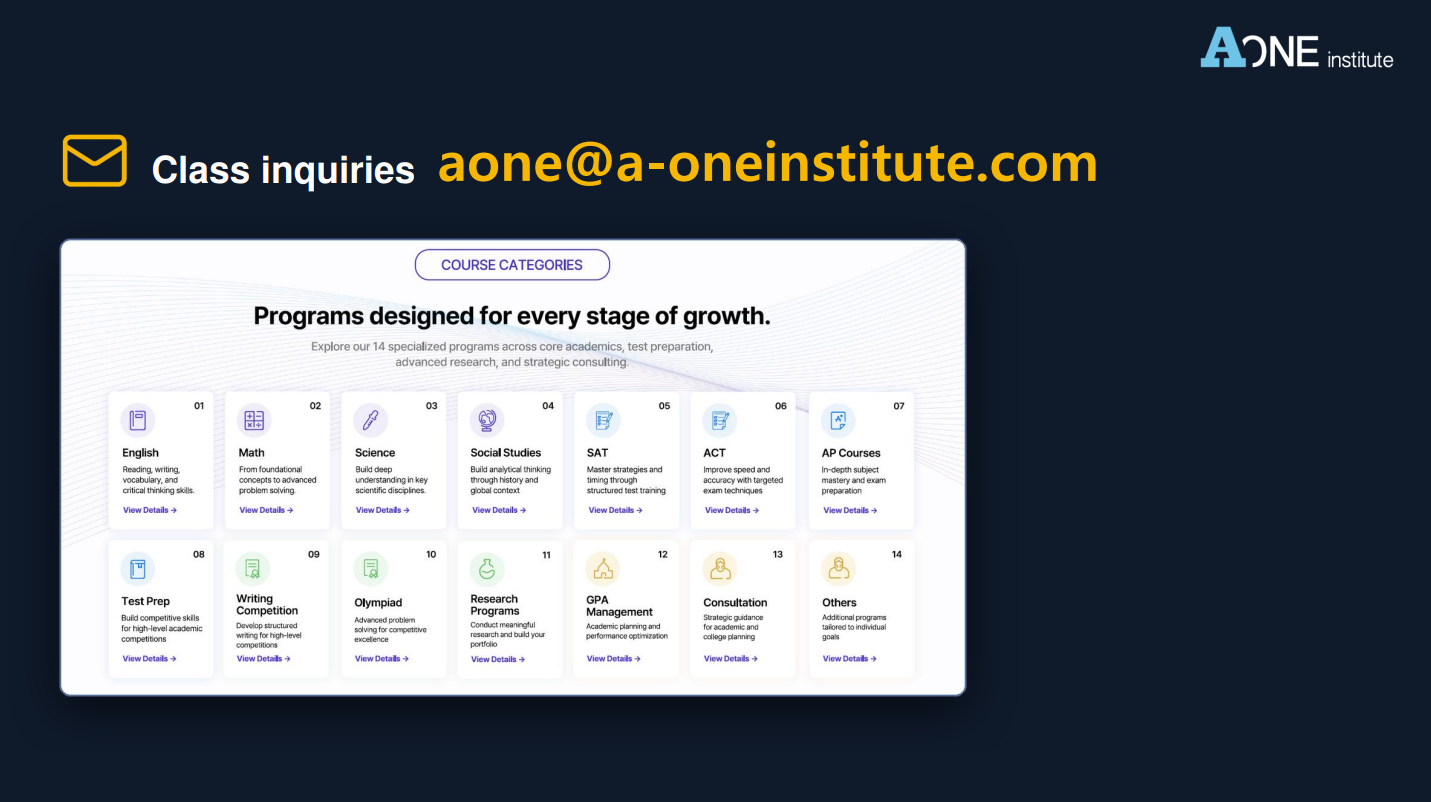
A ONE Institute helps students prepare for U.S. college admissions through academic planning, essay development, extracurricular evaluation, and individualized guidance. During the final essay review, the priority is to ensure that each student's writing accurately reflects their experiences and communicates the personal perspective behind their achievements.
College Essay Checklist
College Application Essays
Supplemental Essays
AI Essay Policies
Common App Essay
College Admissions 2026–2027
