
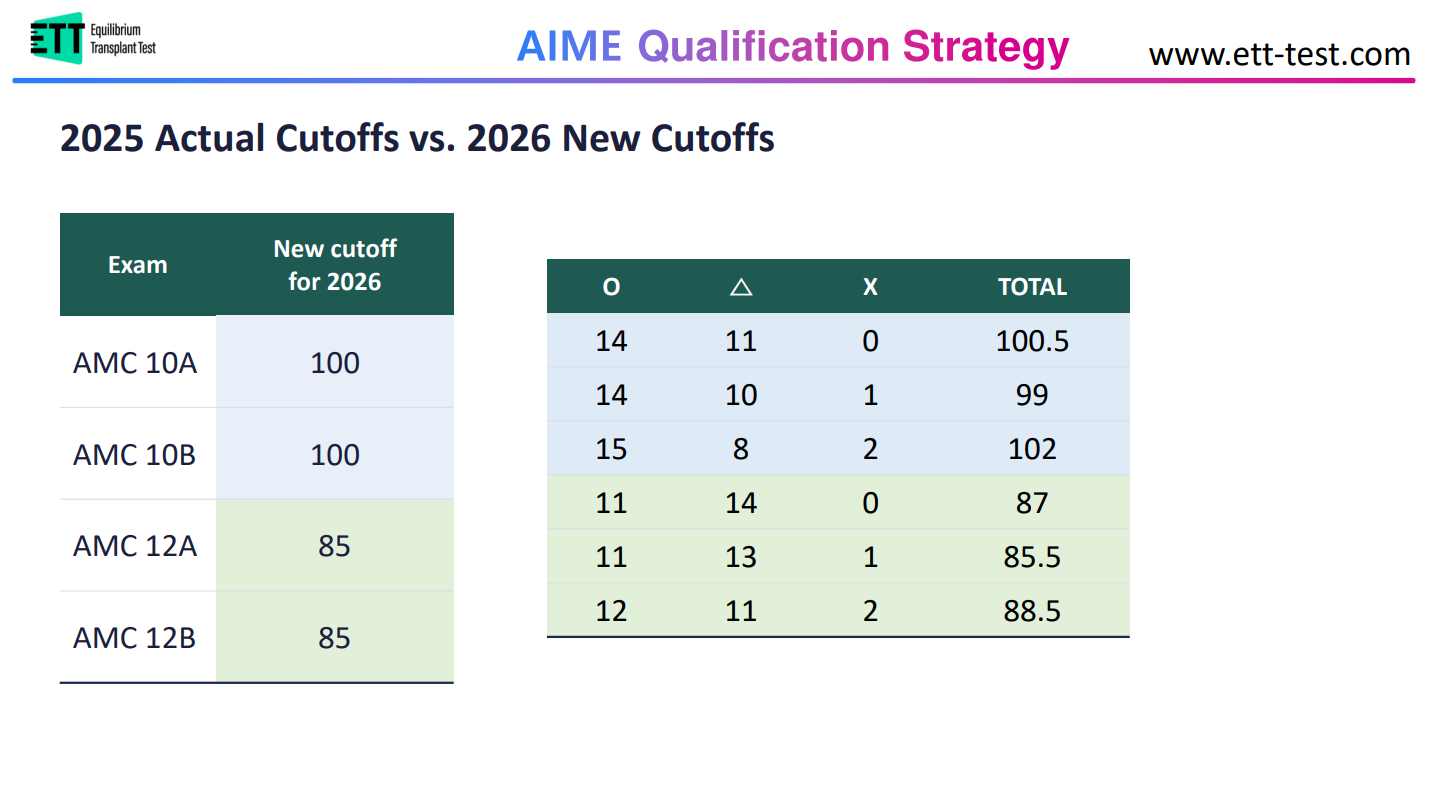
For students who once assumed that AIME was only realistic for exceptionally advanced competition-math students, the 2026 AMC 12 creates a different strategic opportunity. With the new fixed AIME qualification threshold of 85 points on AMC 12, a student can qualify by getting 11 questions correct and leaving the remaining 14 unanswered, which produces a score of 87. The key is not trying to solve all 25 questions. It is identifying the questions that matter most, getting them right, and using the remaining time to verify those answers carefully.
What Changed for AIME Qualification?
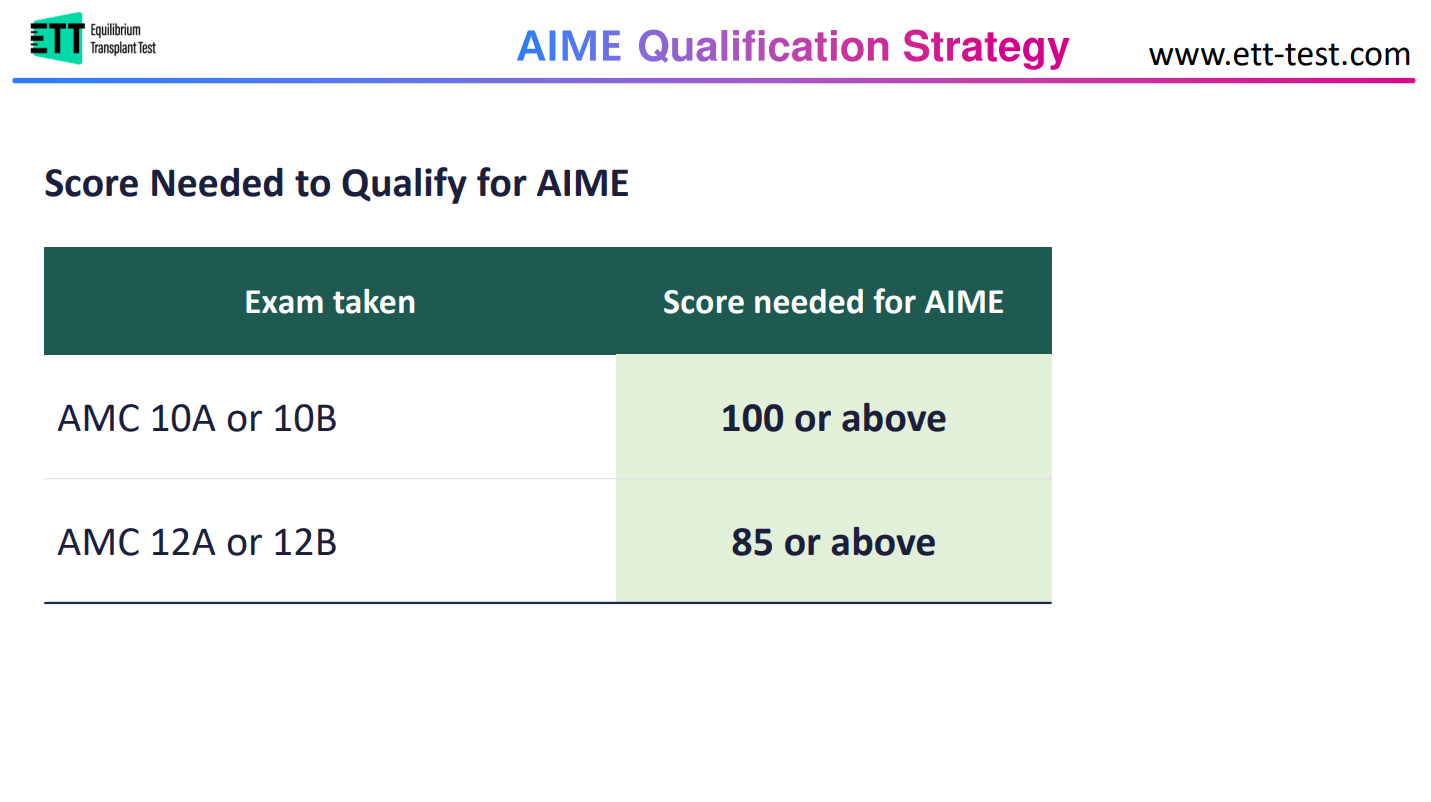
One clarification is important. The basic AMC scoring system itself has not newly changed. What changed for the 2026–27 competition cycle is the AIME qualification threshold: qualification now uses fixed scores rather than thresholds determined by percentages.
For this cycle:
- AMC 10: 100 or higher
- AMC 12: 85 or higher
The AMC still has 25 questions in 75 minutes. A correct answer earns 6 points, a blank answer earns 1.5 points, and an incorrect answer earns 0.
That difference between a blank answer and a wrong answer is what makes the strategy especially important.
The AMC 12 Target: Get 11 Questions Right
For this strategy, we are focusing specifically on the AMC 12.
Suppose a student gets the first 11 questions correct and leaves Questions 12 through 25 blank.
Eleven correct answers produce:
11 × 6 = 66 points
Fourteen blank answers produce:
14 × 1.5 = 21 points
That gives a total score of:
66 + 21 = 87
That is above the 85-point AIME qualification threshold.
There is even a little room for one mistake. If a student attempts 12 questions, gets 11 correct, gets one wrong, and leaves the remaining 13 blank, the score becomes:
66 + 19.5 = 85.5
That still clears the threshold.
So the goal of this strategy is very specific: do not prepare as though you need to conquer the entire AMC 12. Prepare to make the first 11 questions as reliable as possible.
Why Questions 1–11 Become the Entire Strategy
If the objective is AIME qualification rather than maximizing the AMC score, the test can be approached differently.
The student focuses on Questions 1 through 11. If Question 12 also looks manageable, the student may attempt it, but the core objective remains 11 correct answers.
The rest of the 75-minute testing period can then be used to go back through those attempted questions and check the work carefully. Questions beyond the target range can be left unanswered rather than creating unnecessary risk.
This is not how every AMC student should prepare. It is a strategy for a very specific type of student: someone who has studied AMC material before, can already handle much of the earlier part of the test, but has not yet been able to reach AIME consistently.
For that student, trying to improve all 25 questions in a few weeks may be unrealistic. Strengthening the exact portion of the exam needed to reach 85 can be much more focused.
What Did the Last Five Years of AMC 12 Questions Show?
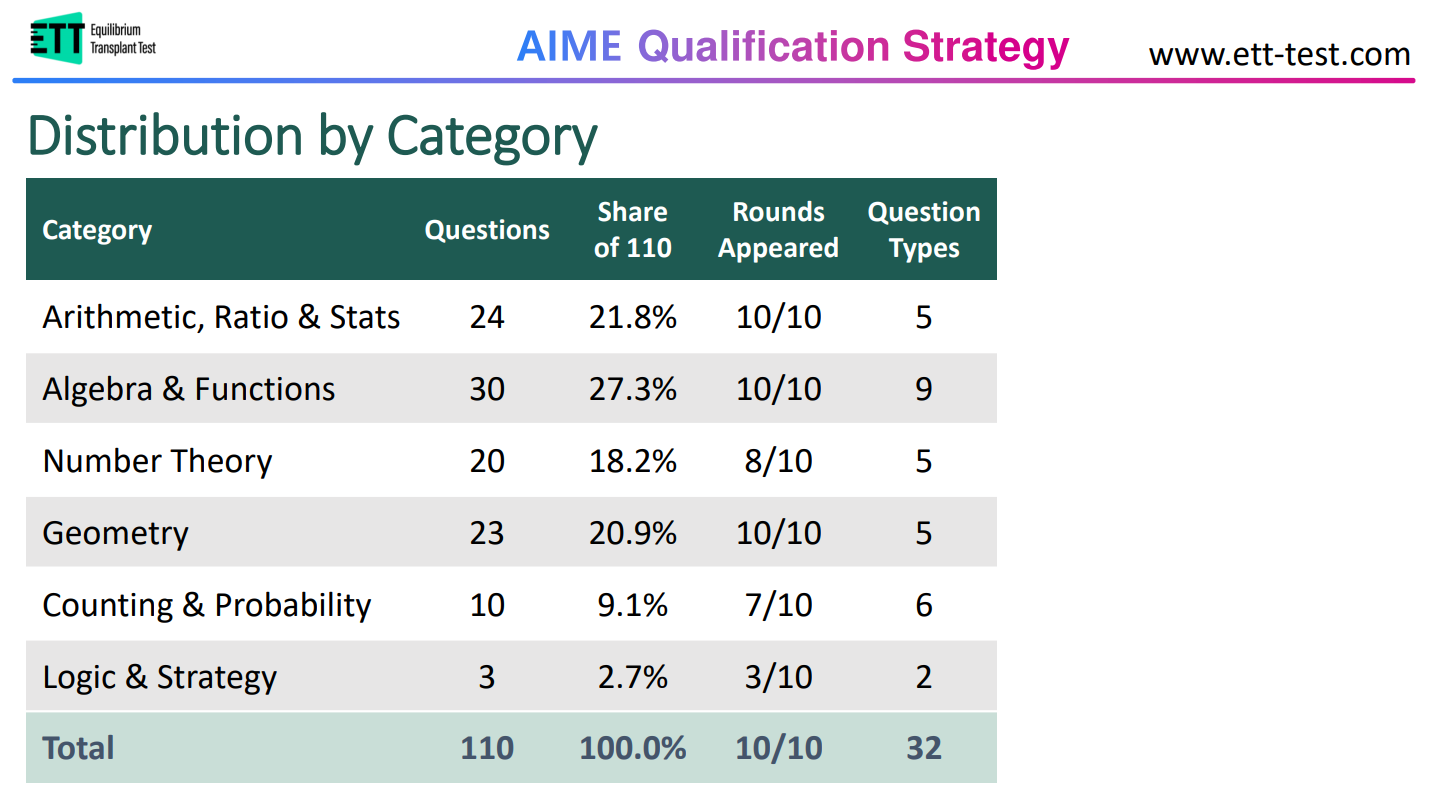
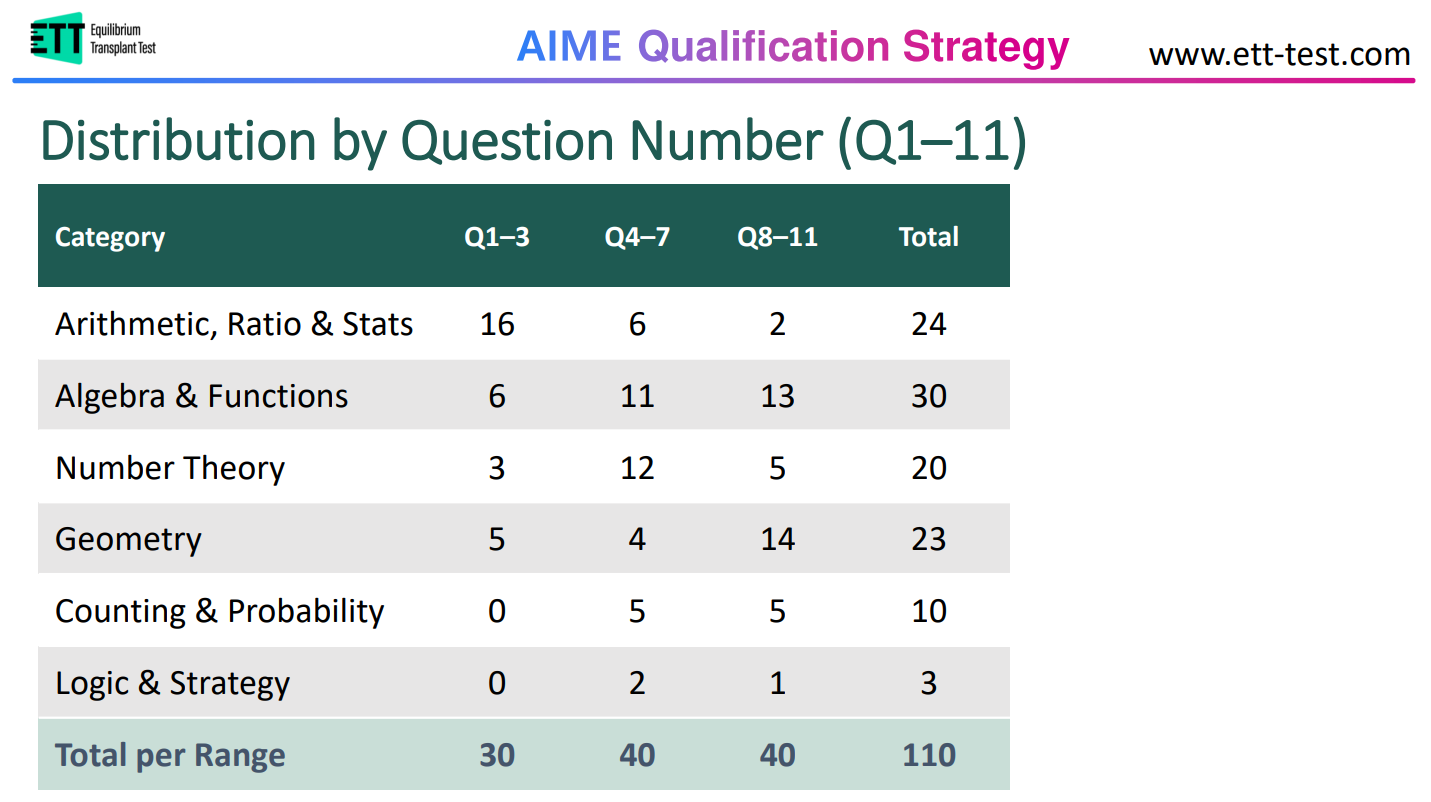
To examine this strategy, A ONE Institute analyzed Questions 1–11 from AMC 12A and AMC 12B over the five years from 2021 through 2025.
That produces 110 questions in total.
The questions were grouped into six broad categories:
- Arithmetic, Ratio & Statistics
- Algebra & Functions
- Number Theory
- Geometry
- Counting & Probability
- Logic & Strategy
Among the 110 questions, Algebra & Functions appeared most often with 30 questions.
Arithmetic, Ratio & Statistics accounted for 24 questions, Geometry for 23, Number Theory for 20, Counting & Probability for 10, and Logic & Strategy for 3.
For a student with limited preparation time, this matters. We are not asking which topics dominate the entire AMC 12. We are asking a narrower question:
Which topics appear most often inside the first 11 questions that this particular strategy is targeting?
Algebra, Arithmetic, Geometry, and Number Theory Deserve the Most Attention
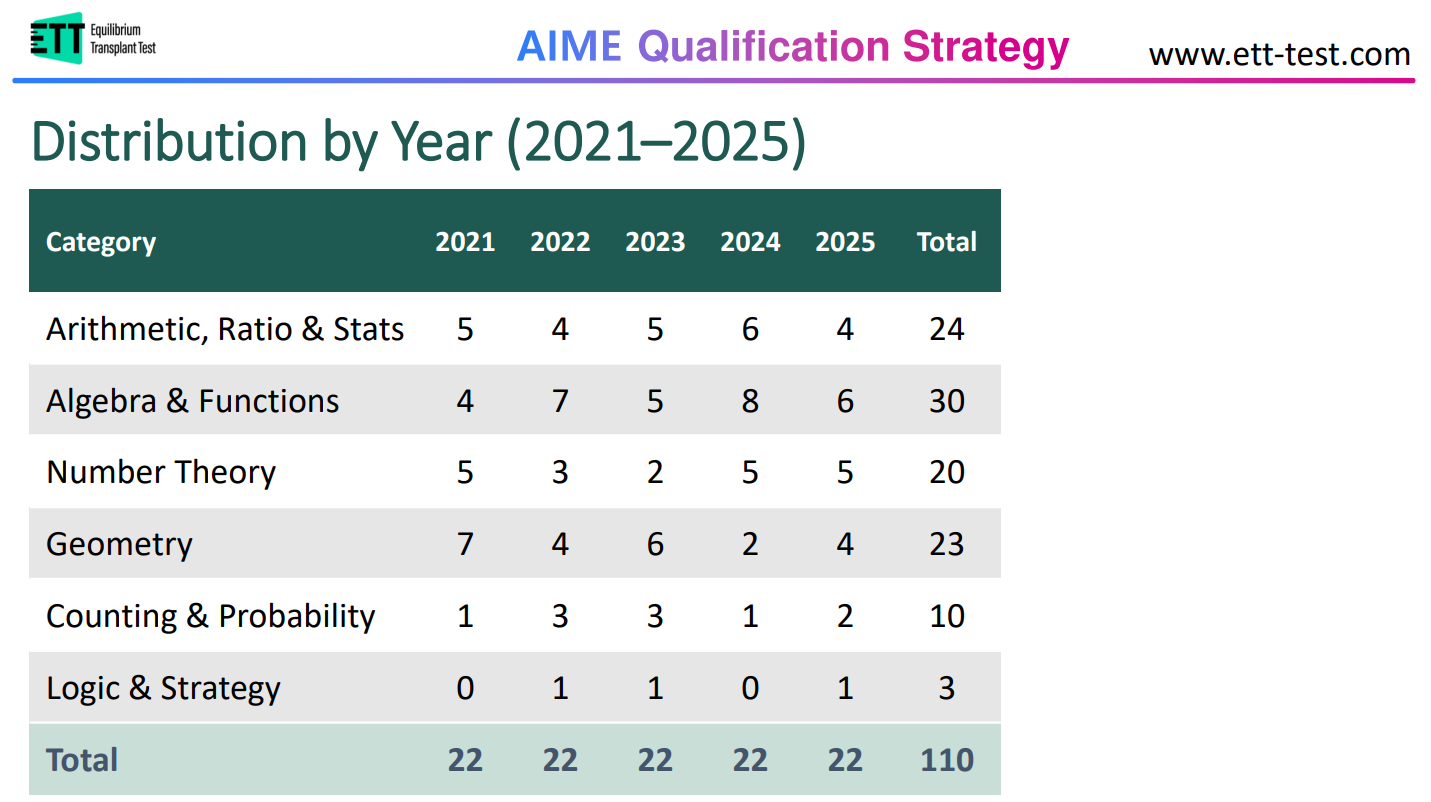
Looking year by year, Arithmetic, Ratio & Statistics appeared consistently throughout the five-year sample.
Algebra & Functions was even more prominent overall.
Geometry and Number Theory also represented substantial portions of the first 11 questions, while Counting & Probability appeared less frequently. Logic & Strategy was relatively rare.
This does not mean students should permanently ignore the less frequent areas. It means that when only a few weeks remain and the target is specifically to secure Questions 1–11, preparation time should not automatically be divided equally among every AMC topic.
The distribution of the targeted questions should influence the study plan.
Questions 1–3, 4–7, and 8–11 Require Different Preparation
Within Questions 1–11, we can also divide the range into three practical difficulty groups.
Questions 1–3 can be treated as the easier group.
Questions 4–7 form the intermediate group.
Questions 8–11 are the hardest part of the specific range we are targeting.
This is an A ONE Institute study framework rather than an official MAA difficulty classification. The purpose is simply to identify where a student's preparation time is most likely to be needed.
The target student for this strategy is someone who can already get through much of Questions 1–7 independently.
The real problem begins around Questions 8–11.
A student may currently solve one of those four questions but struggle with the other three. If that describes the student, then spending the next several weeks repeatedly practicing the later part of the target range may make more sense than reviewing everything from the beginning.
That is where the strategy becomes much more concentrated.
What Appears Most Often in Questions 8–11?
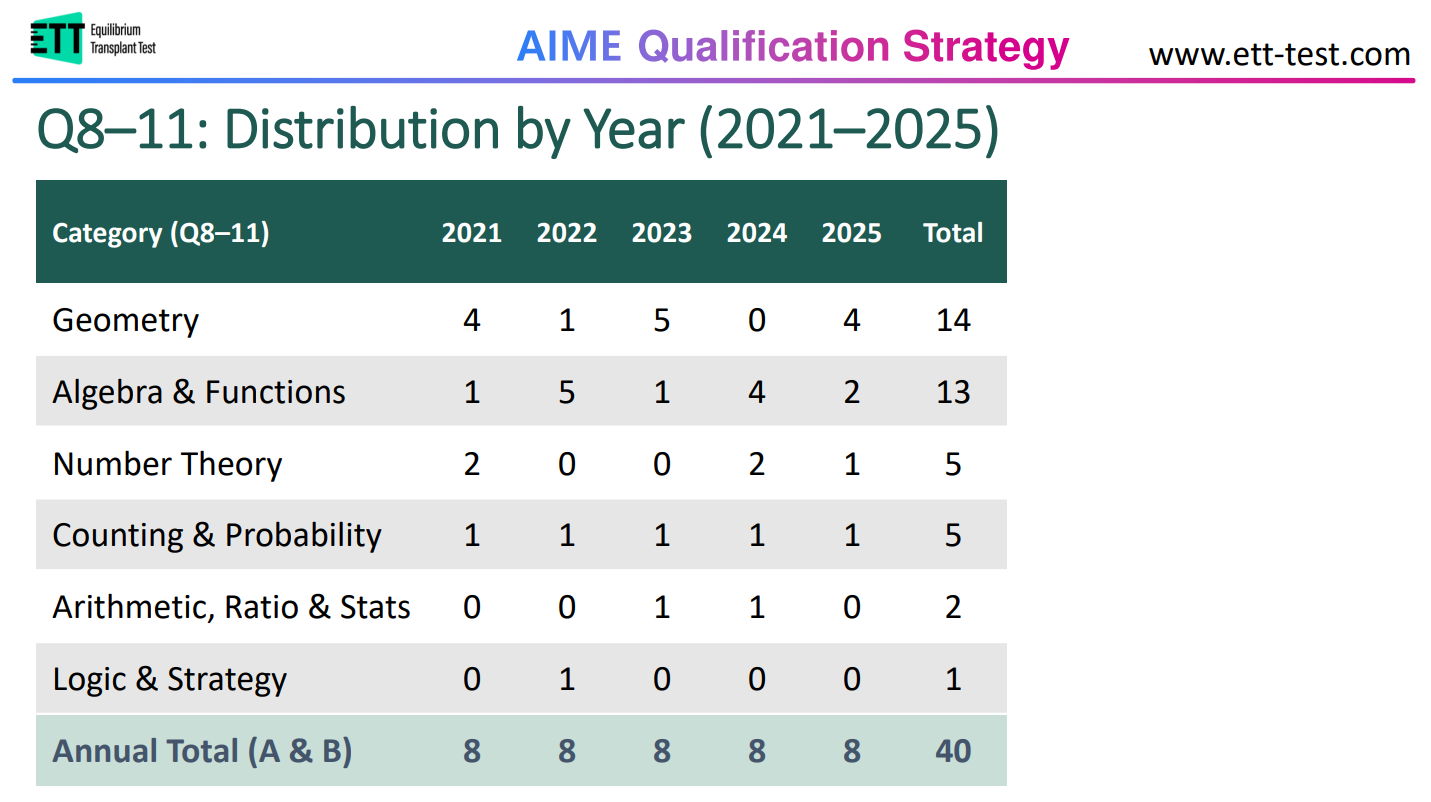
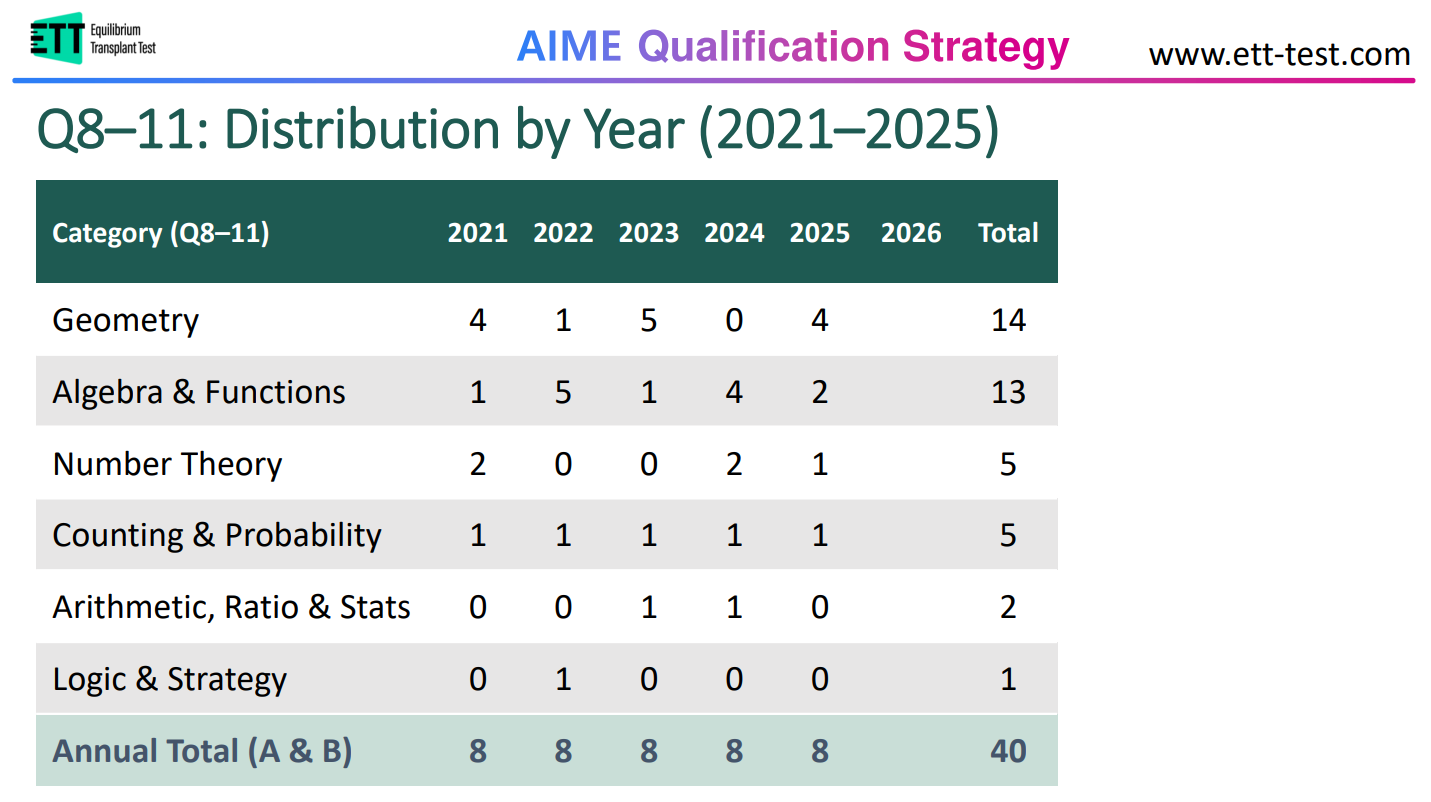
When we isolate only Questions 8 through 11 from the 2021–2025 AMC 12A and 12B exams, the ranking changes.
Across those 40 questions:
Geometry appeared 14 times.
Algebra & Functions appeared 13 times.
Number Theory appeared 5 times.
Counting & Probability appeared 5 times.
Arithmetic, Ratio & Statistics appeared 2 times.
Logic & Strategy appeared once.
The difference between Geometry and Algebra is extremely small. Together, those two categories account for most of this four-question range.
For a student trying to improve Questions 8–11 in a limited amount of time, those two categories therefore deserve particular attention.
The Question Number Also Shows a Pattern
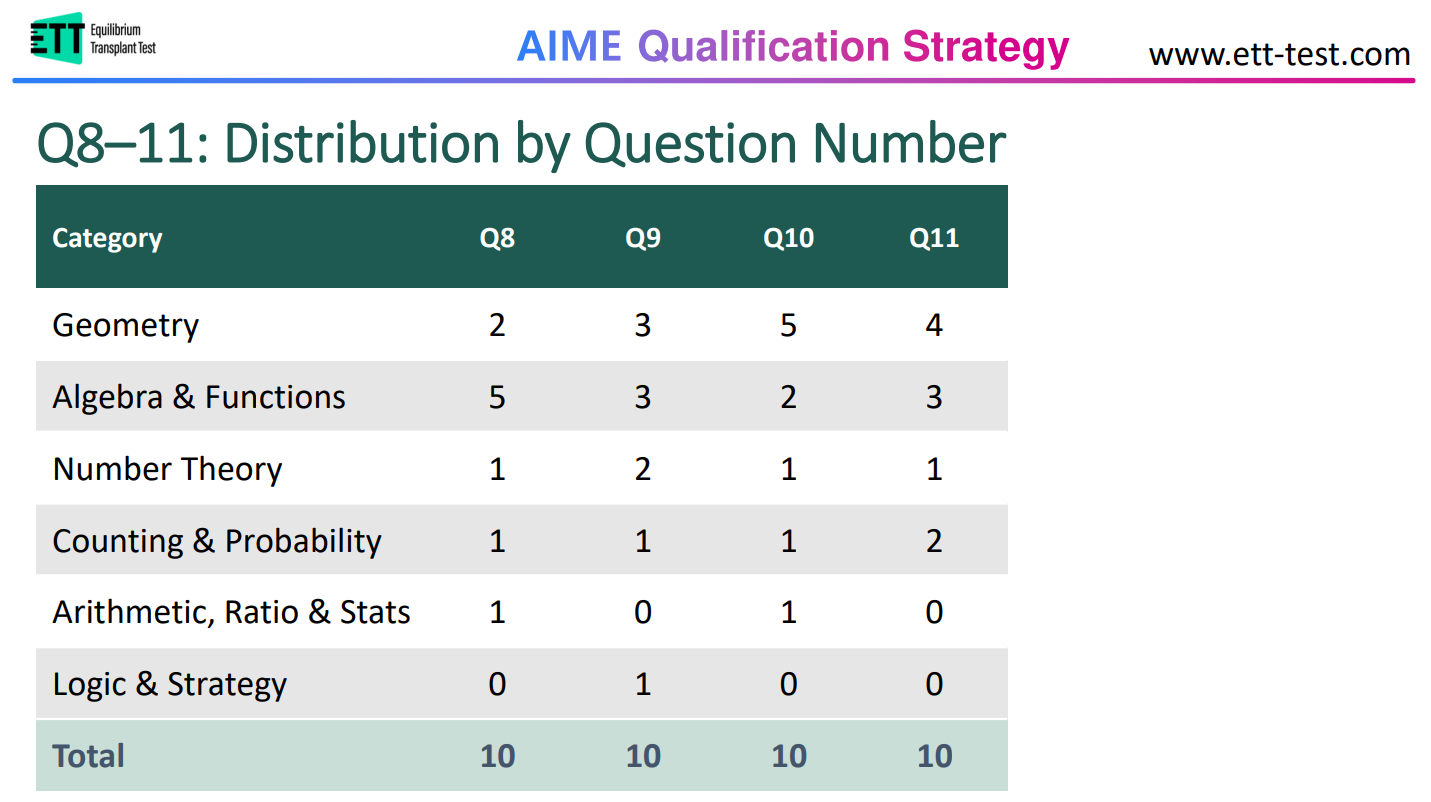
The five-year data can be broken down even further by question number.
Geometry appeared more frequently around Questions 10 and 11.
Algebra & Functions was especially common around Questions 8 and 9.
That does not mean a particular category is guaranteed to appear in a specific position. AMC problems do not follow a rule that requires Question 8 to be algebra or Question 10 to be geometry.
But it gives us another way to organize practice.
Instead of simply saying, "Study more AMC math," a student can work through historical Questions 8–11 and pay particular attention to the types of Algebra, Functions, and Geometry questions that repeatedly appear there.
Can We Predict What Will Appear in 2026?
This is where we need to separate historical patterns from actual predictions.
In the five-year sample, Geometry and Algebra showed an interesting pattern.
In 2021, Geometry appeared heavily in Questions 8–11.
In 2022, Algebra appeared heavily.
In 2023, Geometry was again more common.
In 2024, Algebra was more common.
In 2025, Geometry again had a strong presence.
That creates an alternating pattern that makes Algebra & Functions interesting to study for 2026.
However, this is not evidence that the AMC must alternate topics from year to year, and it does not mean Algebra will necessarily dominate in 2026.
It should be treated as a preparation hypothesis rather than a prediction.
The same caution applies to Counting & Probability. In this five-year dataset, the category appeared once per year within Questions 8–11 across the A and B exams.
That makes it worth preparing.
It does not guarantee that the same pattern will continue this year.
The useful question is not, "Can we predict the test perfectly?"
It is, "If preparation time is limited, where does the historical data suggest we should spend it?"
Algebra Practice Target: Logarithms
One area worth reviewing within Algebra & Functions is logarithms.
Historical AMC 12 questions show that logarithm problems can appear in the question range we are targeting, and they are often much more manageable once the student recognizes a few structural relationships.
Consider a previous AMC 12 problem involving logarithmic expressions.
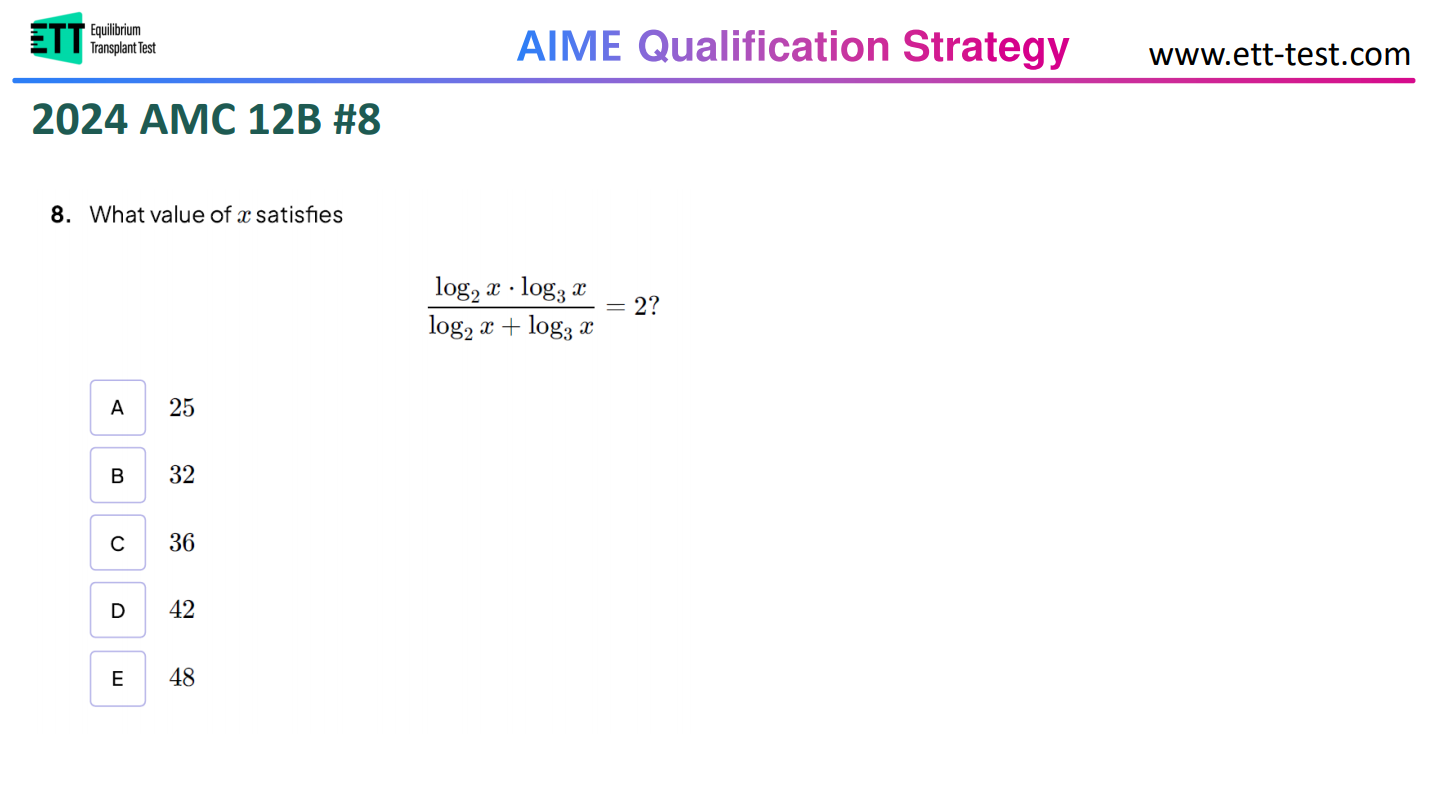
At first glance, the expression may appear complicated because logarithms with different bases are involved.
The important observation is that the expressions share the same argument.
One useful identity is:
log_a b = 1 / (log_b a)
Instead of introducing unnecessary new variables and making the equation more complicated, the logarithms can be rewritten so that they share a common base.
Once the expression is reorganized, the equation simplifies to a logarithmic relationship involving 6 and x.
The result becomes:
log_6 x=2
which gives:
x=36
The important lesson is not simply the answer 36.
It is the recognition pattern.
When logarithms have different bases but related arguments, look first for a way to reverse or rewrite them so that the expression becomes simpler.
For students who already know the basic logarithm rules, this type of AMC problem can often be solved much faster than its initial appearance suggests.
A Slightly More Complex Logarithm Example
Now consider a 2021 AMC 12A Question 9.
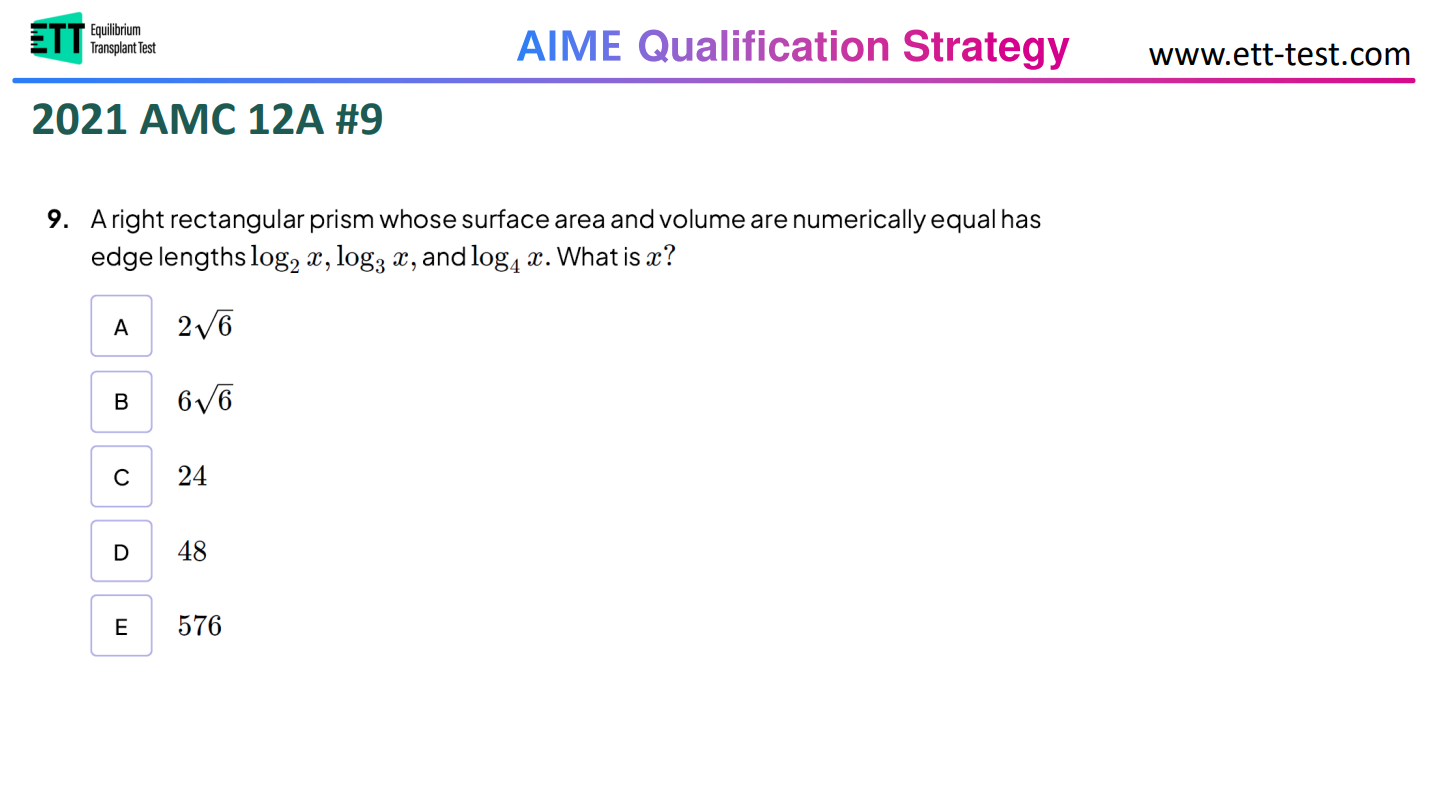
The problem describes a rectangular prism whose surface area and volume are numerically equal.
If its three side lengths are a, b, and c, then the surface area is:
2(ab+bc+ca)
and the volume is:
abc
Because the problem states that the two are equal:
2(ab+bc+ca)=abc
The side lengths are given as logarithmic expressions.
Dividing through and rewriting the reciprocal logarithms allows the terms to be expressed with the same base.
The equation eventually reduces to:
log_x 24=1/2
which means:
x^(1/2)=24
Therefore:
x=24^2=576
Again, the point is not to memorize this particular problem.
The point is to recognize that a problem combining geometry and logarithms may look more complicated than the algebra actually is.
When the student knows the necessary logarithm relationships, the problem can become very direct.
Counting & Probability Is Another Area Worth Preparing
The five-year data also makes Counting & Probability worth reviewing within the target range.
Consider a previous AMC 12 problem asking how many ways the integers from 1 through 14 can be divided into seven pairs so that the larger number in every pair is at least twice the smaller number.
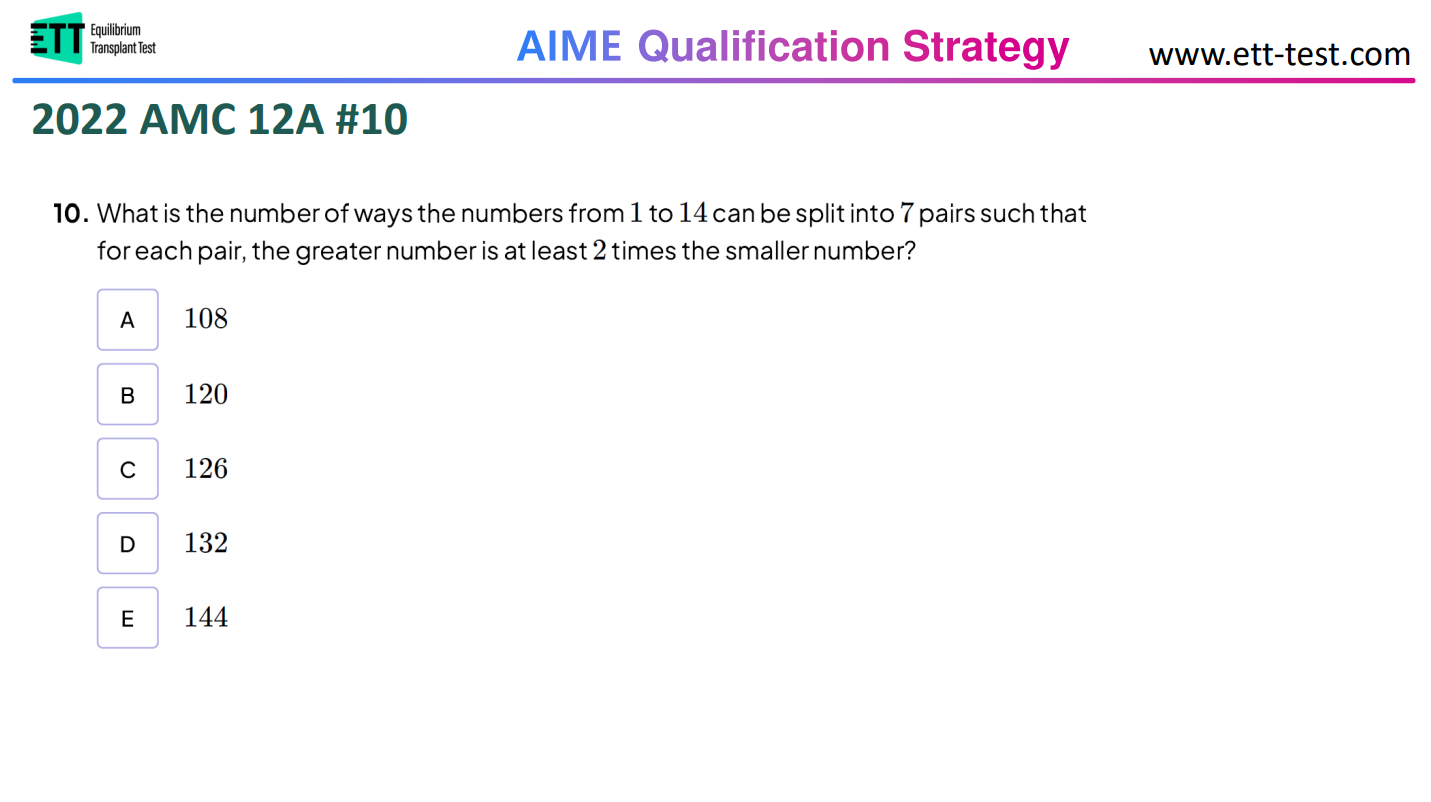
The condition immediately tells us something important.
If a smaller number were 8 or larger, its partner would need to be at least 16, which is impossible because the available numbers end at 14.
So the smaller numbers must be:
1,2,3,4,5,6,7
and their partners must come from:
8,9,10,11,12,13,14
Now count the available choices systematically.
For 7, only 14 works: 1 choice.
For 6, after accounting for the number already paired with 7, there are 2 choices.
For 5, there are 3 choices.
For 4, there are 4 choices.
Continuing the pairing restrictions gives:
3 choices for 3
2 choices for 2
1 choice for 1
Therefore the number of valid pairings is:
1\times2\times3\times4\times3\times2\times1=144
For a student using this AIME-qualification strategy, there is another practical point.
If the student plans to leave Questions 12–25 blank, there may be substantial time available for Questions 8–11.
That means the student does not always need the most elegant competition-math shortcut.
A slower but reliable counting method can still be strategically useful if there is enough time to carry it out accurately.
The Goal Is Not to Master the Entire AMC in Three Weeks
This strategy should not be misunderstood.
We are not saying that a student can suddenly master AMC mathematics in several weeks.
We are narrowing the objective.
The student already needs enough mathematical foundation to handle most of the earlier questions. The student then concentrates heavily on the section where the current score usually breaks down: approximately Questions 8–11.
Instead of spending the remaining preparation period trying to learn every advanced AMC topic, the student repeatedly practices historical problems from this specific range, especially in areas such as Algebra & Functions and Geometry.
That is a very different preparation plan.
There Is Still Time Before the 2026 AMC 12
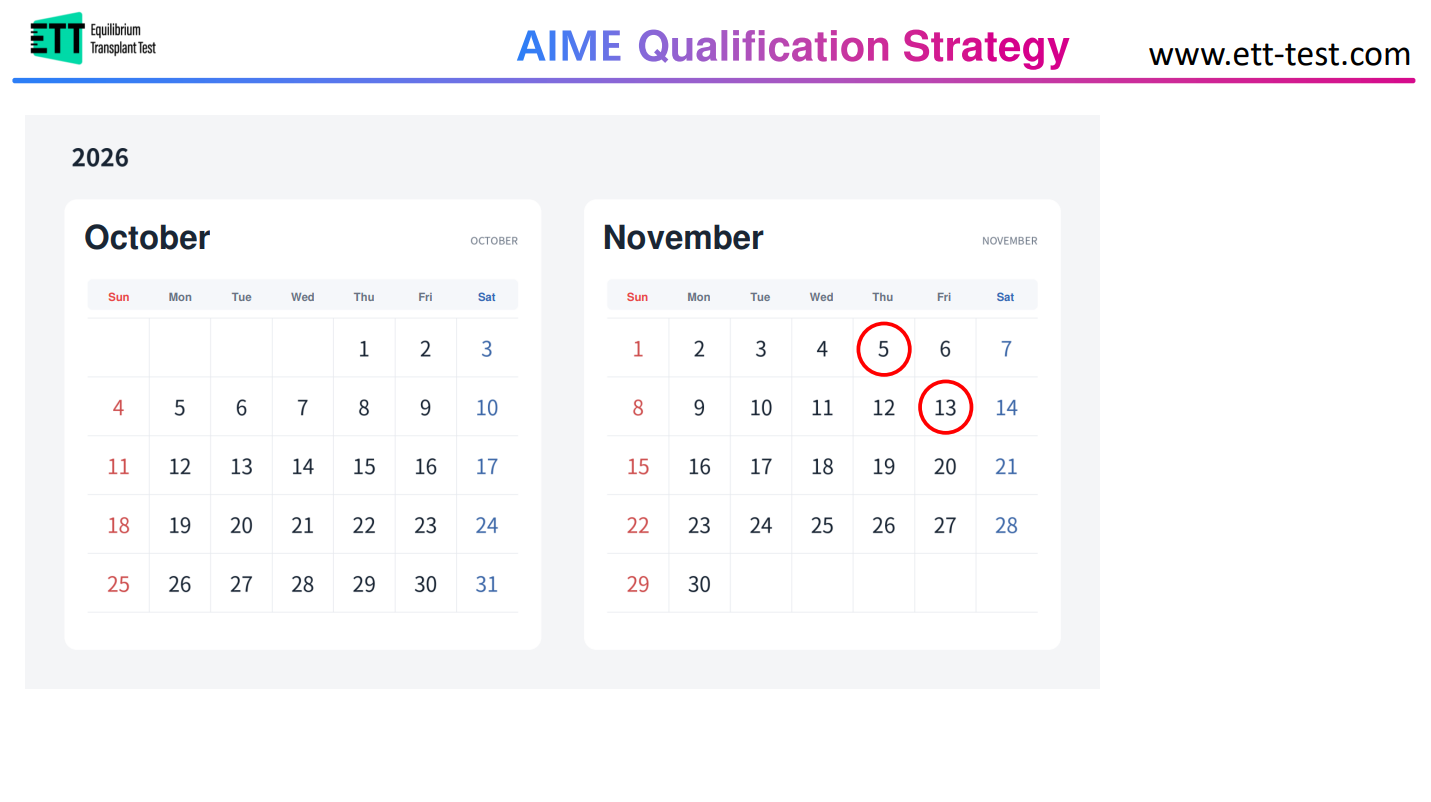
The 2026 AMC 12A is scheduled for November 5, and the AMC 12B is scheduled for November 13.
For a student who already has some AMC experience, the remaining preparation window can still be meaningful if the work is highly targeted.
The objective is simple:
Make Questions 1–7 dependable.
Spend concentrated practice time on Questions 8–11.
Use historical problem patterns to decide where to allocate study time.
During the actual exam, do not automatically chase difficult later problems merely because they are there.
And if the target is AIME qualification through the 85-point threshold, protect the score by understanding the value of leaving uncertain problems blank.
For students who previously studied AMC but gave up because AIME seemed too distant, this is a good time to reconsider the goal.
The target is not 25 perfect questions.
For this particular strategy, the target is 11 reliable ones.
A ONE Institute works with students preparing for advanced mathematics, Olympiad-level competitions, GPA courses, research, writing competitions, and U.S. college admissions. For students considering a focused AMC 12 preparation plan, the first step is to determine whether Questions 1–7 are already stable enough for concentrated work on Questions 8–11 to be realistic.
AIME
AMC12
AMC10
AIME Qualification
Math Competition
