
What Is IYPT, and Why Should Physics and Engineering Students Look at It?
For students interested in physics or engineering, IYPT 2027 is worth examining because the U.S. selection process asks students to go deeply into one open-ended physics problem, develop experimental and theoretical research, present that work, revise it after feedback, and then defend their thinking in an interview. Students selected for Team USA ultimately compete internationally in a format that combines research, presentation, and scientific debate.
IYPT stands for the International Young Physicists’ Tournament. Each year, 17 open-ended physics problems are released. For U.S. selection, a student begins by choosing one problem and developing it in depth rather than trying to prepare all 17 at once. The scope is therefore concentrated rather than broad—but that does not mean the work is easy. The depth of the physics, experimental design, data analysis, and presentation can be substantial.
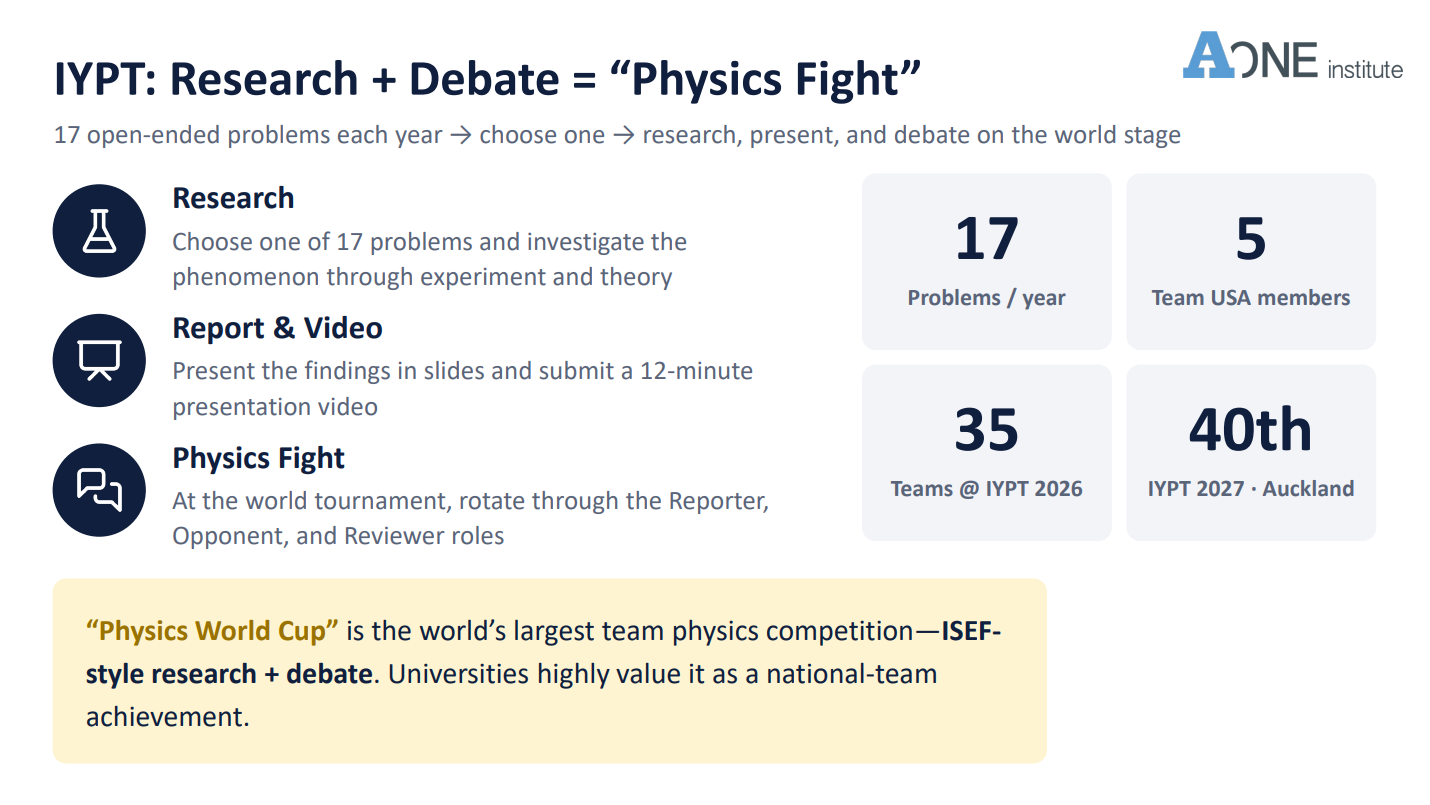
The official IYPT organization describes the event as a competition in which high school students research, experiment, present, and debate complex physics problems. The 40th IYPT will be held in Auckland, New Zealand, from July 5 to July 12, 2027.
Why A ONE Institute Places Team USA at the Top of Its Activity Framework
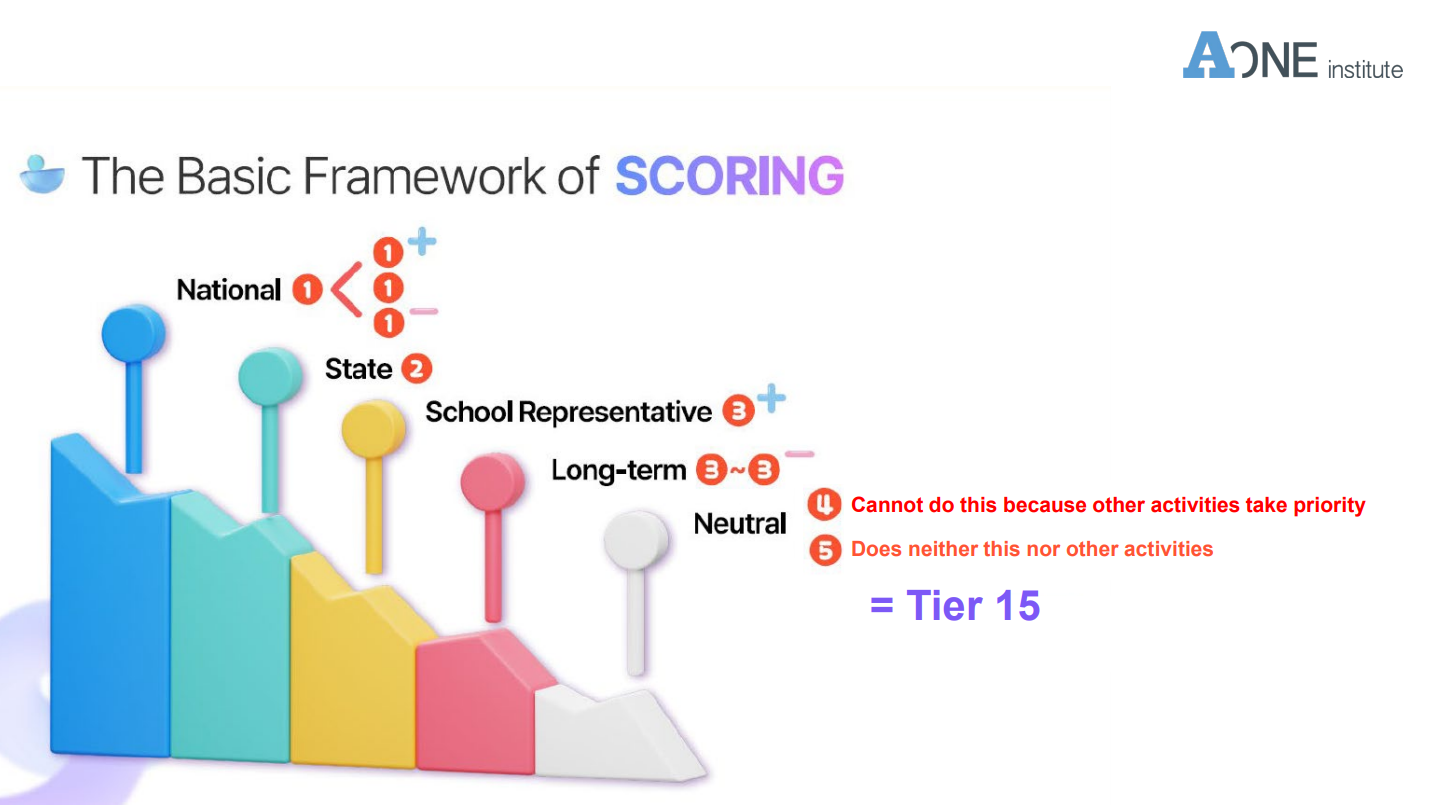
A ONE Institute uses an internal framework to distinguish the level of extracurricular achievement. A school-level distinction, a state-level distinction, and a national-level distinction are not treated as the same type of accomplishment.
Within that framework, earning one of the five positions on Team USA for IYPT would fall into the highest national-level category. This is A ONE Institute's admissions-analysis framework, not an official ranking issued by IYPT or by U.S. colleges.
The reason is not simply that IYPT is a physics competition. A student who reaches Team USA has had to develop a research question experimentally, work with data, explain the physics, communicate the work in a formal presentation, respond to expert questioning, and then prepare to defend and critique research in an international setting.
From an admissions-planning perspective, that combination can make the activity stand out inside a STEM-focused portfolio. The significance comes from the depth and national-team context of the work—not merely from adding the name of another competition to an activities list.
How the U.S. IYPT 2027 Selection Process Works
The U.S. process is relatively straightforward to understand.
First, students select one of the 17 IYPT 2027 problems and notify US IYPT that they intend to participate. US IYPT currently asks interested students to make contact through its website or Instagram and to identify the problem they are researching.
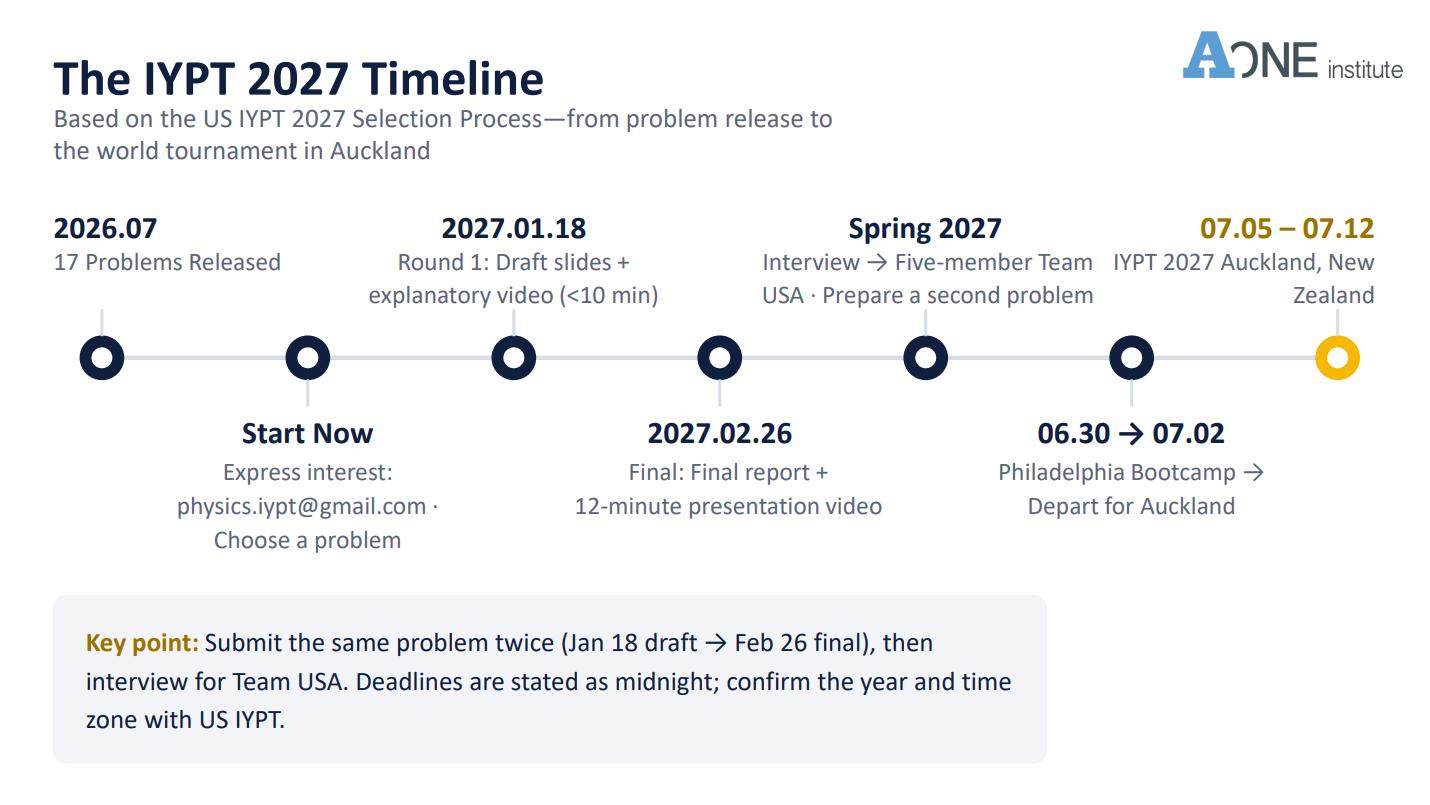
The current official schedule is:
- Choose one problem and express interest.
- January 18, 2027: Submit draft research slides and an explanatory video of less than 10 minutes by midnight.
- College professors review the work and provide detailed feedback.
- Strong submissions are selected as finalists.
- February 26, 2027: Finalists submit an improved final report and a 12-minute presentation video by midnight.
- A national selection board reviews the final work.
- Selected candidates participate in an interview.
- Five students are chosen for Team USA.
- Students who make Team USA complete an additional IYPT problem before the international tournament.
The presentation materials supplied for this program summarize the same process as a draft submission, feedback and revision, a final submission, and an interview leading to the five-member U.S. team.
This is important because students are not expected to create a completely different research project between Round 1 and the final round. They continue developing the same problem, using the feedback to improve the research and presentation.
The Feedback Stage Is Part of the Challenge
A ONE Institute has seen this process directly through students participating in U.S. IYPT selection.
During feedback, students may face detailed questions about their experimental design, assumptions, data, and physics. That experience matters because a polished slide deck alone is not enough. Students need to understand their own work well enough to explain why they designed an experiment in a particular way, what the data mean, and where the limitations are.
The final 12-minute presentation therefore deserves serious preparation. The student is not simply submitting a science-fair display. The research has to be communicated clearly enough to survive technical questioning and later discussion.
A Mentor Is Required
IYPT research often involves physical experiments, which is one reason the U.S. selection process requires participants to work with a local mentor or teaching professional who can provide physics guidance and help ensure experimental safety.
Students may work individually or collaborate with other students, but only one student may submit a particular piece of work for Team USA consideration.
This structure is useful to understand. A student does not have to master all 17 problems before applying. The initial goal is to select one problem, investigate it deeply, change experimental conditions, collect meaningful data, and build a defensible analysis.
Students Can Receive Expert Support During the Research Process
US IYPT currently provides several 30-minute video-conference opportunities with subject-matter experts each month. Meetings are available by appointment on a first-come, first-served basis, and support can include experimental design, physics, academic research, data analysis, and report development.
US IYPT also encourages students to report which problem they have chosen. Organizers may tell students when many applicants are working on the same problem, although students are not forced to switch topics.
A ONE Institute has found this kind of information useful when helping students think about problem selection. If several students are already concentrating on the same problem, another problem may offer a different strategic position—but the quality of the research still has to come first.
What Does Team USA Participation Cost?
US IYPT is currently fundraising for the 2027 team. Its official student information page states that the worst-case estimate, assuming no fundraising support, is approximately $5,000 per student, while also stating that fundraising is expected to reduce the cost.
Current travel planning is also described as tentative. Team USA plans to arrive in Philadelphia for a pre-tournament bootcamp on June 30, depart for Auckland on July 2, compete from July 5 through July 12, and depart Auckland after the tournament.
The A ONE Institute materials also note that sample research materials are available to help students understand what a strong IYPT submission can look like.
What Happens at an IYPT Physics Fight?
The international tournament is where the format becomes very different from a conventional physics exam.
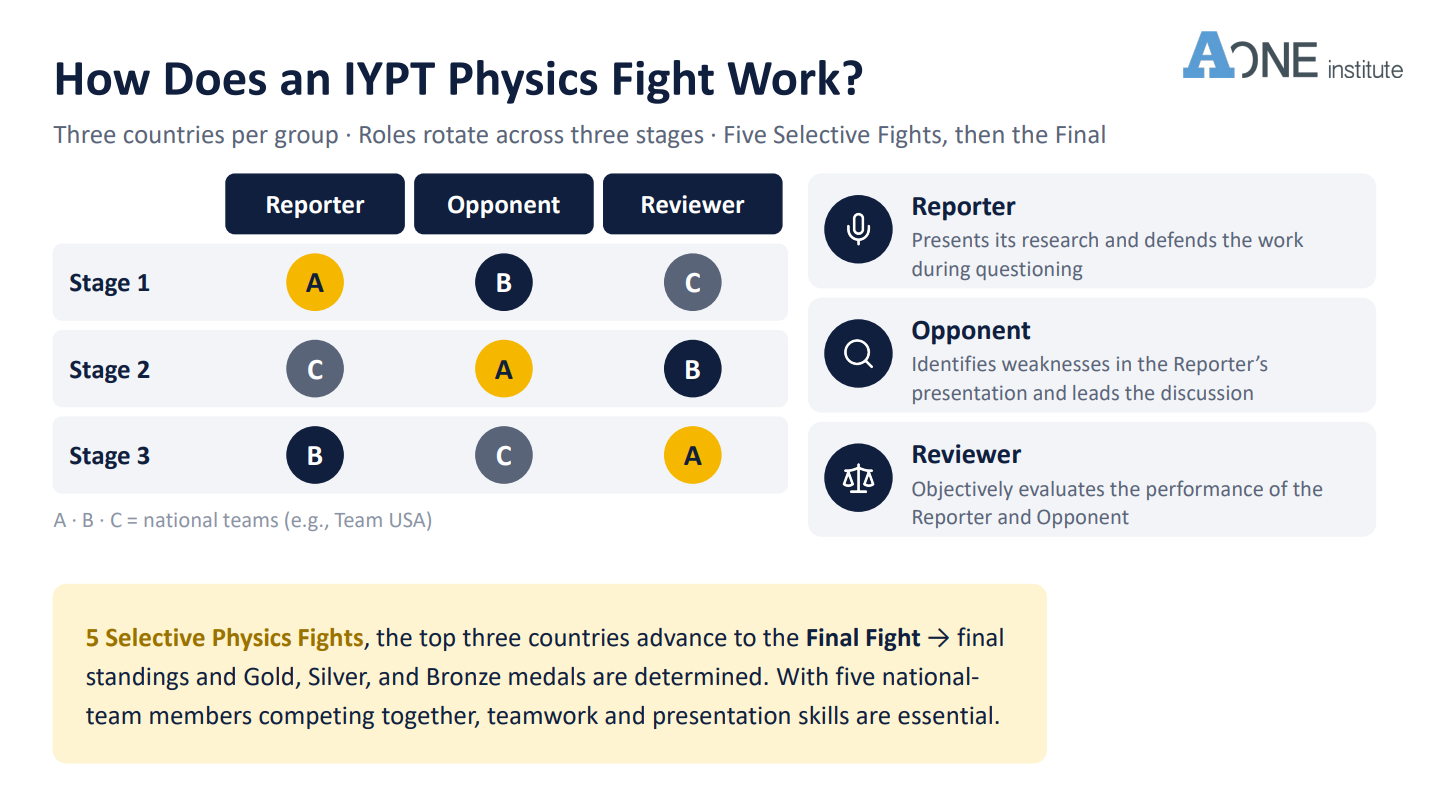
Teams take different roles during a Physics Fight:
Reporter: Presents the team's research and responds to questions and criticism.
Opponent: Analyzes the Reporter's work, identifies weaknesses, and leads the scientific discussion.
Reviewer: Evaluates the performance and discussion involving the Reporter and Opponent.
The roles rotate, which means students need more than technical physics knowledge. They must be able to explain, challenge, defend, and evaluate scientific reasoning.
That is one reason IYPT can be especially interesting for students who want an activity combining research with communication rather than another timed written examination.
What Happened at IYPT 2026?
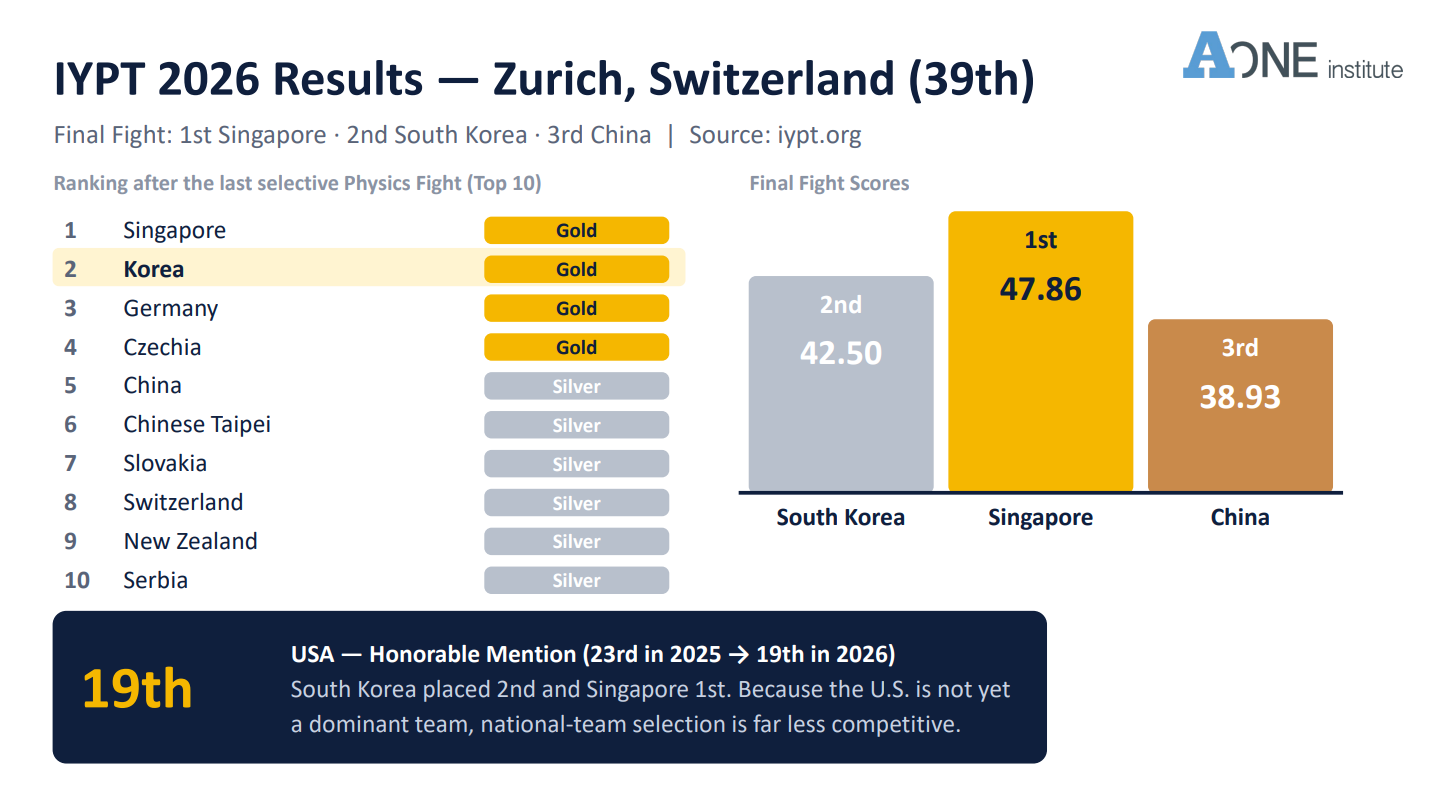
At the 2026 tournament in Zurich, Singapore finished first in the Final Fight with 47.86 points, South Korea finished second with 42.50, and China finished third with 38.93. The United States ranked 19th after the selective Physics Fights and received an honorable mention.
The A ONE Institute presentation uses these results to make another point: the United States is not currently at the top of the international standings.
A ONE Institute has also observed differences in how national teams prepare after selection. The original instructional material describes South Korea as using a much more intensive camp-style preparation process than the U.S., while U.S. preparation has historically involved fewer group training sessions. That comparison should be understood as an internal observation rather than an official IYPT rule or published national-team policy.
Is Team USA Selection Really Less Crowded Than Students Expect?
One reason A ONE Institute continues to bring attention to IYPT is that many U.S. students simply do not know about the opportunity.
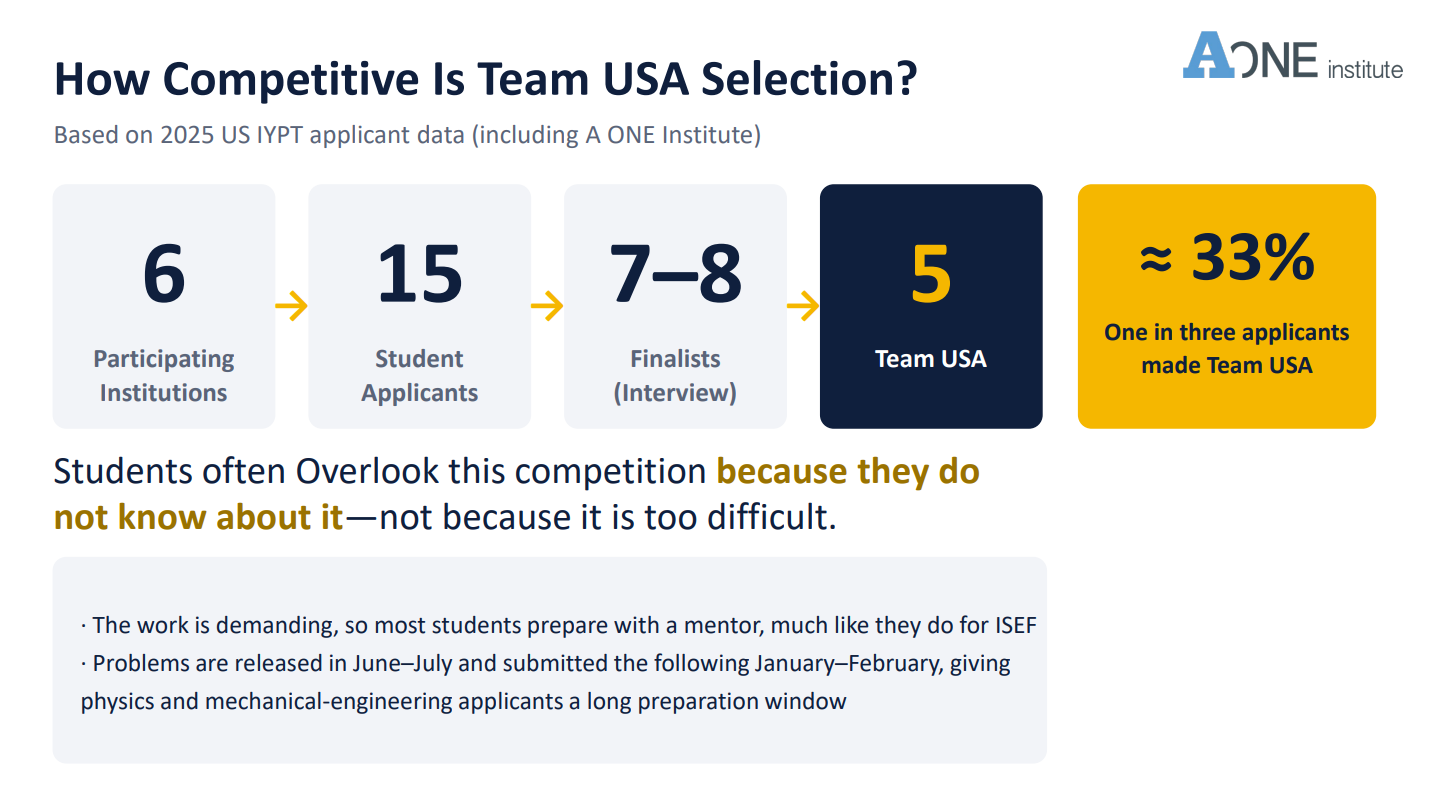
In one prior U.S. selection cycle tracked in A ONE Institute's internal materials, there were:
- 6 participating institutions
- 15 student applicants
- approximately 7–8 finalists
- 5 Team USA selections
That works out to roughly one Team USA selection for every three applicants in that particular cycle.
That figure should not be interpreted as the expected acceptance rate for IYPT 2027. Applicant numbers can change from year to year, and the 15-applicant figure comes from A ONE Institute's prior-cycle records rather than a published US IYPT applicant database.
The more useful point is that students should not assume that "five students on Team USA" automatically means the opportunity is inaccessible.
Why A ONE Institute Compares IYPT with the AMC Path
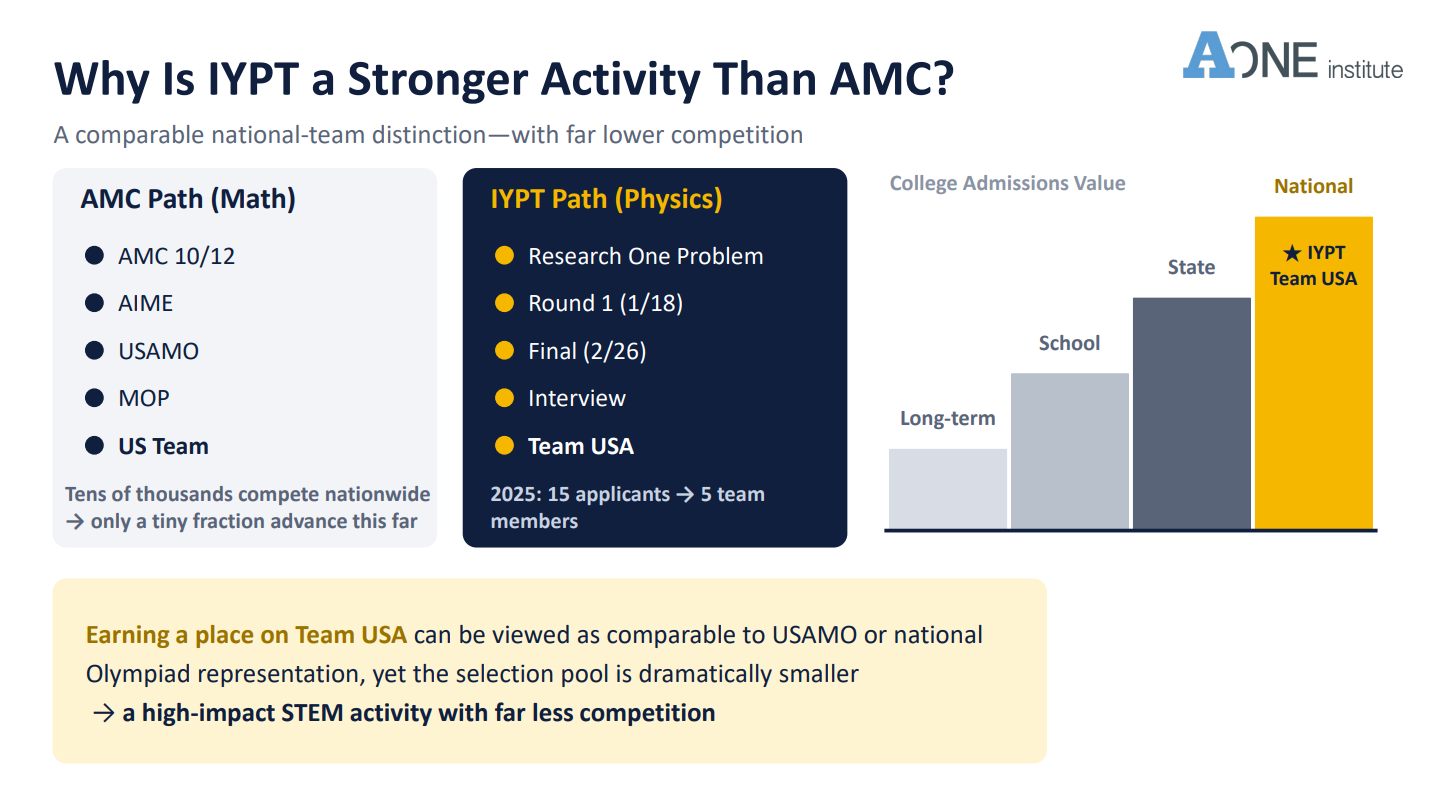
The comparison with AMC is not intended to say that the two competitions test the same skills. They clearly do not.
AMC is an examination-based mathematics pathway. IYPT is a long-term physics research and scientific-discussion pathway.
The comparison is about the size of the participation funnel.
The Mathematical Association of America currently states that its AMC program involves more than 300,000 students annually across AMC 8, AMC 10, and AMC 12. Approximately 9,000 students are invited to AIME, while approximately 500 reach USAMO or USAJMO.
IYPT's U.S. pathway is structurally different: choose a problem, develop the research, submit the first version, revise it, submit the final version, interview, and compete for one of five Team USA positions.
For a student whose strengths lie in physics, experimentation, research, and presentation, this creates a very different route to a national-level STEM distinction.
The important question is therefore not simply, "Which competition is easier?"
It is: Which format fits the student's strengths well enough that the student can produce genuinely high-level work?
The 17 Problems for IYPT 2027
The official problem set for the 40th IYPT contains 17 open-ended problems. It was approved by the International Organizing Committee on July 14, 2026.
1. Invent Yourself: Pinhole Sunglasses
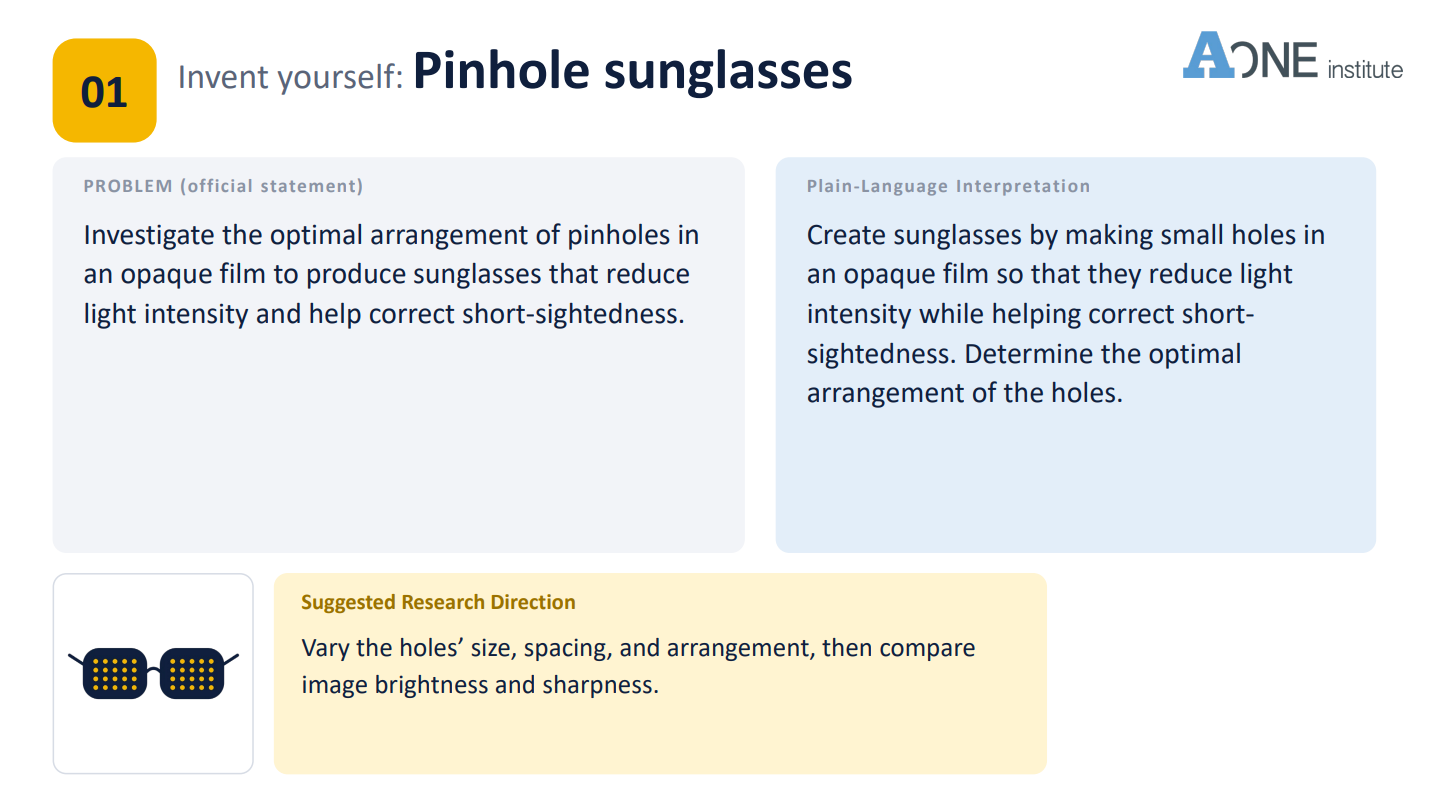
Students investigate how pinholes in an opaque film can reduce light intensity while helping correct short-sightedness. A practical research direction is to vary hole size, spacing, and arrangement and compare image brightness and sharpness.
2. Disc Spectrometer
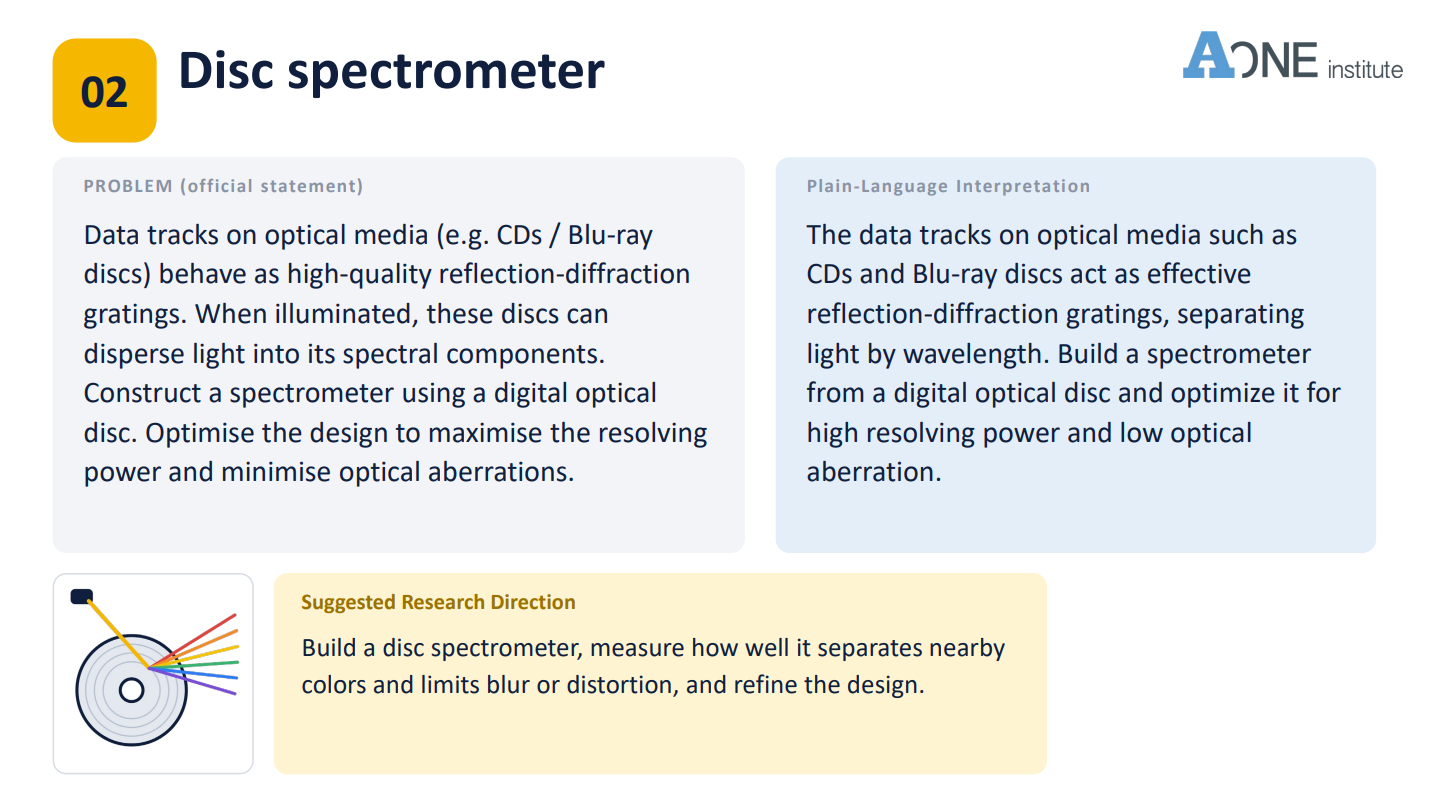
Optical discs such as CDs or Blu-ray discs can behave as reflection-diffraction gratings. Students construct a spectrometer and investigate how to improve resolving power while reducing optical aberrations.
3. Snail Ball
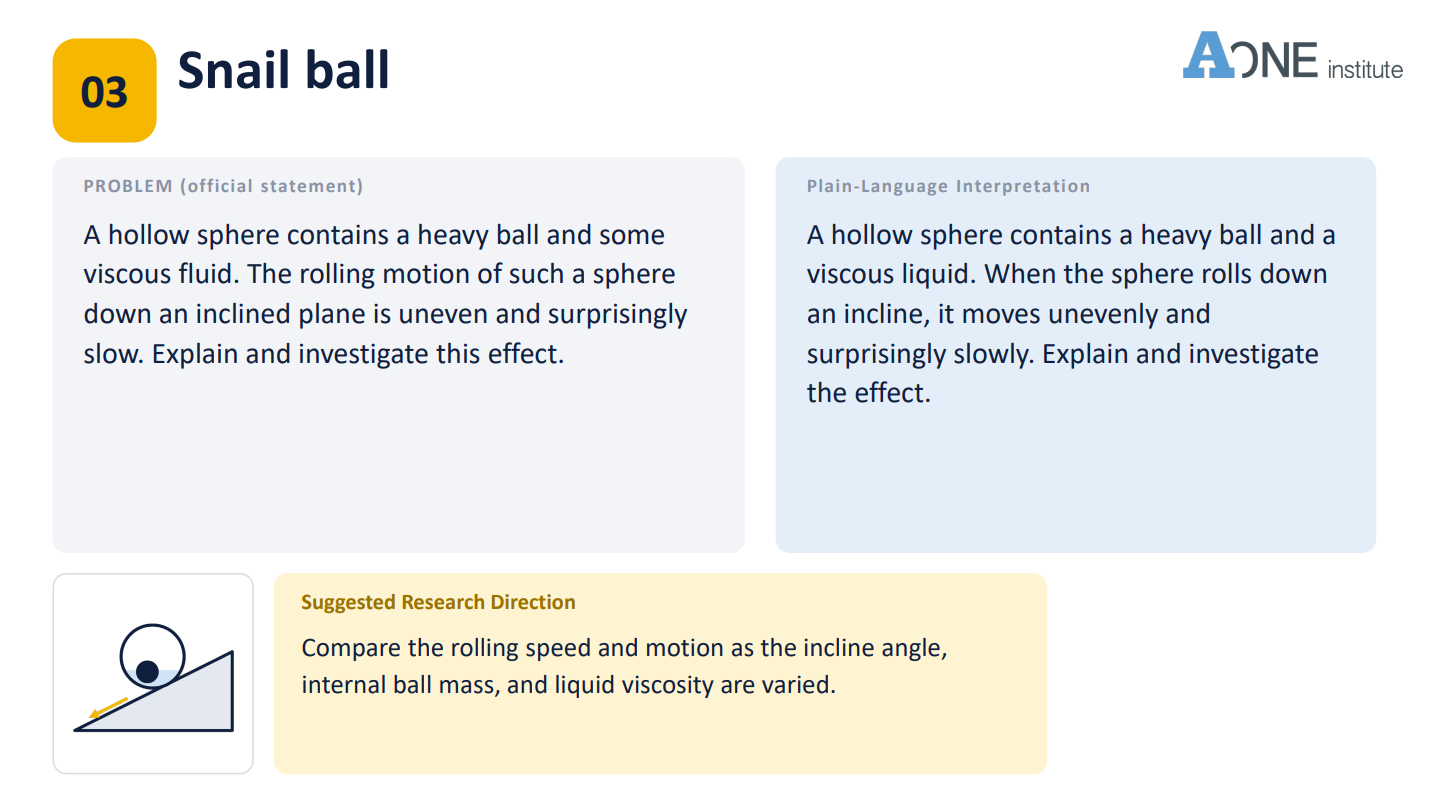
A hollow sphere containing a heavy ball and viscous fluid can roll down an incline unevenly and surprisingly slowly. The task is to explain the behavior and investigate how variables such as incline angle, internal mass, and viscosity change the motion.
4. Singing Capacitor
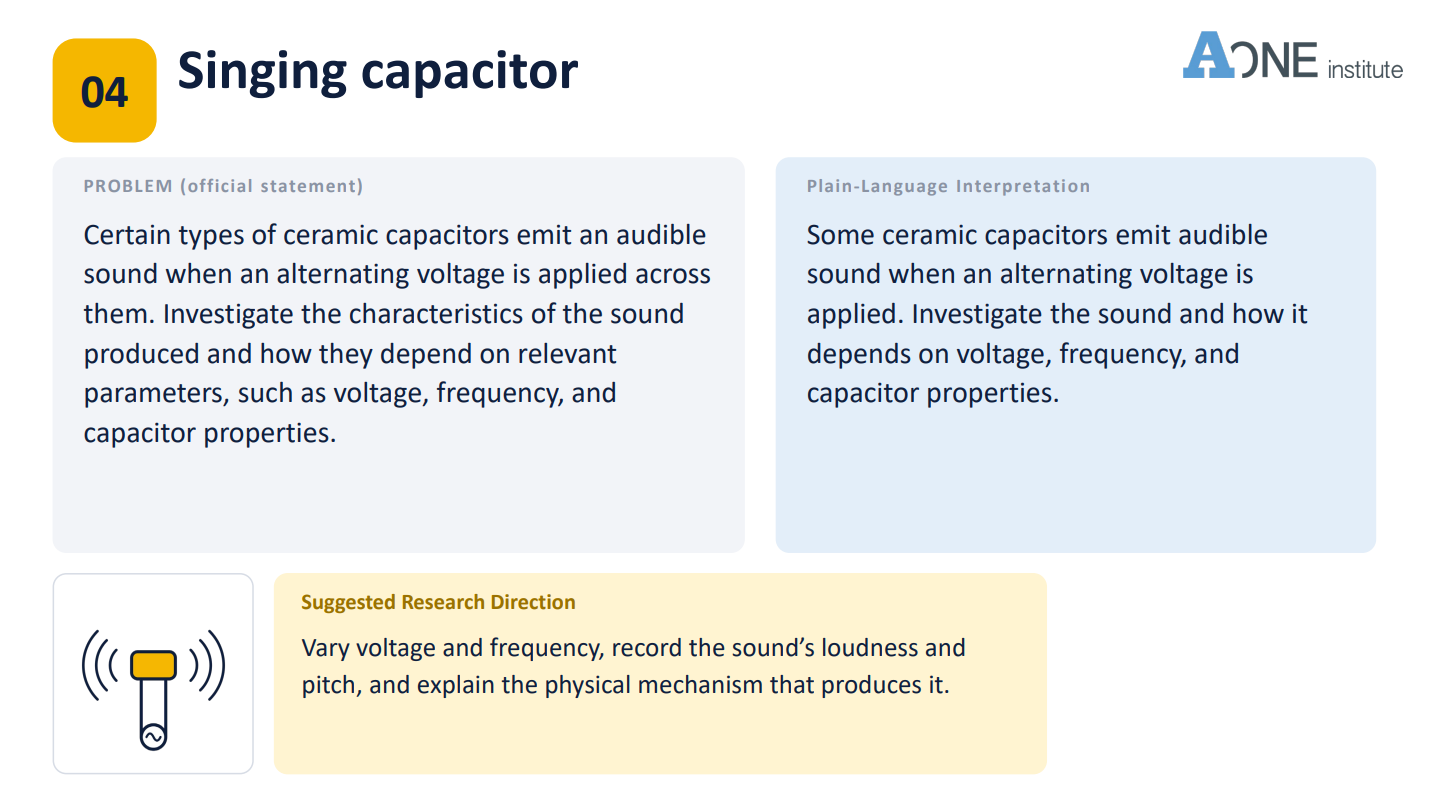
Certain ceramic capacitors can produce audible sound when an alternating voltage is applied. Students investigate how the sound changes with voltage, frequency, and capacitor properties.
5. Y-Shaped Pendulum
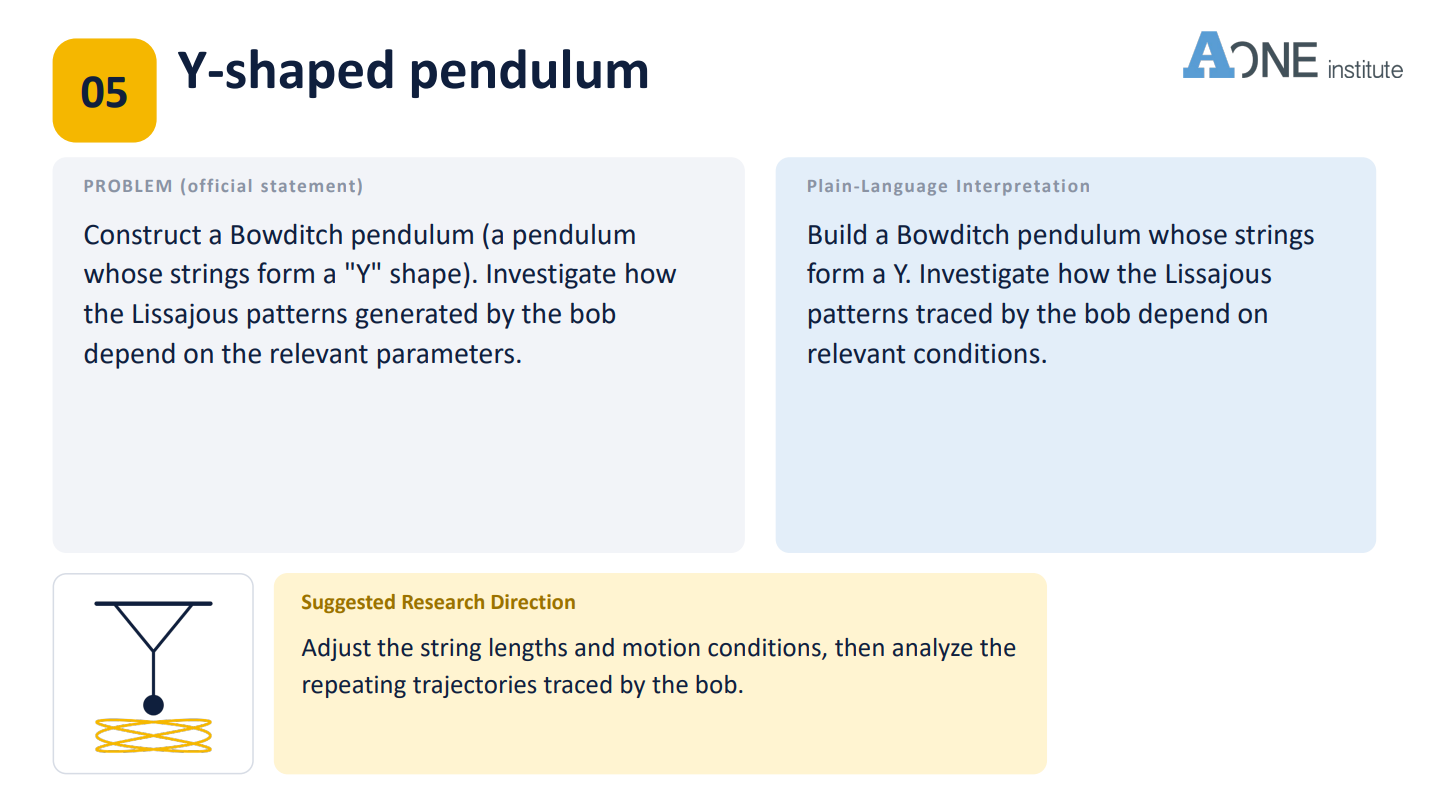
Students build a Bowditch pendulum whose strings form a Y shape and investigate the Lissajous patterns produced by the bob under different conditions.
6. Seeing Sound
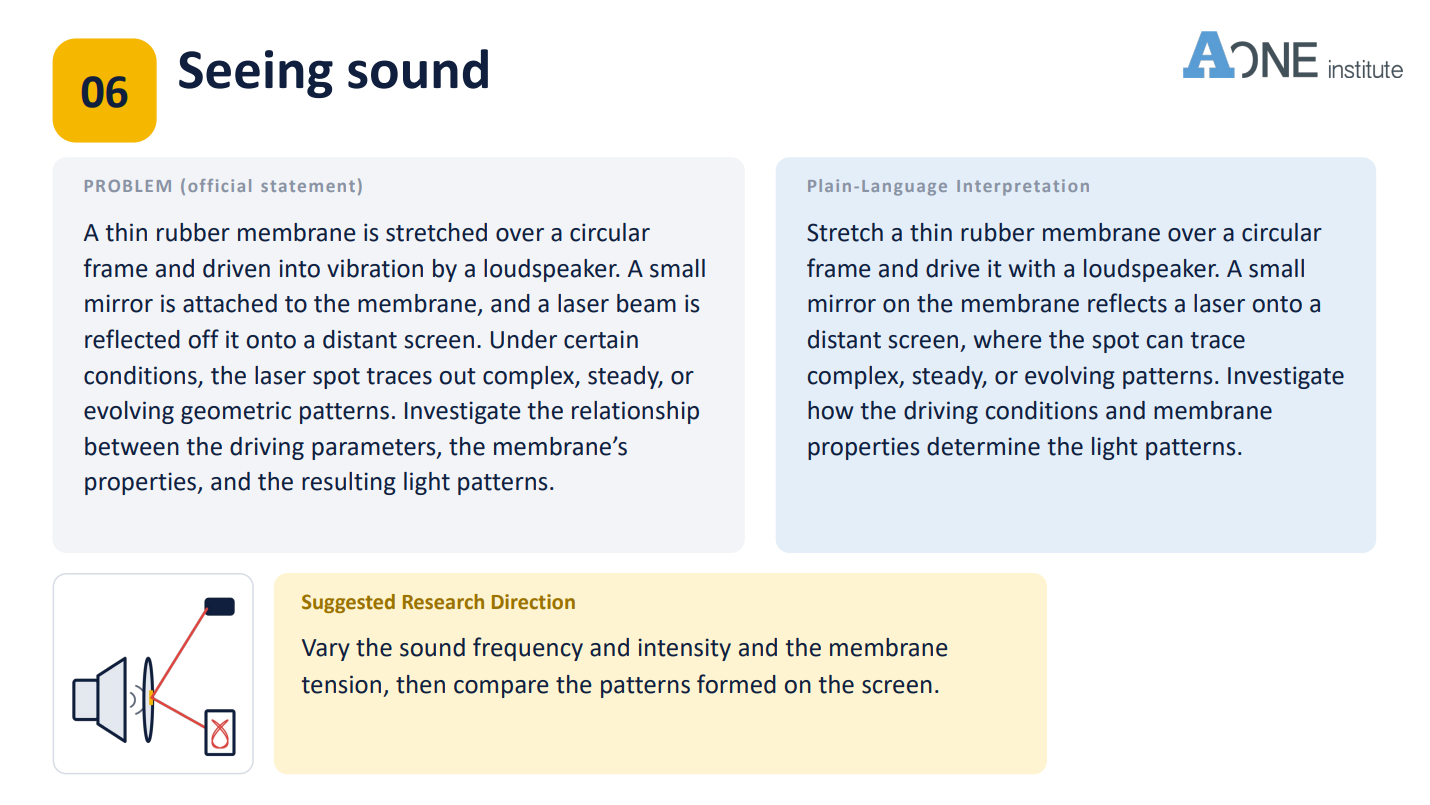
A loudspeaker drives a stretched rubber membrane with a small mirror attached. A reflected laser can create complex patterns on a distant screen. Students investigate how sound frequency, intensity, membrane properties, and other conditions affect those patterns.
7. Sinking Funnel
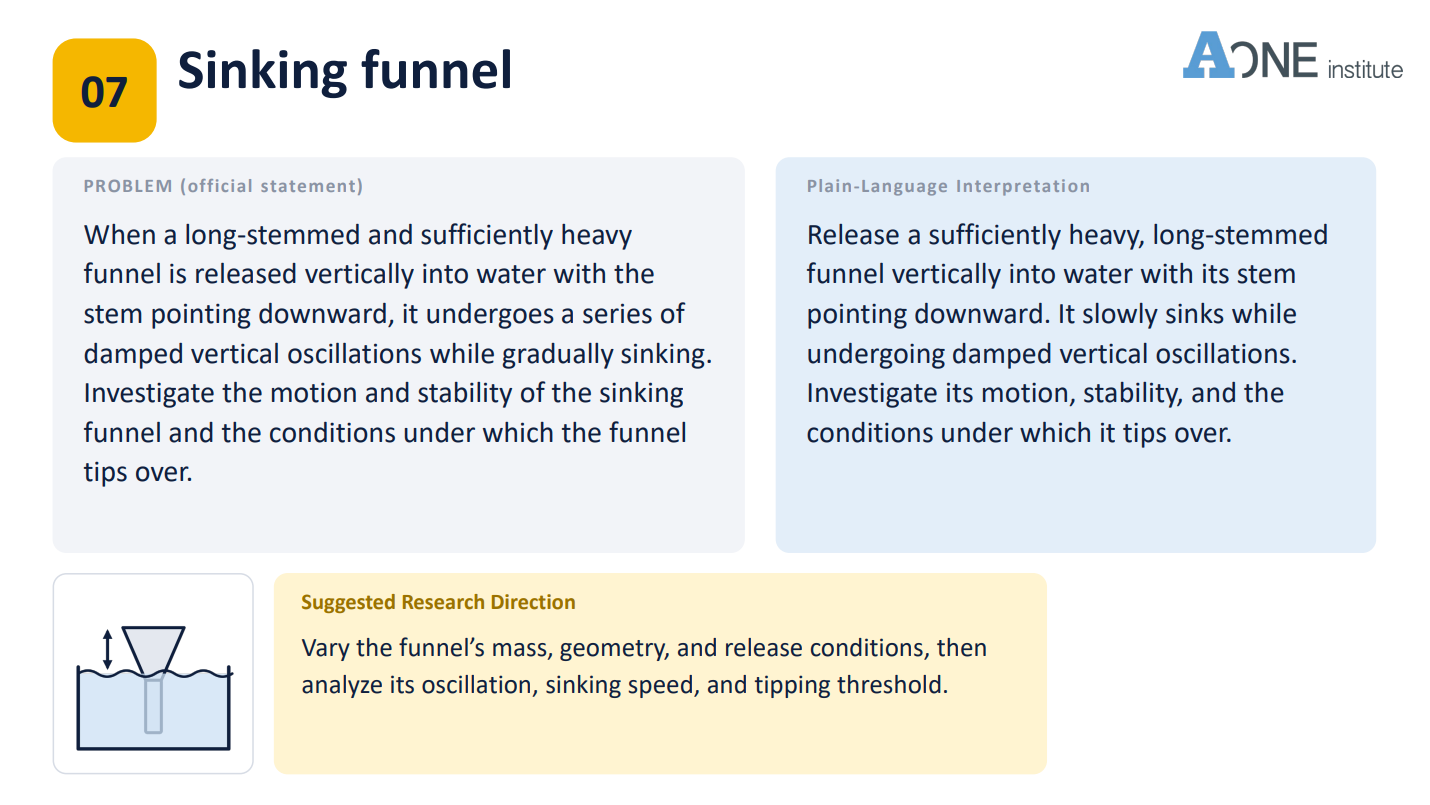
A sufficiently heavy long-stemmed funnel placed vertically in water may oscillate while gradually sinking. Students investigate its motion, stability, and the conditions under which it tips.
8. Upward-Driven Disc
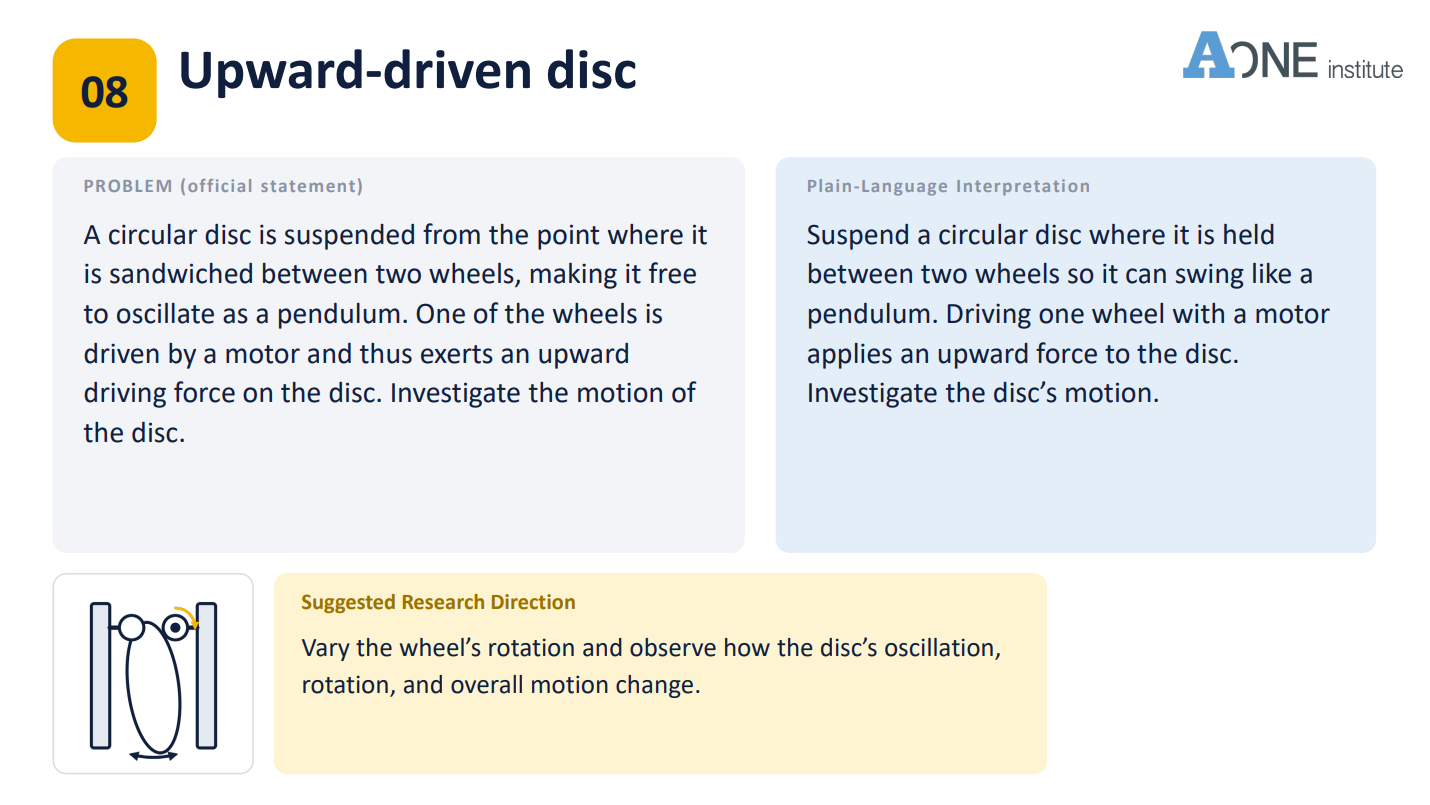
A circular disc is held between two wheels so that it can oscillate like a pendulum. One driven wheel applies an upward force to the disc, and students investigate the resulting motion.
9. Photographic Bokeh
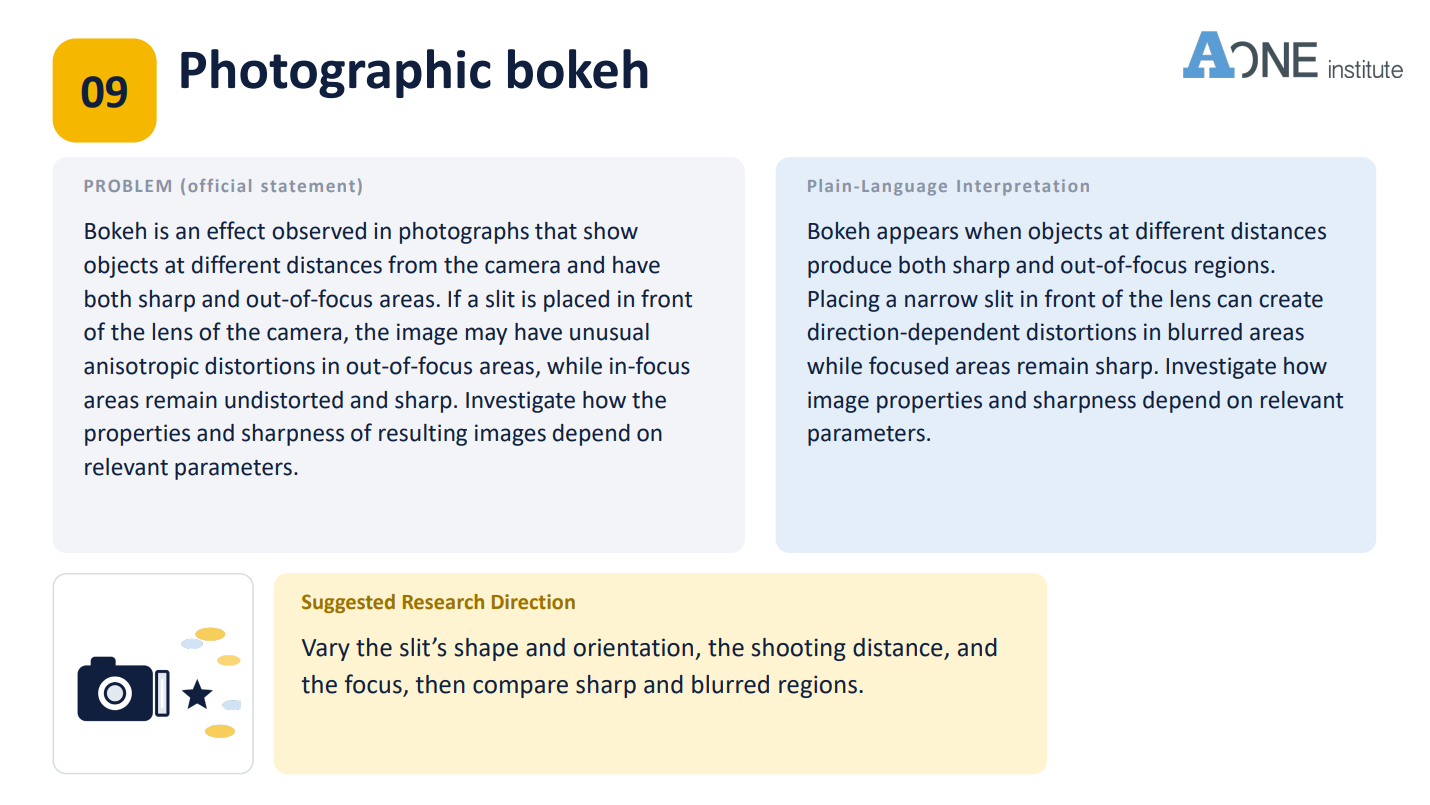
Students examine the bokeh produced when a slit is placed in front of a camera lens. The task investigates how relevant parameters affect distortions in out-of-focus regions while focused regions remain sharp.
10. Air Vortex
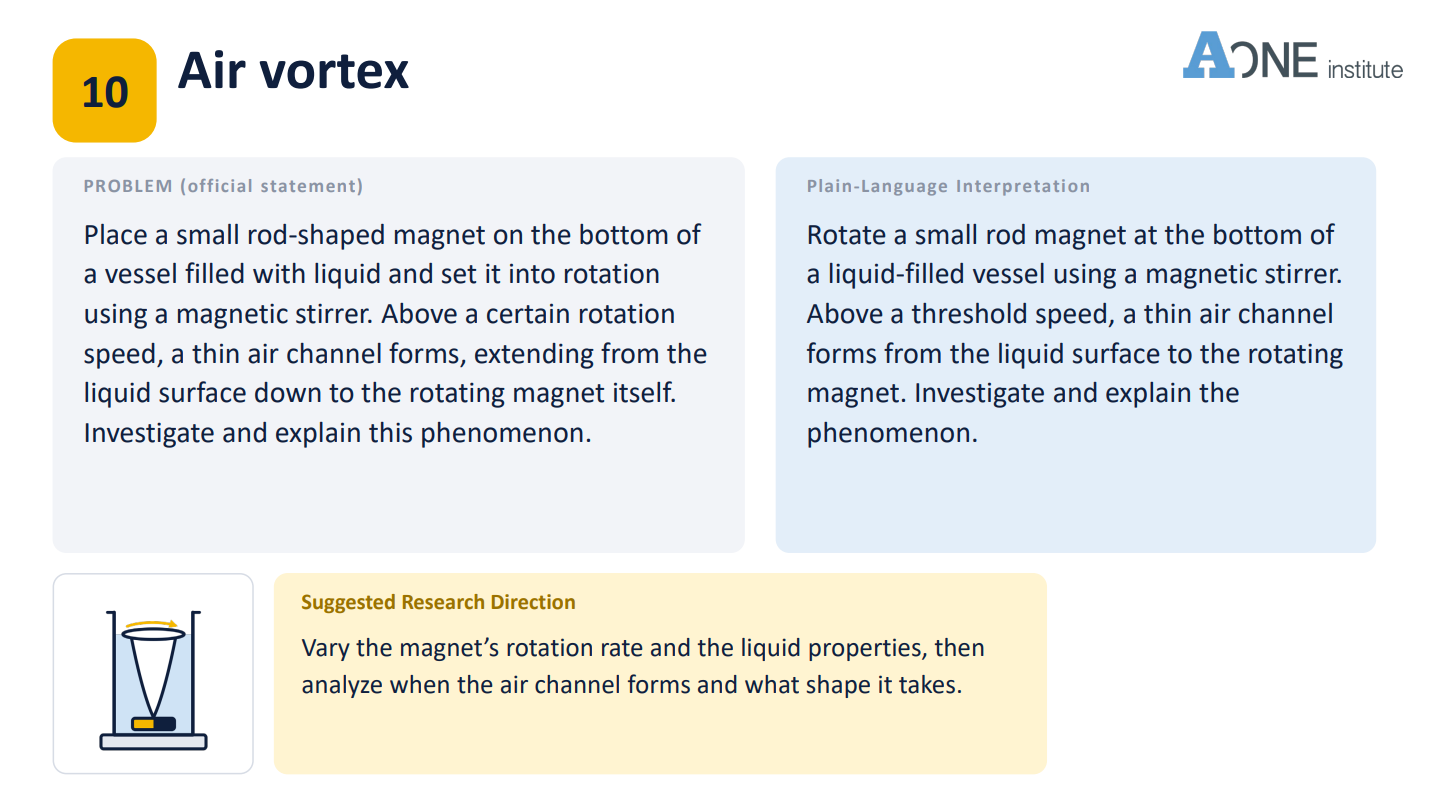
A rotating magnetic stirrer can create a thin air channel extending from the liquid surface toward a rotating magnet. Students investigate when the channel appears and explain the phenomenon.
11. Sound Isolation
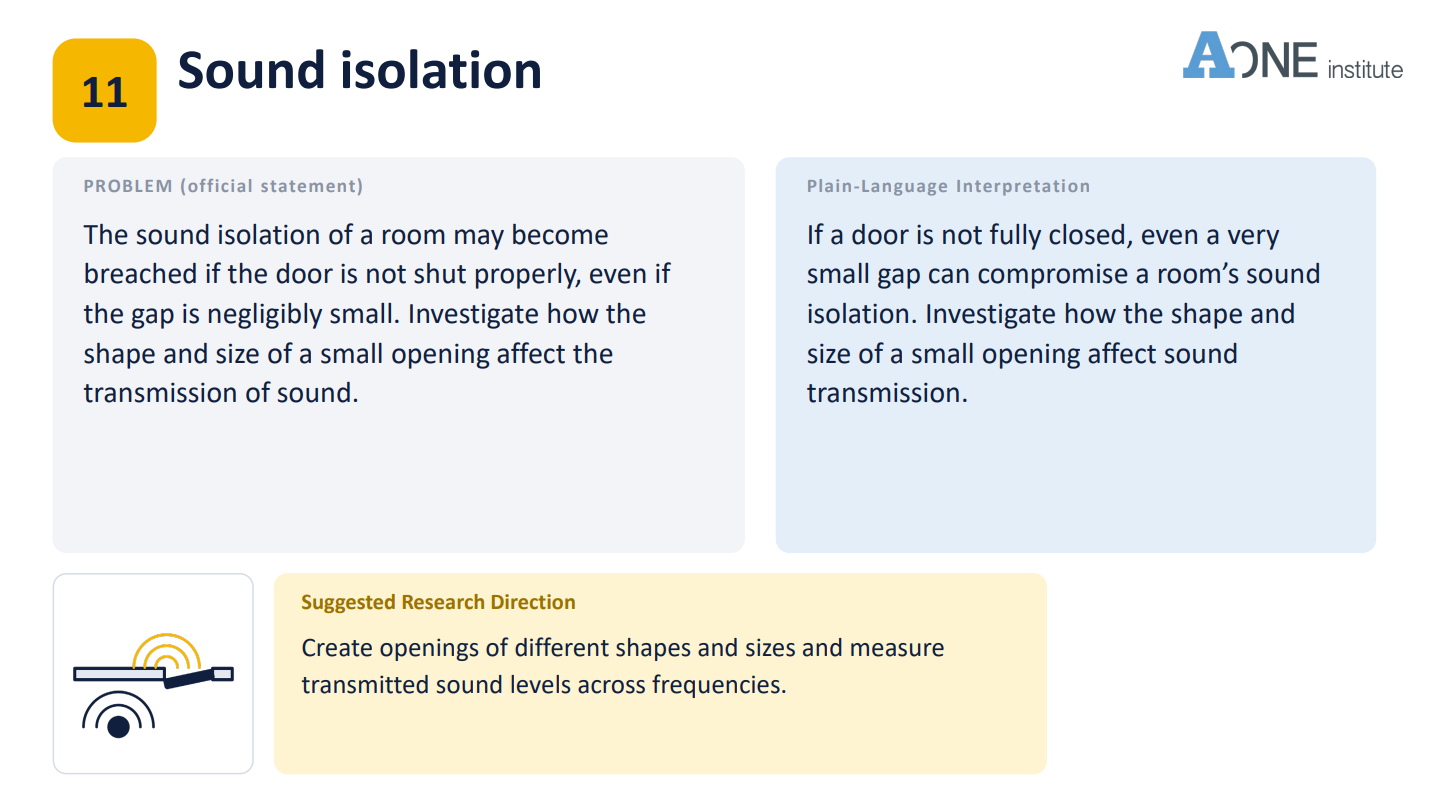
Even a very small opening can compromise the sound isolation of a room. Students investigate how the shape and size of an opening affect sound transmission.
12. Dotted Line Trick
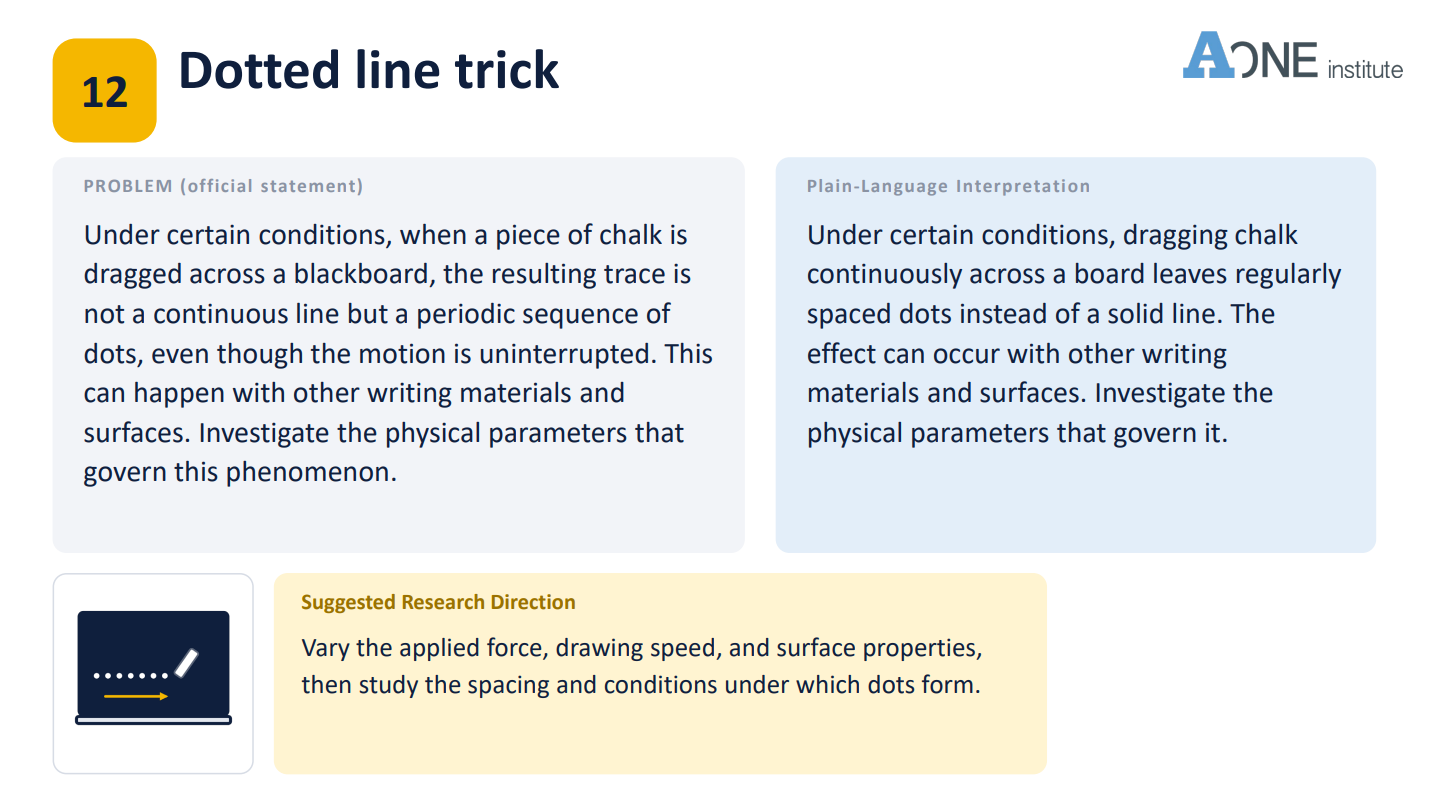
Under certain conditions, chalk dragged continuously across a board can produce a periodic series of dots instead of a continuous line. Students investigate parameters such as applied force, motion, and surface conditions.
13. Vortex Pendulum
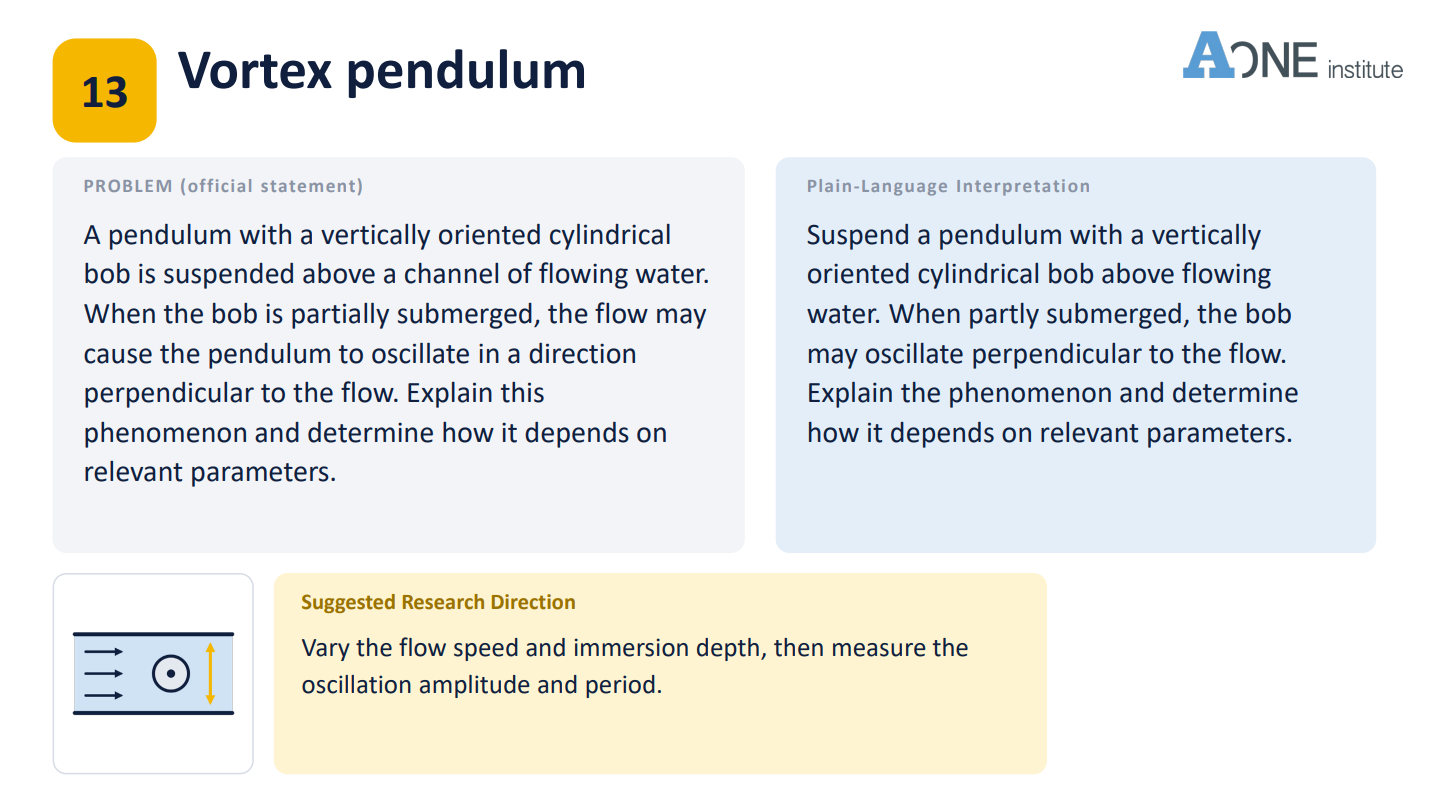
A partially submerged cylindrical pendulum bob placed in flowing water can oscillate perpendicular to the direction of the flow. Students explain the effect and investigate how it depends on relevant parameters.
14. Non-Newtonian Worms
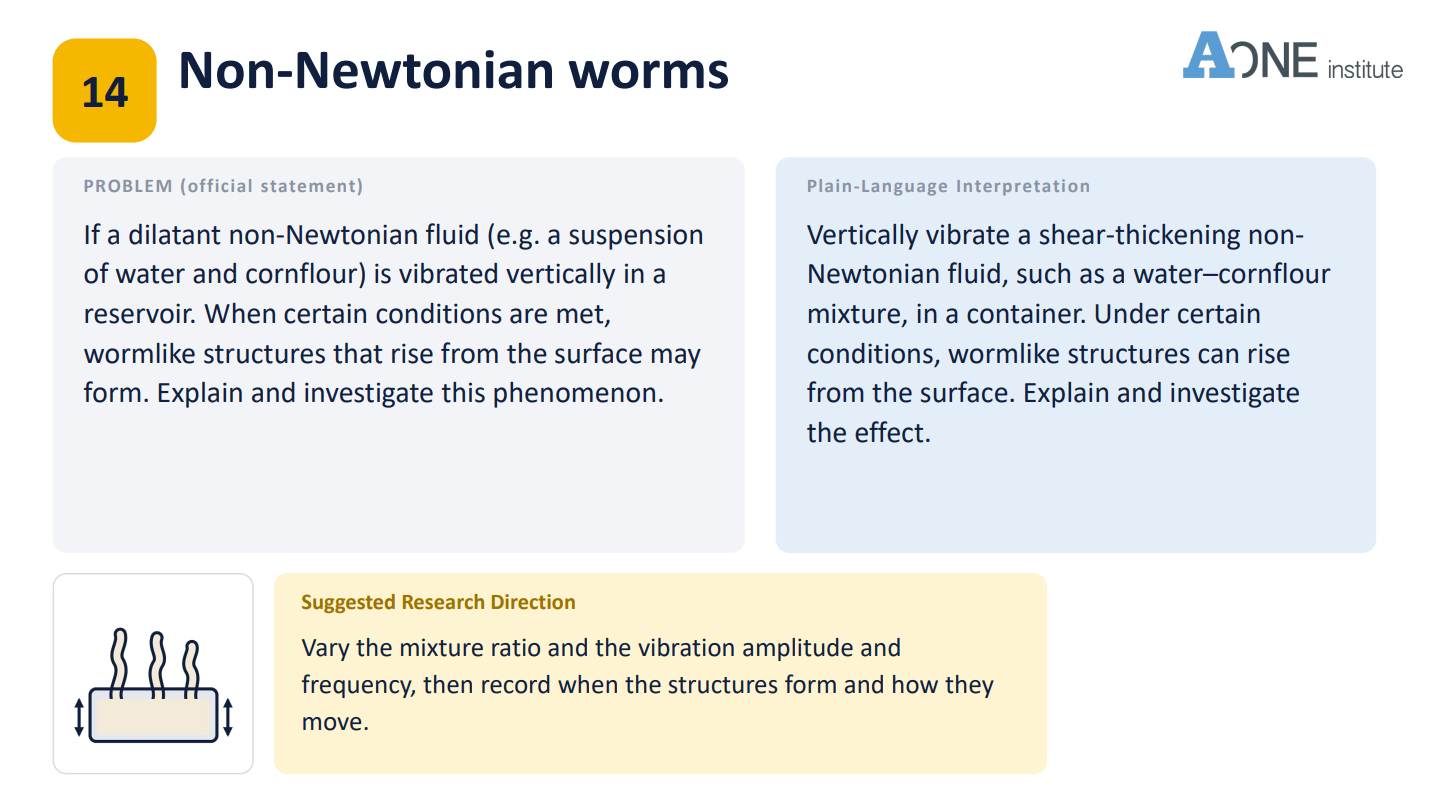
When a shear-thickening non-Newtonian fluid is vibrated vertically, wormlike structures can form above its surface. Students investigate the conditions under which they appear and how they behave.
15. Cold Drink
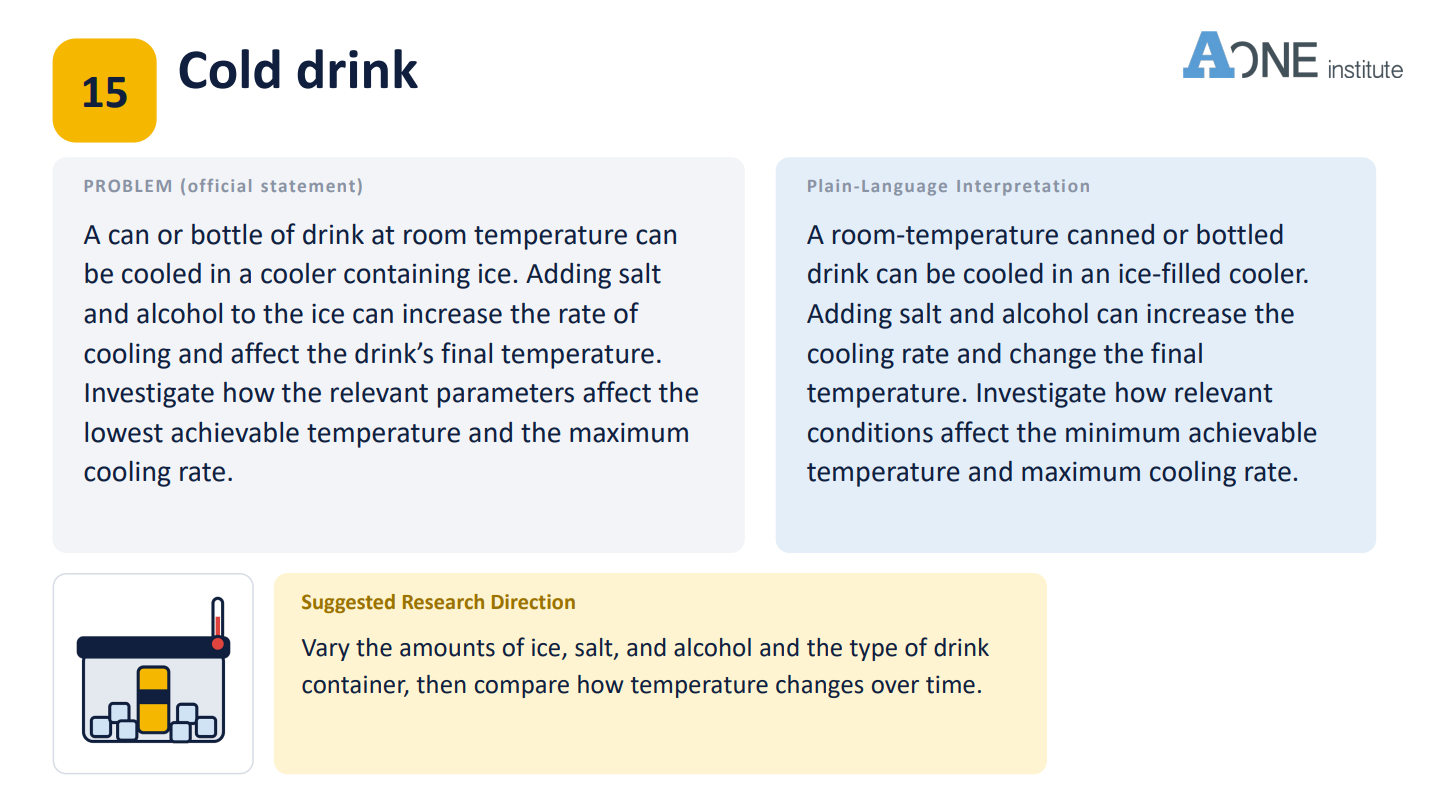
A room-temperature drink can be cooled in ice, and adding salt and alcohol may change both the cooling rate and final temperature. Students investigate the conditions that determine the lowest achievable temperature and maximum cooling rate.
16. Magnetic Carousel
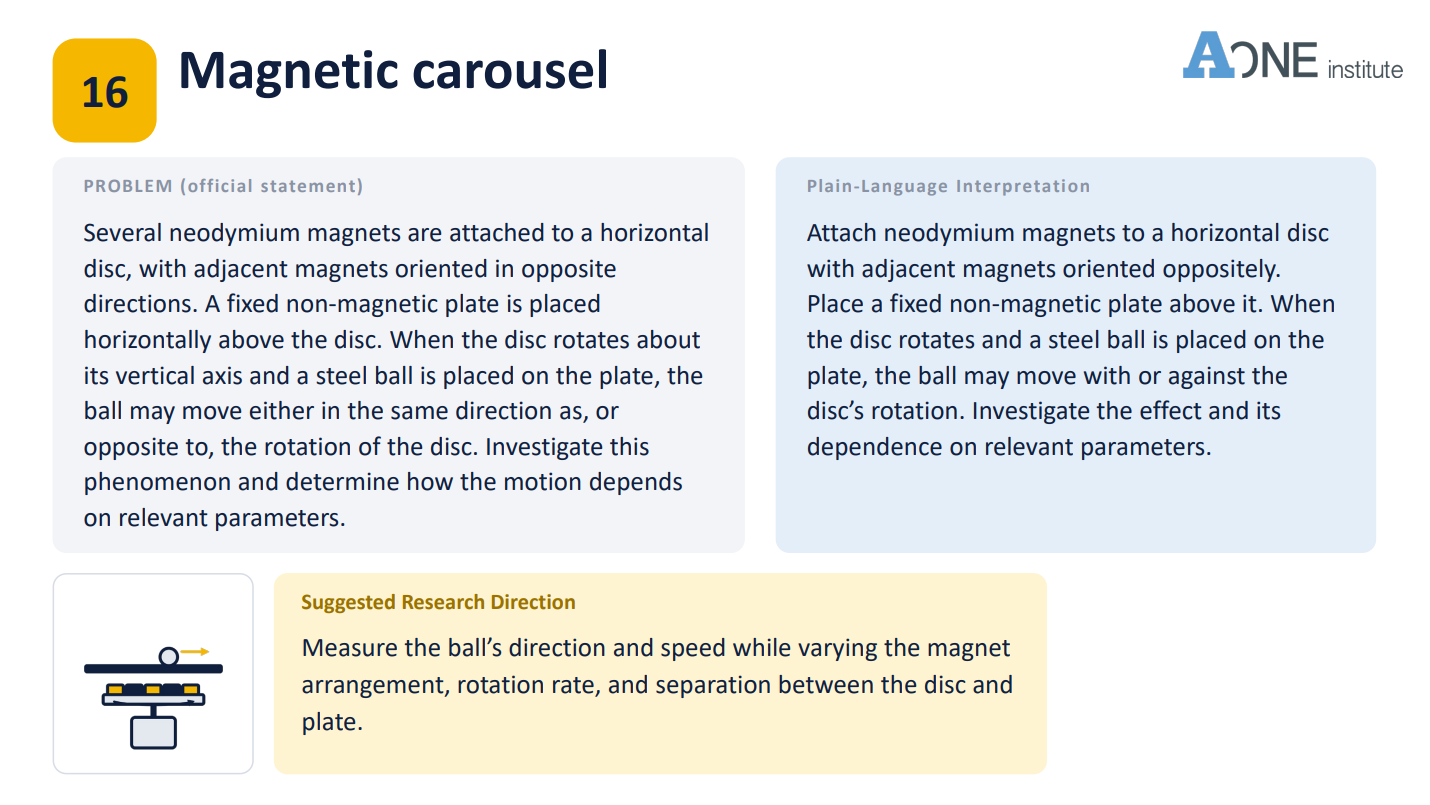
Neodymium magnets are arranged around a rotating disc with alternating orientations. A steel ball placed on a stationary plate above the disc can move either with or against the disc's rotation. Students investigate how magnet arrangement, rotation speed, and separation between the disc and plate affect the motion.
17. Falling Book Cover
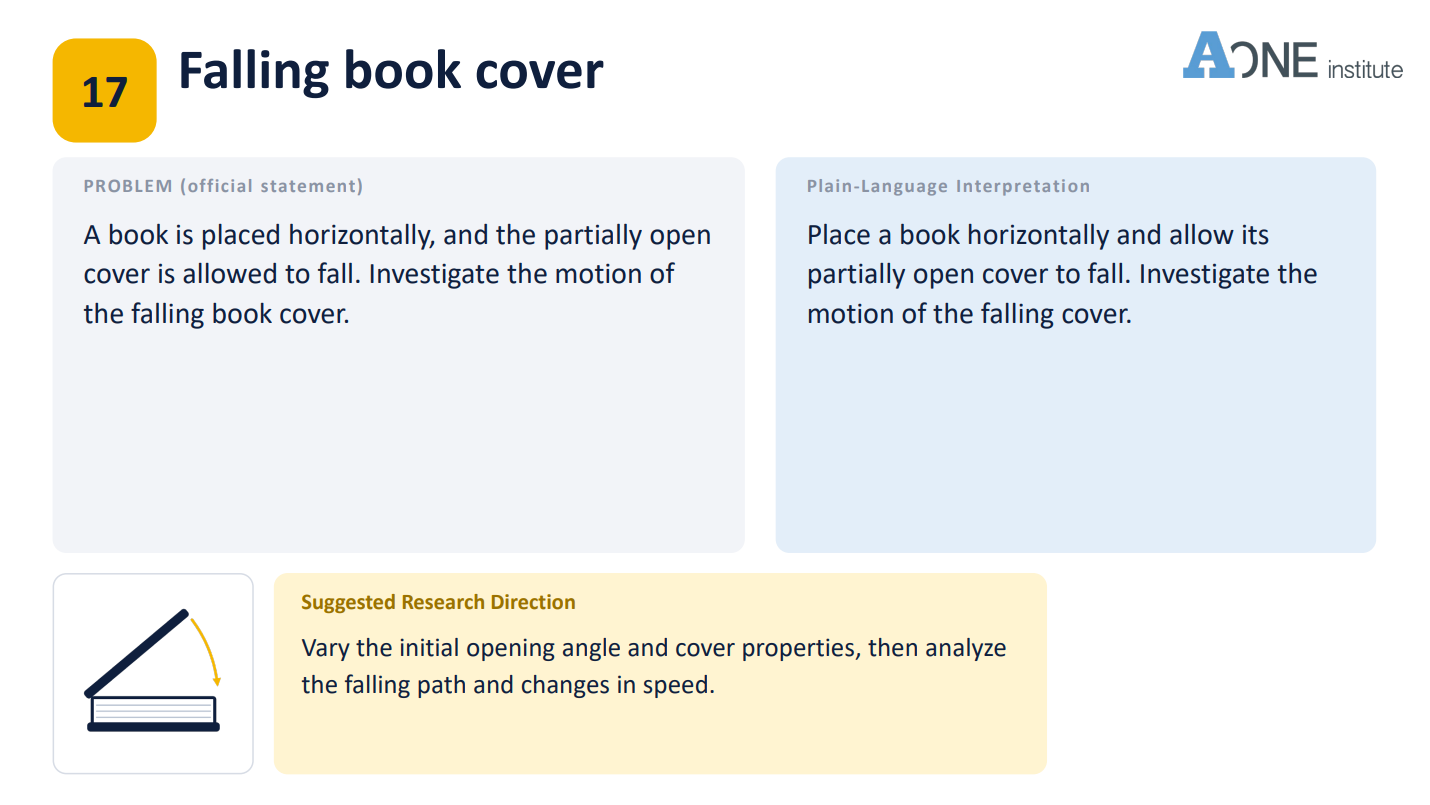
A book is placed horizontally with its cover partially open and allowed to fall. Students investigate the motion of the falling cover, including how initial angle and cover properties may affect its path and speed.
The complete official wording of all 17 problems is published by IYPT.
How Should a Student Get Started?
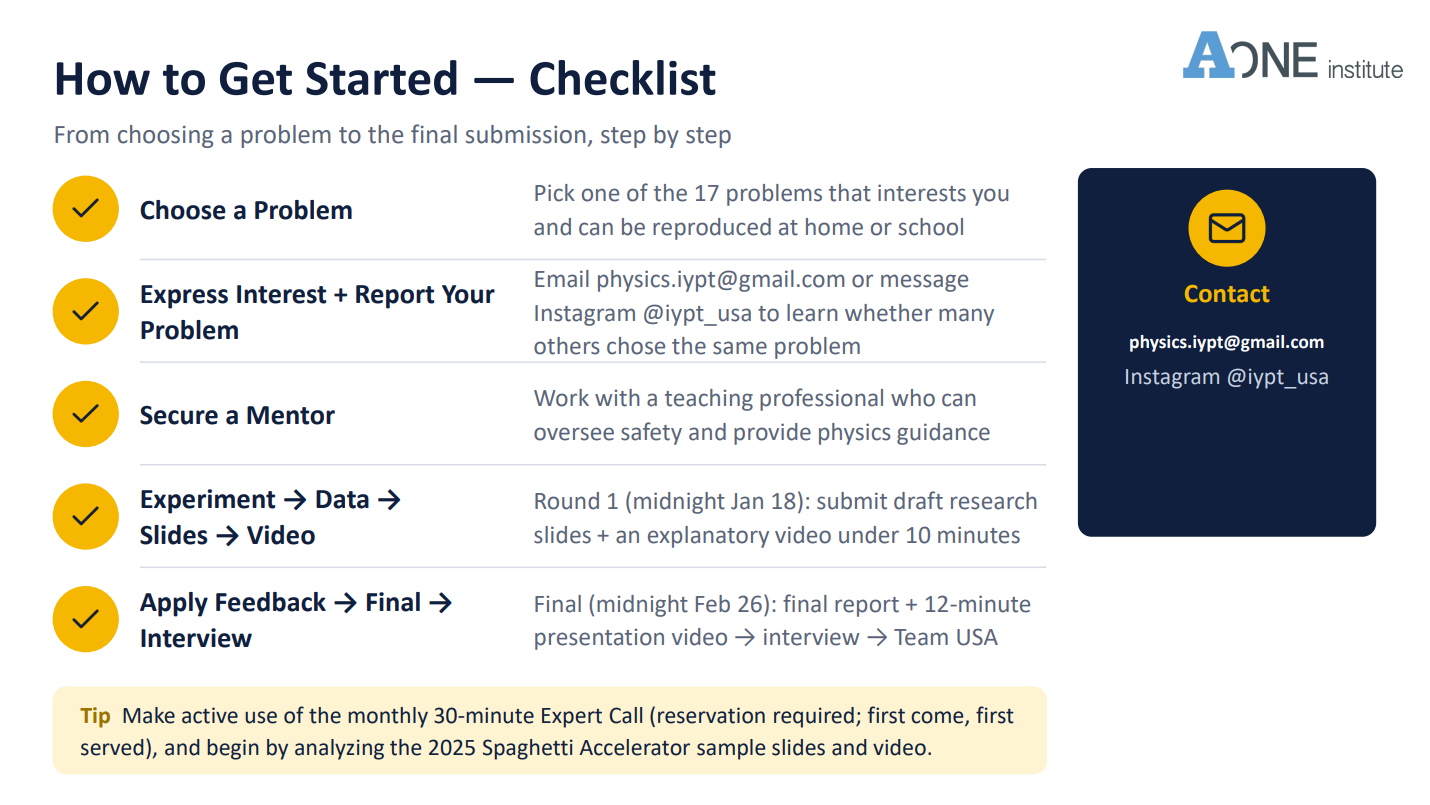
The first step is not to attempt all 17 problems.
Read the full list, identify one phenomenon that is genuinely interesting and experimentally manageable, and then contact US IYPT with the problem choice. Students also need to secure an appropriate mentor before moving into serious experimental work.
From there, the process should move from experiment → data → analysis → slides → video, followed by feedback, revision, the final submission, and potentially an interview.
That is the real opportunity in IYPT. A student is not simply studying more physics. The student is learning how to take one problem far enough to investigate it, defend it, revise it, and communicate it under pressure.
For students whose academic direction is physics, engineering, or another research-intensive STEM field, that is exactly why A ONE Institute believes IYPT deserves serious consideration.
A ONE Institute supports students preparing for advanced physics, Olympiad-level competitions, research programs, and other academically demanding STEM activities. For families considering IYPT, the first priority is to determine whether the student's physics background, research skills, available preparation time, and proposed experiment make the competition an appropriate fit. For class or mentoring inquiries, contact [email protected].
IYPT 2027
IYPT
International Young Physicists’ Tournament
Physics Competition
STEM Activities
