
Students preparing for economics or business competitions often go straight to the prompt. But before trying to answer the question, there's something more important to understand first: how the economy actually works, and how the major forces shaping today's world connect to one another. Knowing individual terms isn't enough — what matters is understanding how inflation, interest rates, government debt, investment, technology, and international markets influence each other. We'll walk through the U.S. economy as an example and connect these ideas step by step, and even for students not preparing for a competition, this framework can make everyday economic news easier to follow.
Understanding the Economy Starts With Markets, Government, and the Central Bank
At the most basic level, a national economy can be understood through three major components.
The first is the market. Households buy goods and services, while businesses produce and sell them. When spending, investment, and economic activity are strong, money moves actively throughout the economy.
The second is the government. Governments collect taxes and issue government bonds to raise money. These funds are then used for public spending while the government manages its finances and debt.
The third is the central bank. In the United States, this role is performed by the Federal Reserve System, commonly called the Fed. The Fed monitors economic conditions and uses monetary policy tools such as interest rates. Two of its major goals are Price Stability and Maximum Employment.
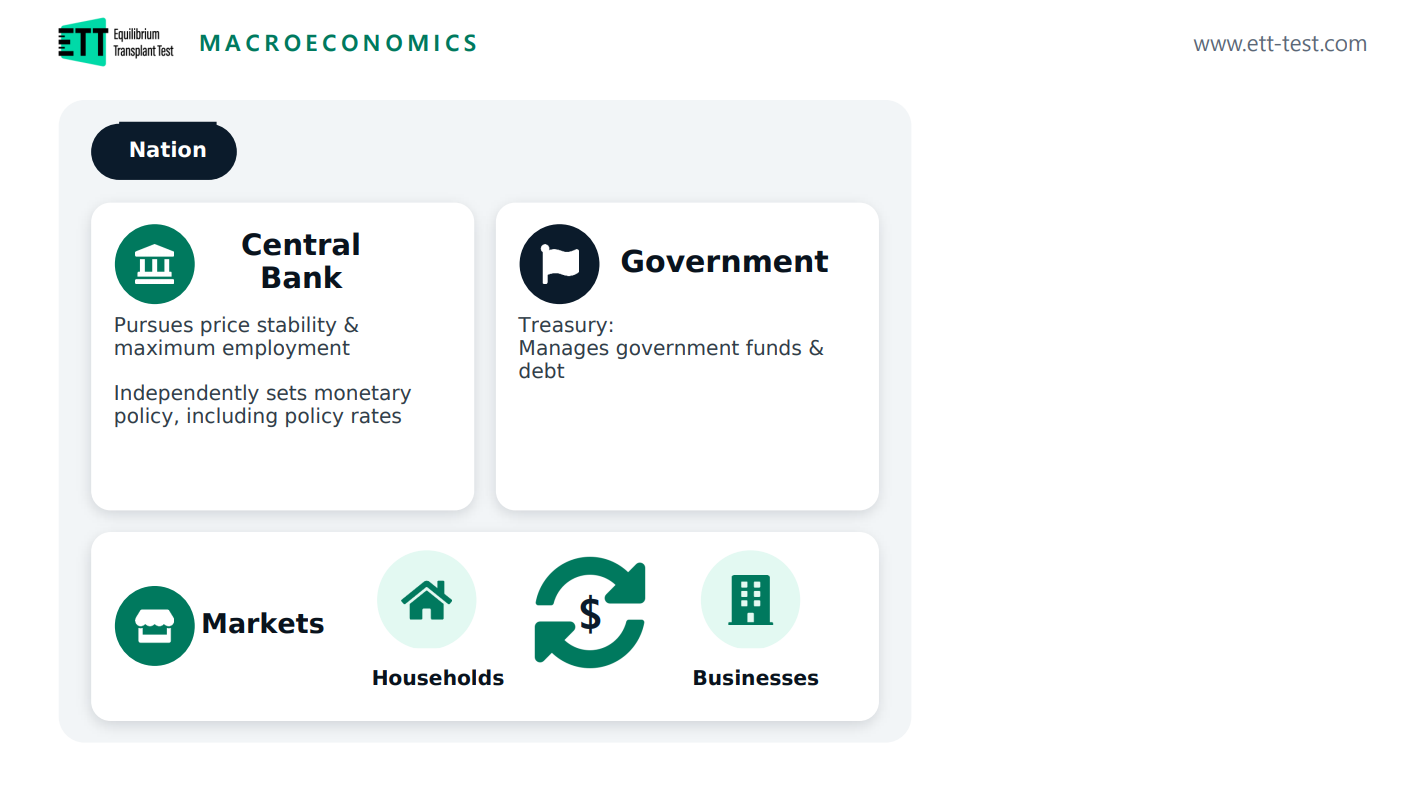
The challenge is that these goals don't always move in the same direction. When employment is very strong and people have more income, spending may increase. But if demand becomes too strong, prices can begin to rise. The central bank therefore tries to find a balance between maintaining economic activity and preventing excessive inflation.
Why Is the Fed Known as an "Inflation Fighter"?
Inflation can be understood as a decline in the purchasing power of money. If a hamburger that once cost $10 eventually costs $20, the same amount of money can buy less than before.
But the most serious problem with inflation isn't simply that prices rise — it's that consumer expectations can change too. Imagine a television costs $1,000 this year, but people expect it to cost $2,000 next year and $3,000 the year after. Anyone who needs that television might decide: "I should buy it now before the price goes up" — and some may even borrow money to make the purchase immediately.
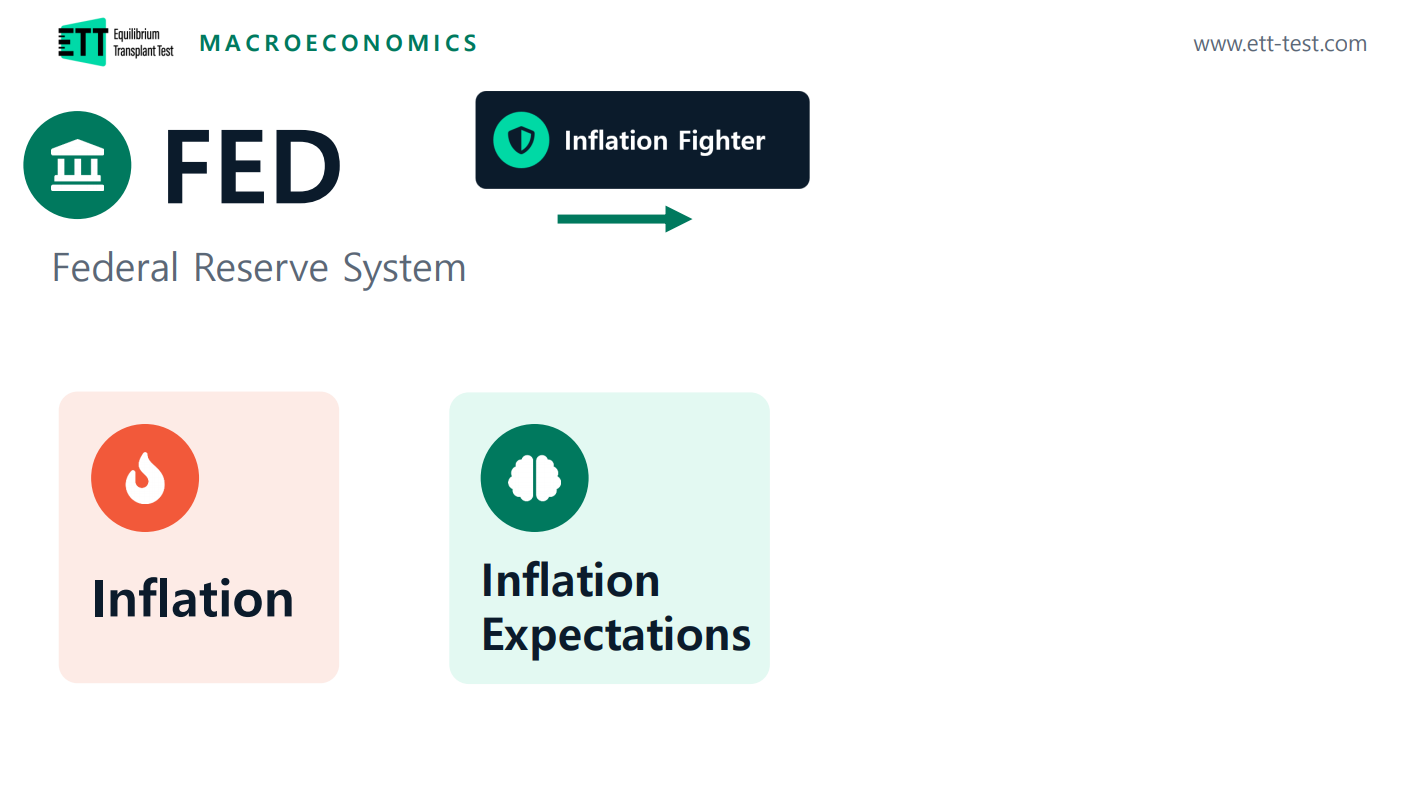
This is where Inflation Expectations become important. When people expect future prices to rise, they may increase spending today, and that higher demand can push prices even higher. A cycle can develop:
Inflation → Higher Inflation Expectations → More Spending → Higher Prices → Even Higher Inflation Expectations
This is one reason the Fed pays such close attention to inflation.
Interest Rates Act as a Brake on Inflation
One of the most important tools central banks use to control inflation is the interest rate. An easy way to think about an interest rate is as the cost of borrowing money.
Suppose housing prices are rising and someone wants to buy a home immediately. If interest rates are low, taking out a mortgage may seem manageable. But if interest rates rise significantly, borrowing becomes more expensive, and the buyer may decide: "Maybe I should wait."
The same idea applies to cars, consumer purchases, business loans, and corporate investment. Higher borrowing costs can reduce spending and investment, and as demand cools, inflationary pressure may weaken too. In this sense, interest rates act as both an accelerator and a brake for the economy.
Why Is the U.S. Policy Rate Expressed as a Range?
Unlike many countries, the United States commonly expresses its policy rate as a target range rather than a single number. The background can be traced to the 2008 financial crisis.
As the economy weakened sharply, the Fed cut interest rates aggressively to support borrowing, spending, and investment. When rates approached zero, the Fed began setting the federal funds rate using a target range — a framework that has continued, which is why U.S. interest rates are still commonly discussed as a range rather than a single number.
Why Do Interest Rates and Bond Prices Move in Opposite Directions?
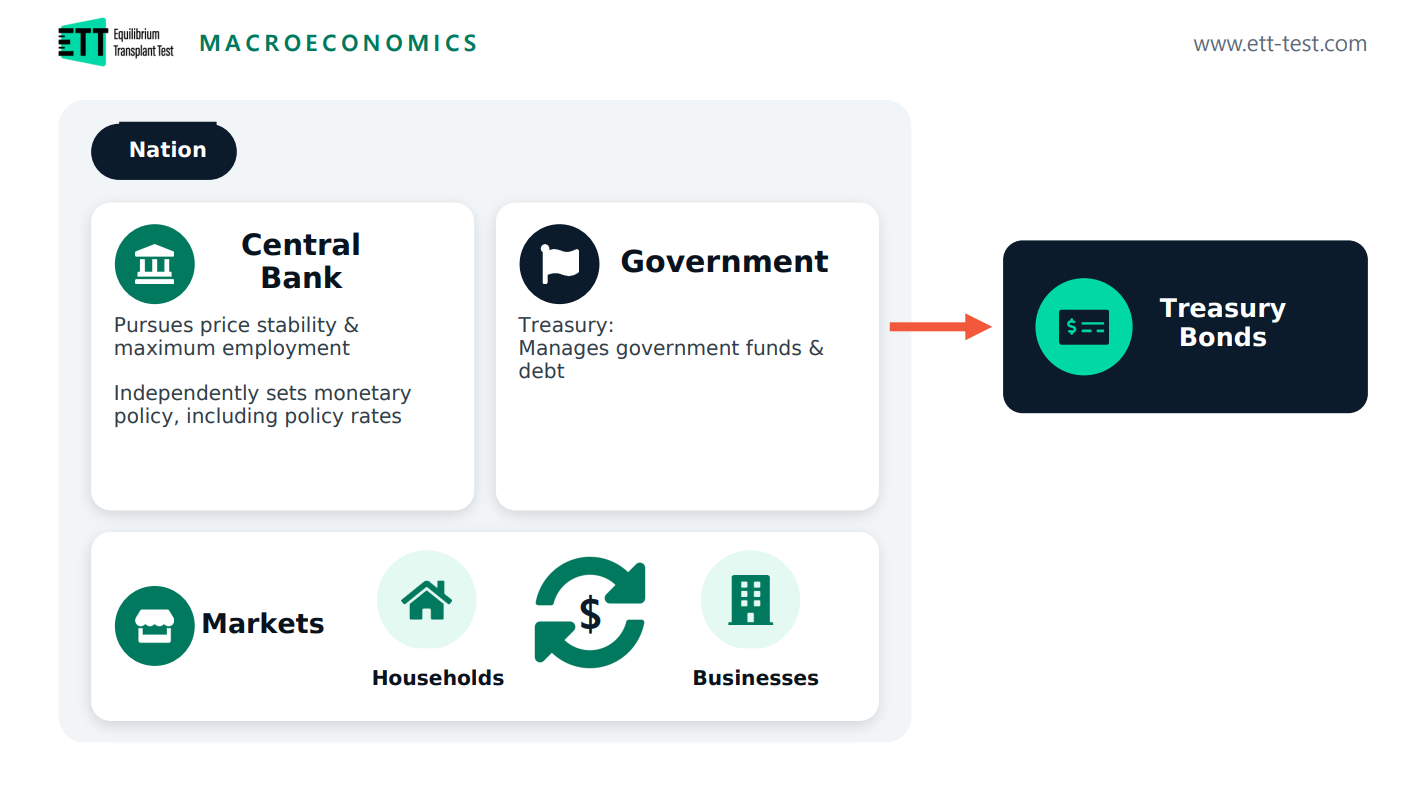
Now we can move from the central bank to the government. The U.S. government doesn't fund all of its spending through taxes alone — it also raises money by issuing U.S. Treasuries.
A Treasury can be understood as a promise from the government: "Lend us money today, and we will pay you back according to the terms of this security."
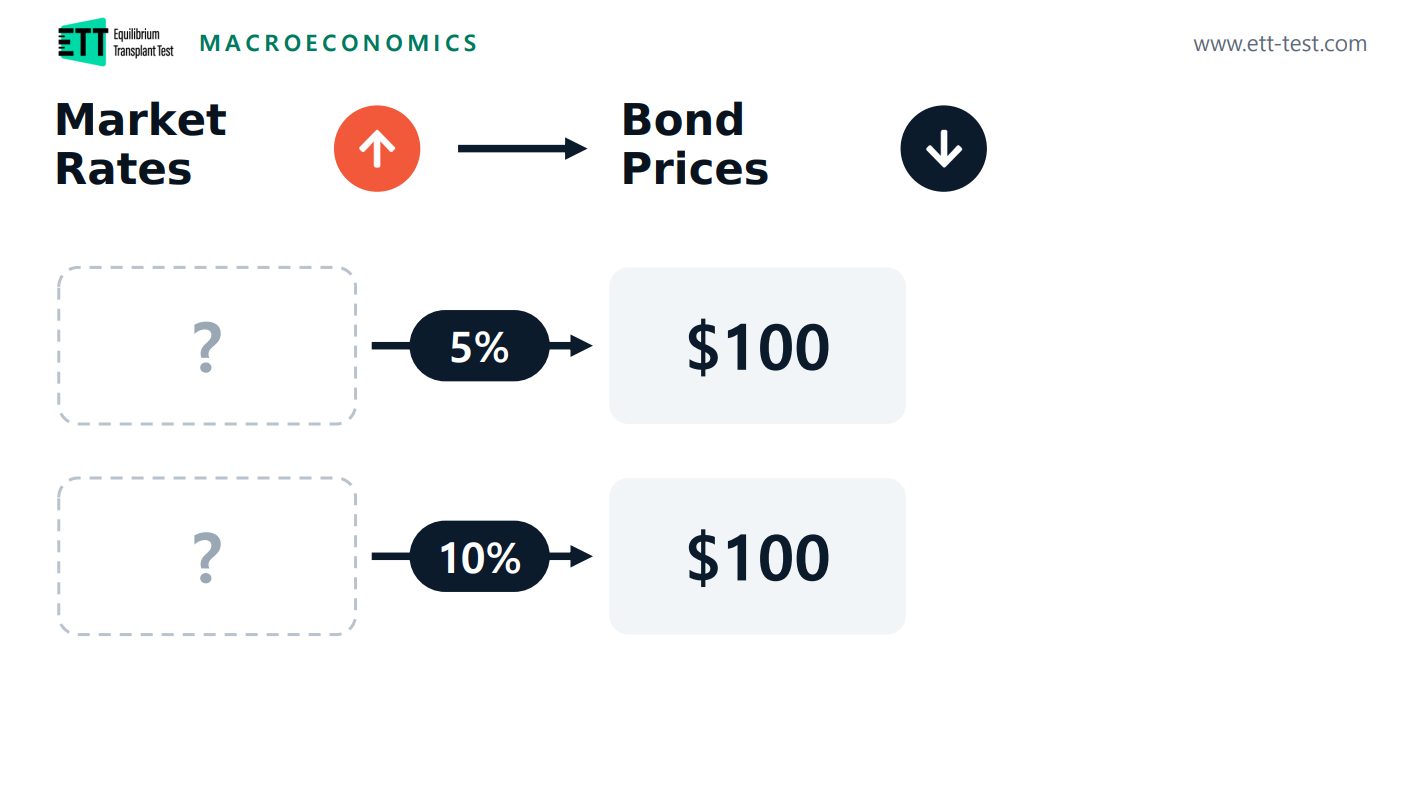
One of the most important relationships students should understand is this: Market Interest Rates ↑ → Existing Bond Prices ↓.
Consider a simple example. Suppose a one-year bond pays $100 at maturity. If the return is 5%, an investor would pay approximately $95.24 today to receive $100 one year later. If the return rises to 10%, an investor would only need to pay about $90.91 today to receive that same $100.
| Yield | Current Price | Value at Maturity |
|---|---|---|
| 5% | $95.24 | $100 |
| 10% | $90.91 | $100 |
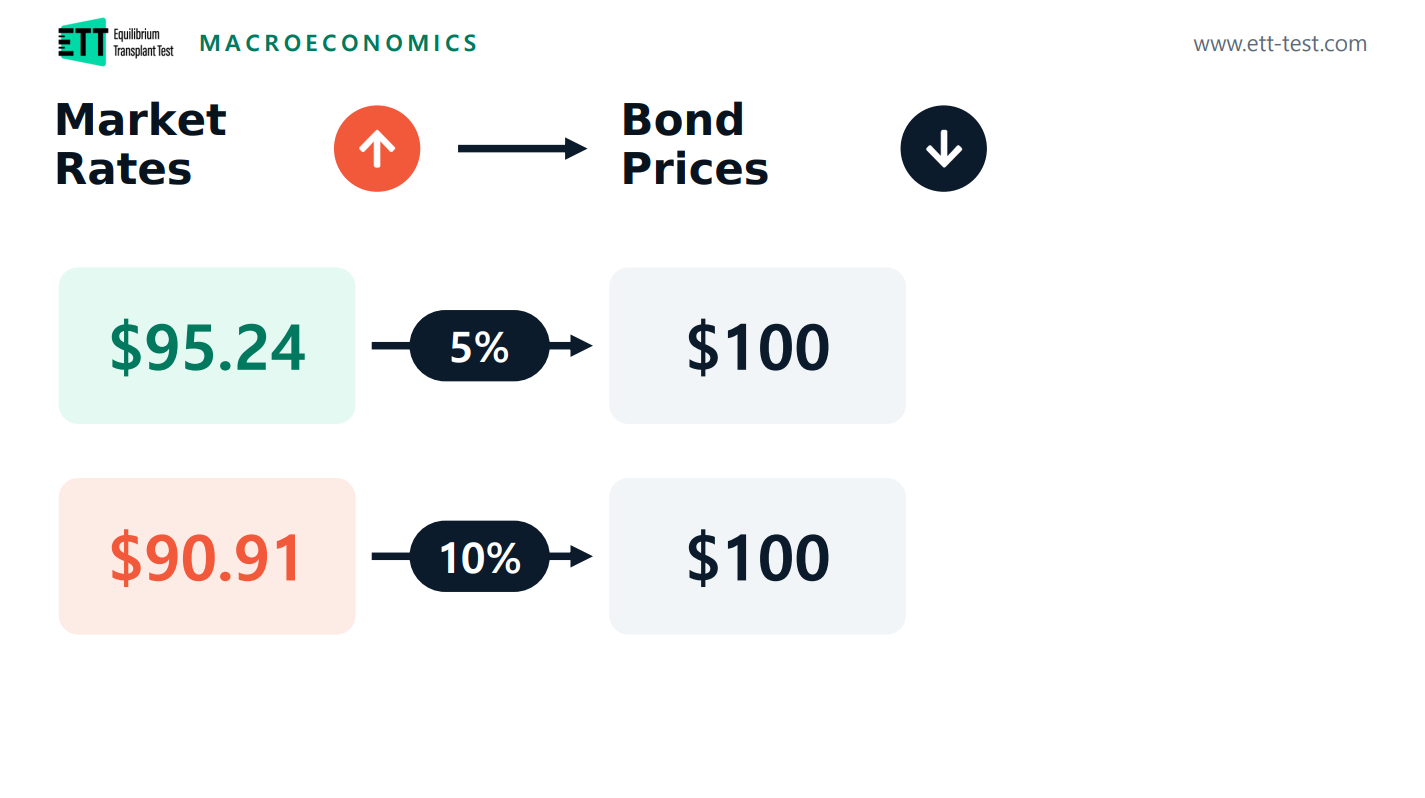
If newly issued bonds offer higher returns, older bonds with lower returns become less attractive, so their market prices fall. For students preparing for economics and investment competitions, this relationship is fundamental.
When Can U.S. Treasuries Become Less Attractive?
Several different forces can affect demand for U.S. government bonds.
The first is the expectation that interest rates may rise further. If investors believe future bonds will offer higher yields, they may choose to wait rather than buy now.
The second is the availability of corporate bonds. Large technology companies may issue bonds when they need significant amounts of capital for investment, including AI infrastructure. If investors believe a major company is financially strong and its corporate bonds offer a higher return than Treasuries, some investors may prefer the corporate bond.
The third factor is the behavior of foreign investors and governments. U.S. Treasuries are held around the world, which means currency movements and the financial policies of other countries can affect demand for U.S. government debt. Japan is an important example, since it has historically been one of the largest foreign holders of U.S. Treasuries — if currency conditions create pressure to support the yen, changes in Japan's dollar-denominated assets can also become relevant to the Treasury market.
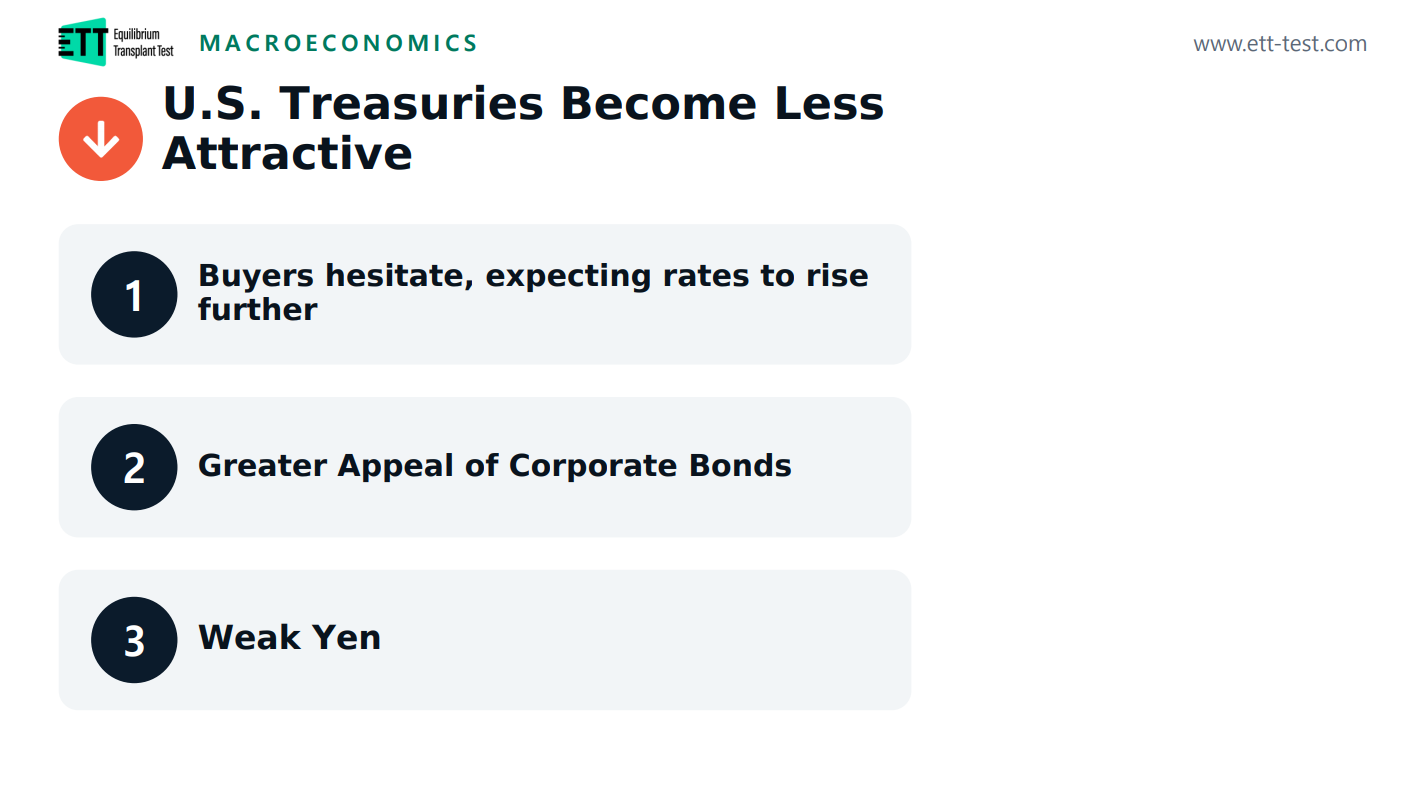
This shows why the U.S. bond market can't be understood by looking only at the United States.
What Are Bond Vigilantes?
Economic news sometimes refers to "Bond Vigilantes." This doesn't refer to a formal organization — instead, it describes bond investors who react collectively when they become concerned about inflation, government borrowing, fiscal policy, or debt sustainability.
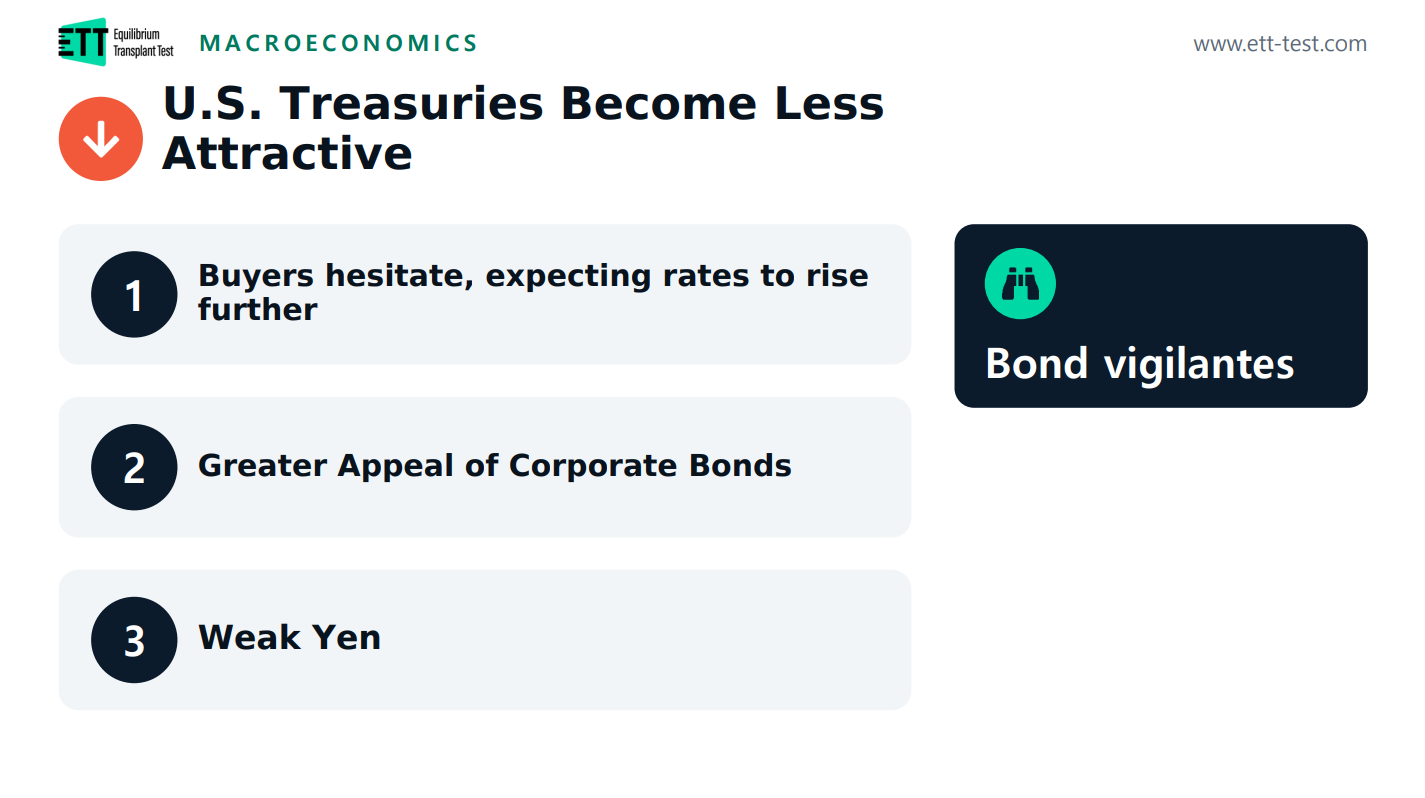
If investors become less willing to buy government bonds, the government may have to offer higher yields to attract buyers. Higher yields reduce the market value of existing lower-yield bonds, which can encourage more investors to sell. A cycle may develop:
More Bond Selling → Lower Bond Prices → Higher Yields → More Selling
Rising government bond yields can also affect the stock market. If relatively safe assets begin offering attractive returns, some investors may question why they should take on additional risk by investing in stocks instead. This is why bond-market movements can influence the broader financial system.
The Discussion Eventually Leads to U.S. Government Debt
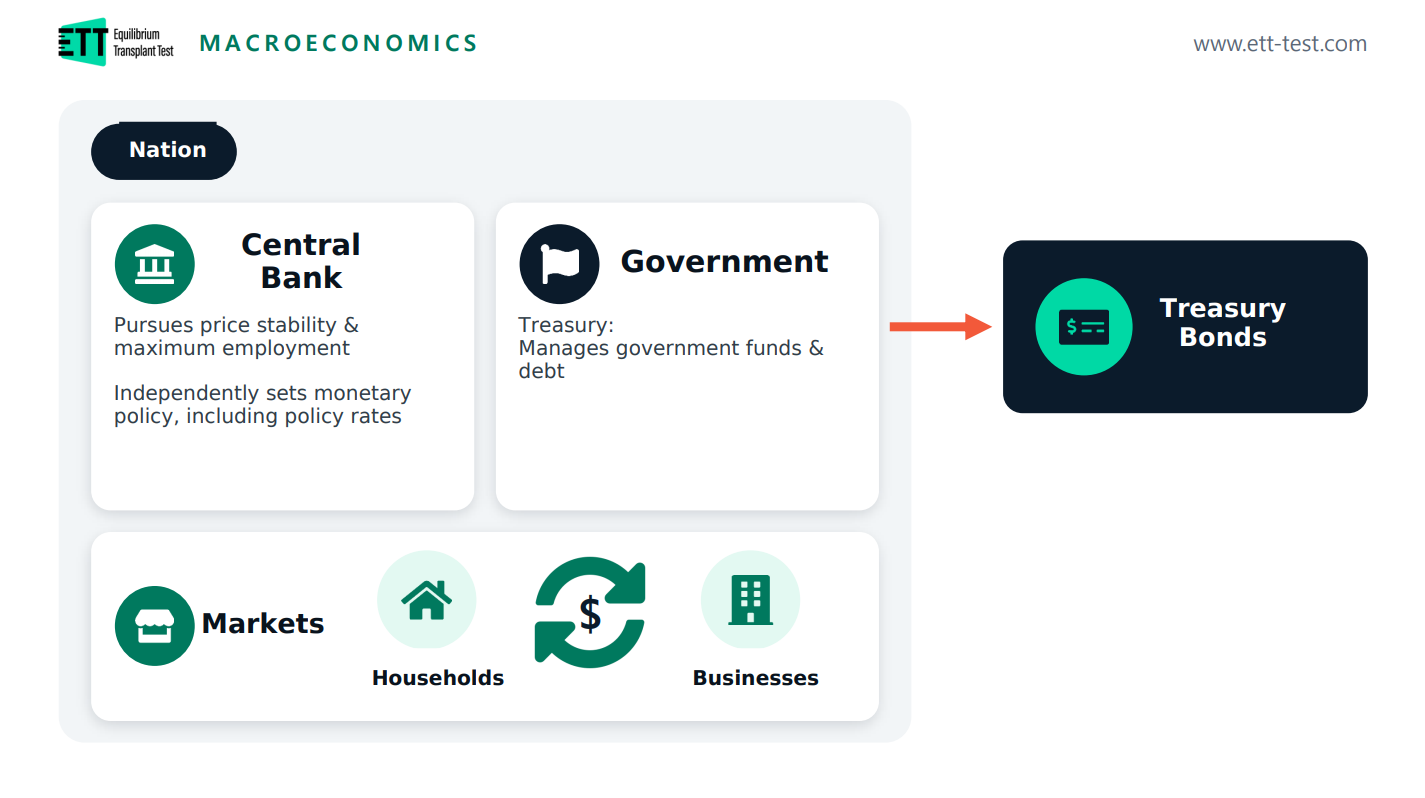
This is where interest rates, Treasuries, and government debt begin to connect. The government issues bonds to borrow money. If the interest rate on that borrowing rises, the government's interest costs can also increase — and when a country already carries a large amount of debt, this becomes increasingly important.
However, economists don't look only at the total dollar amount of government debt. One commonly discussed measure instead is the Debt-to-GDP Ratio.
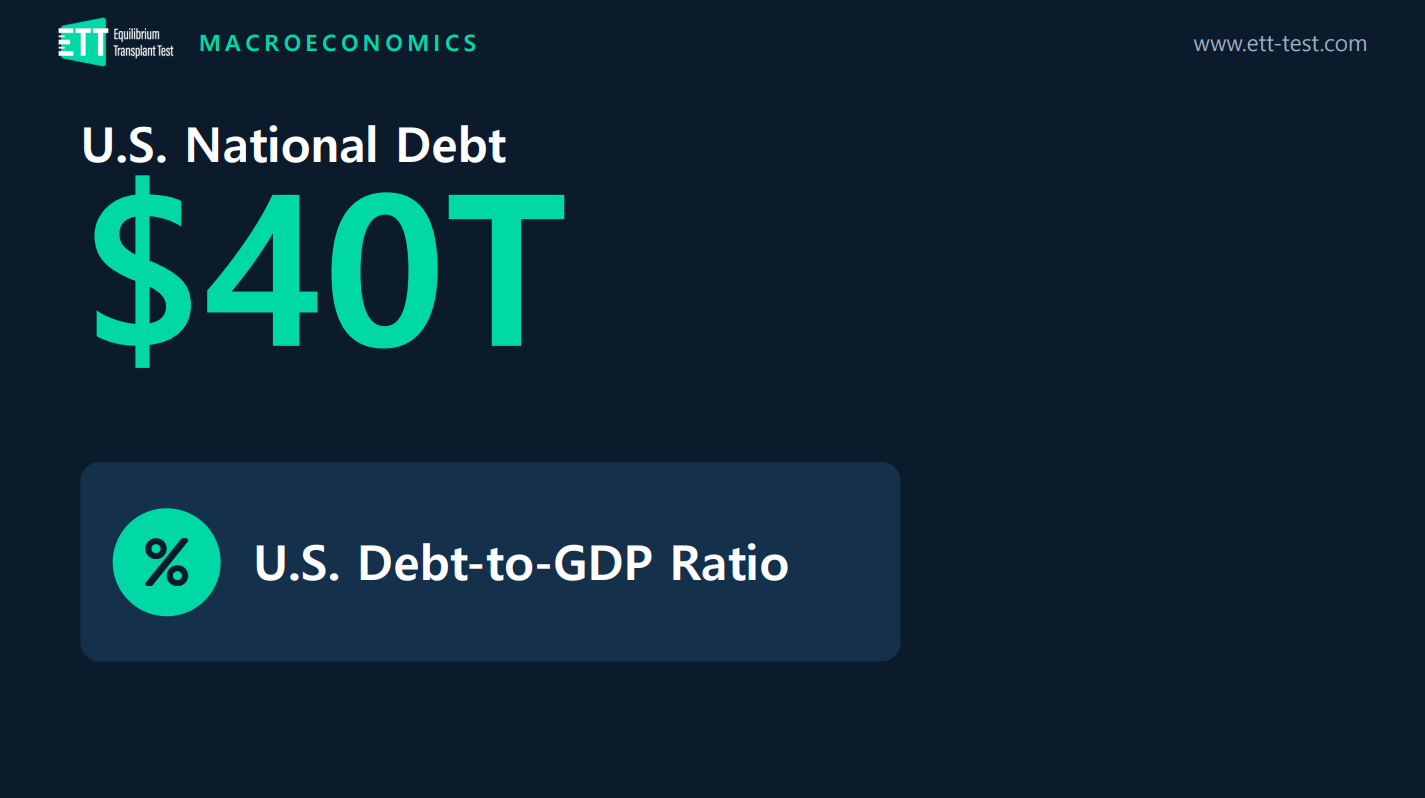
Note: the $40 trillion figure reflects the U.S. national debt as of the most recent Treasury data confirmed at time of writing (September 2026) and will change as the debt grows.
There are two basic ways to reduce this ratio: reduce the amount of debt, or increase GDP. This is where the discussion of Stablecoins and AI becomes especially interesting.
Why Are Stablecoins Connected to U.S. Treasuries?
A Stablecoin is a digital asset designed to maintain a relatively stable value by linking itself to another asset or currency. Dollar-based Stablecoins are generally designed to maintain a value close to the U.S. dollar.
In countries where the local currency is unstable, people may want greater access to dollar-denominated assets. Stablecoins may also be used for international payments, remittances, and transactions within digital-asset markets.
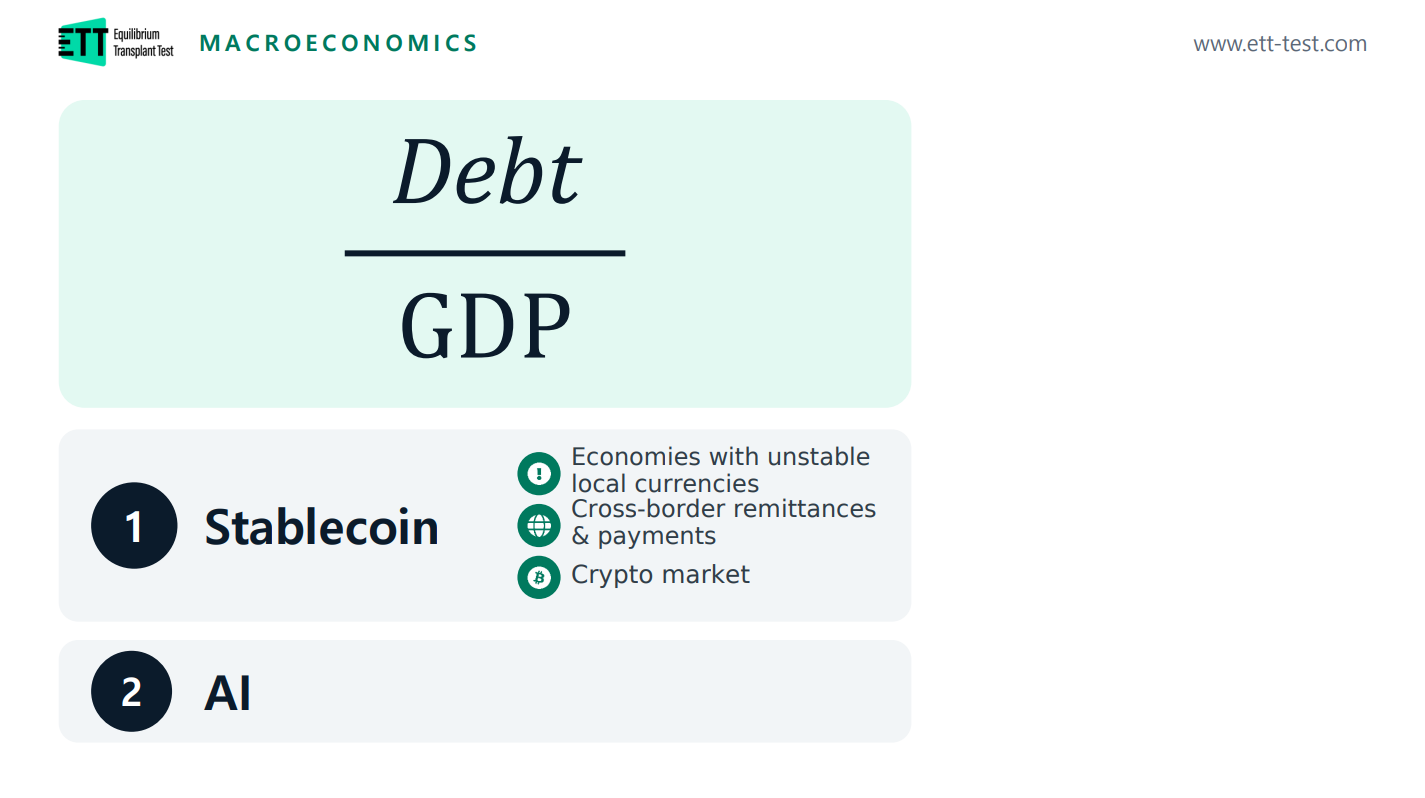
But the important economic question is what happens behind the Stablecoin. Stablecoin issuers need reserve assets, and if a large share of those reserves is held in short-term U.S. Treasury securities, growth in Stablecoin use can contribute to demand for short-term U.S. government debt. The connection can be understood like this:
More Stablecoin Use → Larger Reserve Requirements → Greater Potential Demand for Short-Term U.S. Treasuries
If demand for Treasuries remains strong, the government may face less pressure to offer increasingly high yields simply to attract buyers. This is why Stablecoins can be viewed not only as a Crypto topic, but also as part of a much larger discussion involving the U.S. dollar and government bond markets.
Why Does AI Belong in the Same Discussion?
One of AI's most important potential economic effects is higher productivity. If workers and businesses can produce more output using the same amount of time and resources, total economic output can increase, and if those productivity gains translate into economic growth, GDP can rise.
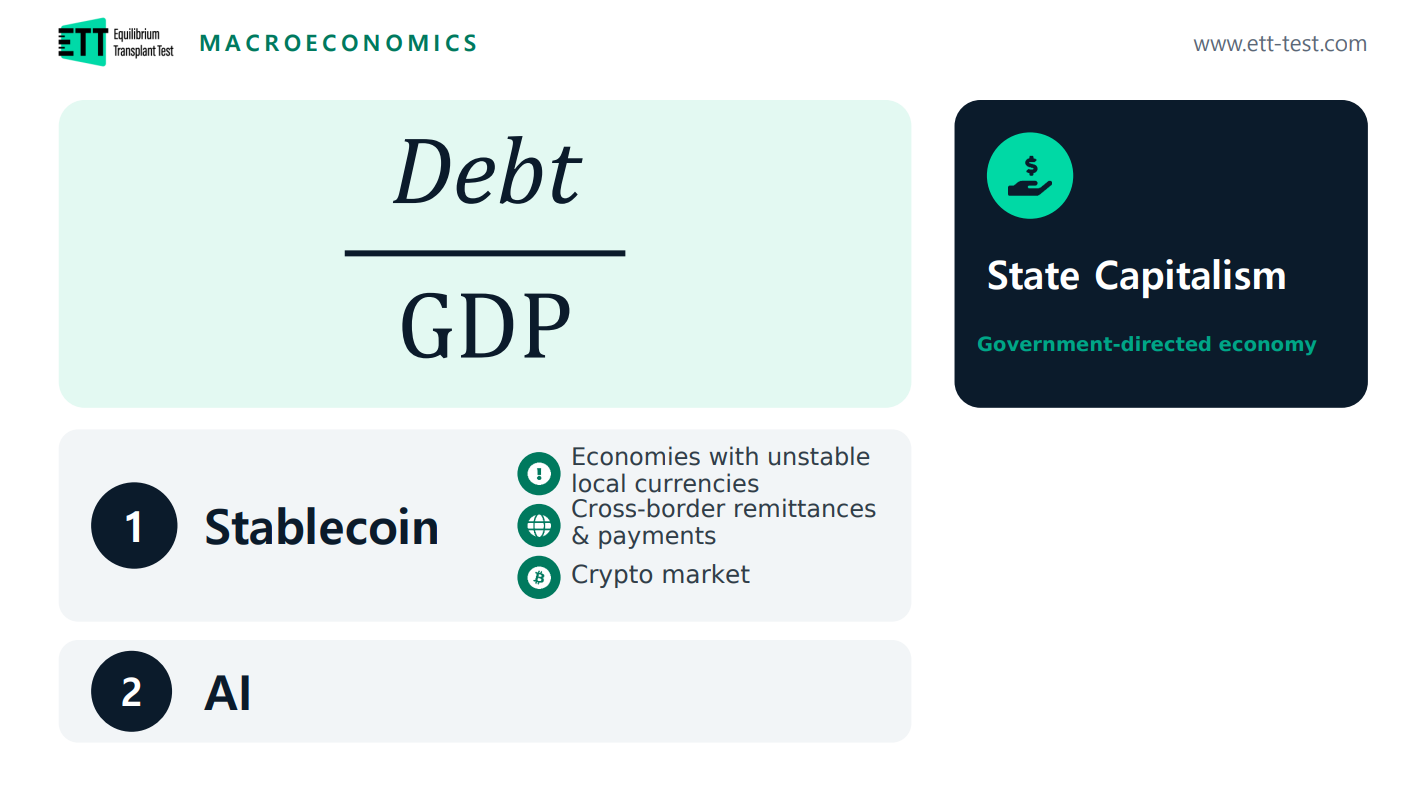
Returning to the Debt-to-GDP ratio, the connection becomes clearer: Stablecoins can be discussed in relation to demand for short-term U.S. Treasuries, while AI can be discussed in relation to productivity and GDP growth. The larger framework is therefore:
Stablecoins → Potential Treasury Demand AI → Productivity Growth → Potential GDP Growth
Looking at these technologies through this broader framework helps explain why they may become part of national economic strategy rather than simply individual industries — which also opens the door to another concept: State Capitalism, where governments actively support specific industries, technologies, or economic priorities, and the boundary between private-sector competition and national strategy becomes increasingly important.
Why Does This Background Knowledge Matter for Competitions?
Students often receive an economics, finance, or business prompt and immediately begin writing, but stronger analysis usually begins before the writing starts — by understanding the economic structure behind the question.
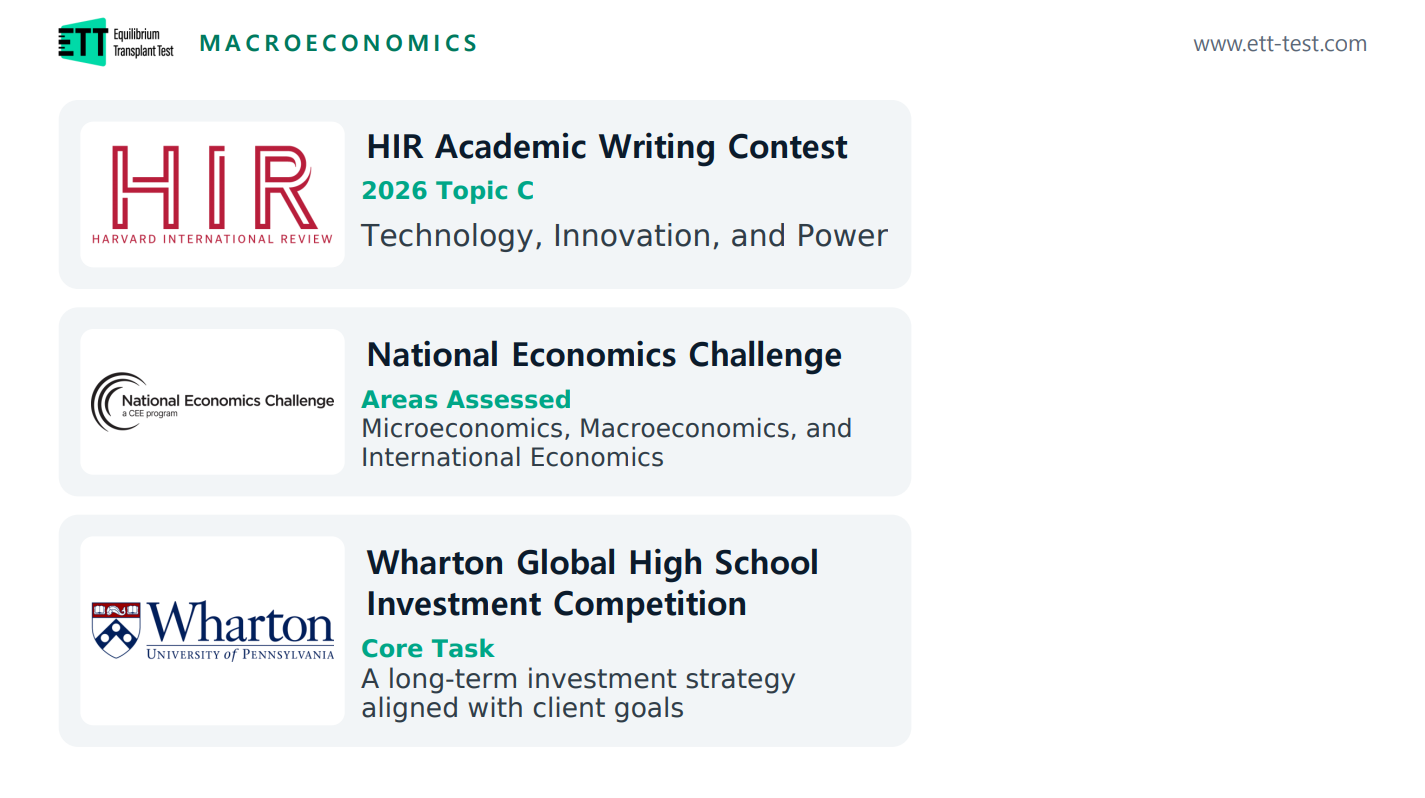
For example, a competition topic involving technology, innovation, and power — such as the HIR Academic Writing Contest's 2026 Theme C — can be approached not only as a technology question, but also through national industrial policy, economic growth, and international competition.
Students preparing for the National Economics Challenge (NEC) need to understand concepts such as inflation, interest rates, bonds, monetary policy, and international economic relationships.
The same applies to investment competitions such as the Wharton Global High School Investment Competition. Building a long-term investment strategy requires understanding whether interest rates are rising or falling, how bonds and stocks are affected, how industries are changing, and how AI might affect companies and productivity — macroeconomic knowledge provides the context needed to answer those questions.
HIEEC Prompts Require the Same Kind of Thinking
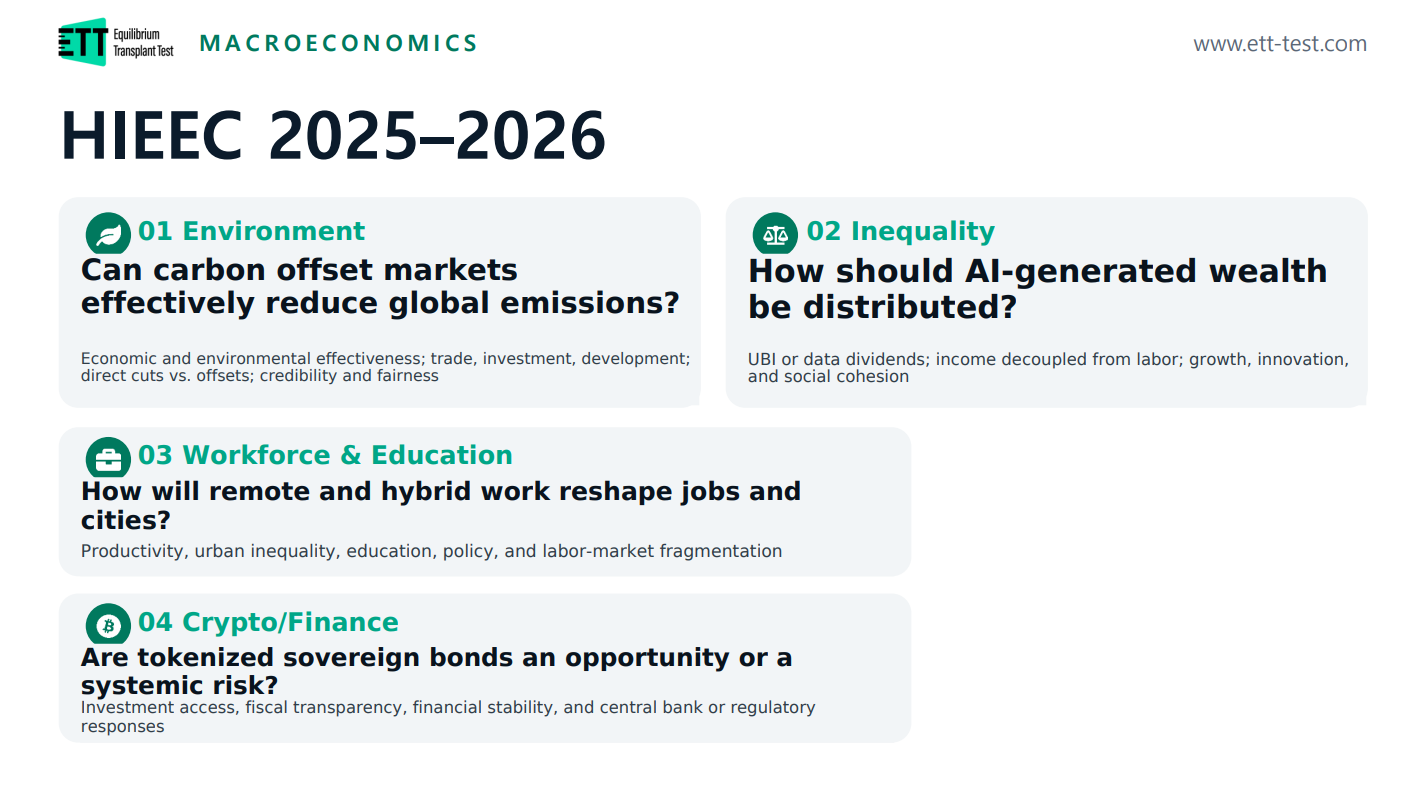
Economics essay competitions also reward students who can identify relationships between multiple economic forces. Consider topics from the 2025–2026 Harvard International Economics Essay Competition (HIEEC):
Environment — Can carbon offset markets effectively reduce global emissions? Students may need to consider direct emission reductions, international trade, investment, development, market credibility, and fairness.
Inequality — How should AI-generated wealth be distributed? This leads to questions about universal basic income or data dividends, income decoupled from labor, and growth, innovation, and social cohesion.
Workforce & Education — How will remote and hybrid work reshape jobs and cities? Students may need to connect productivity with urban inequality, education, policy, and labor-market fragmentation.
Crypto/Finance — Are tokenized sovereign bonds an opportunity or a systemic risk? This topic connects especially closely with the earlier discussion of Treasuries, interest rates, Stablecoins, financial stability, and regulation.
Students who understand the background structure can approach these prompts with much deeper arguments.
The John Locke Essay Competition Works the Same Way
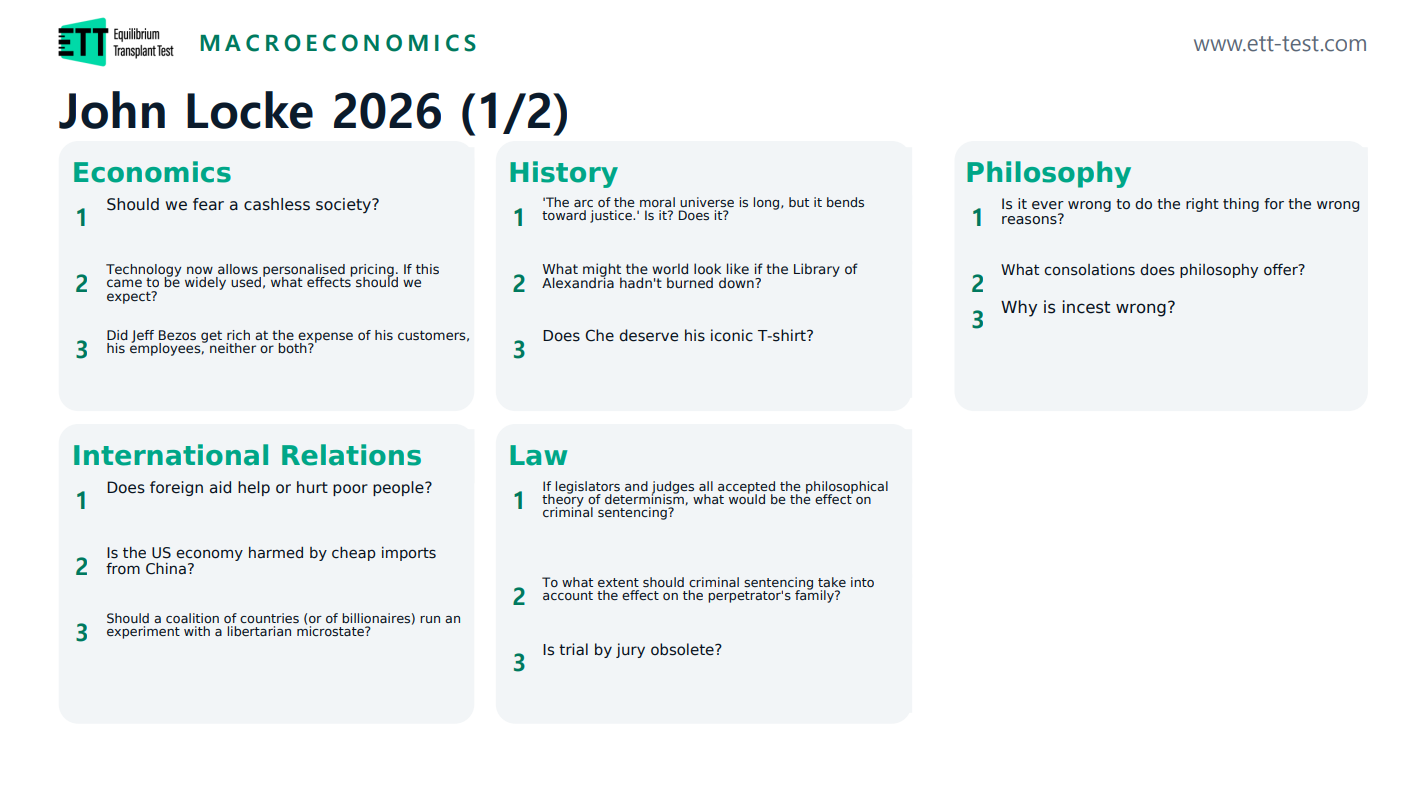
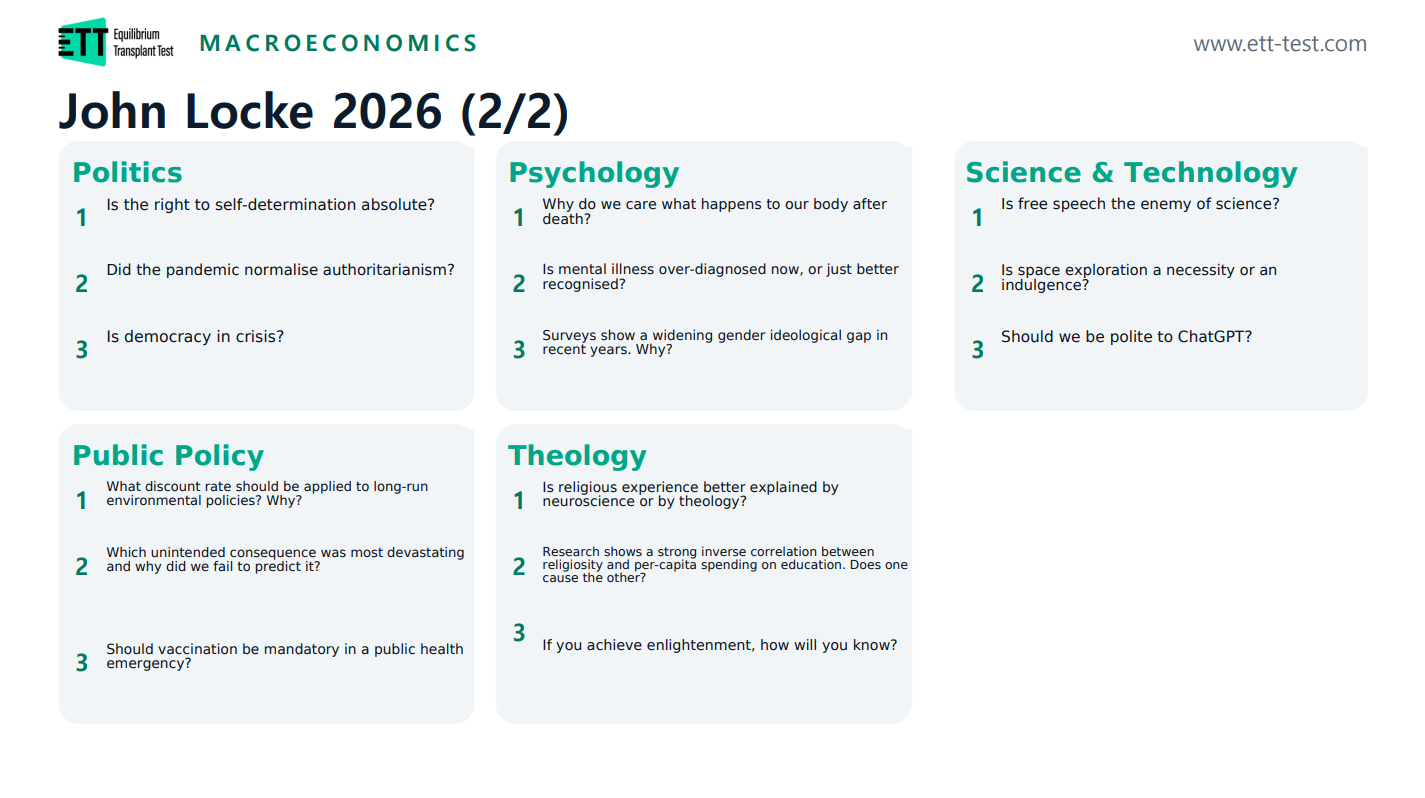
Consider one of the 2026 John Locke Essay Competition's Economics questions: Should we fear a cashless society? At first, the question may seem simple — should society keep cash, or move toward digital payments? But it can quickly expand into credit cards, digital payments, Stablecoins, central banks, financial access, privacy, and a government's control over its own currency.
Another example comes from International Relations: Is the US economy harmed by cheap imports from China? This isn't simply a question about whether Chinese products are inexpensive — it can involve trade, industrial policy, consumer welfare, domestic firms, employment, supply chains, and international economic relations.
A strong essay doesn't simply list facts — it explains how one economic force leads to another.
Business Competitions Also Begin With the Same Economic Foundation
High school students can explore many different business competitions: NFTE's WSI Impact League and Youth Entrepreneurship Showcase, FBLA's Competitive Events, BPA's WSAP and Virtual Competitions, and partner competitions such as the Social Impact Challenge, Virtual Business Challenge, and LifeSmarts BPA Challenges.
[PDF Page 16 placement — "8 Business Competitions for High School Students"]
Although the formats differ, students still need to understand the economic environment businesses operate in: what happens to a company when interest rates rise, how weaker consumer demand affects revenue, how AI might change productivity and employment, and how currency movements and international trade affect business strategy. These aren't isolated questions — they're all connected.
Strong Competition Students Do Not Start With the Prompt
The main idea here can be summarized in one sentence: before students try to answer an economics or business competition prompt, they should first understand how the world behind that prompt works.
Studying inflation by itself isn't enough. Studying interest rates by themselves isn't enough. Studying government bonds by themselves isn't enough. What matters is understanding the connections: inflation affects interest rates, interest rates affect bond prices, bond markets affect government borrowing and financial markets, government debt connects to economic growth, and new technologies such as Stablecoins and AI can become part of the same economic discussion.
Students who understand these relationships don't need to memorize an answer for every new prompt. Instead, they can ask: what caused this problem, what other economic forces are connected to it, and what consequences might follow? That way of thinking is one of the most important foundations for economics, finance, and business competitions.
If you need help planning Activities or developing a student resume, please contact us at [email protected]. A ONE Institute offers live online programs for students regardless of location, including English, Math, Science, Social Studies, SAT, ACT, AP Courses, Test Prep, Writing Competitions, Olympiads, Research Programs, GPA Management, and Consultation — 14 specialized programs in total.
Economics & Business Competitions
Macroeconomics
AI Economy
HIEEC
John Locke Essay Competition
HIR Writing Contest
National Economics Challenge
