
The AMC math competition just went through an important change: the Mathematical Association of America (MAA) has fixed the score needed to qualify for AIME, replacing the floating, unpredictable cutoffs of past years. That means a student can now aim for a specific, knowable number instead of guessing at a moving target — and for many students, especially on the AMC 12, that number is more reachable than it used to be.
Why AMC Changed Now
AMC has repeatedly dealt with problem leaks. When students without sufficient preparation managed to score highly because of leaked material, the cutoff score climbed to abnormal levels, and students who had genuinely studied hard ended up penalized by the resulting inflation. To address this structural problem, the MAA overhauled how AMC is scored.
Why AMC Matters for College Admissions
Top-tier colleges increasingly look beyond GPA and SAT/ACT scores for objective proof of academic ability. GPA and SAT/ACT scores are treated as a baseline, and academic-competition activities like AMC or Olympiad-track competitions are what build on top of that baseline.
Students who excel in other areas — athletics, music, visual arts — can sometimes offset a thinner academic-proof record with strength in those areas. But for a student who wants to directly demonstrate academic ability itself, American Mathematics Competitions (AMC) and the broader Olympiad track remain the most effective and most intuitive route.
How AMC and the Olympiad Pipeline Are Structured
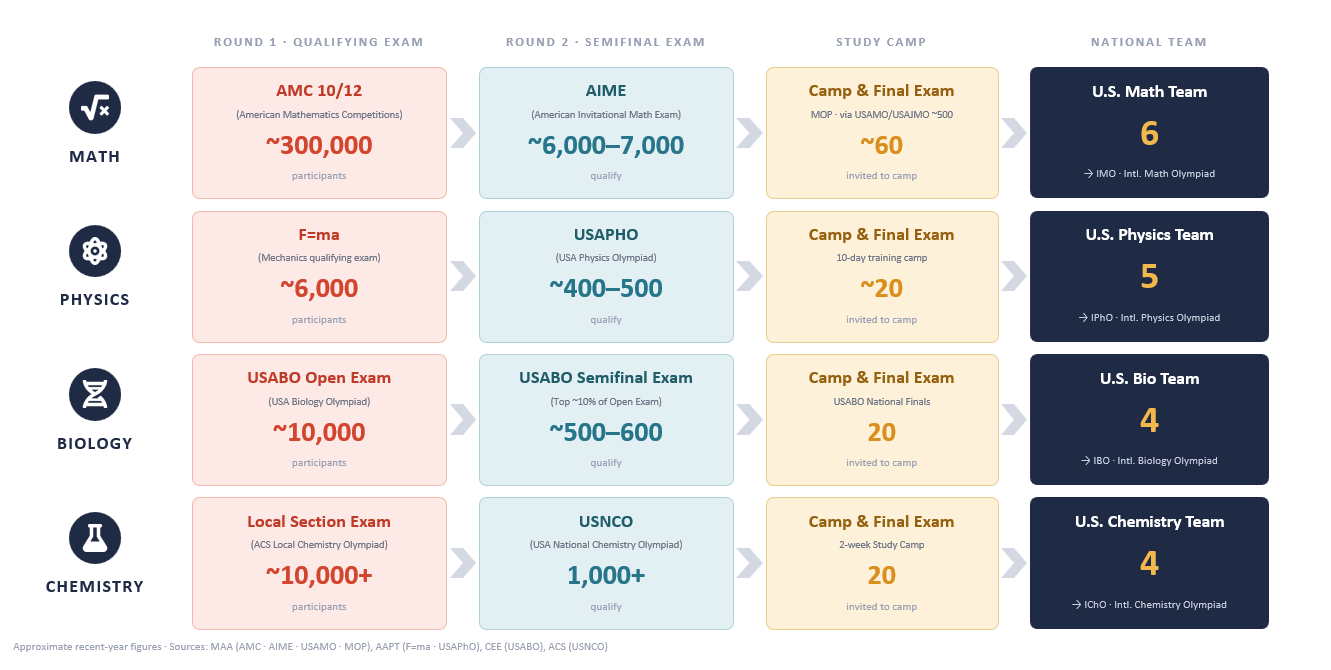
AMC functions as the qualifying round in math. Laid out alongside the other STEM Olympiad tracks, the structure looks like this:
Math
| Stage | Competition | Approx. Participants |
|---|---|---|
| Round 1 (Qualifying) | AMC 10/12 | ~300,000 |
| Round 2 (Semifinal) | AIME | ~6,000–7,000 advance |
| Study Camp | MOP (via USAMO/USAJMO) | ~60 |
| National Team | U.S. Math Team (6 students) | → IMO |
Physics
| Stage | Competition | Approx. Participants |
|---|---|---|
| Round 1 | F=ma | ~6,000 |
| Round 2 | USAPhO | ~400–500 |
| Camp | 10-day training camp | ~20 |
| National Team | U.S. Physics Team (5 students) | → IPhO |
Biology
| Stage | Competition | Approx. Participants |
|---|---|---|
| Round 1 | USABO Open Exam | ~10,000 |
| Round 2 | USABO Semifinal (top ~10% of Open) | ~500–600 |
| Camp | USABO National Finals | 20 |
| National Team | U.S. Bio Team (4 students) | → IBO |
Chemistry
| Stage | Competition | Approx. Participants |
|---|---|---|
| Round 1 | Local Section Exam (ACS regional chemistry olympiad) | 10,000+ |
| Round 2 | USNCO | 1,000+ |
| Camp | 2-week Study Camp | 20 |
| National Team | U.S. Chemistry Team (4 students) | → IChO |
The 6,000–7,000 students who reach AIME each year come from a field of roughly 300,000 AMC participants, which on its own is a meaningful, state-representative-level achievement.
How AMC Scoring Works
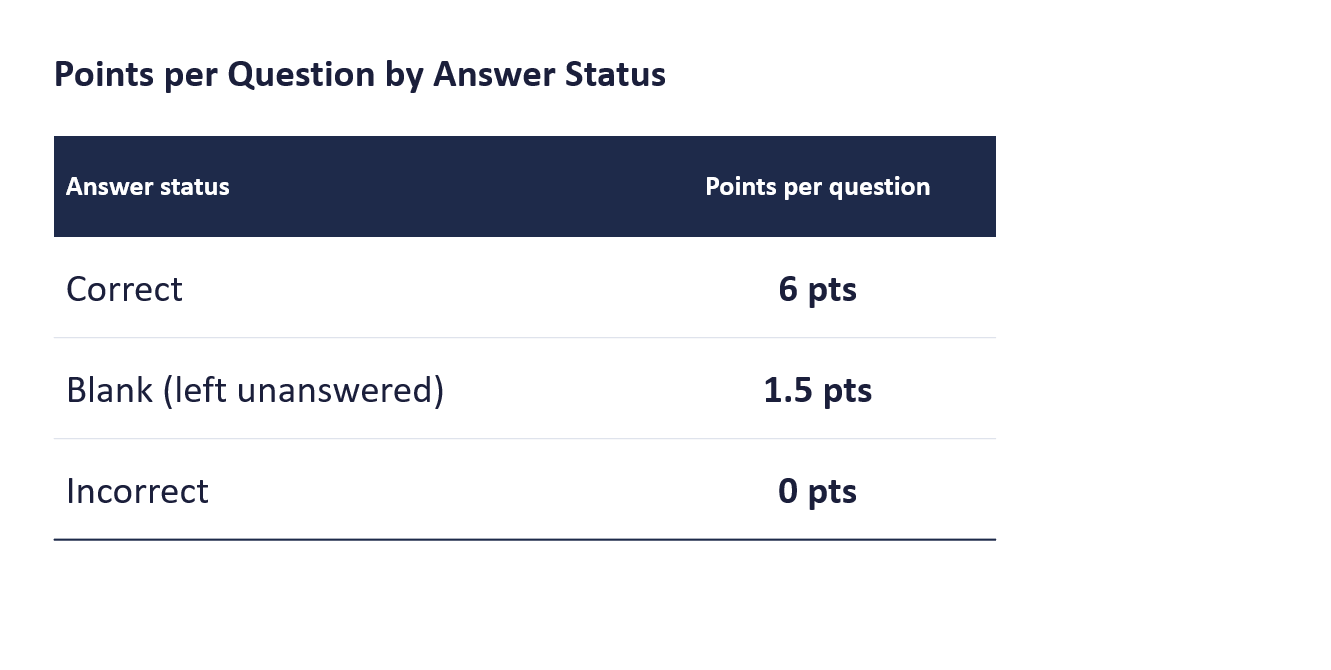
The AMC 10 and AMC 12 both consist of 25 questions, and each is offered in two versions, A and B.
| Answer Status | Points per Question |
|---|---|
| Correct | 6 pts |
| Blank / left unanswered (Skip) | 1.5 pts |
| Incorrect | 0 pts |
Because a wrong answer earns zero points, skipping a question you're not confident about is generally the better move.
The 2025 Cutoffs — and How Hard They Were to Hit
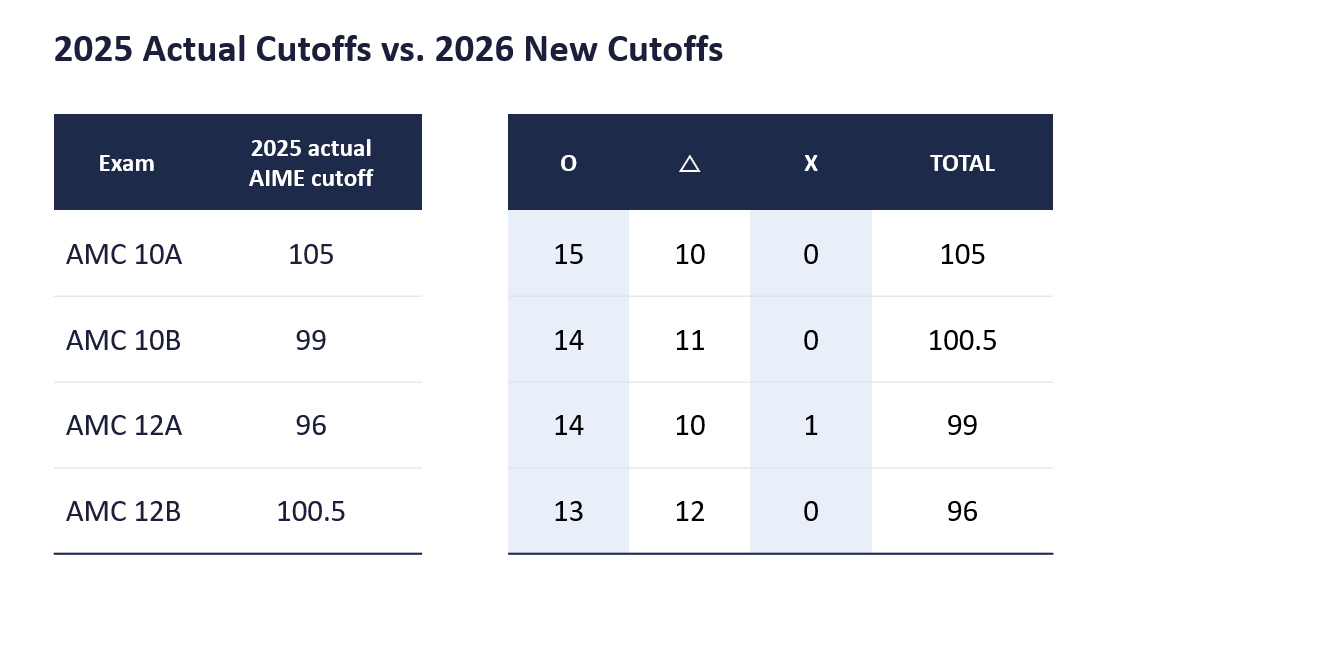
Based on last year's (2025) exam, the AIME qualification cutoffs were:
| Exam | 2025 Actual AIME Cutoff |
|---|---|
| AMC 10A | 105 |
| AMC 10B | 99 |
| AMC 12A | 96 |
| AMC 12B | 100.5 |
The combinations of Correct (O), Skipped (△), and Incorrect (X) answers needed to reach each cutoff looked like this:
| Correct | Skipped | Incorrect | Total | Cutoff Reached |
|---|---|---|---|---|
| 15 | 10 | 0 | 105 | AMC 10A |
| 14 | 11 | 0 | 100.5 | AMC 12B |
| 14 | 10 | 1 | 99 | AMC 10B |
| 13 | 12 | 0 | 96 | AMC 12A |
In other words, clearing the AMC 10A cutoff of 105 meant answering all 15 attempted questions correctly and skipping the other 10 — a strategy that was genuinely difficult to execute, even for well-prepared students.
Change #1: From Relative to Absolute Scoring (Starting November 2026)
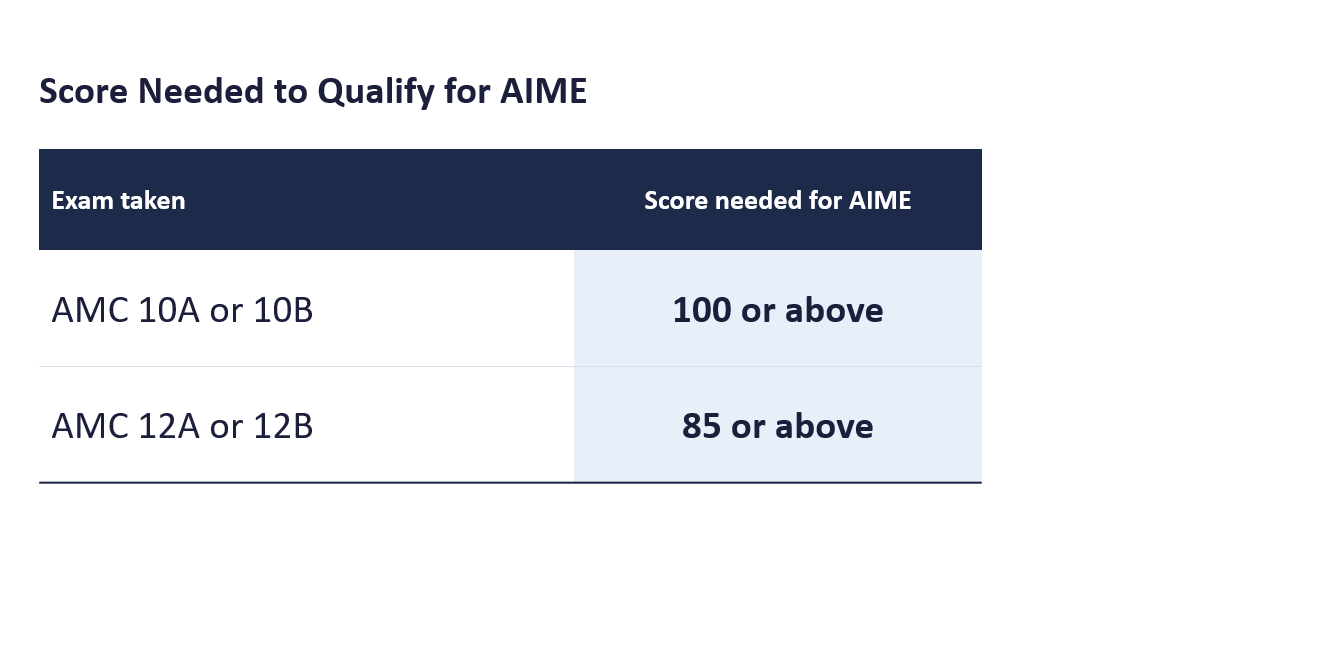
Under the new system, taking effect from November 2026:
| Exam Taken | Score Needed for AIME |
|---|---|
| AMC 10A or 10B | 100 or above |
| AMC 12A or 12B | 85 or above |
Under the old system, the cutoff was relative — it shifted every year based on that year's score distribution. When leaked material pushed more students to high scores, the cutoff rose along with it, penalizing students who had studied honestly. Under the new absolute scoring system, a student who clears a fixed score qualifies for AIME regardless of how anyone else performed.
Source: Mathematical Association of America (MAA), confirmed via independent MAA-sourced reporting as of September 16, 2026.
What the New Cutoffs Mean: 2025 vs. 2026
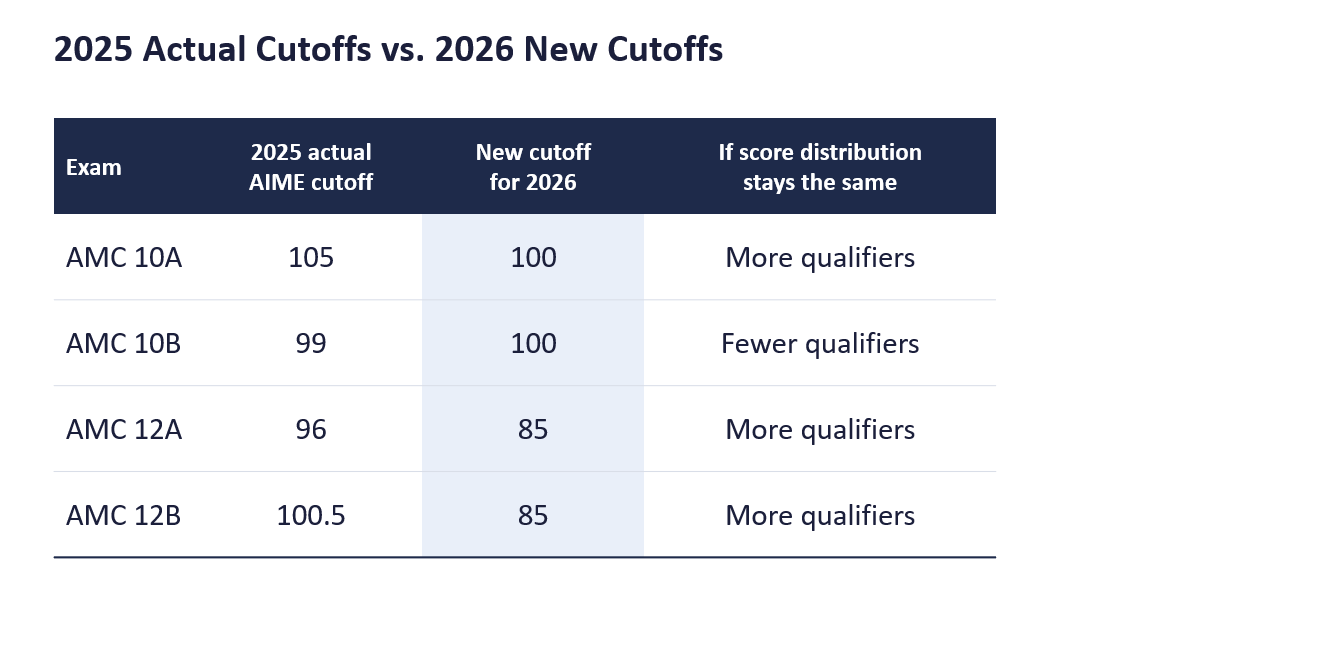
| Exam | 2025 Actual AIME Cutoff | New Cutoff for 2026 | Effect If Score Distribution Stays the Same |
|---|---|---|---|
| AMC 10A | 105 | 100 | More qualifiers |
| AMC 10B | 99 | 100 | Fewer qualifiers |
| AMC 12A | 96 | 85 | More qualifiers |
| AMC 12B | 100.5 | 85 | More qualifiers |
Only AMC 10B became slightly less favorable; the other three exams all became more favorable — and the shift on AMC 12A and AMC 12B is especially large.
New Score Combinations That Now Qualify
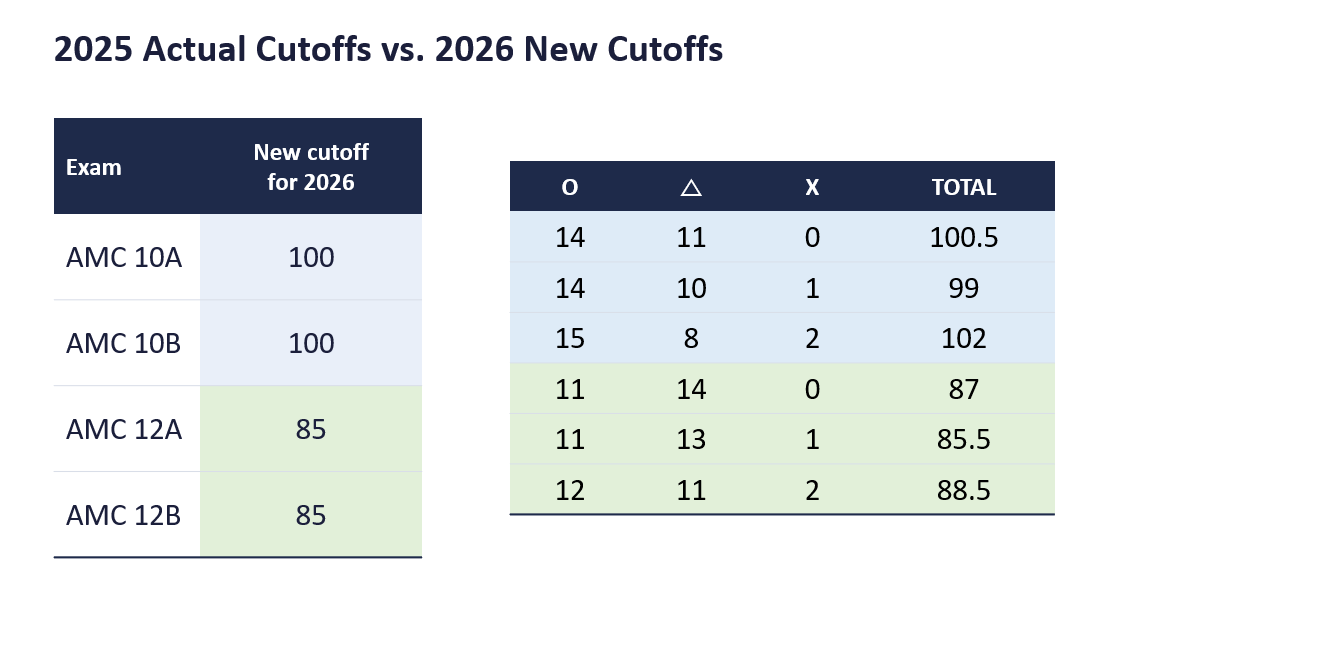
AMC 10 (100-point cutoff)
| Correct | Skipped | Incorrect | Total | Result |
|---|---|---|---|---|
| 14 | 11 | 0 | 100.5 | ✅ Qualifies |
| 14 | 10 | 1 | 99 | ❌ Does not qualify |
| 15 | 8 | 2 | 102 | ✅ Qualifies |
AMC 12 (85-point cutoff)
| Correct | Skipped | Incorrect | Total | Result |
|---|---|---|---|---|
| 11 | 14 | 0 | 87 | ✅ Qualifies |
| 11 | 13 | 1 | 85.5 | ✅ Qualifies |
| 12 | 11 | 2 | 88.5 | ✅ Qualifies |
On the AMC 12, answering just 11 of the 25 questions correctly and skipping the remaining 14 reaches 87 points, enough to qualify. Attempting 12 questions and missing 1 still clears the cutoff at 85.5. Attempting 14 and missing 2 still clears it at 88.5.
On the AMC 10, answering 14 questions perfectly and skipping the remaining 11 reaches 100.5 and qualifies — but missing even one out of 15 attempts (leaving the combination at 99) falls short, so accuracy on attempted questions matters.
How Many More Students Will Reach AIME
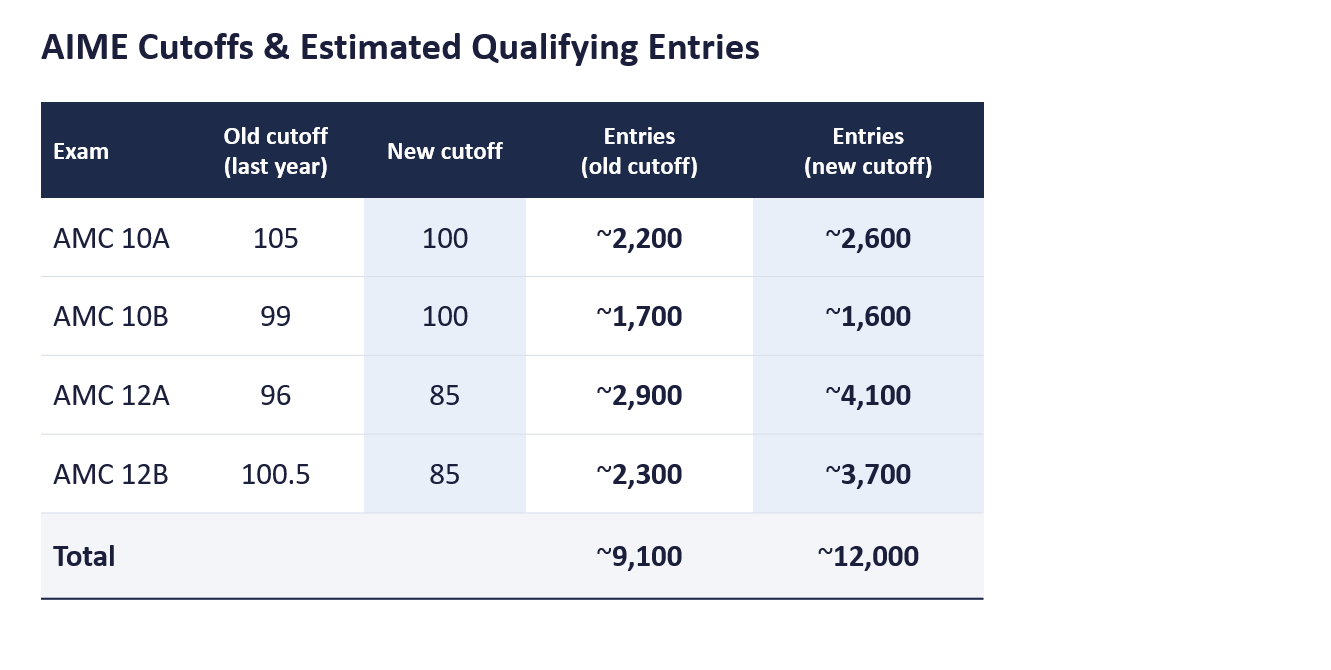
| Exam | Old Cutoff (Last Year) | New Cutoff | Entries (Old Cutoff) | Entries (New Cutoff) |
|---|---|---|---|---|
| AMC 10A | 105 | 100 | ~2,200 | ~2,600 |
| AMC 10B | 99 | 100 | ~1,700 | ~1,600 |
| AMC 12A | 96 | 85 | ~2,900 | ~4,100 |
| AMC 12B | 100.5 | 85 | ~2,300 | ~3,700 |
| Total | ~9,100 | ~12,000 |
Total qualifying entries rise from roughly 9,100 to roughly 12,000. Because many students sit for more than one exam, removing that overlap puts the actual number of students who experience AIME at somewhere between 9,000 and 10,000, up from the previous 6,000–7,000 — an increase of around 3,000 students.
Most of that increase comes from the AMC 12: about 1,200 additional qualifiers from AMC 12A, and about 1,400 additional qualifiers from AMC 12B.
Note: the entry-count figures above are A ONE Institute's own estimates based on the new fixed cutoffs and past score distributions, not officially published MAA statistics.
AMC 10 vs. AMC 12: Shared Problems
AMC 10 and AMC 12 share a number of questions, which is why a student who prepared for AMC 10 has an advantage when sitting for AMC 12.
Shared Problems
| AMC 10A | Same Problem on AMC 12A | AMC 10B | Same Problem on AMC 12B |
|---|---|---|---|
| #1 | #1 | #1 | #1 |
| #2 | #2 | #2 | #2 |
| #4 | #3 | #4 | #4 |
| #8 | #4 | #8 | #6 |
| #13 | #5 | #13 | #10 |
| #14 | #6 | #14 | #11 |
| #18 | #12 | #16 | #13 |
| #21 | #15 | #17 | #14 |
| #23 | #16 | #19 | #15 |
| #24 | #23 | #21 | #17 |
| — | — | #23 | #19 |
| — | — | #24 | #20 |
AMC 10A and AMC 12A share 10 questions; AMC 10B and AMC 12B share 12.
A student who struggles starting around question 14–15 on the AMC 10 can, through these shared questions, already answer a large share of the AMC 12's earlier-numbered problems correctly. Adding just 5 more correct answers from AMC 12's questions 7 through 13 fills out the 11 correct answers needed to reach AIME.
Take the Leap to AMC 12 This November
The message behind this change is clear: consider attempting AMC 12 in the November 2026 exam.
If your student has assumed "AMC 12 is out of reach," this is the moment to reconsider. The new 85-point cutoff is achievable by answering just 11 of the 25 questions correctly with confidence. And a student who has already prepared for AMC 10 has, thanks to the shared problems, roughly half the groundwork already in place.
Change #2: The Three-Stage Shift in USAJMO/USAMO Selection
The method for selecting USAJMO/USAMO qualifiers — the stage after AIME — is also shifting in stages, year by year.
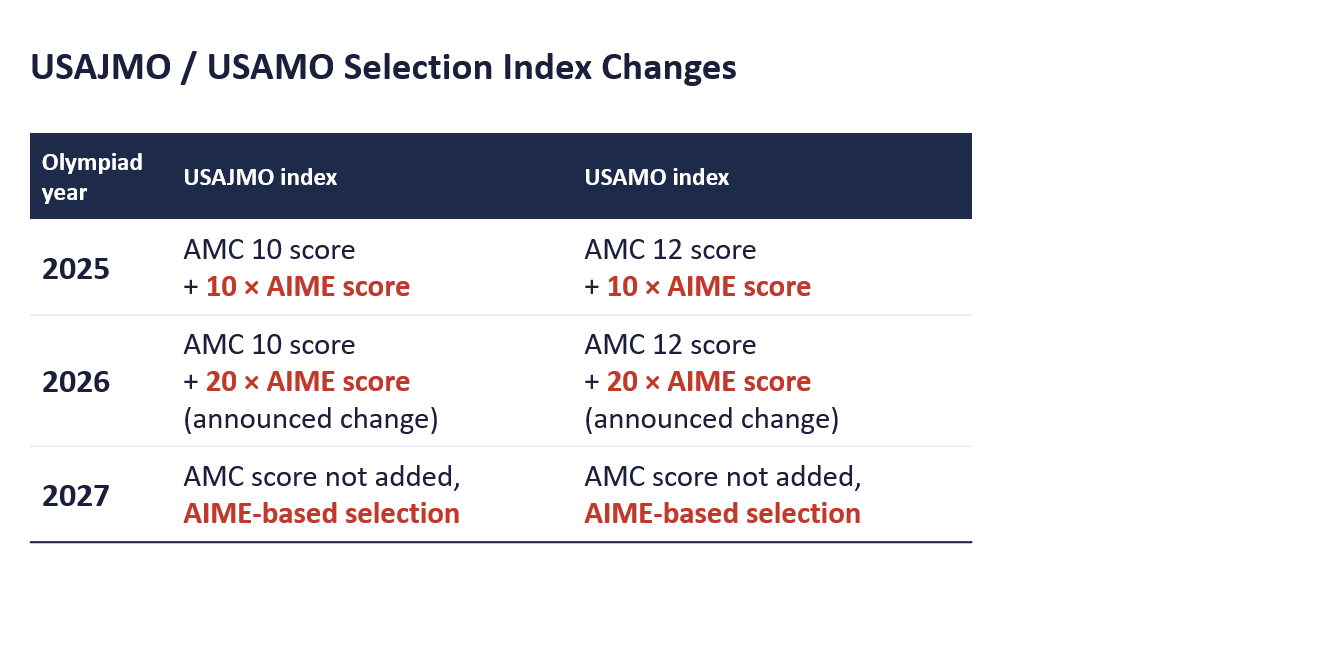
USAJMO / USAMO Selection Index Changes
| Olympiad Year | USAJMO Index | USAMO Index |
|---|---|---|
| 2025 | AMC 10 score + 10 × AIME score | AMC 12 score + 10 × AIME score |
| 2026 | AMC 10 score + 20 × AIME score (announced change) | AMC 12 score + 20 × AIME score (announced change) |
| 2027 | AMC score not added; AIME-based selection | AMC score not added; AIME-based selection |
In 2025, selection used AMC score + AIME score × 10. In 2026, the AIME weighting rises to ×20. Starting in 2027, the AMC score is no longer factored in at all, and selection shifts entirely to AIME performance alone.
Source: Mathematical Association of America (MAA), confirmed via independent MAA-sourced reporting as of September 16, 2026.
The reasoning is straightforward: even if a student's AMC score was inflated by a leaked exam, that student would still eventually have to compete purely on ability at the more secure AIME level. Students aiming for USAMO or USAJMO will, starting in 2027, be judged on AIME performance alone, regardless of their AMC score.
If your student needs help preparing a Common App activity list or building out a resume alongside their AMC/Olympiad prep, reach out at [email protected]. A ONE Institute runs 14 specialized programs — including AMC/Olympiad, English, Math, Science, Social Studies, SAT, ACT, AP Courses, Test Prep, Writing Competition, Research Programs, GPA Management, and Consultation — all live online.
AMC8
AMC10
AMC12
USAMO
USAJMO
AIME
AONEINSTITUTE
Math Competition
Math Olympiad
