
As AI becomes capable of producing intellectual work almost instantly, what matters most for a student preparing for college — and for life after college — isn't finding some narrow task AI still can't do. It's building a personal story, grounded in real learning and real experience, that can genuinely resonate with other people. That idea is easiest to see by looking at how people have responded to new technology before.
Impressionism and the Camera
At MoMA in Manhattan, a large Monet painting is on display, alongside works by Edgar Degas and Pierre-Auguste Renoir — artists we now call the Impressionists. Their work raises an important question. Before the camera was invented, a painter's skill was judged largely by how realistically they could render a subject. Once the camera arrived, it could reproduce reality far more precisely than any painter, and painting could no longer compete on those same terms.
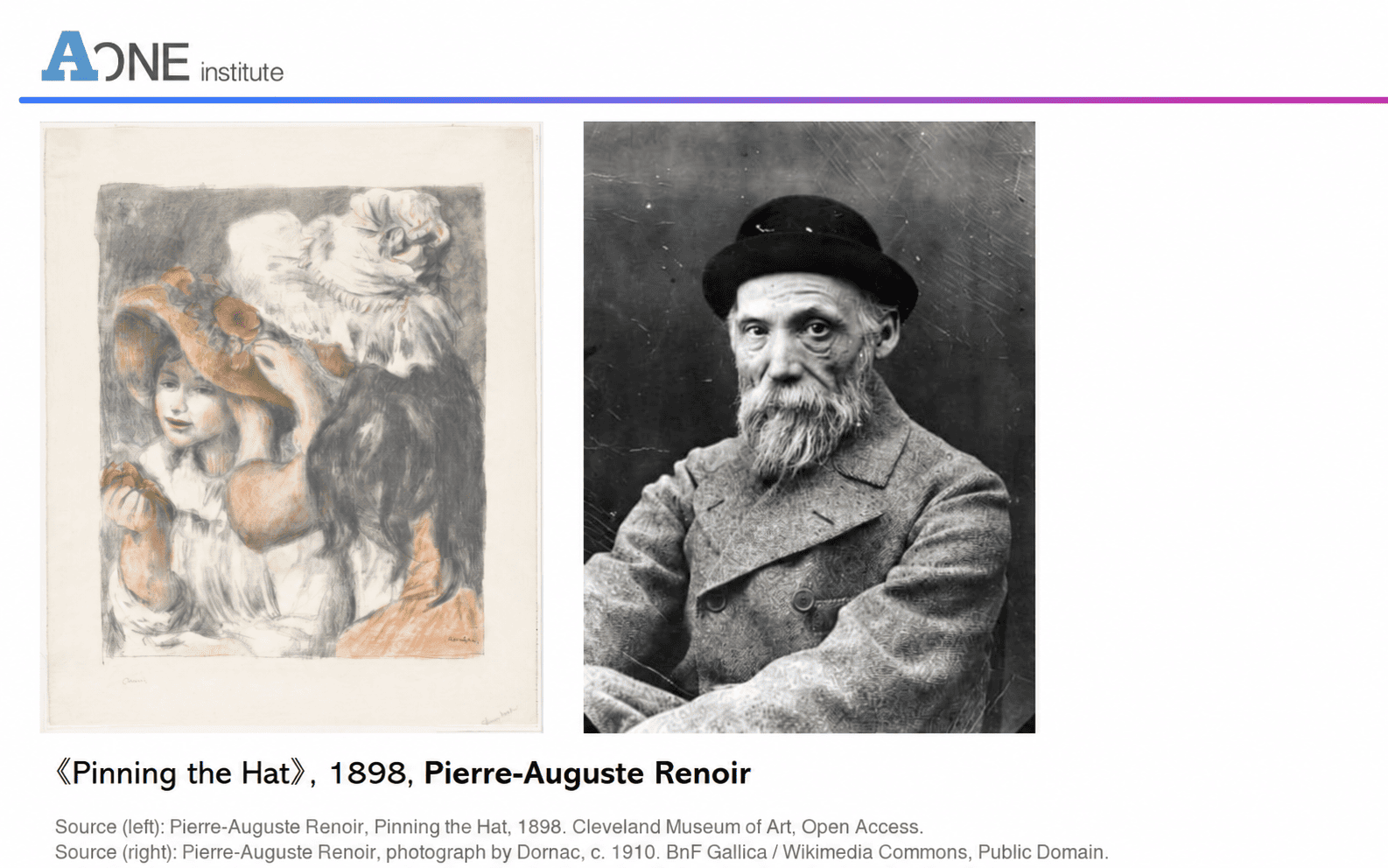
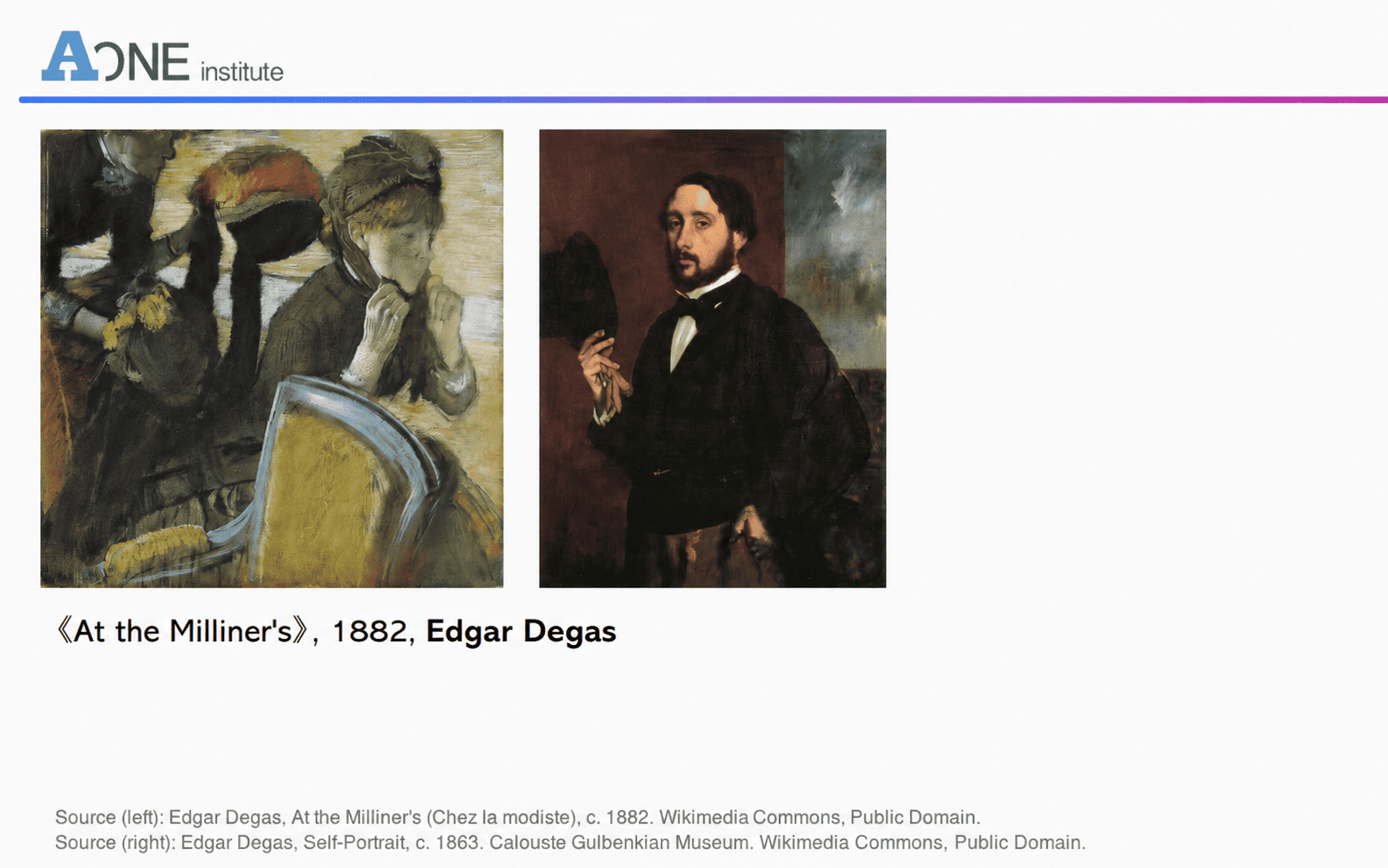
Painters didn't respond by giving up. Instead, they embraced what the camera had made newly possible and changed the standard by which painting itself was judged. Cropped compositions, asymmetrical framing, the emotional weight of a fleeting moment, shifting light, and visual ambiguity all became new modes of expression. Rather than reproducing a subject exactly, Impressionist painters focused on how that subject appeared to the human eye in a single instant.

Look at Monet's flower paintings, and the point was never how precisely the petals were rendered. What mattered was the beauty of color in that moment, the sense of blurred edges, the impression created by light itself. Monet painted the same location again and again precisely because the impression of light and color shifted every time.
The larger message here: when something more capable than us appears, people don't simply lose and give up — they change the terms of the competition and create new value on different ground.
History Repeating: The Industrial Revolution
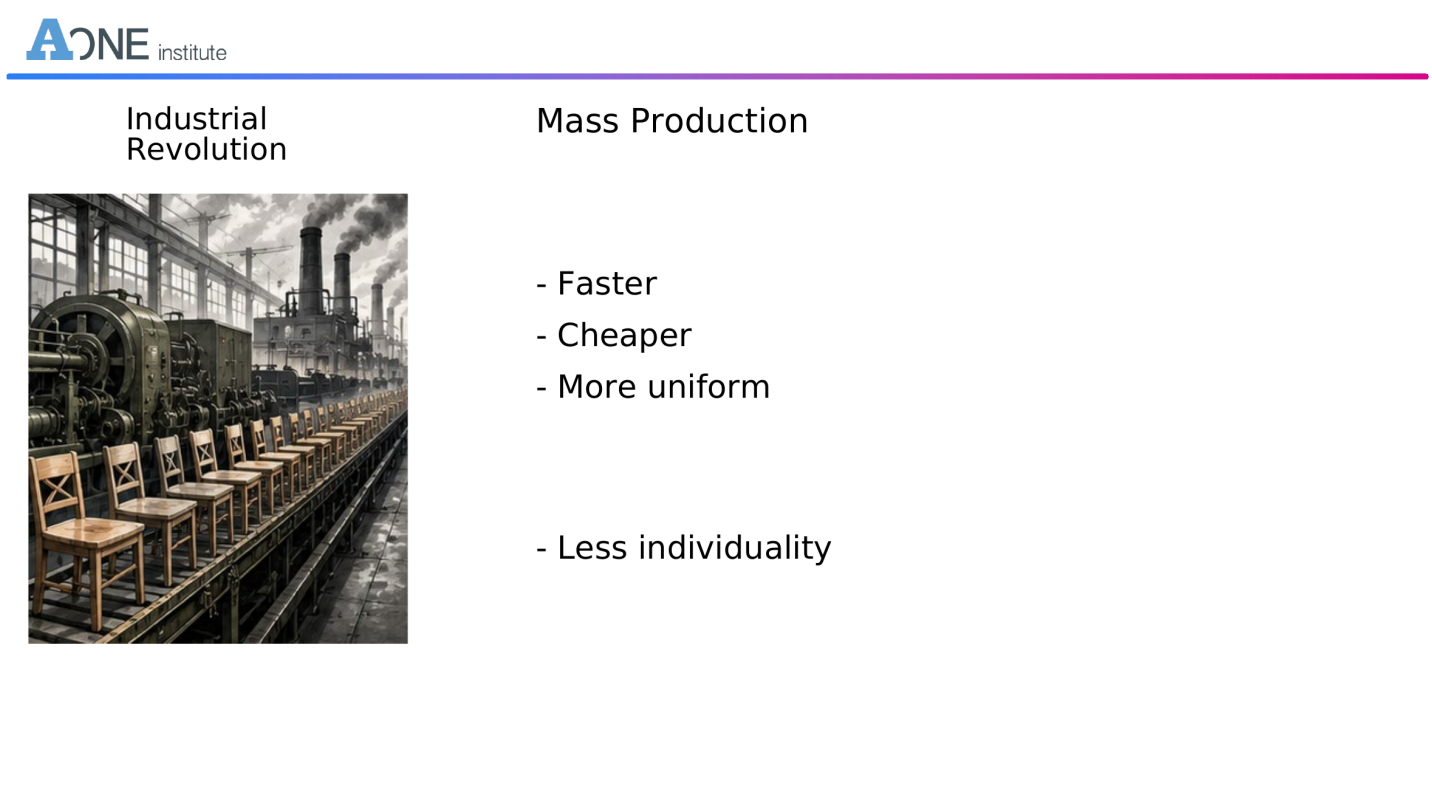
A similar pattern shows up in the Industrial Revolution. In the late 18th and early 19th centuries, Britain's First Industrial Revolution made mass production possible — goods could be made faster, cheaper, and more uniformly than ever. But people still place real value on individuality and aesthetic sensibility. As uniform, mass-produced goods became the norm, interest in handmade objects and in the philosophy behind how they were made grew again rather than fading.
Out of that tension came the Arts and Crafts Movement in late-1800s Britain. It wasn't simply an aesthetic preference for handmade goods — it was a philosophical movement about how things ought to be made in the first place. Thinking through an object with the mind, shaping it with the hands, and feeling the meaning of the work in that process were treated as aesthetic values in their own right.
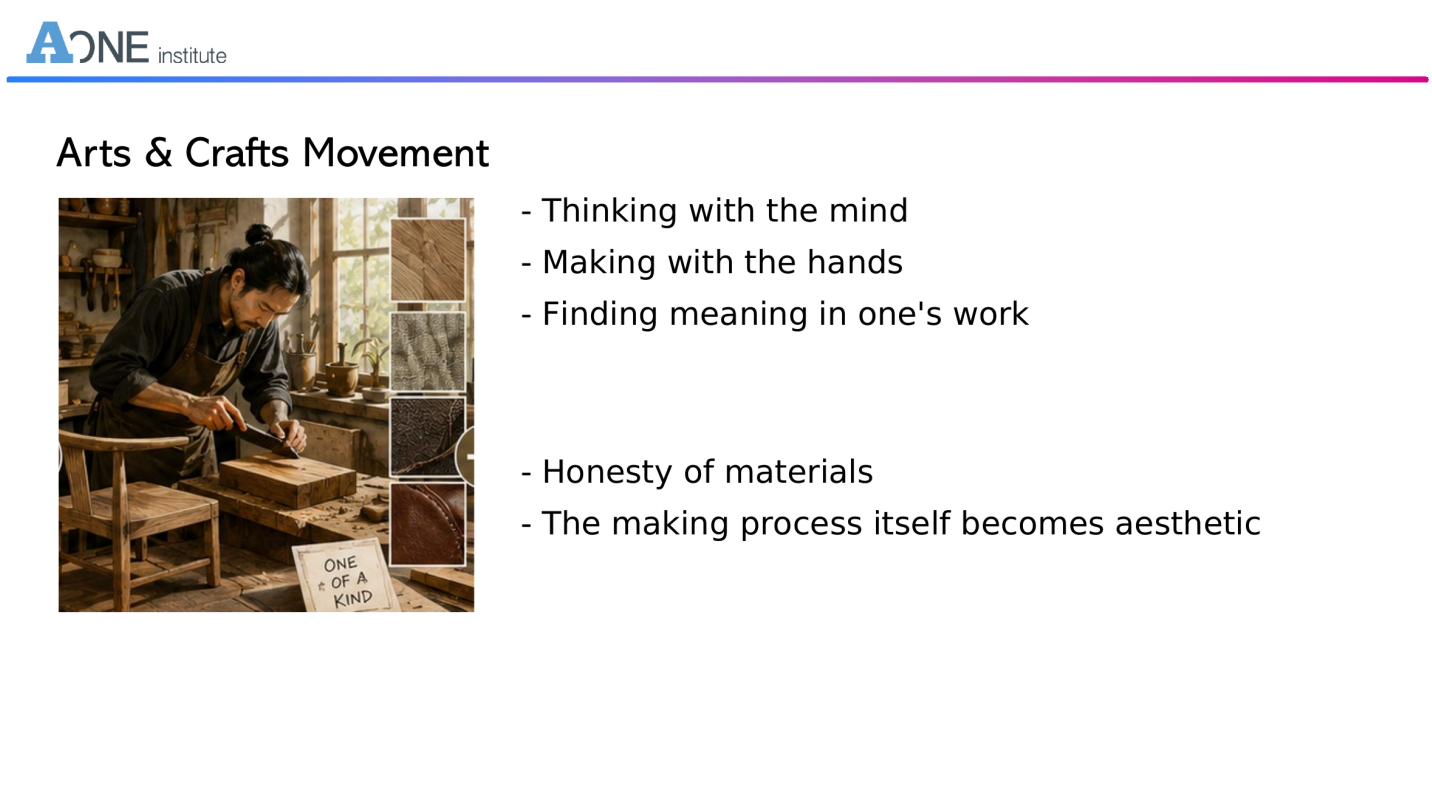
Today's brands emphasizing craftsmanship, process, and a distinct story reflect the same underlying idea. Loewe, for example, emphasizes the specific leather it uses, the artisans who make its products, and the techniques accumulated over time. Consumers respond not only to a product's function, but to the accumulated skill and story behind the brand.
Stussy is a similar case: what began as a surfboard maker signing his own boards eventually grew into a full brand. People are drawn to Stussy not only for its designs, but for the background, attitude, and cultural context the brand carries with it.
Recorded Music and the Rise of the Artist's Story
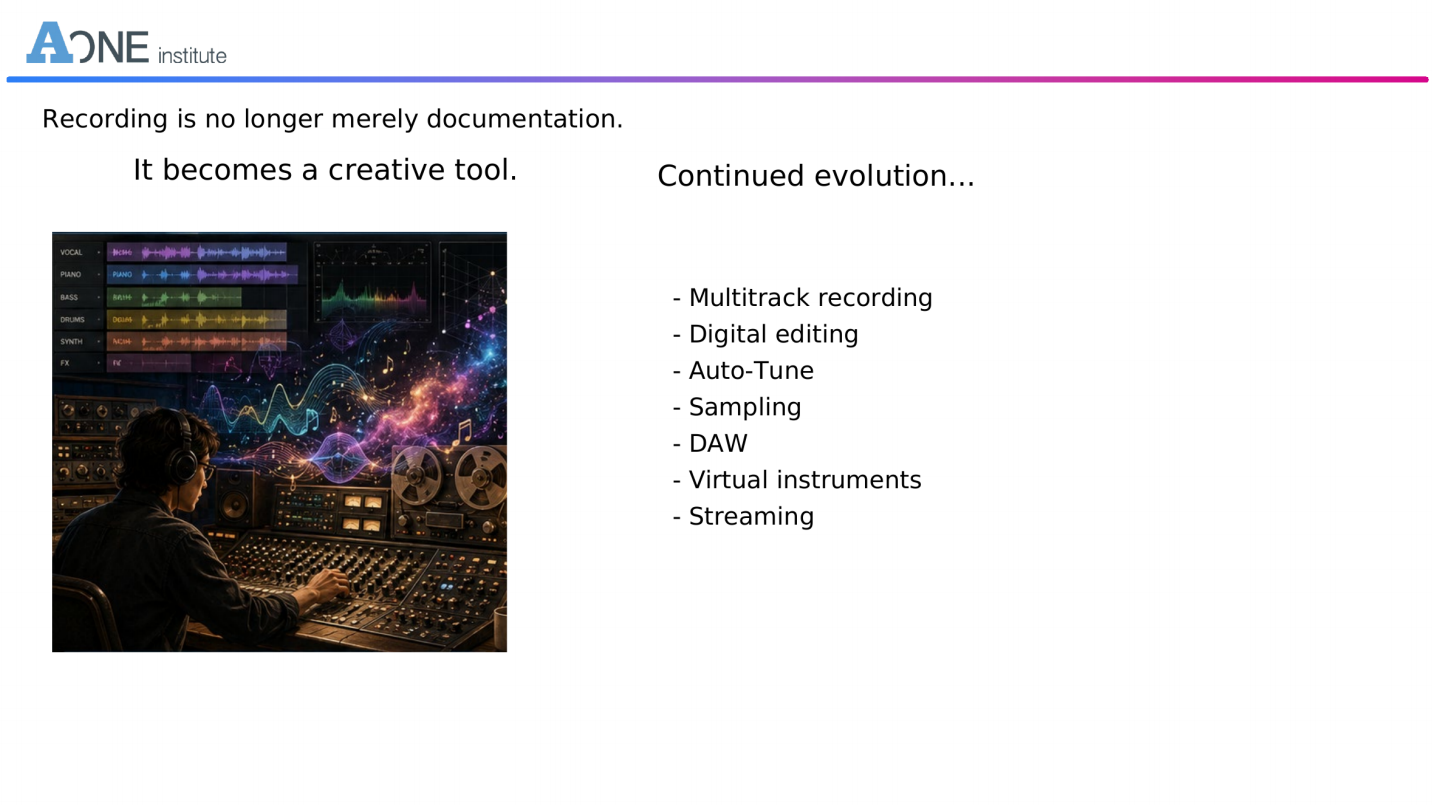
Music went through a comparable shift. To hear music, a listener once had to be physically present at the moment a performer played it — the music existed only in that instant. Once Thomas Edison invented the phonograph, and recording technology advanced from there, music could exist without the performer present. A performance could now be reproduced.

Musicians weren't made obsolete by recording technology — they embraced it. The Beatles' Sgt. Pepper's Lonely Hearts Club Band is widely understood as an album that actively used studio recording technology, creating music that could only exist because that technology existed.
The music industry kept advancing from there. Eventually, music could be made through technology alone, without a musician ever playing an instrument. As that happened, people began placing greater meaning not just on the music itself, but on the artist's own story, fandom, and community. As IFPI has put it, the goal is building community around the artist, not around a single song — as technology makes it easier to mass-produce content, people respond more strongly to the creator's own identity and narrative.
The Real Lesson: From Cameras to AI
The camera made it possible to mass-produce high-level painting. The Industrial Revolution made it possible to mass-produce high-level manufactured goods. Recording and audio technology made it possible to mass-produce high-level music. Today, we live in an era where AI mass-produces the output of intellectual labor.
Someone with almost no background knowledge in a field can now use AI to write a report, or something resembling a short academic paper, within a single day. The result may not reach the very top level of quality, but it can reach a solidly above-average level of intellectual output, and very quickly.
That's why so much current discussion focuses on which jobs AI will replace, and which jobs will still be safe from AI a decade from now. But holding onto that question alone isn't enough. Trying to find some small area AI still can't do, and sharpening only that, may not hold up for long — given how fast AI is advancing, whatever it can't do today is likely to be caught up with soon.
Why "Finding What AI Can't Do" Isn't a Real Strategy
What matters isn't hunting for the narrow sliver of tasks AI currently can't handle. It's understanding how people have survived new technology in the past. When the camera arrived, painting changed its own aesthetic standard and produced Impressionism. After the Industrial Revolution, a maker's philosophy and story became important again in response to uniform mass production. After recording technology, an artist's identity and fandom became more important than ever.
The same holds true in the AI era. The point isn't simply finding what AI can't do — it's having a story of one's own that can genuinely create resonance with other people.
It's worth reconsidering what "becoming famous" actually means here. A line often misattributed to Andy Warhol — get famous first, and afterward even something unremarkable will be applauded — isn't something Warhol actually said. But the line became well known precisely because people accepted it as coming from someone influential. In the end, people respond not just to words themselves, but to the presence and context of the person who said them.
Not every student can become famous, of course. Applied to students, "becoming famous" is better understood as the ability to create resonance with other people — and resonance here isn't simple sympathy, but something closer to the power to genuinely move and resonate with someone else's inner sense of things.
What Creates Resonance: Learning, Perspective, Intent, Experience, Story
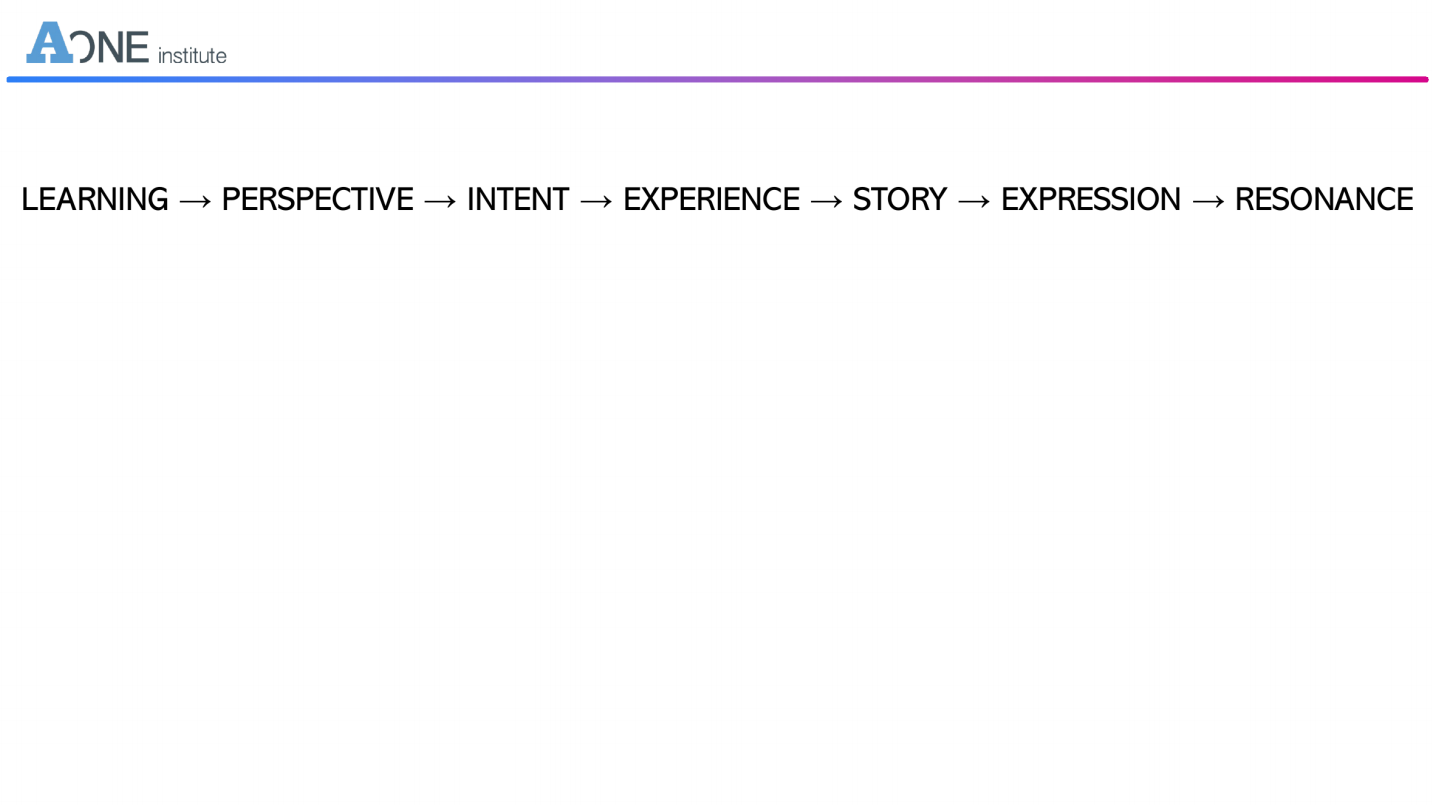
Creating resonance with other people requires a story of one's own. A story alone isn't enough, either — a student also needs to be able to express that story so it actually reaches other people. Where does a story come from in the first place? From experience — whether that's something physically lived through, or a moment of genuine realization. Without experience, there's no personal story to tell.
Creating experience requires physically moving and acting. Moving requires intent. Intent, in turn, requires the right kind of learning, and it's through that learning that a student's own perspective is formed.
Put together, the chain runs like this: the right, varied learning accumulates into a student's own perspective; that perspective becomes intent; only someone with real intent actually moves; that movement produces experience; that experience becomes a personal story; and expressing that story is what creates resonance in other people.
What students need in order to hold their own in the AI era isn't searching out and sharpening the narrow things AI can't yet do. It's learning more broadly, building a deeper perspective, acting on the intent that perspective produces, and shaping a personal story out of that action — and then being able to express that story so it reaches other people. This becomes a genuine advantage both while preparing for college and while preparing for life after it.
What This Means for College Essays
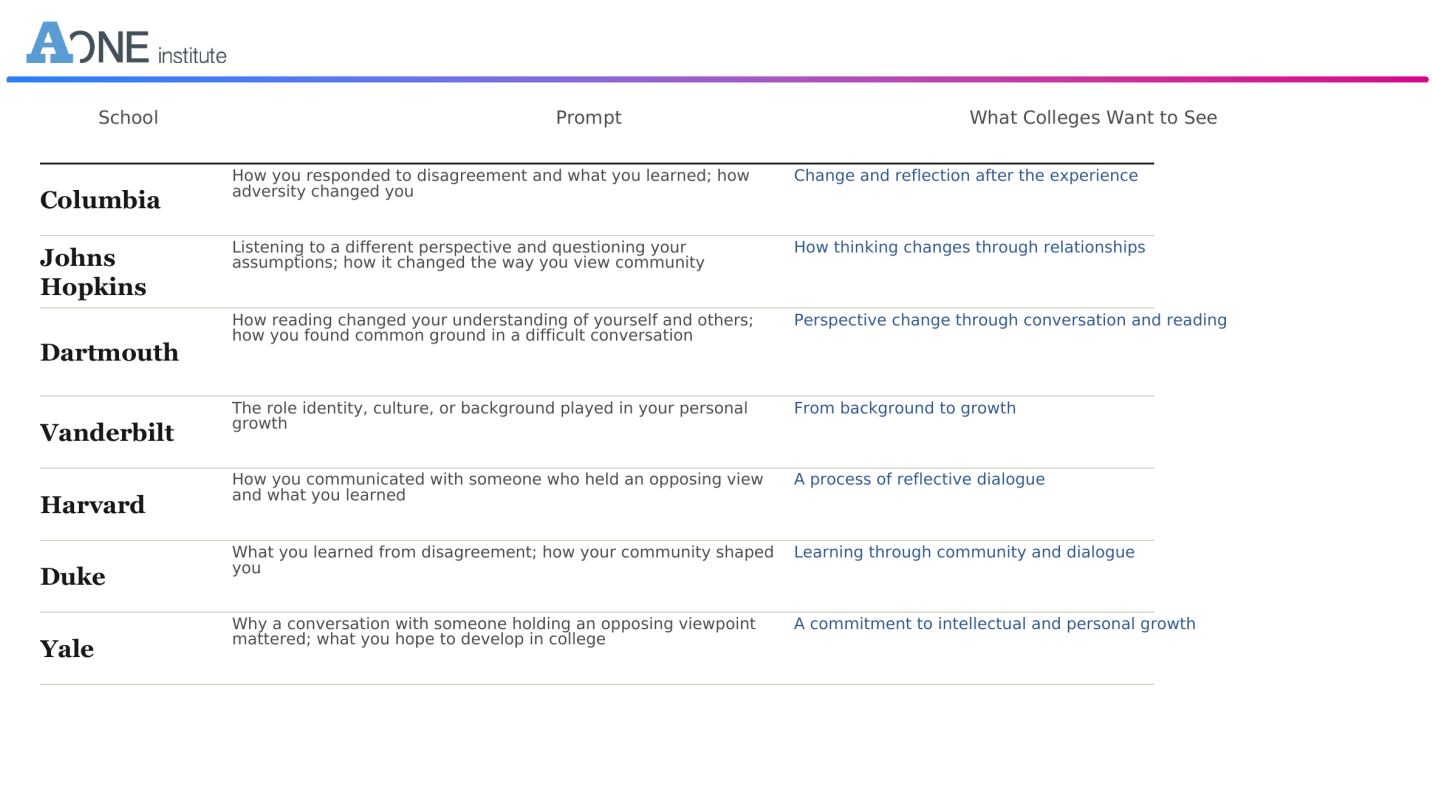
American college supplemental essay topics connect directly to this same idea. Colleges rarely ask only "what rank did you achieve," "what result did you produce," or "how did you feel at the end." More often, they ask about the process of change itself: how a student responded to conflict and what they took from it, how they changed after going through adversity, whether they've ever doubted their own experience after hearing a different perspective, and how a particular experience shaped the way they see their community.
In other words, colleges are looking at more than results — they're looking at the change and reflection that follows an experience, the way thinking gets revised through relationships, the way perspective shifts through conversation and reading, the way a student's background leads into growth, and the learning that happens through interaction with a community.
That means it's genuinely fine if a student doesn't advance from AMC to AIME, or doesn't reach an Olympiad semifinal or final. Some baseline level of achievement may still be necessary, but what matters more is the process of building a personal story throughout the high school years. If a student is learning, forming their own perspective, moving with real intent, and accumulating experience along the way, they are already growing in a meaningful direction.
There's a line from Kung Fu Panda worth remembering here: yesterday is history, tomorrow is mystery, and today is a gift — that's why we call it the present. That gift of a present moment lives inside the process of every student building their own story. What matters most, right now, is that students do their best within that process.
Helping students build a real, well-expressed personal story — not just a resume of results — is at the center of how A ONE Institute approaches college preparation in the AI era. If you'd like guidance on how your child's own learning and experience can come together into a story that resonates, reach out to A ONE Institute for a consultation.
AI Era
College Admissions
Personal Story
Supplemental Essays
A ONE Institute
