
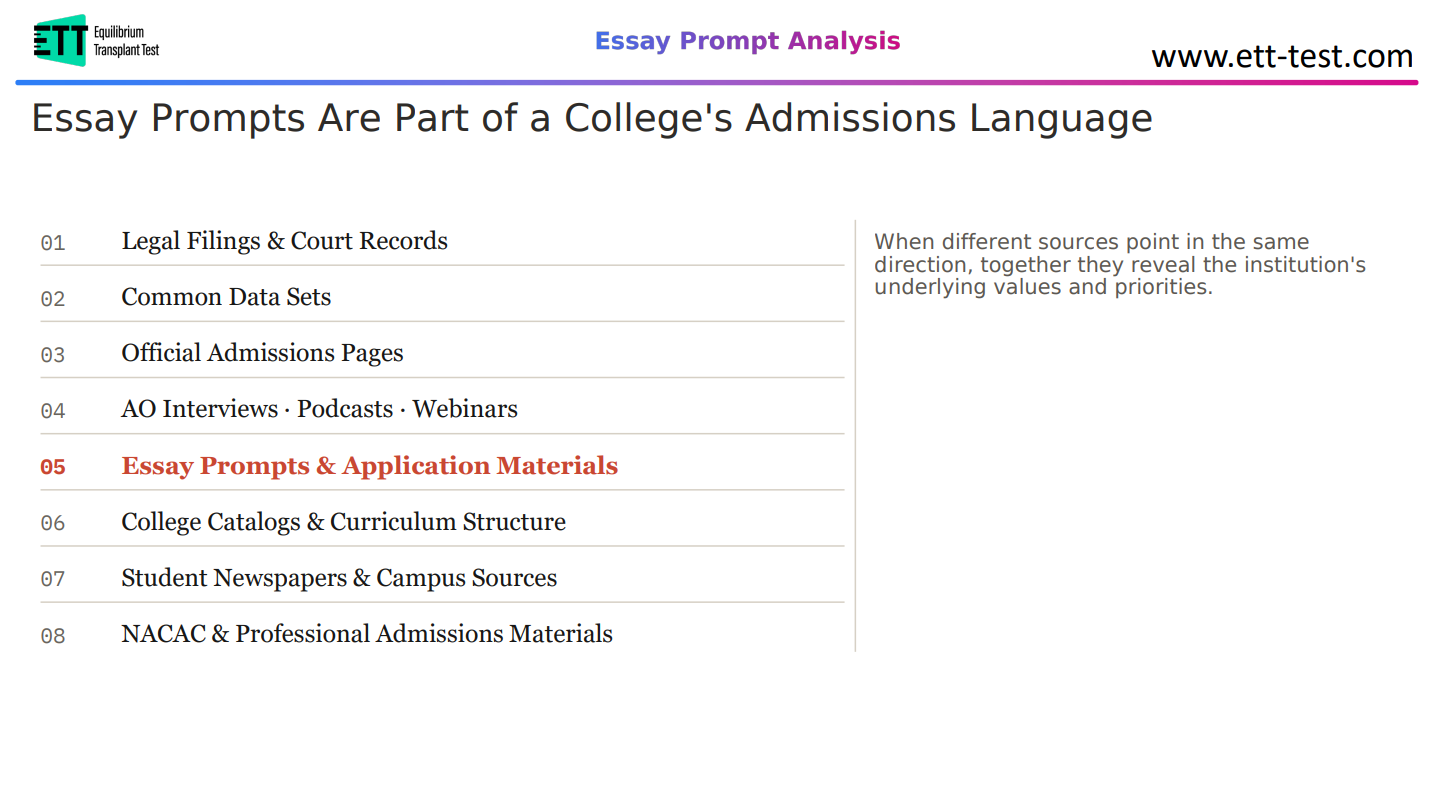
Reading a college's essay prompts closely tells you far more about what that school values than almost any other public source. Colleges reveal their admissions priorities through several channels — legal filings and court records, Common Data Sets, official admissions pages, admissions officer interviews and webinars, essay prompts and application materials, college catalogs and curriculum structure, student newspapers, and NACAC or other professional admissions materials — and when several of these sources point in the same direction, together they reveal the institution's underlying values.
Today we're focusing on one of those sources: essay prompts. Not just what colleges say they care about in general, but the finer differences between schools once you read closely.
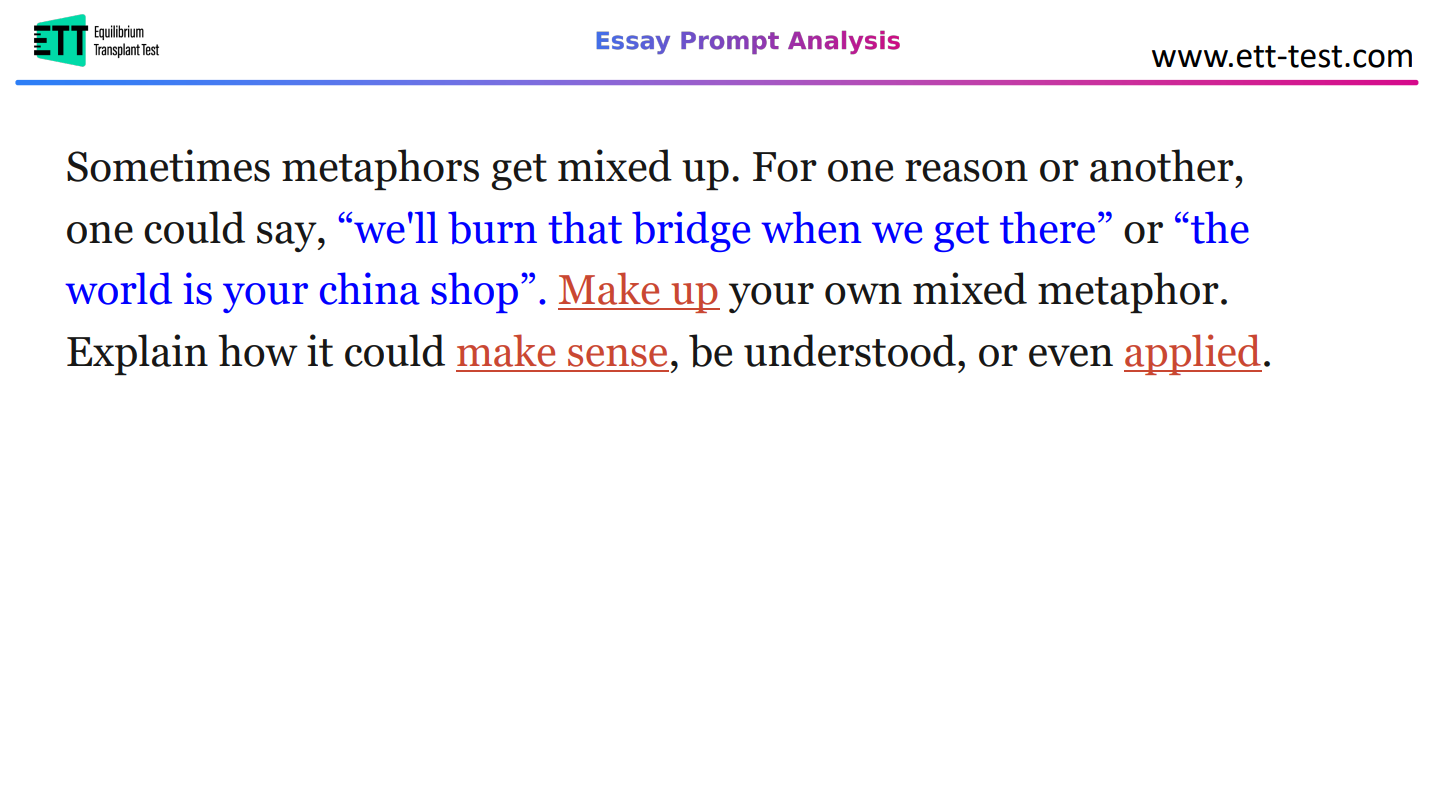
Before naming the school, take a look at this prompt and guess which university asks it: create your own mixed metaphor and explain how it could make sense, be understood, or even applied.
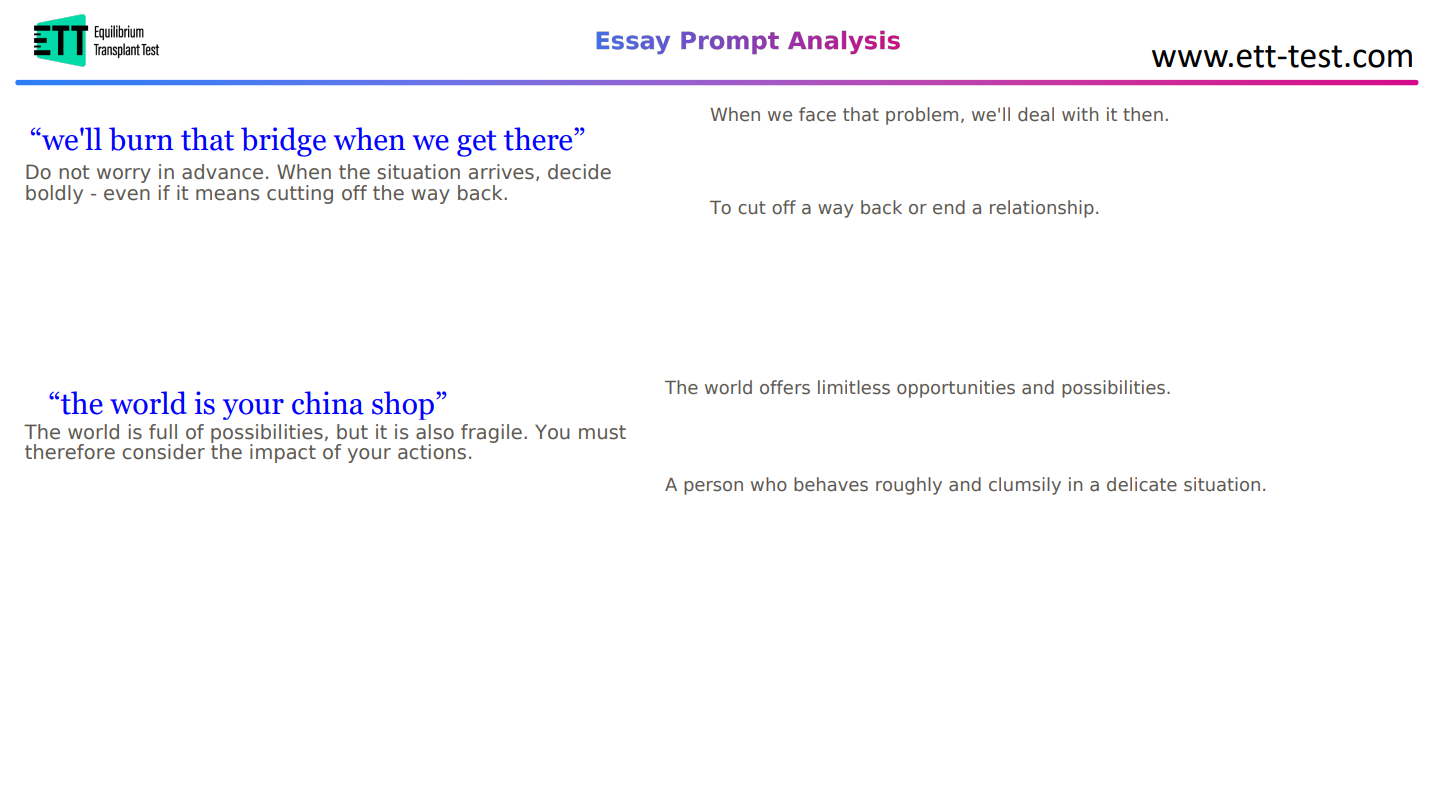
Two example metaphors help illustrate the exercise. "We'll burn that bridge when we get there" combines "we'll cross that bridge when we come to it" (deal with a problem only once it actually arrives) with "burn your bridges" (cut off any way back or end a relationship) — together suggesting: don't worry in advance, and when the moment comes, decide boldly, even if that means cutting off your own retreat. "The world is your china shop" combines "the world is your oyster" (limitless opportunity and possibility) with "a bull in a china shop" (someone who behaves roughly and clumsily in a delicate situation) — together suggesting that the world is full of possibility, but also fragile, so you have to be mindful of the impact of your actions.
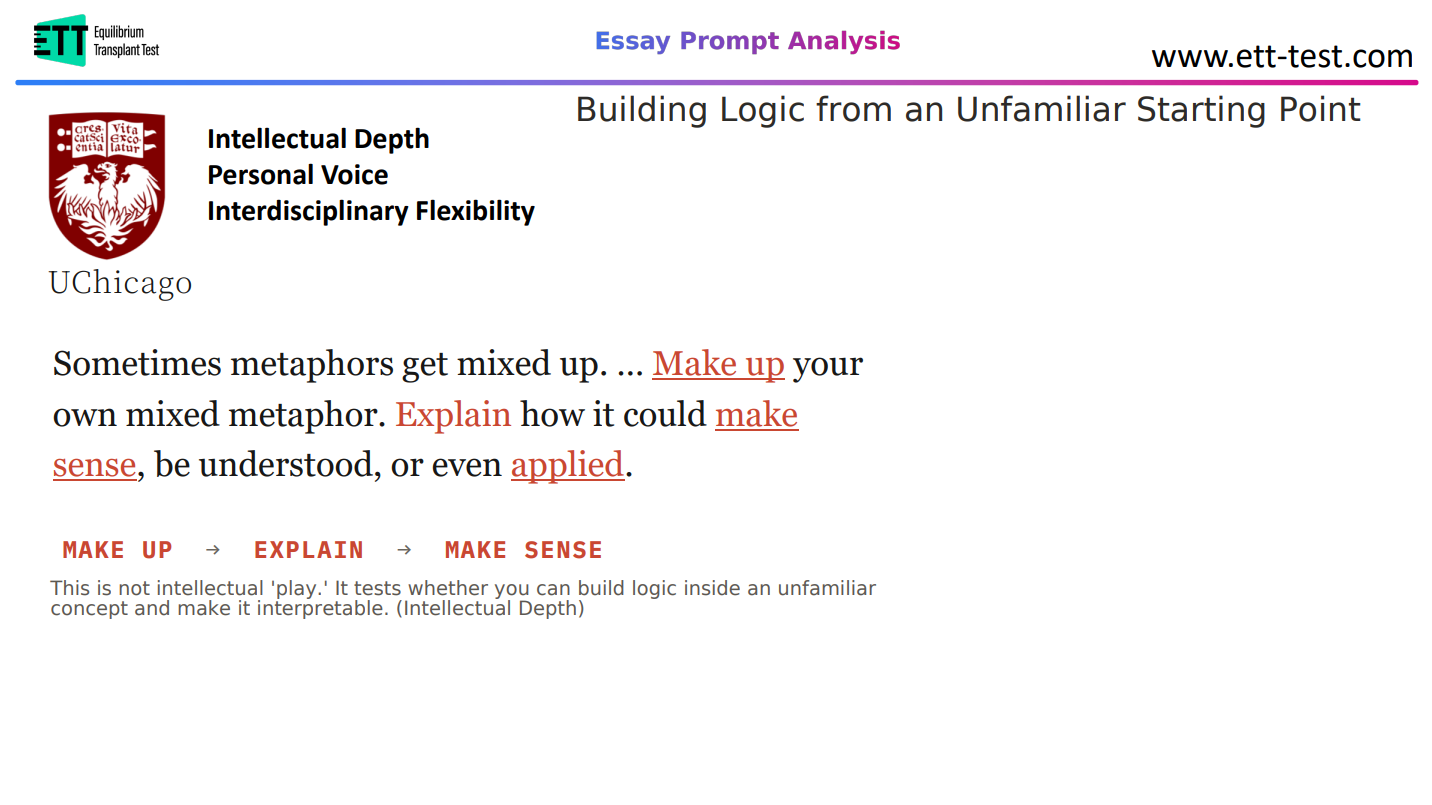
UChicago: Intellectual Depth Through Generating Ideas
The answer is UChicago. UChicago's essay prompts point to three priorities: Interdisciplinary Flexibility, Intellectual Depth, and Personal Voice — and the mixed-metaphor prompt speaks directly to Intellectual Depth.
When reading any college's essay prompts, look at the verbs, not just the nouns. The nouns tend to show broad values that many schools share; the verbs are where the finer, school-specific differences show up. The point of this UChicago prompt isn't how creative or bizarre an idea a student can come up with — it's whether the student can build logic and interpretation starting from a premise that doesn't yet make sense. The invented phrase itself doesn't matter; what matters is the student's own logic and interpretive ability, which is exactly what Intellectual Depth means here.
Columbia: Intellectual Depth Through Accumulated Influences
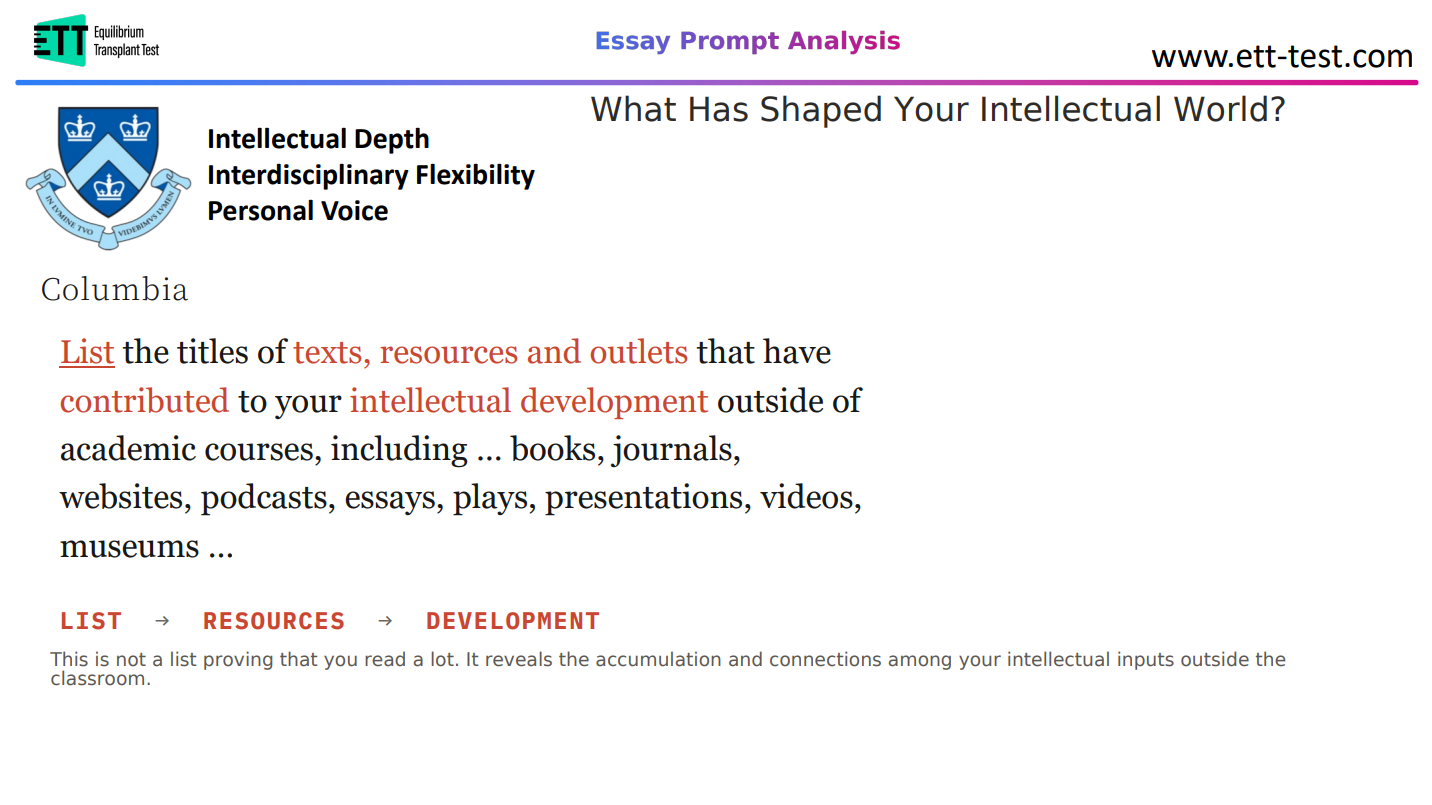
Columbia values the same three qualities as UChicago — Intellectual Depth, Interdisciplinary Flexibility, and Personal Voice — just in a slightly different order: Columbia ranks Interdisciplinary Flexibility second, where UChicago ranks it third.
Columbia's version of the Intellectual Depth prompt asks students to list the titles of texts, resources, and outlets — books, journals, websites, podcasts, essays, plays, presentations, videos, museums — that contributed to their intellectual development outside of academic courses. Where UChicago wants to see a student's ability to generate and interpret an idea from scratch, Columbia wants to know what the student has taken in and how those inputs accumulated and connected to build their intellectual world.
Caltech: Intellectual Depth Through Process
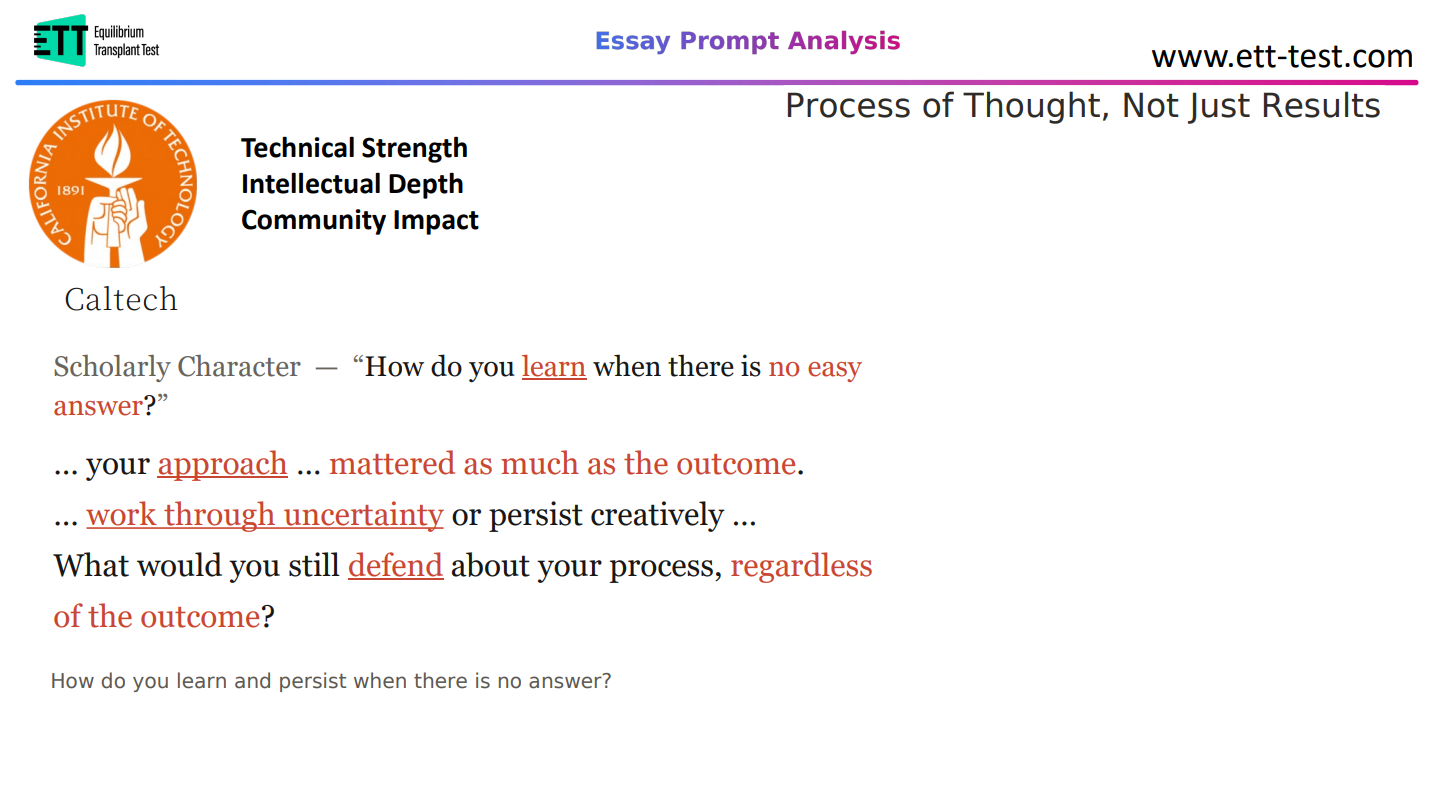
Caltech's priorities are Technical Strength first, then Intellectual Depth, then Community Impact. Its version of the Intellectual Depth prompt asks how a student learns when there is no easy answer — what your approach was, whether you worked through uncertainty or persisted creatively, and what about your process you'd still defend regardless of the outcome.
Here, Intellectual Depth is measured through process rather than result. The prompt asks how valuable a student's approach was, and whether that approach mattered enough to the student that they'd still stand behind it even after the outcome is known — a form of scholarly character, not just a strong answer.
Three Schools, One Shared Value — With Three Different Angles
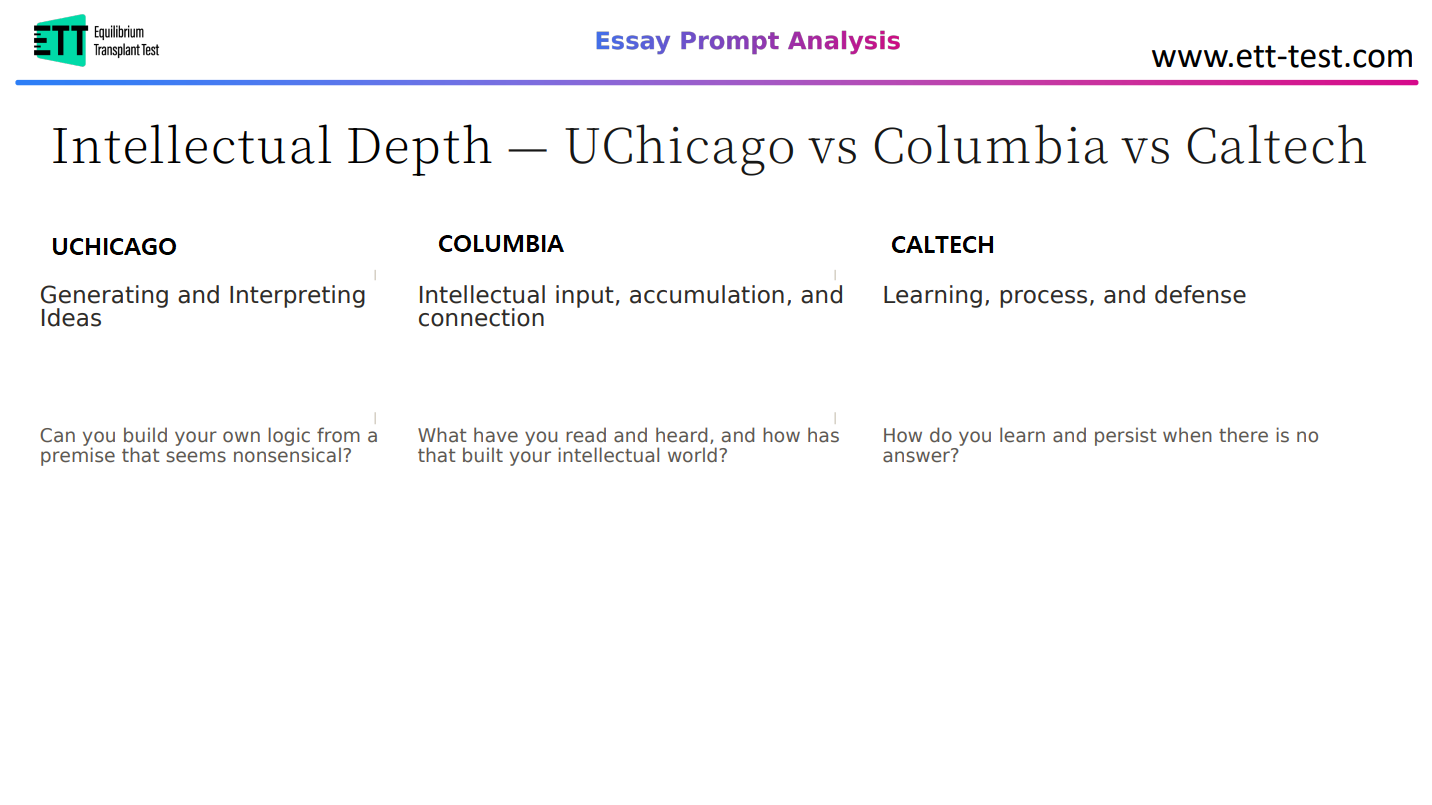
UChicago, Columbia, and Caltech all prioritize Intellectual Depth, but each looks for something slightly different: UChicago wants to see a student generate and interpret an idea from an unfamiliar starting point; Columbia wants to see what intellectual inputs a student has accumulated and how they connect; Caltech wants to see the learning process itself and how strongly a student can defend it. Knowing this baseline is what makes a school's other supplemental questions easier to answer consistently.
Stanford, MIT, and UPenn: Real-World Problem Solving and Career Readiness
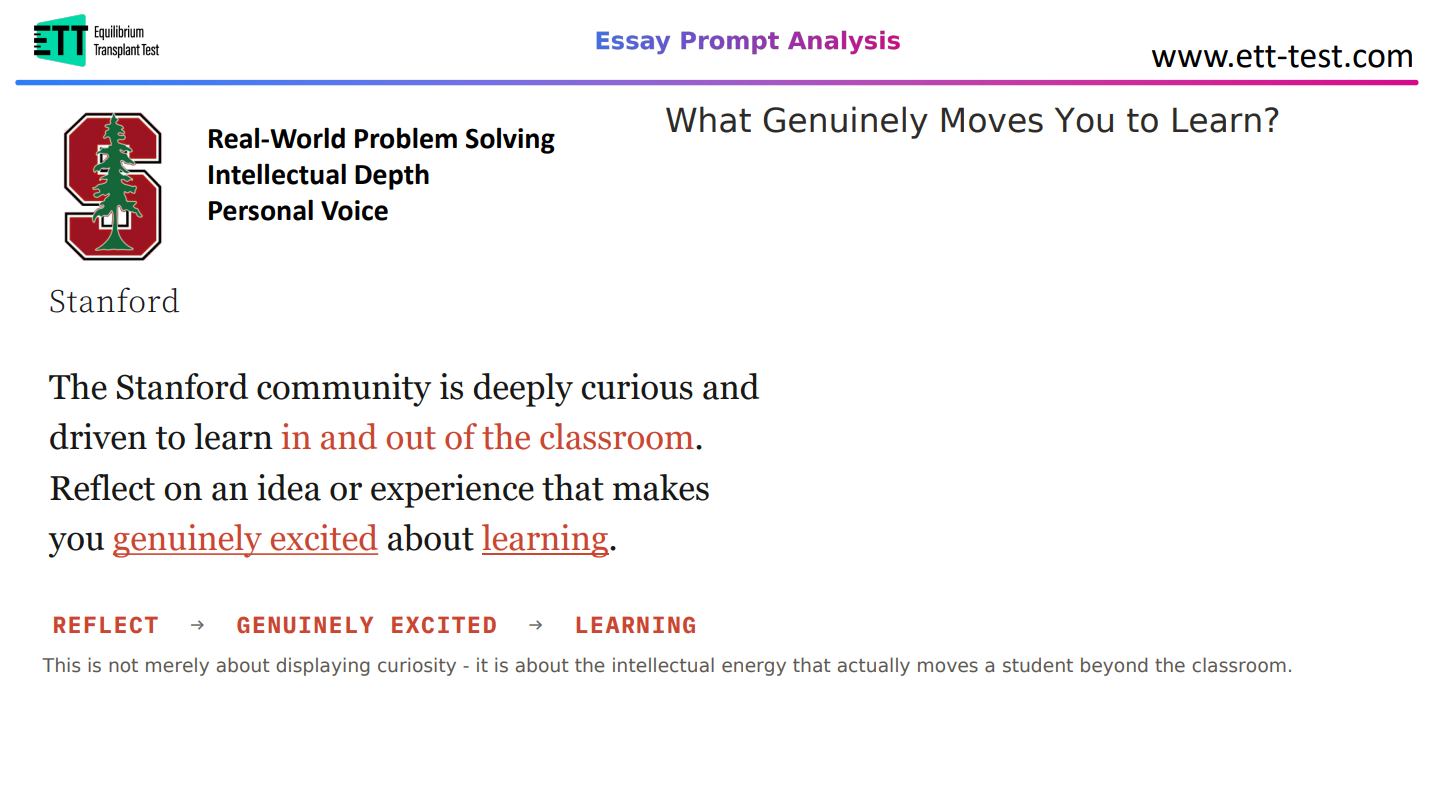
Stanford prioritizes Real-World Problem Solving, Intellectual Depth, and Personal Voice. Its prompt asks students to reflect on an idea or experience that makes them genuinely excited about learning, in or out of the classroom. The real intent isn't just to hear that a student is curious about something — it's to see how far that curiosity's energy has actually pushed the student to act, and what kind of real-world problem that energy might eventually be pointed at.
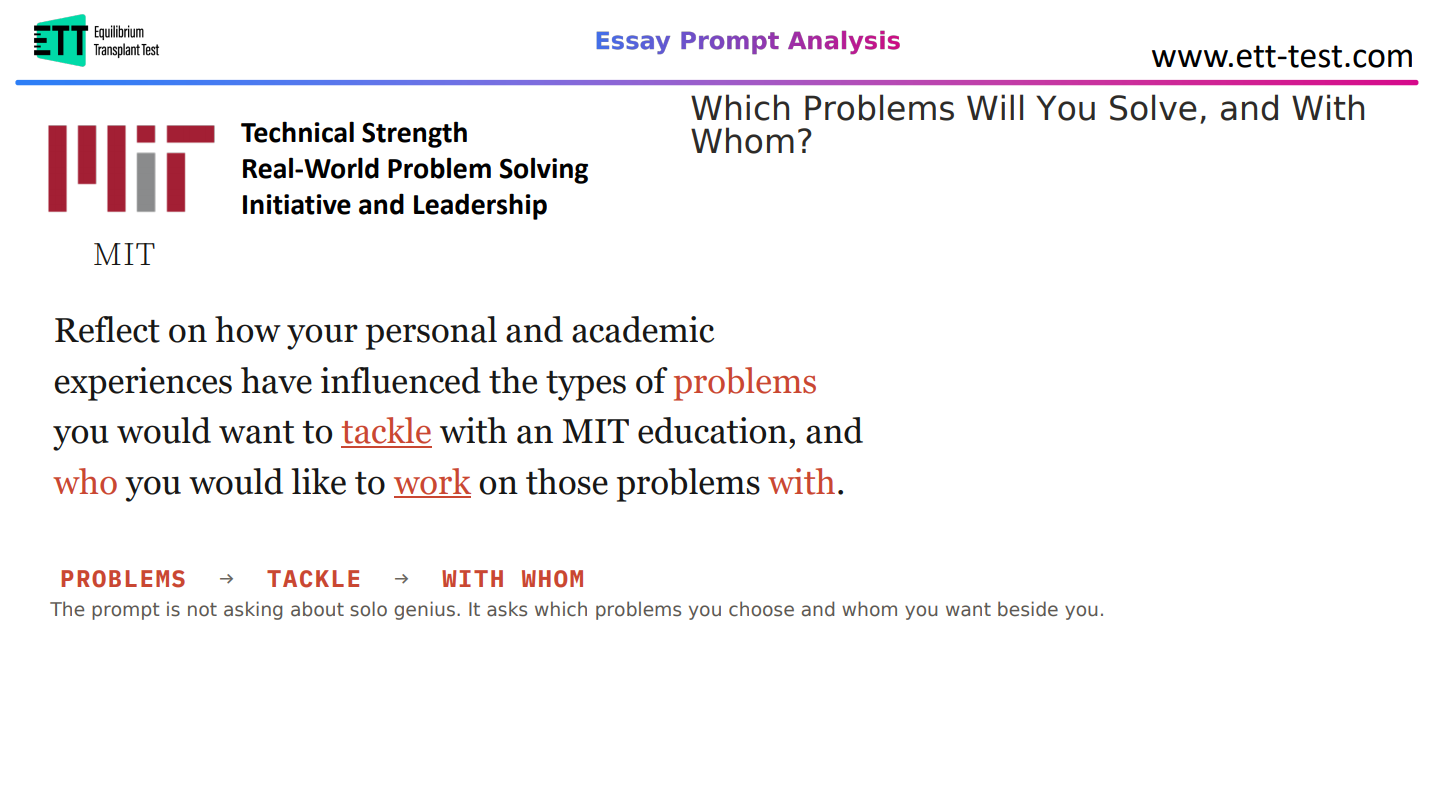
MIT prioritizes Technical Strength first, then Real-World Problem Solving, then Initiative and Leadership. Its prompt asks how a student's personal and academic experiences have shaped the kinds of problems they want to tackle at MIT, and who they'd want to work on those problems with. This is asking about more than solo brilliance — a student needs the initiative to move first, and the collaborative instinct to know who they want beside them.
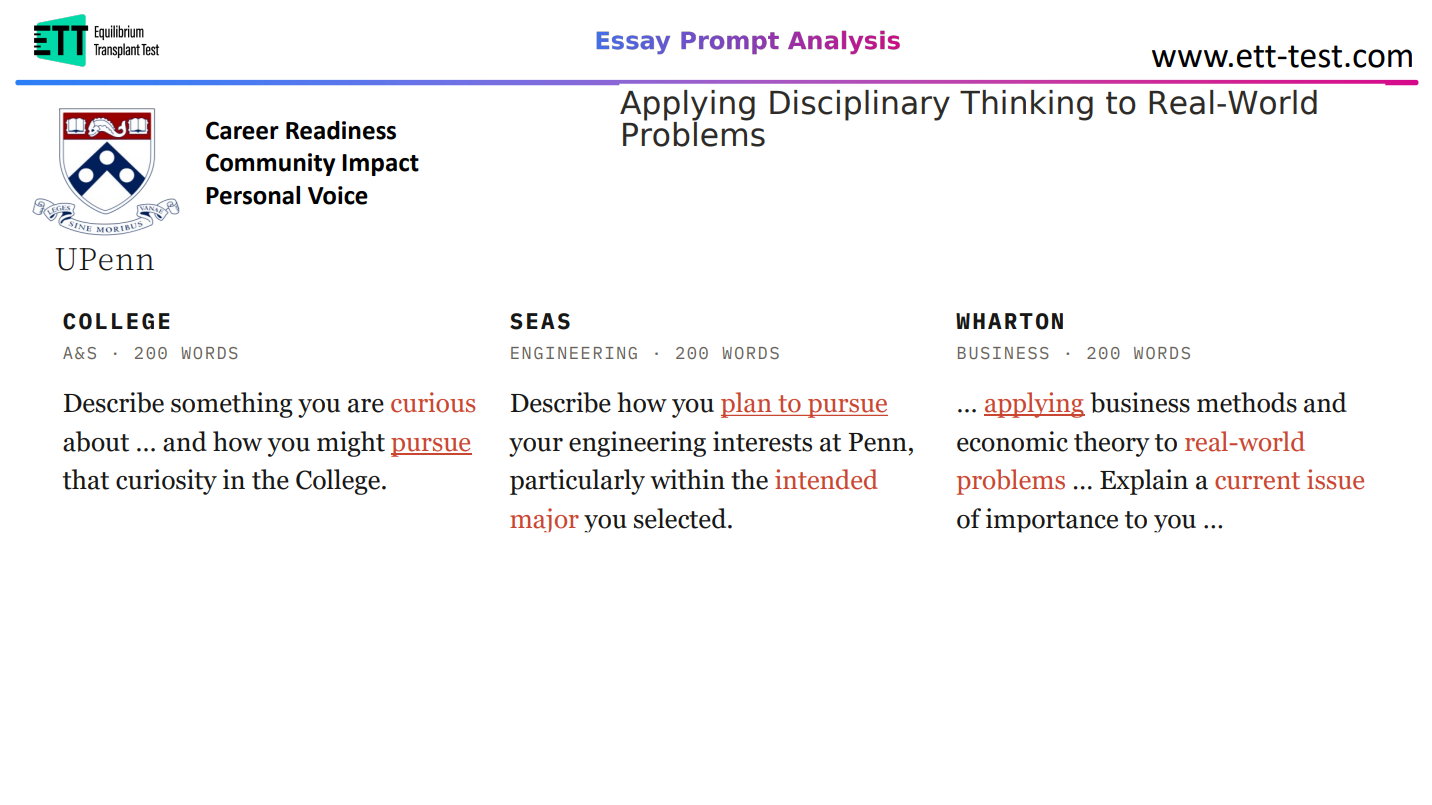
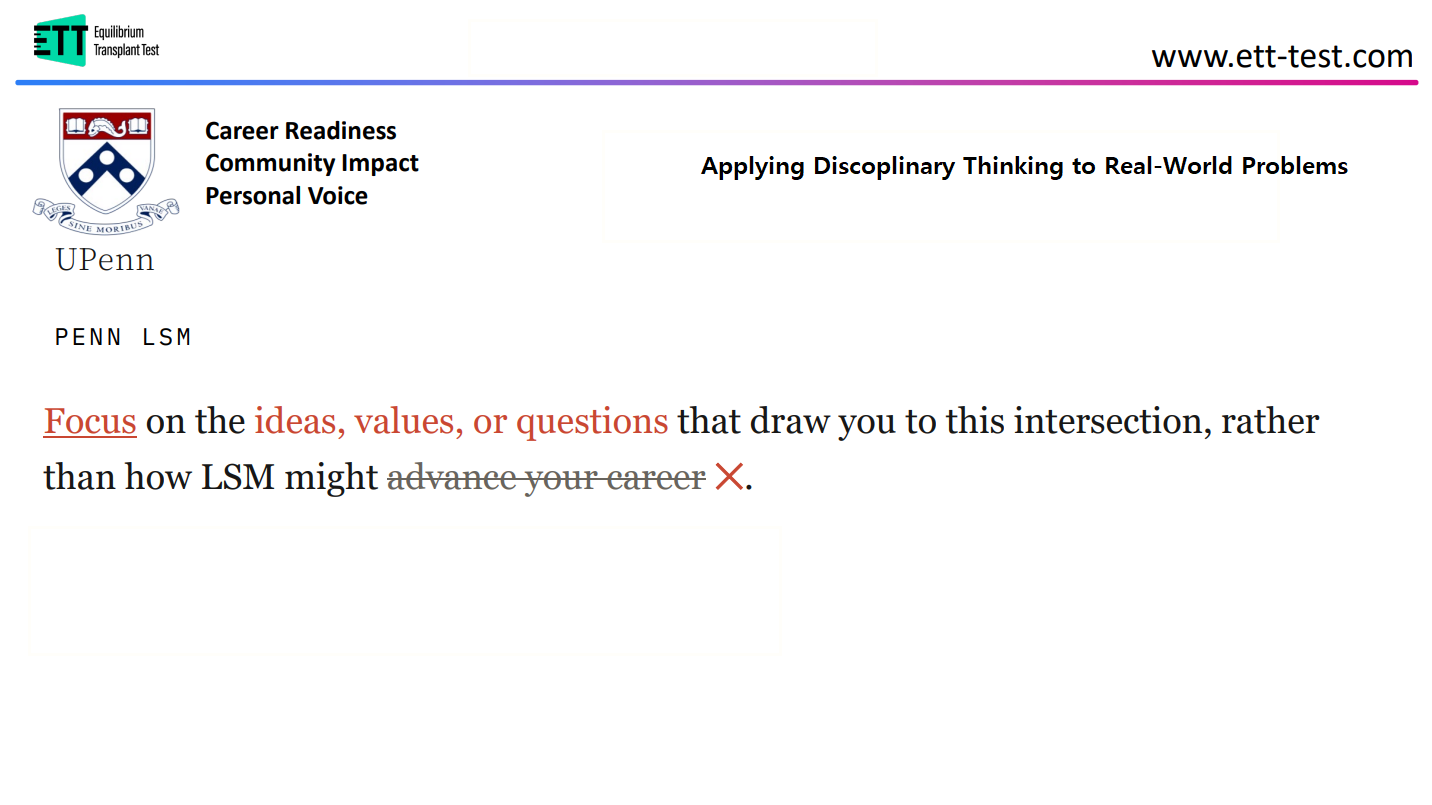
UPenn prioritizes Career Readiness, Community Impact, and Personal Voice — closely related to real-world problem solving. Its College of Arts & Sciences prompt asks how a student would pursue a specific curiosity; its Engineering (SEAS) prompt asks how a student plans to pursue their engineering interest within their intended major; and its Wharton prompt asks about a current issue a student wants to apply business methods and economic theory toward. UPenn's Life Sciences & Management (LSM) program prompt goes a step further, asking students to focus on the ideas, values, or questions that draw them to that specific intersection, rather than how the program might simply help their career.
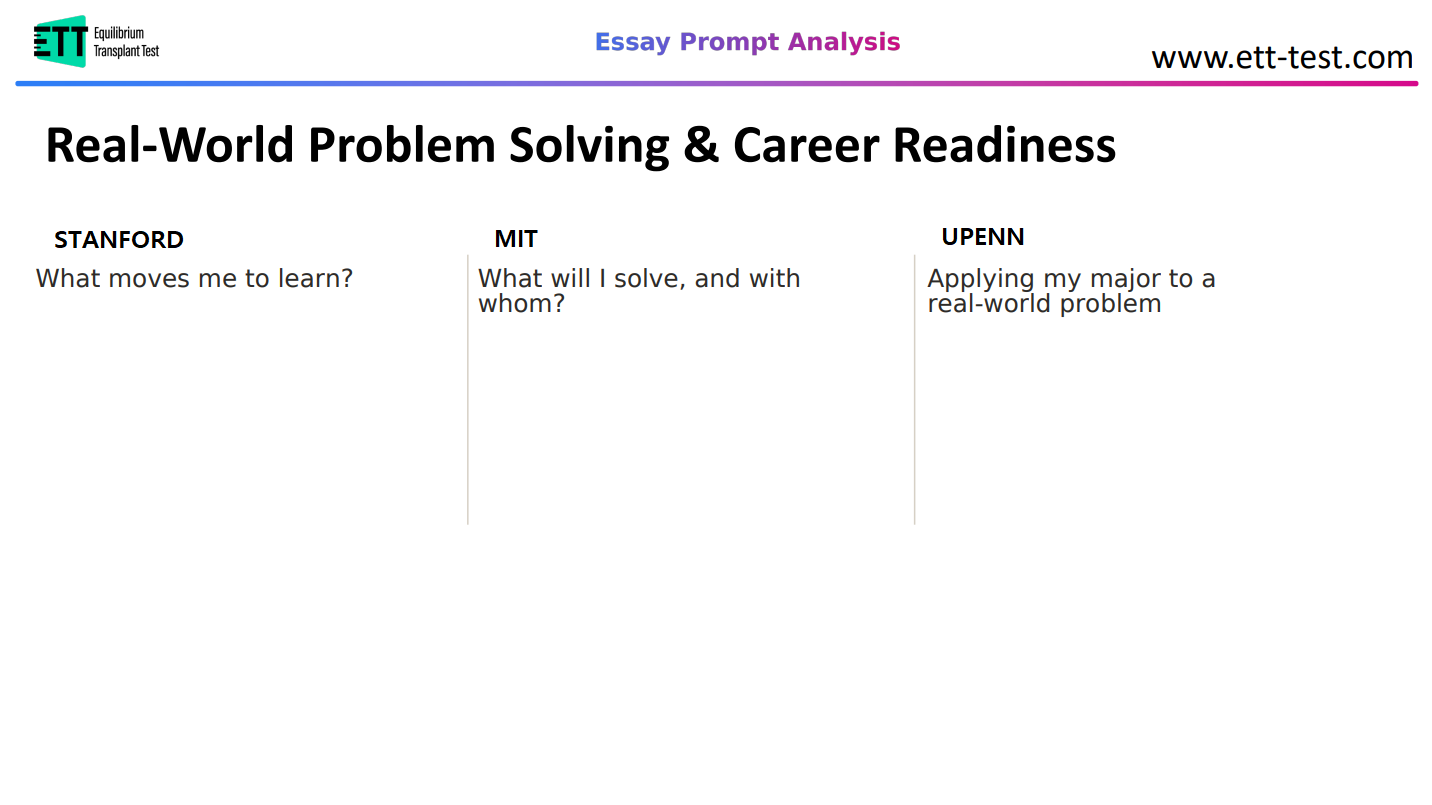
Across these three schools, the shared value is real-world problem solving and career readiness, but each asks it differently: Stanford asks what moves a student to learn, MIT asks what problem a student wants to solve and with whom, and UPenn asks how a student wants to apply their intended major to a real-world problem.
Northwestern and Brown: Interdisciplinary Flexibility
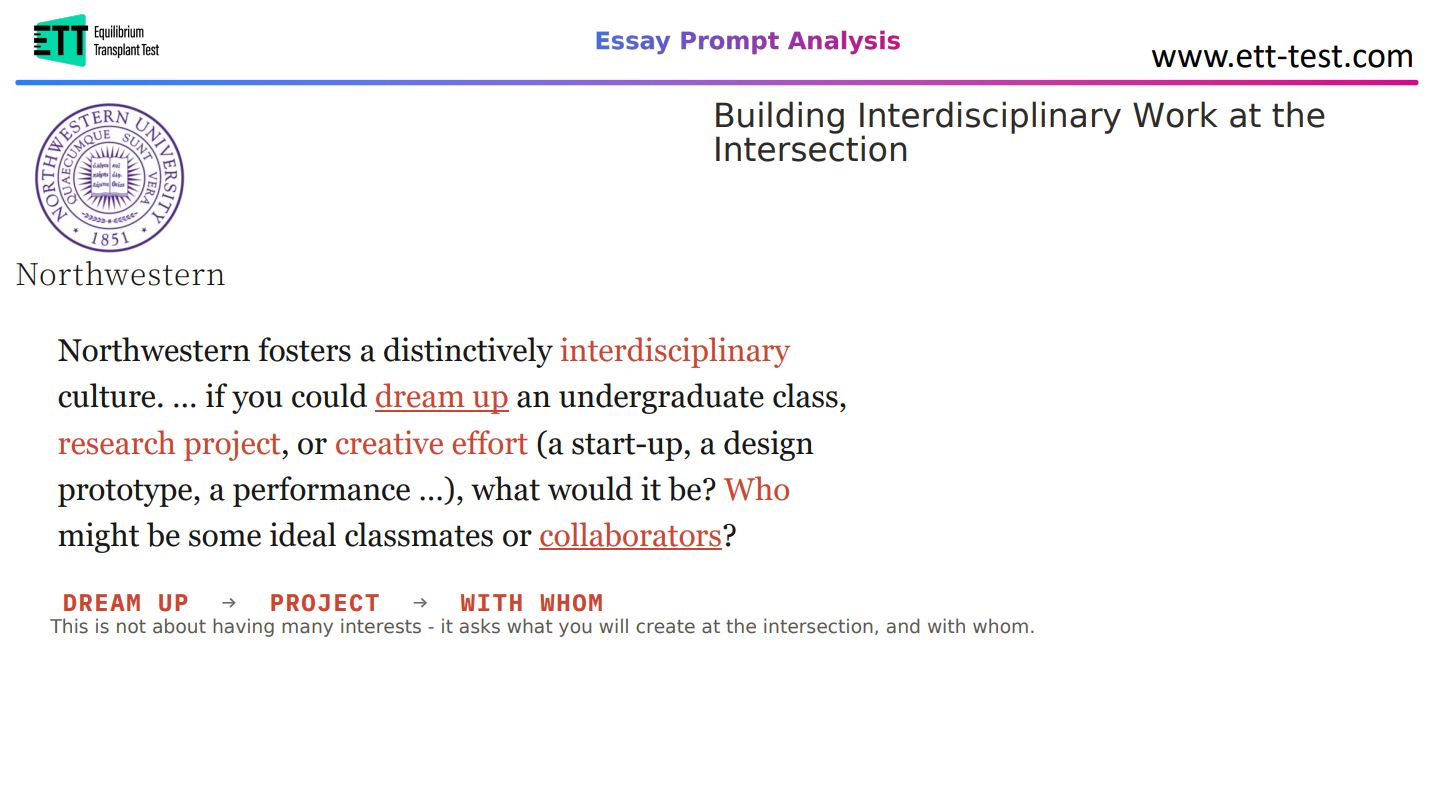
Northwestern's essay culture leans heavily on interdisciplinary thinking. Its prompt asks students to dream up an undergraduate class, research project, or creative effort — a start-up, a design prototype, a performance — and to name who might be their ideal classmates or collaborators. It's asking a student to imagine an interdisciplinary intersection, and who they'd want to build it with.
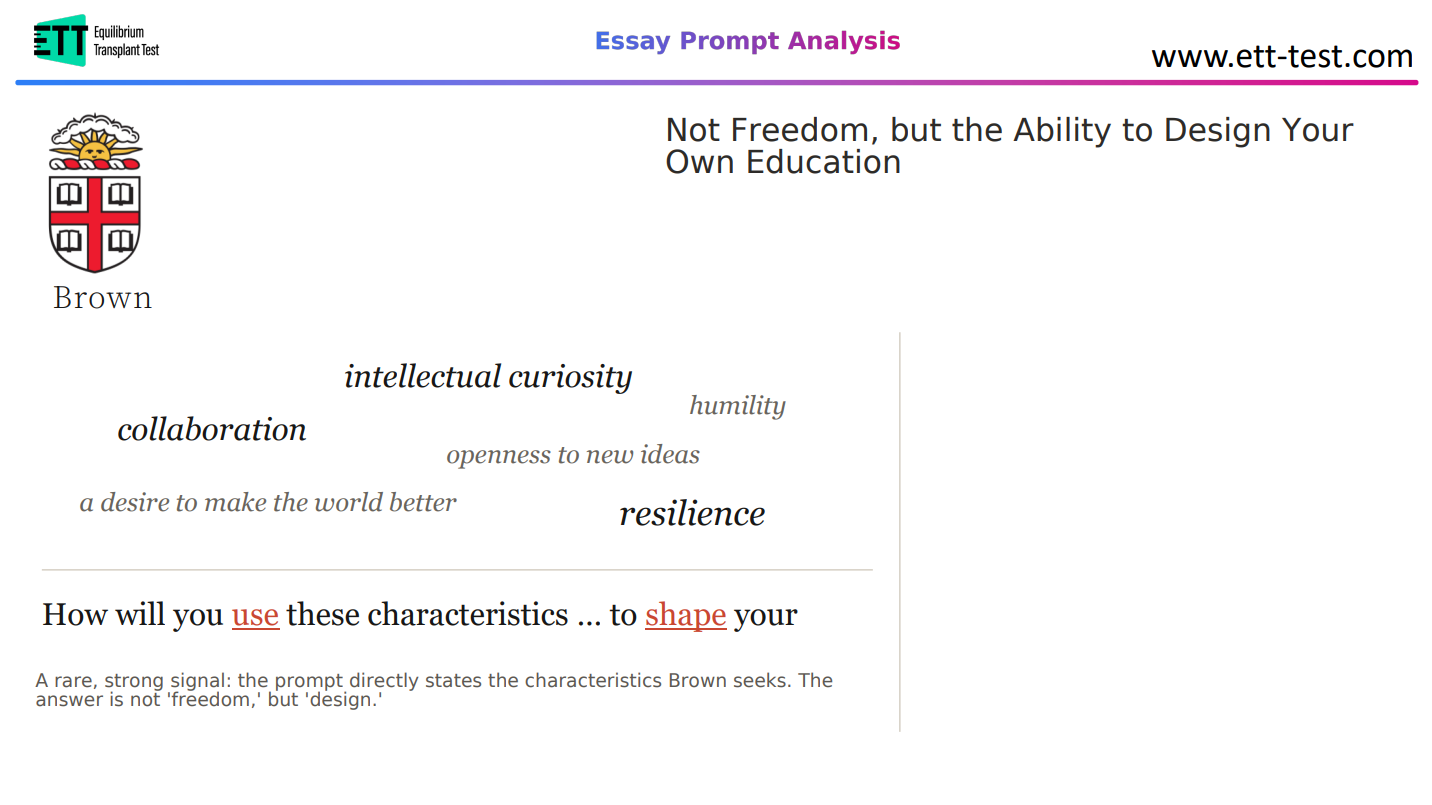
Brown's prompt draws directly from qualities its president has publicly named as important — intellectual curiosity, humility, collaboration, openness to new ideas, resilience, and a desire to make the world better — and asks how a student would use those characteristics to shape their own course of study. This is a rare, direct signal of exactly what a school is looking for: the answer isn't simply "freedom," but the ability to design.
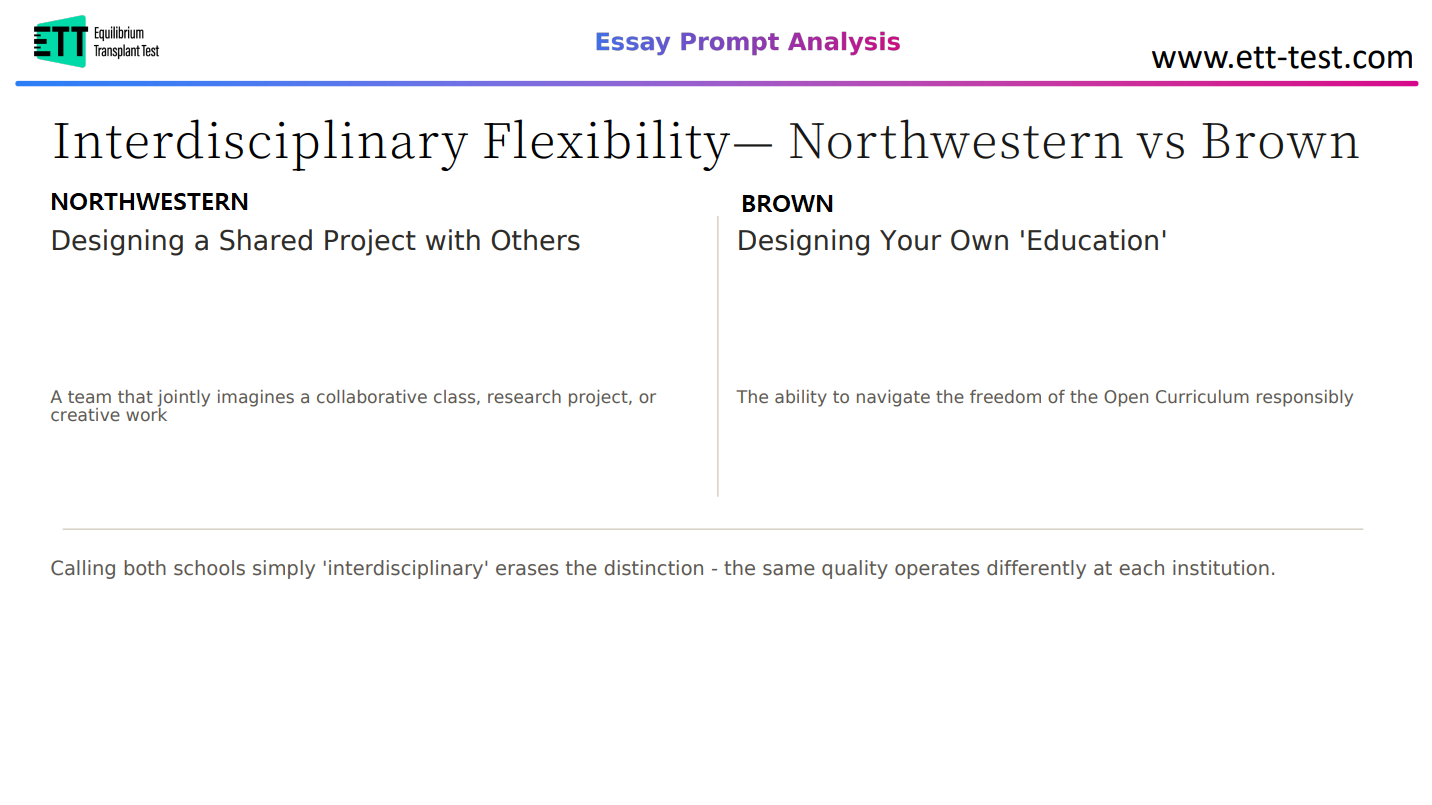
Northwestern and Brown share a broader value: the ability to synthesize across disciplines. But they ask for it differently — Northwestern wants to see a student design a shared project together with others, while Brown wants to see a student design their own education.
Reading Every Prompt Through the Same Lens
Knowing that a school's essay prompts consistently point toward Intellectual Depth, Real-World Problem Solving, or Interdisciplinary Flexibility — and knowing exactly which angle that school takes on it — gives students a stable foundation for answering any of that school's other supplemental questions in a way that stays consistent with the values the school has already shown it's looking for.
Reading essay prompts this closely — matching each school's verbs to its actual priorities — is exactly the kind of analysis that goes into building a consistent, well-aimed application. A ONE Institute works with students on this level of essay prompt analysis alongside Common App activity lists, resume writing, and coursework ranging from foundational subjects to Olympiad, research programs, and writing competitions, all available online regardless of where you're located. If you'd like help with your own essay strategy, reach out to A ONE Institute for a consultation.
Essay Prompts
College Admissions
UChicago
Columbia
Caltech
Stanford
MIT
UPenn
Northwestern
Brown
