
Colleges are increasingly looking past extracurriculars and other activities to scrutinize academic substance more closely, and that shift matters most for students aiming at the top 20 or the "near-Ivy" tier. For those students, the question is what strategy actually makes sense in this environment — and that's what this post works through.
Why This Is Happening
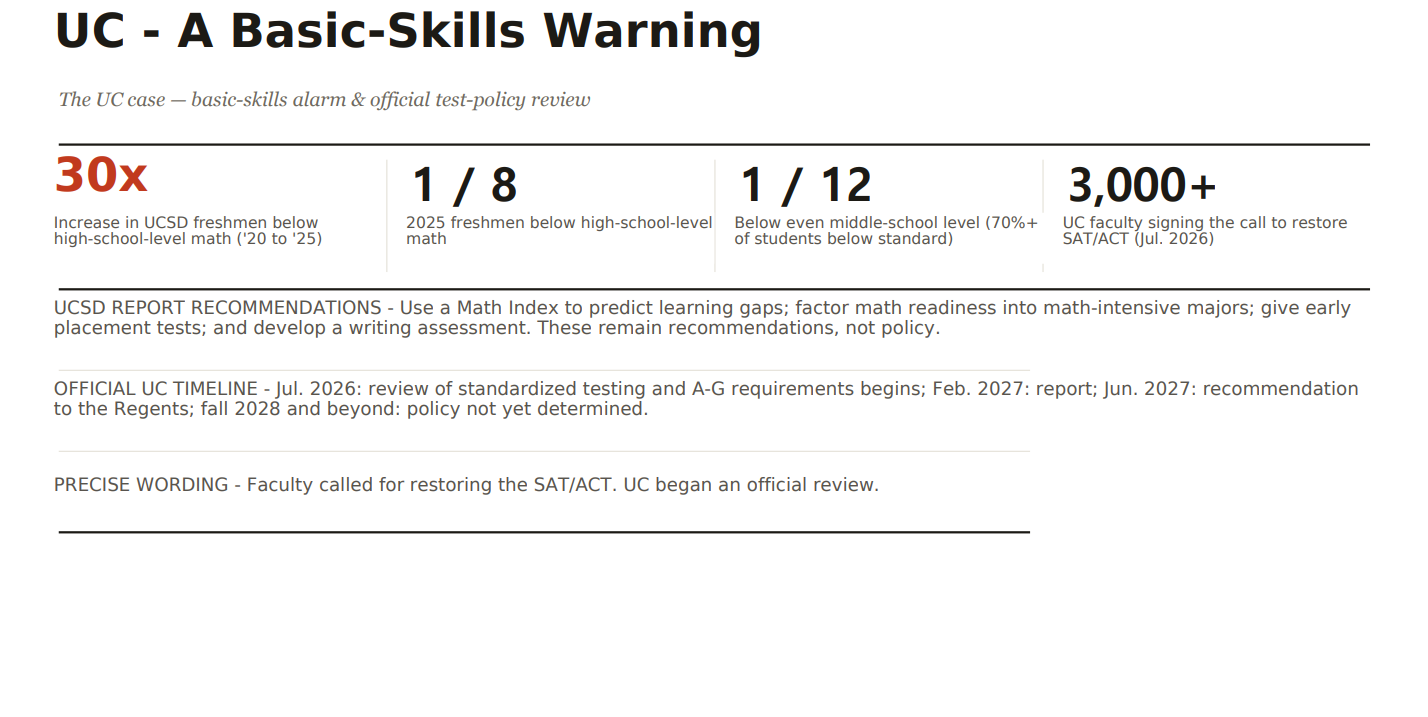
The University of California's test-blind policy is a useful starting point, because the backlash against it shows exactly what's driving this shift. As basic academic skills among incoming students have declined, pressure to bring standardized test results back into the admissions picture has grown. At UC San Diego, the number of students testing below high school math level has risen roughly thirtyfold in recent years. Looking at the UC system as a whole, incoming students below high school math level are said to make up about one in eight, and those below middle school level about one in twelve. More than 3,000 professors across the UC system have now signed a petition calling for the SAT and ACT to be reinstated.
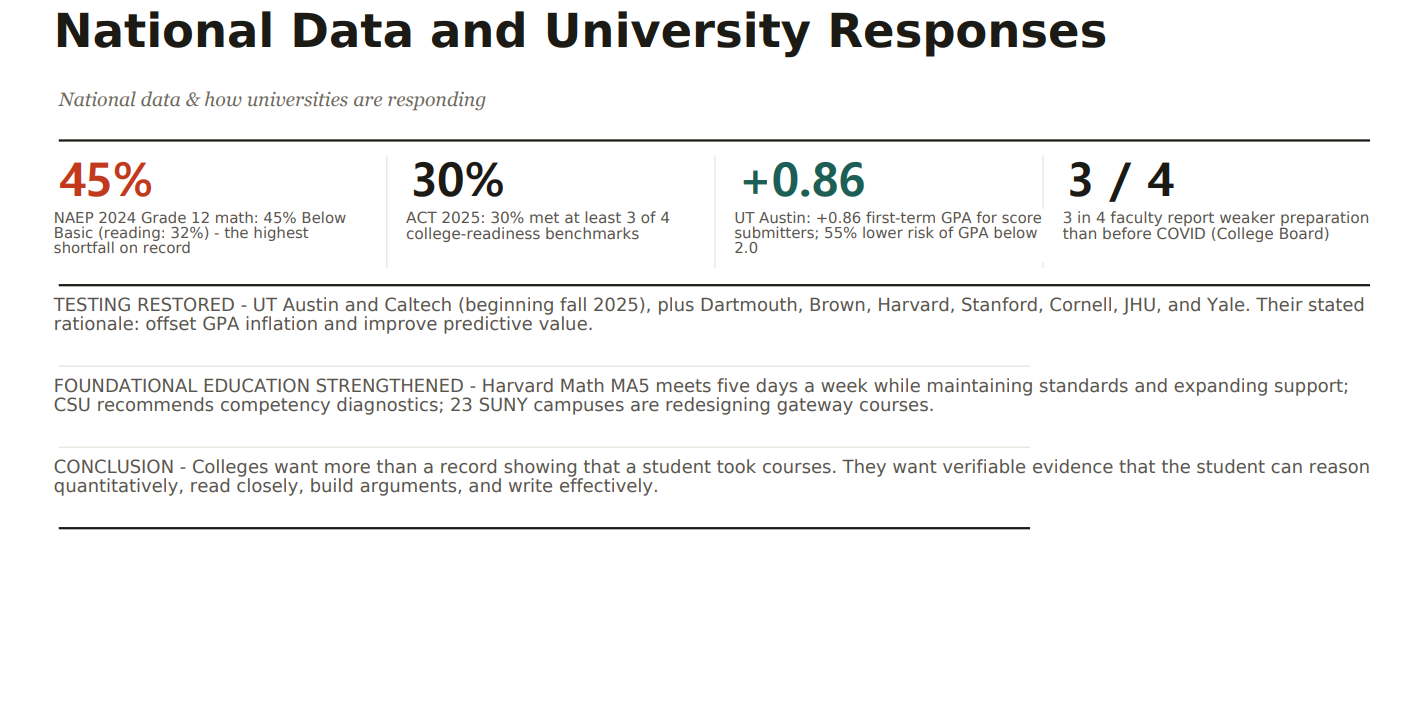
This isn't just a UC problem, and it isn't limited to higher education. Failure rates on academic achievement testing at the high school level have hit a record 45%, and roughly 30% of college students test below proficient on ACT-measured skills. At UT Austin, students who submitted SAT or ACT scores as part of their application went on to earn a college GPA about 0.86 points higher, on average, than those who didn't. When professors were asked whether student preparation has weakened compared to before COVID, three out of every four said yes. Because GPAs have become so uniformly high nationwide that they're difficult to use as a differentiator on their own, more and more colleges are restoring SAT and ACT score requirements.
Harvard has responded in its own way: the university has expanded support for foundational academic coursework while keeping its academic standards in place, signaling its own concern about declining preparation. Tracking the steady stream of news coming out of individual colleges makes one thing clear — schools are moving toward wanting to see verifiable, numeric evidence of academic ability, not just a general impression of it.
What Caltech and MIT Say They're Looking For
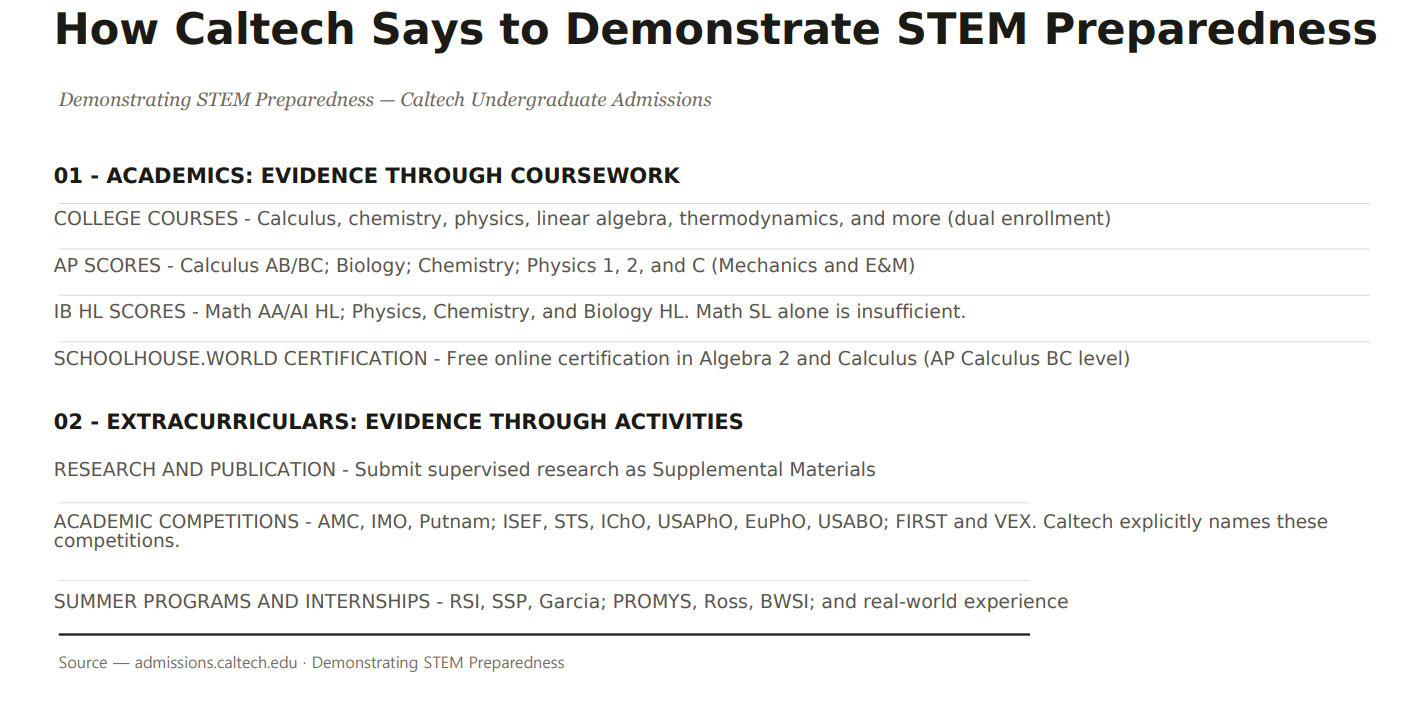
Caltech's own admissions website is direct about this. High school grades matter and are the baseline, but the school explicitly states that completing college-level coursework in advance is a plus, and that it looks directly at IB Higher Level and AP scores. (This is worth clarifying for parents who've heard otherwise: AP scores absolutely factor into admissions decisions at schools like this — that's not a myth.) Verified certifications from outside coursework are also officially recognized, and published research can be submitted through a Supplemental Material route. Caltech names specific academic competitions directly on its site — AMC, ISEF, STS, USAPhO, and VEX among them — making clear that objectively verified competition results are viewed as a genuine strength. Well-known summer camps and internships are named directly as well.
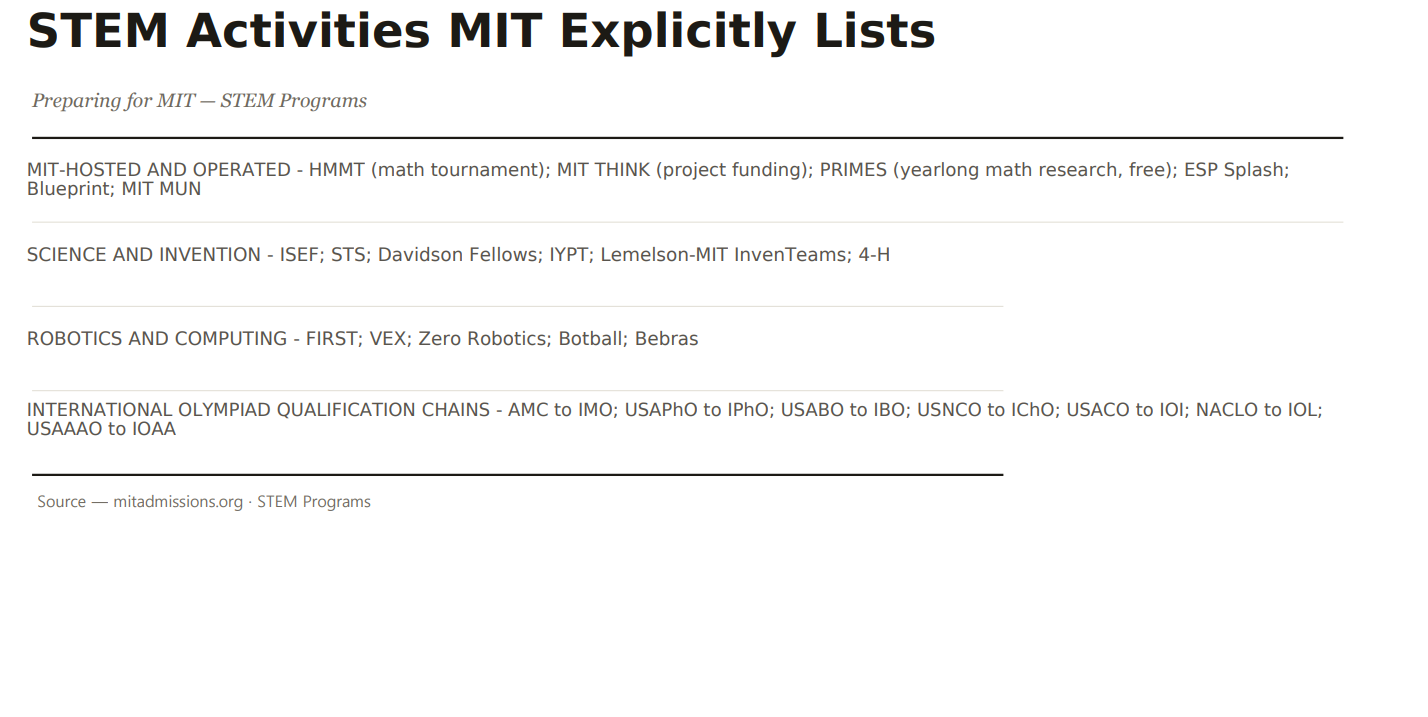
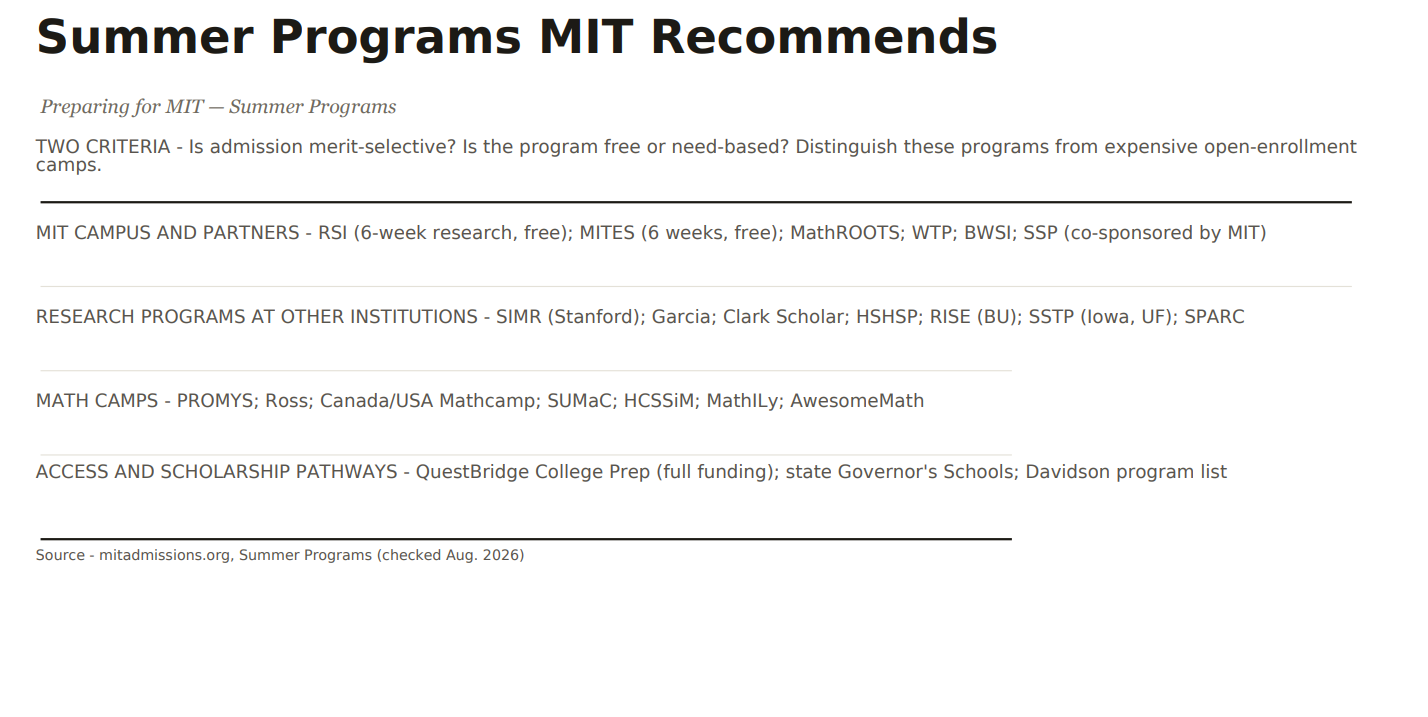
MIT takes the same approach. Its materials repeatedly reference science and invention competitions like ISEF and STS, along with competitions that have produced Team USA representatives and international olympiad qualifying rounds and finals. MIT's recommended summer programs overlap heavily with Caltech's list, so rather than detail each one individually here, students and parents can look them up directly — these have been covered in more depth in previous posts.
Taken together, colleges are effectively sorting applicants into informal categories of their own — not a rigid, officially published rubric, but a consistent pattern across schools. Extracurriculars, sports, and other activities still matter, but the academic category is becoming more heavily weighted. For schools at the top-20-or-near-Ivy level, GPA and SAT/ACT scores are already uniformly high across nearly the entire applicant pool, so what colleges are really looking for on top of that is objective, verifiable proof of academic ability. Since most students realistically can't reach national-team-level recognition, the rest of this post lays out a practical framework for what's actually achievable.
A Realistic Tier System
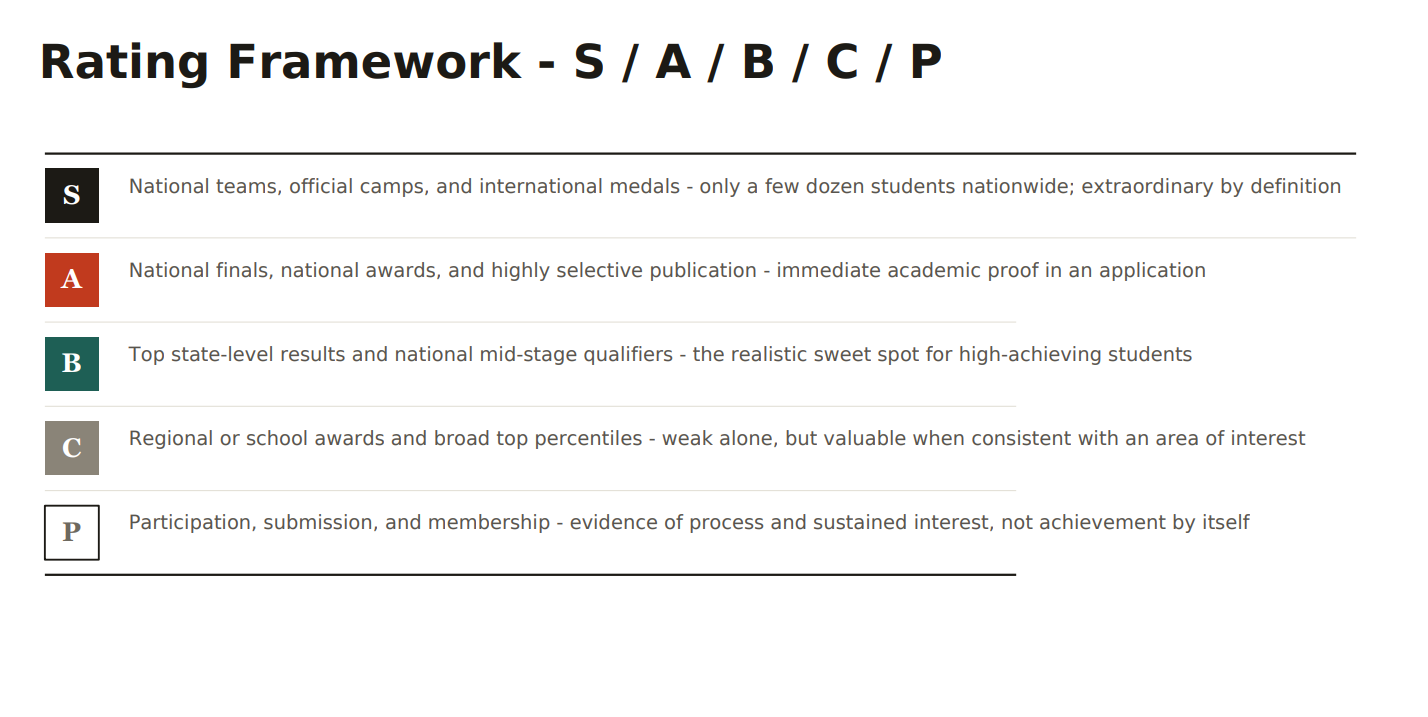
Breaking activity strength into tiers makes the target easier to see:
- S tier: Official national team selection — the kind of camp where only the top 10 or so are chosen — or an international medal. This is elite, rare territory.
- A tier: Recognized at the national level, even without cracking the very top ranks. On an application, this directly and intuitively signals to admissions that a student's academic ability is proven.
- B tier: Roughly state-level top performance — good enough to be selected as a kind of state representative. This is the realistic sweet spot most students preparing seriously should be aiming for.
- Regional awards: Weaker as a standalone credential, but genuinely useful for showing sustained, consistent interest in a field.
- C tier: Simple participation.
Calibrating the Tiers With Real Numbers
Math offers the clearest benchmark, since AMC 10/12 is the most well-known competition in the space. Roughly 300,000 students attempt the qualifying round. Advancing to AIME narrows that down to about 6,000–7,000 students. Combining AIME and AMC scores, only about 60 students nationwide are selected for the MOP training camp — that's S tier.
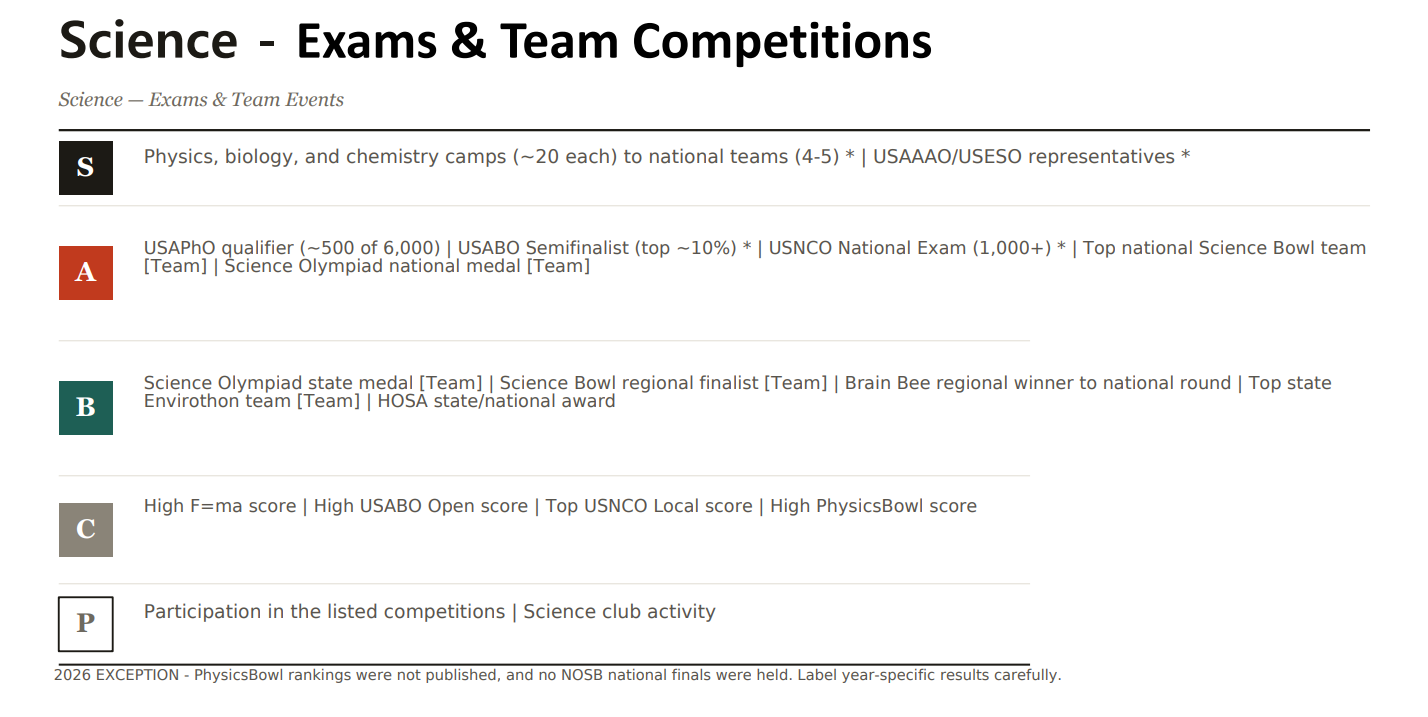
One notch below that sits the science olympiads — Physics, Biology, and Chemistry — which also start with a qualifying exam. Physics draws roughly 6,000 applicants at that stage; Biology and Chemistry draw roughly 10,000 each. Passing the qualifying round moves students into USAPhO (Physics), the USABO Semifinal Test (Biology), or USNCO (Chemistry). From there, Physics selects only about 400–500 students, Biology about 500–600, and Chemistry about 1,000. That level doesn't quite fit "B tier" — it's closer to A tier, or more precisely, the high end of B bordering the low end of A. The roughly 20 students who go on to camp and a final exam land solidly in A tier, and the students who go on to represent Team USA reach S tier.
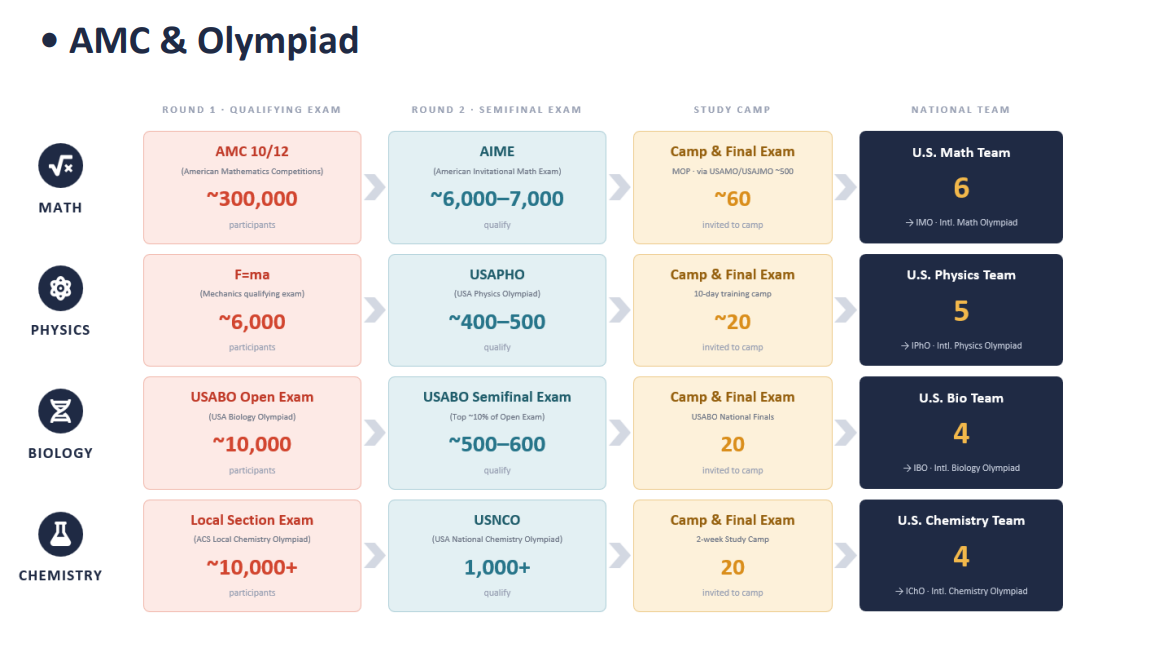
The goal from here isn't necessarily to chase AMC or an olympiad specifically — it's to understand what B-or-low-A-tier achievement looks like across a range of competitions, and to aim realistically for that zone.
Field-by-Field Targets
Math and Math Modeling
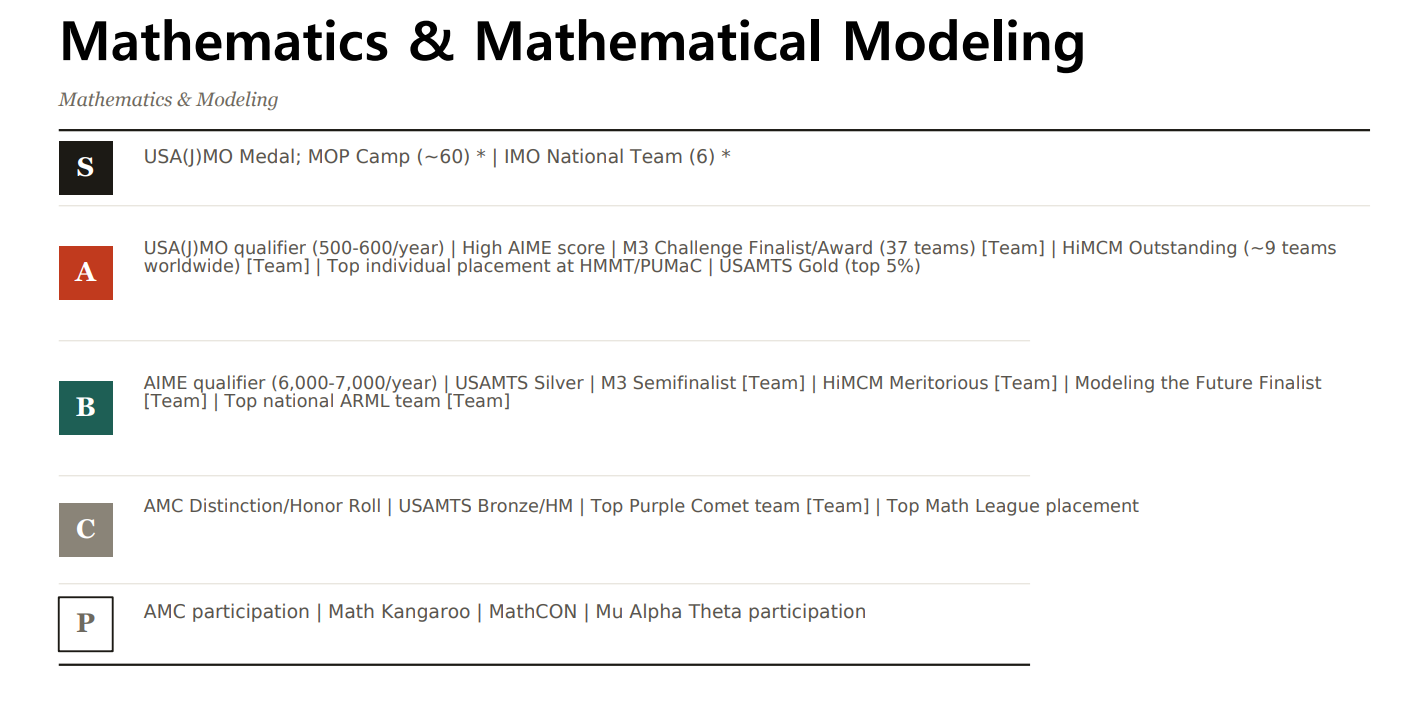
S tier: A USAMO or JMO medal, or selection to the MOP camp — essentially IMO-team-level, and genuinely rare. A single S-tier result here is strong enough on its own to make a real difference, even if nothing else on the application stands out.
A tier: Qualifying for USAMO, a high AIME score, reaching the M3 Challenge final and placing, an Outstanding rating in HiMCM modeling, or placing in the top 5% individually in HMMT (the Harvard MIT Math Tournament, taken online as an individual).
Realistic target zone (B, reaching toward A): Qualifying from AMC to AIME, USMTS Silver, reaching the M3 Challenge semifinal as a team, HiMCM Meritorious Team, reaching the final in Modeling the Future, or a top-3 national finish for an ARML team. This is the zone worth watching most closely, with A-tier results as a stretch goal where possible.
C tier: Simply participating is still a solid activity in its own right — it just doesn't carry the same objective proof that a B-tier result does.
Science — Team Competitions and Exams
S tier: Representing Team USA in fields like astronomy or earth science.
Strong, realistic results: A state medal in Science Olympiad, advancing to Science Bowl's regional finals as a team, winning Brain Bee at the regional level (or advancing further to nationals), or placing at the state or national level in HOSA. Reaching the semifinal round in the Physics, Biology, or Chemistry olympiads (described above) is also genuinely meaningful. Students currently in 8th or 9th grade should consider trying at least one of these at some point, since by the time they apply, colleges are likely to weigh objective academic proof even more heavily than they do today.
Science — Research and Engineering
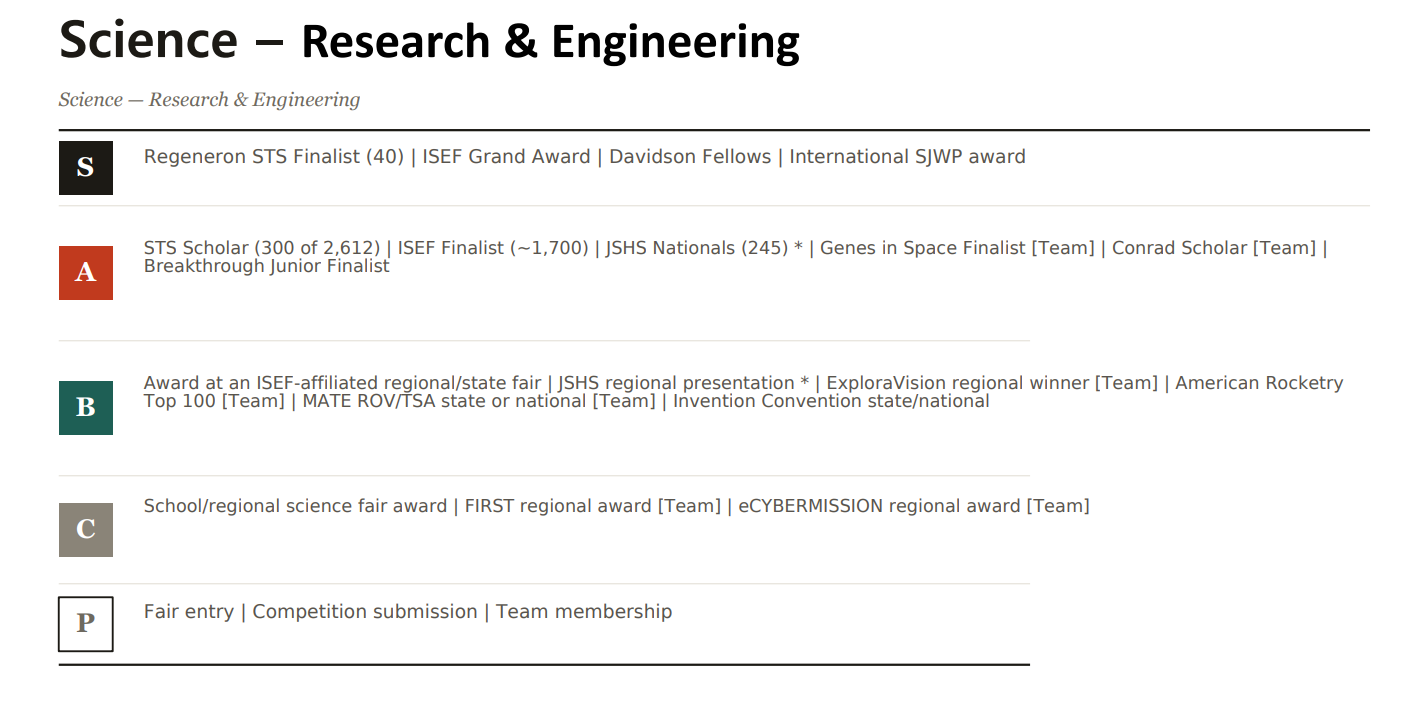
S tier: Reaching the Regeneron STS final, winning an ISEF Grand Award, becoming a Davidson Fellow, or winning internationally at SJWP — all essentially Team-USA-caliber results.
Worth aiming for: An award at an ISEF-affiliated regional or state fair, JSHS, or the Invention Convention (which paused and has since restarted) at the state level.
Computer Science, Cybersecurity, and Linguistics
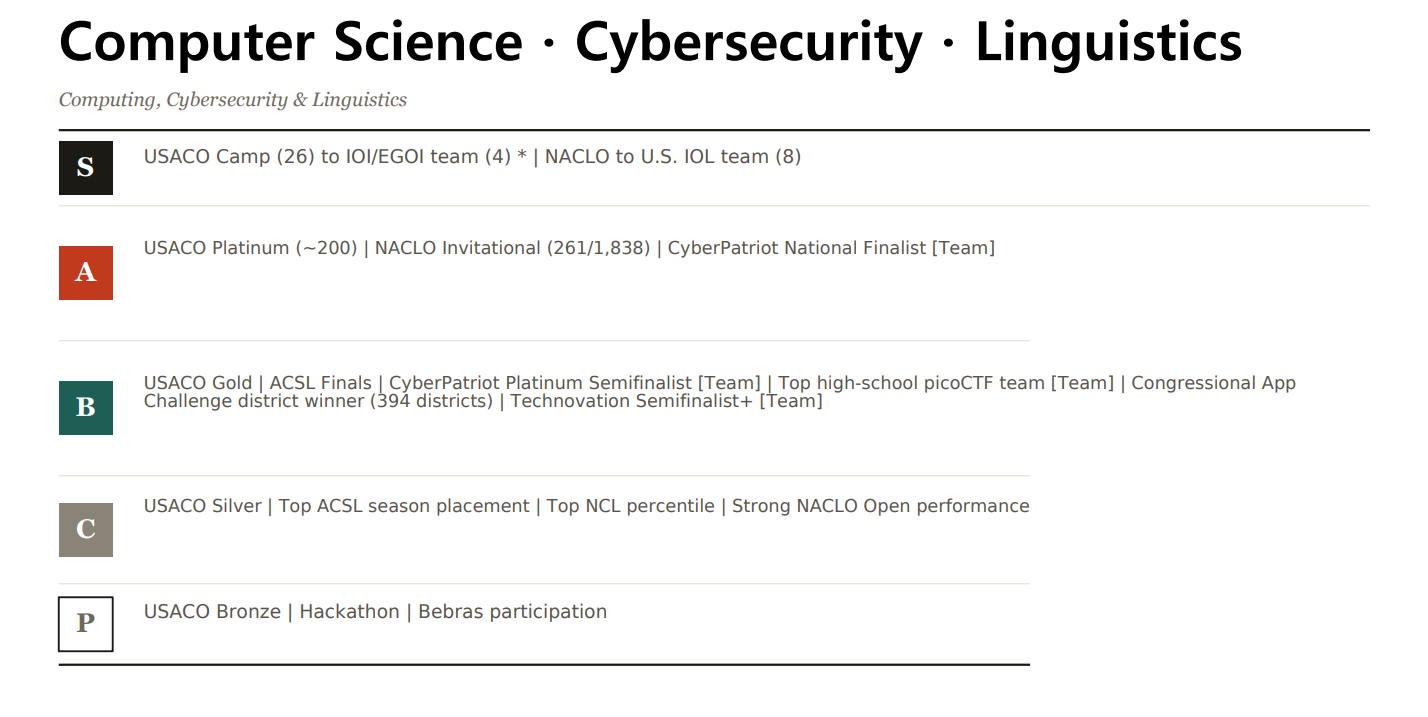
A tier: Reaching the national final of the International Olympiad in Informatics, or the national final of the linguistics problem-solving competition.
Worth aiming for at the state level: USACO Gold, an ACSL final, reaching the semifinal round of CyberPatriot Platinum, advancing to a top team at the high school level in that same competition, winning your district in the Congressional App Challenge, or reaching the semifinal round in a technology-entrepreneurship competition for young women.
History/Social Studies/Civics
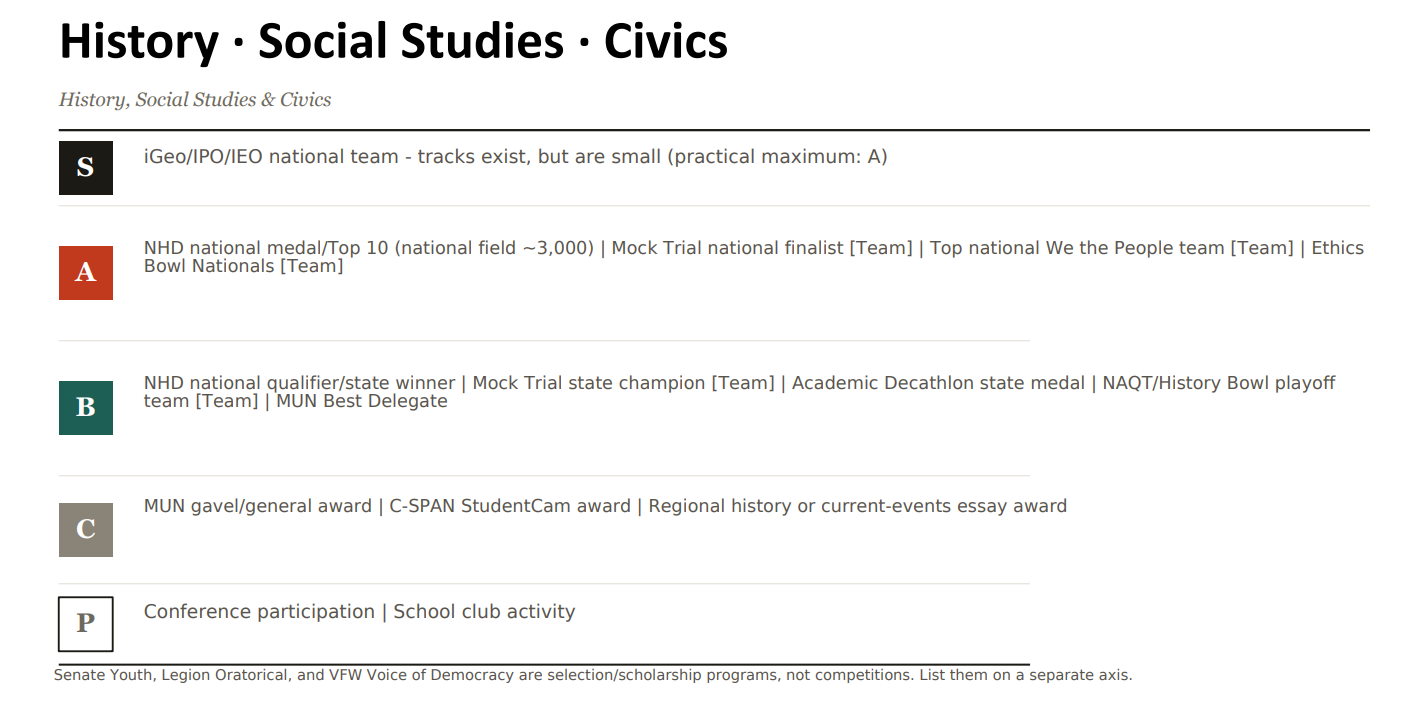
Reaching the national round of NHD, becoming a state champion in Mock Trial, earning a state medal in Academic Decathlon, advancing to the playoff round of History Bowl, or being named Best Delegate at MUN are all state-level-caliber results worth pursuing. These are competitions colleges recognize well, so even attempting one and falling short of the very top result is still meaningful.
Economics/Finance/Business
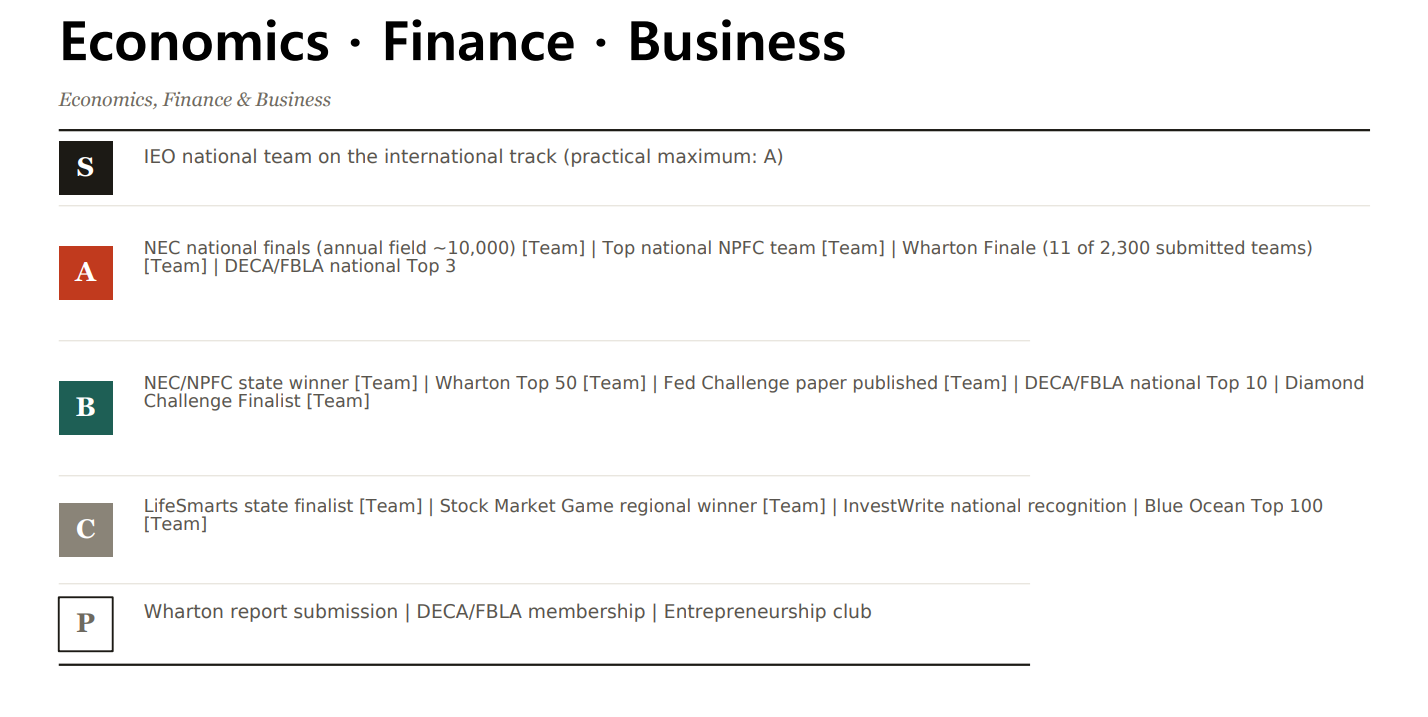
A national top-10 finish in DECA or FBLA (Future Business Leaders of America), or reaching the final round of the Diamond Challenge, are both genuinely significant results.
English/Writing/Speech
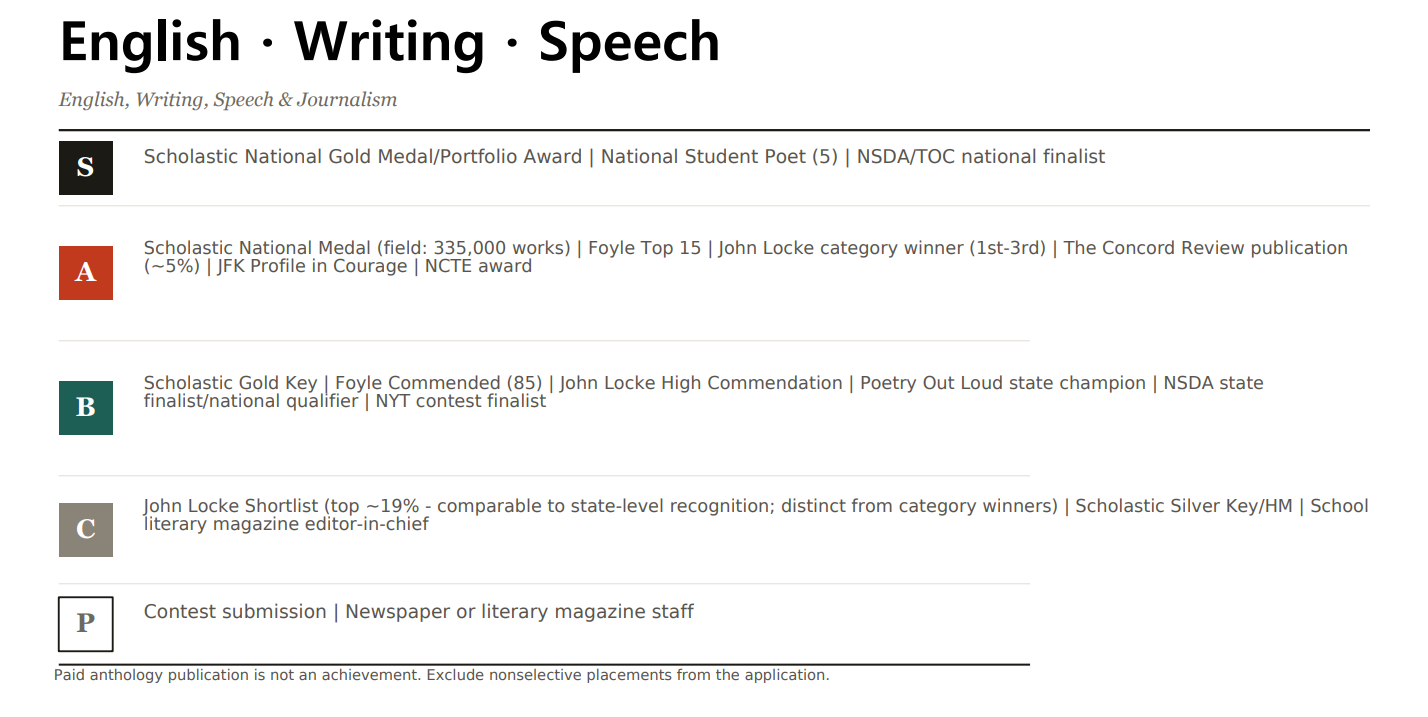
Reaching the national final in NSDA or TOC — both debate circuits — is close to a Team-USA-level result. Coming down a level: a Gold Key in the Scholastic Art & Writing Awards, or a Commended distinction in the Foyle Young Poets of the Year Award. A High Commendation in the John Locke Institute's essay competition, further debate results, and New York Times student contests are all meaningful as well.
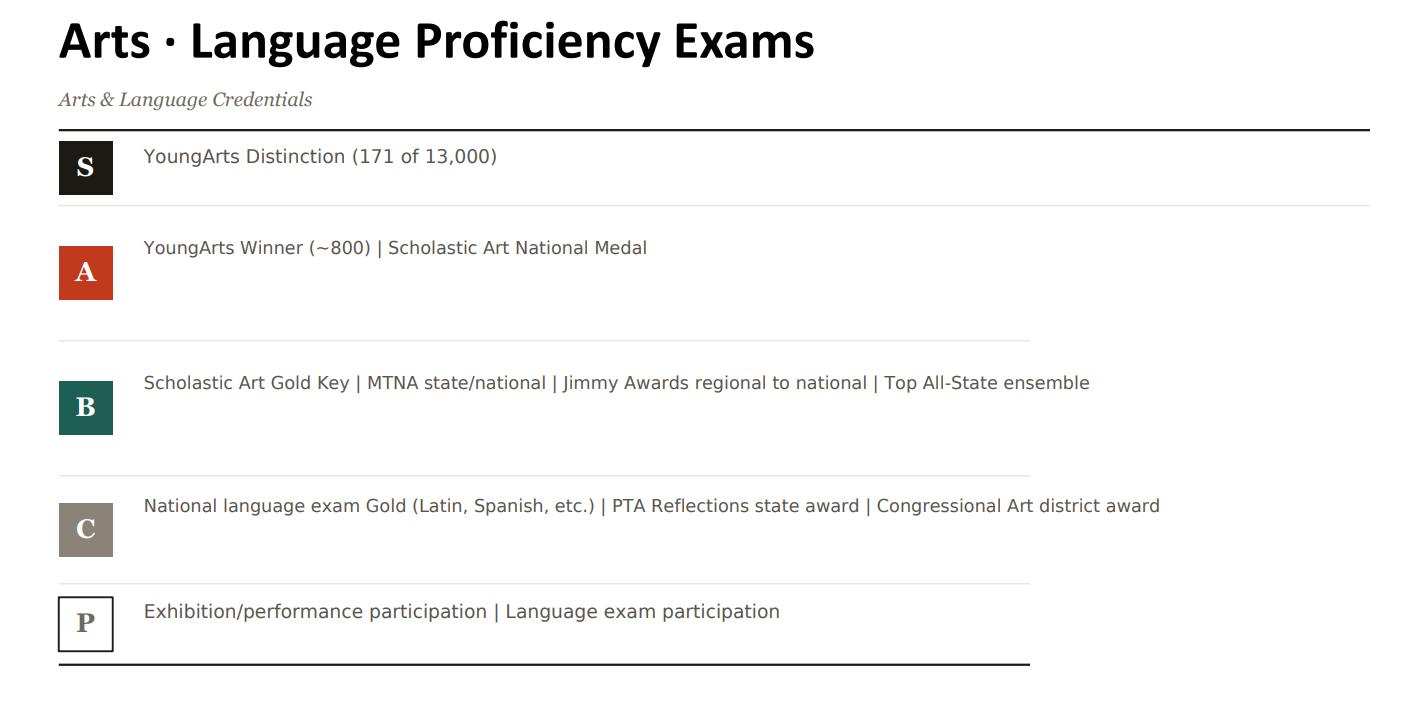
There are other categories worth exploring too — art among them — that go beyond what this post covers.
GPA, SAT, and ACT scores are the baseline that every applicant is expected to bring. On top of that foundation, aim for a low-A or B-tier result in at least one area if possible; even a C-tier result still falls within the range colleges recognize to some degree. As this admissions trend continues, the mindset worth adopting is building a body of objective, verifiable evidence of academic ability alongside GPA — not instead of it.
If your student is deep in application season right now and finding the Activities section or resume-building difficult, we're glad to help directly. A ONE Institute also runs competition-preparation classes across Science, Math, Social Studies, and English, along with research programs, olympiad prep, and writing competition courses — all available online regardless of where you're located.
College Admissions Trends
Academic Competitions
Standardized Testing
Extracurricular Strategy
