
An Application Is a Low-Resolution Document
Hello, this is A ONE INSTITUTE.
Colleges do not all read applications in exactly the same order. However, the examples examined in this seminar show that a student’s transcript, GPA, school context, and standardized testing are usually reviewed early. Together, these components form the first admissions threshold.
Research from Caltech reports that the human sensory system receives information at a rate of approximately one billion bits per second, while conscious thought operates at only about 10 bits per second. That is a difference of 100 million times.

Even when we try to express the enormous amount of information in our minds through writing or video, the medium captures only a small portion of what we know and experience.

What does this have to do with college applications?
Students spend years building academic records, developing interests, and participating in activities. Yet all of those experiences must eventually be represented through a limited number of application fields, essays, activity descriptions, and recommendation letters.
Writing is a low-resolution medium. An effective application therefore needs meaningful compression: a concise signal that communicates far more than its word count alone.
The seminar illustrates this idea with an anecdote about Siemens and the negotiations surrounding the Shanghai maglev train project. Instead of providing a lengthy explanation, the Siemens chairman reportedly turned his pockets inside out to communicate that there was nothing more to offer.
The message was compressed into one memorable gesture.
A college application must accomplish something similar. Within a limited format, it must communicate enough substance, direction, and evidence to make the reader slow down and pay closer attention.
Admissions Readers Evaluate Applications Through Three Gates
At A ONE INSTITUTE, we organize the application review process into three gates.
First Gate: Threshold
The first gate evaluates the student’s academic foundation through:
- GPA and course performance
- AP, IB, or other advanced coursework
- SAT or ACT results when considered
- School Report and academic context
- Evidence of the student’s foundational academic ability
Second Gate: Caliber and Fit
The second gate evaluates:
- The level of the student’s extracurricular achievements
- How those activities fit the colleges being considered
- Whether the student’s academic interests and activities converge into a coherent direction
Third Gate: Facts and Compression
The third gate focuses on:
- Activity Descriptions and the résumé
- Letters of Recommendation
- Whether concise descriptions are supported by credible factual evidence
- Whether the application components reinforce one another and create coherence
This article focuses on the first gate: the Threshold.
Application Volume Limits How Readers Allocate Attention
Many families assume that an admissions officer begins every application with complete concentration and reads every component at the same depth. The volume of applications makes that difficult.
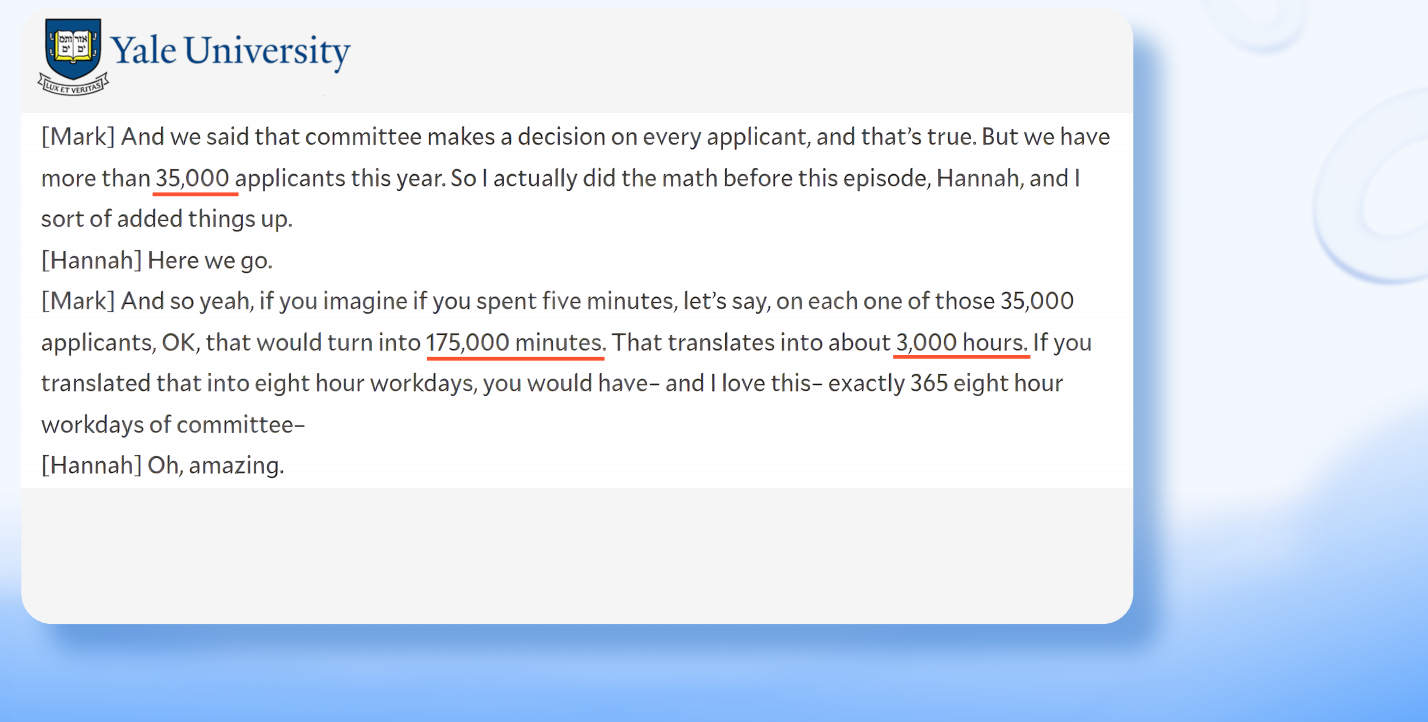
In a Yale admissions discussion, an officer used a simple calculation to illustrate the scale of the review process. If a committee spent only five minutes on each of 35,000 applicants, that would equal 175,000 minutes, or approximately 3,000 hours. It would amount to 365 eight-hour workdays of committee time.
The seminar also notes that Yale’s application volume later increased from approximately 35,000 to more than 50,000 without a proportional increase in Reader staffing and resources.
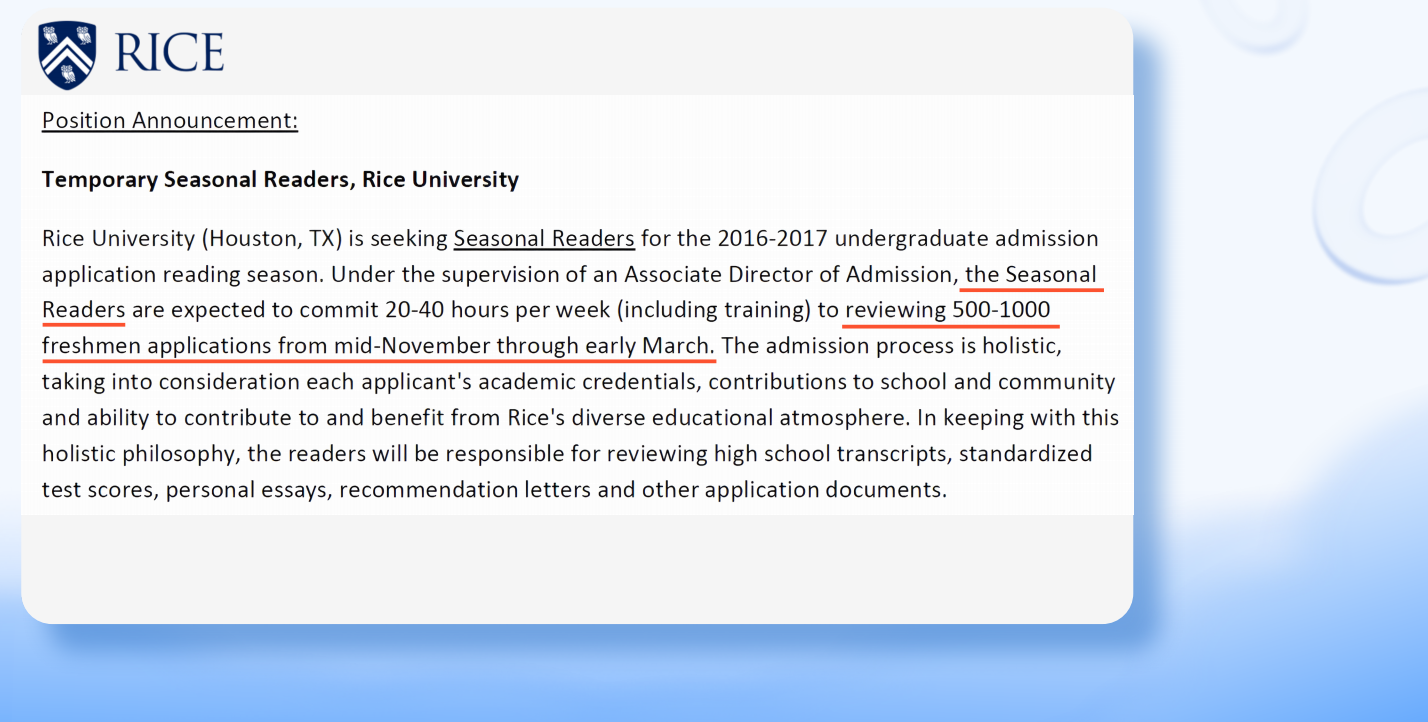
A Rice University Seasonal Reader announcement for the 2016–2017 application cycle expected each Reader to work 20 to 40 hours per week while reviewing approximately 500 to 1,000 first-year applications between mid-November and early March.
At UC Irvine, the source presented in the seminar reported that 180 part-time Readers and 50 full-time admissions staff members shared responsibility for approximately 142,000 applications. Because each application was expected to be read at least twice, this represented approximately 284,000 application reads.
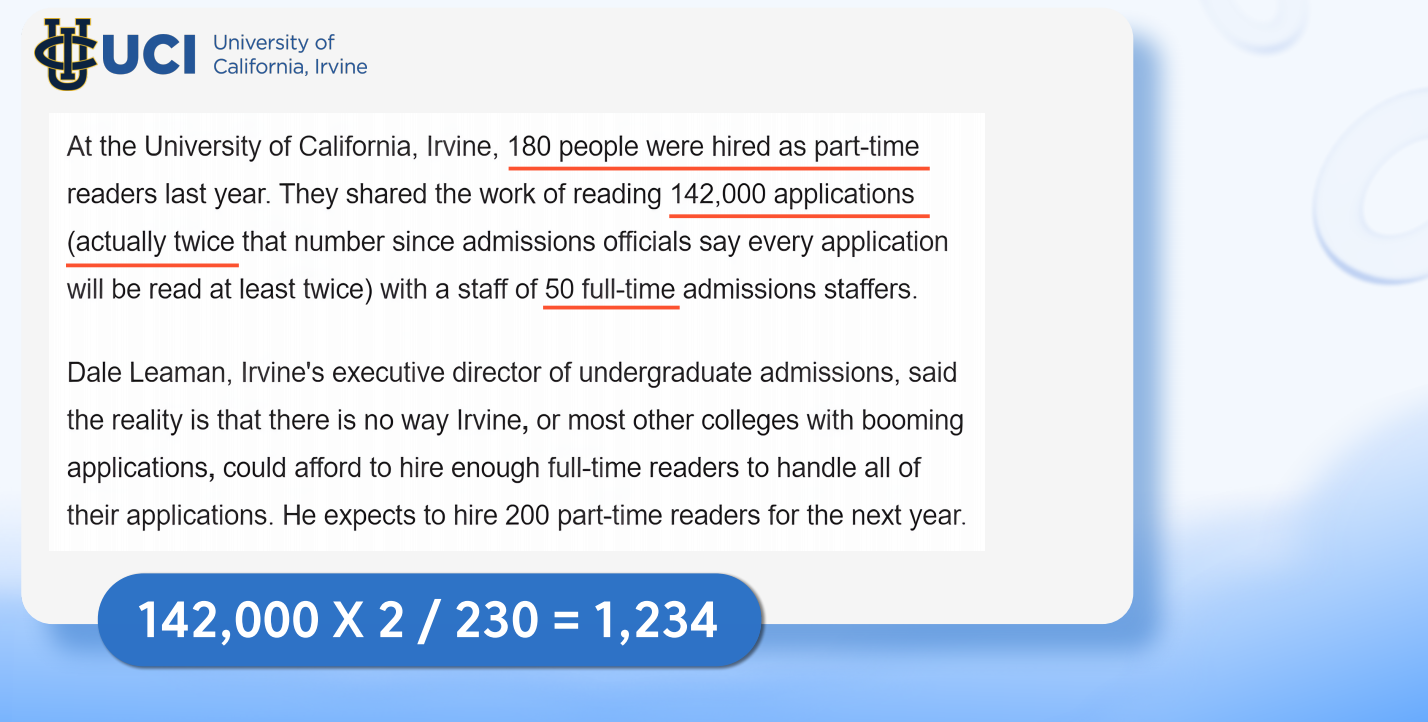
Dividing those reads among 230 Readers results in an average of approximately 1,234 application reads per Reader.
These examples do not mean that colleges ignore portions of an application. They demonstrate why Readers must identify important signals quickly and why the early academic review carries substantial weight.
When an application presents evidence that clears the first Threshold, the Reader has a reason to continue through the remaining components with greater interest and context.
The Order in Which Colleges Read Applications
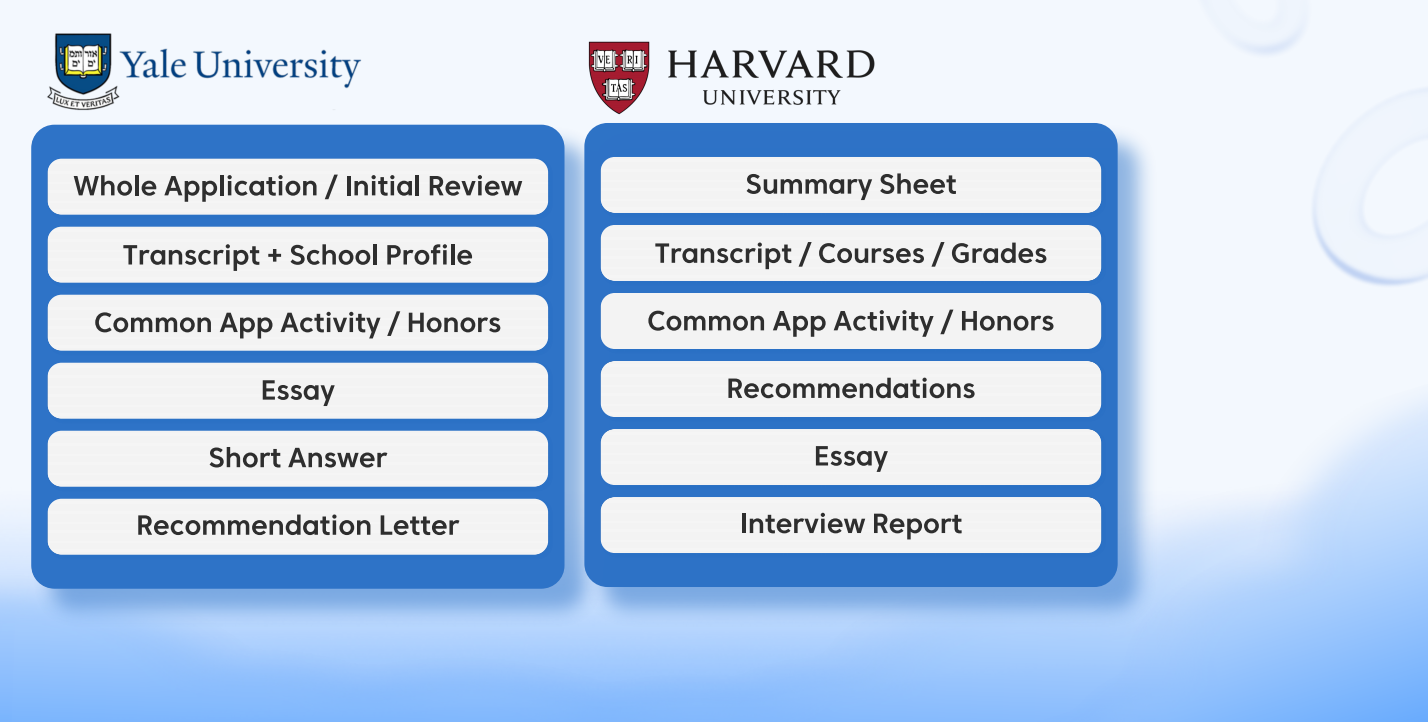
Yale
- Whole Application or Initial Review
- Transcript and School Profile
- Common App Activities and Honors
- Essay
- Short Answers
- Recommendation Letters
Harvard
- Summary Sheet
- Transcript, Courses, and Grades
- Common App Activities and Honors
- Recommendations
- Essay
- Interview Report
Vanderbilt
- Summary Sheet
- Transcript, Courses, and Grades
- School Report and Context
- Recommendation Letters
- Essay
- Common App Activities
- Short Answers or Supplements
Dartmouth
- Summary or First-Read Summary
- Transcript, Courses, and Grades
- School Context
- Essay
- Recommendations
- Common App Activities
- Interview Report
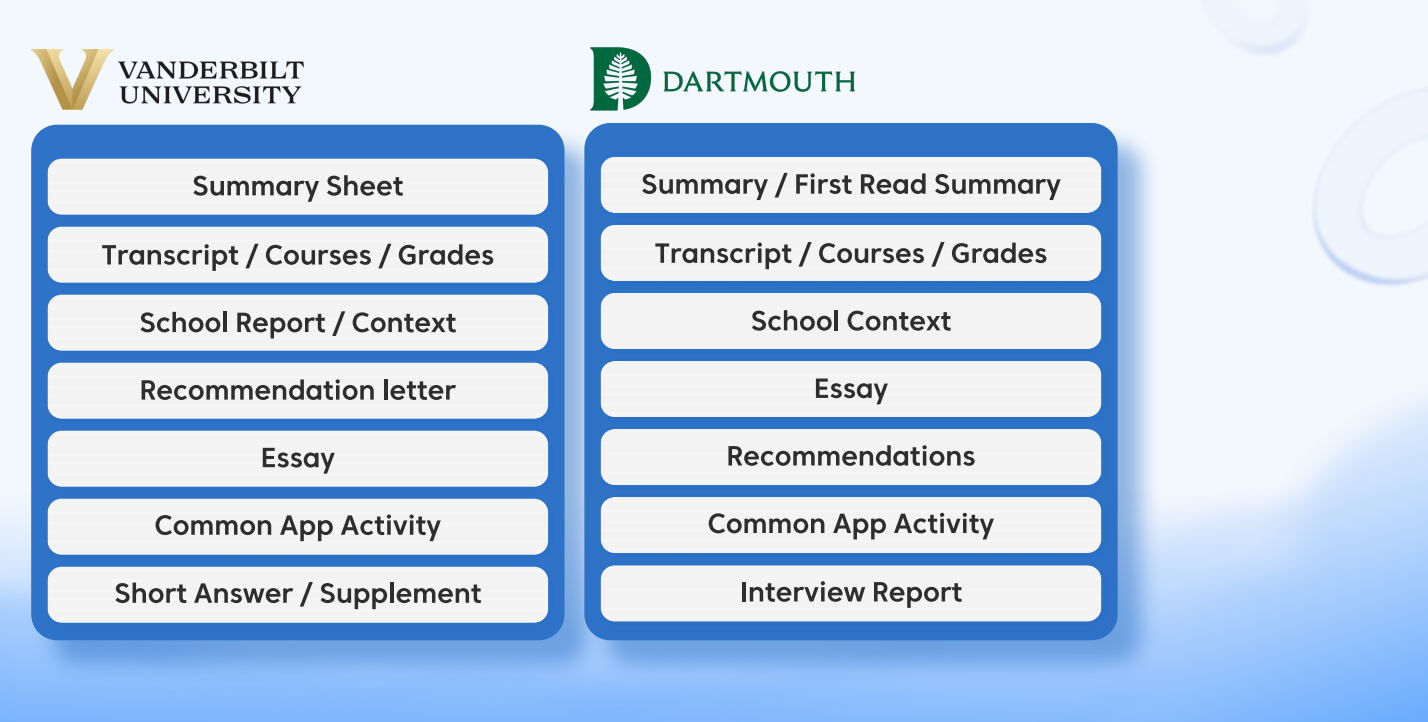
The exact order differs, but the student’s academic record and school context appear near the beginning of each process.
Two Broad Reading Patterns
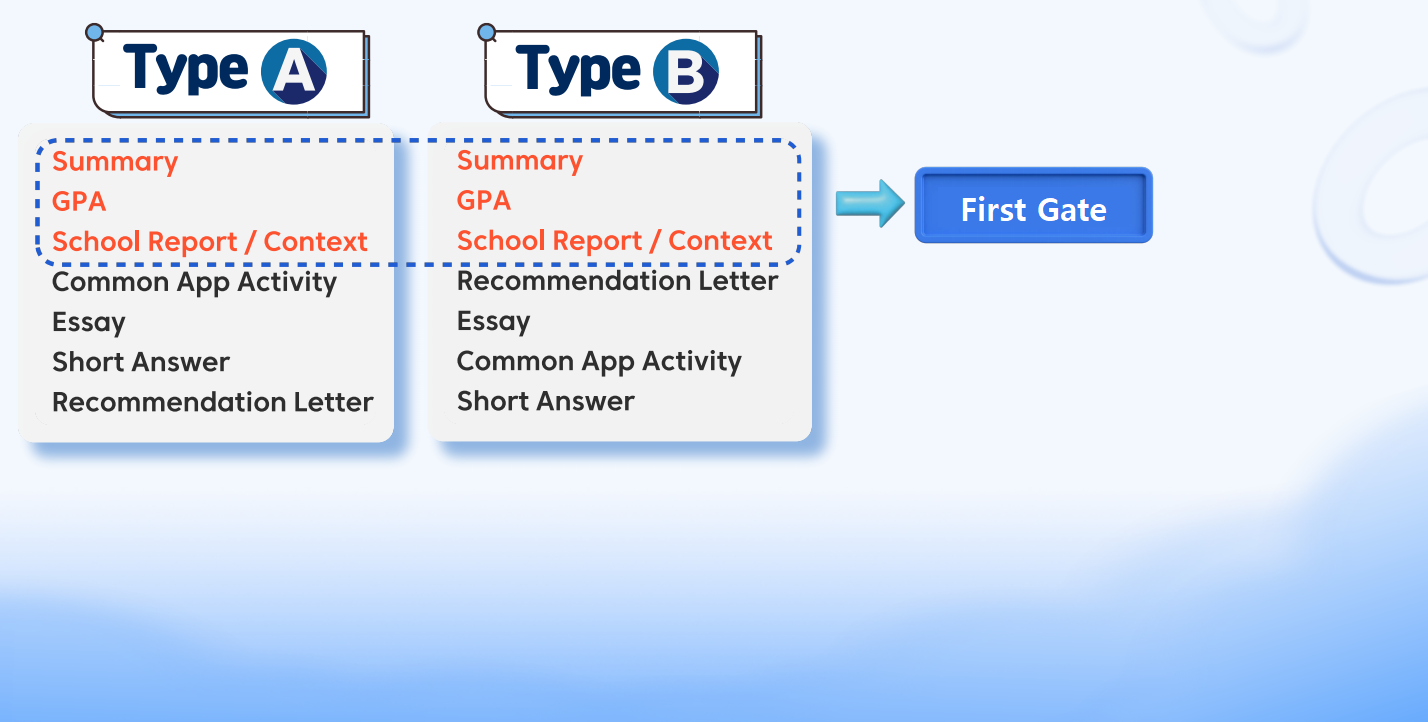
Type A
- Summary
- GPA
- School Report and Context
- Common App Activities
- Essay
- Short Answers
- Recommendation Letters
Type B
- Summary
- GPA
- School Report and Context
- Recommendation Letters
- Essay
- Common App Activities
- Short Answers
The placement of Activities, Essays, and Recommendation Letters may change. What remains consistent is that GPA and School Report information appear early.
This is why the academic Threshold functions as the first gate.
The First Gate Is Not Based on GPA Alone
At the first gate, the Reader does not interpret GPA as an isolated number. The academic record must first be placed within the context of the student’s high school.
1. Grading Scale
The Reader identifies how the high school calculates and reports grades.
A 4.0 may represent an unweighted GPA, while a higher number may include additional weight for Honors, AP, IB, or other advanced courses. The Reader must understand the school’s scale before interpreting the student’s number.
2. GPA Distribution
The Reader may examine how the student’s GPA compares with the distribution of grades at the school.
For example, a 3.9 GPA carries one meaning if a large percentage of students at the school earn a 3.9 or higher. It may carry a different meaning if only a small percentage reach that level.
The number has meaning only when the Reader understands how grades are distributed.
3. Class Rank Availability
The School Report may indicate whether the high school provides an official Class Rank.
If rank is available, it gives the Reader an additional way to understand the student’s academic position within the graduating class.
4. Class Rank Calculation
The Reader must also understand how the school calculates Class Rank.
Schools may use weighted or unweighted grades, include or exclude particular courses, or apply different rules to advanced coursework. Two students with similar numerical ranks may therefore have been evaluated under different systems.
Three Additional Inputs Complete the Threshold Evaluation
1. Alumni Outcome Benchmarking
Historical school data can show how previous students from the same high school performed in admissions to a particular college.
A Scattergram may compare:
- Previous applicants’ GPAs
- SAT or ACT results
- Acceptance, rejection, and waitlist outcomes
- The current student’s position relative to those outcomes
Platforms such as Naviance, Scoir, MaiaLearning, Cialfo, Xello, and College Kickstart may be used to organize this historical information.
When available, this data helps place the current student within the application history of the same high school.
2. Counselor Rigor Rating
The School Report may ask the counselor to evaluate the difficulty of the student’s course selection.
This evaluation helps answer an important question:
Did the student choose a sufficiently challenging academic program based on the courses the school actually offered?
The Counselor Rigor Rating adds context that cannot be understood from GPA alone. It shows whether the student selected an appropriately demanding course load relative to available opportunities.
3. Standardized Testing
Standardized test results provide an external academic reference point when a college requires or considers them.
School grading systems differ, but the SAT and ACT provide a more consistent form of comparison across schools. For this reason, the seminar treats standardized testing as one of the three important inputs in the first Threshold evaluation.
The exact role of testing still depends on each college’s current testing policy.
Why Clearing the First Threshold Matters
After reviewing the transcript, School Report, historical school data, Counselor Rigor Rating, and standardized testing, the Reader forms an initial judgment about the student’s academic preparation.
This judgment does not make the final admission decision by itself. Activities, Essays, Recommendation Letters, and the overall coherence of the application still matter.
However, the first Threshold establishes the academic foundation for everything that follows.
If the academic record does not provide sufficient evidence of preparation, the later components must work within that initial concern. If the student clearly passes the Threshold, the Activities, Essays, and Recommendations can be interpreted from a stronger starting position.
The third gate may still provide a final opportunity to strengthen or reshape the Reader’s understanding, but it cannot be evaluated independently from the first two gates.
Why General Admissions Advice Is Not Enough
Families often hear recommendations such as:
- “A student should have at least a 3.85 GPA.”
- “Applicants to Top 20 or Top 30 colleges need an SAT score of 1530 or higher.”
- “Students should begin major-related activities in ninth grade.”
- “The Essay should reveal the student’s character rather than focus only on academics.”
These recommendations are not necessarily wrong. However, they are not enough to determine whether a particular student is positioned to clear the first Threshold at a particular college.
A 3.9 GPA must be interpreted through the school’s grading scale, GPA distribution, Class Rank policy, Counselor Rigor Rating, and historical outcomes. A test score must also be considered together with the student’s academic context rather than treated as an isolated number.
Accurate college selection therefore requires a clear evaluation of all three gates:
- Threshold: GPA, course rigor, standardized testing, and academic foundation
- Caliber and Fit: Extracurricular level, college fit, and convergence
- Facts and Compression: Activity Descriptions, résumé content, Recommendations, and factual coherence
Evaluating the student’s position at each gate provides a stronger foundation for determining an appropriate college tier, building a realistic college list, and developing an admissions strategy.
If you would like help evaluating your student’s admissions position and presenting their experiences clearly and coherently, contact A ONE INSTITUTE for personalized guidance.
Thank you.
College Application Review Process
College Admissions
School Profile
Holistic Admissions
