
If you're filling out the Common App this fall, you've probably run into the same question we hear constantly from families in August: what order should your 10 Activities go in? The answer isn't about ranking your achievements from biggest to smallest — it's about giving the admissions officer a clear, connected story of who you are as an applicant.
To show what we mean, let's walk through a real approach using a case (based on an actual student we worked with, lightly adjusted for privacy). This student had an unweighted GPA of 3.9, a weighted GPA of 4.4, and an SAT score of 1490. They attend a public high school, are applying as a senior this fall, and want to study Statistics or Data Science.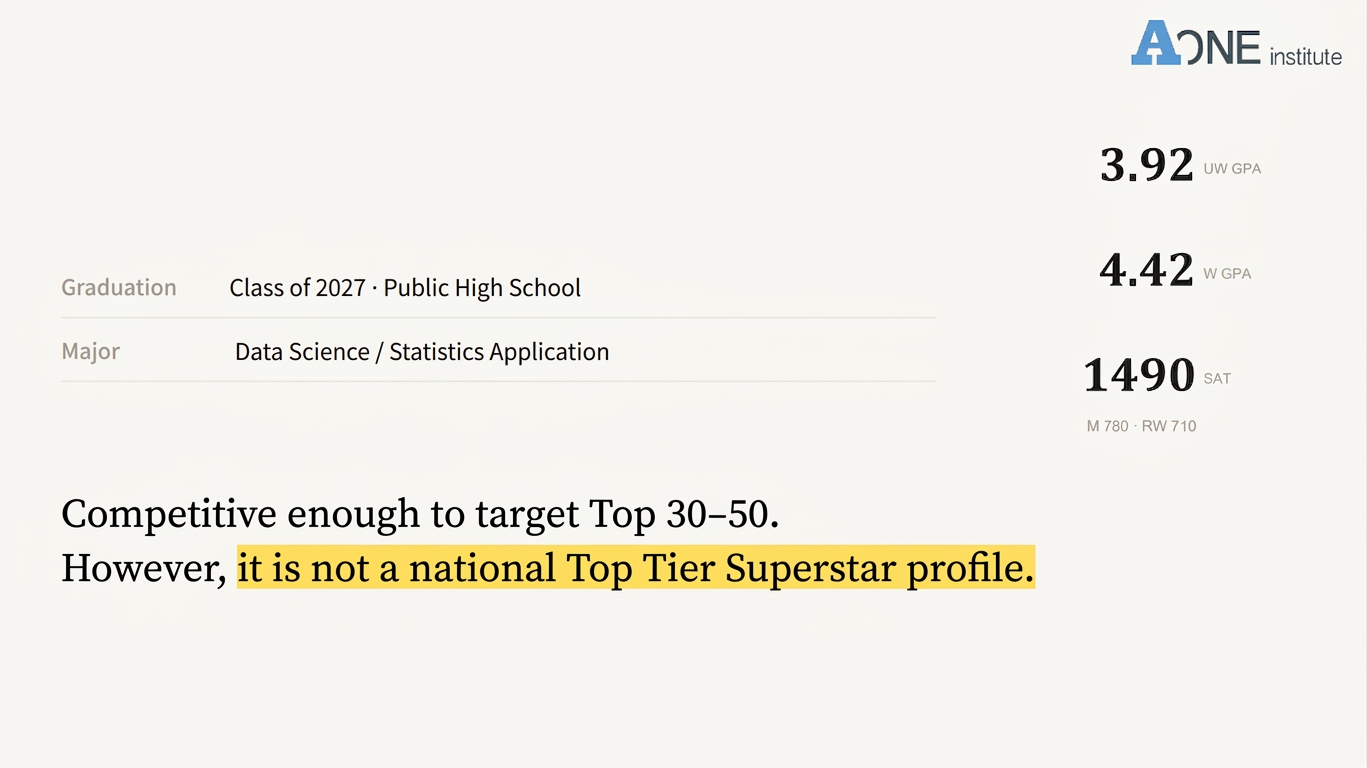
Academically, this places the student in a competitive range for schools roughly ranked 30 to 50 — not because the numbers are weak, but because GPAs at both public and private schools have climbed so high in recent years that a 3.9/4.4 no longer stands out on its own. Where this student's ranking can move is entirely dependent on how the Activities are presented.
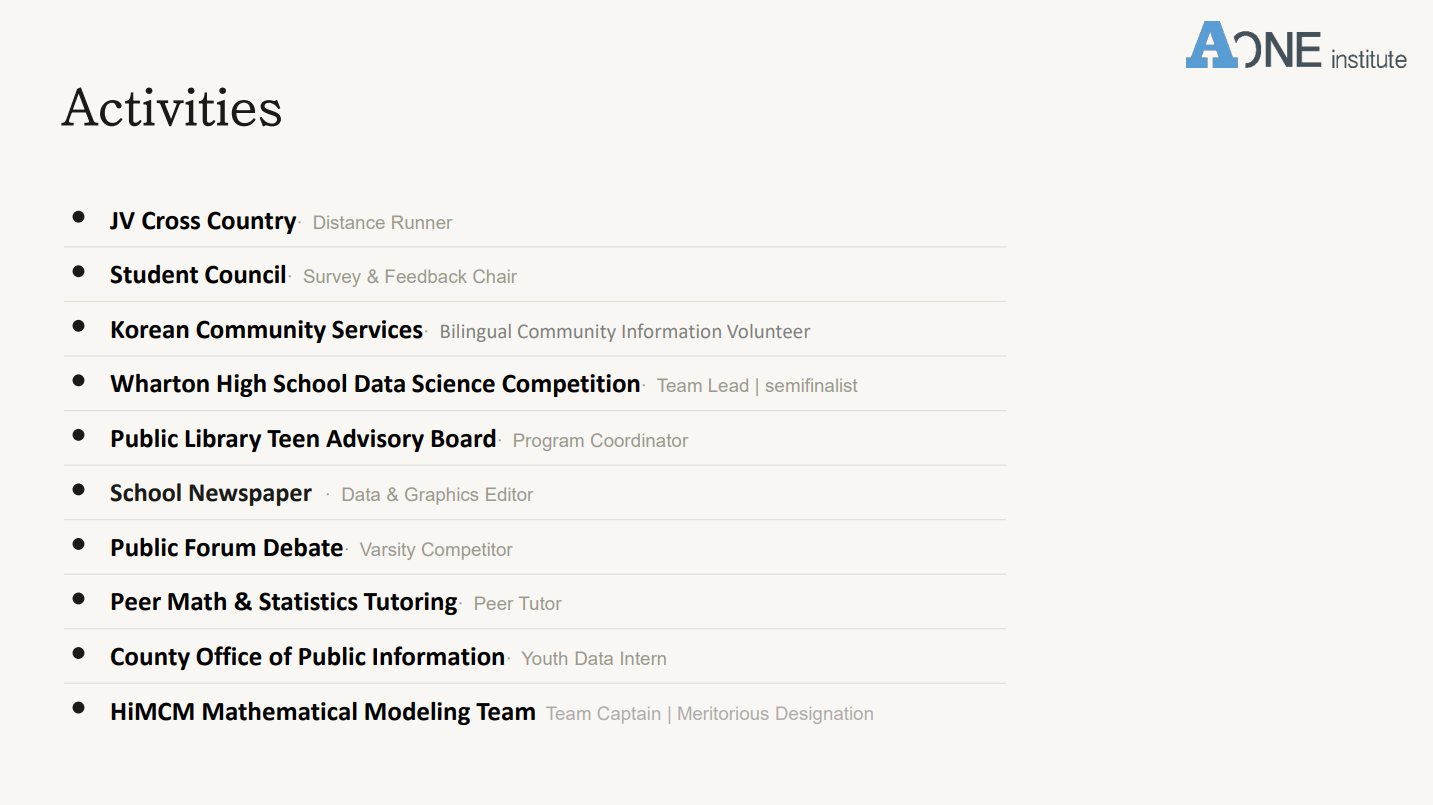
This particular student wasn't a standout in music or athletics. Here are the 10 activities, in no particular order yet:
- JV Cross Country — Distance Runner
- Student Council — Survey & Feedback Chair
- Korean Community Services — Bilingual Community Information Volunteer (translating information for elderly community members)
- Wharton High School Data Science Competition — Team Lead, Semifinalist (competed with the school's Math Club team against more than 700 teams from 48 countries)
- Public Library Teen Advisory Board — Program Coordinator
- School Newspaper — Data & Graphics Editor
- Public Forum Debate — Varsity Competitor (no specific award)
- Peer Math & Statistics Tutoring — Peer Tutor
- County Office of Public Information — Youth Data Intern (summer internship)
- HiMCM Mathematical Modeling Team — Team Captain, Meritorious Designation
Before we show you our recommended order, it's worth pausing and thinking through how you would sequence these 10 yourself. Once you have an order in mind, compare it to the two versions below.
Version 1: The Order Most Students Use
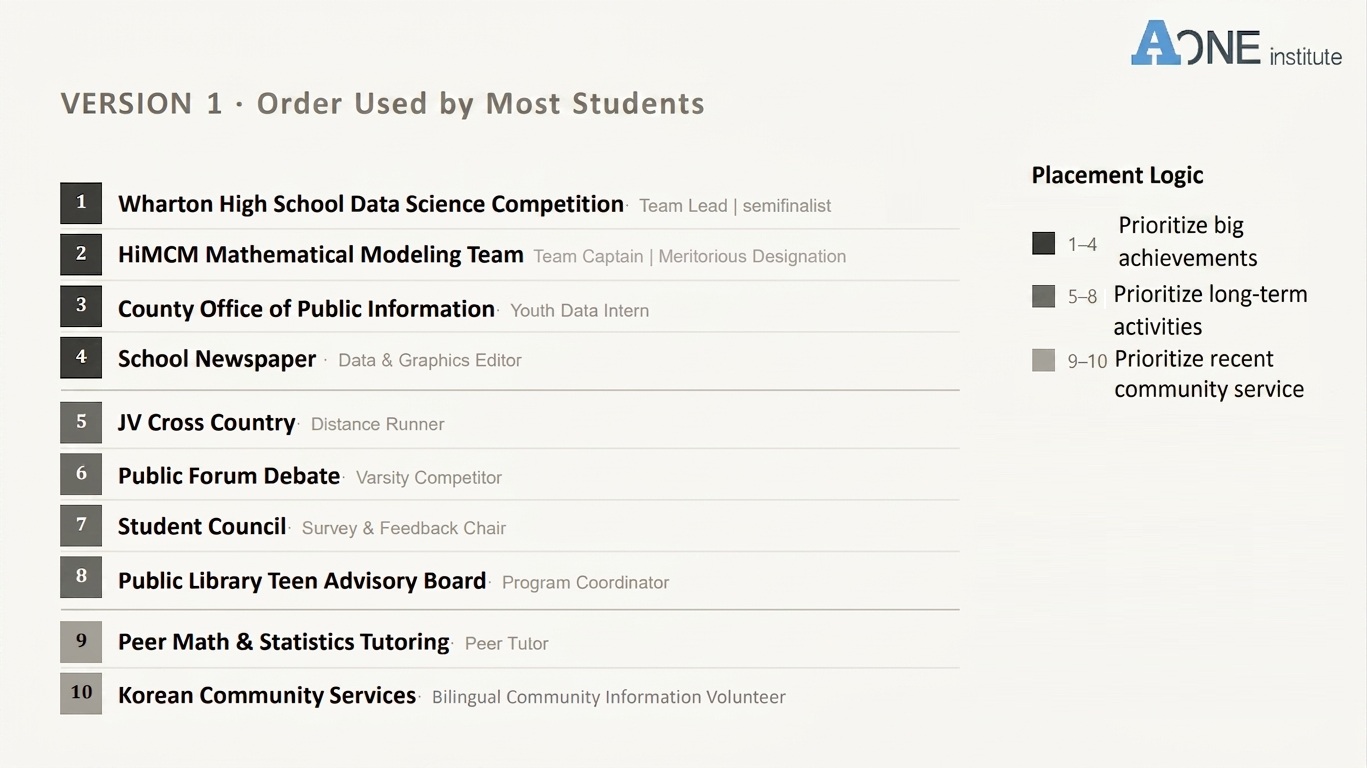
The most common approach ranks activities by impact, by the prestige of the organization, or by how long the student has been involved — the logic being that the most meaningful activities are the ones with the biggest external results or the longest track record. Applied to this student, that produces an order like this:
1–4 (Strongest, most objective achievements):
- Wharton High School Data Science Competition
- HiMCM Mathematical Modeling Team
- County Office of Public Information
- School Newspaper
5–8 (Long-term commitments): 5. JV Cross Country 6. Public Forum Debate 7. Student Council 8. Public Library Teen Advisory Board
9–10 (Recently started or no formal recognition): 9. Peer Math & Statistics Tutoring 10. Korean Community Services
This isn't a bad order at all. It's actually quite persuasive: the objectively provable achievements come first, three-to-four years of consistency comes next, and activities without an award or with a shorter track record close out the list.
Why Version 1 Isn't Wrong, But Isn't Enough
Read purely through Version 1, an admissions officer walks away with a clear takeaway from Activities 1 through 4: this student is interested in Data Science, has real skill in it, has the math ability to back that skill up, and has applied it both in an internship and in a role at school. That message comes through strongly in the first four entries.
The problem is what happens after that. Activities 5 through 10 read as a loosely connected set of long-running commitments and lower-priority items — supporting evidence, but not evidence that's driving toward anything in particular. The order shows what the student is good at, but it doesn't carry a throughline all the way to the end. That's the gap we try to close.
Version 2: A ONE Institute's Approach — Define, Prove, Apply, Expand
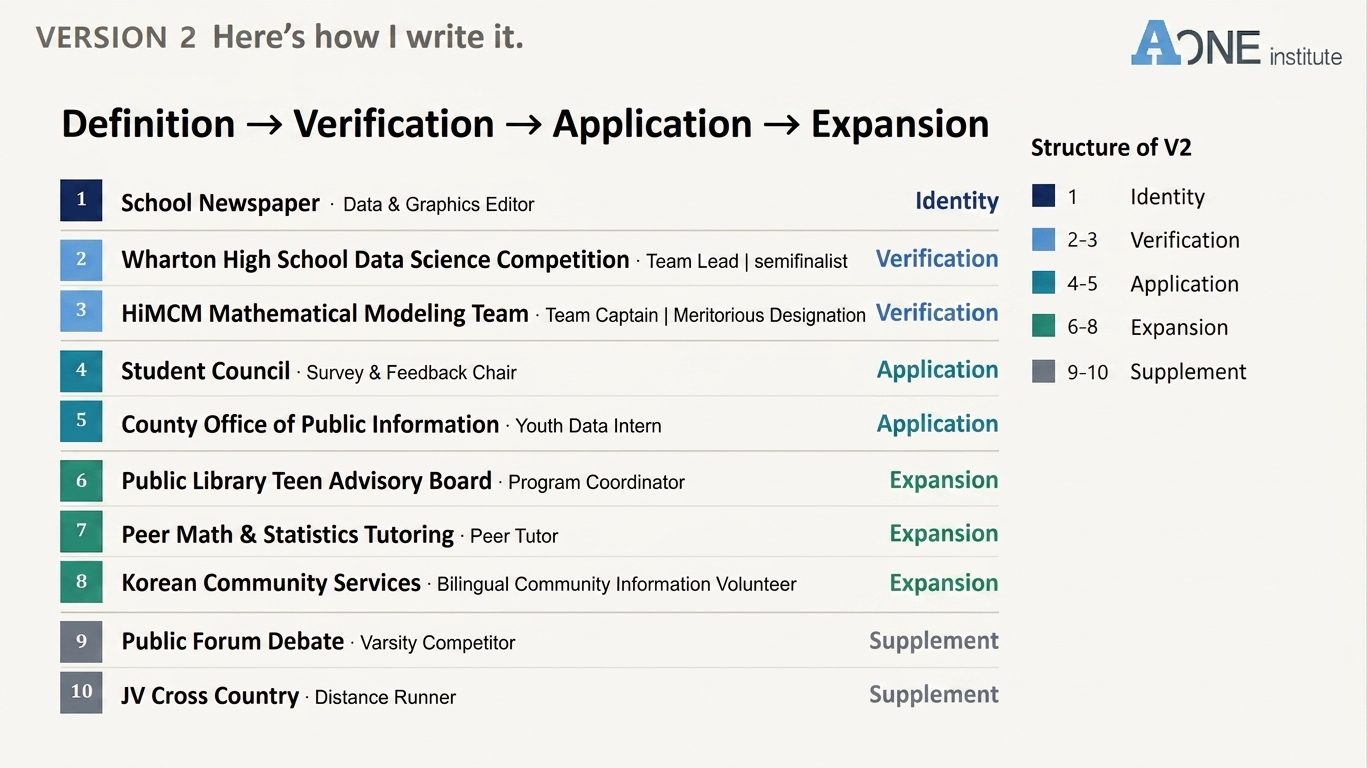
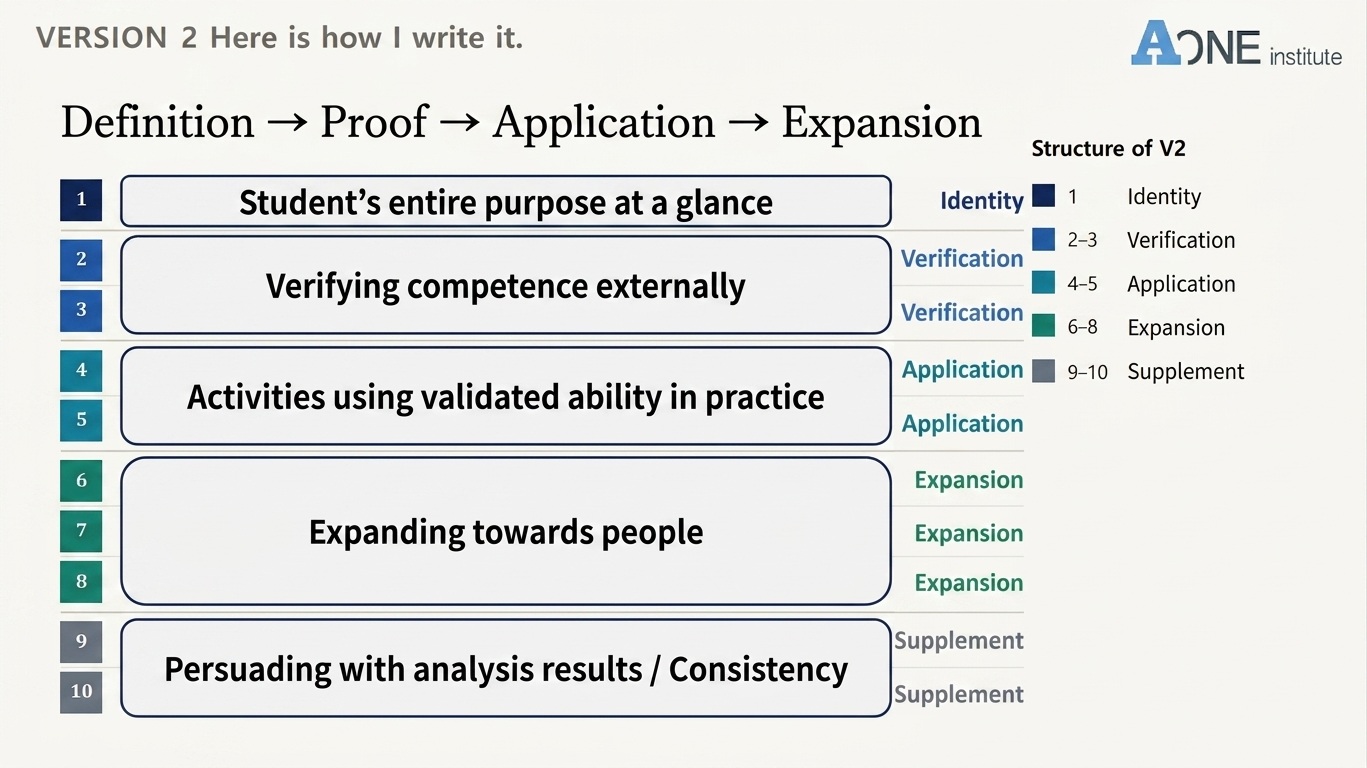
Instead of ranking by achievement size, we build the order around a structure: Define → Prove → Apply → Expand, followed by supporting activities that round out the picture.
1. Identity (School Newspaper — Data & Graphics Editor)
We put School Newspaper first, and we know that looks strange at first glance for a student aiming at Data Science — Newspaper usually signals a Journalism or humanities-track applicant. But look at what the student actually did in that role: pulling data, extracting the relevant pieces, turning it into visual graphics, and then continuing to train underclassmen on how to do the same. That's not a Journalism activity — it's this student's core identity condensed into 150 characters: someone who works with data and teaches others to do the same. Placed first, it tells the reader exactly what to look for in everything that follows.
2–3. Verification (Wharton High School Data Science Competition, HiMCM Mathematical Modeling Team)
Once the reader knows what to look for, these two activities prove it. Semifinalist status in a 700-team international competition and a Meritorious Designation on a math modeling team are external, third-party validation — this isn't a skill the student claims for themselves, it's one that's been independently confirmed.
4–5. Application (Student Council, County Office of Public Information)
With the skill established and verified, the story shows where it gets used: inside the school in a Student Council role, and outside the school in a government internship. The verified skill is now shown doing real work in two different environments.
6–8. Expansion (Public Library Teen Advisory Board, Peer Math & Statistics Tutoring, Korean Community Services)
From there, the story extends outward to people: coordinating programs at a public library, tutoring peers at school, and translating information for elderly community members. The verified, applied skill is now reaching and benefiting other people directly.
9–10. Supplementary (Public Forum Debate, JV Cross Country)
Very few students — close to none — have all 10 activities connect into one perfect thread. The remaining two activities become supporting indicators: Debate shows the ability to argue and persuade with logic and language, and Cross Country shows persistence and grit. They round out the character without needing to fit the data-science throughline directly.
Reading the Activities Like an Admissions Essay
Read in this order, an admissions officer sees the student's character established immediately, watches that character get verified from outside sources, sees the verified skill put into real use, watches that use extend to benefit other people, and finally sees the student's persuasive ability and persistence layered on top. It reads as one continuous narrative rather than a list of 10 separate items — much closer to how a well-constructed essay is read than how a ranked list is read.
Admissions officers read thousands of these lists every cycle, and they're highly trained at reading a student's 10 activities as a single narrative rather than 10 disconnected entries. Ordering activities to answer "who is this student, and what are they trying to do?" — rather than "which of my activities looks the most impressive?" — is what makes that narrative land. Combined with a well-written 150-character description for each entry, this ordering approach is what lets a student's character come through clearly rather than getting lost in a list of achievements.
Ordering 10 Common App activities, writing each 150-character description, and coordinating that with your 5 Honors entries and your resume all need to work together as one coherent story — not as separate, disconnected sections. A ONE Institute helps students build that full narrative from the ground up. If you'd like guidance on your own Activities list, reach out to A ONE Institute for a consultation.
Common App
Activities List
College Application Strategy
Extracurricular Profiling
