
The AP Landscape Is Shifting — Again
AP exams underwent a major structural overhaul in 2024, when College Board introduced digital testing and hybrid formats across dozens of subjects. Starting with the May 2027 exam cycle, another significant round of changes is taking effect — and this time the scope is broad enough that virtually every AP student needs to be aware of what's different.
Before getting into the specifics, one important piece of context: College Board doesn't make these changes unilaterally. Each revision cycle involves rounds of feedback from university faculty, and any structural change to a course or exam reflects a consensus built with input from professors at colleges and universities that accept AP credit. The changes described below have already been discussed with the institutions that will ultimately evaluate these scores.
Here's what's changing.
Two New AP Courses: Business and Cybersecurity
College Board is adding two new subjects to the AP portfolio under a framework it calls Career Kickstart — courses designed to connect AP-level academic content with practical, career-relevant skills. An AP Networking course is also in development but has not yet been finalized.
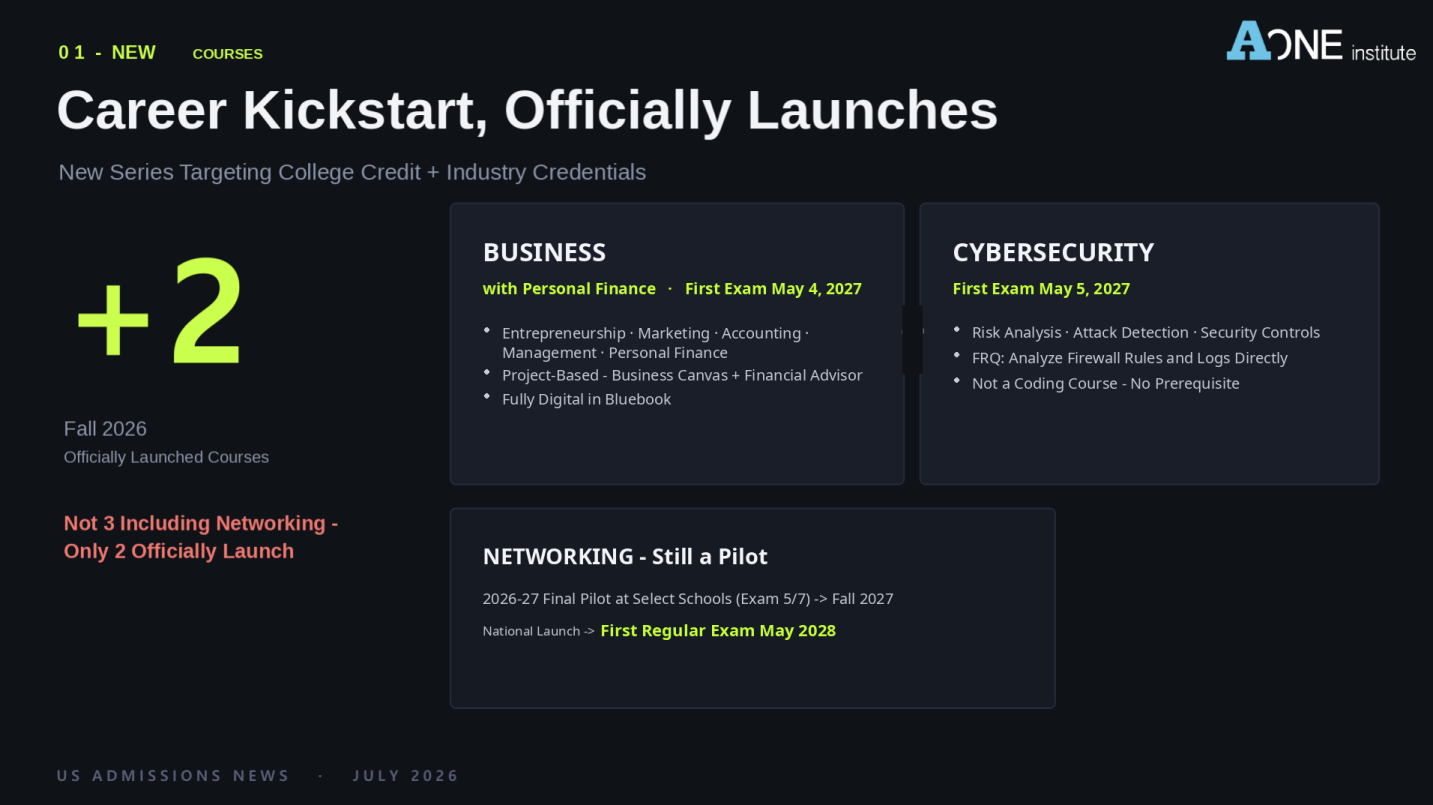
AP Business With Personal Finance
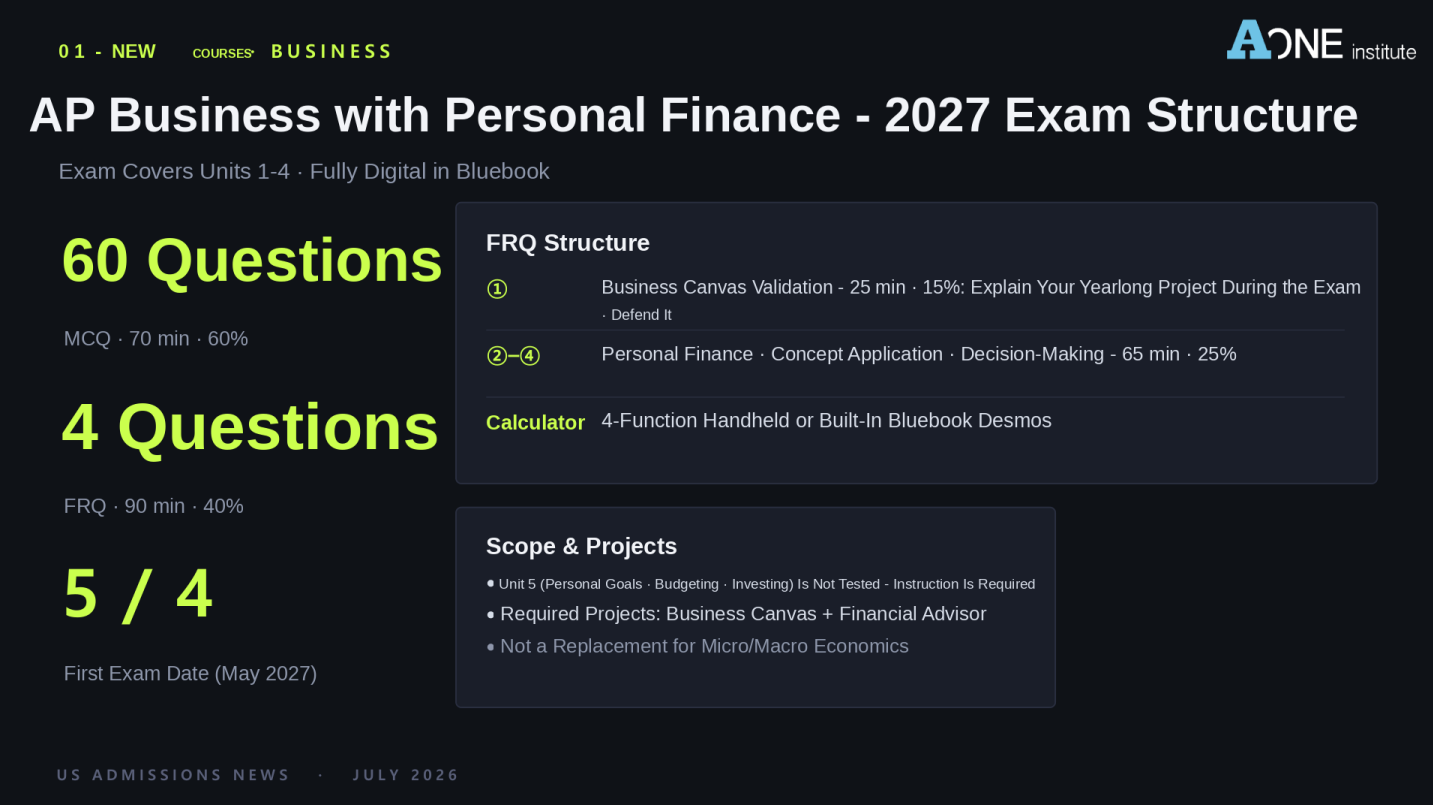
This is not a duplicate of AP Macroeconomics or AP Microeconomics. The course is structured around entrepreneurship, business planning, and personal financial decision-making — and its most distinctive feature is a year-long student project that becomes part of the AP exam itself.
Students select their own business concept at the start of the course and develop it throughout the academic year. The project is not simply a classroom assignment. It is directly connected to the Free Response section of the AP exam. One FRQ, worth 15% of the total exam score, asks students to respond using their own business project as the context. College Board provides a standardized set of questions in advance so that students can prepare their project materials around the same expectations.
The other three FRQs, worth 25% of the total exam score combined, assess the broader course content, including personal finance, business concepts, economic reasoning, and applied analysis. Together, the four FRQs account for 40% of the exam, while the Multiple Choice section accounts for the remaining 60%.
The course therefore combines traditional content knowledge with a longer-term applied project. Students interested in business, entrepreneurship, or finance as possible college majors or career directions may find this structure more directly connected to those interests than the existing AP economics courses.
AP Cybersecurity
The addition of AP Cybersecurity reflects the growing institutional recognition of cybersecurity as a core technical discipline — a response to sustained demand for qualified professionals in a field that is only expanding in scope and complexity.
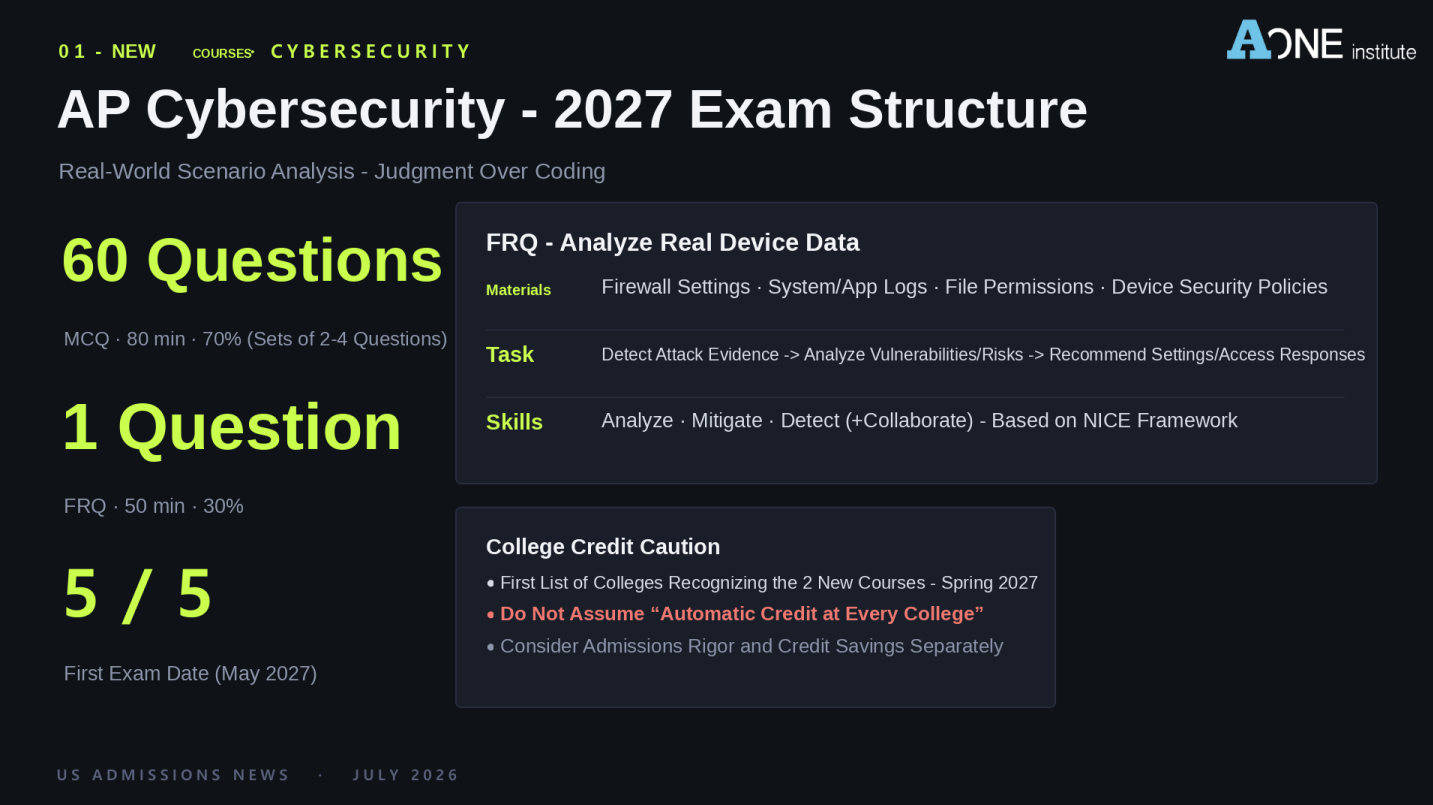
The structure is weighted heavily toward applied analysis. There is only one Free Response question on the exam, but it is 50 minutes long and accounts for 30% of the total score. In that question, students are presented with actual device or system data and asked to: identify vulnerabilities and the severity of potential attacks; explain mitigation strategies including firewall configuration, password strength requirements, and multi-factor authentication; and demonstrate the ability to detect whether an attack is actively occurring within the system data provided.
The first administration is scheduled for May 2027. Students interested in computer science — particularly security, networks, or systems — should consider this course seriously. One caveat: not all universities have yet confirmed whether they will grant credit for this exam. Clarity on college credit policies is expected by spring 2027 as institutions review the new curriculum.
AP Statistics: Streamlined and More Accessible Earlier
AP Statistics is undergoing one of the more significant structural changes on the academic content side.
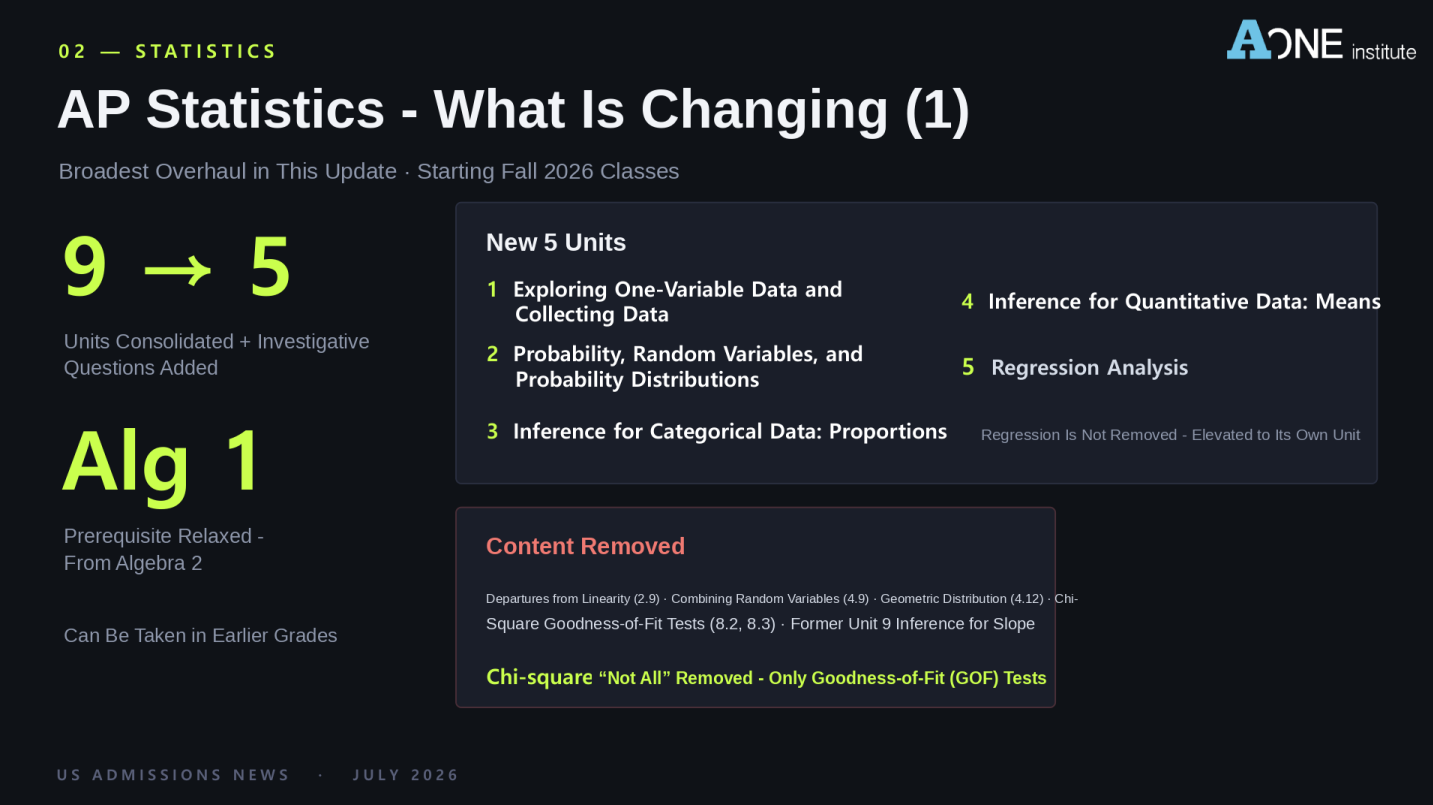
The course is being consolidated from nine units to five, reducing total content scope while maintaining coverage of the core statistical concepts that matter most. Notably, chi-square analysis is not being eliminated — it remains part of the curriculum, restructured within the updated unit framework.
The more consequential change for many students is the prerequisite revision. Previously, AP Statistics required completion of Algebra 2 (Second-Year Algebra). Starting with the 2027 cycle, students who have completed only Algebra 1 (First-Year Algebra) are eligible to take AP Statistics. This is a significant lowering of the entry bar — one that will likely prompt many high schools to offer AP Statistics earlier in the course sequence, potentially as a 10th-grade option rather than 11th or 12th grade.
College Board has made clear that this change reflects the growing importance of statistical reasoning and data literacy across virtually every field of study and professional domain.
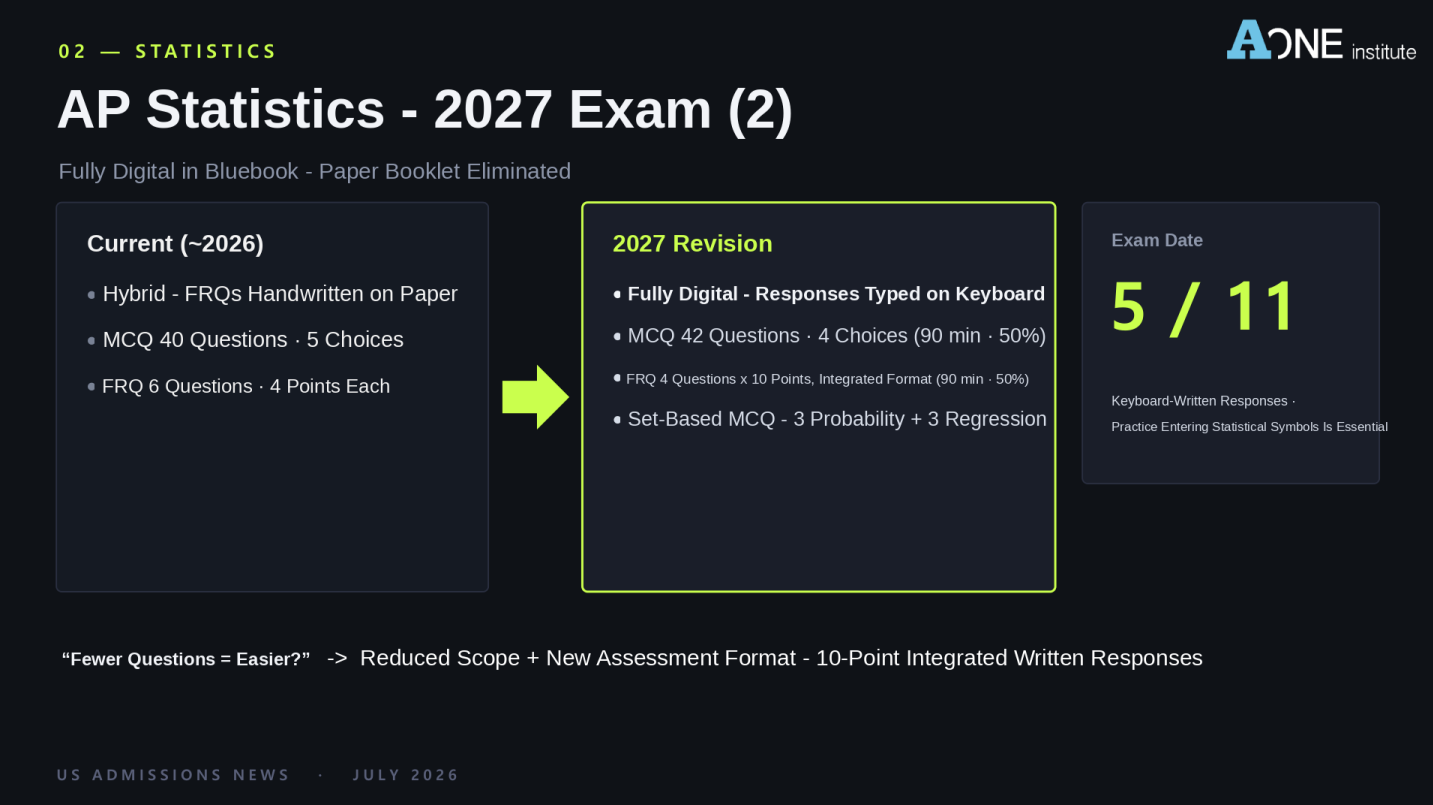
Format changes for AP Statistics (May 2027 and beyond):
- The exam transitions from hybrid (digital MCQ, handwritten FRQ) to fully digital — both sections answered on a keyboard in Bluebook.
- MCQ changes from 40 questions (5-choice) to 42 questions (4-choice).
- FRQ reduces from 6 questions to 4 questions, increasing the weight of each individual response.
- Set-based MCQ questions (multiple questions linked to a single data set) increase in frequency.
The shift to typed statistical notation is worth specific preparation. Students must be able to input statistical symbols and notation using keyboard tools within Bluebook. Practice in this format — not just content mastery — is necessary before exam day. College Board's Bluebook practice environment should be used for this purpose well in advance.
AP Language Courses: The Course Project (PPR) Is Now Part of the Exam
This is the most substantial structural change in the 2027 cycle, and it affects six AP Language courses: Chinese Language and Culture, French Language and Culture, German Language and Culture, Italian Language and Culture, Japanese Language and Culture, and Spanish Language and Culture.
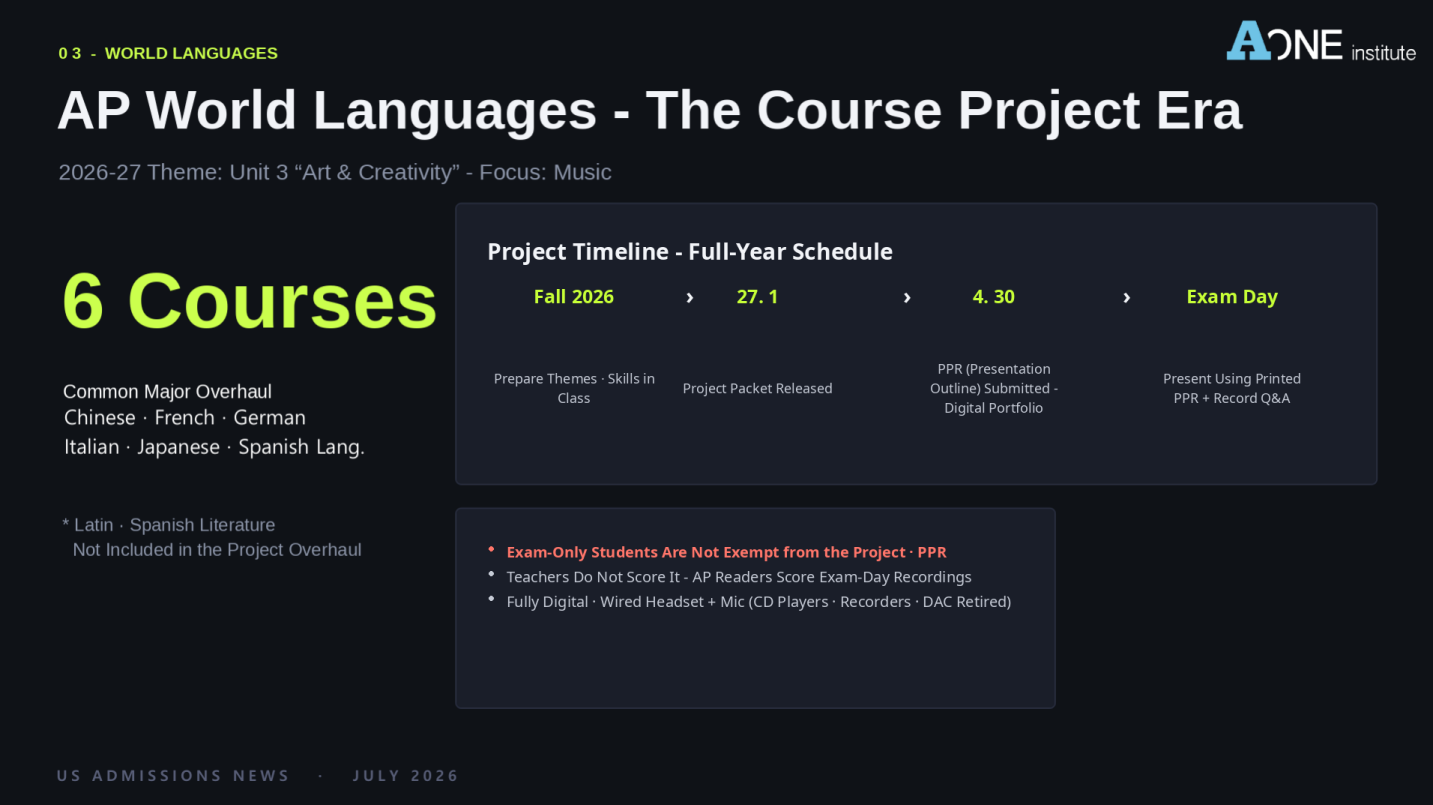
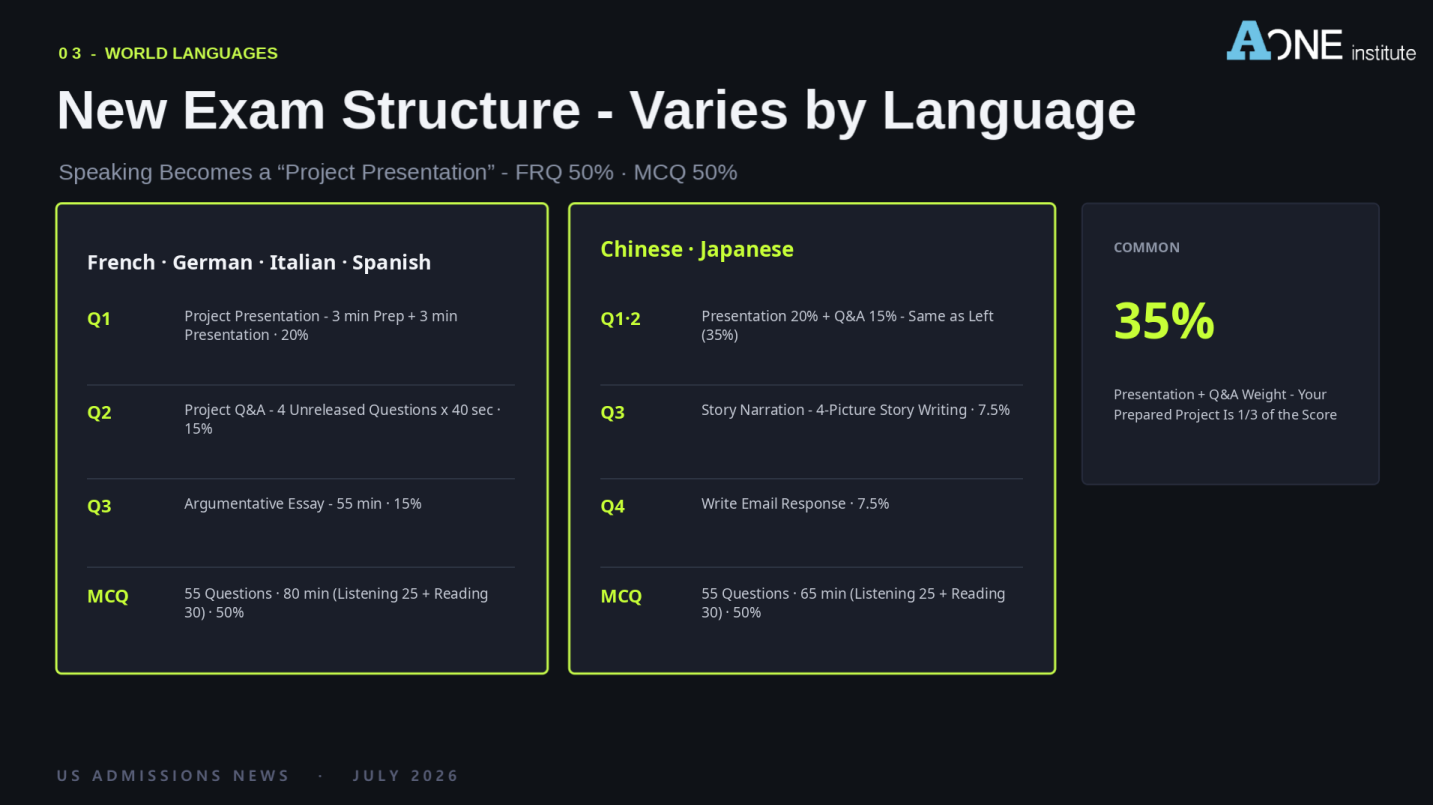
Each of these courses now includes a required Course Project — a research-based project that becomes a scored component of the exam itself.
How the Course Project works:
Each January, College Board releases a Project Packet announcing the broad thematic focus for that exam year. Students have until April 30 to complete their Personalized Project Reference (PPR) — a curated digital portfolio of sources they have researched, all drawn from authentic media produced in the target language community. For French, this might mean current news articles, podcasts, or reports from French-speaking communities relevant to the announced theme. The requirement is that sources must be genuine, in-language, and from communities where the target language is actually spoken.
On exam day, students receive a printed copy of their PPR and deliver a 3-minute spoken presentation in the target language. Following the presentation, students answer a series of spontaneous follow-up questions — one question at a time, 40 seconds to respond per question — which are recorded and sent to College Board for scoring.
The scoring weight of this component is significant: the 3-minute presentation accounts for 20% of the total exam score, and the Q&A section accounts for an additional 15% — meaning the Course Project component alone constitutes 35% of a student's final AP score.
This requirement applies to all students who plan to sit the exam — including those who are self-studying without formal AP class enrollment. There are no exemptions.
Format breakdown by language group:
For French, German, Italian, and Spanish:
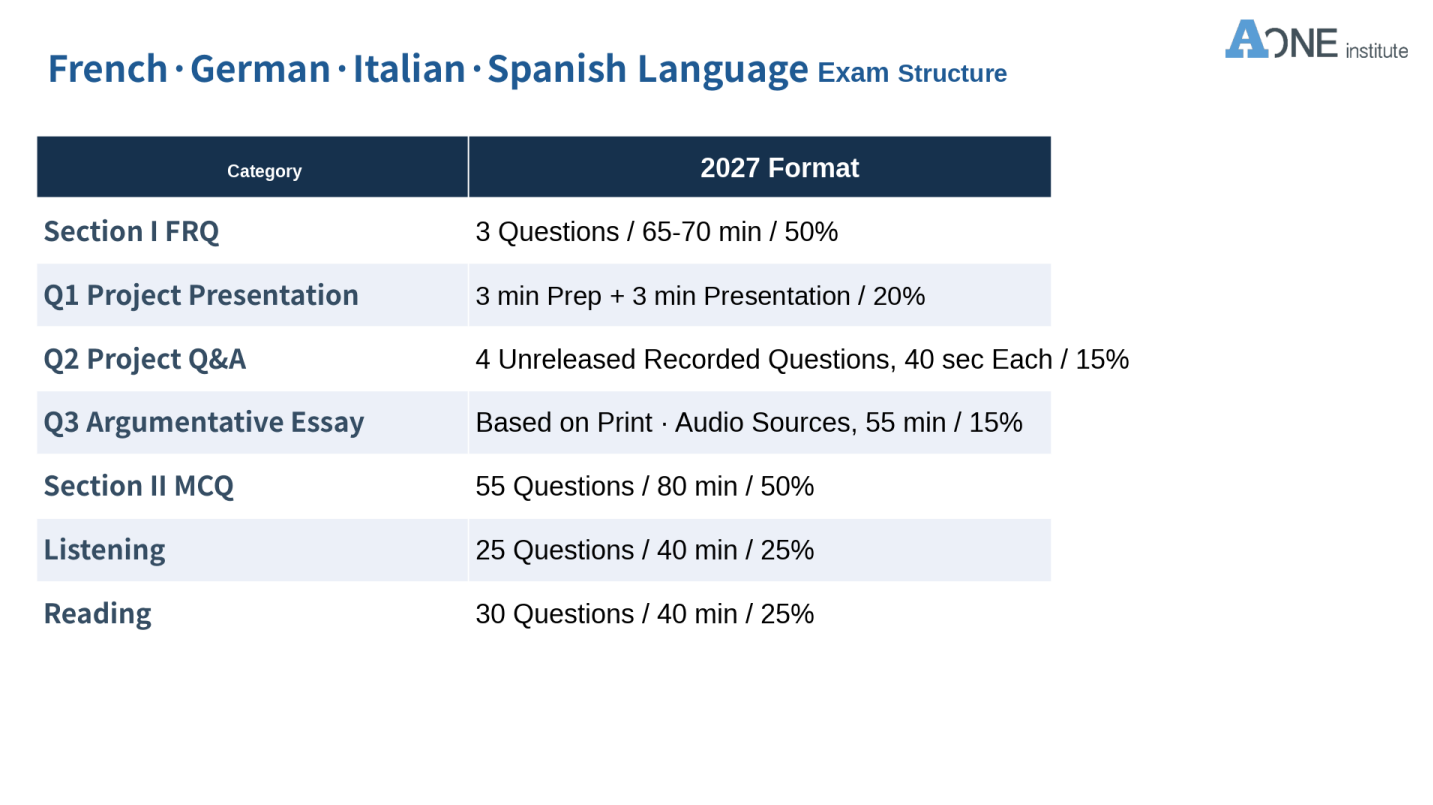
- MCQ: 55 questions, 80 minutes (includes listening)
- FRQ: Three-minute project presentation (20%), spontaneous Q&A responses (15%), and an argumentative essay written in the target language
For Chinese and Japanese:
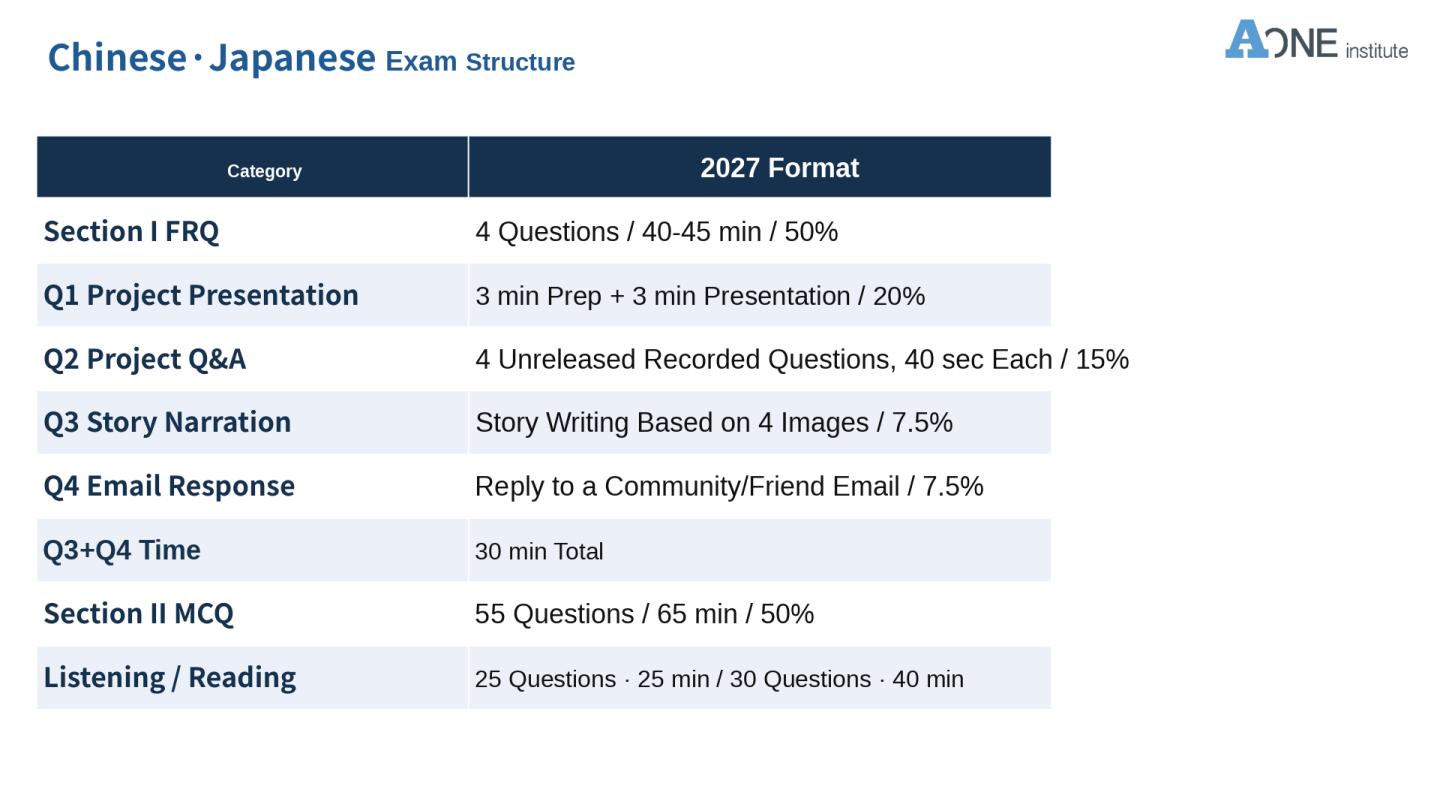
- MCQ: 55 questions, 65 minutes (includes listening)
- FRQ: Project presentation (20%), Q&A (15%), picture-based story narration (4-panel comic strip), and email response
The introduction of the PPR and spoken presentation component represents a meaningful shift toward authentic language use under exam conditions. Students who have relied primarily on written and reading-based preparation will need to invest significantly more time in spoken production and research skills.
AP History: SAQ and LEQ Changes
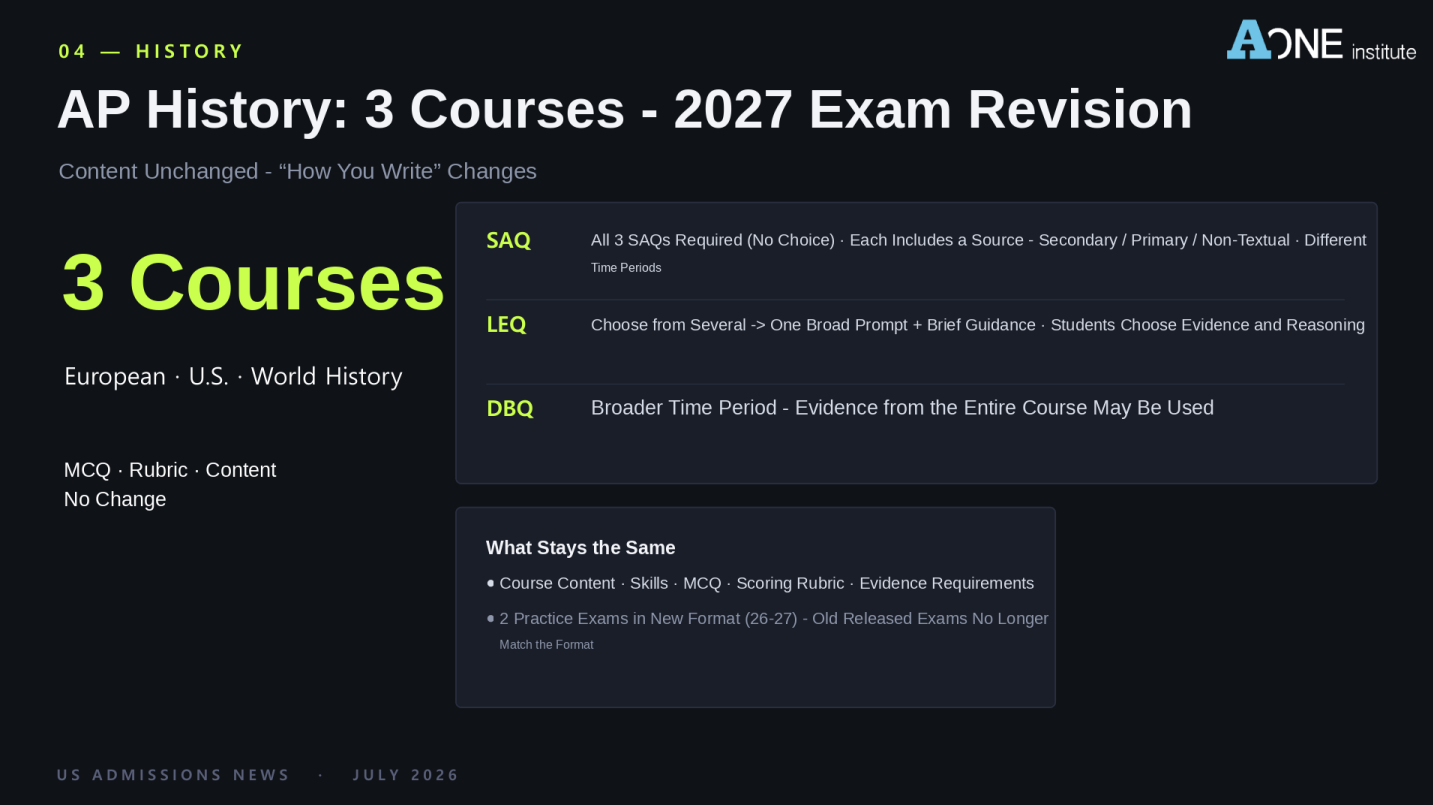
The three core AP History courses — AP European History, AP U.S. History, and AP World History: Modern — retain their existing content scope and MCQ format. The changes apply to Free Response questions.
Short Answer Questions (SAQ):
Previously, the SAQ section presented four questions, with questions 1 and 2 mandatory and a choice between questions 3 and 4. Starting in 2027, there are three questions and all three are mandatory. The optional choice is eliminated.
Long Essay Question (LEQ):
Previously, students chose one prompt from a set of three essay options. Starting in 2027, only one prompt is provided and all students must respond to it. The selection option is removed entirely.
Document-Based Question (DBQ):
The format itself is unchanged — students still analyze seven documents to construct a historical argument. However, the chronological range covered by potential DBQ prompts has expanded. Students who previously focused their preparation narrowly within certain time periods will need to broaden their preparation to account for the wider range of possible document sets.
AP U.S. Government and Politics: Required Document List Expands
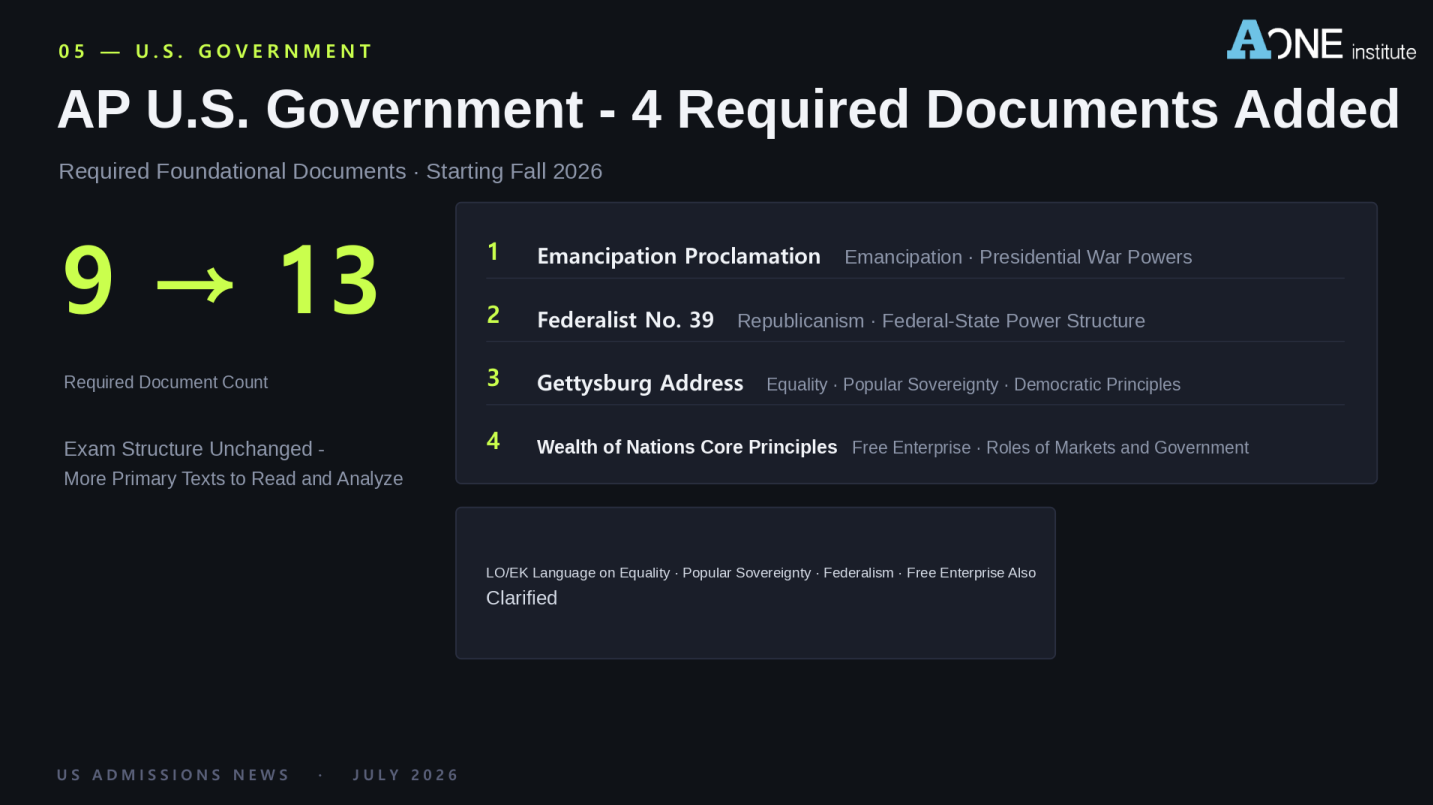
AP U.S. Government and Politics has long required students to know a set of Foundational Documents — texts that students are expected to understand and analyze without being given the document itself on exam day. Previously, this list included nine documents. Starting with the 2027 exam, that list expands to thirteen.
Students should treat all thirteen documents as core knowledge — not optional background reading. The four additions represent an increase in the analytical baseline the exam now assumes.
This change reflects the same pattern visible across AP History: the expectation of deeper, broader foundational knowledge is increasing as College Board and the universities it works with raise the academic bar for what AP-level performance should demonstrate.
Math and Science: 42-Question Standardization
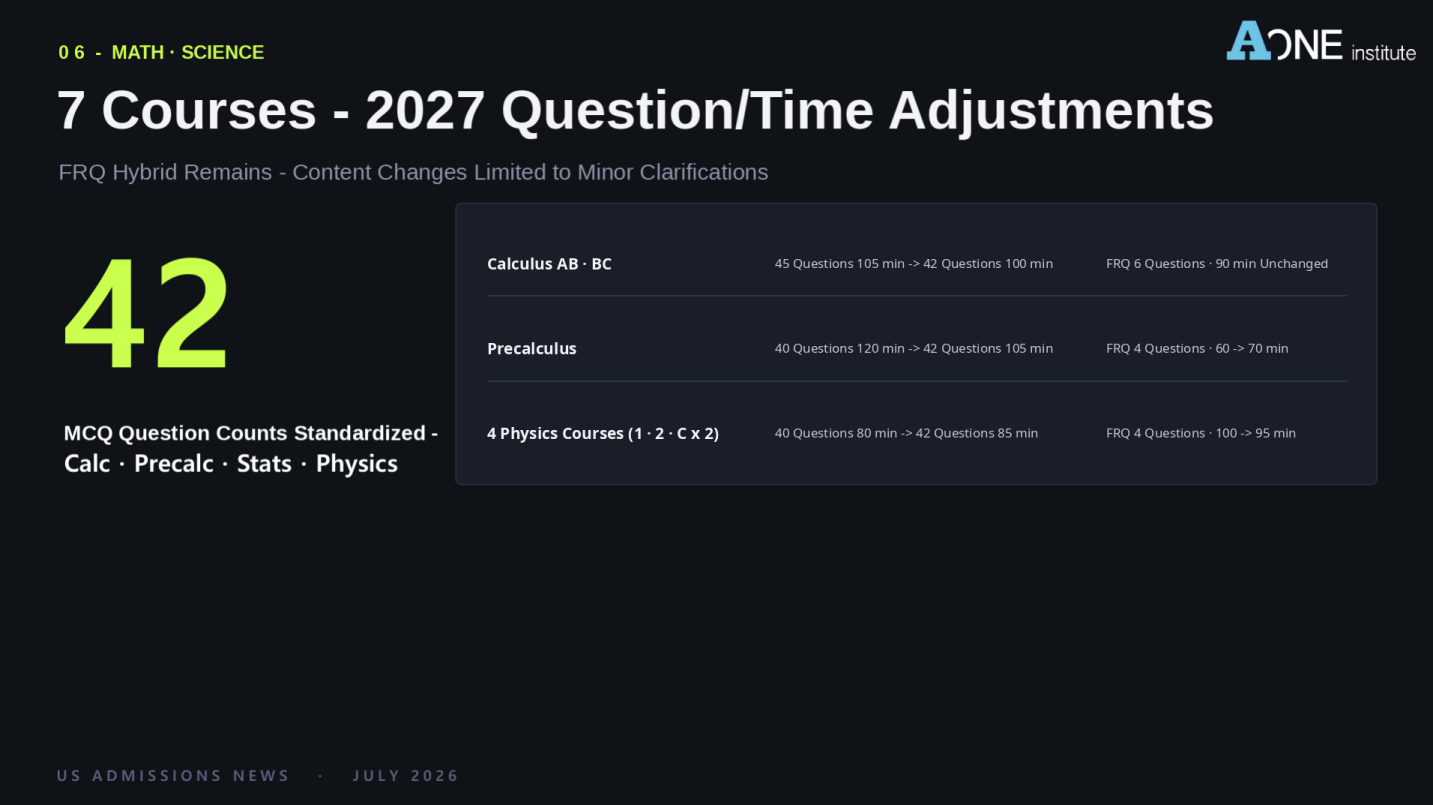
Several math and science courses are being standardized at 42 MCQ questions, with minor adjustments to time allocations.
AP Calculus AB and BC:
Previously 45 questions in 105 minutes; now 42 questions in 100 minutes. FRQ remains at 6 questions. Hybrid format (digital MCQ, handwritten FRQ) is maintained.
AP Precalculus:
Previously 40 questions in 120 minutes; now 42 questions in 105 minutes — more questions, less total time. FRQ increases from 60 to 70 minutes, reflecting increased difficulty in the written portion.
AP Physics 1, 2, C: Mechanics, and C: Electricity and Magnetism:
Previously 40 questions in 80 minutes; now 42 questions in 85 minutes. FRQ remains at 4 questions with slightly reduced time. Hybrid format maintained.
The 42-question standardization appears to be a deliberate College Board policy decision to align MCQ format across the math and science AP portfolio.
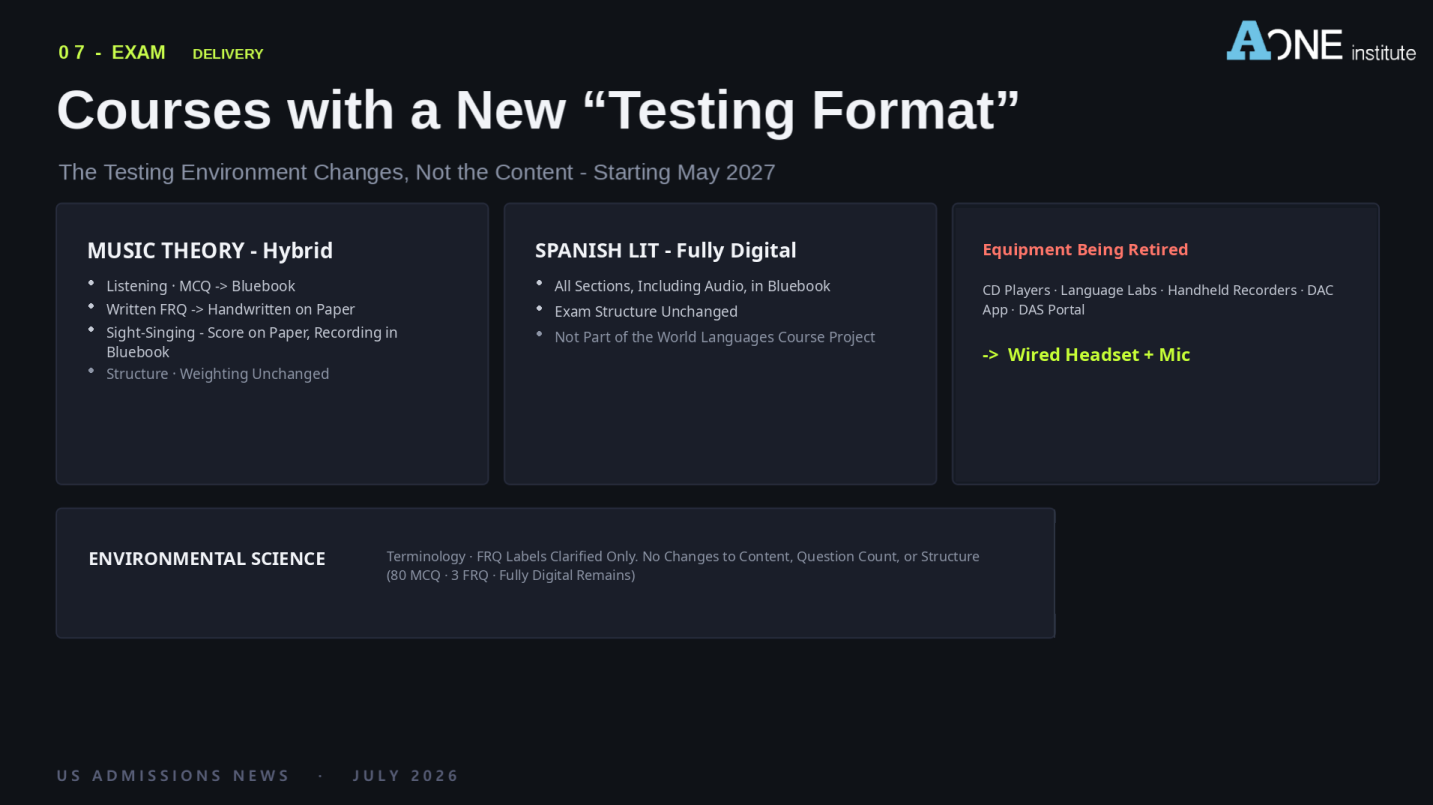
AP Music Theory:
Previously paper-only; now transitioning to hybrid (digital MCQ and listening in Bluebook, handwritten FRQ).
AP Spanish Literature and Culture:
Transitioning from hybrid to fully digital.
AI Policy Update: Partial Use Permitted With Disclosure
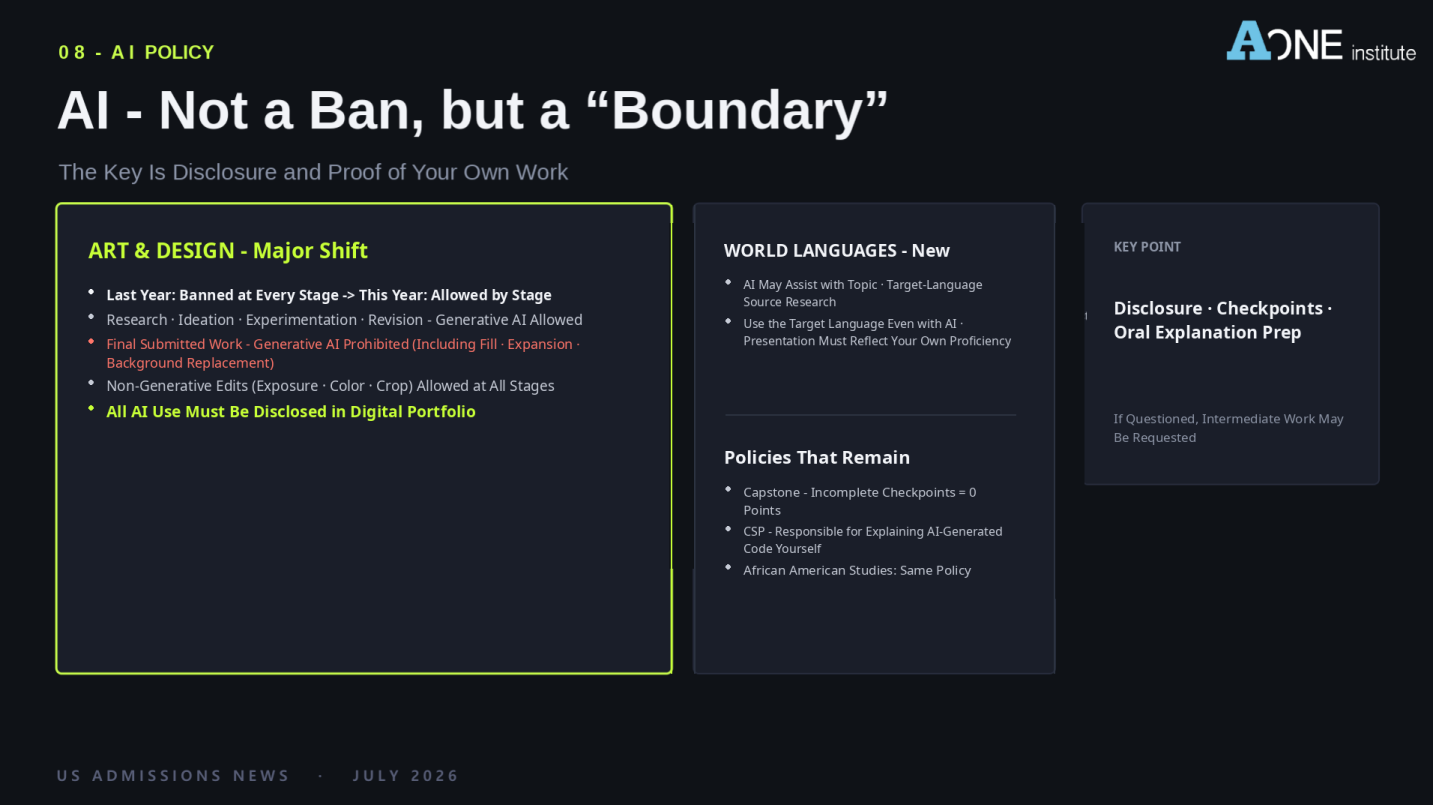
College Board has updated its guidance on AI use in AP coursework, with changes most relevant to AP Art and Design.
Previously, generative AI was prohibited across all stages of the creative process for Art and Design submissions. Starting with the 2027 cycle, AI tools are permitted for intermediate steps — including brainstorming, ideation, and technical editing tasks such as image enhancement or color adjustment. Generative AI remains prohibited in final submitted works.
The key requirement accompanying this relaxation: any AI use at any stage of the creative process must be disclosed and documented in the student's process materials. Transparency is mandatory.
This is a meaningful shift in how College Board is approaching AI in AP coursework — moving from blanket prohibition toward structured, disclosed use with clear boundaries. It is reasonable to expect similar policy evolution in other AP subjects over the coming cycles.
The Broader Pattern Behind These Changes
Taken together, the 2027 AP changes reflect a consistent underlying direction: College Board and the university faculty providing curriculum guidance are raising the academic floor for what AP-level preparation requires.
Mandatory LEQ prompts replace student choice. Required document lists grow longer. Course Projects introduce research and spoken production requirements that didn't exist before. DBQ time ranges expand. Content scope in some courses increases even as specific unit counts decrease.
As discussed in previous A ONE Institute content, universities have been observing measurable declines in the foundational academic preparation of recently admitted students — particularly in mathematics and writing. AP exam changes are one mechanism through which that concern is expressed. Each cycle has moved incrementally toward more rigorous, less formulaic assessment of whether students genuinely command the material they're claiming to have mastered.
Students preparing for AP exams in 2027 and beyond should treat these changes as a signal — not just about what will appear on exam day, but about what elite universities are increasingly looking for in the applicants they admit.
At A ONE Institute, we help students prepare for AP exams with the level of rigor these changes require — including the new spoken and project-based components that are now part of AP Language courses. If you have questions about how to approach the 2027 changes for a specific subject, we're here to help.
AP exam changes 2027
AP Cybersecurity
AP Business
AP Statistics
AP Language Course Project
AP History changes
