
Something Has Shifted in How Top Colleges Are Evaluating Students
College admissions trends evolve gradually — but occasionally, a cluster of institutional signals points clearly in one direction at the same time. That's happening right now, and the message from multiple top universities is consistent enough to take seriously.
Starting this year and continuing through the next two to three admissions cycles, elite universities are placing significantly greater emphasis on one specific quality: demonstrated academic preparedness — the evidence that a student can actually handle rigorous college-level coursework, beyond what GPA and test scores alone can show.
This isn't just a philosophical shift. It's a response to a documented problem, and it's reshaping what competitive applicants need to bring to the table.
Where This Is Coming From: The UC System's Wake-Up Call
The clearest public signal came from UC Berkeley and the broader UC system.
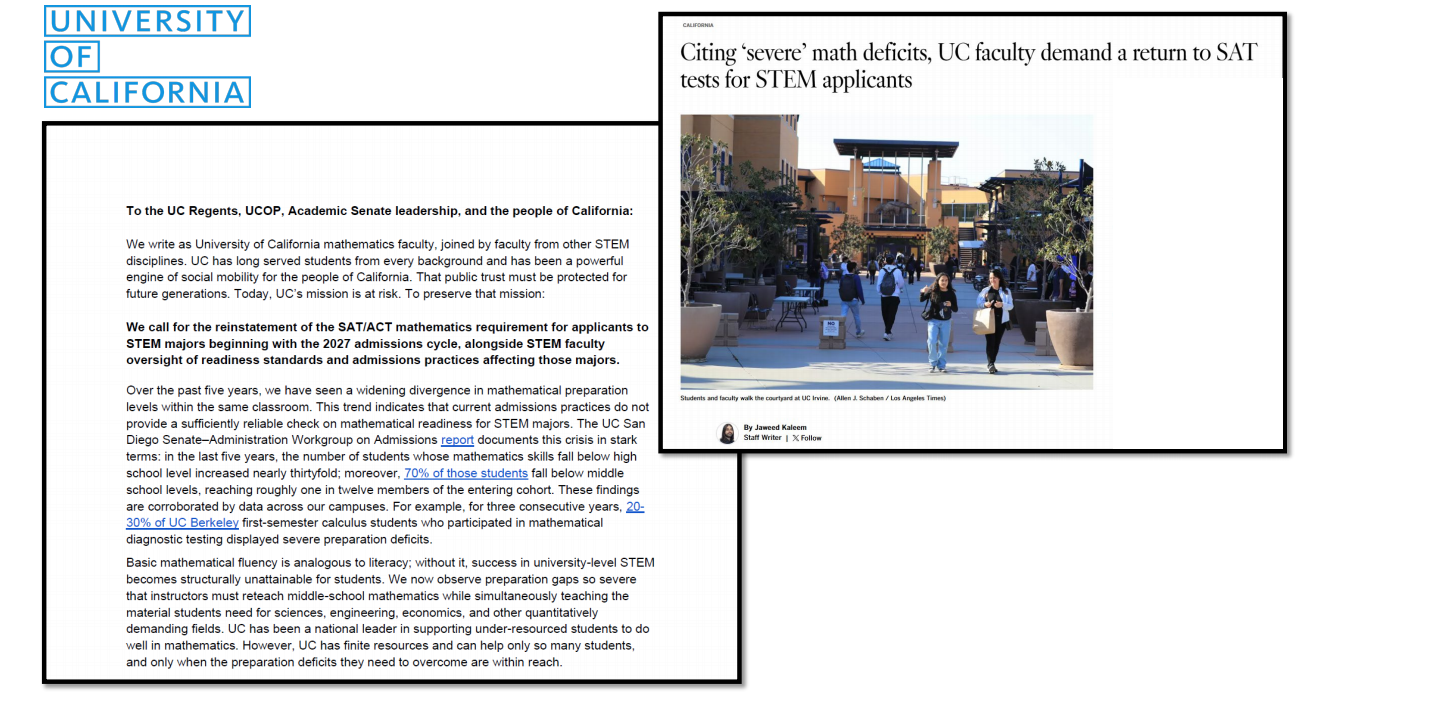
Hundreds of professors — led by faculty at UC Berkeley — sent a formal letter to the UC Academic Senate raising a specific concern: since the shift to test-blind admissions, the academic preparation of incoming students has declined measurably, particularly in mathematics.
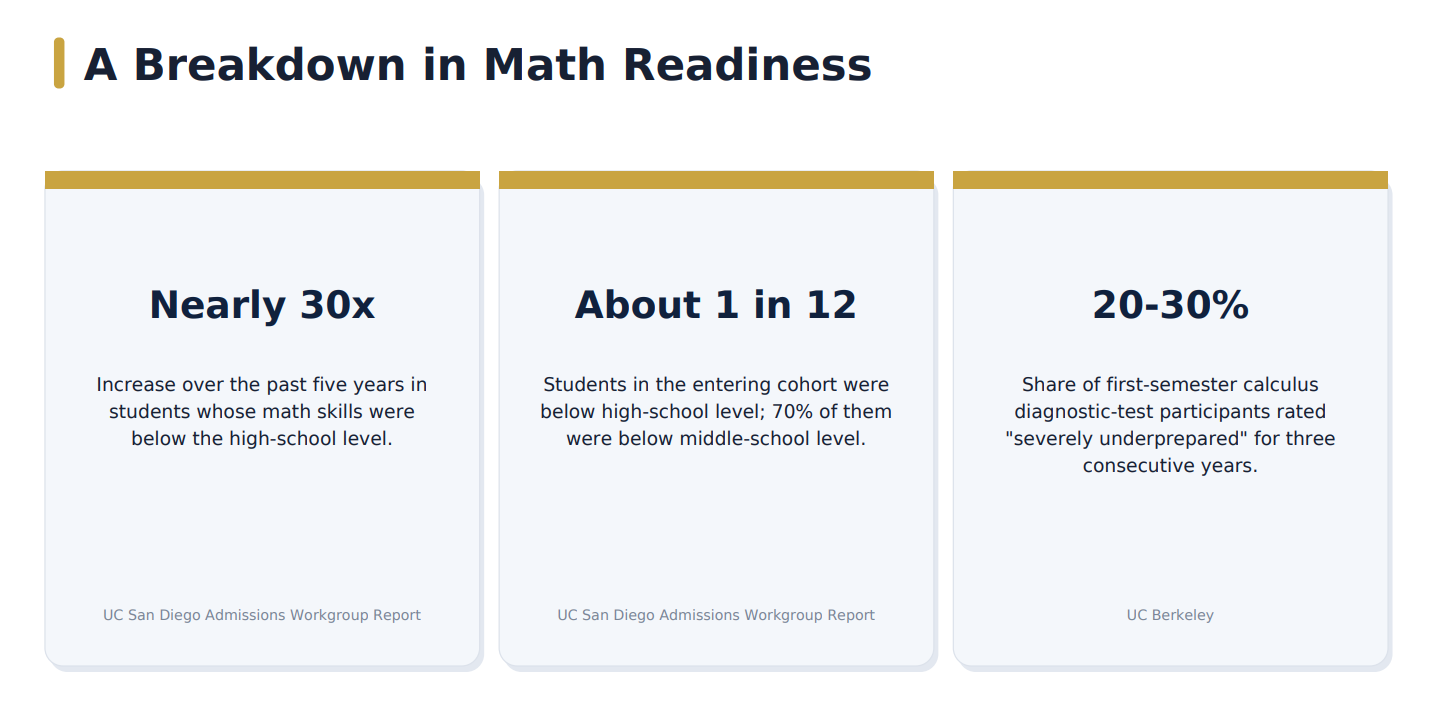
The data behind that letter is striking. At UC San Diego, the number of incoming students performing below high school level in math increased 30 times over five years. Approximately one in twelve students arrived with math skills below high school level — and of those, roughly 70% were assessed at middle school level. At UC Berkeley, diagnostic testing of STEM-admitted students found that 20–30% could not demonstrate proficiency in calculus — a subject foundational to virtually every STEM major.
In response, the UC Academic Senate Chair issued a formal directive to BOARS — the Board of Admissions and Relations with Schools, the UC body responsible for undergraduate admissions policy. The directive: identify what went wrong, and produce a roadmap for how the UC system will select students going forward.
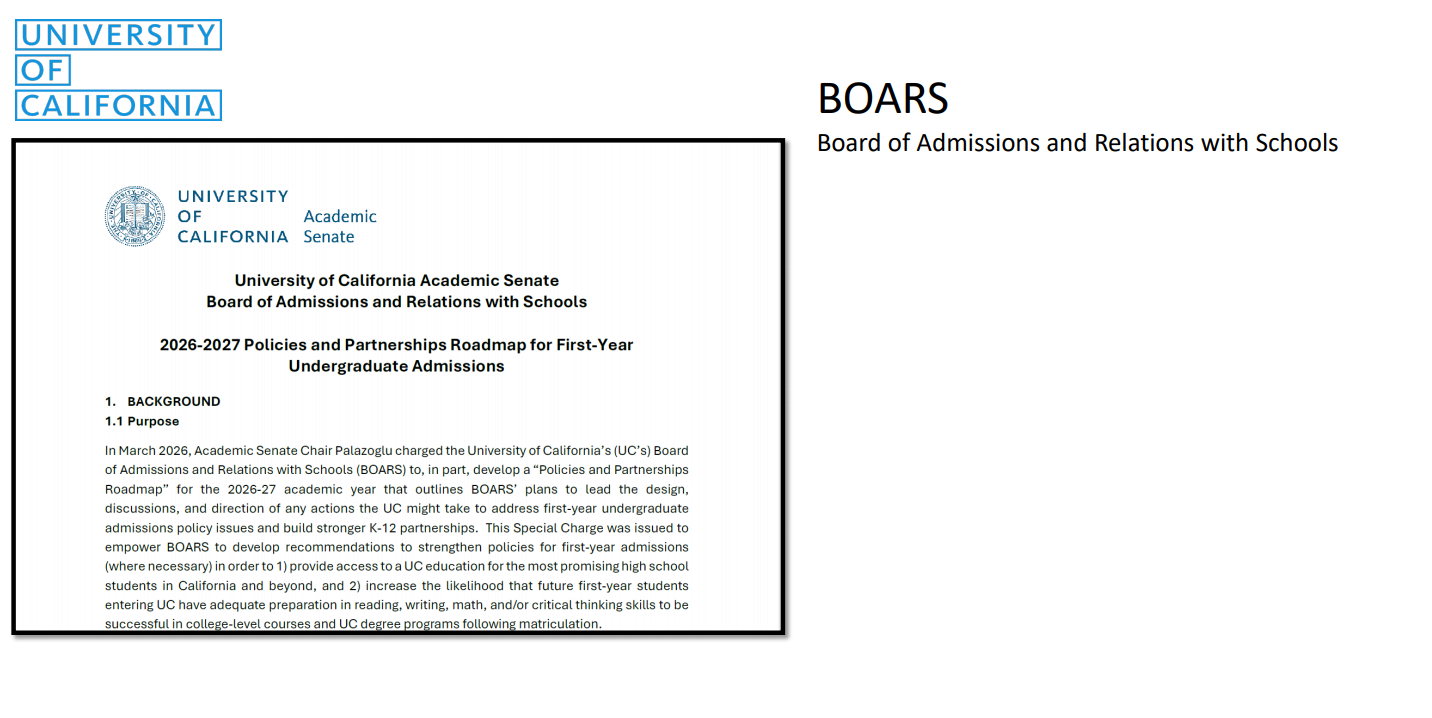
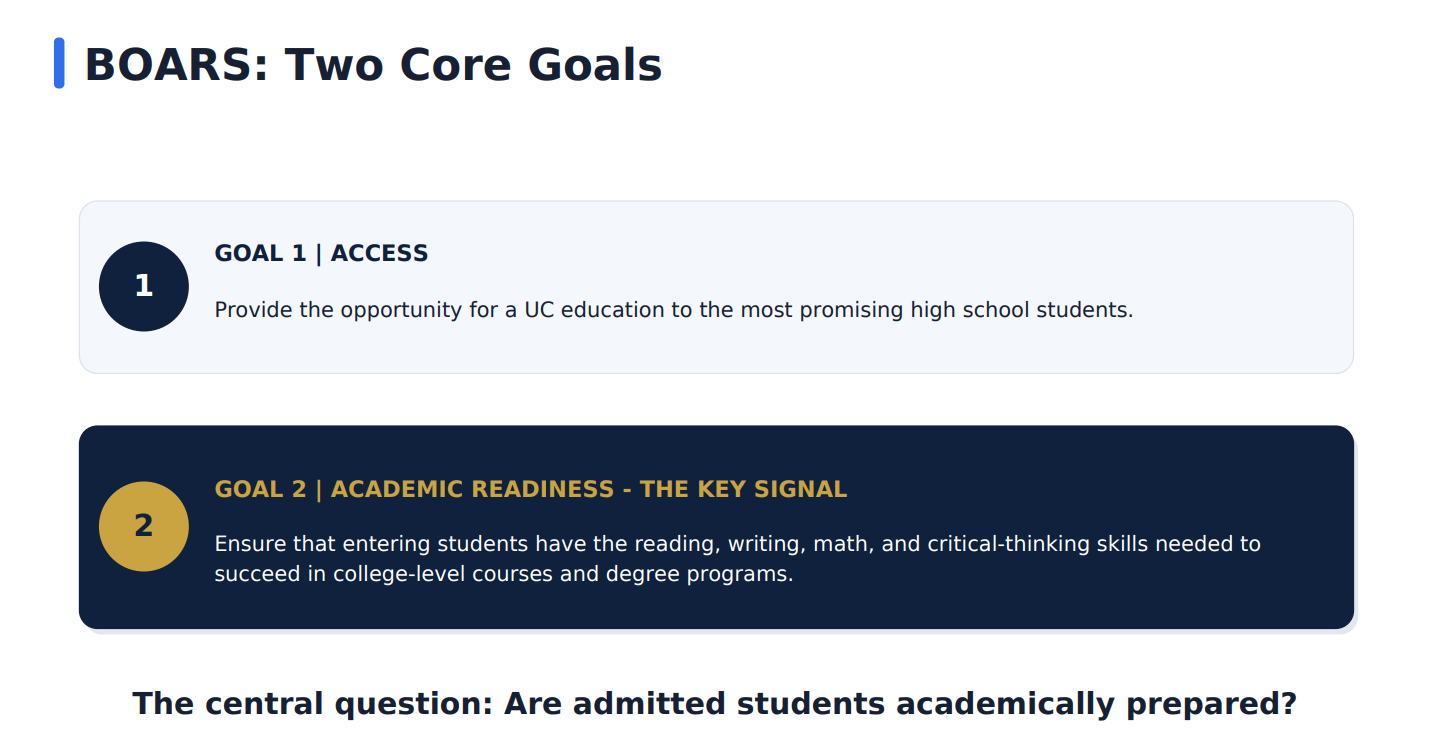
That roadmap has now been submitted. Its two stated goals are to admit the most academically promising high school students and to prioritize applicants who already demonstrate sufficient preparation in reading, writing, mathematics, and critical thinking.
What the UC Roadmap Actually Proposes
The UC's response is not simply "bring back the SAT." The changes being considered are more structural — and the timeline matters.
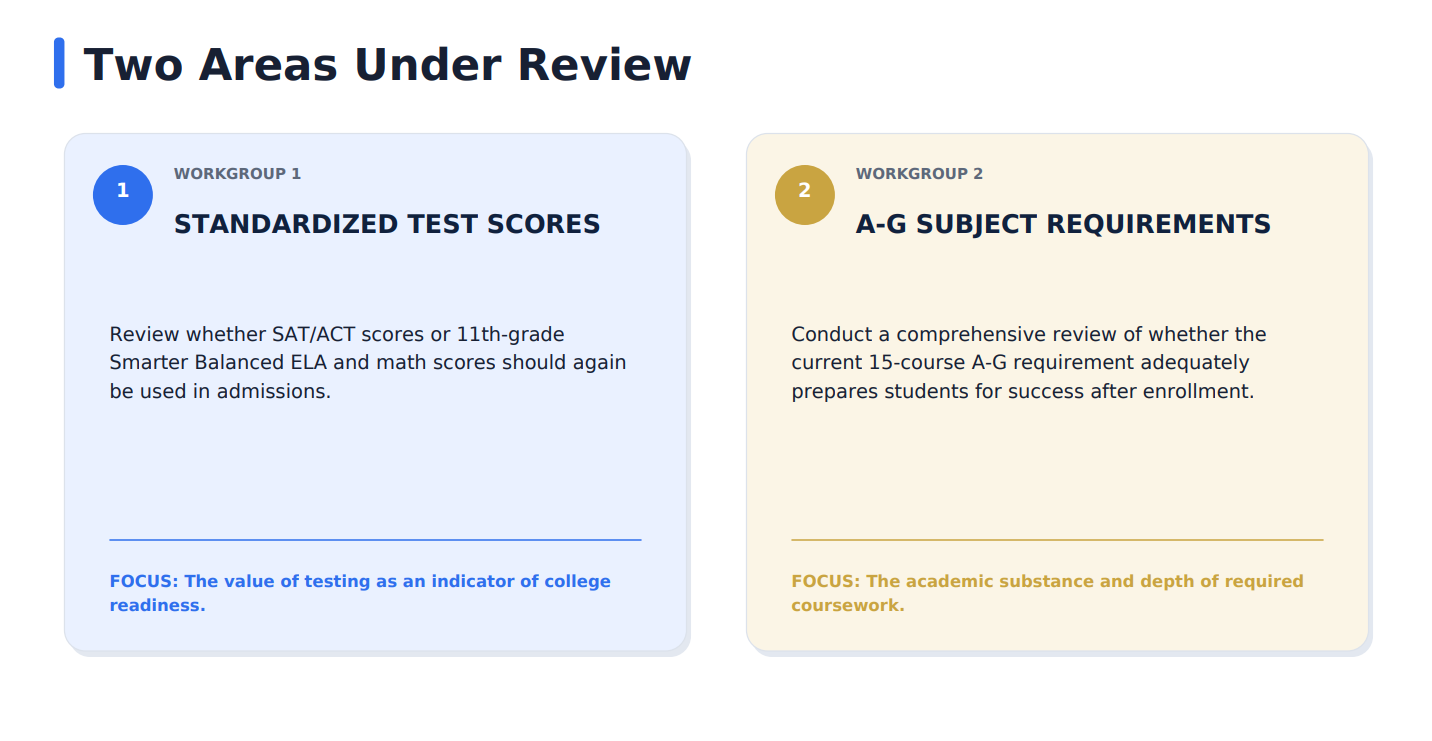
The roadmap calls for a serious review of whether standardized test scores — SAT, ACT, or California's Smarter Balanced assessments in English and math — should be reintegrated into the admissions process. It also calls for a comprehensive review of the A-G Curriculum requirements, the baseline course sequence UC applicants must complete.
For context: the A-G Curriculum is the minimum course requirement for admission to any UC campus. It covers 15 years of coursework across History/Social Science, English, Mathematics, Laboratory Science, Language other than English, and Visual and Performing Arts. The review asks whether these requirements are adequately calibrated to actual college readiness.
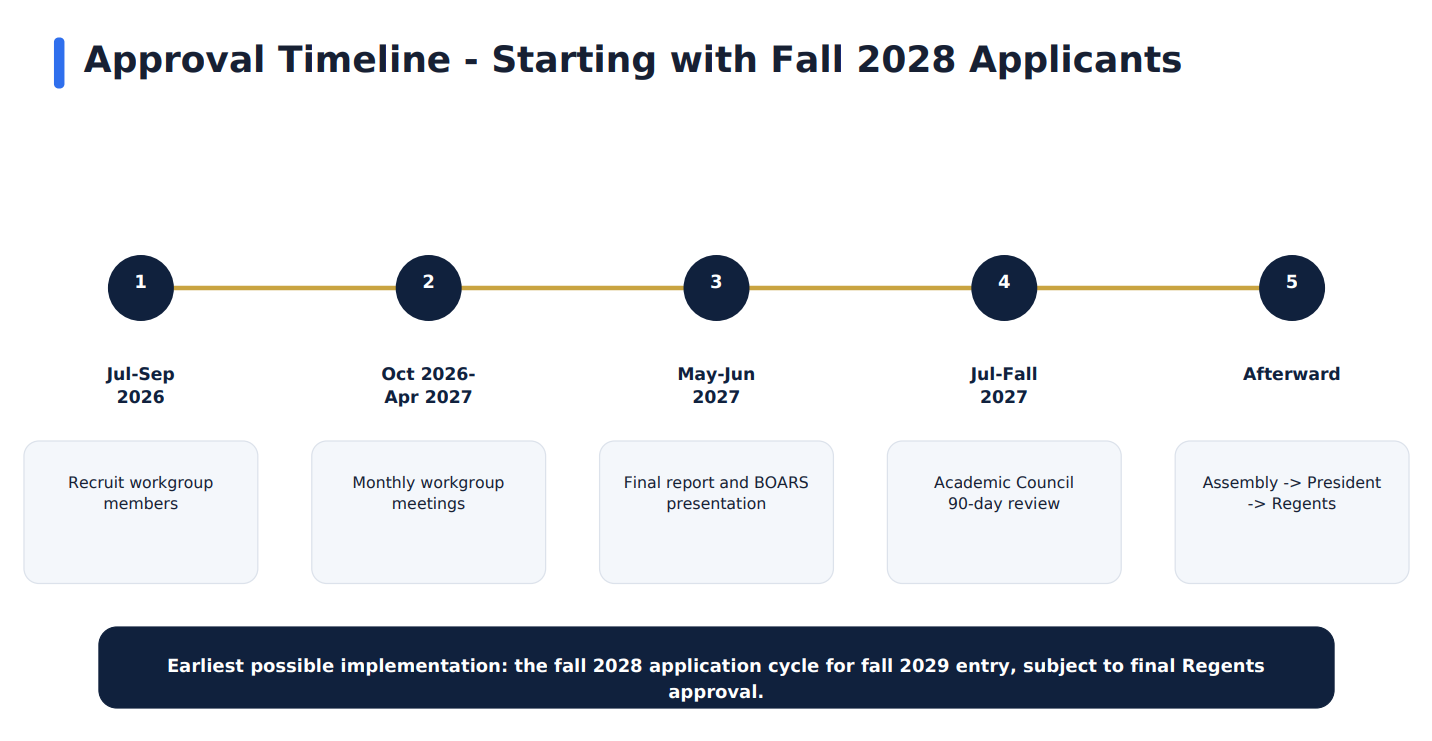
The implementation timeline is specific. Committee formation begins in July and September 2026. A final report is expected in 2027. Policy changes, if adopted, would most likely affect applicants for Fall 2028 admission. Students currently in 9th or 10th grade should treat this as a live and developing consideration — not a distant hypothetical.
Princeton, Yale, and Brown Are Saying the Same Thing
The shift isn't limited to the UC system. Several highly selective universities have published admissions reports in the past year that signal the same directional change.
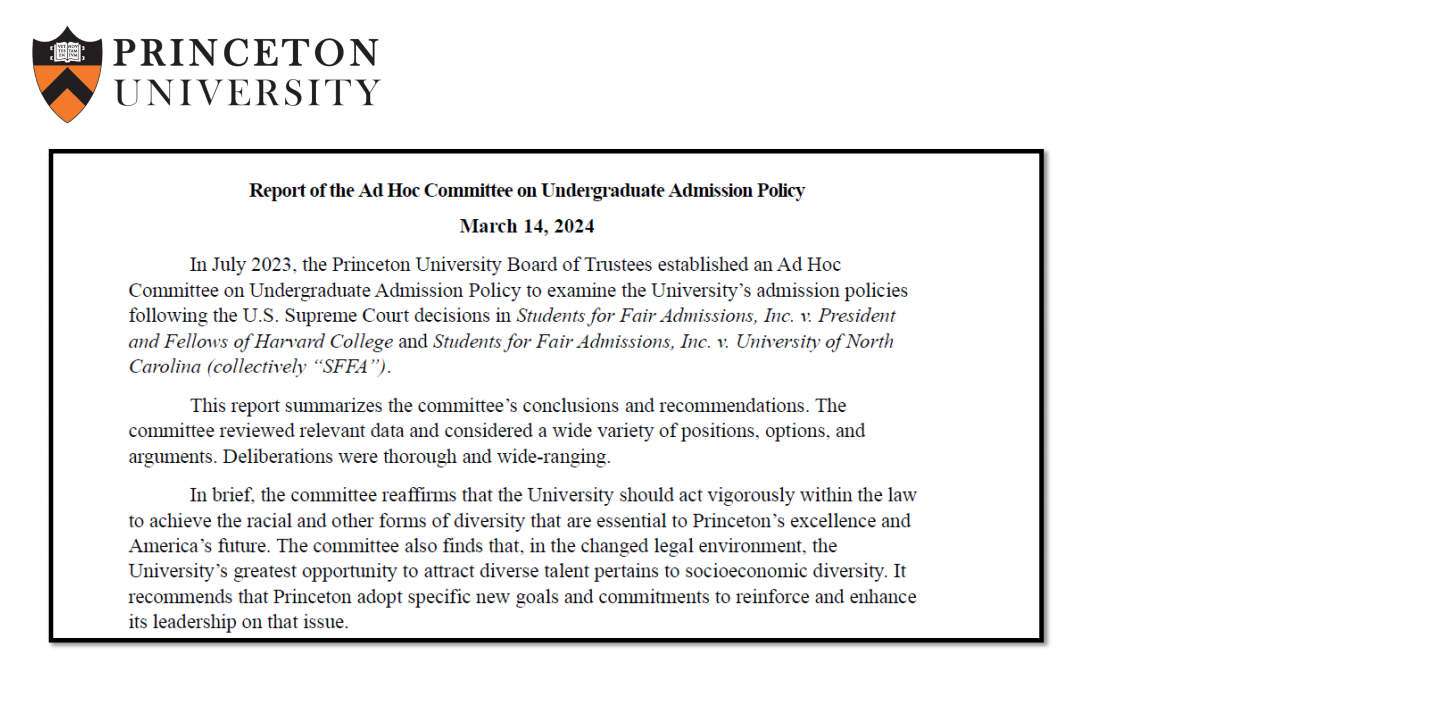
Princeton has described its admissions philosophy as merit-driven, explicitly stating that it selects students who demonstrate strong foundational academic preparation. The report emphasizes that the school is not simply looking for the highest GPA, SAT, AP, or IB scores in isolation — but is committed to selecting students who show academic excellence across multiple dimensions, while maintaining clear academic standards.
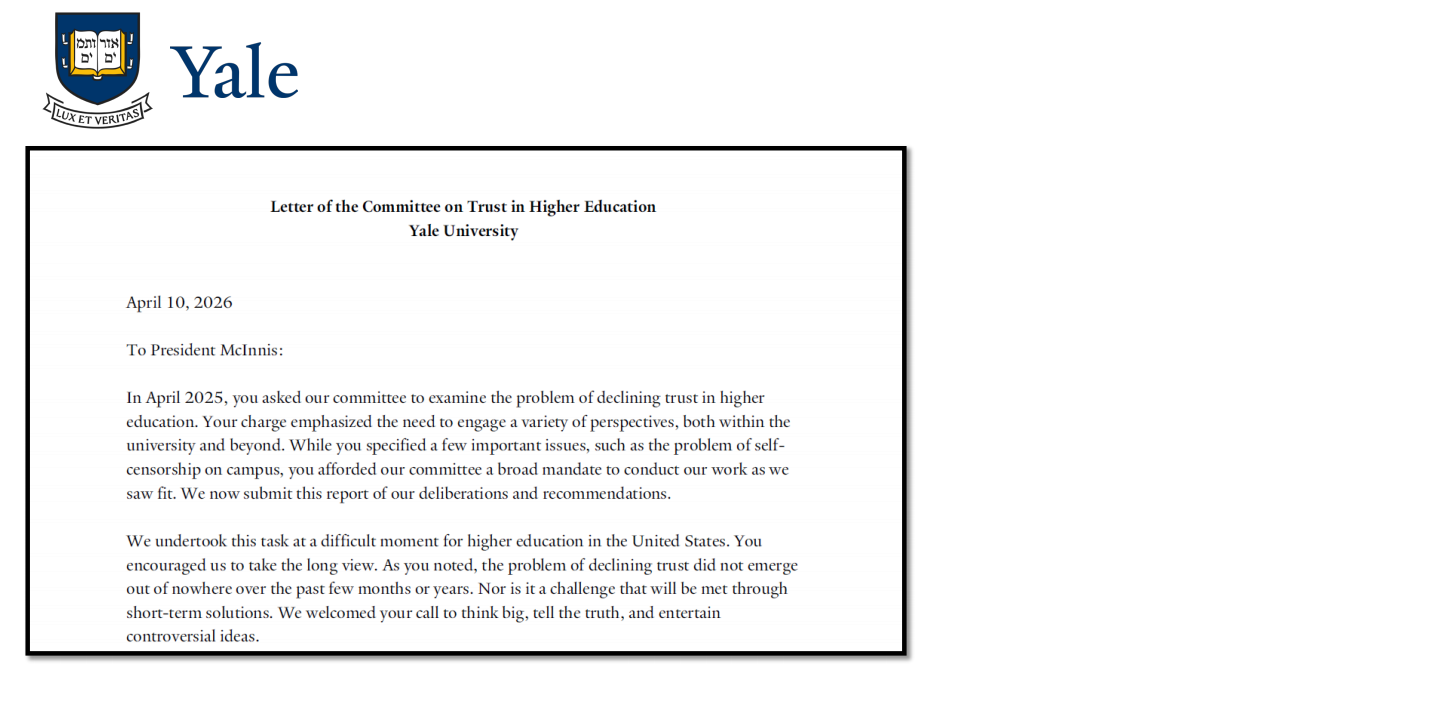
Yale has gone further in its public language. Its most recent report explicitly states that academic achievement must be the top priority in admissions decisions. Yale acknowledged a concern that holistic review — when communicated unclearly — can create a false impression that strong academics are optional if other parts of an application are strong enough. The report commits to greater transparency about minimum academic standards and states that academic preparation will be evaluated more rigorously, not less — even in cases where it's harder to measure precisely.
Brown has published similar findings, noting in its report that GPA is increasingly difficult to use as a differentiating factor because more than 70% of applicants arrive with straight-A transcripts. This is precisely why, Brown notes, standardized test scores function as a useful secondary signal — and why both scores and other evidence of academic achievement are being weighted more carefully.
The common message across all three institutions: GPA and standardized test scores remain important — but what these universities are now asking for, more explicitly than before, is evidence that a student can perform at the level of rigor their programs demand. That evidence needs to come from somewhere beyond the transcript.
What UC's Academic Evaluation Framework Reveals
UC's admissions guidelines include a detailed breakdown of how academic preparation is evaluated. Because other highly selective schools are moving in the same direction, this framework offers a useful roadmap for any competitive applicant — not just those targeting UC campuses.
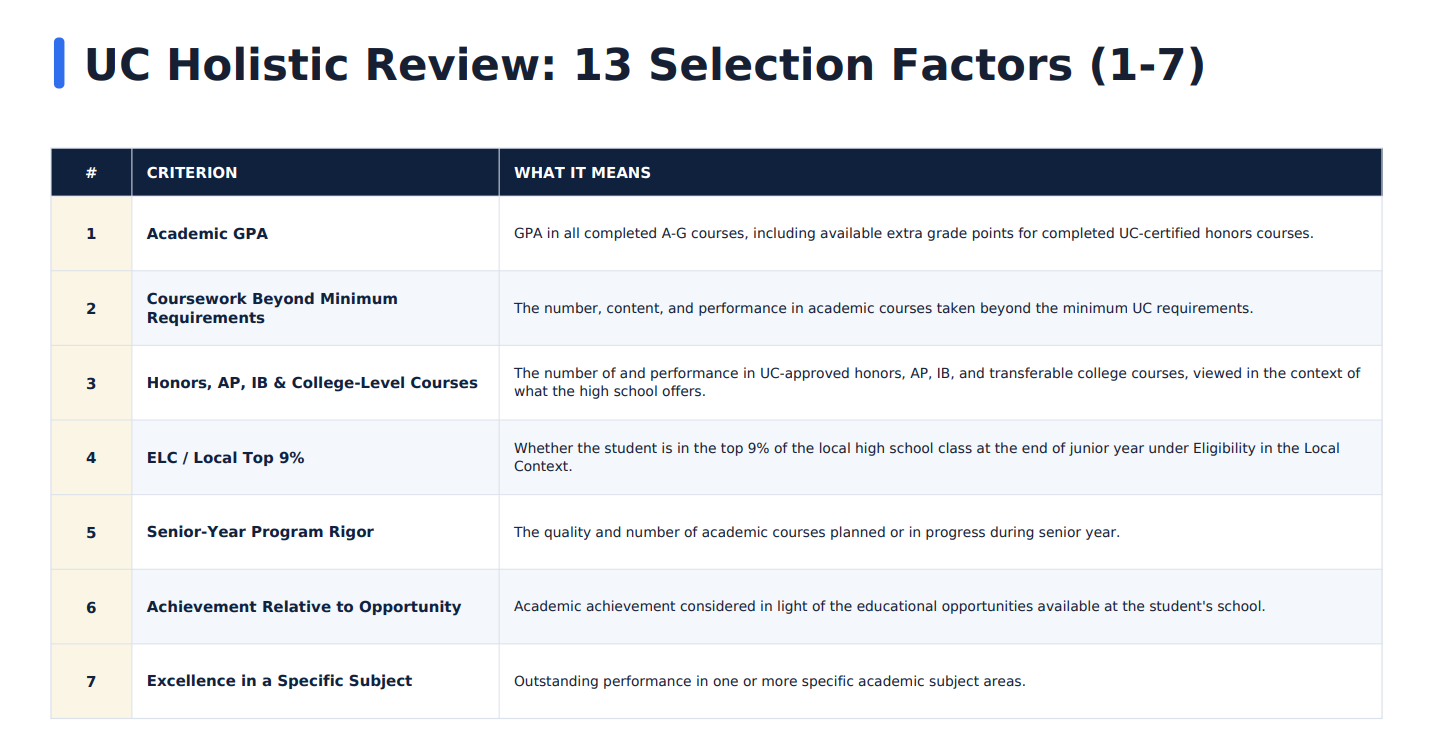
The evaluation covers nine areas:
GPA — foundational and non-negotiable. The absolute quality of grades matters.
Coursework beyond the A-G minimum — what additional academic courses a student took beyond the required baseline.
AP, IB, and Honors courses — the extent to which a student challenged themselves with the most rigorous available curriculum.
Local ranking — California's standard is top 9% within the student's region, which for most students correlates directly with GPA performance.
Senior year rigor — whether the student maintained or increased course difficulty through 12th grade.
Participation in special academic programs — school-based research programs, selective academic tracks, or specialized coursework the school makes available to a limited subset of students.
Outstanding performance in a specific academic domain — this is where the evaluation goes beyond GPA. A student who earns straight A's has the same GPA as every other student who earns straight A's. To stand out within this criterion, the evidence must come from outside the standard grading system — through competitions, research, publications, or external assessments that evaluate subject-matter depth independently.
Special academic projects or research — documented independent inquiry, whether through formal research programs or self-directed academic projects.
Recent upward grade trends — the most recent academic performance carries disproportionate weight. A student whose grades have improved consistently into junior and senior year is evaluated more favorably than one whose grades have declined, even if the overall GPA numbers are similar.
Items 7 and 8 are the most significant shift in what's being asked for — and the most directly actionable for students building their profiles now.
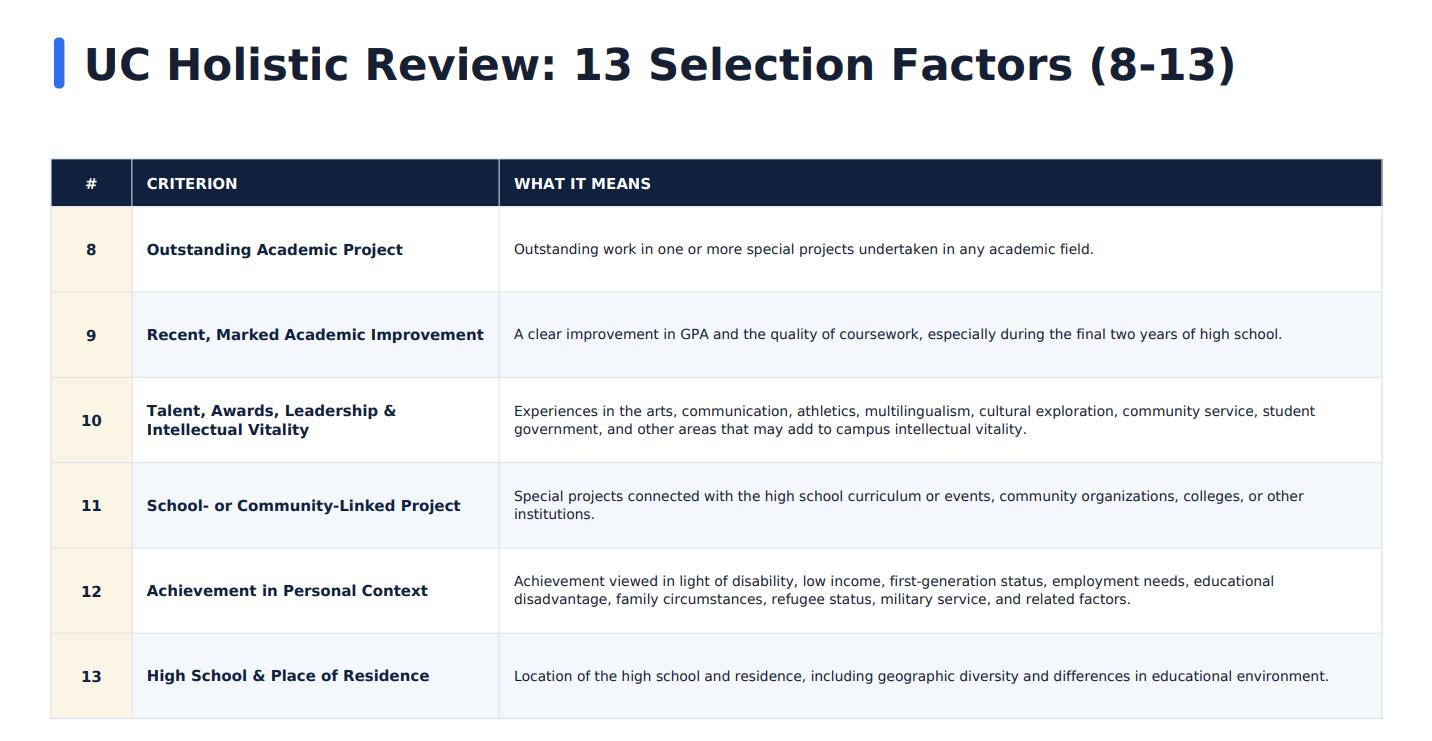
The Category That Now Carries More Weight Than Before
Here's what this all points to practically: GPA and standardized test scores are necessary but no longer sufficient on their own to differentiate the strongest applicants.
With GPA inflation making transcripts increasingly difficult to interpret, and with SAT/ACT scores functioning as a secondary rather than primary signal, what universities are now looking for — more explicitly and more consistently than before — is verifiable, external evidence of academic depth in a specific discipline.
That evidence comes primarily from academic competitions, research, and subject-specific recognition. The following categories represent the range of activities that directly serve this purpose:
Mathematics: AMC (American Mathematics Competition), ARML, North American Mathematics League, Mu Alpha Theta, and other math league competitions.
Computer Science and Technology: CyberPatriot, Congressional App Challenge, Robotics competitions, Coding Team competitions.
Sciences: Physics Olympiad (leading to USAPhO), Chemistry Olympiad, Biology Olympiad, Science Bowl, Science League, and subject-specific academic leagues at the school team level.
Medicine and Health Sciences: USMDO, Brain Bee (leading to the National Brain Bee), Medical HOSA, HOSA Bowl, Biomedical Debate.
Research: ISEF-affiliated Science Fairs, JSHS (Junior Science and Humanities Symposium — recently reinstated after a period of discontinuation), and school-based team research projects.
Humanities and Social Science: American Philosophy Olympiad, National History Day, Ethics Bowl, NSDA Debate (with points accumulation through the National Speech and Debate Association), National Economics Challenge, National Personal Finance Challenge, Wharton Investment Competition.
Writing: Scholastic Art and Writing Awards, YoungArts, Bennington Young Writers Award, philosophy essay competitions, JFK Profile in Courage Essay Contest, Concord Review, NHD, Bow Seat, EngineerGirl, NCTE Achievement Awards in Writing.
These are not simply extracurricular activities in the conventional sense. They are externally evaluated, academically grounded, and increasingly central to what selective universities are using to distinguish between applicants whose transcripts look similar on paper.
What This Means for Students Applying in 2026, 2027, and 2028
The shift being described by UC, Princeton, Yale, and Brown is not a sudden reversal of holistic admissions. It is a recalibration — a deliberate move toward greater emphasis on academic rigor as a primary selection criterion, with clearer expectations and less reliance on the parts of a holistic application that are hardest to verify.
For students planning to apply over the next two to three years, the practical implications are specific:
GPA and standardized test scores are the floor, not the differentiator. Meeting the academic threshold is necessary to be considered seriously. It is no longer sufficient to stand out.
Academic competition results, research participation, and subject-specific achievement are becoming the primary tools for demonstrating what GPA and test scores can't show: that a student is genuinely prepared to succeed at the level top universities now expect.
The students who will be most competitive in this environment are the ones who have built sustained, verifiable academic depth in at least one domain — and can point to external recognition of that depth through the kinds of activities described above.
At A ONE Institute, we prepare students for the academic competitions, research programs, and writing competitions described in this article — and we help students present that work effectively in their activity sections and resumes. If you have questions about how to build or position this kind of academic profile, we're here to help.
college admissions trends
academic preparedness
UC admissions
academic competitions
holistic review
