
The Resume Question Nobody Answers Clearly
When students fill out the Common App activity section, a familiar concern comes up: ten slots may not feel like enough to capture everything. So the question becomes — should I also submit a resume?
The honest answer is: it depends entirely on the school. Some colleges welcome a resume as a meaningful supplement. Others have explicitly stated they don't want one — and submitting anyway can create a negative impression rather than a stronger application.
At A ONE Institute, we've reviewed the stated policies and general practices across the top 30 universities. Here's what the landscape actually looks like.
Schools Where Submitting a Resume Is Recommended
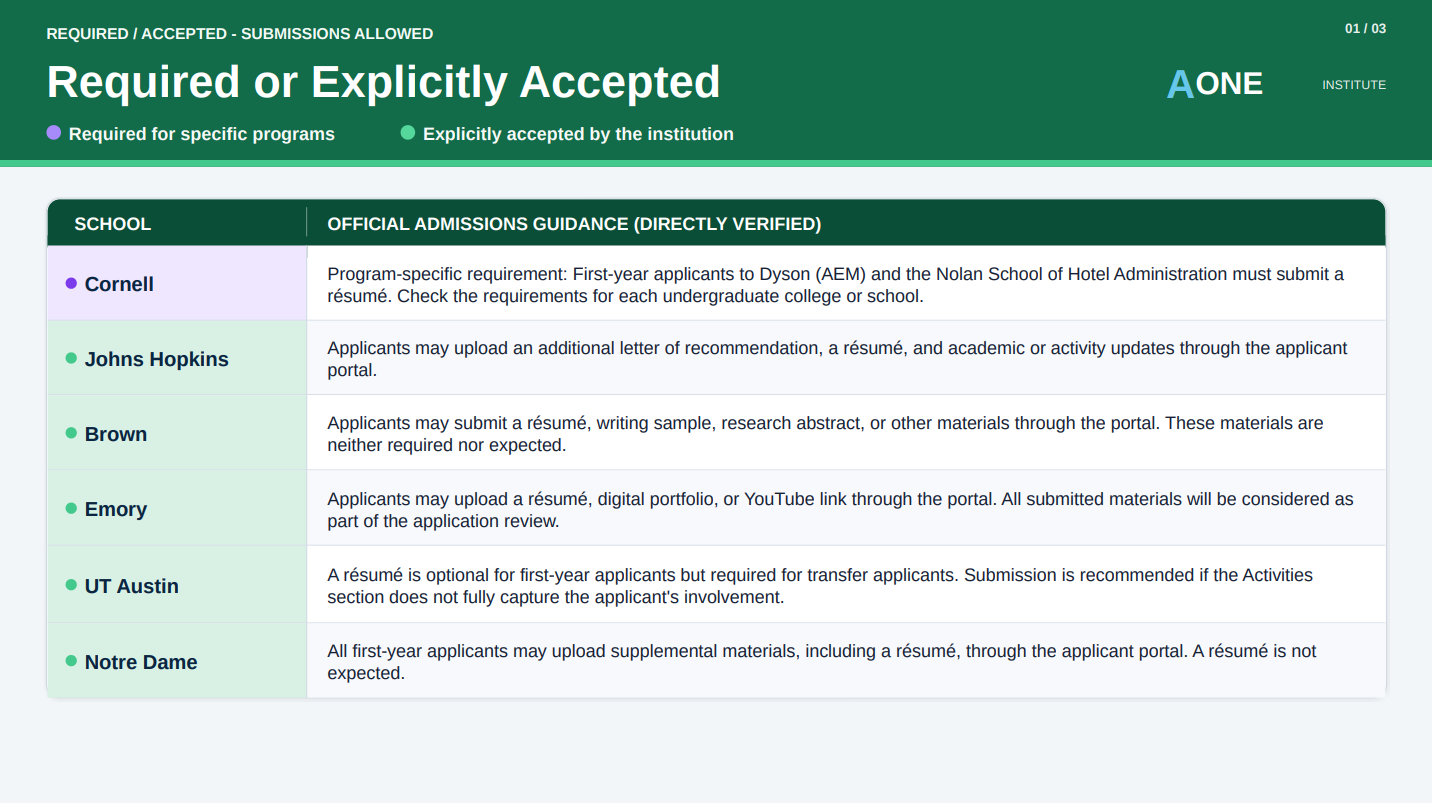
These schools either require a resume in certain programs, provide a portal specifically designed for resume upload, or have indicated that a resume is a meaningful and welcome addition to the application.
Cornell — Resume submission requirements vary by college. Certain programs — including hospitality management and other professionally oriented schools — require a resume even from first-year applicants. For other colleges within Cornell, submission is generally permitted and commonly done. Check the specific college's requirements before applying.
Johns Hopkins — The applicant portal allows students to upload supplementary materials including resumes, additional recommendation letters, and other documents beyond the standard counselor and two teacher recommendations. Submitting a resume through the portal is standard practice.
Brown — Similar to Johns Hopkins, Brown's portal accepts resumes, writing samples, and research abstracts as optional supplementary materials. Submission is not required, but it's common among competitive applicants.
Emory — Emory actively encourages supplementary materials. The portal accepts resumes, digital portfolios, and links to external work such as YouTube, and the university has stated that all submitted materials are considered in the evaluation process.
UT Austin — Transfer applicants are required to submit a resume. For first-year applicants, UT Austin specifically recommends submission if the activity section didn't provide enough space to fully represent the student's involvement and accomplishments.
Notre Dame — The applicant portal accepts resume uploads from first-year applicants, consistent with the general approach at comparable institutions.
Schools Where Submission Is Permitted but Not Enthusiastically Encouraged
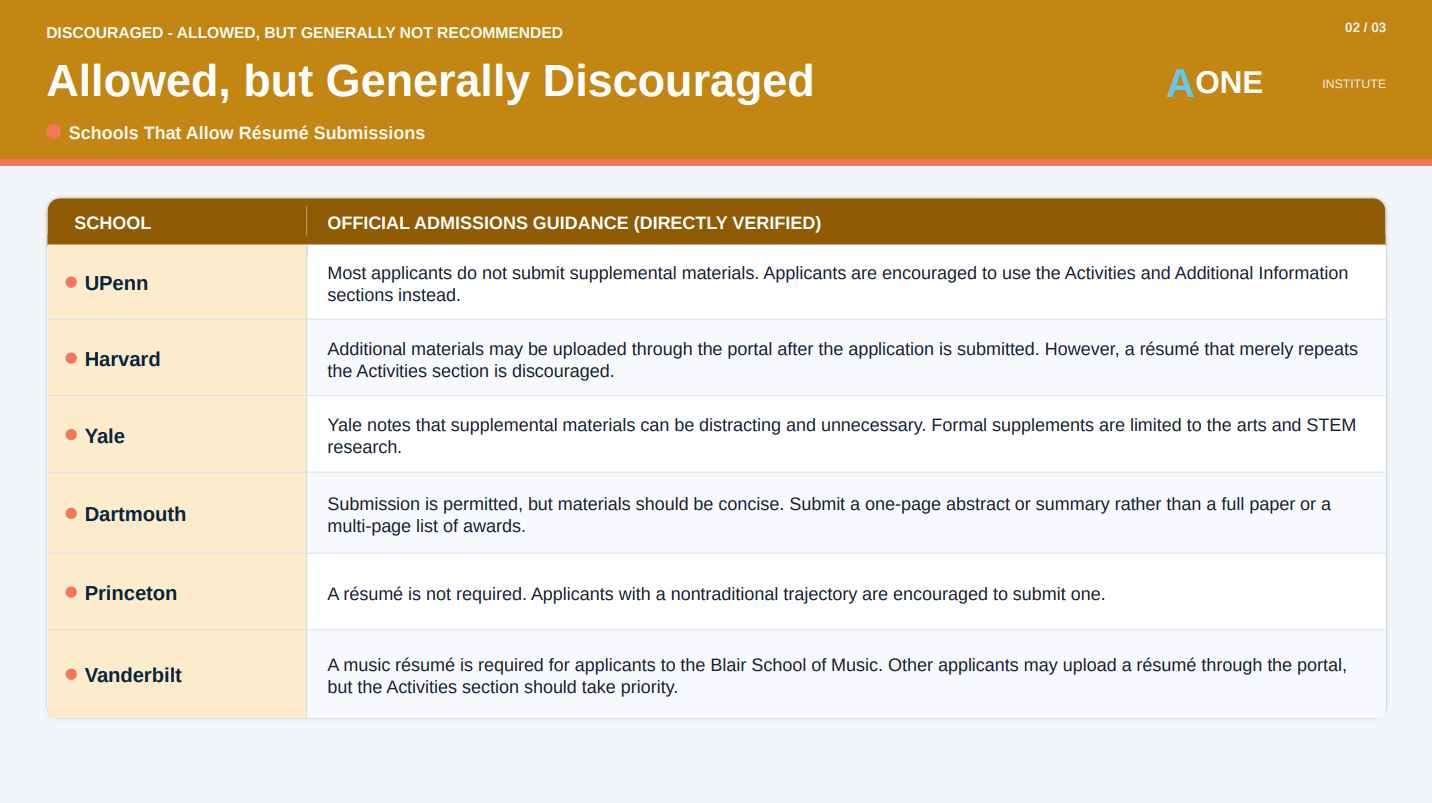
These schools accept resumes but have communicated — directly or indirectly — that they prefer other formats for additional information, or that an unnecessary resume creates more friction than value. In these cases, submitting is fine, but the resume needs to be purposefully constructed.
UPenn — Penn has indicated a preference for the Additional Information section as the primary vehicle for content that doesn't fit elsewhere in the application. That said, submitting a resume is generally acceptable. At A ONE Institute, we typically do submit resumes to Penn — the key is ensuring it doesn't simply duplicate what's already in the activity section.
Harvard — Harvard permits resume submission, but has specifically stated that resumes which simply restate what's already listed in the activity section add nothing. If you're going to submit one, it needs to provide genuinely new information or context. A resume that's essentially a reformatted version of the activity list isn't worth including.
Yale — Yale accepts resumes but has communicated — informally but clearly — that it views them as potentially distracting and adds review workload without necessarily adding insight. Submitting is not prohibited, but the resume should be purposeful and concise.
Dartmouth — Dartmouth permits resume submission with one clear guideline: keep it to one page. A condensed, focused resume is acceptable; a multi-page document is not.
Princeton — Princeton recommends resume submission specifically for students with a non-traditional background or academic trajectory — circumstances that differ meaningfully from the typical applicant path and warrant additional context. For students with a more conventional profile, the activity section is generally sufficient.
Vanderbilt — Vanderbilt's portal accepts resume uploads, and students applying to music programs are required to submit a music resume. For other applicants, the activity section carries more weight, but a resume is a permitted supplementary document.
Schools Where You Should Not Submit a Resume
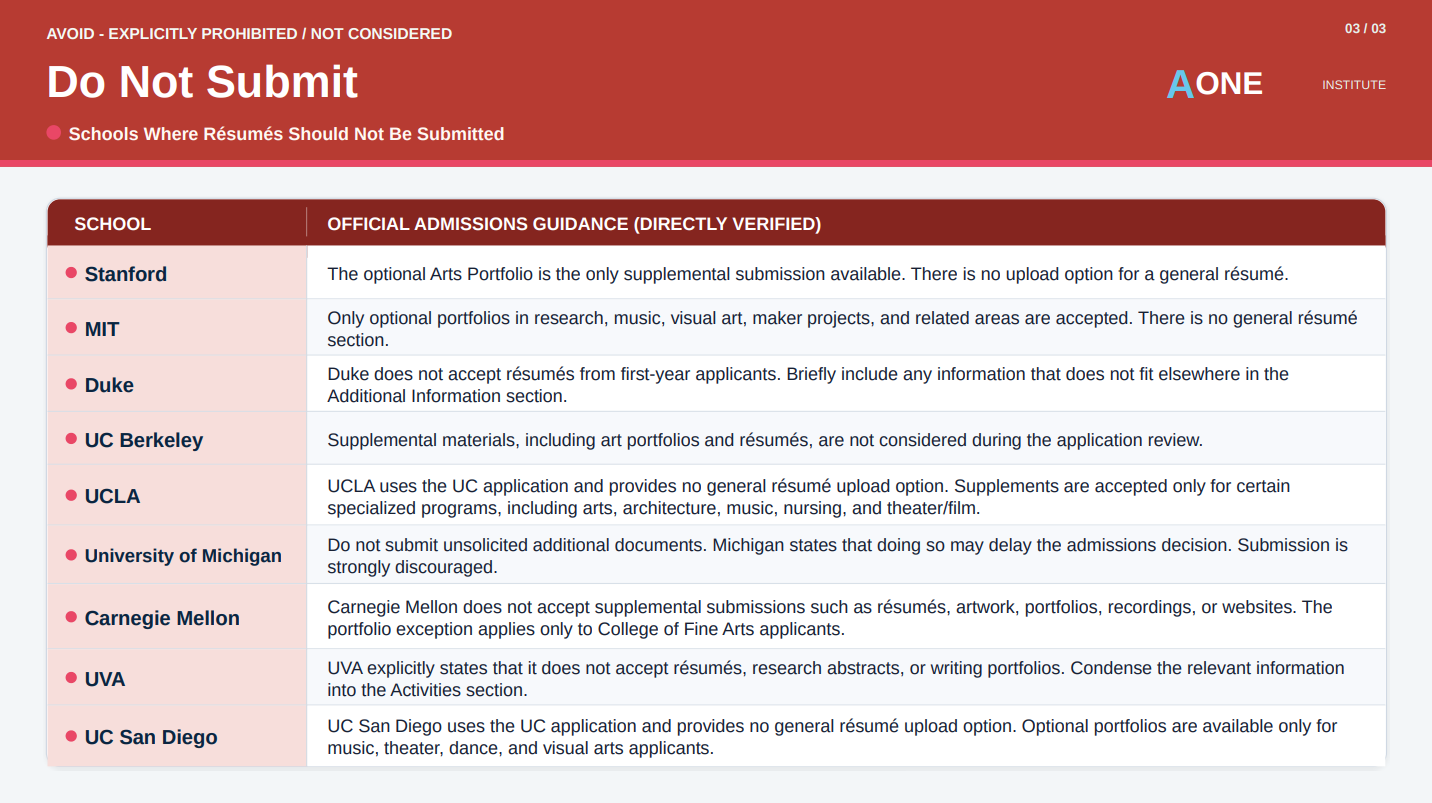
This is the most important category to know — because submitting a resume to these schools doesn't help and may actively create a negative impression.
Stanford — The only optional supplementary materials Stanford accepts are arts portfolios for students who wish to submit one. There is no resume upload function in Stanford's application portal. Do not submit a general resume.
MIT — MIT limits the activity section to four entries — a deliberate signal about how the university thinks about extracurricular information. Additional unsolicited materials run against that philosophy. MIT does not want a resume.
Duke — Duke does not accept resumes from first-year applicants. Students who have information that doesn't fit in the activity section are directed to use the Additional Information field instead.
UC Berkeley, UCLA, and the UC System generally — UC applications are built around a detailed Personal Insight Question format that asks students to address specific aspects of their experience in writing. The application is intentionally self-contained, and UC schools do not accept supplementary resumes. Do not submit one to any UC campus.
University of Michigan — Michigan is the most explicitly discouraging school on this list. The institution has made clear that resume submissions are strongly discouraged, making it the clearest "do not submit" case among all the schools covered here.
Carnegie Mellon and UVA — Both institutions have indicated, through official guidance, that they prefer applicants not to submit resumes. This is a firm preference, not simply a neutral policy.
A Practical Framework for the Schools Not Listed Here
For any top-30 school not covered above, the default assumption is that resume submission is permitted. When in doubt, check the school's official admissions portal guidance — most schools are explicit about what optional materials they accept and how those materials are reviewed.
Knowing which schools accept resumes is only part of the equation. The more important questions are: when you do submit a resume, what order should the content follow — and how do you write it so that it complements rather than duplicates the activity section?
Those questions matter because the admissions reader who reviews your activity list is the same reader who will see your resume. The two documents are evaluated as a pair. A resume that simply echoes the activity section wastes the opportunity entirely; one that adds genuine new dimension strengthens the overall impression.
At A ONE Institute, we help students build activity sections and resumes that work together as a coherent, non-redundant presentation of who they are. If you're preparing your application and want guidance on how to approach these documents for your specific list of schools, we're here to help.
college resume
Common App, activity section
college application strategy
supplementary materials
