
When students fill out the Activities section of the Common Application, the biggest risk usually isn't leaving something out — it's overselling what's actually there. Title inflation, vague filler language, listing every routine duty instead of the one thing that matters, and overstating your role in someone else's work are the four mistakes we see most often, and each one is enough on its own to make an admissions officer stop trusting the rest of an application. Below are four real activity entries, shown first as students originally drafted them and then as they should have been written, so you can see exactly what separates a credible entry from one that raises red flags.
Understanding the Common App Activities Section
Every student applying through the Common Application can list up to ten activities. For each one, you choose an activity type from a list of thirty options, then fill in a Position/Leadership description in 50 characters or fewer, indicate whether it's a school club or an outside organization in 100 characters or fewer, and — the field that matters most — describe the activity itself in 150 characters or fewer. You also select the grade levels you participated in, whether the activity took place during the school year or during a break, how many hours per week and weeks per year you spent on it, and whether you intend to continue the activity in college.
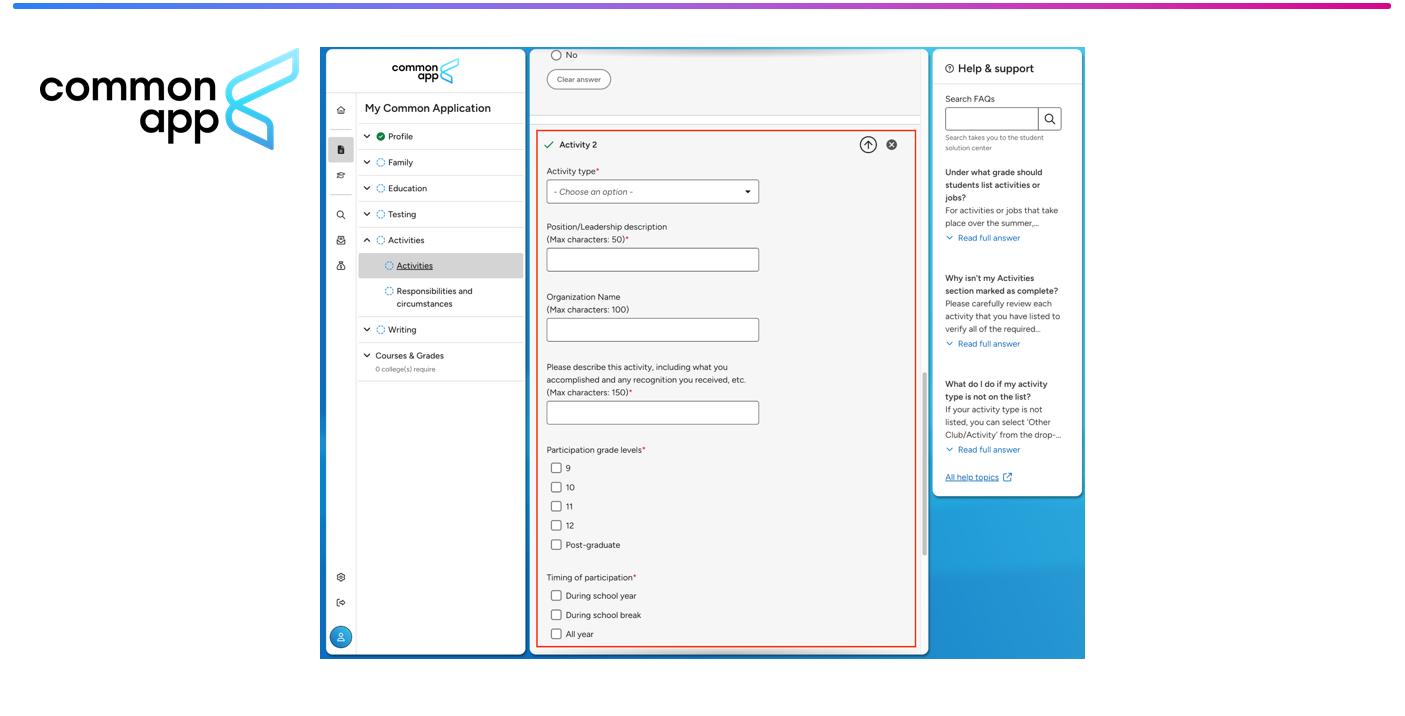
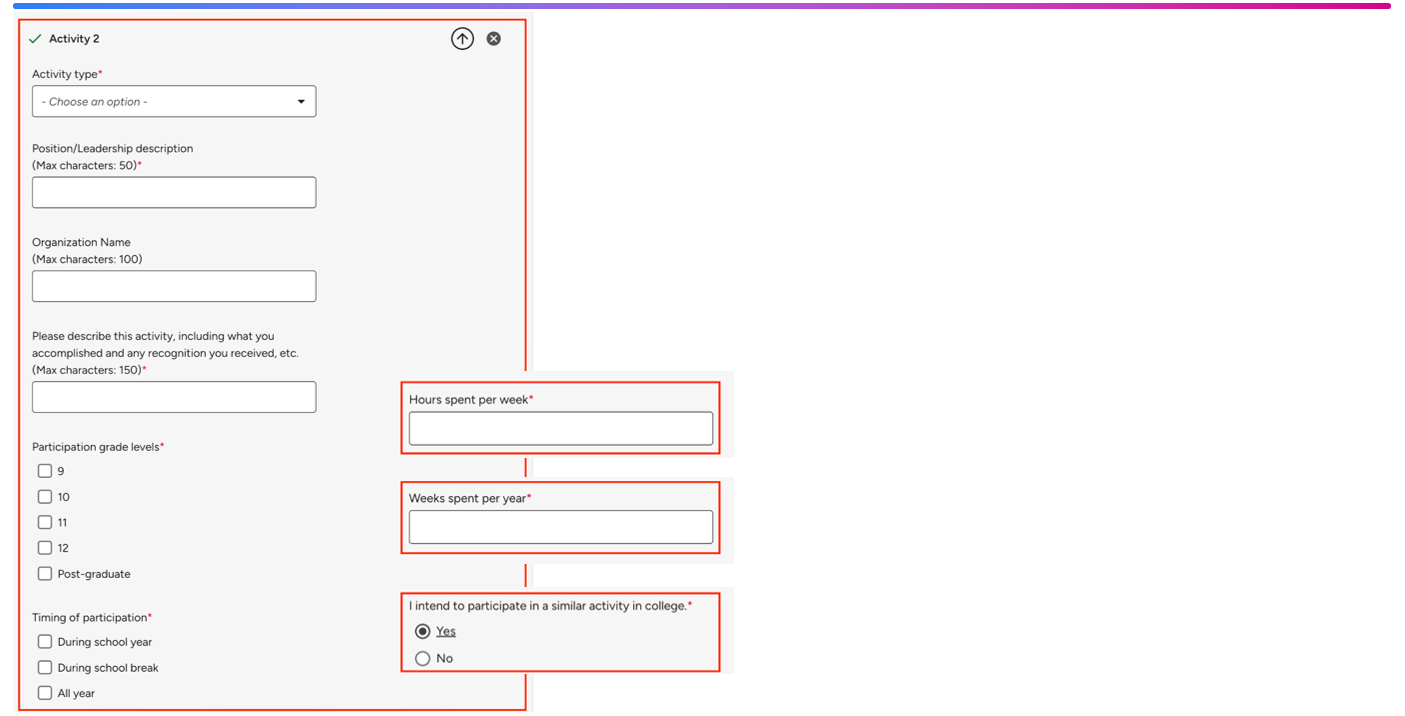
With only 150 characters to describe an entire year — or several years — of involvement, students often reach for one of two shortcuts: making the position sound bigger than it was, or filling the description with impressive-sounding language instead of specifics. Both backfire. Here's what that looks like in practice, and how to fix it.
Mistake #1: Inflating Your Title
Student #1
Consider a student in 11th grade who has been a general member of her school's Eco Club since the fall of 10th grade. Her official title is simply "member." What she actually did was design event posters three times, hand out roughly 80 seedlings at an Earth Day booth, and make six recycling signs for the cafeteria — about two hours a week between lunch and after school.
The mistake: listing her position as "Co-Founder & Outreach Director" and describing her role as leading a "campus sustainability outreach campaign." Neither is true, and that matters for a reason beyond honesty alone — a counselor's or teacher's letter of recommendation may describe this same club involvement, and if it says "member" while the application says "Co-Founder," the mismatch undermines the rest of the file.
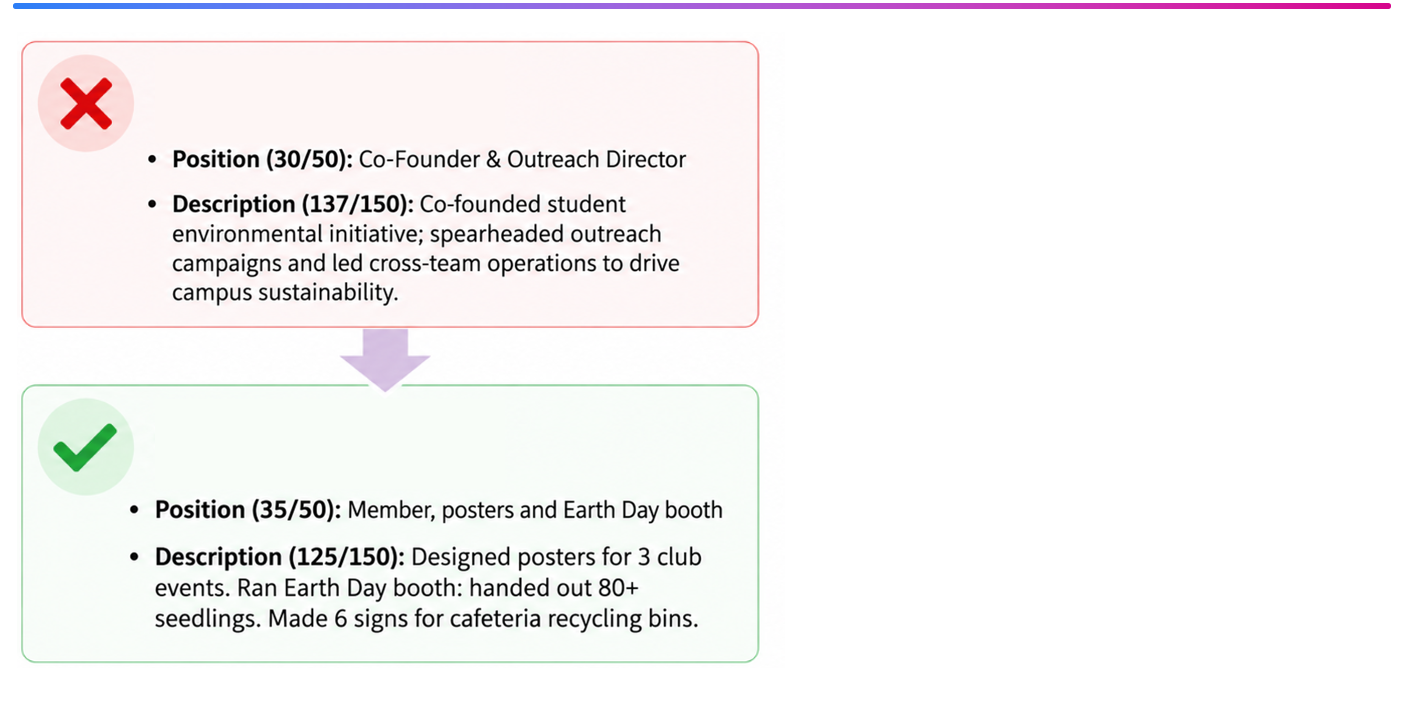
The fix isn't just to write "member" and stop there — that reads as flat and forgettable. It's to pair the honest title with the specific contribution: designed posters for three club events, ran the Earth Day booth and handed out more than 80 seedlings, made six signs for the cafeteria recycling bins. Specific numbers describing exactly what a student personally did are far more convincing than an inflated title, and they read as more genuine because they're precise enough that they couldn't be describing someone else's work.
Mistake #2: Filling the Description with Vague, Overused Language
Student #2
A different student tutors elementary reading at a local Korean community center on Saturday mornings. She works with four students in grades 1 through 3. Over one semester, two of them moved up a reading level, one is still working through phonics, and one recently immigrated and isn't yet ready to move at the same pace.
Her position title, "Volunteer Tutor Mentor," was fine. The problem was the description: "passionate volunteer dedicated to fostering literacy and empowering underserved youth through impactful weekly tutoring sessions." Every word sounds meaningful and says almost nothing. Admissions readers see language like this hundreds of times a day — so often that it barely registers as an actual sentence describing an actual person.
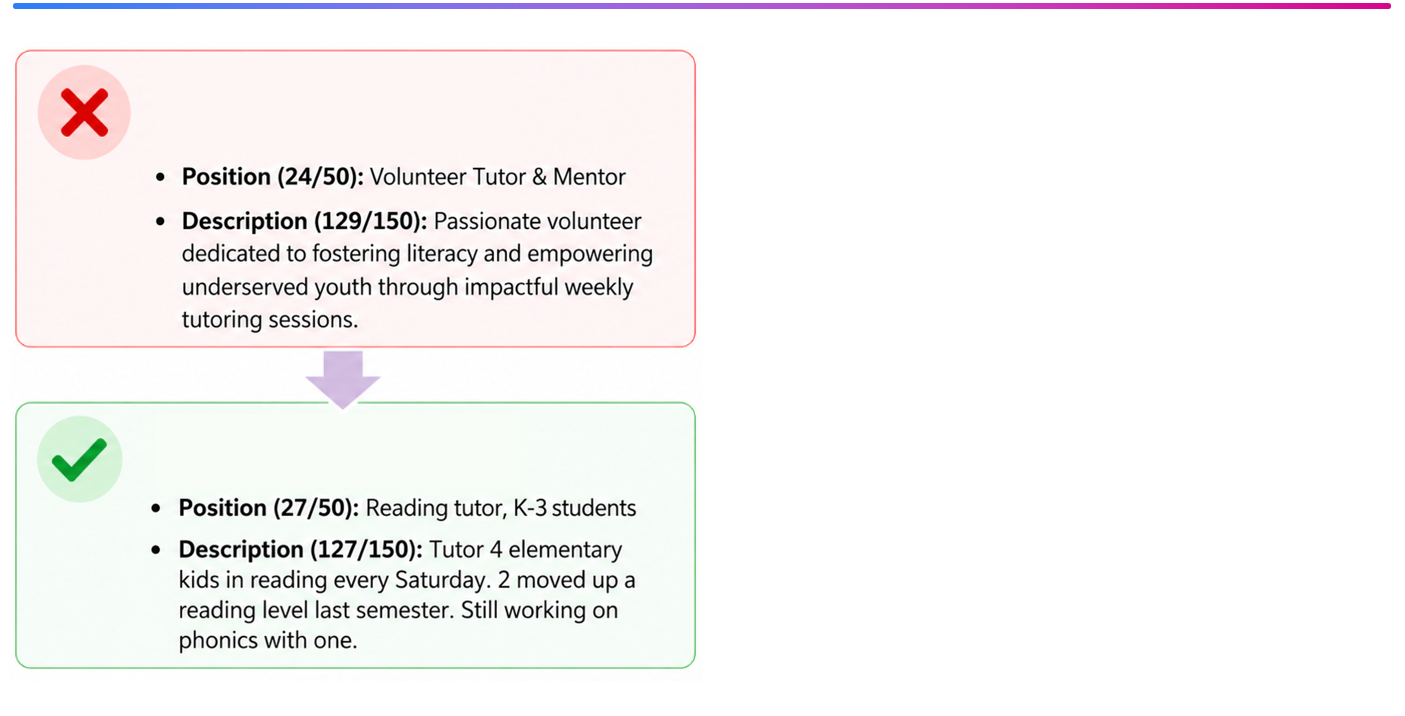
A claim like "all four students improved significantly" is exactly the kind of vague, unsupported statement to avoid — it isn't what actually happened, and it reads as abstract rather than true. The stronger version says only what's real: tutors four elementary kids in reading every Saturday, two moved up a reading level last semester, still working on phonics with one. It reads as more believable precisely because it's specific — the kind of detail that's hard to fabricate, which is exactly why admissions readers trust it.
Mistake #3: Listing Every Duty Instead of Highlighting Your Impact
Student #3
A student serving as Opinion Section Editor for her school newspaper had a genuinely full role: editing five to six opinion articles every issue, mentoring a 10th-grade staff member, attending weekly meetings, and taking part in some page design. When the cafeteria policy changed in the spring of 11th grade and students had complaints, she proposed and launched a new column for student responses, which was approved and ran.
Everything in her first draft was true. The problem was that she tried to fit all of it in: "Edit articles, manage layout, coordinate writers, attend weekly meetings, mentor new staff, design pages, and collaborate with faculty advisor." Read quickly, it's hard to tell what she actually accomplished, because most of what's listed is simply what any Opinion Section Editor does by default.
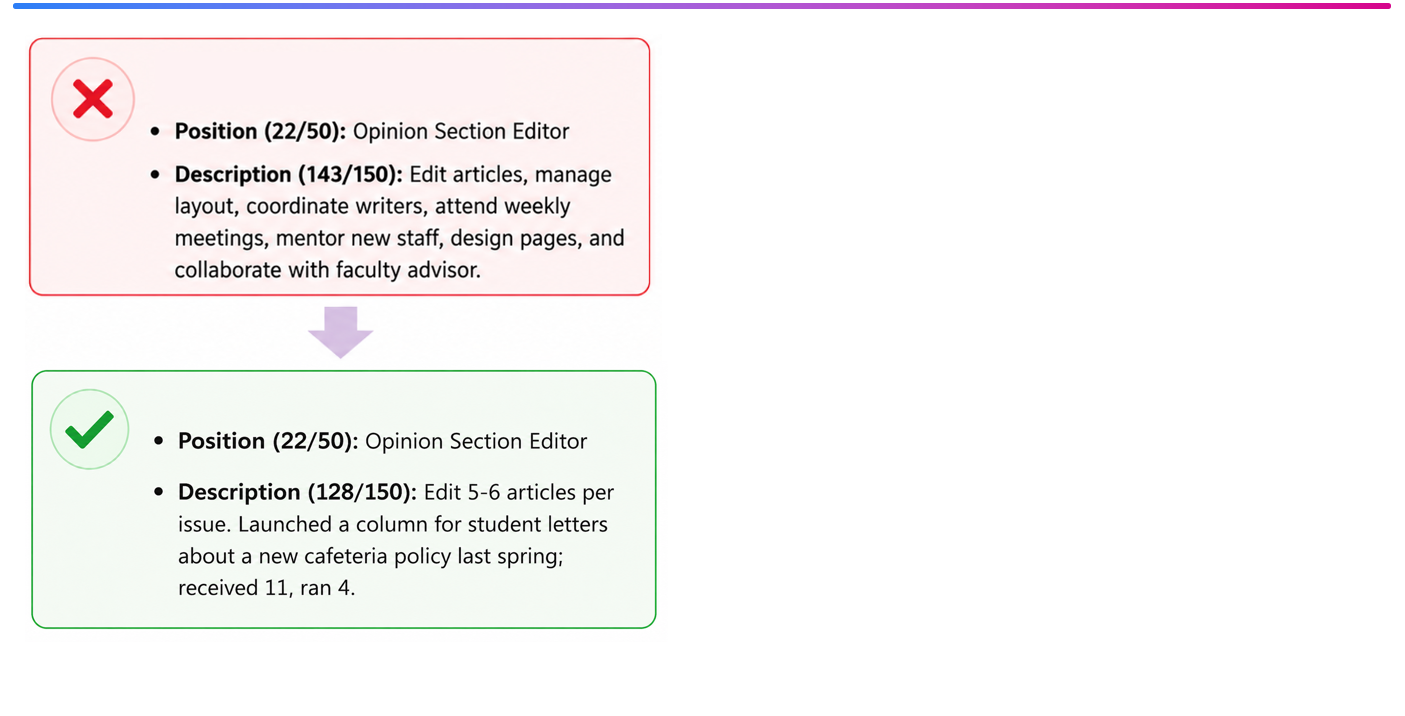
The stronger version cuts the routine duties down to a single phrase and spends the rest of the 150 characters on the one thing that shows initiative: "Edited 5-6 articles each issue. Launched a column for student letters about a new cafeteria policy last spring; received 11, ran 4." Each piece of that sentence is doing different work — the article count shows the scale of her regular workload, "last spring" anchors the claim to a specific, verifiable moment, the 11 submissions show that students actually responded to what she built, and running only 4 of them shows her own editorial judgment. Duties that come standard with a role don't need to be spelled out; what's worth the character count is the specific thing that shows initiative.
Mistake #4: Overstating Your Role in Someone Else's Research
Student #4
A student began interning at a state university neuroscience lab the summer before 11th grade, with no official title beyond assisting a PhD student. Her actual tasks were entering data from about 200 trials of a rat behavior experiment, setting up and organizing lab equipment, attending lab meetings, and occasionally helping build graphs with software — about 20 hours a week in the summer and 4 hours a week on weekends during the school year.
The mistake here had two layers. First, the position was listed as "Neuroscience Research Project" — a category label, not an actual title — instead of the more accurate "Summer Intern." Second, the description said she "conducted neuroscience research at university lab studying rat behavior" and "performed data analysis and contributed to ongoing experiments." Read on its own, that sounds like she was leading the research. For a high school student, a claim like that invites skepticism from an admissions officer — and because the organization name field already reveals exactly where and at what level this work took place, an inflated description next to an honest organization name simply doesn't add up.
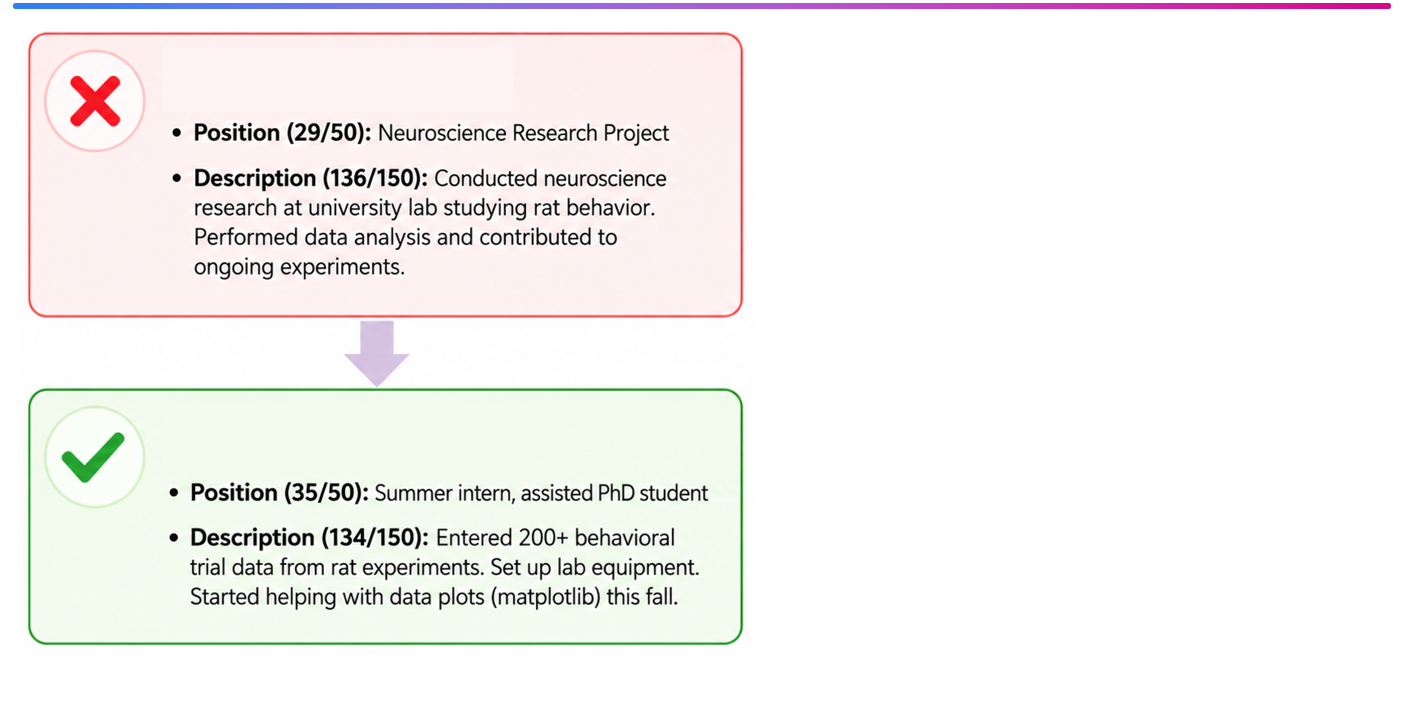
The honest version reads as far more credible: entered data from over 200 behavioral trials from rat experiments, set up lab equipment, started helping with data plots using matplotlib in the fall. It sounds exactly like what a high school intern supporting a PhD student's research would actually do — because it is.
One more note on the Position field specifically: it's meant to describe your actual role, not the category of what you did. Writing "Project" or "Activity" into that field, instead of an actual position title, is one of the most common mistakes we see.
The Pattern Behind All Four Mistakes
Title inflation, vague filler language, listing routine duties instead of a real contribution, and overstating your role in someone else's work all come from the same instinct: trying to make 150 characters sound more impressive than the truth. In every one of these four cases, the honest, specific version read as more convincing than the exaggerated one — not less. These four examples aren't the only ways students undercut a strong activity, either. Repeating information you've already given elsewhere in the entry, restating the organization name inside the description itself, and the order in which you list your ten activities all deserve just as much attention.
Reviewing ten Common App activities line by line — checking every position title, every description, and every character against what actually happened — is exactly the kind of detail work that's easy to get wrong alone. A ONE Institute works with students on their full Activities list, entry by entry, to make sure each one is honest, specific, and doing its job. If you'd like a second set of eyes on your list before you submit, reach out to us.
Common App Activities Section
College Application Mistakes
Extracurricular Activities
Common App Tips
Activities List Writing
