
With early decision and early action deadlines roughly six months away, this is the question 11th grade parents ask most often: what exactly should we be doing with the time that's left? The honest answer is that a brand-new, headline-worthy achievement — the kind of standout accomplishment often called a "spike" or a "hook" — is very unlikely to appear out of nowhere in this window. If a student hasn't built that level of activity since 9th grade, six months is not enough time to manufacture one. That reality should shape everything else about how these final months are spent.
How College Admissions Officers Grade Extracurricular Activities
To understand why a new spike is so hard to produce in six months, it helps to understand how these activities are evaluated in the first place. Every activity a student pursues — a school club, a sport, an art practice, an academic competition, a research project submitted to a science fair, or a humanities-focused competition or research effort — ends up being ranked on a rough tier scale. An activity that places a student among the top performers nationally is considered a national-level (Tier 1) achievement. An activity strong enough to rank among the top performers in a state is roughly a Tier 2 (with finer distinctions like 2+ or 2- within that). Serving as a school representative in something typically lands around a 3+.
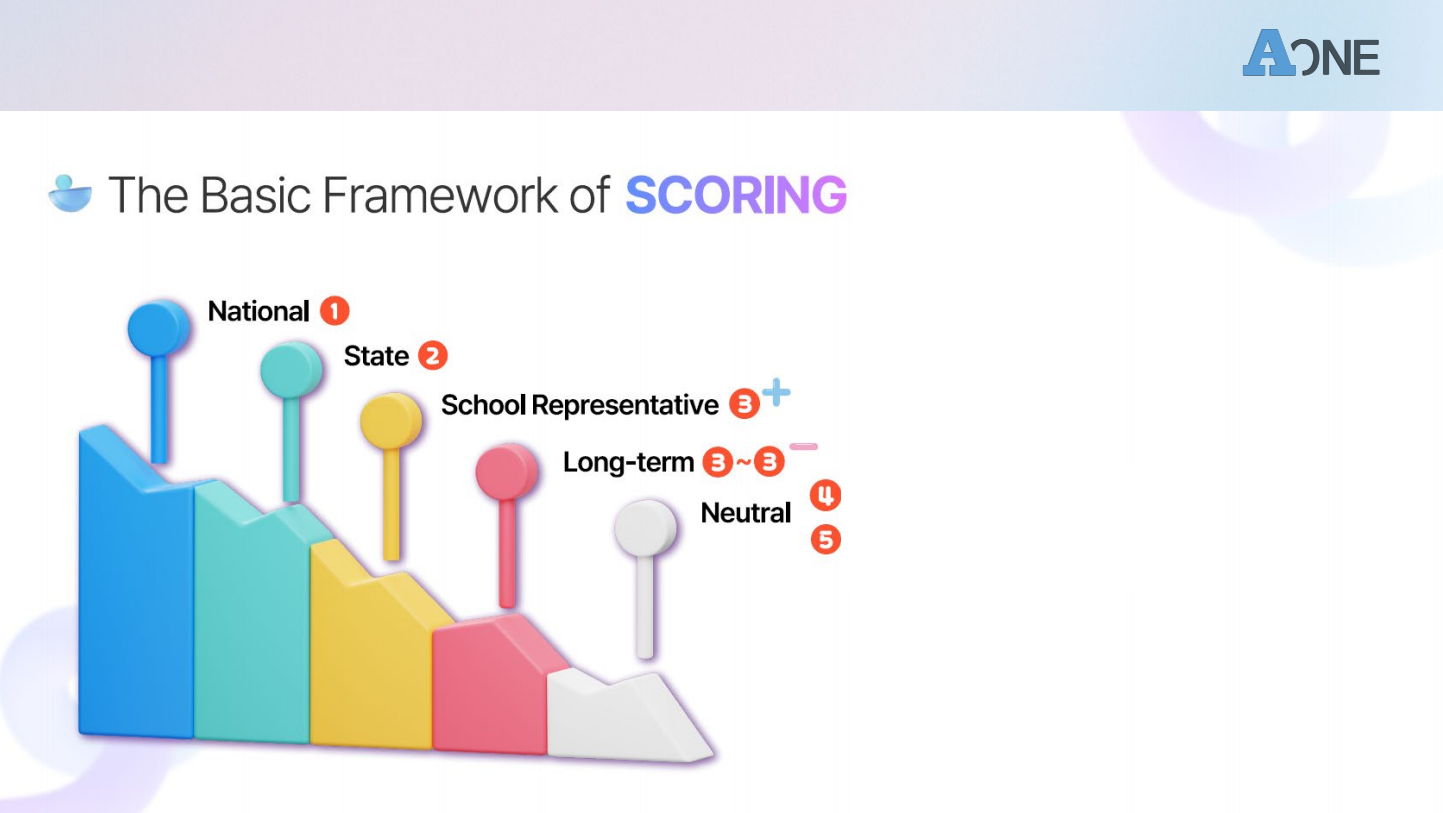
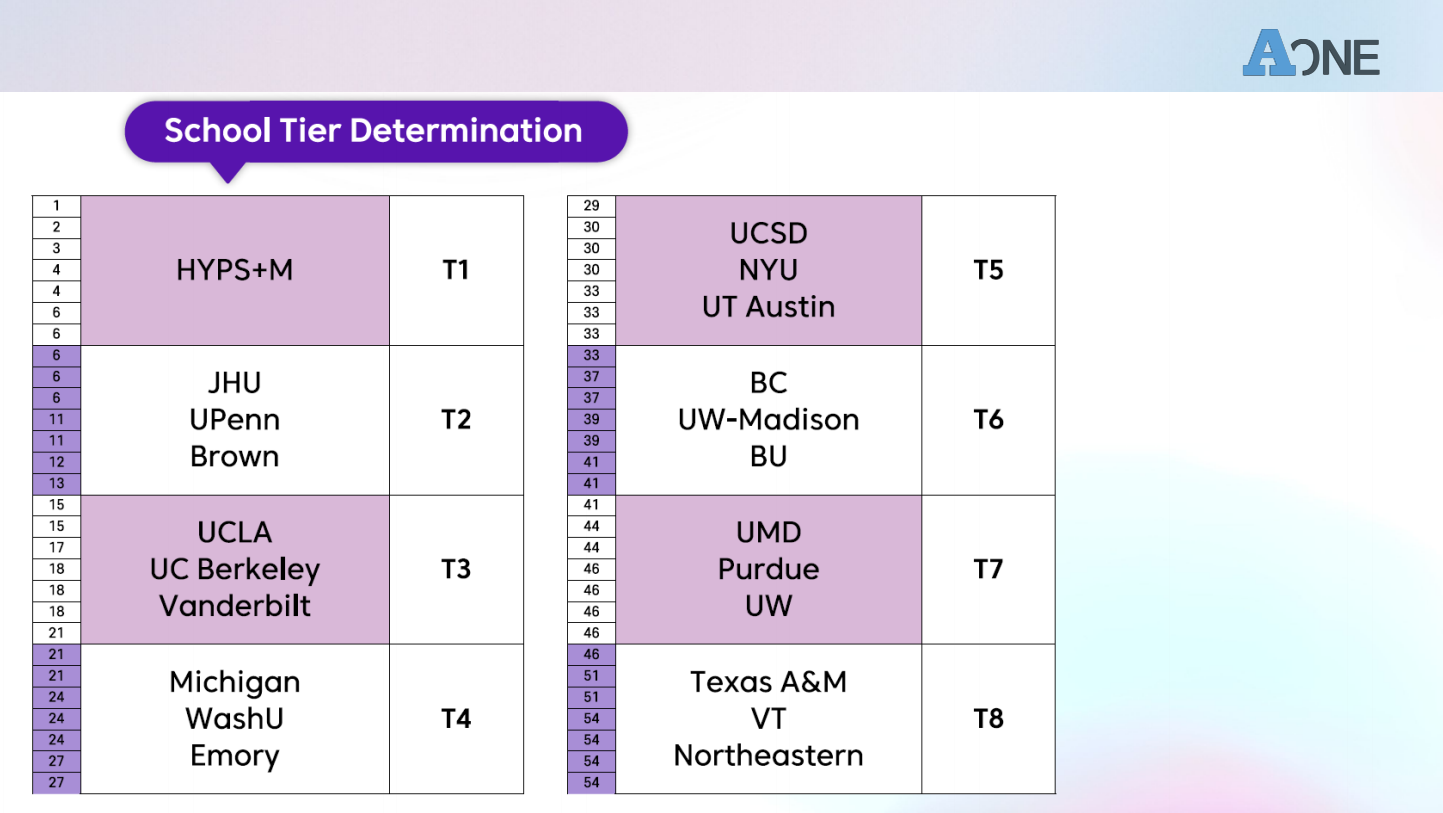
Once a student's various activities — extracurriculars, academics, athletics, music, everything — are tallied up this way, the highest tier they've reached becomes the most important single factor, followed closely by how well those activities connect into a coherent narrative. Together, these two things largely determine which tier of college a student can realistically target. A tier chart like the one below only lists a handful of representative schools per tier — there are many more schools within each band — but it illustrates the point.
Why Raising Your Tier in Six Months Is So Difficult
Take a student whose highest-ranked activity currently sits at a 2- level. To meaningfully move that student's target-school tier upward in the time that's left, adding another 3+ or 4+ activity won't do it — what's needed is an activity that breaks through to a higher tier than anything the student has achieved so far. Reaching that level of accomplishment in six months is extremely difficult for most students.
So what should students actually do with the time they have? First, don't stop what's already in motion — go deeper into it. Use these six months to add depth to existing activities and, wherever it genuinely makes sense, connect activities that have been running independently of each other into a single, coherent story. If two activities can't be honestly connected, don't force it — but where a real connection exists, weaving those threads together is one of the most productive uses of this window.
Why How You Describe an Activity Matters as Much as the Activity Itself
The second — and arguably more important — task for these six months is learning to describe each activity well. When an application is submitted, a first reader evaluates it, and because that reader is working through a large volume of applications, they typically spend somewhere between four and twelve minutes per file, averaging around six to eight minutes. Since a student's activity tier is already essentially fixed at this point, the way each activity is written becomes the main lever left for creating impact.
Inside the Common App Activities Section: What's Changed
On the Common App, students describe their activities through two main channels: the ten-activity list and an optional resume upload (note that not every college accepts the resume, which is part of why the ten-activity list deserves the most attention). It's worth reviewing the current version of this section, since some meaningful updates have rolled out recently.
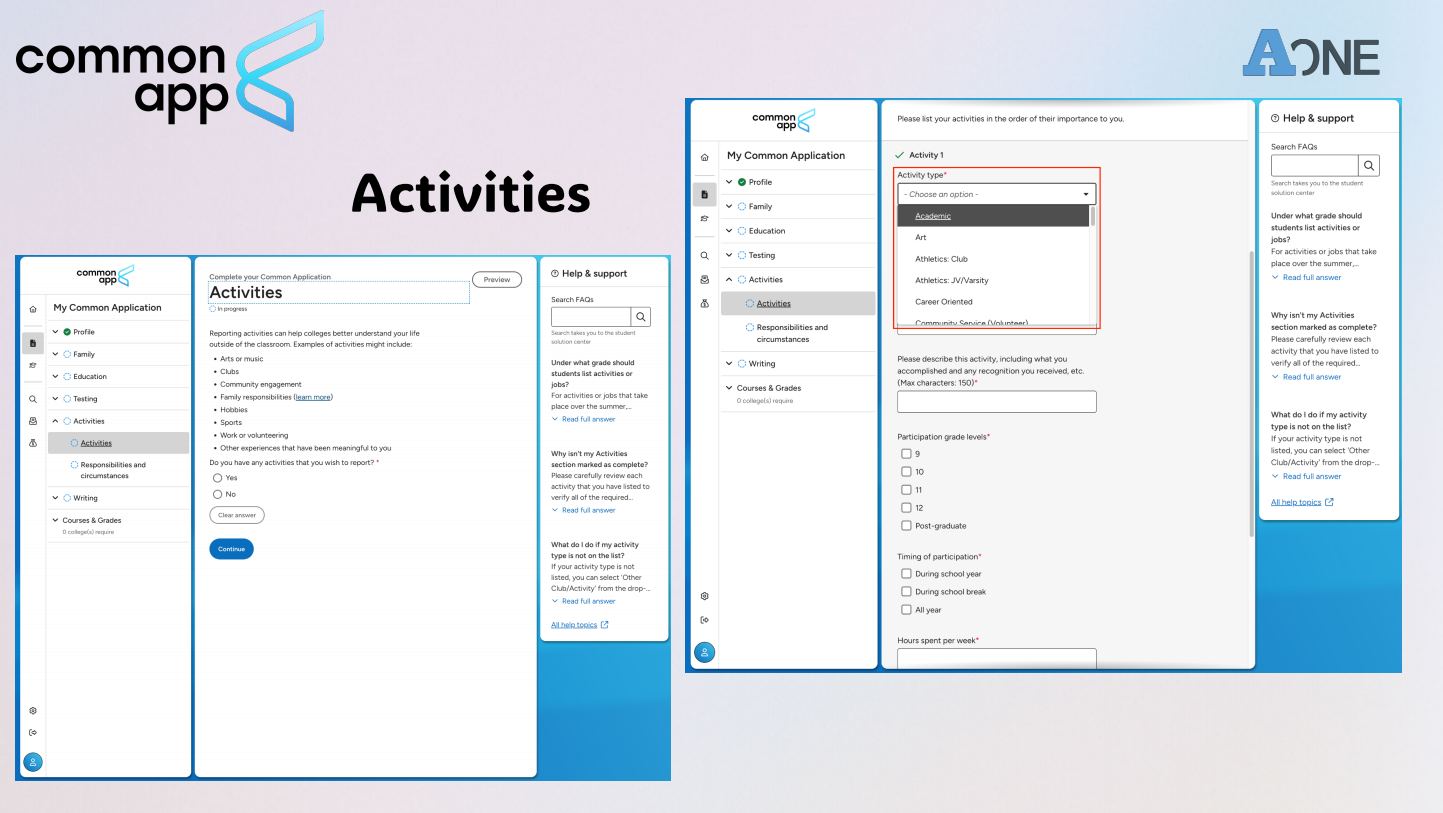
One update involves the Additional Information section — a separate space where students can share information beyond the ten listed activities. Its word limit was reduced from 650 words down to 300.
This reduction matters because many families were misusing that space. After filling out ten activities, students often feel they've done far more than ten things worth mentioning — so they'd try to stuff an eleventh or twelfth activity description into the Additional Information section. That was never its intended purpose. Additional Information exists for the rare case where an activity genuinely can't be understood without extra background — not as an overflow bucket for more activities. Cutting the word count in half signals that Common App wants students to focus their energy on writing the ten listed activities well, rather than trying to squeeze in more.
The second update concerns how family responsibilities are treated. In the past, contributions like caring for family members or helping with a parent's work were somewhat undervalued in how applications were read. Common App has since placed much more emphasis on this kind of contribution, and extensive research informed the decision to expand that recognition. Household labor and family responsibility can now be written up as a legitimate activity, and colleges are reviewing it favorably.
What to Do When Writing Each of the Ten Activities
With those two updates in mind, here are several things students should actively do when writing this section.
Compress each description into 150 characters of action and result
After selecting an activity type, students fill in a Position/Leadership field (50 characters), an Organization Name (100 characters), and a description of the activity (150 characters, not 150 words) — so the description has to be tightly compressed.
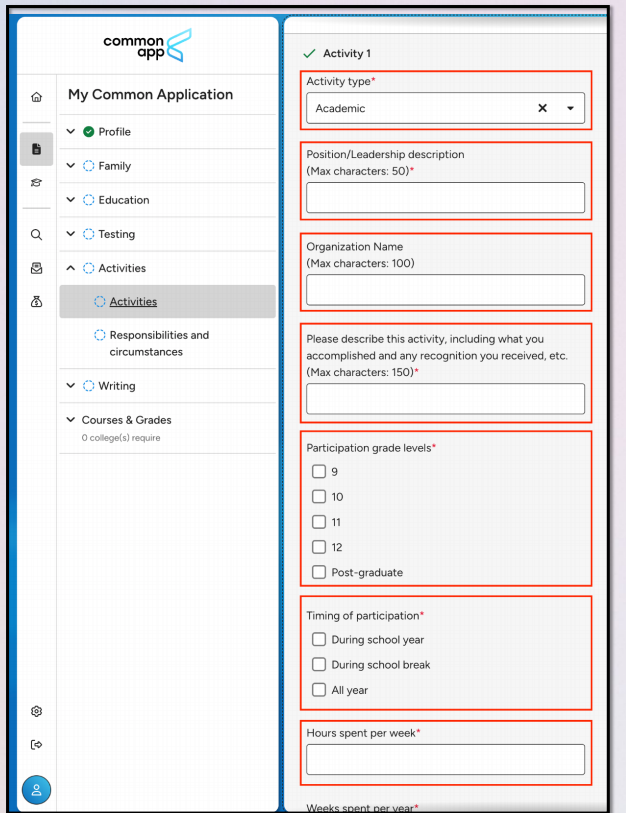
Since the position and organization are already stated separately, there's no need to repeat "I" or restate the organization's name inside the 150-character description, and since total hours are entered elsewhere as a number, there's no need to mention time either. Stripping out all of that leaves room to focus purely on what was done and what came of it.
Order activities by importance, not by how impressive they look
Sequencing matters a great deal here. Activities should be listed starting with what is most important to the student personally and most central to their values — not simply ranked by which one produced the most impressive outcome. That said, this isn't purely a personal exercise: the order also needs to read as a narrative that makes sense to the reader, one where the reasoning behind the sequence feels coherent as they go through it. An activity with a strong, visible achievement can absolutely sit near the top, but it shouldn't automatically be Activity 1 — the first slot belongs to whatever the student considers most important. Also note that anything already reflected in the separate Honors section (which has five slots of its own) doesn't need to be repeated here.
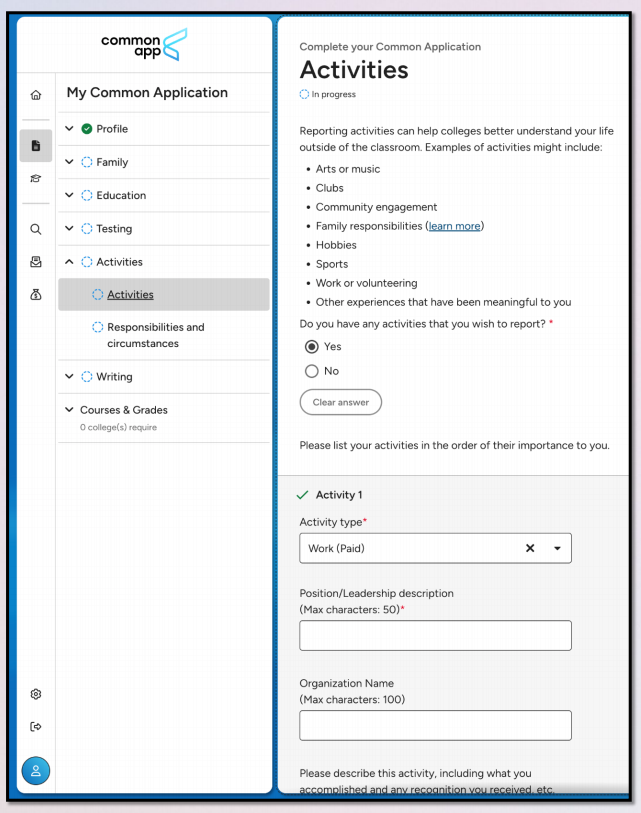
Choose the correct activity type from the official list — don't pick what "sounds good"
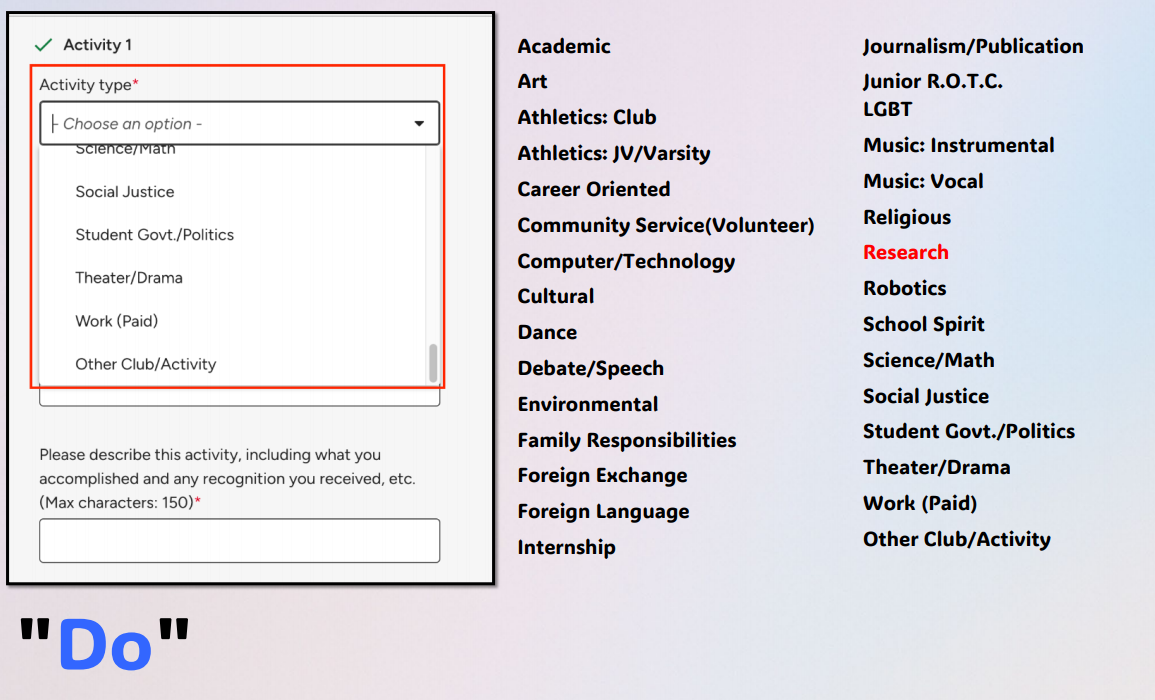
Students can select from a list of official activity type categories — 30 options now, up from 29 previously. Choosing a type just because it sounds impressive, rather than the one that actually matches what the student did, is a mistake. One notable addition is "Research" as its own category (previously, research fell under "Academic"). The fact that Research now has its own dedicated category signals how much more weight it's carrying in admissions overall — an area worth paying close attention to. Choosing the wrong category doesn't just cost a few points on some hidden rubric; it can shift how the reader perceives the credibility of the entire activity.
Recognize that family responsibility and paid work count as real activities
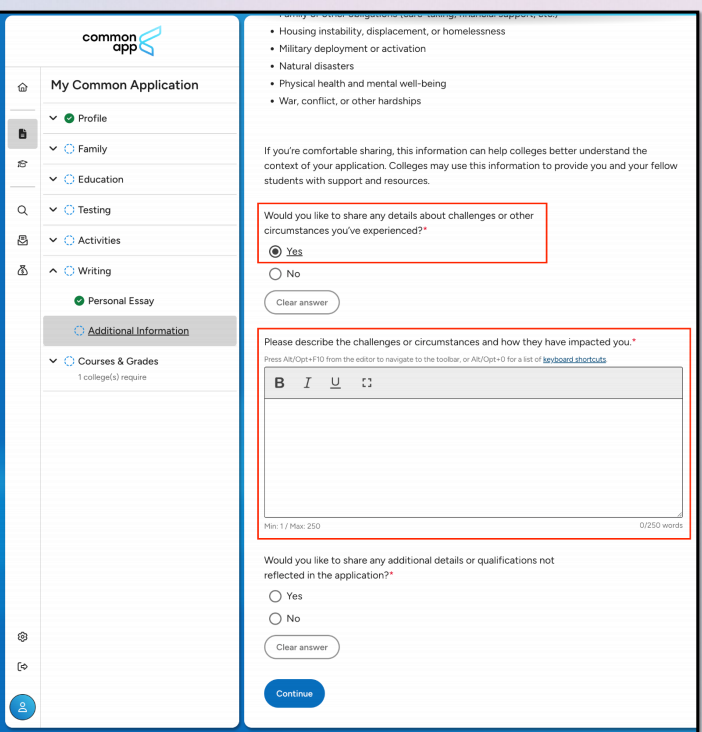
In line with the broader shift toward valuing household and caregiving contributions, students who have supported a family member with a disability, helped care for a sibling who needed more attention, prepared meals at home, or served as an interpreter for a 1.5-generation parent can legitimately describe these as activities (there's a 250-word space for this, where relevant details can be shared).
Leave slots blank if there simply aren't ten real activities to list
It's important to be able to say no to filling every slot. Forcing a count to exactly ten by padding the list with weaker or unrelated entries is something admissions readers can spot immediately — and it leaves a poor impression, since it reads as though everything past the fifth or sixth activity was added just to hit the number. If a student genuinely has five or six activities worth including, listing only those and leaving the rest blank will not hurt their application.
Between the ten Common App activities and the optional resume, how these final months are spent matters more than most families realize — which is exactly why so many applications in this area end up needing significant revision after the fact.
A ONE Institute's Approach
Because this part of the application is so frequently mishandled, A ONE Institute has restructured its schedule from June through October to focus specifically on helping 11th grade students and families with the ten-activity list and resume writing. If you have questions or need guidance as you work through this section, A ONE Institute's consulting team is available to help.
Category: College Admission
Tags: Common App Activities, 11th Grade Application Strategy, Activity List Writing, Common App Updates, A ONE Institute
Common App Activities
11th Grade Application Strategy
Activity List Writing
