
Doing Research and Winning With Research Are Two Different Things
At A ONE Institute, we've emphasized research repeatedly as one of the most effective ways for students to demonstrate intellectual curiosity and academic depth in a college application. That's still true.
But there's a distinction worth making clearly: conducting research and placing in a competitive science fair are not the same activity, and they require somewhat different preparation.
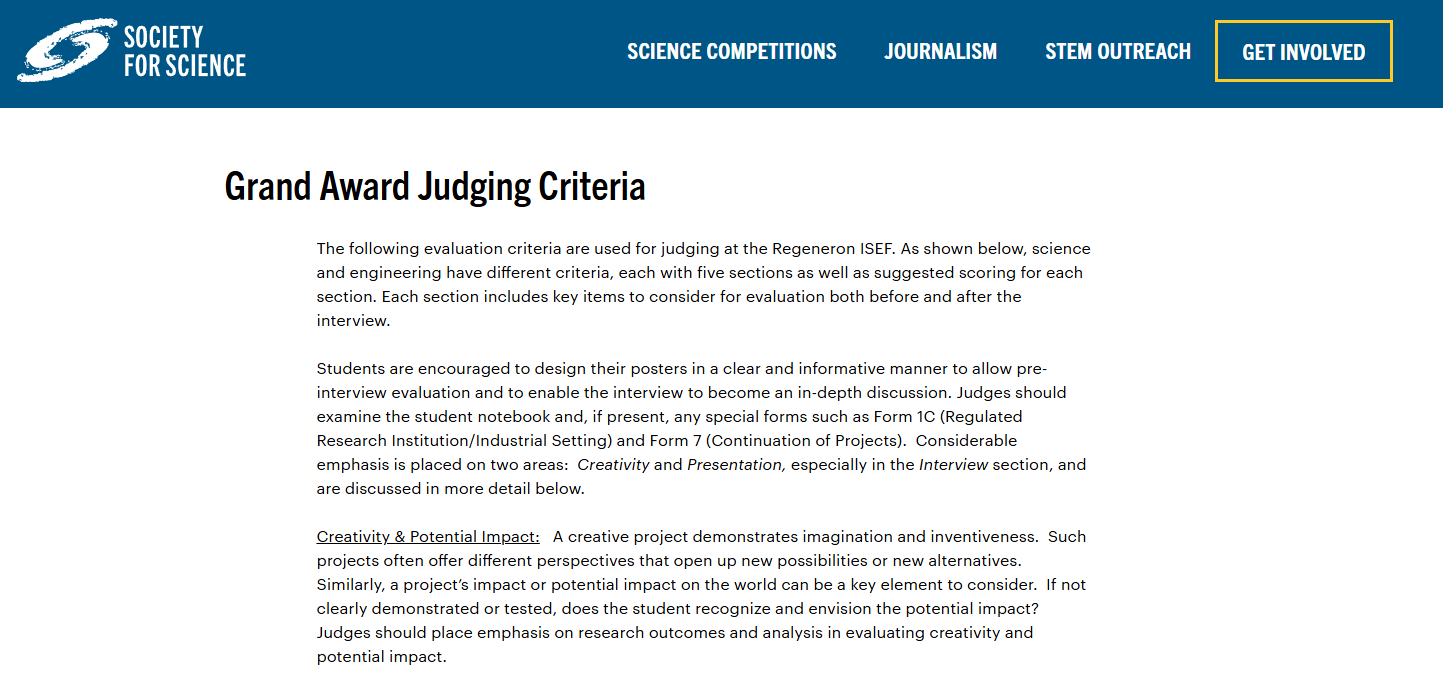
This article focuses specifically on what it takes to place — drawing directly from ISEF's published scoring criteria, the most rigorous and widely recognized science fair competition available to high school students. The same framework applies to affiliated science fairs that feed into ISEF, and it transfers well to other competitive research venues including journals that evaluate high school submissions.
The ISEF Pathway — and Why It Matters
ISEF (the International Science and Engineering Fair) sits at the top of the science fair hierarchy for high school students. To reach ISEF International, students typically first compete at affiliated regional or state fairs, where top performers advance. This pathway structure means that performing well at affiliated fairs is the intermediate goal — and understanding what ISEF judges are looking for shapes how students should build their projects from the start.
A practical note on sequencing: the most efficient path to competitive research recognition is generally to pursue science fairs before attempting journal publication, not the other way around. Science fairs provide structured external evaluation and feedback that can then inform how the work gets prepared for submission to a journal. Starting with a journal submission delays that feedback loop unnecessarily.
I. Research Question — 10 Points
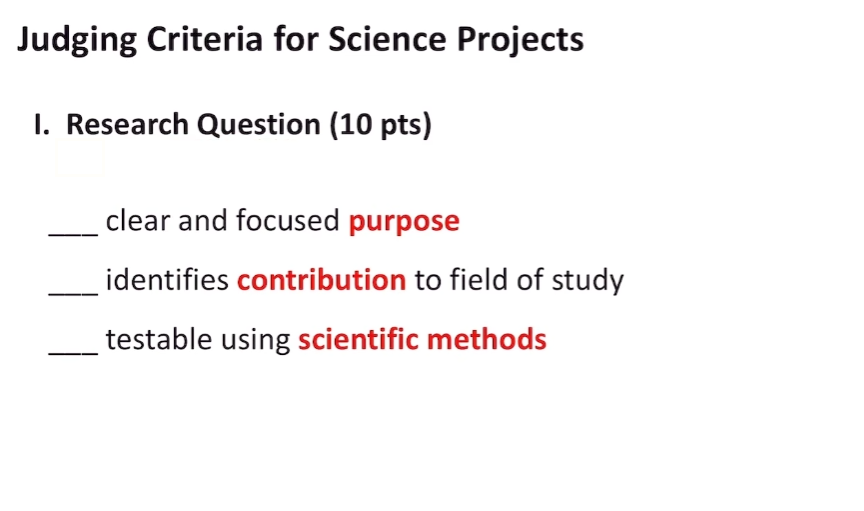
Judges evaluate three things here: whether the question has a clear and focused purpose, whether it identifies a contribution to the field of study, and whether it is testable using scientific methods.
On paper, 10 points may seem modest. In practice, this category is the most consequential of all — because the quality of the research question shapes every other category downstream. A poorly framed question makes sound methodology harder to execute, makes data interpretation murkier, and signals to judges before they even read the methodology that the project may have structural weaknesses.
What a strong research question looks like:
Enhancing the stability of n-type organic electrochemical transistors via chemical doping.
This title communicates the purpose (enhancing stability), the specific target (n-type organic electrochemical transistors), and the method (chemical doping). A judge reading this title immediately understands what the study is investigating and why it matters.
Quantifying microplastic concentration in coastal waters using spectroscopy-based analysis.
Again — a specific target, a specific goal, and a specific method. The scope is narrow enough to be answerable.
What a weak research question looks like:
Effect of music on brain activity or Music and neurological disorders.
These titles are so broad that no single study could meaningfully address them. The question isn't specific enough to have a focused answer, and judges reviewing the title before seeing any methodology will already be skeptical.
The structural principle: name the specific intervention or variable, the specific target, and the specific method or condition. A useful template:
- Improving X using Y under condition Z
- Investigating A within B under condition C
- Quantifying X in Y using method Z
Students currently mid-project should evaluate their research question against this standard: is it narrow enough to be answered? Does the title communicate what the study is investigating and how?
II. Design and Methodology — 15 Points
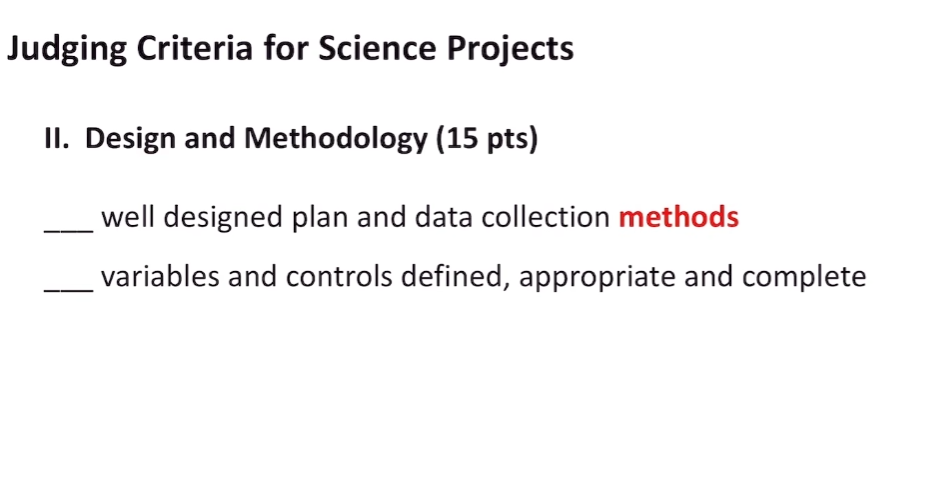
This category evaluates whether the study has a well-designed plan and data collection methods and whether variables and controls are defined, appropriate, and complete.
A well-chosen research question and a competent mentor largely resolve this category — but there are foundational errors that can undermine even well-designed projects. The most common and most damaging: failing to control variables.
Consider a simple example. A student wants to study how the angle of a solar panel affects its power output efficiency. If the student simply changes the angle while allowing temperature, light intensity, and panel type to vary randomly across measurements — then concludes that 45 degrees is optimal — that result is essentially meaningless. The output differences could be explained by any of the uncontrolled variables. Judges would view the methodology as fundamentally flawed regardless of how clearly the results are presented.
The correct approach: fix all variables except the one being studied. Temperature, lighting intensity, and panel type should all be held constant. Only by controlling everything else can the effect of angle be meaningfully isolated.
This is the same experimental design content covered in AP Science FRQ questions. The fact that it appears as a dedicated ISEF scoring category signals that judges encounter this error frequently enough to explicitly evaluate it.
III. Execution: Data Collection, Analysis and Interpretation — 20 Points
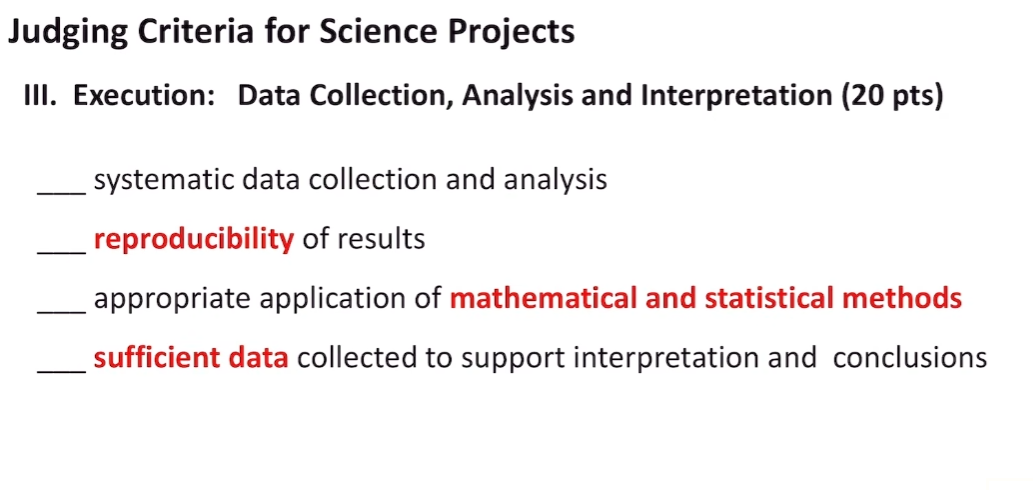
This category evaluates four things: systematic data collection and analysis, reproducibility of results, appropriate application of mathematical and statistical methods, and sufficient data collected to support interpretation and conclusions.
The practical reality: if the research question is well-defined and the methodology is sound, this category tends to resolve naturally during the process of actually conducting the research. Students who collect data inconsistently, skip statistical analysis, or run only a handful of trials will lose points here that could have been protected with proper planning.
On trial volume specifically: too few trials produce jagged, unreliable graphs. Running significantly more trials smooths the data distribution. Judges who are scientists — which they all are — notice immediately whether the data looks like three trials or thirty.
IV. Creativity & Potential Impact — 20 Points
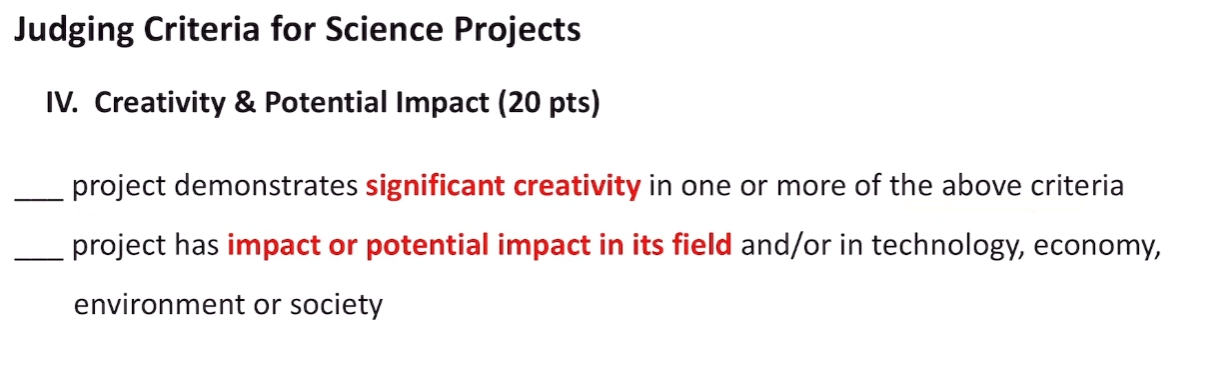
Judges evaluate whether the project demonstrates significant creativity in one or more of the above criteria, and whether it has impact or potential impact in its field and/or in technology, economy, environment, or society.
This is the category where many projects with technically sound science still fall short. Creativity doesn't require a completely unprecedented research topic — it requires a perspective or angle that produces something new within an established area.
Return to the solar panel example. A study that simply identifies the optimal angle for a fixed installation adds some value — but judges have seen this question before. A study that develops an automated tracking system continuously optimizing panel angle in real time based on climate conditions and time of day — and demonstrates a 12% increase in power output — is working in the same domain but asking a more specific and consequential question. The creativity comes from the angle of inquiry, not from inventing an entirely new field.
A more advanced example from biology: many students currently conduct research on protein misfolding and its relationship to neurodegenerative diseases like Alzheimer's and Parkinson's. A project that simply models accumulated misfolded protein correlating with disease progression documents something already well-established — it's not offering a novel perspective.
A more original approach within the same domain: introducing the concept of a threshold — the point at which accumulated misfolded proteins trigger a rapid, nonlinear escalation in disease progression. A study that models the dynamics of this threshold, or examines what happens to progression rates above versus below it, is working in the same biological territory but asking a question with meaningfully higher scientific interest.
The broader principle: originality requires finding a specific, non-obvious angle within an established area, and pursuing that angle rigorously. The difference between a generic study and an original one is often not the field or the methodology — it's the precise question being asked.
V. Presentation — 35 Points
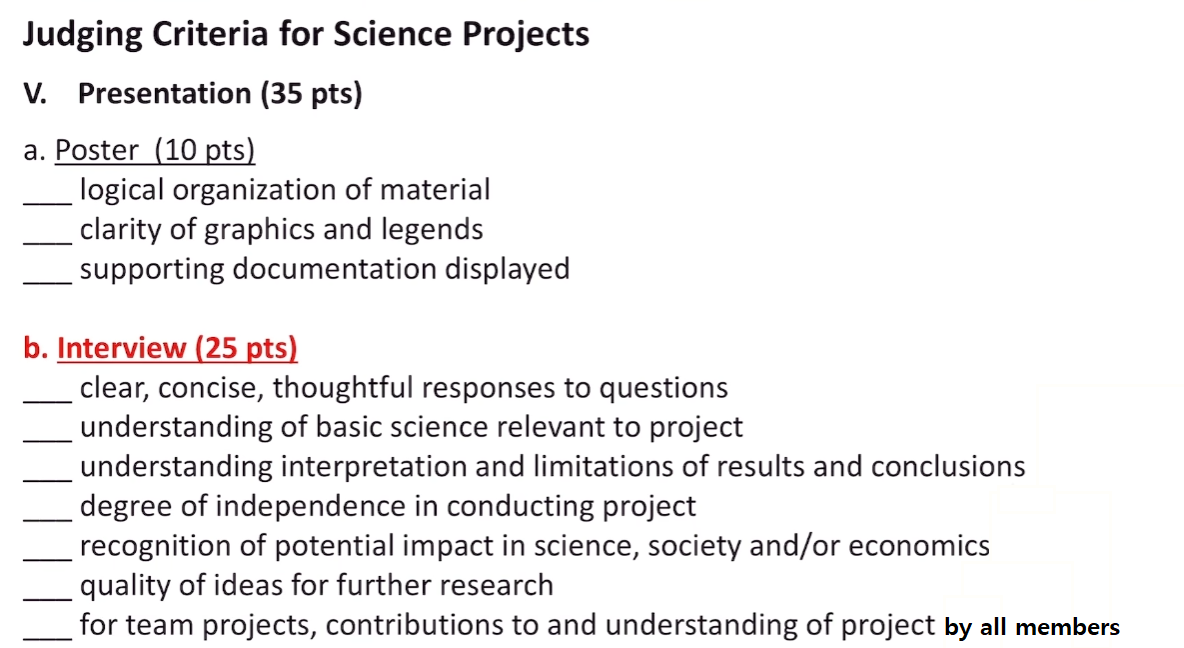
This is the single largest scoring category, and it's where many technically excellent projects are won or lost. It's divided into two subcategories.
a. Poster (10 points)
Judges evaluate logical organization of material, clarity of graphics and legends, and supporting documentation displayed. Most students prepare this reasonably well after rehearsal. The poster is what judges look at while the student explains their work — but 10 of the 35 presentation points are here, not the majority.
b. Interview (25 points)
This is where 25 of the 35 presentation points are allocated — and it's the most consequential single subcategory in the entire scoring framework.
The interview format: groups of five to eight judges circulate through the fair, stop at each poster, and ask the student to explain the research. After the initial explanation, the judges ask questions — specific, probing questions designed to evaluate how deeply the student actually understands their own work.
Judges evaluate seven things in the interview:
- Clear, concise, thoughtful responses to questions
- Understanding of basic science relevant to the project
- Understanding of the interpretation and limitations of results and conclusions
- Degree of independence in conducting the project
- Recognition of potential impact in science, society, and/or economics
- Quality of ideas for further research
- For team projects: contributions to and understanding of the project by all members
The judge panel is deliberately cross-disciplinary. For a biology project, three or four judges may have biology expertise while the rest specialize in chemistry, physics, or other fields. All of them are watching how the biology-expert judges react to the student's responses — so a student who fails to satisfy the domain experts visibly affects how the entire panel perceives the project.
The degree of independence criterion is assessed indirectly through the quality of answers. A student who deeply understands their own research can handle specific, unexpected questions. A student who conducted the work mechanically, without fully understanding it, will be exposed by precise questioning.
Preparation for the interview requires actively anticipating challenging questions and rehearsing responses. Students should be able to explain every methodological choice, articulate what the results mean and what they don't, describe the study's specific limitations, discuss implications for the broader research area, and propose meaningful directions for future research.
The Two Categories That Matter Most
To summarize the framework in practical terms: the Research Question and the Interview account for the most consequential scoring outcomes.
The research question shapes everything downstream. A poorly framed question makes sound methodology harder to execute, data interpretation murkier, and signals structural weakness to judges before they evaluate anything else.
The interview — worth 25 of 100 total points on its own — is where technically excellent work can be lost in minutes if the student can't defend and explain it under questioning.
The middle categories (Design and Methodology, Data Collection and Analysis, Creativity and Impact) are important, but they tend to resolve naturally when the research question is well-framed and a qualified mentor is guiding the process. Students working with experienced mentors should confirm that their mentor is explicitly familiar with ISEF evaluation standards — some mentors focus intensely on the science itself while giving less attention to the framing and presentation elements that significantly affect competitive outcomes.
What to Do Right Now
If you're mid-project, evaluate your research question against the Category I criteria: does it have a clear and focused purpose? Does it identify a contribution to the field? Is it testable using scientific methods? This is the most high-leverage adjustment available if the answer to any of these is no.
If your methodology is in place, verify that all variables except the independent variable are fully controlled, and that you're running enough trials to produce statistically meaningful, reproducible data.
If your research is approaching completion, begin preparing for the interview now — not the poster presentation, which is easier to deliver after rehearsal, but the in-depth question-and-answer session. Generate every challenging question a knowledgeable judge might ask about your methodology, your results, your limitations, your potential impact, and your ideas for future research. Practice answering with precision and confidence.
The science is the foundation. The framing, the perspective, and the ability to defend the work under questioning are what determine whether that foundation translates into a competitive result.
At A ONE Institute, we work with students throughout the research process — from research question selection and methodology design through presentation and interview preparation. If you're currently working on a project and want to evaluate how it maps against ISEF criteria, we're here.
ISEF
Student Research
Research Competition
Science fair tips
Research Methodology
