
Most Essay Advice Stops Too Early
At A ONE Institute, we've reviewed thousands of college essays over the years — and the most common problem isn't bad writing. It's a misunderstanding of what the essay is actually for.
The personal statement isn't a resume in paragraph form. It isn't a list of accomplishments dressed up as a story. It isn't a performance of maturity or ambition. It's an attempt to let an admissions reader understand, through a specific scene or experience, who the applicant actually is — how they think, what they notice, what they've genuinely learned about themselves.
This guide covers what to avoid, what to do instead, and then walks through a complete original essay with detailed analysis of what's working and why.
What Not to Do — And Why These Approaches Fail
These aren't absolute prohibitions. Some skilled writers can make any topic work. But each of the following carries meaningful risk — and most of the time, the risk isn't worth it.
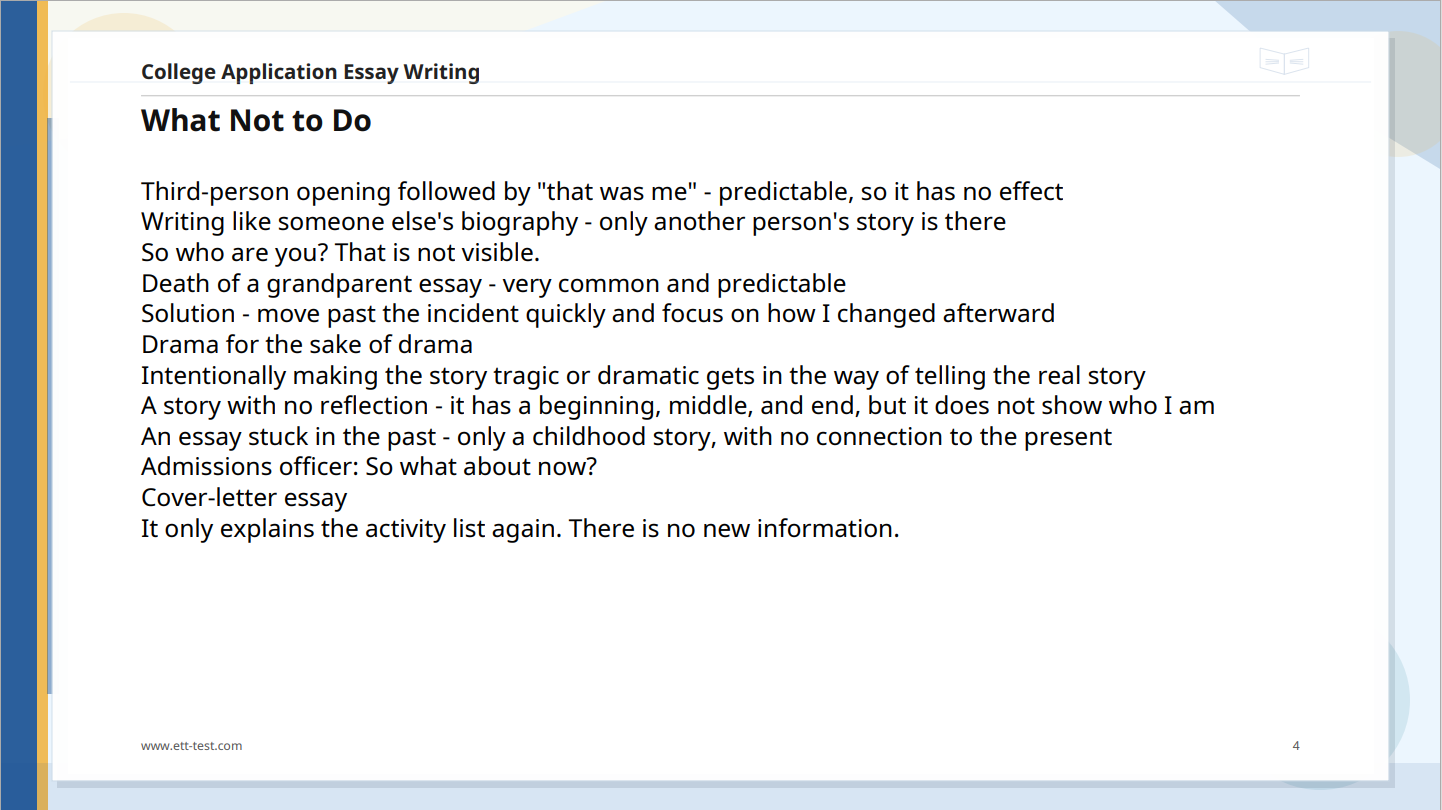
The "it was me" reveal. Opening with a third-person description — "he loved the water and never liked losing" — then landing on "and that person was me." Admissions readers have seen this structure so many times it signals predictability before the content even begins.
The biography essay. Writing primarily about someone else — a parent, a coach, an immigrant grandparent — without making yourself the center of the reflection. When the essay spends more time describing another person than examining how that person shaped your thinking, the reader's reaction is: I want to know about you, not them.
Grandparent essays. These are common enough that admissions officers have a category for them. The structure is predictable (beloved grandparent, difficult loss, lesson learned), and without a truly distinctive angle, they read as the same essay in different clothing. If this is your topic, move through the event quickly and spend almost all your words on how your thinking actually changed — not on the person or the loss itself.
Overdramatic framing. The temptation to make your experience sound larger or more consequential than it was. Admissions readers are good at detecting inflation. A small, honest moment handled with genuine reflection is more compelling than a dramatic story treated superficially.
Story without reflection. An engaging sequence of events that ends without revealing anything about how you see the world. Events are the vehicle. Insight is the destination.
Living only in the past. An essay focused entirely on childhood or early adolescence with no connection to who you are now. The reader needs to understand the present version of you.
Resume repetition. Describing accomplishments that are already listed in your activity section. The essay should add a dimension that isn't visible anywhere else in your application.
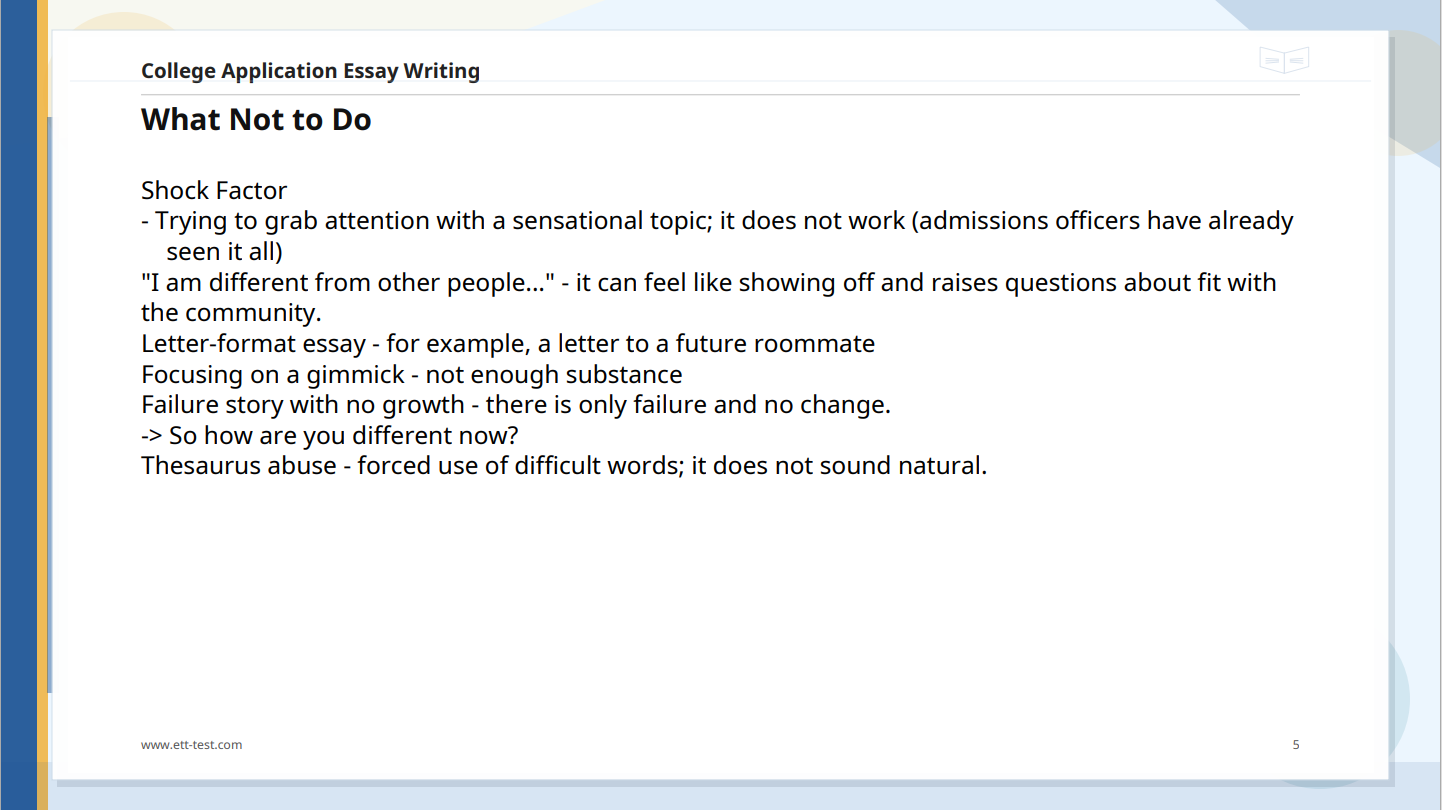
Shock value. Using extreme content to be memorable. This strategy almost always backfires — it may be memorable, but rarely in the way the writer intends.
Self-congratulation. Framing the essay as evidence that you're exceptional. The reader will always find this less convincing than the writer does.
Letter formats. "Dear future roommate" and similar structures tend to concentrate too much attention on the device and too little on the content. Admissions readers have noted that this format rarely produces essays with strong substance.
Failure without follow-through. Describing a mistake or setback honestly — then failing to show what that experience actually did to your thinking or your life. Honesty about failure is valuable. Honesty without insight is just an unfinished story.
Unnatural language. Reaching for vocabulary that doesn't sound like you, or writing in a register that's too formal or too polished. The reader should hear a real person, not a performance.
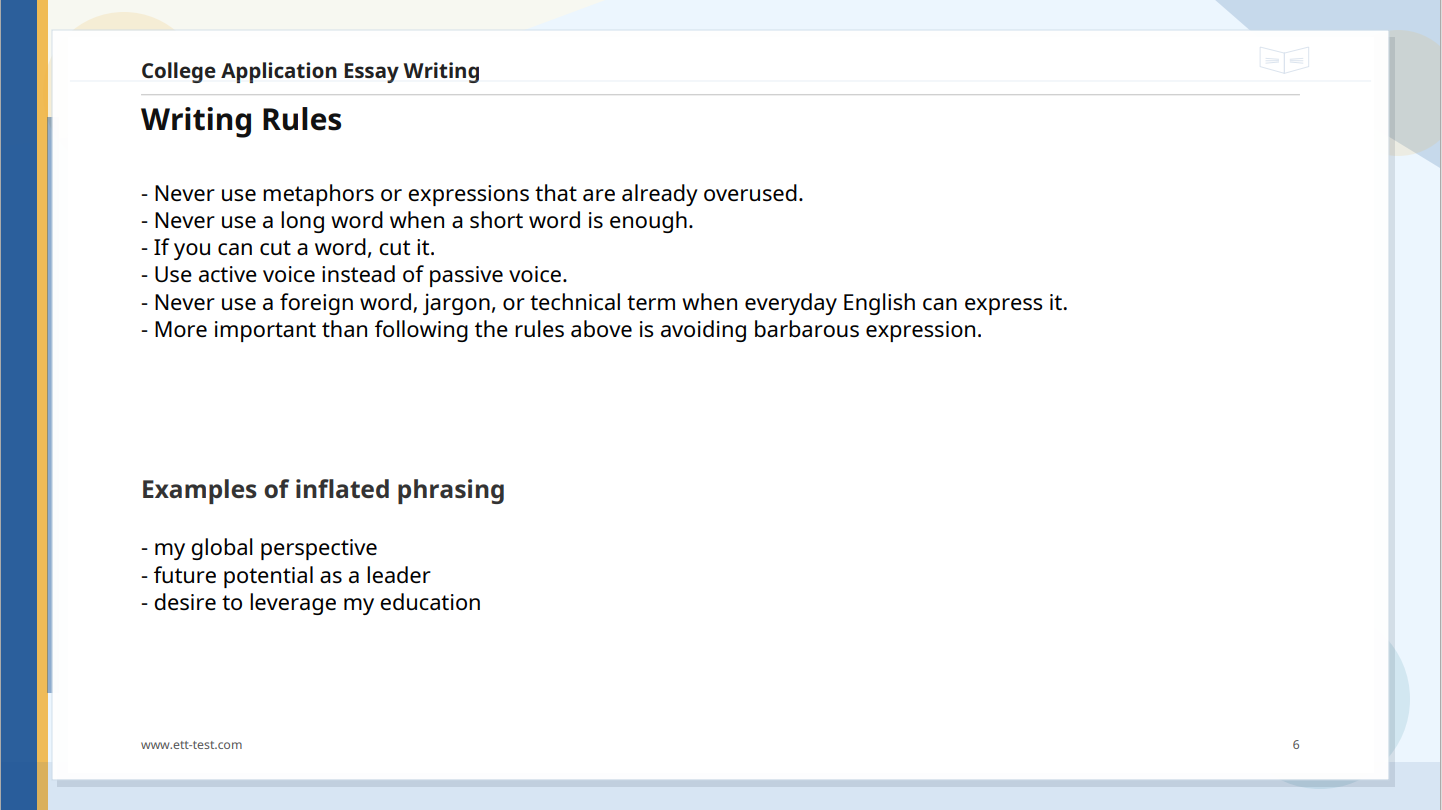
Clichés. "As a global citizen..." "My passion for..." "I want to use my education to..." These phrases appear in so many essays that they've stopped meaning anything.
Toilet humor or gratuitously crude content. This genuinely needs no explanation.
The Essay Is a Scene, Not a Statement
Korean families who have grown up with a formal writing tradition often find the American personal essay disorienting — and that's worth acknowledging directly.
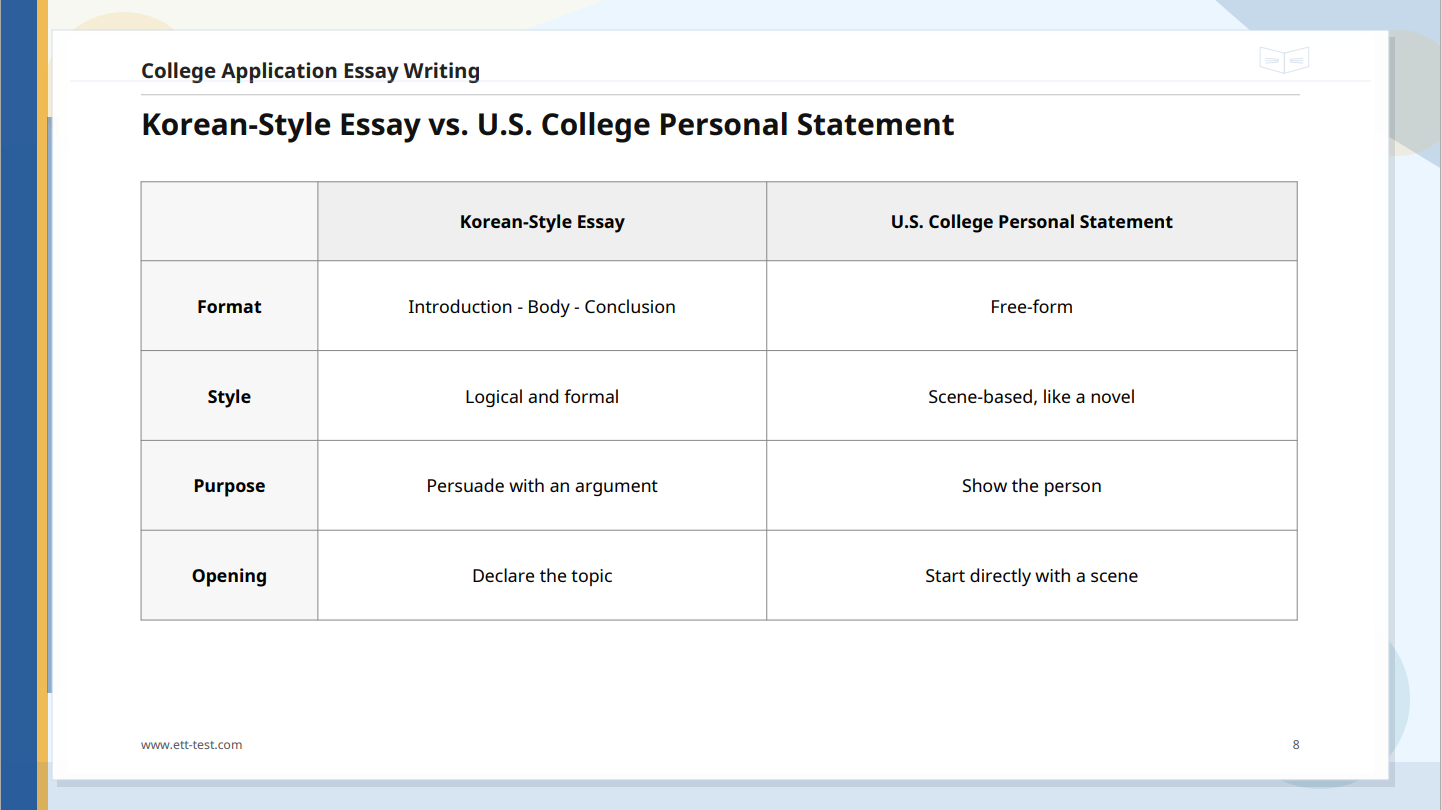
Korean academic writing tends to follow a clear structure: introduction states the thesis, body paragraphs develop the argument logically, conclusion restates the point. The mode is formal, persuasive, and declarative.
The American college personal statement operates on a completely different logic. It's closer to literary fiction than to academic writing. You start in a scene — a specific moment, fully rendered — and you let the reflection emerge from that moment rather than announcing it upfront. The reader understands who you are by watching you in action and following your thinking, not by being told.
If you're a parent reviewing your student's draft and it feels "too much like a novel," that's likely a sign it's on the right track.
What Actually Makes an Essay Work
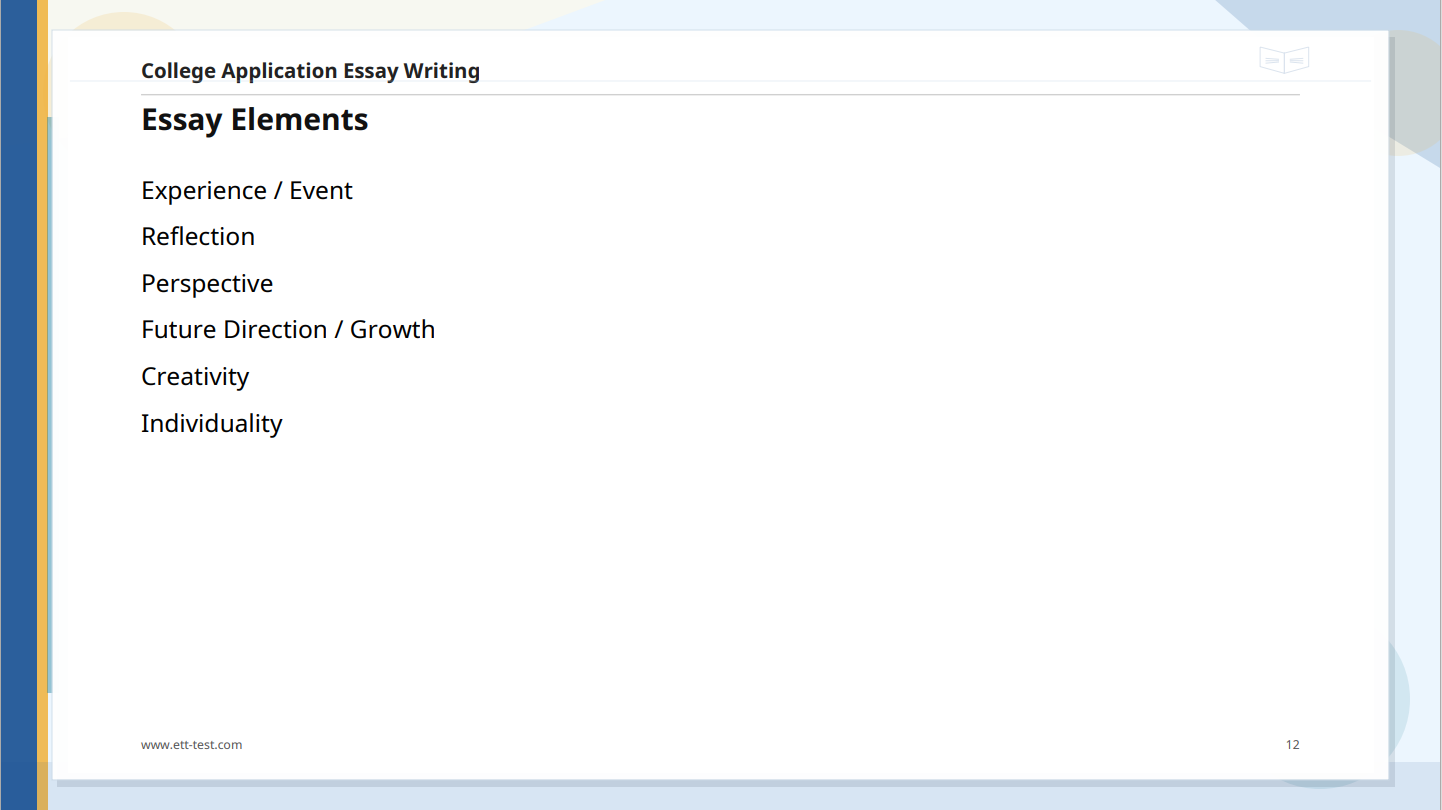
Topic is almost irrelevant. An essay about ironing a shirt, folding origami, an argument with a friend, a temporary separation from family — any of these can be a strong essay. The topic is the container. What matters is what the student puts inside it.
Perspective is everything. Two students can describe the exact same experience. What separates a strong essay from a weak one is whether the writer has a genuine, specific, non-obvious insight about what that experience revealed. Not "I learned to persevere" — but a more precise observation about how their own mind works, what they noticed about themselves, what they now see differently.
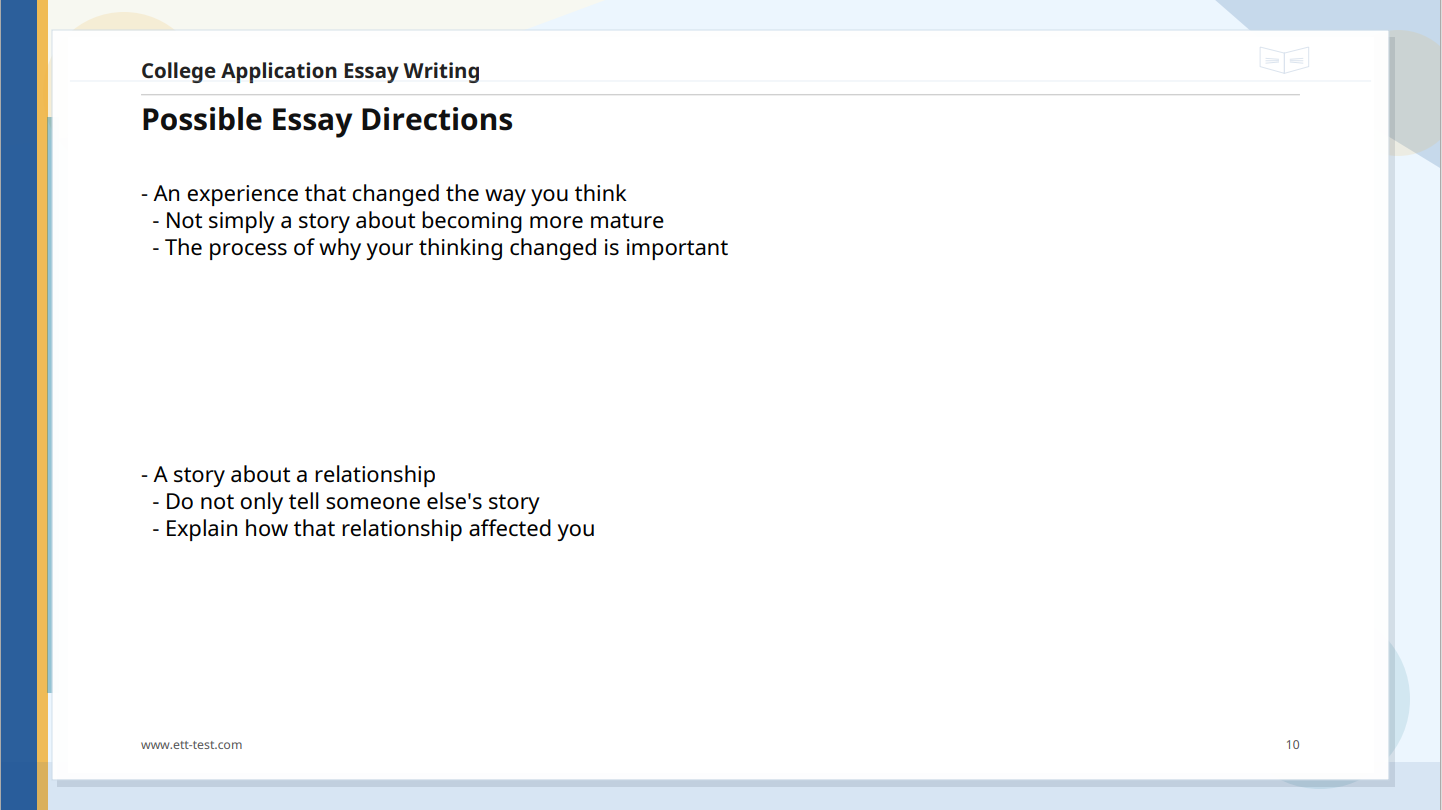
Changed thinking requires a genuine process. If your essay describes a shift in how you see something, the reader needs to see the actual mechanism of that shift — not just the before and the after. Walk through the confusion, the uncertainty, the moment things started to resolve differently.
Relationships reveal character. How you relate to other people — what you notice in them, what you misread, what you learned from a conflict or a moment of unexpected connection — tells the reader something about who you'll be in a community. The reader is building a class of people who will live and work together. How you function with others matters.
Vulnerability, handled honestly, is a strength. An admission of failure, immaturity, or misunderstanding — followed by genuine reflection on what it revealed — creates more trust than a polished account of success. But the reflection must be real. Confessing weakness without examining it is just a different kind of performance.
The ending should clarify your perspective, not summarize your story. Close by making your specific point of view clear — the thing you understand now, or see differently, because of what the essay describes. Not "and that's how I learned to work hard," but something more exact and more genuinely yours.
A Complete Essay — With Full Analysis
The following is an original essay written for illustration purposes, imagining a male student applicant. Read it through once before moving to the analysis.
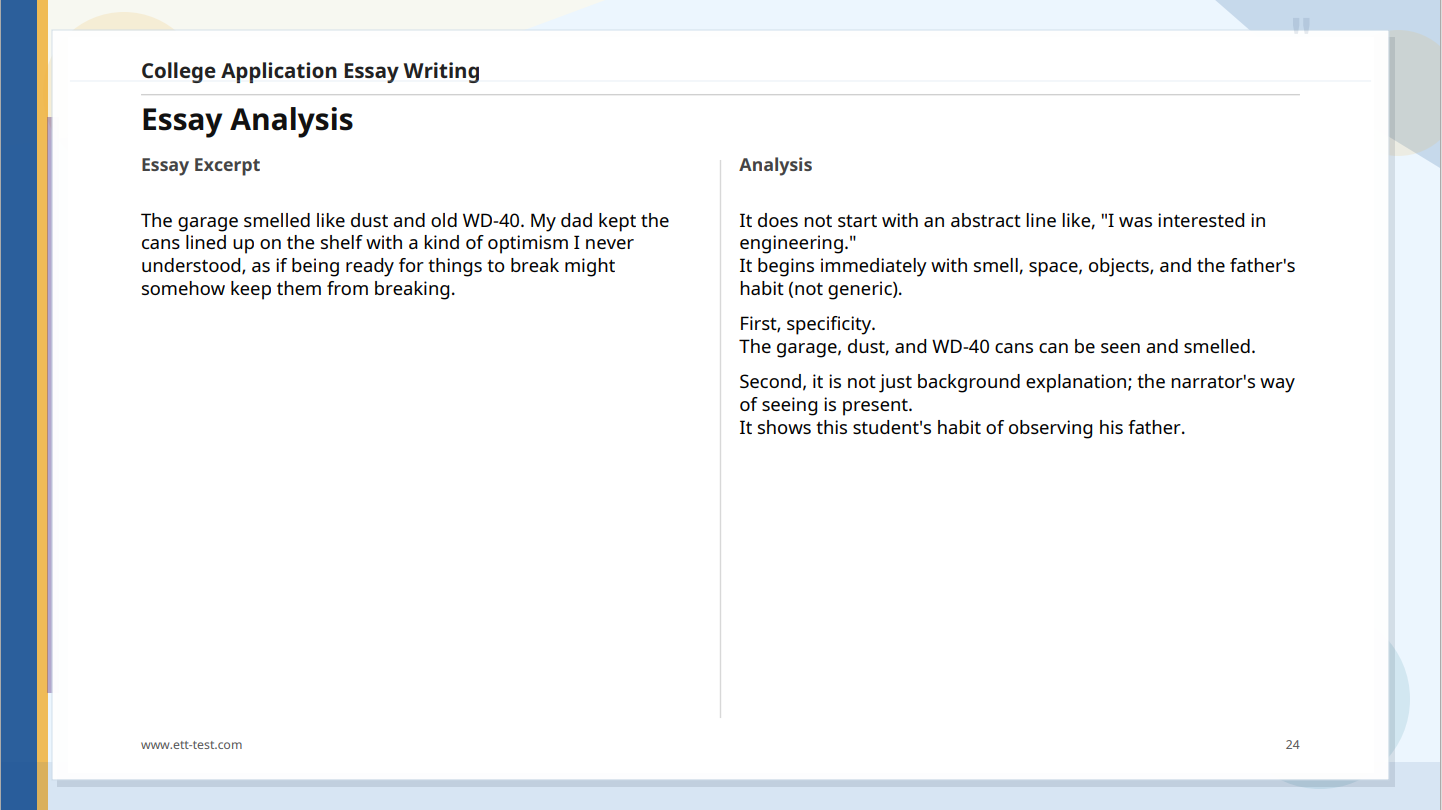
The garage smelled like dust and old WD-40. My dad kept the cans lined up on the shelf with a kind of optimism I never understood, as if being ready for things to break might somehow keep them from breaking.
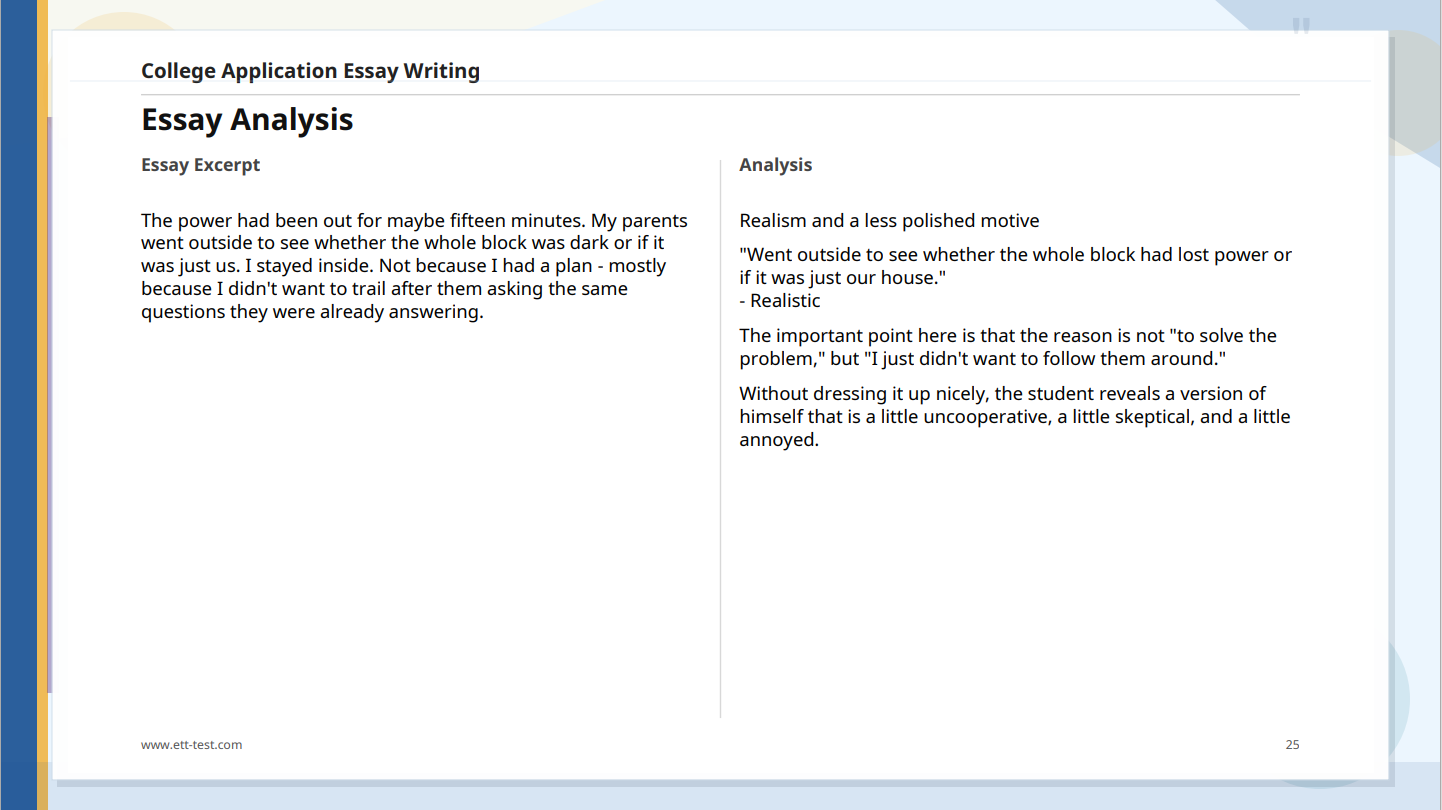
The power had been out for maybe fifteen minutes. My parents went outside to see whether the whole block was dark or if it was just us. I stayed inside. Not because I had a plan - mostly because I didn't want to trail after them asking the same questions they were already answering.
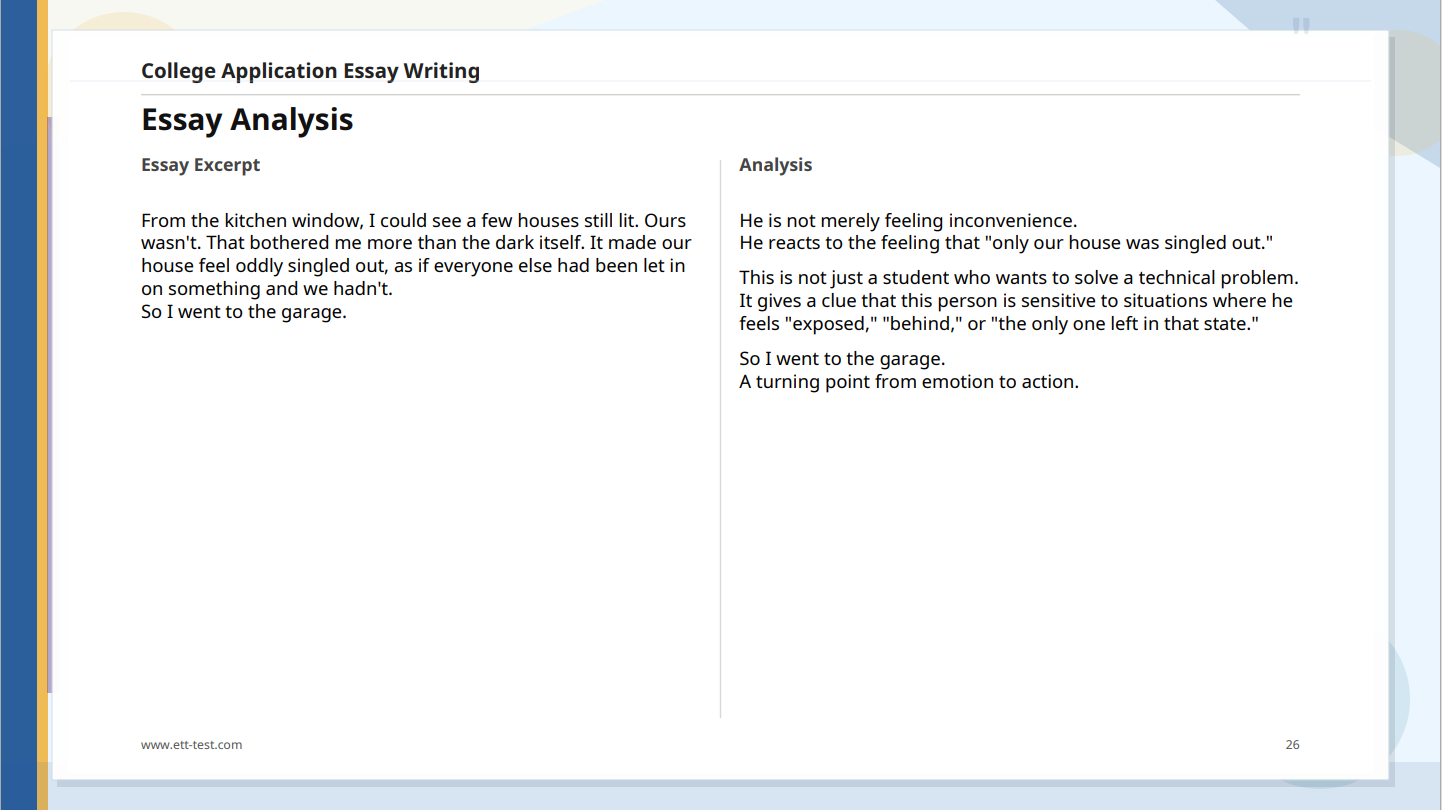
From the kitchen window, I could see a few houses still lit. Ours wasn't. That bothered me more than the dark itself. It made our house feel oddly singled out, as if everyone else had been let in on something and we hadn't.
So I went to the garage.
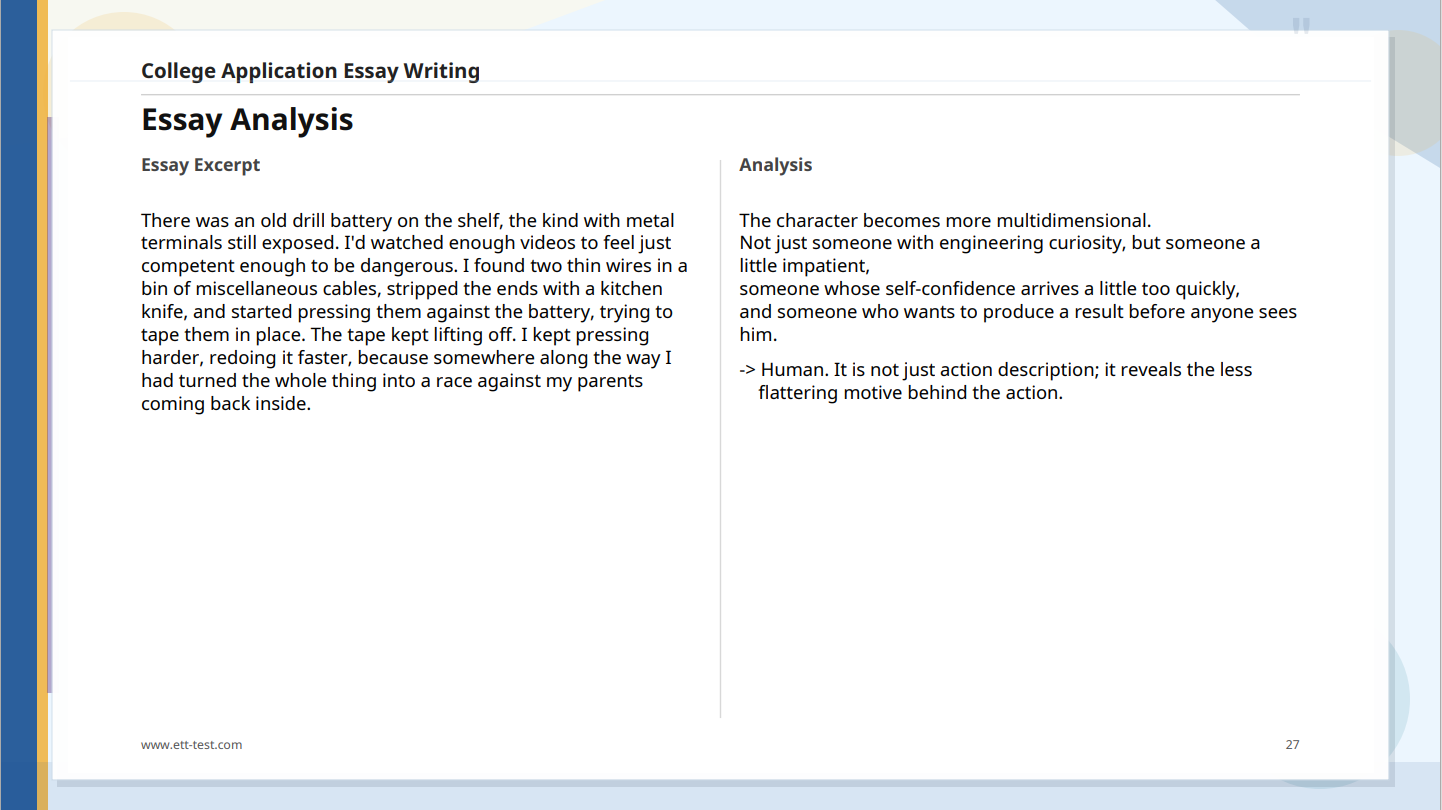
There was an old drill battery on the shelf, the kind with metal terminals still exposed. I'd watched enough videos to feel just competent enough to be dangerous. I found two thin wires in a bin of miscellaneous cables, stripped the ends with a kitchen knife, and started pressing them against the battery, trying to tape them in place. The tape kept lifting off. I kept pressing harder, redoing it faster, because somewhere along the way I had turned the whole thing into a race against my parents coming back inside.
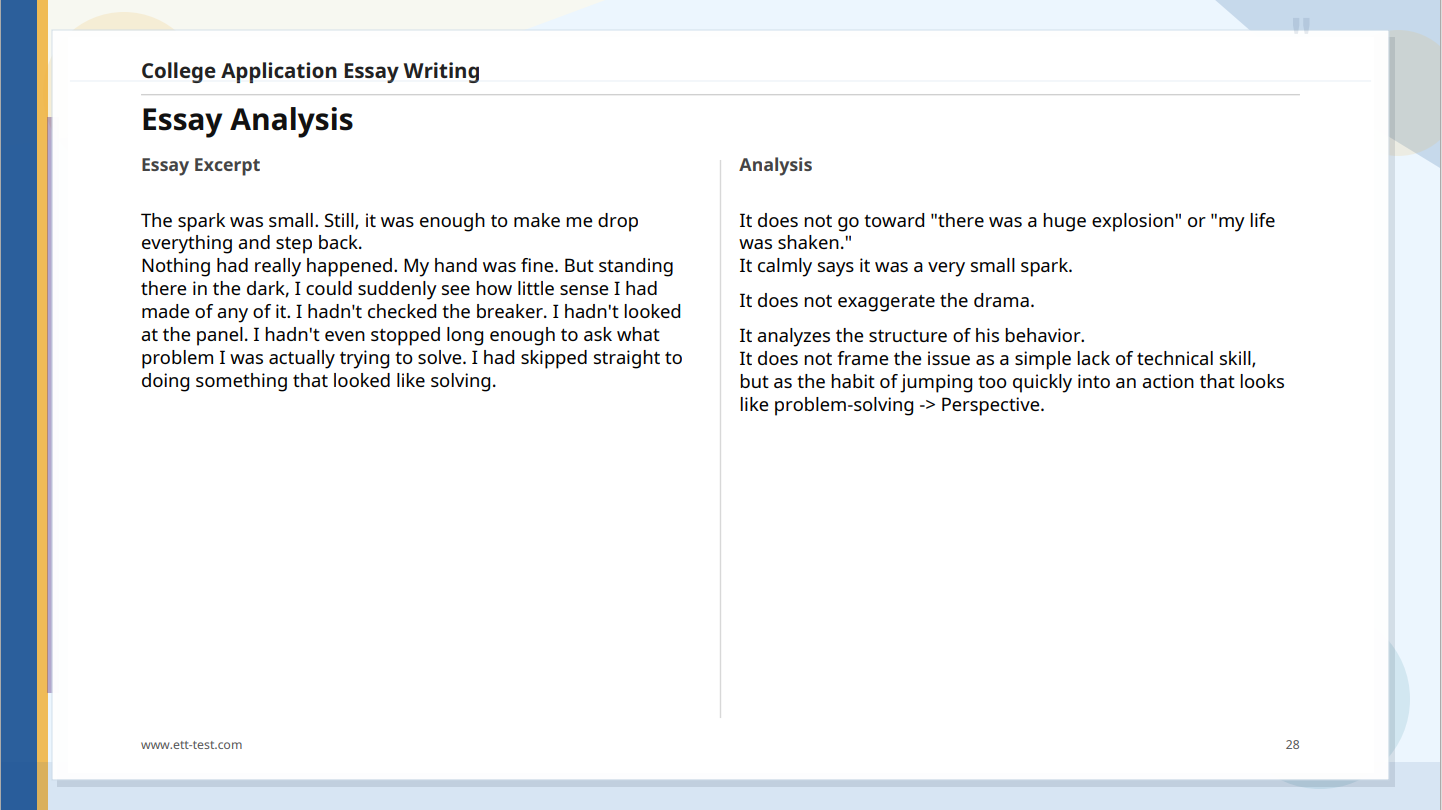
The spark was small. Still, it was enough to make me drop everything and step back.
Nothing had really happened. My hand was fine. But standing there in the dark, I could suddenly see how little sense I had made of any of it. I hadn't checked the breaker. I hadn't looked at the panel. I hadn't even stopped long enough to ask what problem I was actually trying to solve. I had skipped straight to doing something that looked like solving.
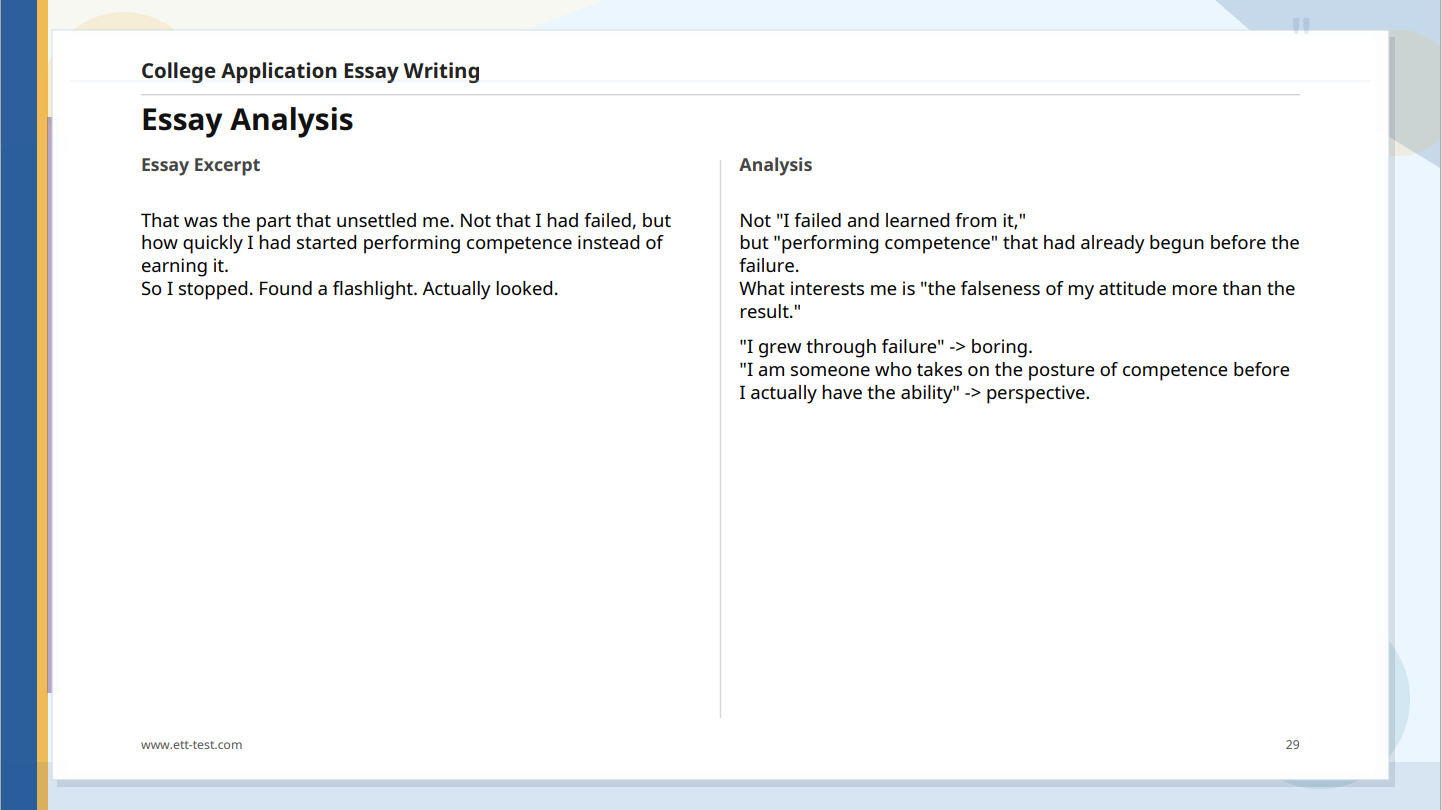
That was the part that unsettled me. Not that I had failed, but how quickly I had started performing competence instead of earning it.
So I stopped. Found a flashlight. Actually looked.
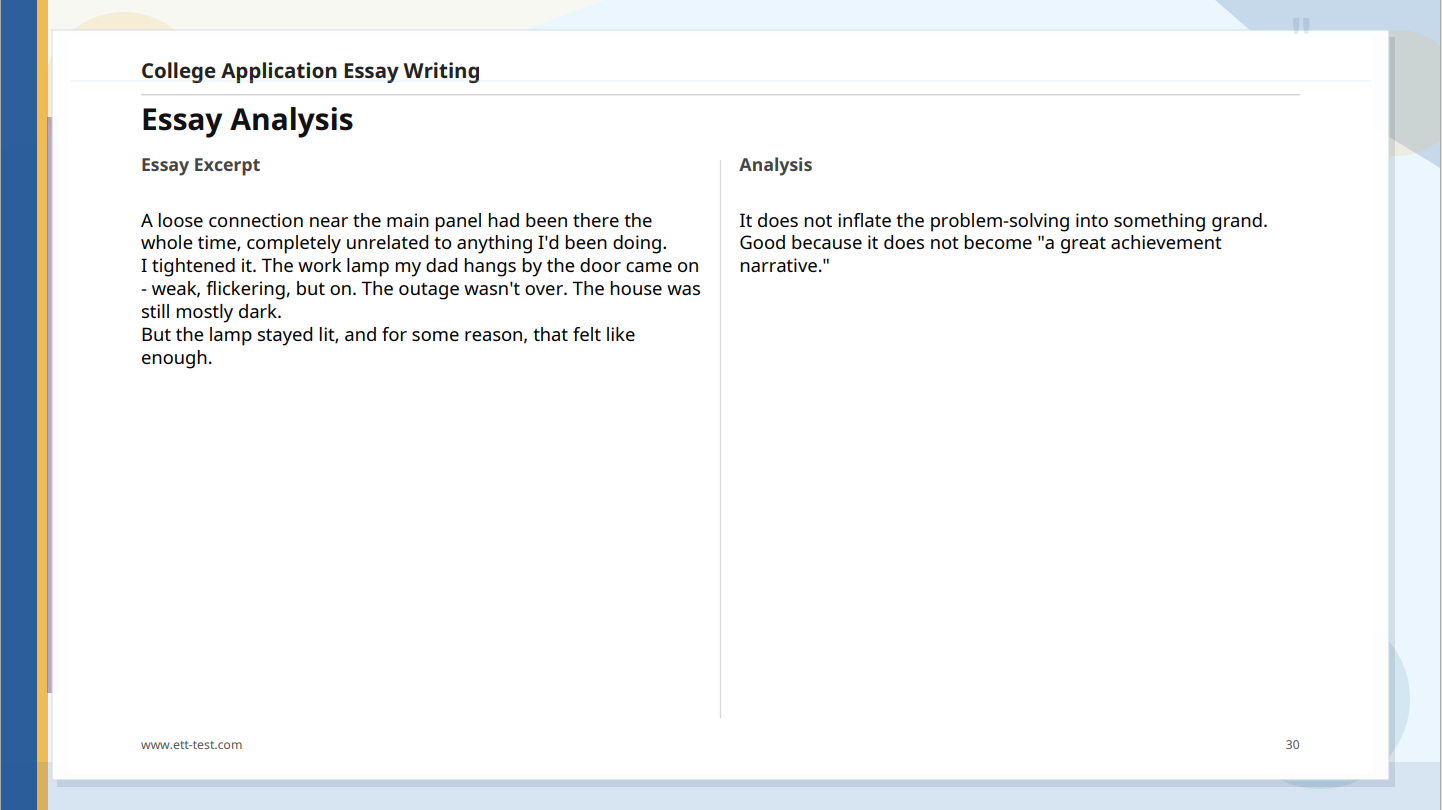
A loose connection near the main panel had been there the whole time, completely unrelated to anything I'd been doing.
I tightened it. The work lamp my dad hangs by the door came on - weak, flickering, but on. The outage wasn't over. The house was still mostly dark.
But the lamp stayed lit, and for some reason, that felt like enough.
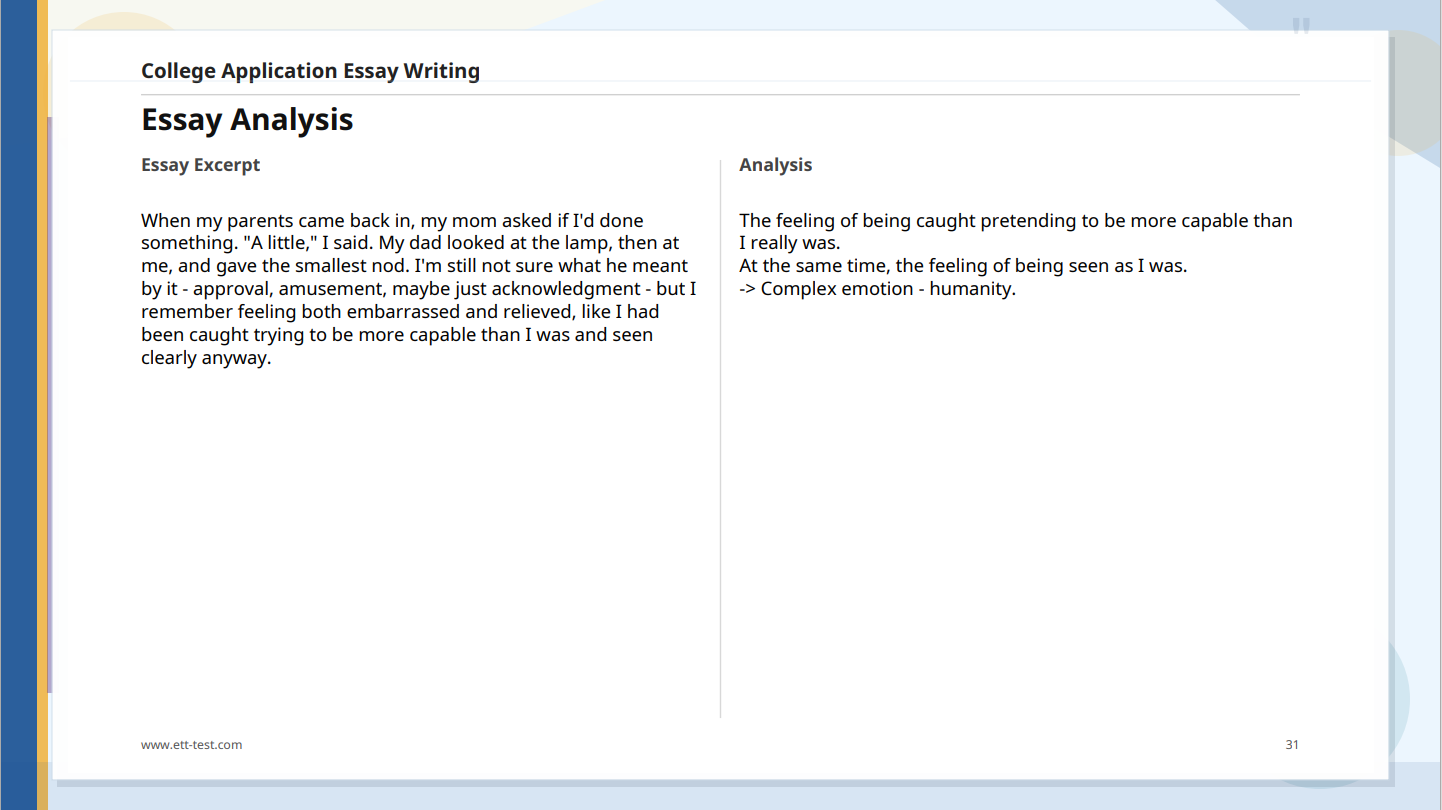
When my parents came back in, my mom asked if I'd done something. "A little," I said. My dad looked at the lamp, then at me, and gave the smallest nod. I'm still not sure what he meant by it - approval, amusement, maybe just acknowledgment - but I remember feeling both embarrassed and relieved, like I had been caught trying to be more capable than I was and seen clearly anyway.
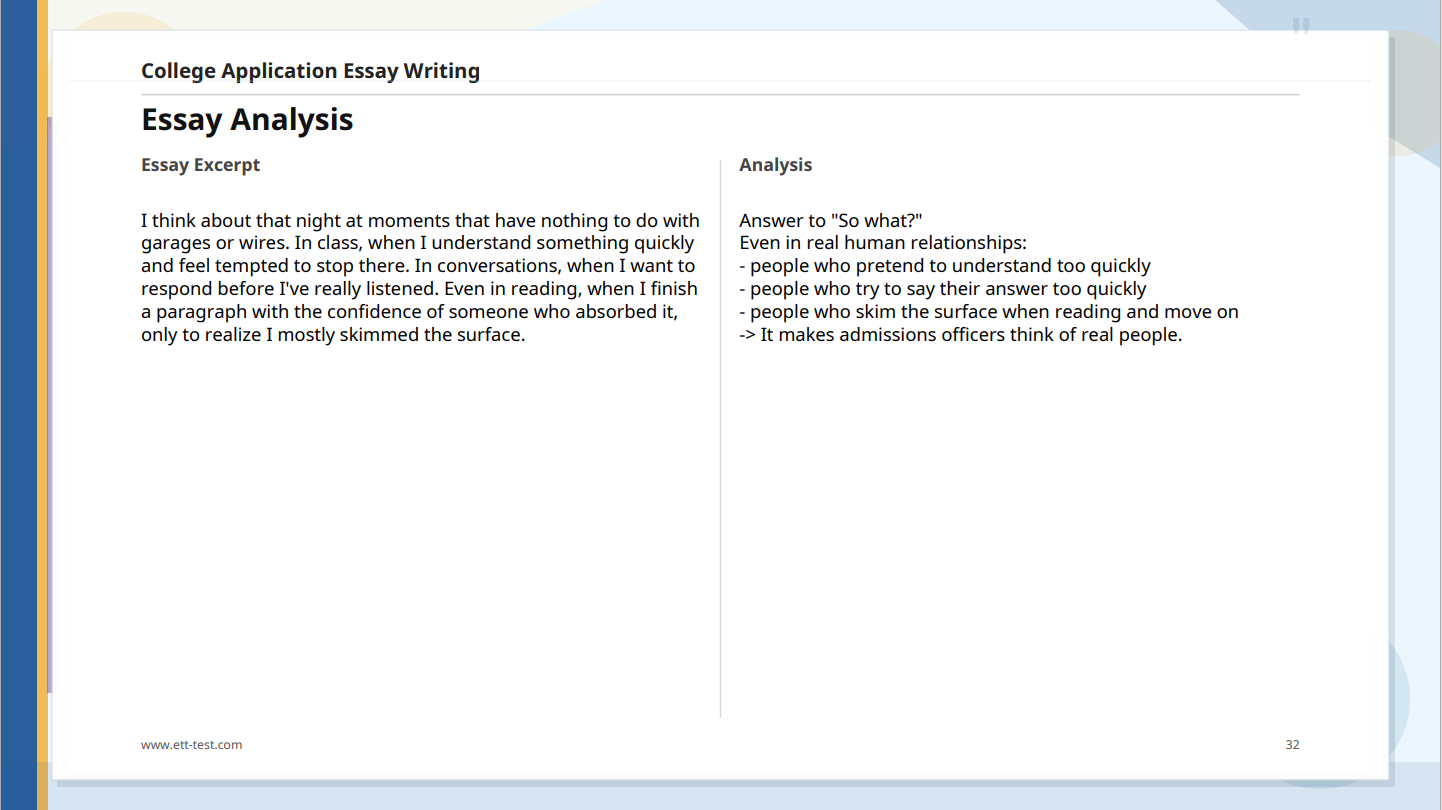
I think about that night at moments that have nothing to do with garages or wires. In class, when I understand something quickly and feel tempted to stop there. In conversations, when I want to respond before I've really listened. Even in reading, when I finish a paragraph with the confidence of someone who absorbed it, only to realize I mostly skimmed the surface.
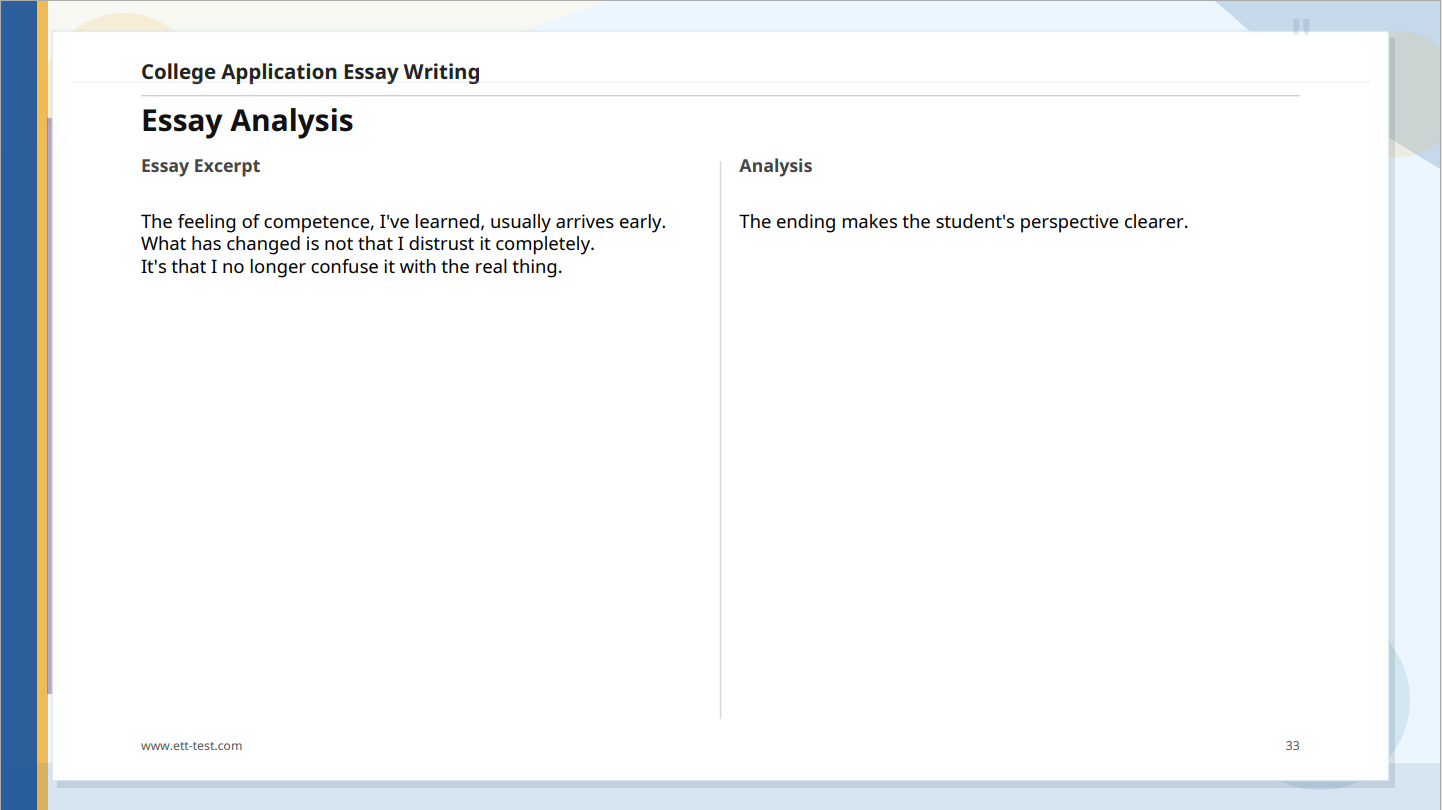
The feeling of competence, I've learned, usually arrives early.
What has changed is not that I distrust it completely.
It's that I no longer confuse it with the real thing.
Analysis: What This Essay Gets Right
The opening scene. The essay begins in a specific physical space with concrete sensory detail — the smell of dust and oil, the cans lined up in a row. There's no declaration of theme, no announcement of what the essay is about. The observation about the father's shelf contains the writer's perspective without explaining it. The reader already understands something about how this person sees the world.
The decision not to follow the parents outside. This detail is doing important work. The motivation is unheroic — the student didn't go inside with a plan, they stayed because they didn't want to follow along and ask redundant questions. This reads as genuinely teenage, slightly uncooperative, a little sulky. That authenticity creates trust. The essay isn't trying to look good in this moment, which makes it easier to believe when it's more impressive later.
The "singled out" feeling. The observation that what bothered him wasn't the dark itself but the specific sensation of being the house left out — "like everyone else knew something we didn't" — reveals something about the character's sensitivity and inner life without naming it directly. This is showing, not telling.
The incompetent competence scene. "I'd watched enough YouTube to feel dangerously competent — which, I would learn, is a particular kind of incompetent." This is one of the best lines in the essay because it's unexpected, specific, and self-aware without being smug. The sequence of physical actions that follows — the stripped wires, the tape that keeps lifting — is rendered with enough detail to feel real, and the embarrassing motivation ("a race to finish before my parents came back") is admitted honestly.
The spark is small. When the moment of genuine danger arrives, the essay refuses to dramatize it. The spark was small. The student stepped back. Nothing happened. This restraint is more effective than inflation would be — it keeps the focus on the internal experience rather than the external event.
The pivot. "Not that I'd failed, but how quickly I had started performing competence before I had any." This is the line the whole essay is building toward, and it earns the attention it receives because the reader has watched the failure unfold in real time. The insight isn't generic ("I learned to slow down") — it's precise and not obvious. The student has identified something specific about his own psychology.
The small victory is small. A loose connection tightened. One work light flickered on, dim and blinking. The outage wasn't over. The essay specifically resists the temptation to make this a grand resolution. The student fixed one small thing, and that was enough. This proportionality makes the essay feel honest.
The nod from the father. The scene with the parents returning — "I still don't know what it meant" — is handled with the kind of ambiguity that real human moments carry. The student doesn't impose a tidy interpretation on the exchange. That uncertainty makes it feel true.
The application to daily life. The essay closes by drawing explicit connections between the garage experience and recurring patterns the writer notices in himself: reading too quickly, preparing a response before the other person has finished talking, the early-arriving feeling of understanding something. These examples are specific enough to be believable and universal enough to resonate. The admissions reader will likely recognize each of them.
The final line. "What changed wasn't that I learned to distrust that feeling of competence. It's that I stopped confusing it with the real thing." This is the perspective the essay was always heading toward, and it lands cleanly. It's a real insight — not borrowed, not generic — and it belongs to this specific student in a way that feels earned.
What This Essay Doesn't Do — And Why That's Fine
The essay doesn't show much about how this student functions in a community or contributes to group dynamics. The only relationship depicted is a brief, quiet exchange with his parents at the end.
That's an acceptable tradeoff. No single essay can cover everything. The community dimension can be addressed in supplemental essays, in the activity list, in recommendation letters. The personal statement is one document in a larger application. Its job is to give the reader a genuine sense of how this person thinks — and this essay does that.
The Single Most Important Principle
Everything in this guide can be condensed to one idea: the essay works when the reader finishes it and understands something true and specific about who you are.
Not something impressive. Not something extraordinary. Something true.
The topic is almost irrelevant. The word count is what it is. The structure is flexible. What cannot be flexible is whether the essay contains a genuine perspective — something the reader couldn't have predicted before reading, and couldn't have found in the activity list or the transcript.
That's what makes an admissions reader pause and take a breath before moving on to the next file. Not the topic. Not the vocabulary. The feeling that they just met a real person.
At A ONE Institute, we work with students on essay development from early drafts through final versions — focusing on finding the genuine perspective that makes each student's application distinctly theirs. If you have questions about a specific essay or approach, feel free to reach out.
Common App Essay
personal statement
college essay tips
admissions writing
essay examples
