
The Honest Answer Most Admissions Consultants Won't Give
At A ONE Institute, we spend an enormous amount of time helping students get into elite colleges. So it might be surprising to hear this directly: college isn't strictly necessary.
That's not a marketing gimmick or a headline designed to provoke. It's a genuine position — with important conditions attached — and it's worth explaining clearly, because the reasoning behind it has direct implications for how students should think about what college is actually for and what they should get out of it.
What Is College Actually For?
Start with the fundamental question: what does college do?
The simplest honest answer is that college is designed to develop intellectual capability. Not just the academic kind — though that's the most visible part — but something broader.
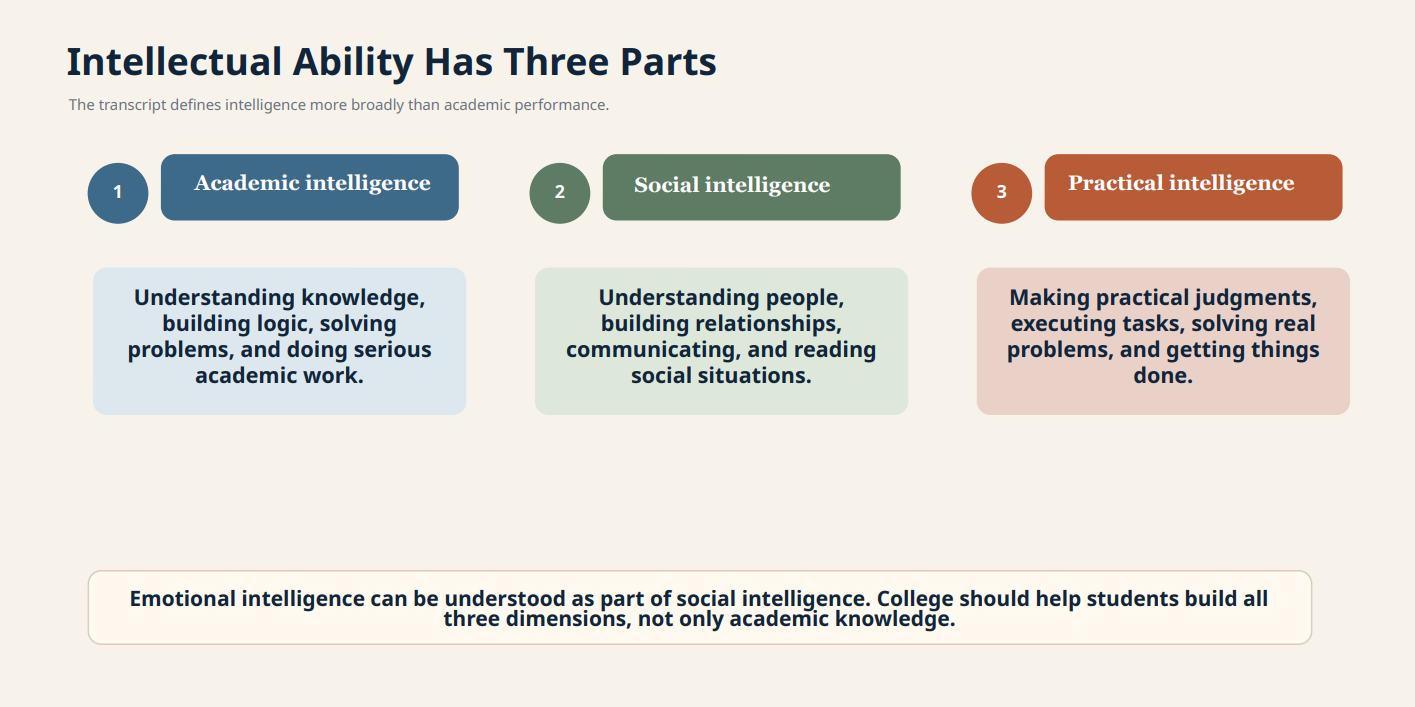
At A ONE Institute, we think about intellectual capability in three distinct dimensions:
Academic intelligence — the ability to engage rigorously with complex bodies of knowledge, follow extended chains of reasoning, and produce work that meets disciplinary standards.
Social intelligence — the ability to read people accurately, navigate different kinds of relationships, and function effectively in groups with varied dynamics and competing interests. Emotional intelligence, as the term is commonly used, fits within this category.
Practical intelligence — often called "street smarts" or "work sense." The ability to figure out how things actually work in real environments, as opposed to how they work in theory. Knowing what to prioritize, how to move things forward in messy real-world conditions, and how to be effective when the situation doesn't match the model.
College, at its best, develops all three. The question is whether it's the only way to do that — and the answer is no, but with a significant caveat.
The Two Conditions That Make College Replaceable
For a genuine alternative to college to develop intellectual capability, two specific things need to be in place:
First: peers at a comparable intellectual level. Human intellectual development happens most efficiently in contact with others who are working at similar levels — not people who are far ahead (which is overwhelming) and not people who are far behind (which stagnates). The right peer environment creates productive friction, raises the ambient standard of what serious work looks like, and generates the kind of motivated competition that pushes individuals to do more than they would alone.
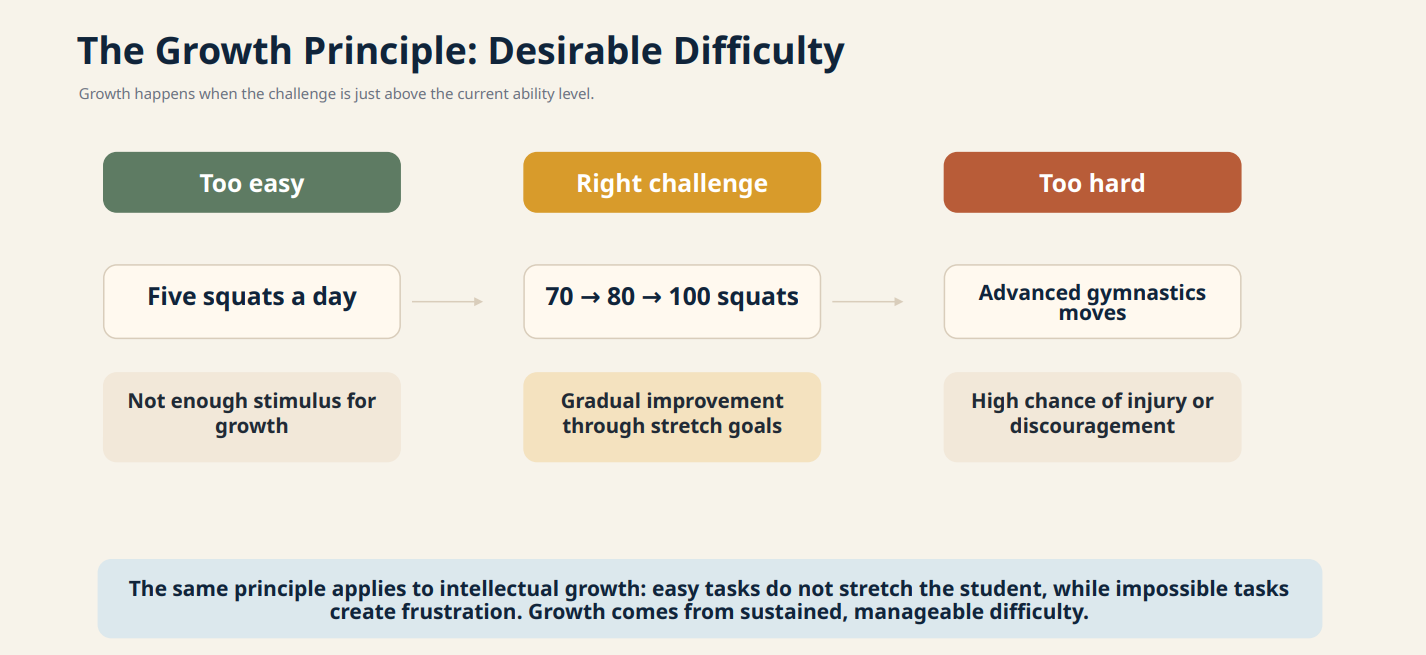
Second: appropriately calibrated challenge. This is what researchers call "desirable difficulty" — challenge that's genuinely hard enough to require real growth, but not so far beyond current capability that it produces failure rather than development. Think of it like physical training: doing five squats a day won't develop much strength, but attempting a movement that's completely beyond your current physical capacity will get you injured. The optimal level is demanding but achievable — something that requires effort to accomplish and gets progressively harder as capability develops.
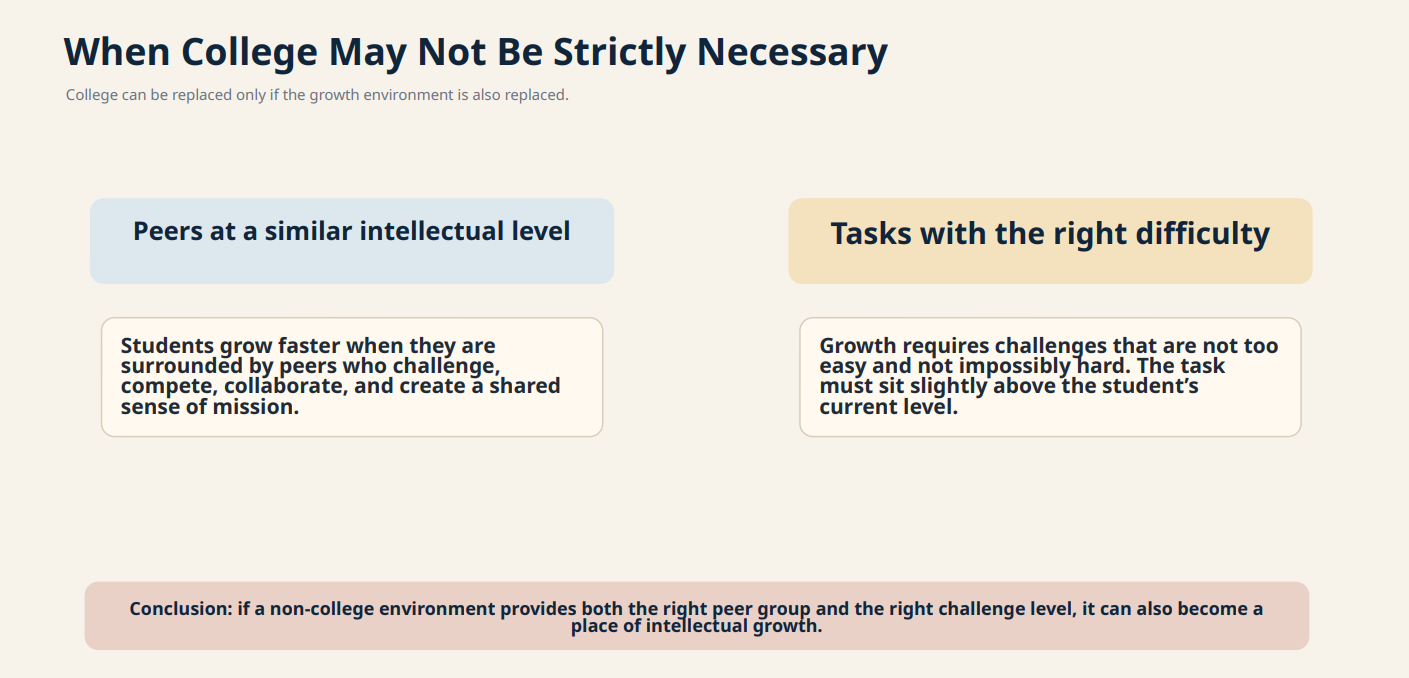
When both conditions are present, college becomes one way among several to develop intellectual capability rather than the only way. Without either condition, even formal college attendance may fail to produce meaningful development.
The problem is scale. The United States produces roughly 3.5 million high school graduates per year. Sorting them by intellectual level, creating appropriate peer clusters for each level, and designing calibrated challenges across the full range — there's currently no institution other than the traditional university system that does this at anything close to that scale. Which is why, despite the theoretical case that college isn't strictly necessary, it remains the most practical option for most students.
The Dropout Founder Argument — and Why It's Weaker Than It Sounds
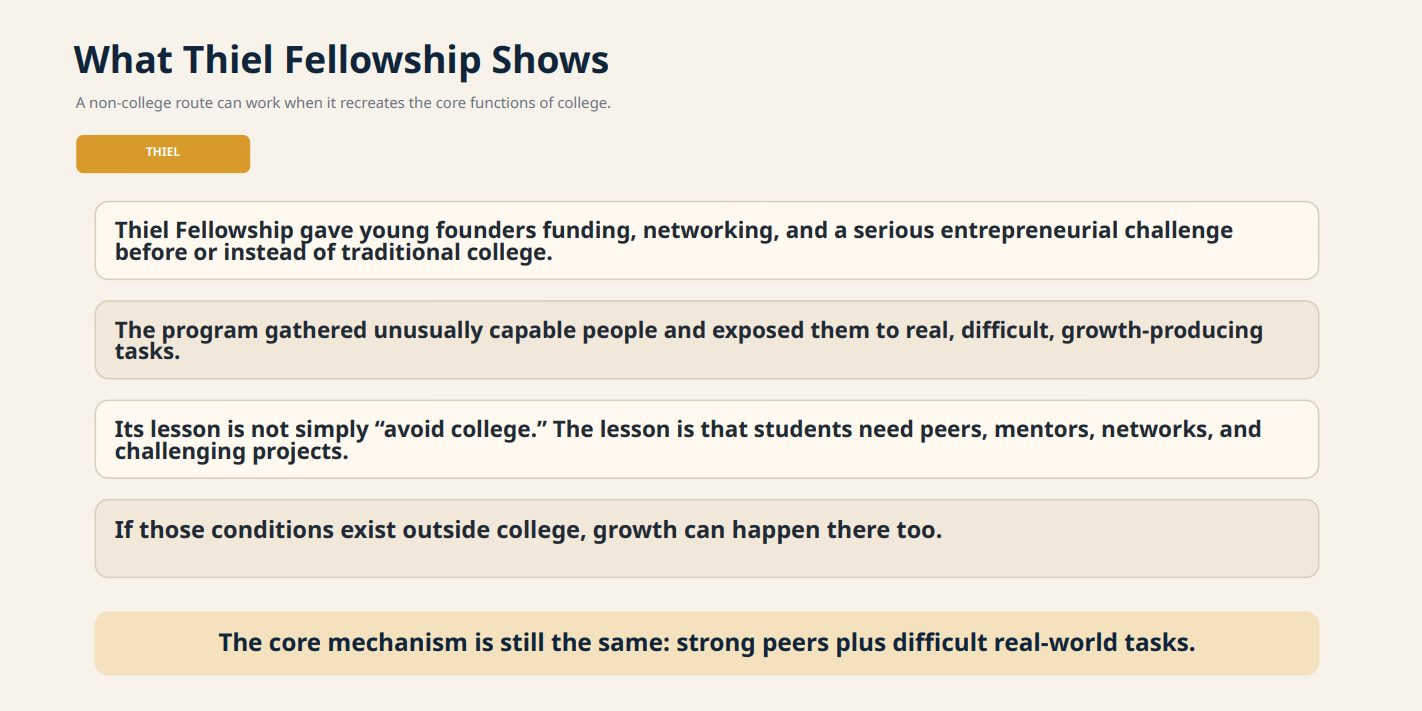
The strongest version of the "college isn't necessary" argument comes from people like Peter Thiel, the PayPal co-founder, and Alex Karp, the Palantir CEO. Both have argued publicly for reducing the emphasis on traditional college education, and Thiel in particular funded the Thiel Fellowship starting around 2011 — offering high school graduates $100,000 and mentorship to skip college and pursue startups instead.
The program has produced genuine success stories. Vitalik Buterin, who created Ethereum, came through it. So did the co-founder of Figma. Palantir has also run high-compensation internship programs for high school graduates, providing another alternative pathway for technically exceptional young people.
These programs work because they satisfy both conditions: they assemble intellectually matched peers and they provide genuinely challenging, meaningful work. The framework holds.
But there's a problem with how the broader argument gets made — which is that the most prominent advocates of "you don't need college" tend to have evidence in their own biographies that contradicts their claim.
Thiel and Karp both advocate for alternatives to traditional university education. Where did they meet? At Stanford Law School. Mark Zuckerberg didn't build Facebook alone — he built it with friends he met at Harvard. Airbnb's founders, by most accounts, met at RISD. The pattern repeats: people who built the most visible arguments against needing elite institutions built their foundational networks inside elite institutions.
That isn't hypocrisy, exactly — it's more like survivorship bias combined with a specific kind of selective framing. The peer connections formed inside these environments were genuinely instrumental. What their rhetoric tends to understate is how much the institution itself, not just the individual's capabilities, contributed to those connections.
There's also a technological reality worth naming: the kinds of companies that were transformative in 2005 were, by current standards, relatively simple to build technically. A social network built on web pages, an accommodations marketplace built on listings and maps — these required engineering skill and good judgment, but not cutting-edge scientific knowledge. The most consequential industries today — AI, robotics, biotech — require something closer to PhD-level domain expertise to compete at the frontier. Even Thiel has acknowledged in recent interviews that dropping out of college to start a company immediately may not be the right call for most people in the current environment. The complexity of the technical landscape has shifted the calculus.
What Korean and Asian Students Are Genuinely Missing
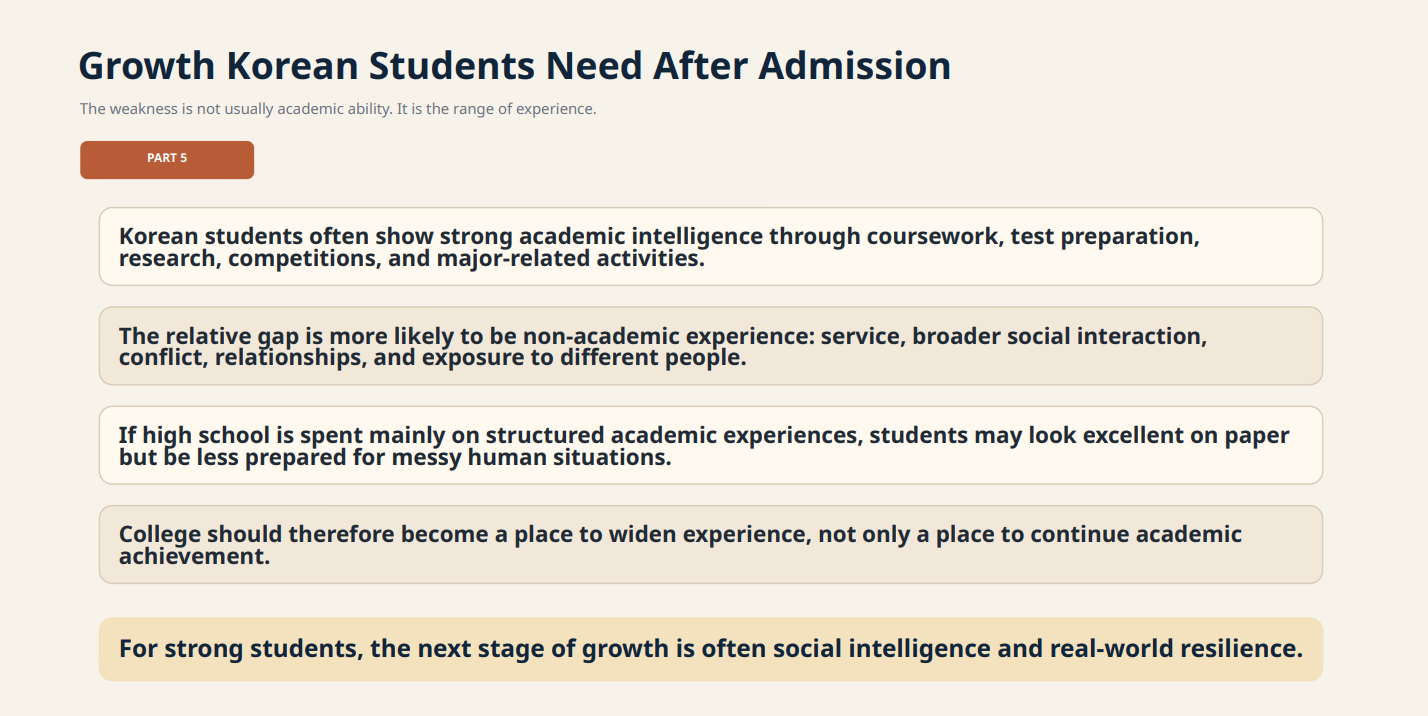
On the specific question of what Korean students tend to do well and where they could do better — academic capability is clearly a strength. By any measure, Korean and Asian students at elite universities show strong academic preparation. That's not the gap.
The gap, if there is one, is experiential. Korean students in particular tend to have high school years that are very densely structured around academic and academically-connected activities — research, competitions, study, carefully curated extracurriculars with clear lines back to intellectual achievement. What's comparatively less present is unstructured time spent with a wide range of people in non-academic contexts, including people who are genuinely different — different values, different backgrounds, different ways of moving through the world.
This isn't a criticism. It makes complete sense given the intensity of college preparation. But it does mean that the social intelligence dimension tends to be less developed than the academic one — specifically the ability to read people accurately across a wide range of types, to navigate genuine conflict and difference, and to build relationships that involve real vulnerability rather than shared academic purpose.
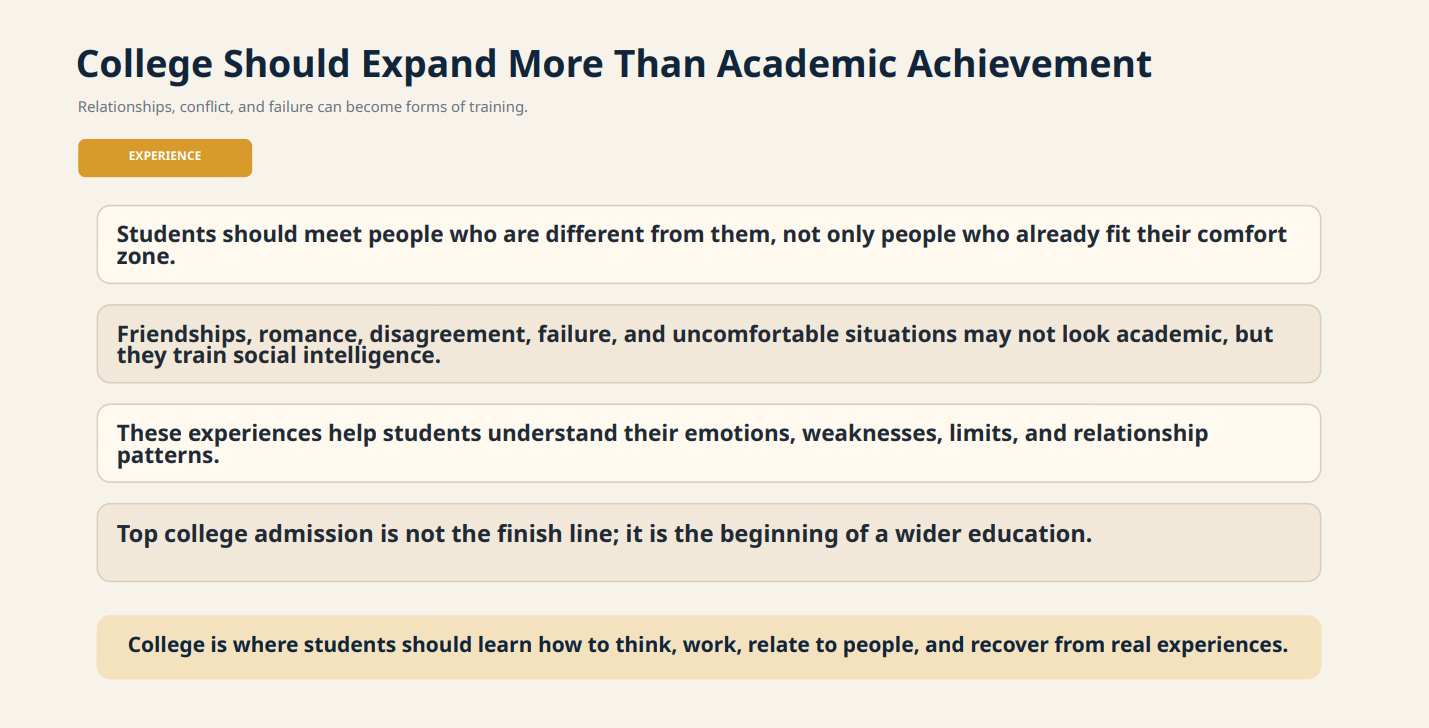
The honest recommendation for Korean students entering college is to use it for exactly this. Go to parties sometimes. Date people. Make friends who aren't pre-med. Spend time with people you find genuinely difficult or confusing. Get into a conflict and work through it. Have at least one experience that feels like hitting a real personal limit and having to figure out what comes next.
None of that is frivolous. It's what builds the social and practical intelligence that academic achievement, on its own, doesn't reach — and that eventually becomes the differentiator in professional life, where technical competence is table stakes and the ability to actually work with people is what determines outcomes.
There's a term in Korean that roughly translates as "looking at your own reflection at the bottom of a well" — seeing yourself clearly, including the parts that aren't flattering. For students who have spent their entire adolescence succeeding in structured environments, college is often the first real opportunity to encounter their limits, fail at things that matter, and find out who they are underneath the credentials. That process is uncomfortable. It's also genuinely valuable.
College isn't strictly necessary — if and only if the alternative provides the same two things: intellectually matched peers and appropriately calibrated challenge. For most people, in the current environment, no alternative reliably delivers both at scale. College remains the most practical path.
The strongest argument for college, though, isn't about credentials or career outcomes. It's about what happens to intellectual capability — academic, social, and practical — when people are placed in demanding environments with a diverse range of peers over a sustained period. That's what college, at its best, does. And it's what students should be intentional about pursuing while they're there.
For Korean students specifically: the academic dimension will take care of itself. It's the experiential dimensions that require deliberate investment — and college is the right time to make it.
A ONE Institute helps students get into elite universities. What students do once they're there matters too. If you want to discuss both the admissions strategy and the longer-term thinking behind it, we're here.
college admissions
social intelligence
elite university preparation
