
A Specific Scenario Worth Planning For
At A ONE Institute, most of our content assumes students are building a multi-dimensional profile — academics plus a coherent set of extracurriculars. But there's a specific, common scenario worth addressing directly: the middle schooler who genuinely has no strong pull toward music, art, or athletics, but who is clearly strong academically and wants to aim for elite universities.
This isn't a deficiency to fix. Some students are simply built this way — their talent and interest concentrate almost entirely in academic work. For these students, the strategic question isn't "how do I force interest in other areas?" It's "how do I use the time available, especially summer break, to build the deepest possible academic profile?"
To be clear upfront: this isn't a universal recommendation. Most students will and should pursue a broader mix of activities. This is specifically for the case where a student has decided, realistically and based on genuine interest, to compete primarily on academic depth.
What MIT's Research Actually Shows About Competition Math
Before getting into the practical plan, it's worth understanding the research basis for why competition math specifically deserves this level of attention.
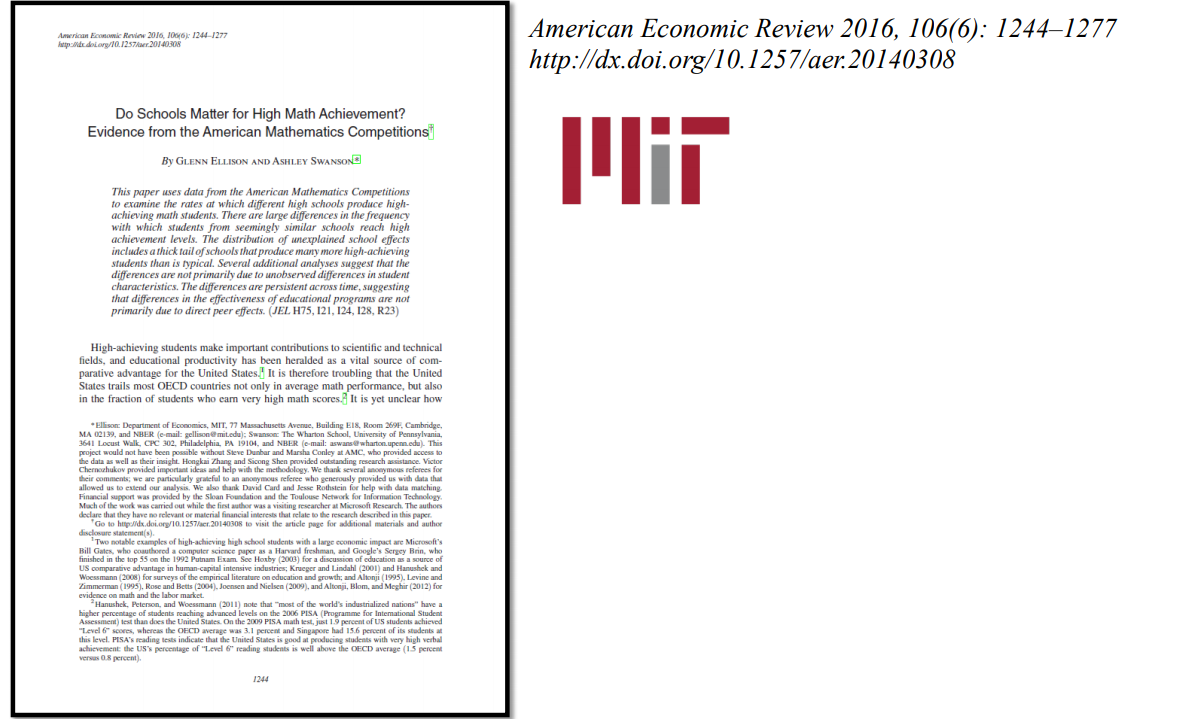
A study examining AMC performance found two notable conclusions. First, students with comparable intelligence and academic performance in middle school can show dramatically different AMC results depending on which high school they attend — meaning the learning environment and preparation methods available at a given school have a measurable effect on competition outcomes, independent of the student's underlying ability. Second, and more directly relevant here: AMC performance turns out to be a more differentiating signal for elite university admissions than many other standardized measures, including the SAT.
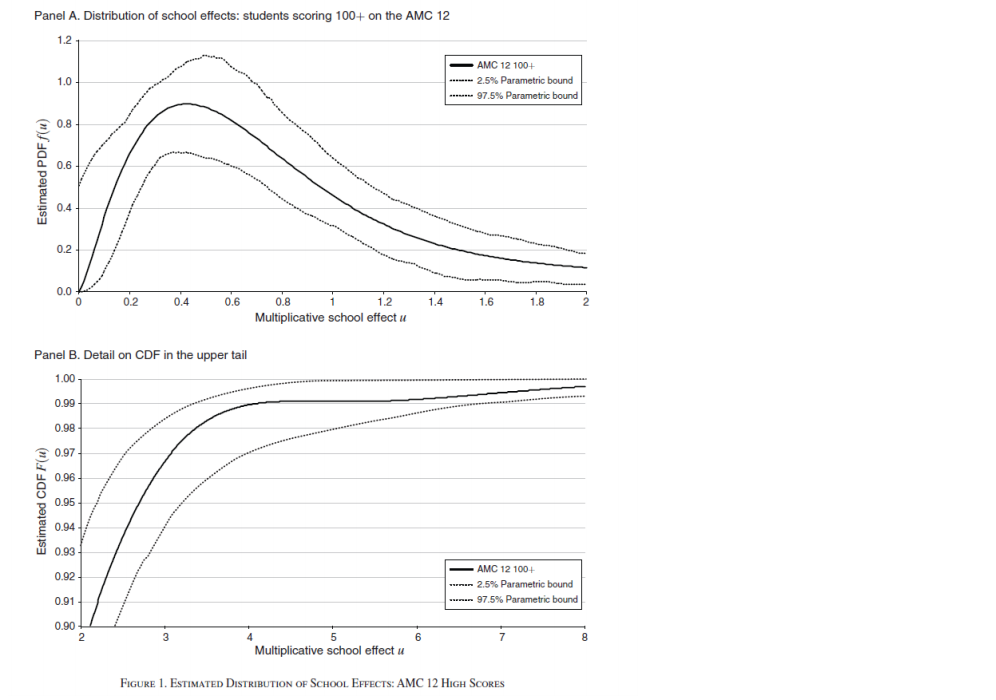
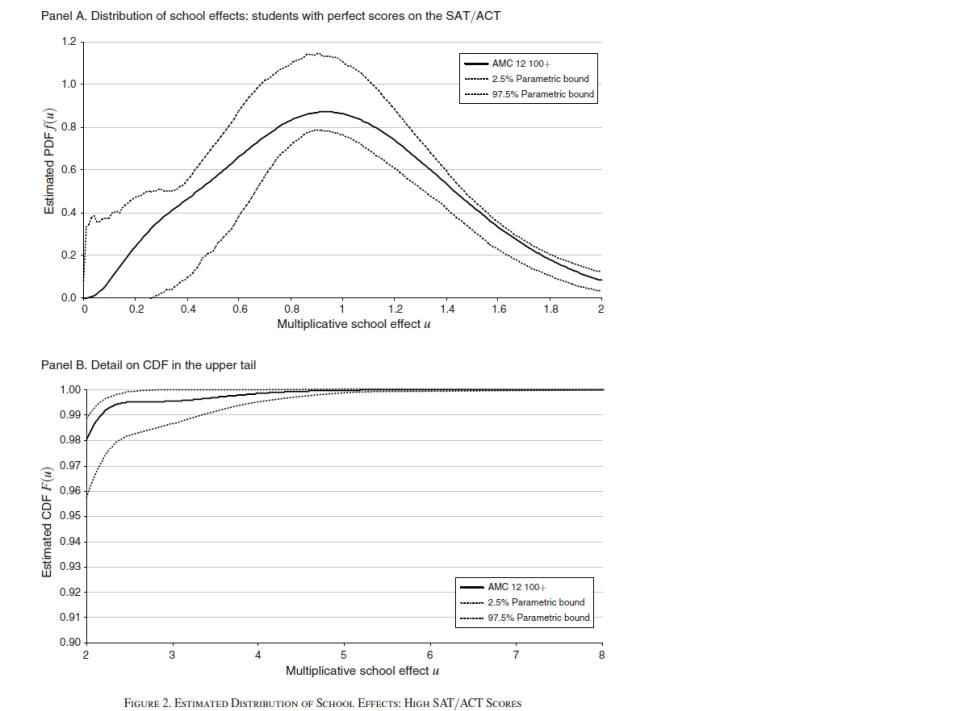
The data behind this second finding is worth understanding, even briefly. When researchers looked at how many high-scoring AMC 12 students (specifically, students scoring 100+) came from individual schools, the distribution was highly concentrated — a small number of schools produced disproportionately large numbers of top scorers, while the vast majority of schools produced very few or none. By contrast, when the same kind of analysis was run on SAT scores, the distribution looked much closer to a standard bell curve across schools — high scorers were spread more evenly.
The practical implication: SAT performance is comparatively normally distributed across schools, while AMC performance is heavily concentrated in a small number of specific environments. That concentration is exactly what makes AMC results more informative to admissions committees at elite schools — a strong AMC score is harder to achieve through generic preparation and more clearly signals access to (or self-driven pursuit of) a genuinely rigorous mathematical environment.
To be precise about scope: this applies specifically to the very top tier of universities, not universities broadly.
The Funnel: Just How Selective Competition Math Actually Is
Understanding the actual numbers helps calibrate expectations and goals.
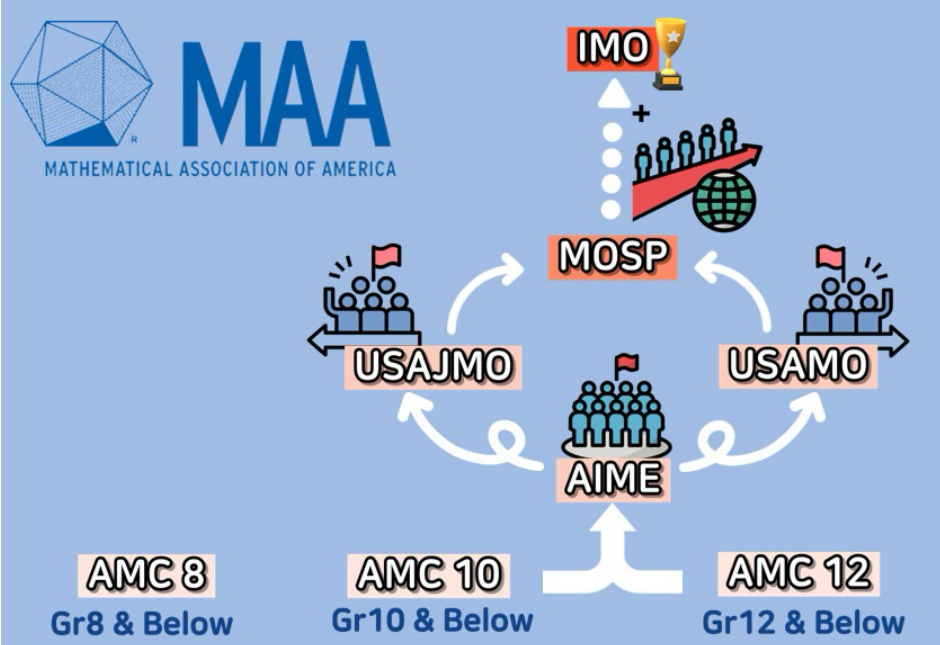
Roughly 250,000 students take the AMC each year across AMC 10 and AMC 12 combined (accounting for overlap between the two). From that pool, approximately 8,000 advance to AIME — already a meaningful credential on its own. From AIME, roughly 500 students qualify for USAJMO or USAMO. From there, 60 students are invited to MOP (the Math Olympiad Program, often called "MOP camp"). And from that group, just 6 students are selected to represent the United States at the International Mathematical Olympiad (IMO).
Research tracking the career paths of IMO-level students shows they overwhelmingly matriculate at MIT, École Polytechnique (France's MIT-equivalent), Cambridge, Harvard, Princeton, Stanford, and Caltech. Given that pattern, it's unsurprising that these institutions place significant weight on strong AMC/AIME results when they appear in an application.
Four Tracks for Math-Focused Students
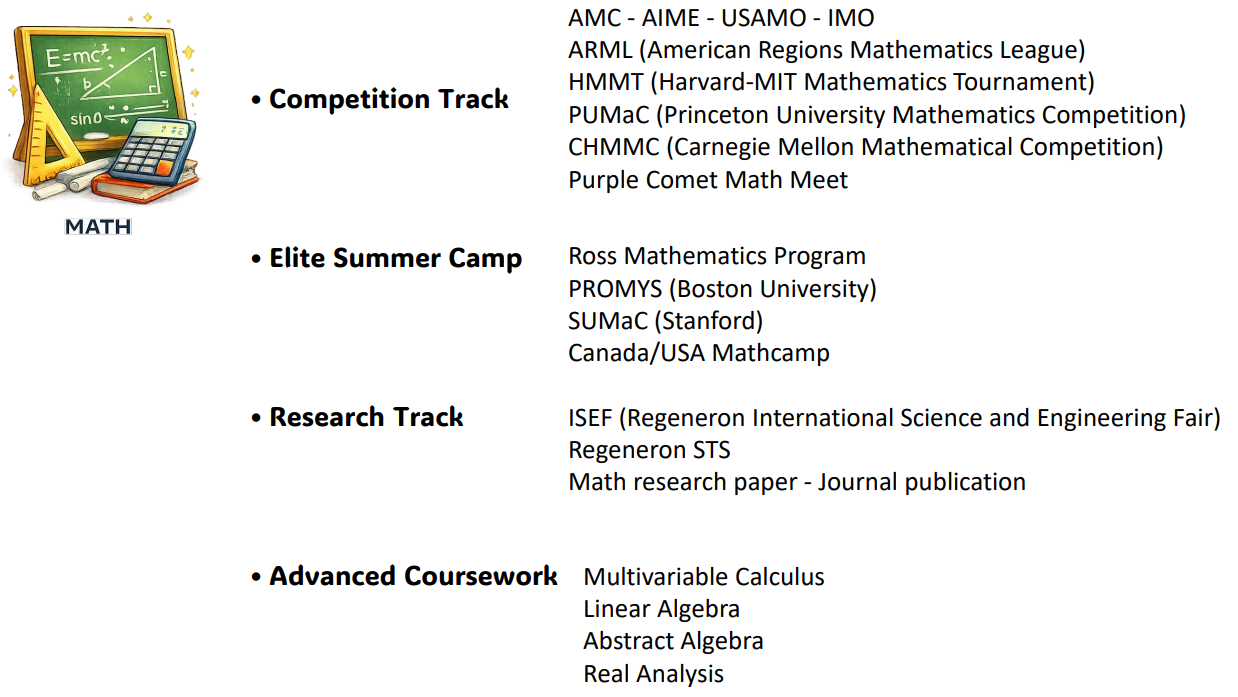
For a student committing seriously to mathematics as their primary academic differentiator, there are four broad tracks — and a student can pursue one intensively or attempt several:
Competition track: AMC → AIME → USAMO → IMO, supplemented by other well-regarded competitions including ARML (American Regions Mathematics League), HMMT, the Princeton University Mathematics Competition, the Carnegie Mellon competition, and Purple Comet Math Meet.

Elite summer camp track: Programs like Ross Mathematics Program, PROMYS, SUMaC, Stanford's GO program, and Canada/USA Mathcamp.
Research track: Building toward ISEF as the primary goal (more on this below), with STS (the Regeneron Science Talent Search) as a senior-year target, and potentially publishing a research paper in an academic journal.
Accelerated coursework track: Moving quickly through multivariable calculus, linear algebra, abstract algebra, and real analysis — material well beyond standard high school math.
A Critical Distinction: Discrete vs. Continuous Mathematics
This is a point worth understanding clearly, because it directly shapes how summer should be spent.
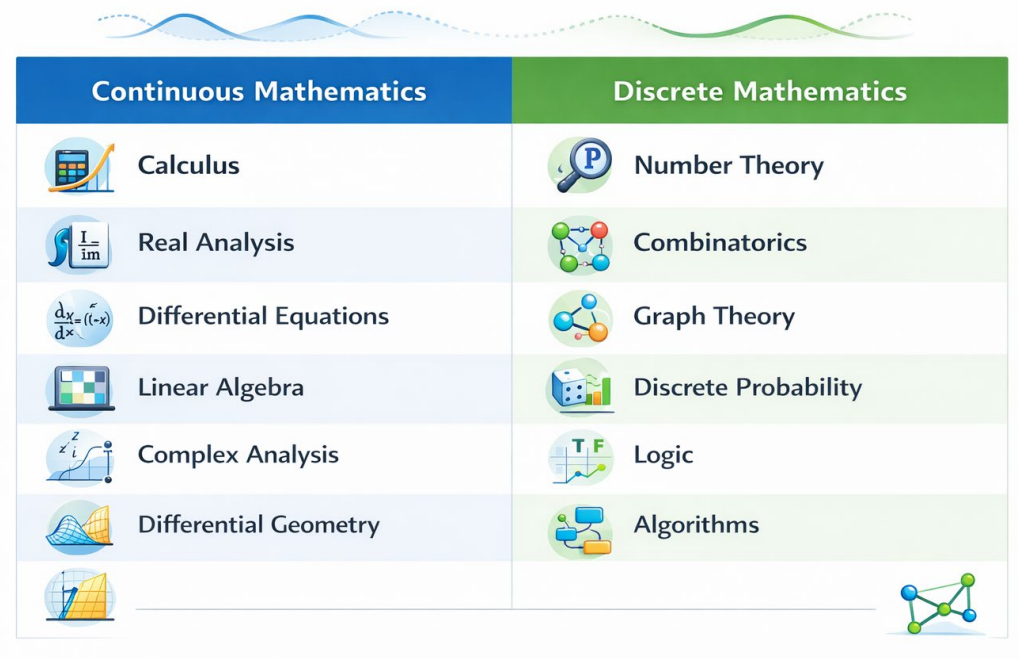
Mathematics broadly splits into two domains: continuous mathematics (the calculus-based sequence most schools teach — algebra, geometry, precalculus, calculus, multivariable calculus) and discrete mathematics (number theory, combinatorics, and related areas that standard school curricula generally don't cover in depth).
Standard school coursework covers continuous mathematics reasonably well, simply by following the normal academic sequence. But it covers discrete mathematics very little — and discrete mathematics is exactly where competition math and elite summer camps concentrate. Roughly 20% of AMC problems draw specifically from number theory, making it one of the highest-leverage topics for competition preparation.
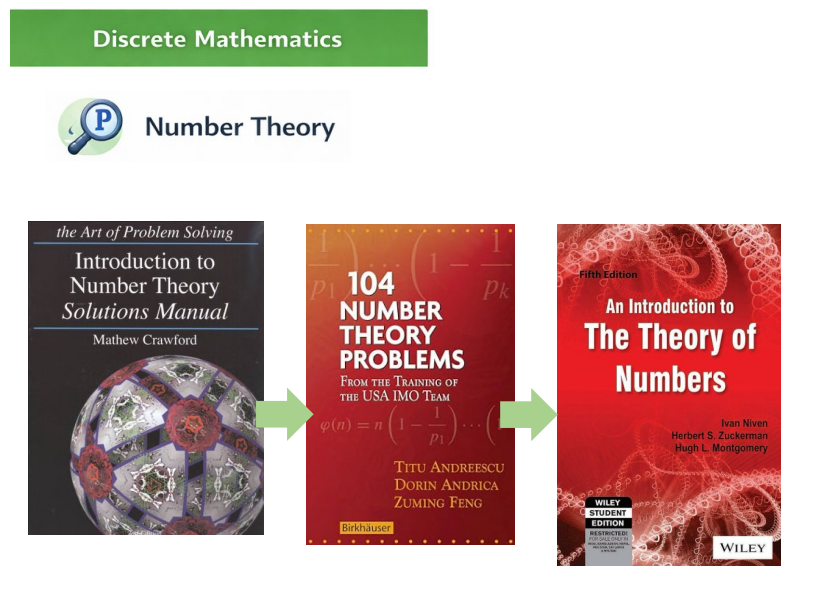
For students pursuing the competition or elite summer camp track, number theory should be the first priority. A practical study sequence: start with AoPS's Number Theory text, move to "104 Number Theory Problems," and then progress to a college-level text such as Leveque's Number Theory. Given that students aiming for elite summer camps are often expected to handle this material comfortably by 7th or 8th grade, preparation realistically needs to begin earlier than that.
For students pursuing the accelerated coursework track, the priority is moving efficiently through the standard continuous mathematics sequence: pre-algebra, Algebra 1, Geometry, Algebra 2, Precalculus, AP Calculus AB and BC, then on to multivariable calculus and linear algebra. For a student with no other major extracurricular commitments, completing this sequence by 6th or 7th grade is an ambitious but achievable target; finishing by 8th or 9th grade is also perfectly fine. Earlier completion simply creates more flexibility to pivot toward research or discrete math afterward.
The research track can draw from either domain, depending on the specific project.
Applying the Same Framework to Science
The same basic logic extends to physics, biology, and chemistry, each with their own olympiad pathway and a shared research track through ISEF.
The selectivity data here is striking. Roughly 6,000 students compete in the physics olympiad pathway annually, with about 400 advancing to USAPhO (the semifinal stage), narrowing to 20 finalists and ultimately 5 representing the U.S. team. Biology and chemistry each draw roughly 10,000+ applicants (biology often considerably more), with 800–1,000 advancing to semifinals, narrowing to 20 finalists and then 4 team members in each subject.
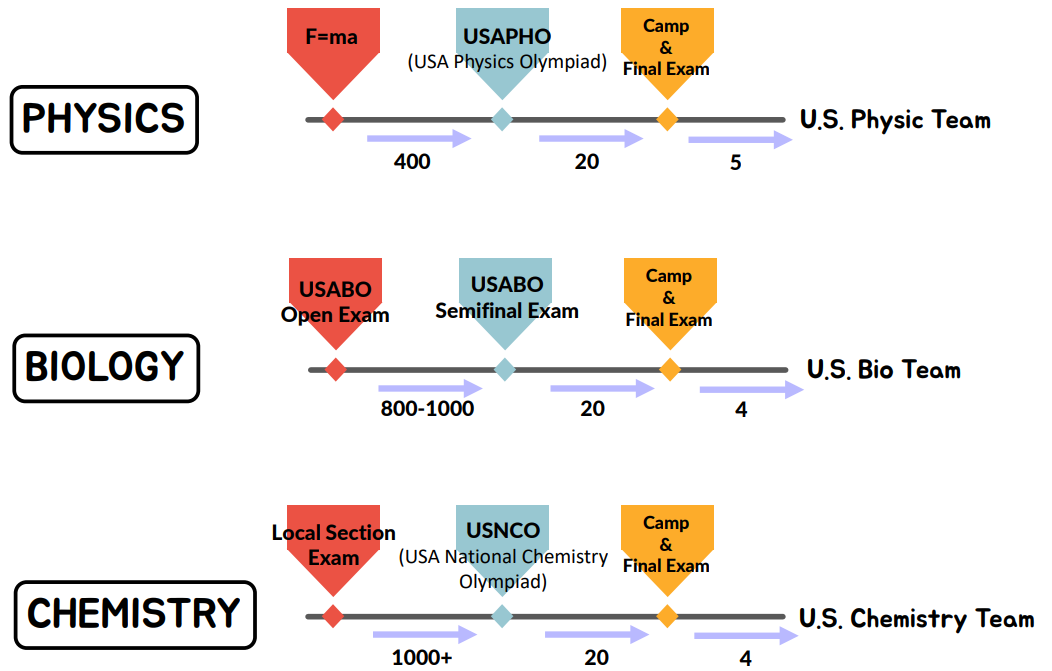
Notably, chemistry's funnel — roughly 10,000 applicants narrowing to 1,000+ semifinalists — has a comparatively higher rate of advancement to the semifinal stage relative to the other sciences. Worth keeping in mind regardless of which subject most genuinely interests a given student. Reaching the semifinal stage in any of these olympiads is, on its own, an extremely strong credential — strong enough that a thin extracurricular profile elsewhere becomes far less consequential to admissions committees.
A Practical Approach for Science
Rather than committing immediately to advanced material, the recommended approach is incremental: work through an honors-level treatment of one science subject first, then attempt AP-level material in that subject. If AP-level work feels genuinely overwhelming rather than just challenging, that's a meaningful signal — for science specifically, the research track is often a better fit than the olympiad track for that student, rather than pushing further into competition preparation.
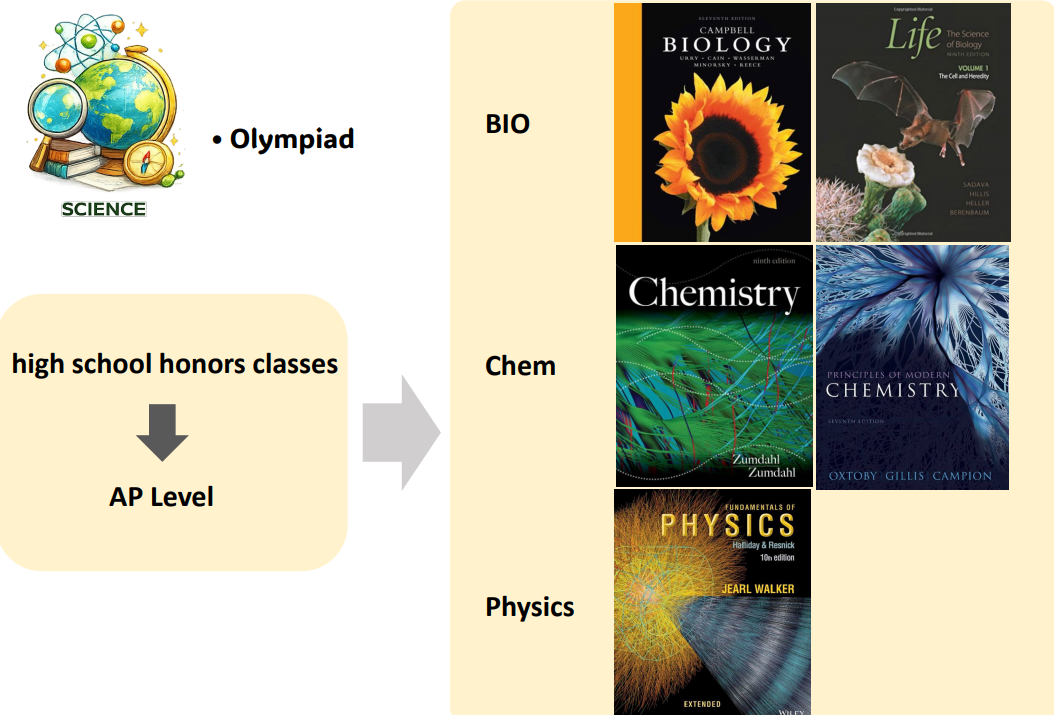
If AP-level material is manageable, the next step is genuinely college-level material: Campbell Biology or a comparable life sciences text for biology; Zumdahl or Oxtoby for chemistry; Halliday for physics. These are standard first-year university textbooks, and the goal is working through their problem sets at a level of comfort that would be appropriate for an actual college freshman.
For context on pacing: students who reach the top 20 in these olympiads have, on average, completed this level of college freshman material by around 6th grade — though this reflects an unusually advanced subset of students, and later completion is entirely fine for the vast majority of strong students pursuing this path.
Research Track: A Tiered Approach to Publication and ISEF
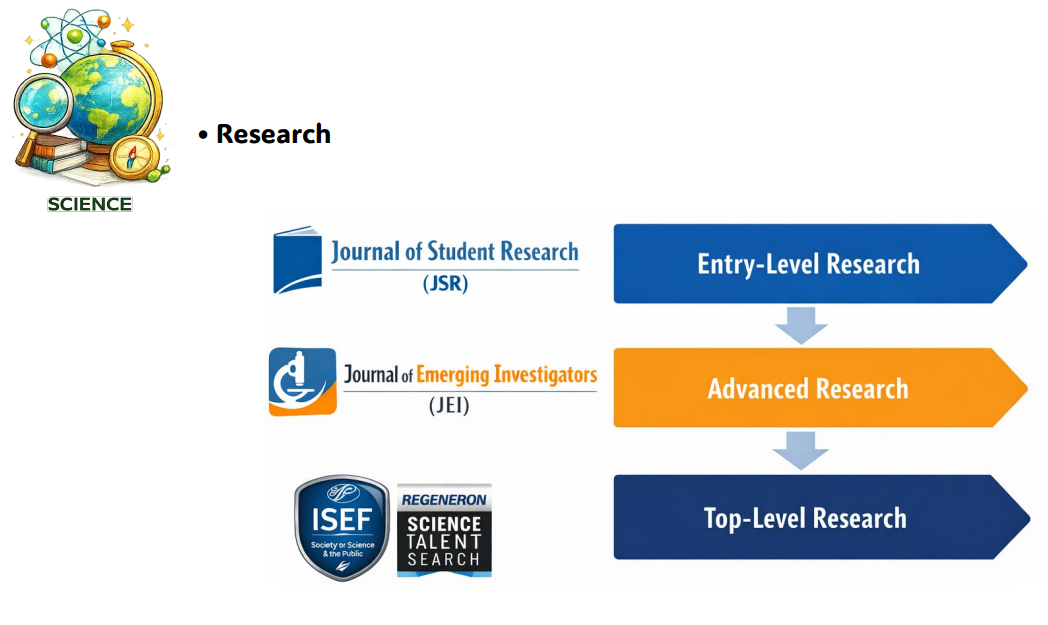
For students pursuing the research track in either math or science, it helps to think in terms of tiers, moving from more accessible to more prestigious:
Entry-level publication venues: Journals like JI (Journal of Insights) and
(Journal of Student Research) provide accessible venues for publishing genuine research work, with JI generally considered somewhat more accessible than JSR.
Primary target: ISEF. This should function as the central goal for most students on the research track, since it's eligible starting in 9th grade — which means preparation should begin well before that.
Senior-tier target: STS (Regeneron Science Talent Search). This is a 12th-grade-only competition and represents the most prestigious outcome on the research track, though it falls outside the scope of middle-school summer planning specifically.
A concrete recommended timeline: for a student following the academics-only path, beginning research around March of 8th grade allows for a first ISEF application in 9th grade. From there, the recommended approach is applying consistently across 9th, 10th, and 11th grade — three consecutive years. If a direct ISEF application feels too ambitious initially, starting with JI or JSR as a lower-stakes entry point, then moving toward ISEF in subsequent years, is a reasonable alternative. Either way, repeated annual attempts — adjusting the research angle slightly each cycle rather than resubmitting the identical project — meaningfully raise the odds that at least one cycle produces a strong result.
Why Summer Specifically Matters for This Plan
All of the material above — discrete mathematics, accelerated coursework, olympiad-level science, sustained research — is difficult to make meaningful progress on during the school year, where progress tends to happen in small, incremental, hard-to-see steps spread across competing demands.
Summer break offers roughly ten concentrated weeks. For a student pursuing the academics-only strategy, dedicating that block of time to intensive focus on just one of the tracks described above — rather than spreading effort thin across several — produces genuinely visible, measurable progress in a way that school-year study often doesn't.
For the specific student who has no strong pull toward music, art, or athletics but is clearly strong academically, summer break is the highest-leverage block of time available for building real depth in math or science. Choosing one track — competition, elite camp, research, or accelerated coursework — and committing to it intensively over the summer produces far more meaningful progress than attempting to touch all four superficially.
This is not a recommendation for every student. Most students should and will pursue a broader mix of academics and extracurriculars. But for the specific case of a genuinely academics-first student, this is the structure that makes the most sense given the data on how elite admissions committees actually evaluate this kind of profile.
At A ONE Institute, we help students — whether they're building a broad extracurricular profile or competing primarily on academic depth — structure their time around what genuinely moves the needle for their specific goals. If you have a student considering the non-STEM equivalent of this path (business, economics, or other academics-focused tracks), let us know — we're considering a follow-up on exactly that.
AMC math competition
ISEF research
summer break planning
STEM extracurriculars
elite college admissions
