
AP Exams Have Changed — Here's What You Need to Know
At A ONE Institute, one structural shift in AP testing deserves attention before getting into preparation strategy: starting in 2025, AP exams transitioned to a digital format.
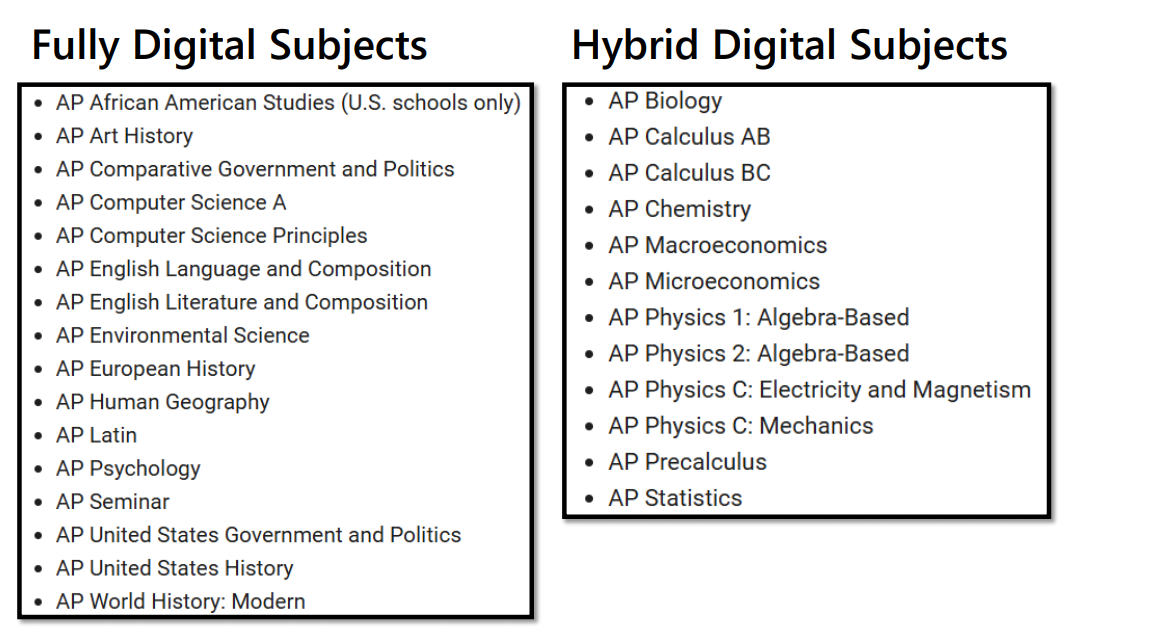
Sixteen AP subjects are now fully digital, including the free-response sections — meaning both MCQ and FRQ portions are completed on a computer. Twelve additional subjects operate as a hybrid format: multiple-choice questions are answered digitally, while free-response answers are still written by hand and submitted on paper. Knowing which format applies to your specific subject matters for how you practice.
Every AP exam, regardless of format, breaks down into the same two core components: multiple-choice questions (MCQ) and free-response questions (FRQ). Preparing well for each requires a different strategy.
The MCQ Problem: Most Practice Materials Don't Match the Real Test
Here's a frustration most AP students run into eventually: there simply aren't enough high-quality places to practice MCQ questions that genuinely resemble what appears on the actual exam.
Commercially available prep books vary widely in quality, and a meaningful number of them include questions that don't closely match the style, difficulty, or format of real College Board questions. Practicing extensively with mismatched material can create a false sense of readiness — or worse, train students toward problem-solving approaches that don't transfer to the actual test.
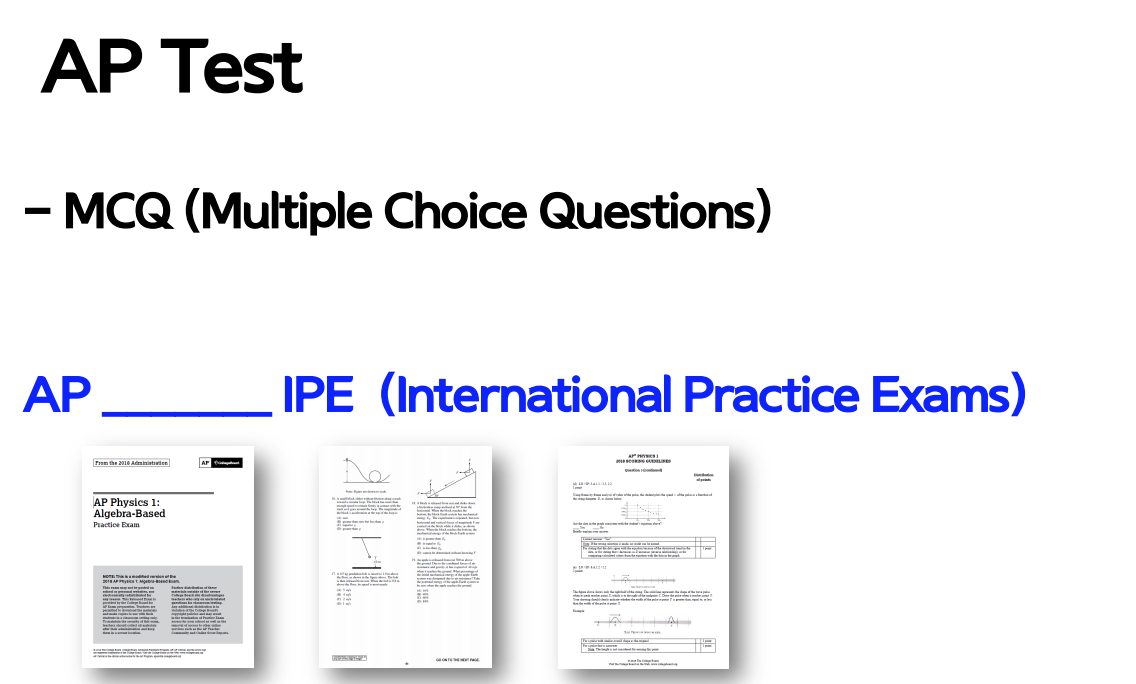
The most reliable source of practice material is College Board's own released questions. Beyond those, a particularly valuable but increasingly hard-to-find resource is the International Practice Exam (IPE) series — official practice tests that College Board historically distributed to teachers to preview exam format and difficulty. These were relatively easy to find through a simple search several years ago. Today, locating them through standard search engines is considerably harder.
Because A ONE Institute has been collecting and archiving these materials over an extended period, we've compiled this resource into full-length practice tests and are making them available for free.
What's Available — Free Full-Length AP Practice Tests
The practice tests are accessible through ett-test.com, the same platform A ONE Institute uses for digital SAT preparation.
Coverage: 26 AP subjects are currently available, spanning the sciences (covering essentially every AP science course), English, World Languages (including Spanish), and Art History. Most students preparing for any mainstream AP subject will find their exam covered.
Format: The testing environment is built to closely replicate the actual digital AP testing experience through College Board's Bluebook platform — including annotation tools that let students underline text, highlight in color, and take notes directly within the test interface, just as they would on exam day.
After completing a test, students receive a results page showing percentile rankings calibrated to the actual 2025 scoring data, with historical year comparisons also available. The platform tracks time spent per question, flags which answers were correct or incorrect, and lets students review any specific question — including the correct answer and, where available, a full video explanation walking through the solution.
Getting started is straightforward: sign up on the platform, navigate from the SAT landing page to the AP section, and select from the full list of available subjects. Free access requires registration with parent consent and a student email address; once submitted, an account is created automatically with login credentials sent by email.
How to Approach FRQ Preparation
Free-response questions are actually more straightforward to prepare for than MCQ — because College Board publishes detailed scoring guidelines for every released FRQ, updated annually, with extensive explanation of exactly how points are awarded.
This makes FRQ prep more reliable than relying on third-party books: search for your subject name plus "scoring guidelines" and the relevant year (2025, 2024, 2023, etc.), and you'll find official explanations of how each response is evaluated.
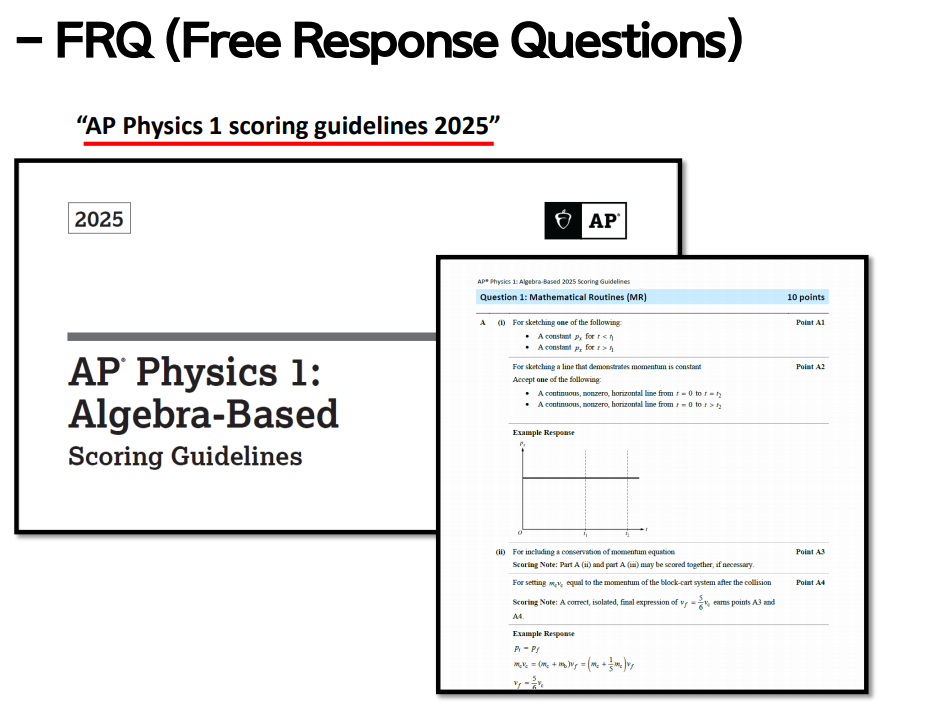
Here's the critical detail most students miss when using these scoring guidelines: it's not enough to understand the reasoning behind why an answer earns points. The actual language and phrasing used in the official scoring guideline should be studied and, where appropriate, mirrored in your own responses. AP graders are trained to look for specific terminology and argument structures — using the same vocabulary and framing that the scoring guideline rewards measurably improves how your response is evaluated.
On sequencing: many students instinctively save the most recent year's released exam for last, reasoning that they should practice with that material right before the actual test. This is the wrong approach. The most recent year's scoring guideline reflects the current grading standards most closely — study it first, internalize its language and expectations thoroughly, and then work backward through earlier years. Saving the most current, most relevant material for last is a consistently suboptimal study strategy.
Why AP Scores Actually Matter — The Data Behind the Recommendation
It's worth understanding precisely why AP performance carries weight in college admissions and beyond, because the data on this is genuinely compelling.
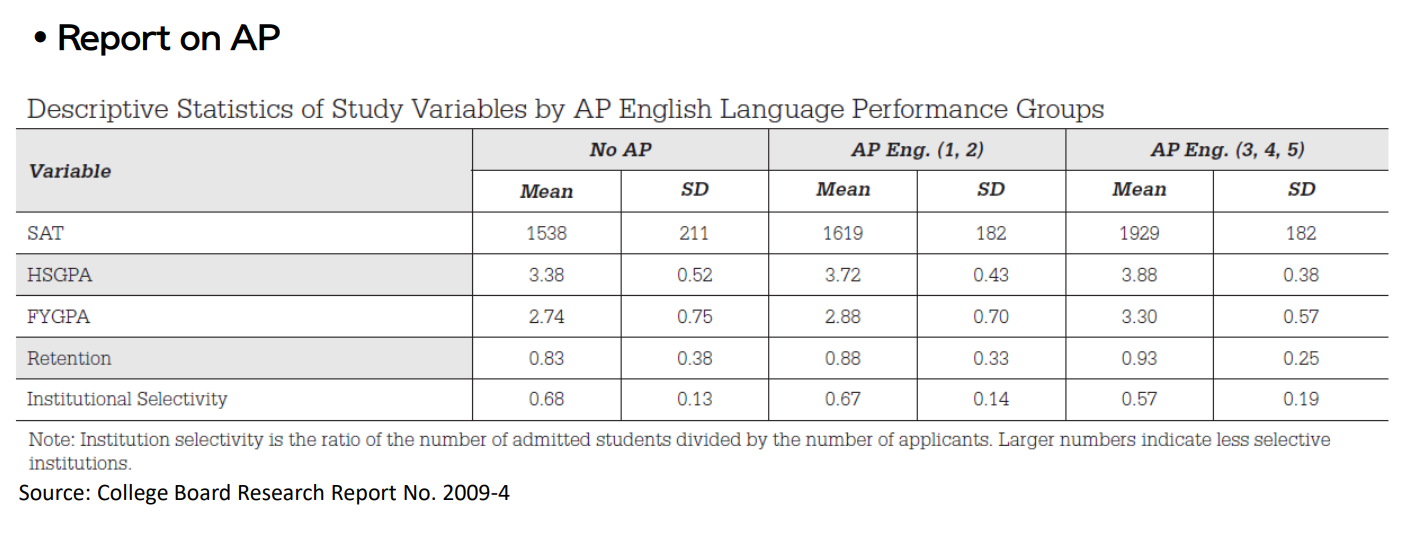
Using AP English Language and Composition (AP Lang) as a representative example: students who never took an AP exam have an average high school GPA of approximately 3.38. Students who took AP courses and scored a 1 or 2 on the exam average around 3.70 — already a meaningful gap. Students who scored 3, 4, or 5 on the AP Lang exam show the highest average GPA of the three groups.
The pattern continues into college performance. First-year college GPA averages 2.74 for students who never took an AP exam, climbs to 2.88 for students who scored 1 or 2 on AP Lang, and rises to 3.30 for students who scored 3, 4, or 5.
This data extends to retention as well: students who scored 3 or higher on AP exams show meaningfully higher four-year college persistence rates — meaning they're more likely to stay enrolled and complete their degree without dropping out — compared to students who scored below 3.
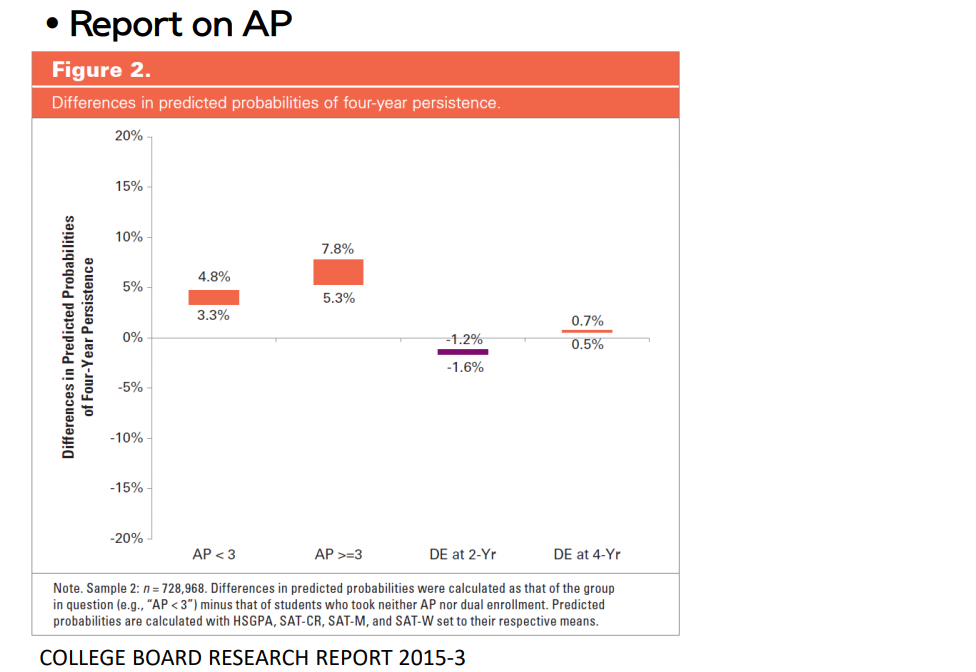
The implication for admissions is direct, even though AP scores aren't formally weighted as a standalone admissions factor at most schools. Colleges have access to extensive longitudinal data showing that students who perform well on AP exams are statistically more likely to perform well academically once enrolled, and more likely to persist through to graduation. That makes a strong AP score a meaningful indirect signal of college readiness — one that colleges have every incentive to factor into how they evaluate an applicant's overall academic profile.
To be clear about priorities: the grade earned in the AP course itself remains the more important academic signal. But given how strongly AP exam performance correlates with both college GPA and retention, treating AP exam preparation as optional or secondary is a mistake that the data doesn't support.
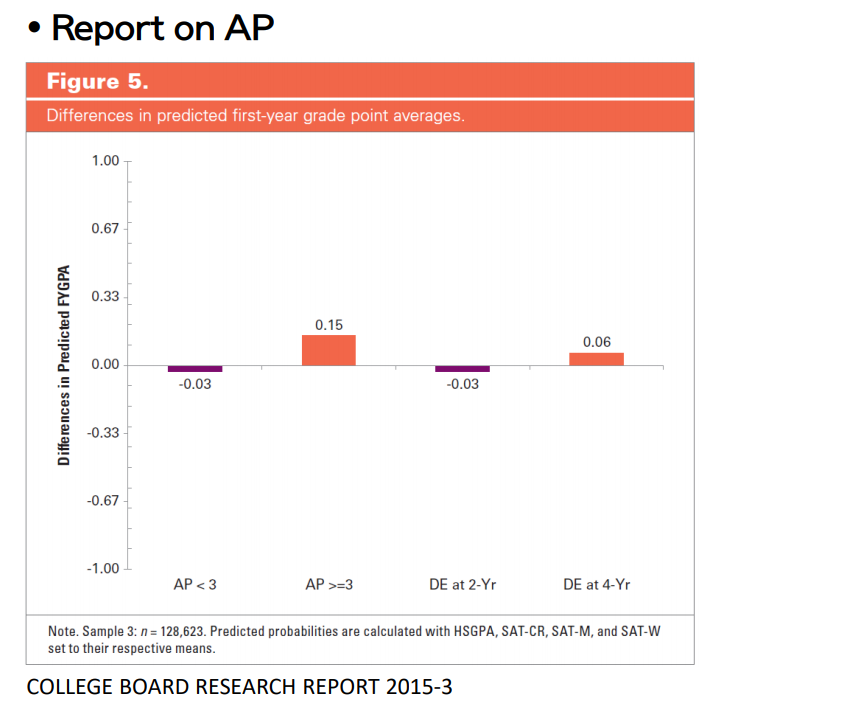
Prepare for MCQ using practice material that genuinely resembles the real exam — not generic third-party questions that may not reflect actual College Board style or difficulty. Prepare for FRQ by studying the most recent year's official scoring guidelines first, internalizing the specific language they reward, and working backward through previous years. And take the exam seriously beyond just the course grade — the data linking AP exam performance to both college GPA and degree completion is consistent enough that colleges have good reason to weigh it, even informally.
The free practice tests and video explanations referenced here are available through ett-test.com, with full sign-up details available through the platform directly.
At A ONE Institute, we build test preparation resources designed to match real exam conditions as closely as possible — because practicing with the wrong material can do more harm than good. If you have questions about AP exam strategy for a specific subject, we're here.
AP exam preparation
digital AP testing
AP scoring guidelines
free practice tests
