
A Quick Detour Through UC Berkeley's Academic Index First
At A ONE Institute, before getting into the main topic, it's worth covering one specific point from UC Berkeley's evaluation criteria that consistently confuses families.
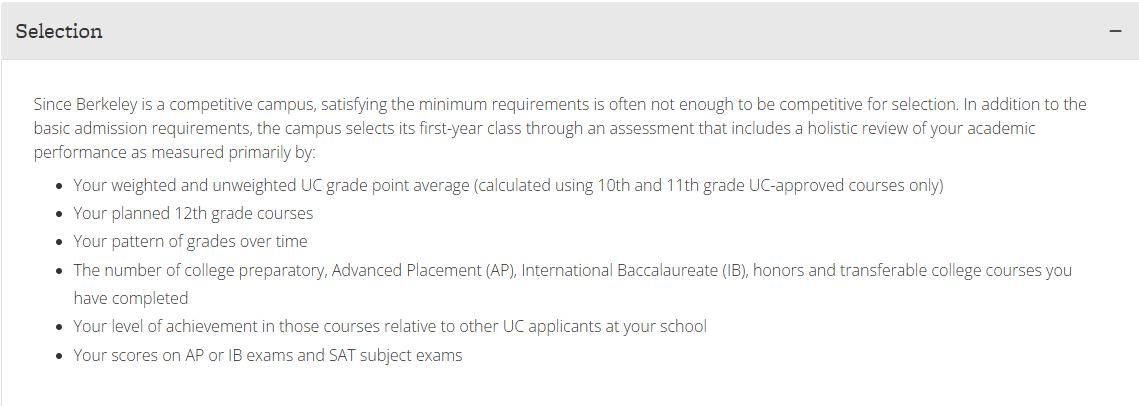
Berkeley evaluates both unweighted and weighted GPA, the rigor of a student's senior-year course schedule, and — importantly — the pattern of grades over time. This last point matters more than most students realize. A student who struggled in 9th grade but shows a clear upward trajectory through 12th grade is read favorably, because the trend itself signals growth. The ideal scenario is obviously a consistently strong GPA across all four years — but a rising trajectory from a rough start is a meaningfully better story than strong 9th and 10th grade years followed by a dip in 11th. An upward arc reads as growth. A downward dip reads as a warning sign, even if the overall GPA numbers look similar.
There's also a common anxiety worth addressing directly: students at academically rigorous schools where high GPAs are hard to earn often worry they'd have been better off at an easier school. Berkeley's own stated approach addresses this. Because school rigor varies significantly, Berkeley evaluates a student's GPA relative to other applicants from the same high school — not against some absolute national standard. This means the first layer of competition is internal: how a student's academic performance compares to other students applying from their own school, not to applicants nationwide.
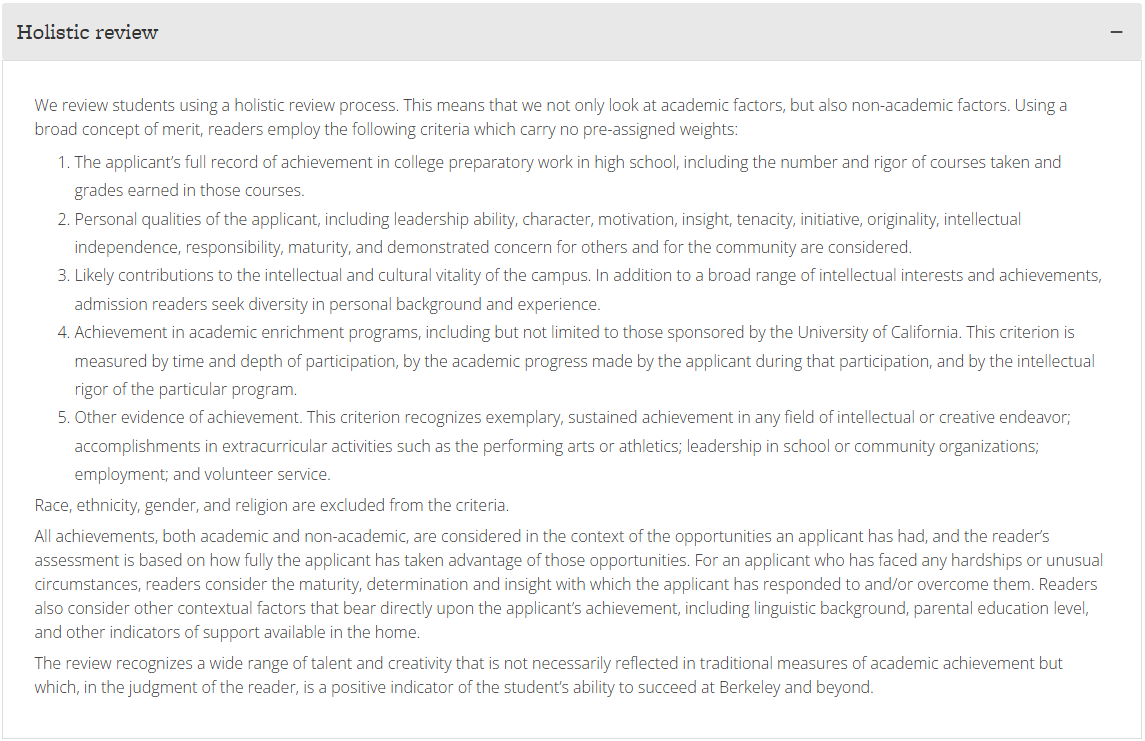
This is also why so many students hear advice like "don't apply to a school if several stronger classmates from your school already applied there." If five students who are academically stronger than you all applied to Princeton, that's a meaningful signal — not because of some quota, but because of how relative, in-school comparison functions in the admissions process. Applying to a different school where you're more clearly differentiated from your own classmates can be the more strategic move.
With that covered, let's get to the main topic.
The Question Worth Sitting With
If your child could only carry forward one single character trait into adulthood, which one would you choose?
This question matters because of where the answer leads.
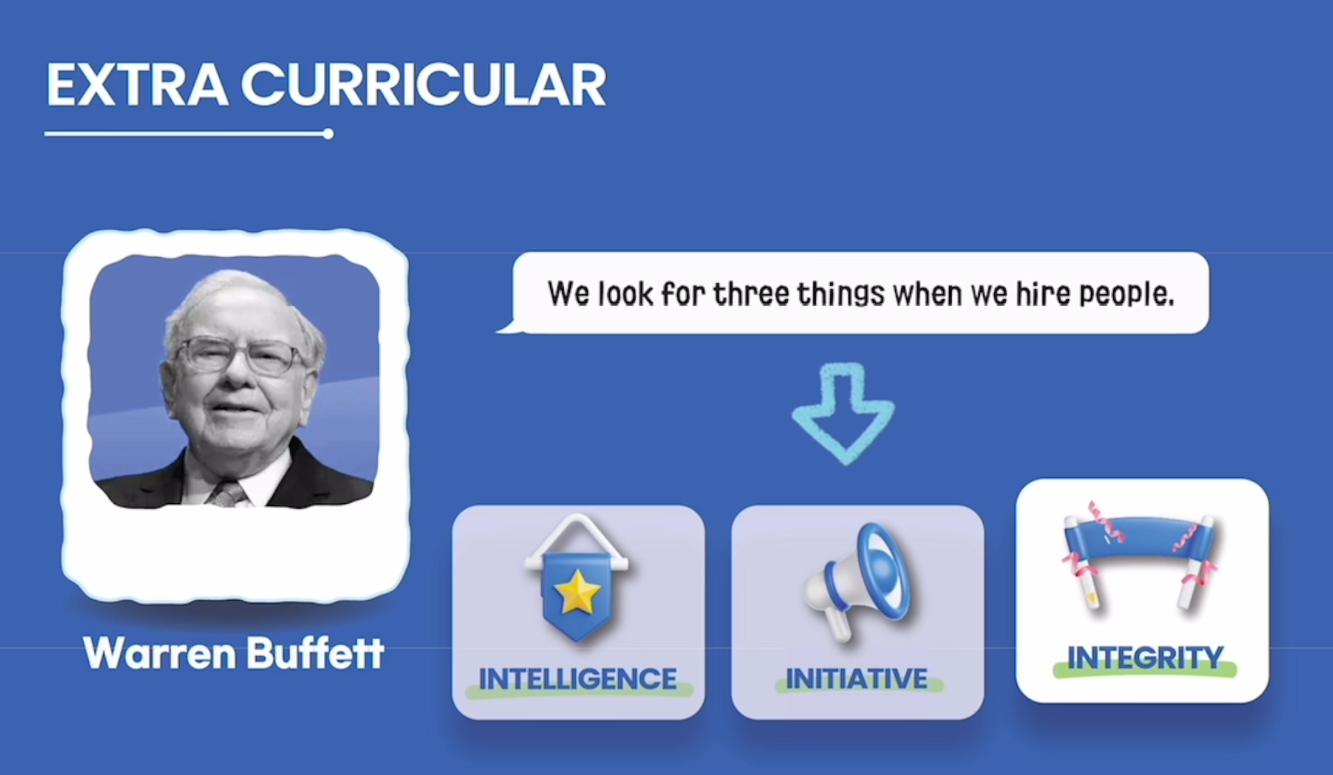
Warren Buffett — a figure widely regarded, fairly or not, as one of the most thoughtful voices on long-term character and success — has spoken about the three qualities he prioritizes most when hiring: intelligence, initiative, and integrity. Of these three, he's been explicit that integrity matters most. Intelligence and initiative without integrity, in his framing, can actually be dangerous — talented, driven people without integrity tend to cause damage rather than create value.
Integrity, in the sense used here, isn't quite the dictionary definition. It's better understood as the state in which what a person thinks, what they say, and what they do are aligned. A person with high integrity doesn't perform one version of themselves publicly while privately believing or doing something different. Thought, word, and action move together.
This is genuinely hard to assess. You can't determine whether someone has integrity by observing them for a day or two. It requires sustained observation over time — which is precisely why it's also one of the hardest traits to demonstrate convincingly in a short application.
There's a related anecdote worth knowing. Buffett has also described an informal exercise: asking students to imagine they could select one friend to receive 10% of that friend's lifetime earnings. Most people might assume the rational choice is the friend who's already wealthy, or the one with obvious talent, or the one with the best grades. But when people actually do this exercise, they tend to choose the friend who is kind, generous, and has demonstrated integrity over time — not necessarily the most conventionally impressive one.
The implication is direct: these qualities — kindness, integrity, sustained character — are widely recognized as predictive of long-term success. But they share a structural problem. They can only be demonstrated, and only be recognized, over an extended period of observation. And that creates a specific disadvantage for one group of applicants in particular.
Where Asian Applicants Are Consistently Underscored — According to Harvard's Own Data
This is where the topic becomes specific and, frankly, uncomfortable — but it's grounded in real data rather than speculation.

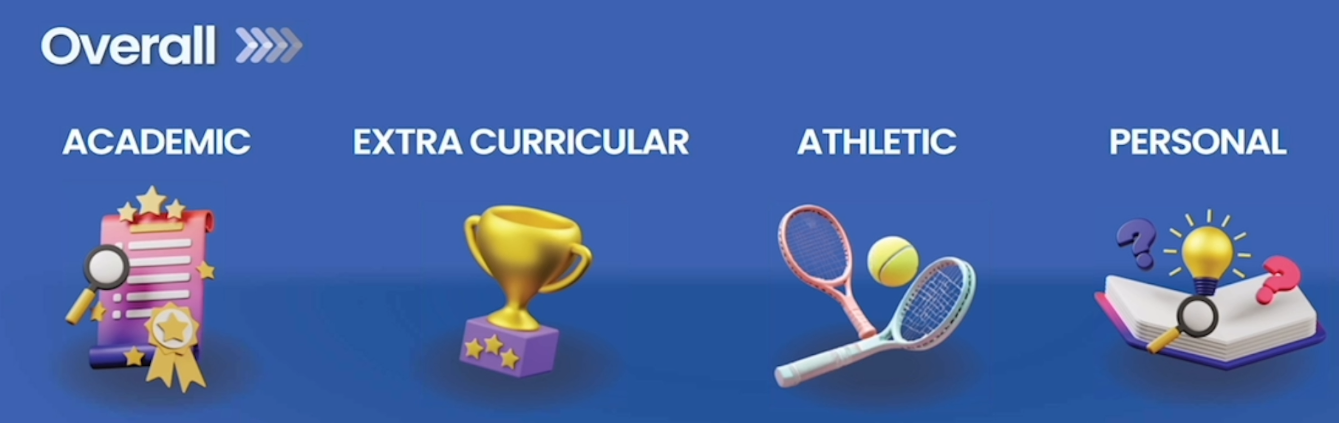
The numbers below come from Harvard's own internal admissions modeling, which became public during the affirmative action litigation. These are not raw counts of students or percentages of an applicant pool — they're scored outputs from Harvard's internal evaluation model, broken out by race, representing the share of applicants in each racial group who scored above a 3 rating in each evaluation category.
Academic rating (share scoring above a 3):
White applicants: 45.52. Black applicants: 9. Hispanic applicants: 17. Asian applicants: 60.
Asian applicants substantially outscore every other group on academic rating — and it's not close.
Extracurricular rating (share scoring above a 3):
White: 24.93. Black: 15.83. Hispanic: 17.16. Asian: 28.34.
Asian applicants score highest here too.
Athletic rating:
White: 14.83. Black, Hispanic, and Asian applicants all score meaningfully lower than white applicants in this category.
Personal rating (share scoring above a 3) — the category this article is about:
White: 22.93. Black: 19.81. Hispanic: 19.23. Asian: 18.01.
Asian applicants score lowest of any group on the personal rating — despite scoring highest on both academic and extracurricular ratings.
There's a second piece of data from the same litigation that makes the implication even clearer. Harvard's modeling examined how many applicants from each racial group the university would want to admit before factoring in the personal rating, compared to after factoring it in.
For white applicants, adding the personal rating increased the desired admit count — from roughly 2,742 upward. For Hispanic applicants, the desired count rose from roughly 302 to 341. For Black applicants, it rose from roughly 163 to 194. For Asian applicants, the desired count went from roughly 2,255 downward — the personal rating made Asian applicants, as a group, appear less attractive in the model, not more.
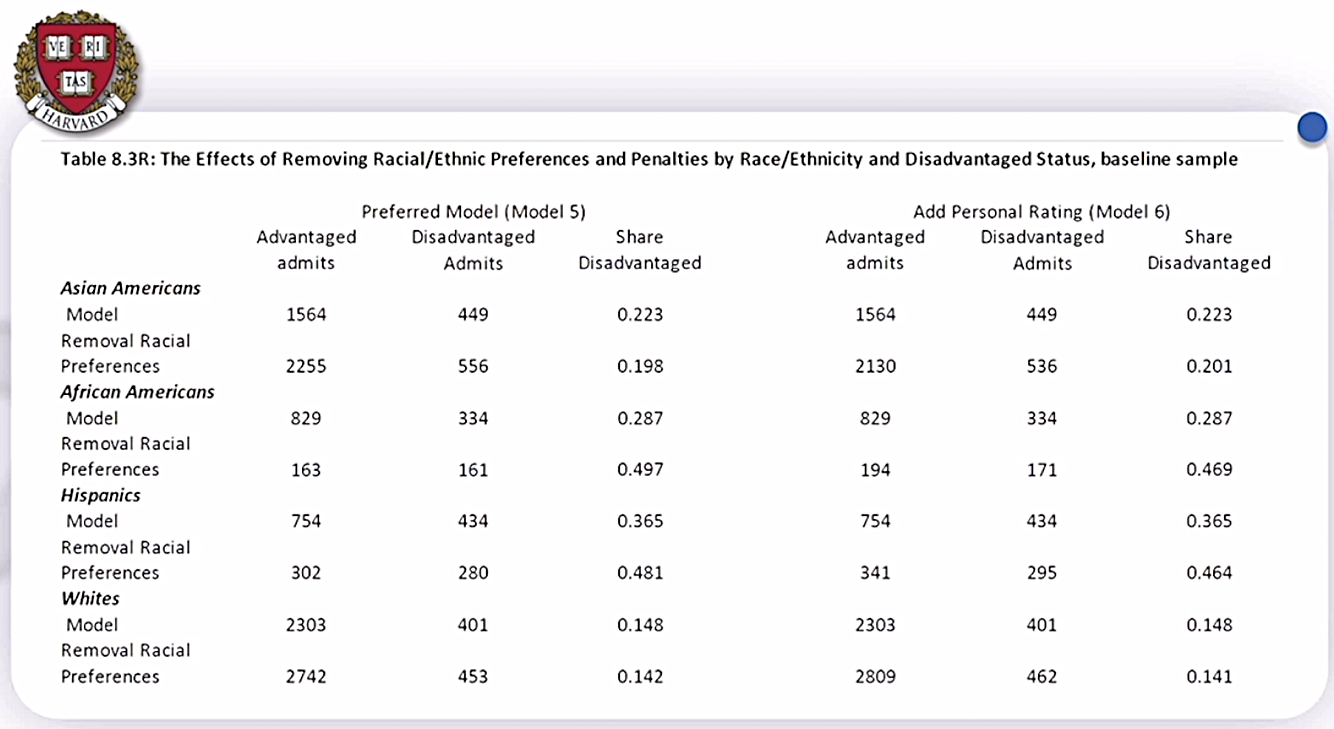
Asian applicants are the only group for whom adding the personal rating decreased perceived attractiveness in Harvard's own modeling.
This is the core problem worth understanding clearly: Asian applicants, on average, lead decisively in the categories that are most directly quantifiable — academic performance and extracurricular breadth — and underperform specifically in the category that requires sustained, observable demonstration of character over time.
Why This Happens — And Why It's Fixable
The personal rating isn't measuring something mystical or unfair. According to the patterns reflected in this data, it's measuring sustained evidence of qualities like integrity, kindness, generosity, and authentic character — demonstrated consistently over time, in ways that come through clearly in essays, recommendation letters, and the overall texture of an application.
The reason this category is harder for many Asian applicants isn't a lack of these qualities. It's that demonstrating them requires a different kind of evidence than academic and extracurricular categories do. A test score is a number. A research paper is a deliverable. But integrity, kindness, and character require narrative — concrete instances, observed over time, that a teacher, mentor, or the student's own writing can point to convincingly.
This is exactly why the framework described in A ONE Institute's broader admissions strategy — research, followed by written expression, followed by teaching or mentoring others — matters so directly here. That three-part sequence isn't just useful for the Academic and Extracurricular categories. It's one of the most effective ways to generate the kind of sustained, observable evidence that the Personal rating is actually trying to measure.
A student who tutors younger students consistently over two years isn't just building a credential. They're generating concrete evidence — visible to a teacher writing a recommendation, citable in an essay, observable by a counselor — that demonstrates patience, generosity, and follow-through. A student who mentors peers through a difficult subject, who shows up reliably for a community commitment, who treats people consistently well across contexts where no one is necessarily watching — that student is building the exact kind of evidence base that the personal rating rewards.
This is also why short-term, transactional activities tend to underperform in this category regardless of how impressive they look on paper. A two-week summer program demonstrates very little about character, because there isn't enough time for character to be observed. A two-year mentoring relationship, a consistent volunteer commitment, a sustained leadership role where the student's treatment of others can be observed repeatedly — these generate exactly the kind of evidence this category requires.
What This Means in Practice
The single most important point here is this: time is the one resource that's genuinely equal across every applicant, regardless of talent, background, or resources. A student with average academic ability and a student with exceptional academic ability both have the same number of years in high school. What differs is how that time gets used — and whether it's used in ways that generate visible evidence of sustained character.
For Asian applicants specifically, given the consistent pattern in the data above, this matters more than it might for other groups. The Academic and Extracurricular categories are already strong. The strategic opportunity — the place where additional investment produces the largest marginal gain — is in generating the kind of sustained, demonstrable evidence that raises the Personal rating.
Concretely, this means:
Sustained commitments over short-term ones. A two-year tutoring relationship with the same group of students generates far more evidence of character than five different one-time volunteer events.
Visible treatment of other people. Recommendation letters that speak to how a student treats peers, younger students, or people without power or status in a given context carry disproportionate weight in this category — because they're exactly the kind of evidence that's hard to fabricate or compress into a short period.
Consistency across contexts. A student who is generous and reliable specifically when it benefits their application reads very differently from a student who is consistently that way regardless of whether anyone is watching. Teachers and counselors who write recommendations are often unconsciously evaluating exactly this distinction.
Starting early. Because this category depends on sustained observation over time, the students who score highest on it are almost always the ones who began building these commitments well before junior or senior year — when there's enough runway for character to actually be demonstrated, not just asserted.
This isn't about performing kindness or integrity for admissions purposes — that kind of performance tends to read as exactly what it is, and it doesn't generate the sustained evidence this category requires anyway. The actual fix is more straightforward, if less convenient: commit to fewer things, for longer, in ways that consistently involve other people — and let the evidence of character accumulate naturally over real time.
Given how consistently the data shows Asian applicants underperforming specifically in this one category — while leading in nearly every other measurable dimension — this is genuinely one of the highest-leverage areas for improvement available. Not because the underlying character is missing, but because the kind of evidence this category requires has often gone undeveloped or undocumented.
Start building sustained, visible commitments early. Choose depth over breadth in these specific kinds of activities. And recognize that the time required to demonstrate this trait convincingly is exactly the kind of investment that compounds — the earlier it starts, the more convincing the evidence becomes by the time applications are due.
At A ONE Institute, we help students build the kind of sustained, authentic activity profile that generates real evidence of character — not just academic and extracurricular credentials. If you want to think through how to structure this for your student specifically, we're here.
admissions
holistic review
