
The Problem With How Most Families Think About Admissions
At A ONE Institute, the most common misconception we encounter is that selective college admissions is fundamentally subjective — that admissions officers read applications and make impressionistic judgments based on some ineffable sense of fit or potential.
That's not entirely wrong. But it misses something important.
The reality, based on extensive analysis of court documents, published rubrics, and institutional research, is that top universities evaluate applicants through structured scoring systems with defined categories and explicit grading tiers. The holistic review that schools describe publicly is real — but it operates within a quantitative framework that's more systematic than most families realize.
Understanding that framework changes how you think about preparation. Not because admissions is reducible to a formula, but because knowing how categories are weighted and how scores are assigned makes it possible to build a student profile strategically rather than reactively.
Where This Framework Comes From

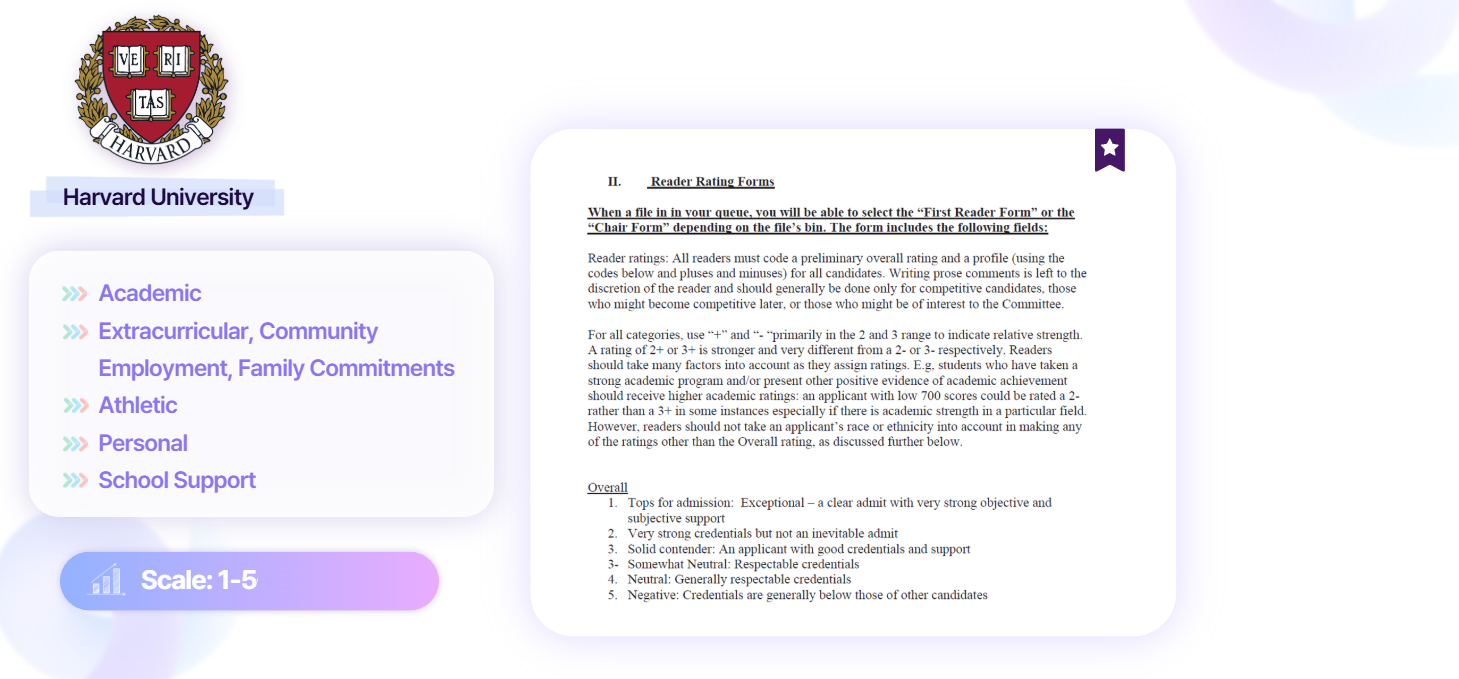
The scoring analysis described here is grounded in multiple primary sources — not one consultant's opinion.
The most significant source is the 130-page Harvard admissions scoring document that became public during the affirmative action litigation. This document describes in detail how Harvard categorizes and scores applicants across multiple dimensions, using a five-tier grading system within each category.
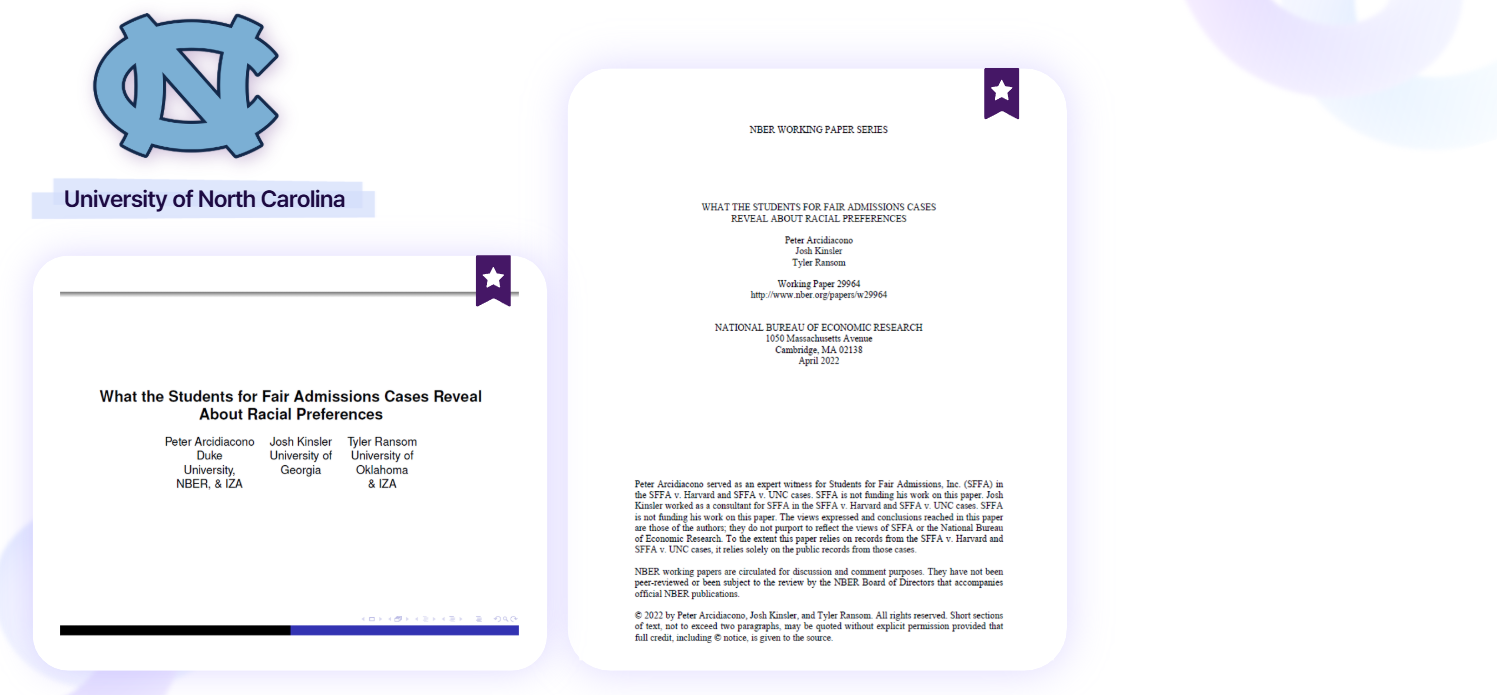

A second source is the 53-page UNC admissions document from the same litigation. UNC's framework uses different category labels but reveals the same underlying logic: structured scoring across several defined dimensions, with explicit attention to context and environment.
A third source is the UT Austin admissions framework, which emerged from separate 2016 litigation. UT Austin uses a two-index system — an Academic Index followed by a Personal Achievement Index — scored on a six-tier scale.


Beyond these litigation documents, additional schools — Yale, Caltech, Penn, Duke, Northwestern, and others — have published or otherwise made available enough information about their evaluation priorities to allow pattern analysis. Mapping the language these schools repeatedly use across their admissions materials reveals a consistent set of categories, even when the specific terminology differs.


The framework at A ONE Institute synthesizes all of this into a working evaluation model. It's not identical to any one school's internal rubric — and it's not claimed to be. But it reflects the genuine structure of how competitive admissions evaluation works across institutions.
The Five Evaluation Categories
Across all the source materials, the same core categories emerge consistently. A ONE Institute's working framework organizes them as follows:
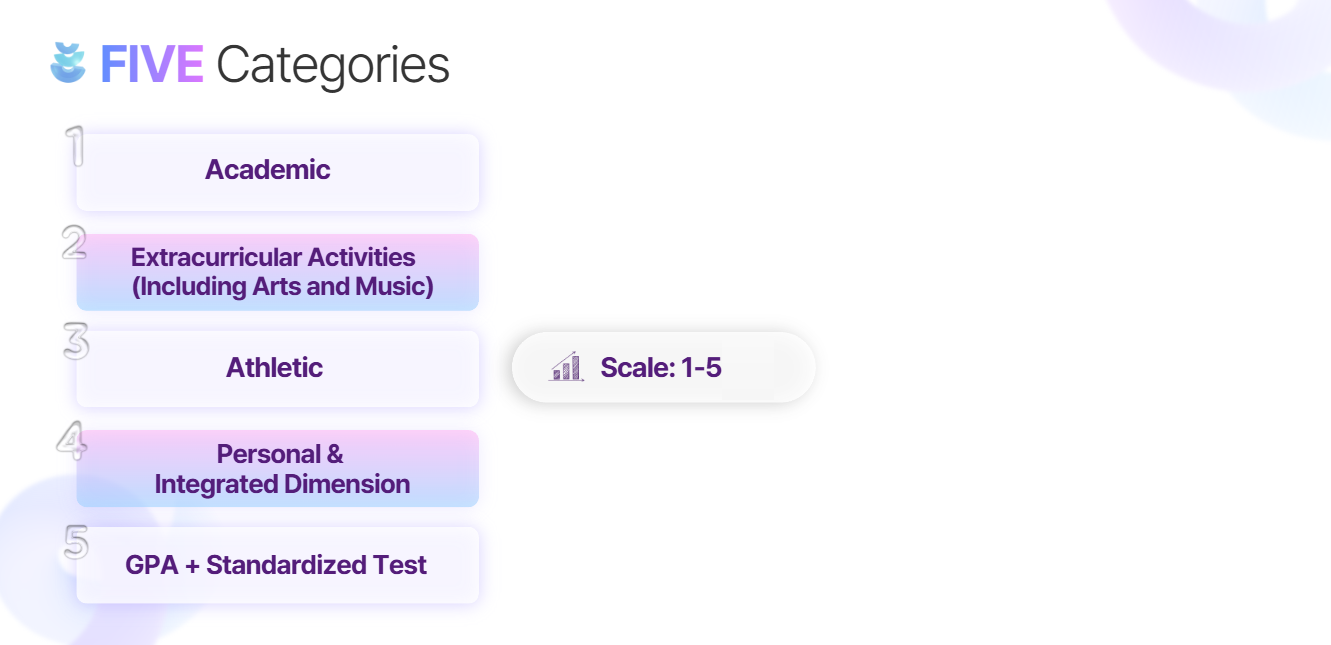
1. Academic
This covers everything related to intellectual engagement and demonstrated academic achievement: GPA and course rigor (covered separately below), research activity, academic competitions, scientific inquiry, and evidence of genuine intellectual depth beyond classroom performance.
2. Extracurricular
Activities outside the classroom — clubs, community involvement, volunteer work, passion projects, leadership roles, and sustained engagement in areas of genuine interest. This category rewards depth and coherence over volume. A long list of unrelated activities scores worse than a smaller set of deeply connected ones.
3. Athletics
Treated as a distinct category because athletic achievement — particularly at varsity, regional, or national levels — carries specific evaluative weight. This doesn't mean non-athletes are disadvantaged overall, but athletic achievement at competitive levels scores meaningfully within this category.
4. Personal and Integrated Dimension
This is the category most families understand least clearly — and the one with the highest potential for score improvement. It evaluates the degree to which a student's activities, intellectual work, and personal qualities form a coherent, integrated picture. More on this below.
5. GPA and Standardized Testing
Academic metrics — weighted and unweighted GPA, course rigor, SAT/ACT scores — evaluated in context. These function as a foundational threshold: strong scores don't guarantee admission, but weak scores create a ceiling that other categories can't fully overcome.
Each category is scored on a five-tier scale. The total score across all five categories provides the quantitative foundation for admissions decisions — which are then refined through committee discussion, contextual factors, and class composition goals.
The Category That Most Students Are Missing: Personal and Integrated Dimension

Harvard's framework includes what it calls "personal" ratings. UNC describes something similar as "personal quality." Stanford emphasizes "intellectual vitality" — the degree to which a student actively pursues and applies knowledge, not just receives it. UT Austin's Personal Achievement Index addresses how students have performed within their specific environmental context.
Across all of these frameworks, one consistent signal emerges: the highest-scoring students in the personal dimension aren't necessarily the ones with the most impressive individual credentials. They're the ones whose work is connected — where one activity genuinely leads to the next, where knowledge developed in one context gets expressed and applied in others.
According to A ONE Institute's analysis of how these frameworks function in practice, the most reliable way to score well in the Personal and Integrated Dimension is through a specific three-part sequence:
Research or deep inquiry — not necessarily formal academic research with a faculty mentor, though that helps. Any sustained engagement with a question or problem that goes beyond standard coursework. The student who reads deeply into a topic, runs an informal experiment, analyzes a dataset, or synthesizes information from multiple sources has begun this step.
Written expression — taking that research or inquiry and expressing it in writing, publicly. This means contributing to a school newspaper or magazine, submitting to a writing competition, publishing in a student journal, or producing any written work that puts the student's thinking into the world rather than keeping it private. The writing doesn't need to win awards to count. It needs to demonstrate that the student has moved from internal learning to external expression.
Teaching or transmission — taking what has been learned and sharing it with others, particularly younger students. Tutoring, mentoring, running a workshop, leading a study group, teaching a class. The specific form is less important than the underlying dynamic: the student is now the source of knowledge rather than the recipient.
When a student completes this sequence — inquiry, then writing, then teaching — they're no longer just accumulating credentials. They're demonstrating intellectual agency. They're showing that knowledge drives action, and that their engagement with ideas extends into the world around them.
This is what the Personal and Integrated Dimension is actually measuring. And starting this sequence in 9th grade, with consistent development through junior year, is the most reliable path to high scores in this category.
Why "More Activities" Is the Wrong Goal
The instinct most families have when they read about competitive admissions is to do more. More activities, more competitions, more clubs, more leadership positions. More everything.
This instinct is understandable. It's also counterproductive.
Admissions evaluators don't see a long activity list as evidence of a high-achieving student. They see it as a signal that the student may not know what they actually care about — or that their profile was assembled strategically rather than grown authentically.
The scoring framework makes this concrete. A student who has pursued ten loosely related activities will score well in some categories and poorly in others, with the Personal and Integrated Dimension reflecting the absence of coherent through-lines across the profile. A student who has pursued four or five deeply connected activities — where each one builds on the others — will score well across multiple categories simultaneously, because each activity is doing multiple jobs in the evaluation.
The biology student who does research, writes about it for the school paper, and runs a Saturday science workshop for middle schoolers isn't doing three separate things. They're doing one thing — demonstrating genuine engagement with biology — through three different channels. And that registers across Academic, Extracurricular, and Personal and Integrated Dimension simultaneously.
The math student who competes in AMC, tutors younger students in problem-solving, and writes a reflection on a particularly interesting problem type is showing more than mathematical ability. They're showing intellectual ownership of a subject. That's what top universities are looking for.
What This Means for Preparation at Each Stage
The framework has direct implications for how students should think about their activities at different points in high school.
9th and 10th grade is when the foundation gets built. This is when students should identify the area of genuine interest that will serve as the spine of their application — not necessarily their intended major, but the intellectual or creative territory where their curiosity is most alive. The goal at this stage isn't impressive credentials. It's developing the habit of going deep: reading beyond what's assigned, asking questions that don't have easy answers, beginning to form views about problems worth working on.
11th grade is when the structure should become visible. Research or sustained inquiry should be underway. Written expression in some public form should have started. At least one teaching or mentoring relationship should exist. By the end of junior year, the student's profile should tell a coherent story — one where a reader can see the through-line connecting activities without having to work to find it.
12th grade is when the structure gets refined and documented. The activity list should be sequenced to make the narrative as legible as possible. Essays should deepen what the activities establish rather than introduce entirely new dimensions. The full application should confirm and extend a picture that was already visible by the end of junior year.
The Two Core Conclusions
Everything above points toward two specific ideas worth holding clearly.
First: top universities evaluate students more quantitatively and structurally than most families realize. The holistic review process is real, but it operates within defined categories and explicit scoring tiers. This means that "doing well in admissions" isn't entirely subjective or unpredictable — it's a matter of performing well across the categories that matter, and understanding what high performance in each category actually requires.
Second: structural preparation is therefore possible — and necessary. Preparing without understanding the framework is like studying for a test without knowing what subjects are covered. The students who consistently gain admission to highly selective schools aren't the ones who did the most things. They're the ones whose profiles were built with an understanding of what the evaluation is actually measuring — and whose genuine interests happened to generate exactly the kind of integrated, connected, multi-dimensional evidence that the scoring framework rewards.
The goal isn't to game a system. It's to understand one — and to use that understanding to help students develop in ways that are both genuinely meaningful and strategically well-positioned.
At A ONE Institute, we help students and families understand not just what to do, but why it works — building profiles that are coherent, authentic, and structurally sound. If you want to understand how a specific student's current profile would score across these categories, and what the highest-leverage next steps would be, we're here.
college admissions scoring
application evaluation
Harvard admissions
extracurricular strategy
admissions framework
