
Why Writing Competitions Matter — For Every Student, Not Just Humanities Majors
At A ONE Institute, one of the most underutilized tools in a competitive application is a well-chosen writing competition. And the underutilization cuts across student types — STEM-focused students often assume these competitions aren't relevant to them, while humanities-focused students sometimes treat them as generic resume additions rather than strategic profile-builders.
Both assumptions are wrong. Here's why writing competitions matter regardless of intended major.
A student's English ability — their genuine capacity to read, analyze, and communicate at a high level — needs to show up credibly in the application. School GPA helps, but grade inflation means admissions readers apply a discount to it. SAT and ACT reading and writing scores help, and for international students TOEFL and IELTS scores add another data point. But none of these demonstrate the ability to construct a compelling, original written argument from scratch.
That's what a writing competition result does. A recognized result in a credible writing competition — even a semifinal or honorable mention at a competitive tier — directly addresses the question admissions readers are implicitly asking: can this student actually write at a level that will serve them in a demanding academic environment?
For STEM students applying to research-intensive programs, this matters. For pre-law students whose entire future profession depends on written argumentation, this matters. For business students who will spend careers writing memos, reports, and proposals, this matters. The specific competition you choose should connect to your intended field — but the underlying value of demonstrated writing ability is universal.
How to Think About Competition Tiers
Not all writing competitions carry equal weight in an application. The field is broadly organized into two tiers — not as a judgment of quality, but as a practical description of selectivity and recognition.
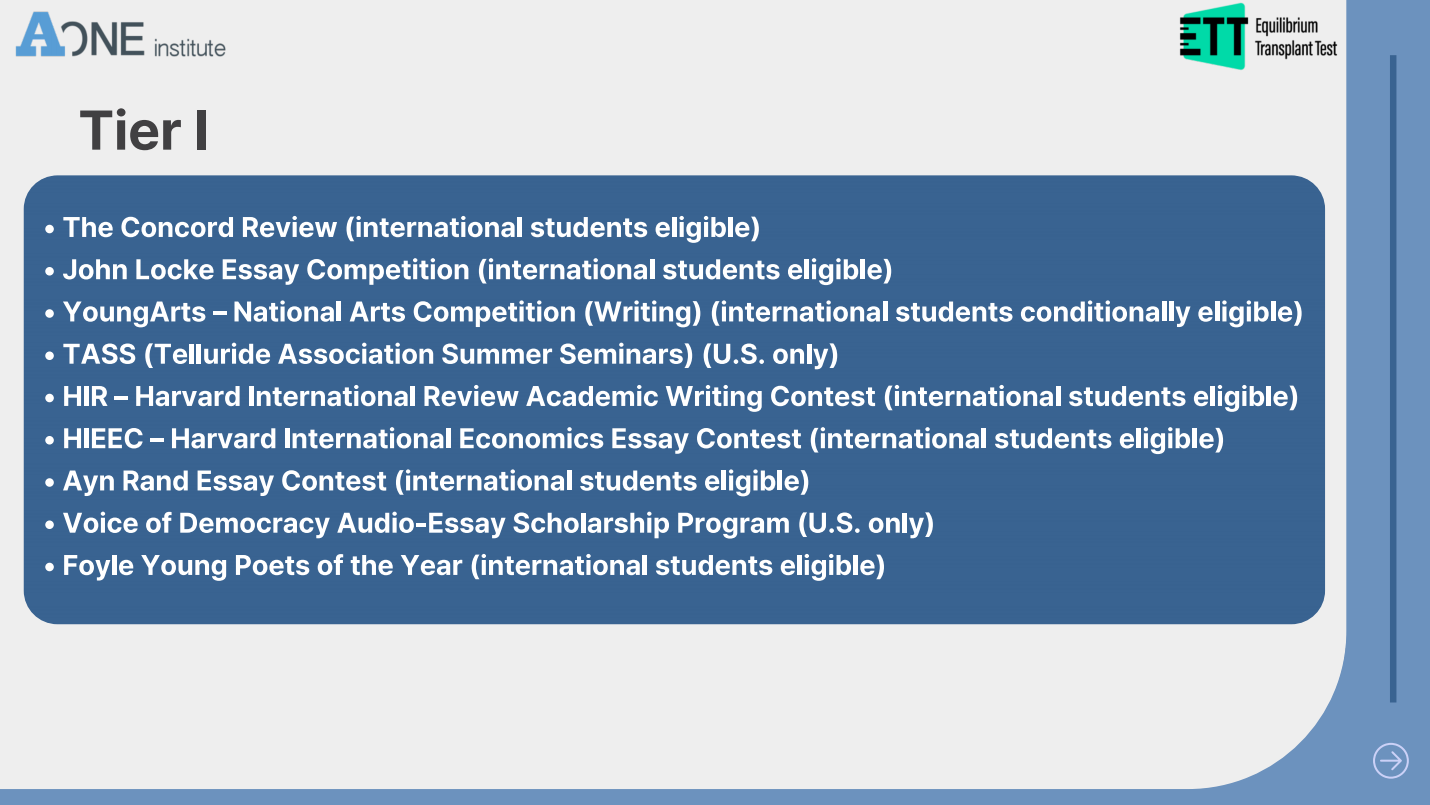
Tier 1 competitions are highly selective, widely recognized in admissions circles, and genuinely difficult to place in. Winning or placing at this level is a meaningful credential. Being submitted and reviewed is still worthwhile for the writing development it forces. Examples include:
- Concord Review
- John Locke Essay Competition
- National Art Competition
- TASS (The Scholastic Art and Science)
- Harvard International Review Academic Writing Contest
- Harvard International Economics Essay Contest (HIEC)
- AFSA Essay Contest
- Voice of Democracy Audio Essay Scholarship Program
- Foyle Young Poet of the Year
- Immerse Essay Contest
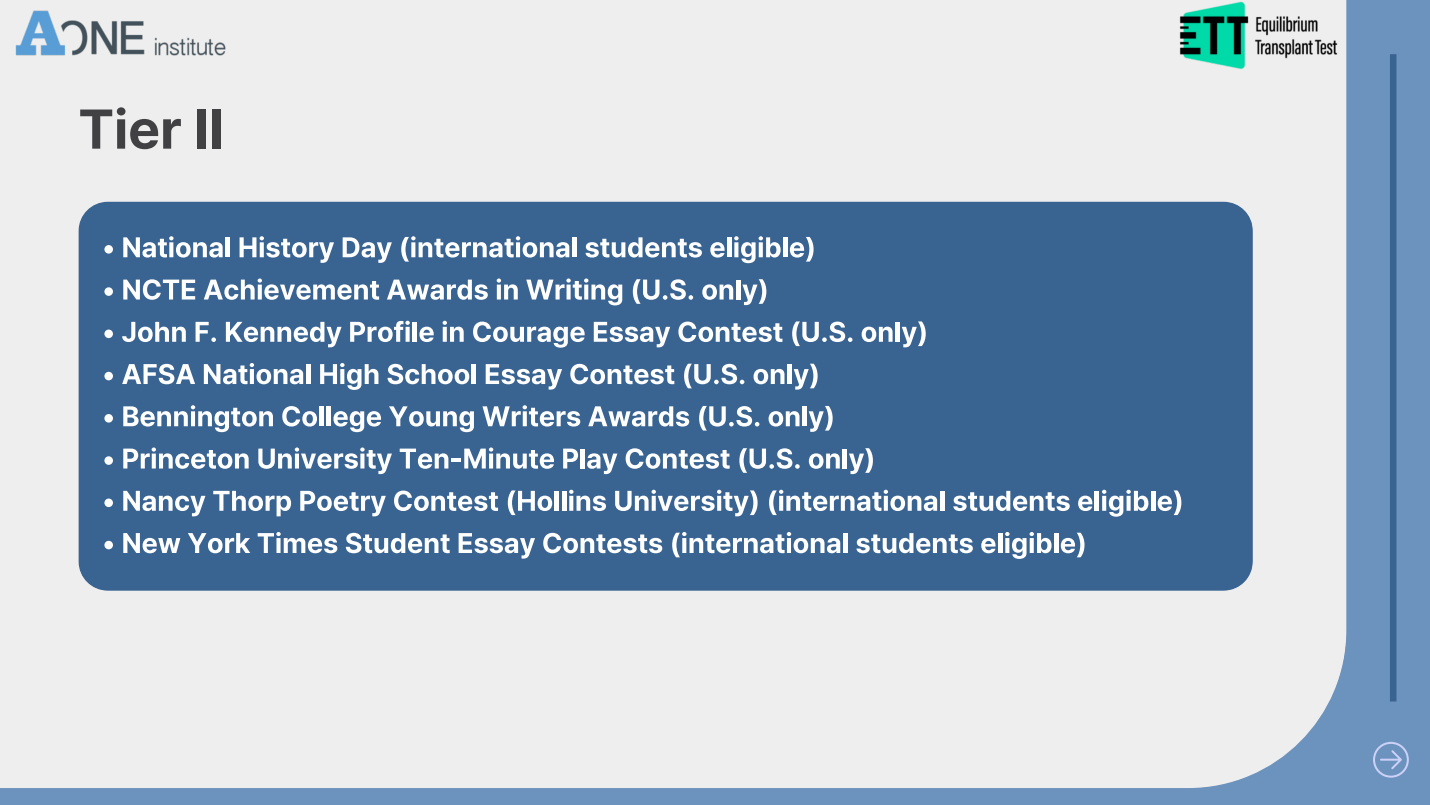
Tier 2 competitions are more accessible at entry levels but still genuinely competitive at the top, and they serve an important function: they're where most students should start building the habit and skill of formal competitive writing before attempting Tier 1. Examples include:
- Scholastic Art and Writing Awards
- National History Day
- NCTE Achievement Awards in Writing
- John F. Kennedy Profile in Courage Essay Contest
- Bennington College Young Writers Award
- Princeton University 10 Minute Play Contest
- New York Times Student Essay Contest
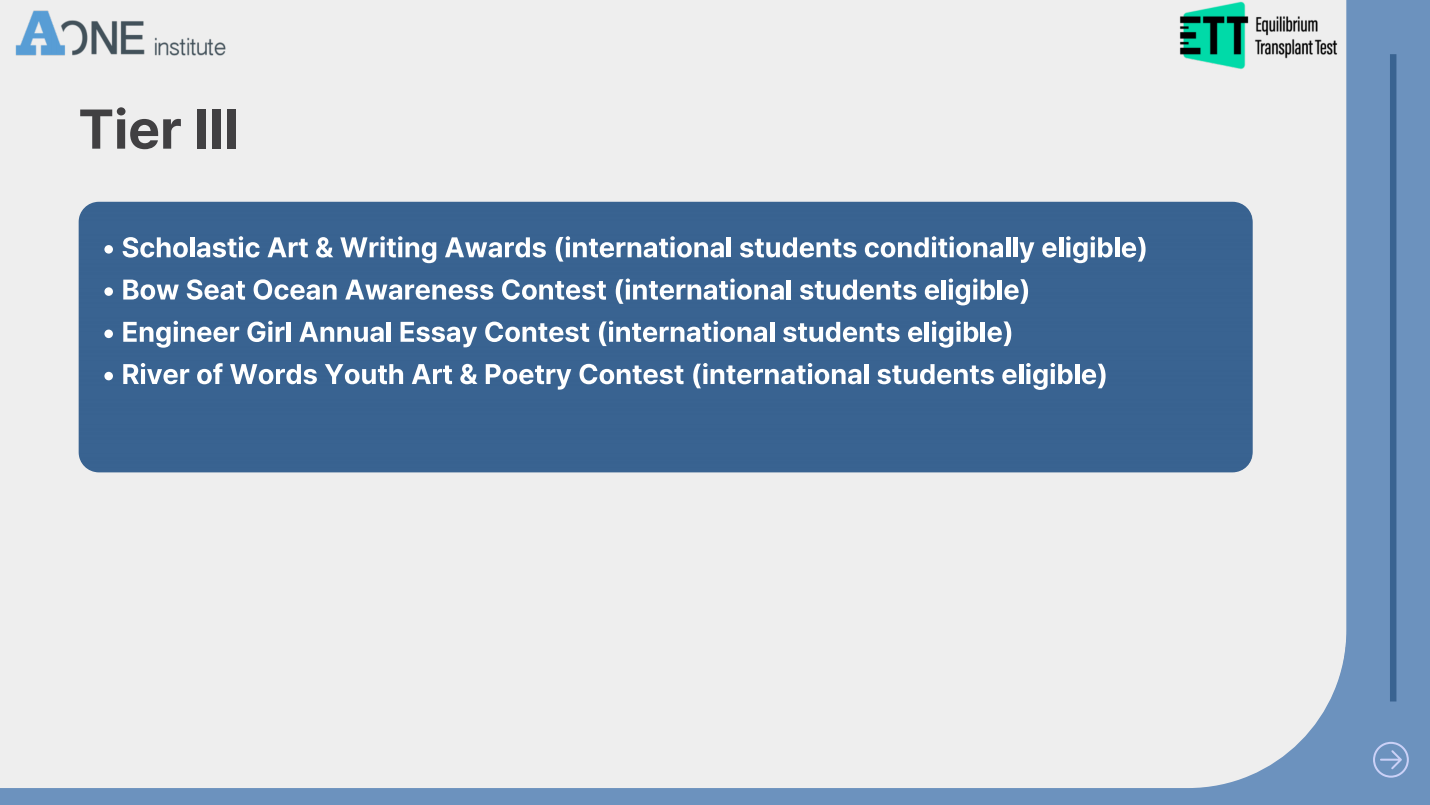
- Bow Seat Ocean Awareness Contest
- Engineer Girl Annual Essay Contest
The sequencing principle is consistent across all fields: start with Tier 2 competitions where your intended major's themes can be explored — even loosely — and build toward Tier 1 as skill and confidence develop. The goal isn't necessarily to win along the way. The goal is to develop the writing ability and competitive experience that raises your probability of performing well when the stakes are higher.
Roadmaps by Intended Major
Literature and Creative Writing
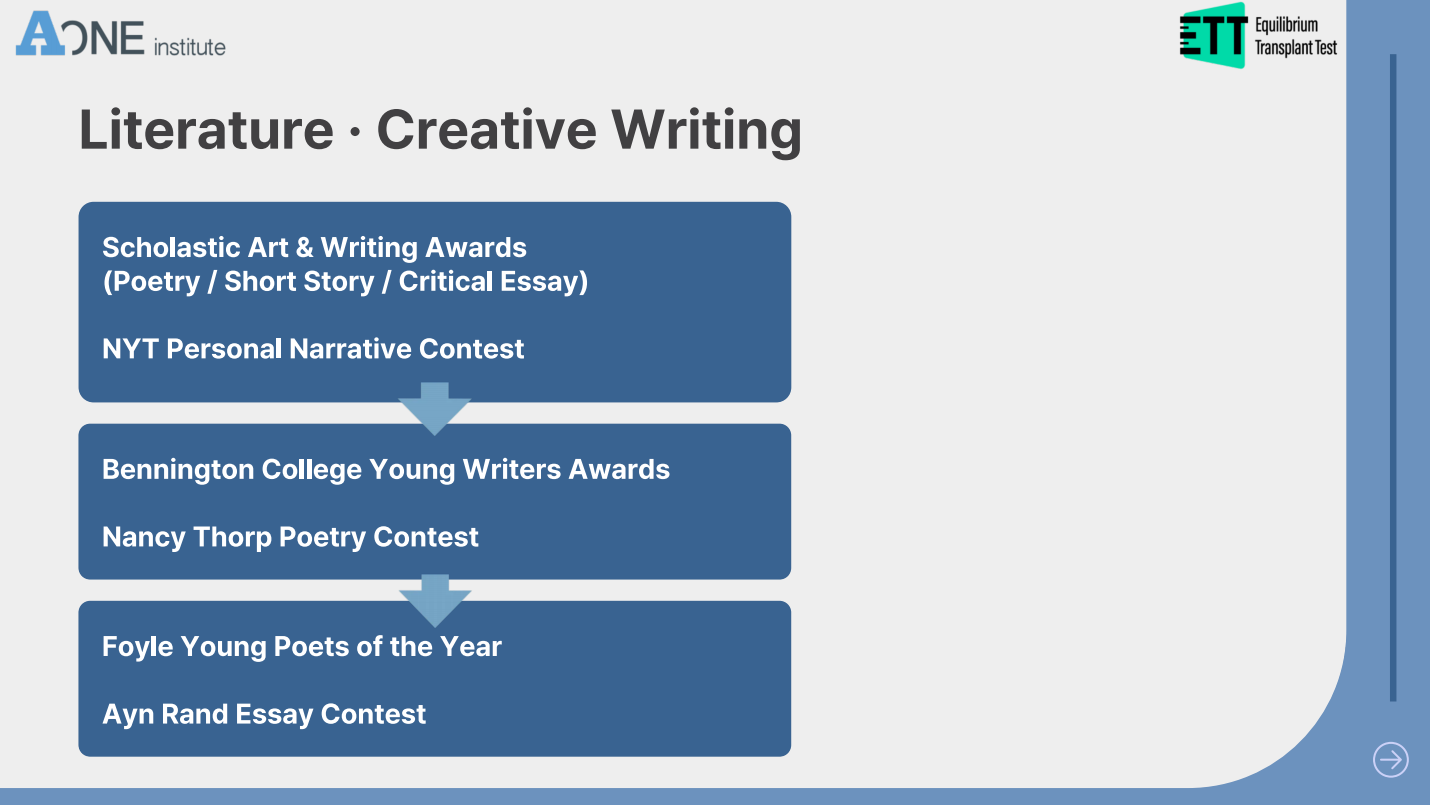
For students aiming at literature, creative writing, or English as an intended major, the writing competition path is the most direct signal of fit. These students need to demonstrate not just that they can write, but that they're already thinking and writing like a serious literary practitioner.
Entry point: Scholastic Art and Writing Awards — specifically in categories like Short Story, Personal Essay, or Poetry. The key is choosing subject matter that connects to literary themes rather than picking whatever seems easiest. If this is genuinely your intended direction, the topics you engage should reflect that.
Intermediate step: Bennington College Young Writers Award — a more selective and prestigious competition in the creative writing space, and a natural progression from Scholastic.
Target: Foyle Young Poet of the Year (for poetry-focused students) or Immerse Essay Contest (for literary and critical writing). These are internationally recognized competitions where placing or being shortlisted carries real weight.
The through-line for this path is consistent: each competition should push the student toward deeper engagement with craft, not just toward completing another submission.
Economics — Policy and Public Affairs Focus
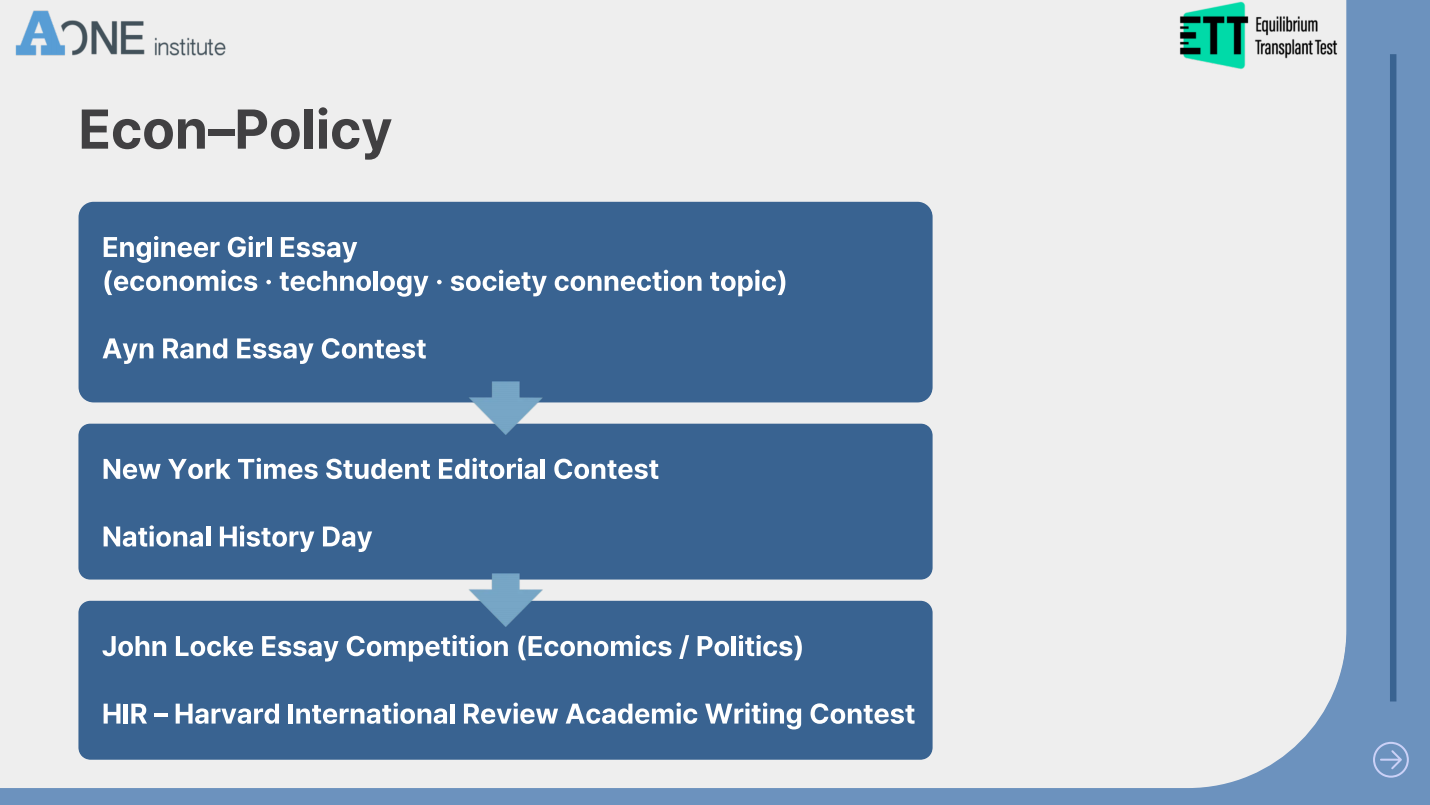
Students interested in economics from a policy or political economy angle — think public policy, international relations, or development economics — should build toward competitions that reward analytical writing about systems, governance, and social outcomes.
Entry point: Scholastic Art and Writing Awards (Personal Essay or Journalism categories), with topics drawn from policy questions the student is genuinely interested in. At this stage, quality of thinking matters more than polish.
Recommended reading alongside: Animal Farm — not as a strict academic text, but as an example of how ideological systems can be analyzed through narrative and argument. For students interested in economic policy and its social consequences, this kind of reading sharpens the analytical lens that competitions in this tier reward.
Intermediate step: John F. Kennedy Profile in Courage Essay Contest — which rewards writing about civic courage and public service, directly relevant to this area of focus.
Target: John Locke Essay Competition (Philosophy and Politics tracks) and Harvard International Review Writing Contest, which explicitly addresses international and domestic policy questions. Placing or submitting quality work here is a strong signal of readiness for rigorous policy-focused undergraduate programs.
Economics — Finance and Markets Focus
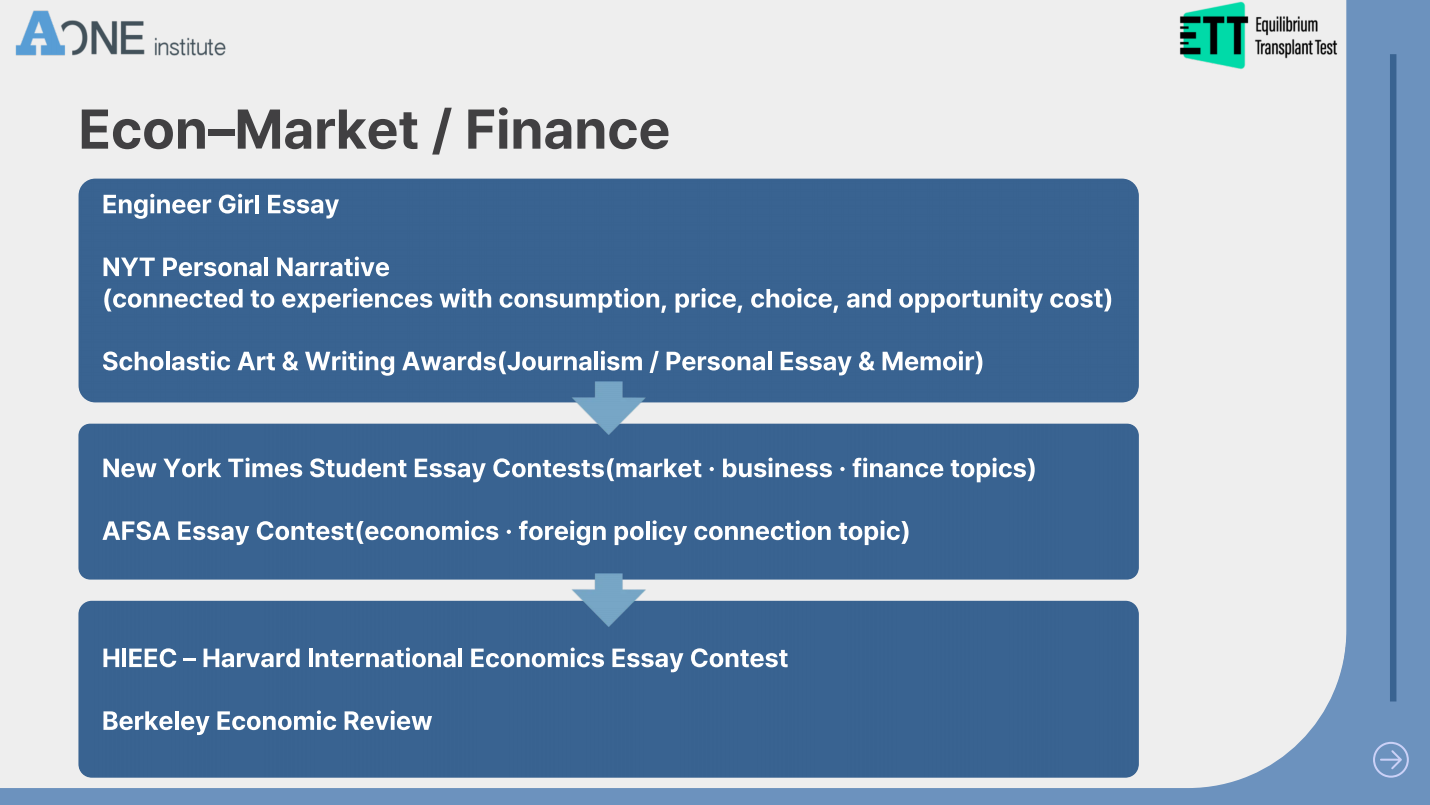
Students interested in the more quantitative and market-oriented side of economics — finance, econometrics, financial markets — should build toward competitions that reward analytical rigor about economic phenomena.
Entry point: Engineer Girl Essay Contest or New York Times Student Essay — both accessible starting points for building the habit of structured argumentative writing. Scholastic Art and Writing (Journalism or Personal Essay) also works here if topics are chosen with financial or economic themes.
Intermediate step: AFSA Essay Contest — which addresses national security and foreign policy but rewards analytical depth that translates well across economic writing.
Target: Harvard International Economics Essay Contest (HIEC) and Berkeley Economic Review. Both require genuine research engagement — this isn't a competition you can approach with opinion alone. Students should be developing research habits in parallel with writing preparation for these targets.
Business — Entrepreneurship and Ethics Focus
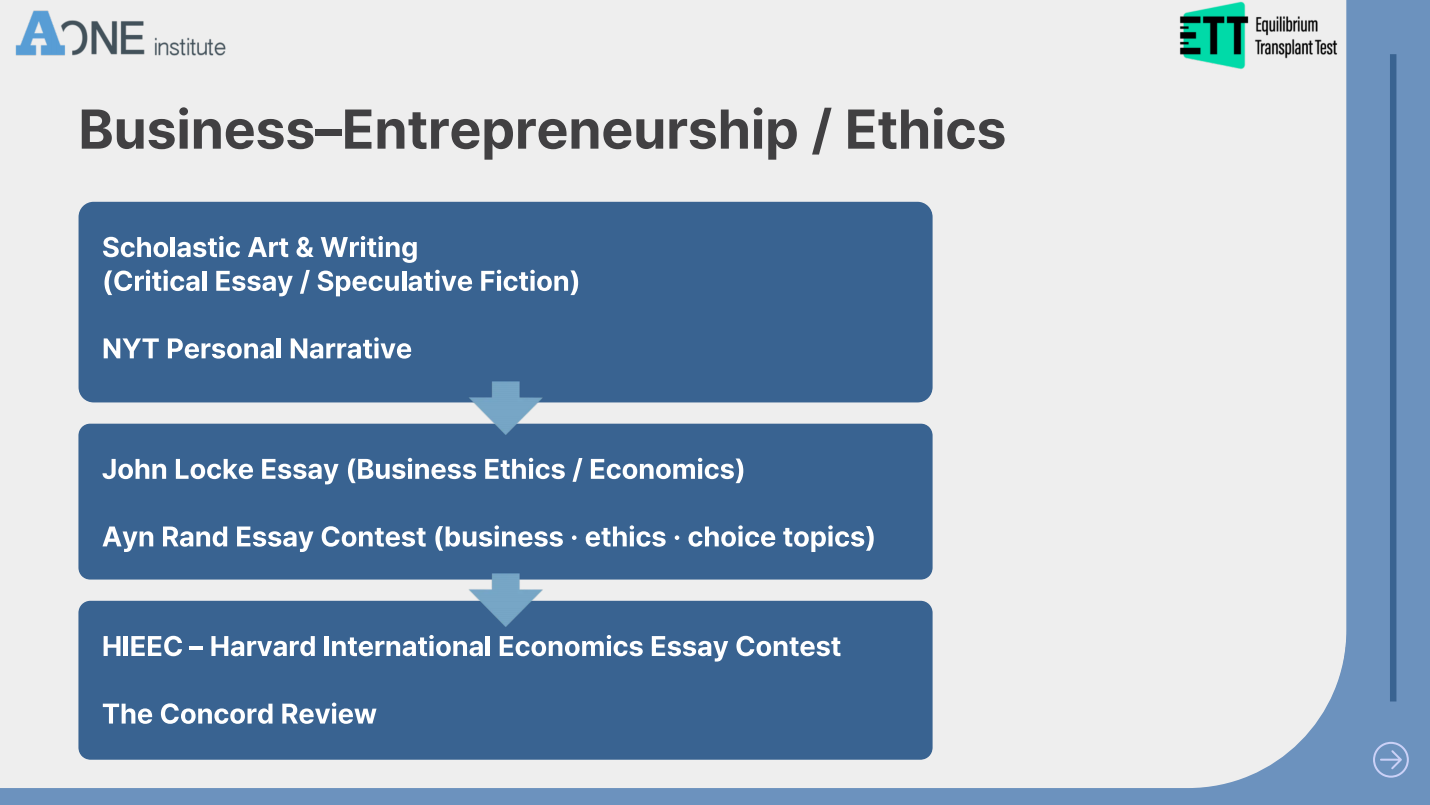
Students aiming at business programs with an interest in entrepreneurship, organizational ethics, or the intersection of business and society should build toward competitions that reward writing about institutions, incentives, and values.
Entry point: Scholastic Art and Writing Awards (Personal Essay or Journalism), with topics drawn from business cases, social enterprises, or ethical dilemmas the student has observed or researched.
Intermediate step: New York Times Student Essay Contest (accessible and widely read) followed by John Locke Essay Competition, which rewards systematic argument-construction across Philosophy, Economics, and Politics tracks — all directly relevant to business ethics.
Additional option: Ayn Rand Essay Contest — which engages directly with questions of individual agency, institutional design, and economic philosophy. Regardless of one's view of the underlying ideas, the exercise of engaging seriously with a coherent philosophical framework and writing about it rigorously is valuable.
Target: Concord Review — the most prestigious high school academic writing publication in the world. A Concord Review publication for a business-focused student signals the ability to produce genuinely rigorous long-form analytical work, which is a rare credential.
STEM — Theoretical and Research Track
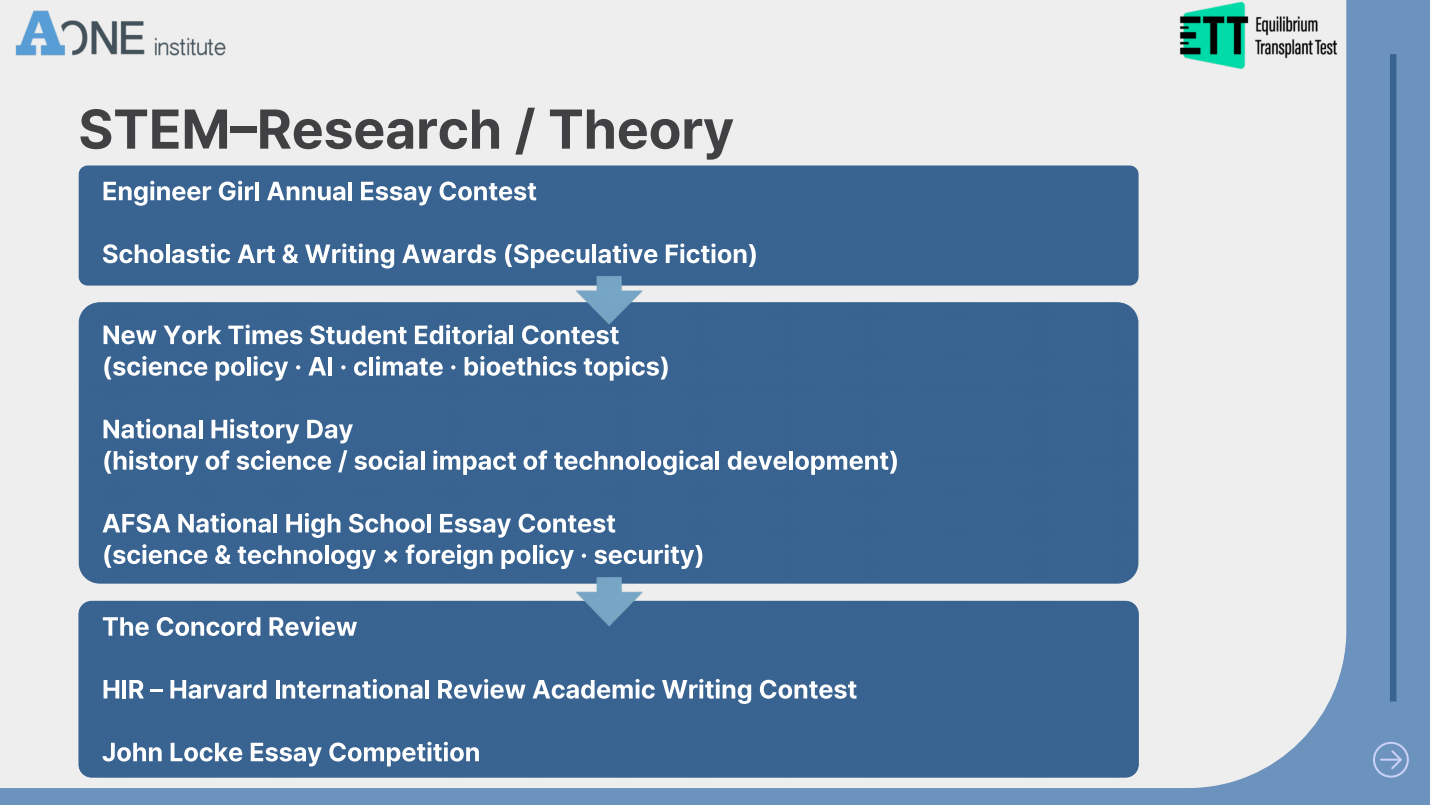
For students oriented toward research-intensive STEM fields — mathematics, physics, theoretical biology, computer science — writing competitions serve a specific function: they demonstrate that this student can think at a high level across domains, not just within their technical specialty. Admissions readers at research universities want to see evidence of intellectual breadth, and strong writing competition credentials provide it.
The competitions for this path aren't primarily about scientific writing. They're about demonstrating the full range of the student's analytical capacity.
Entry point: Scholastic Art and Writing Awards — specifically Science Fiction or Speculative Fiction categories. This is an underused entry point for STEM students: the genre allows them to engage imaginatively with scientific concepts while developing narrative and argumentative craft.
Intermediate options (choose one): New York Times Student Essay, National History Day, or AFSA Essay Contest. These are not equally appropriate for every student — the right choice depends on current writing level and available time. The goal is one solid intermediate competition experience, not all three simultaneously.
Target: Concord Review (for students with the capacity to produce rigorous long-form academic writing), Harvard International Review, and John Locke Essay Competition. These are the competitions where STEM students can most effectively signal intellectual range and writing sophistication to admissions readers at elite research institutions.
How to Use This Guide
The roadmaps above illustrate a principle, not a checklist. No student should attempt all of the competitions listed for their track — the goal is one well-chosen competition per stage, executed seriously, with genuine writing development between attempts.
A few practical guidelines:
Start earlier than feels necessary. The skills required for Tier 1 competitions don't develop in a single cycle. Students who place in Tier 1 competitions as juniors or seniors have almost always been writing competitively since 9th or 10th grade.
Choose topics that connect to real intellectual interests. Judges at serious competitions read hundreds of submissions and can identify when a student chose a topic because it seemed strategically safe rather than because they genuinely cared about it. Topic authenticity is a competitive advantage.
Treat non-placing submissions as training, not failure. The value of a competition submission is partly in the result, but mostly in the discipline of preparing it. The student who submits to Scholastic for three consecutive years and places once is better prepared for John Locke than the student who submits once and gives up.
For international students: note that some competitions are open only to U.S.-based students. Check eligibility before investing preparation time. Most Tier 1 competitions listed here accept international applicants; some Tier 2 competitions have geographic restrictions.
The right writing competition for your student depends on their current writing level, intended major, grade, and how much time is realistically available for preparation. If you'd like a specific recommendation — factoring in all of those variables — contact A ONE Institute directly and we'll put together a sequenced plan.
At A ONE Institute, we help students identify and prepare for writing competitions that genuinely fit their profile and intended direction — not just the most prestigious ones available. If you have questions about where to start, we're here.
writing competitions
high school essays
college admissions
extracurricular activities
