
The World Your Student Is Graduating Into Isn't What You Think
At A ONE Institute, most of our conversations focus on what students need to do right now — GPA, AP courses, extracurriculars, research, essays. That's all important. But occasionally it's worth stepping back and asking a bigger question: what kind of world are these students actually preparing for?
This matters because the answer shapes which skills are worth developing — and which extracurricular activities are worth prioritizing — in ways that go beyond just what looks good on a college application.
The short answer: a world where two forces that seem contradictory are actually both real and both growing. Understanding them is the starting point for thinking clearly about what your student should be doing right now.
Meritocracy vs. Legacy — And Why Both Still Matter
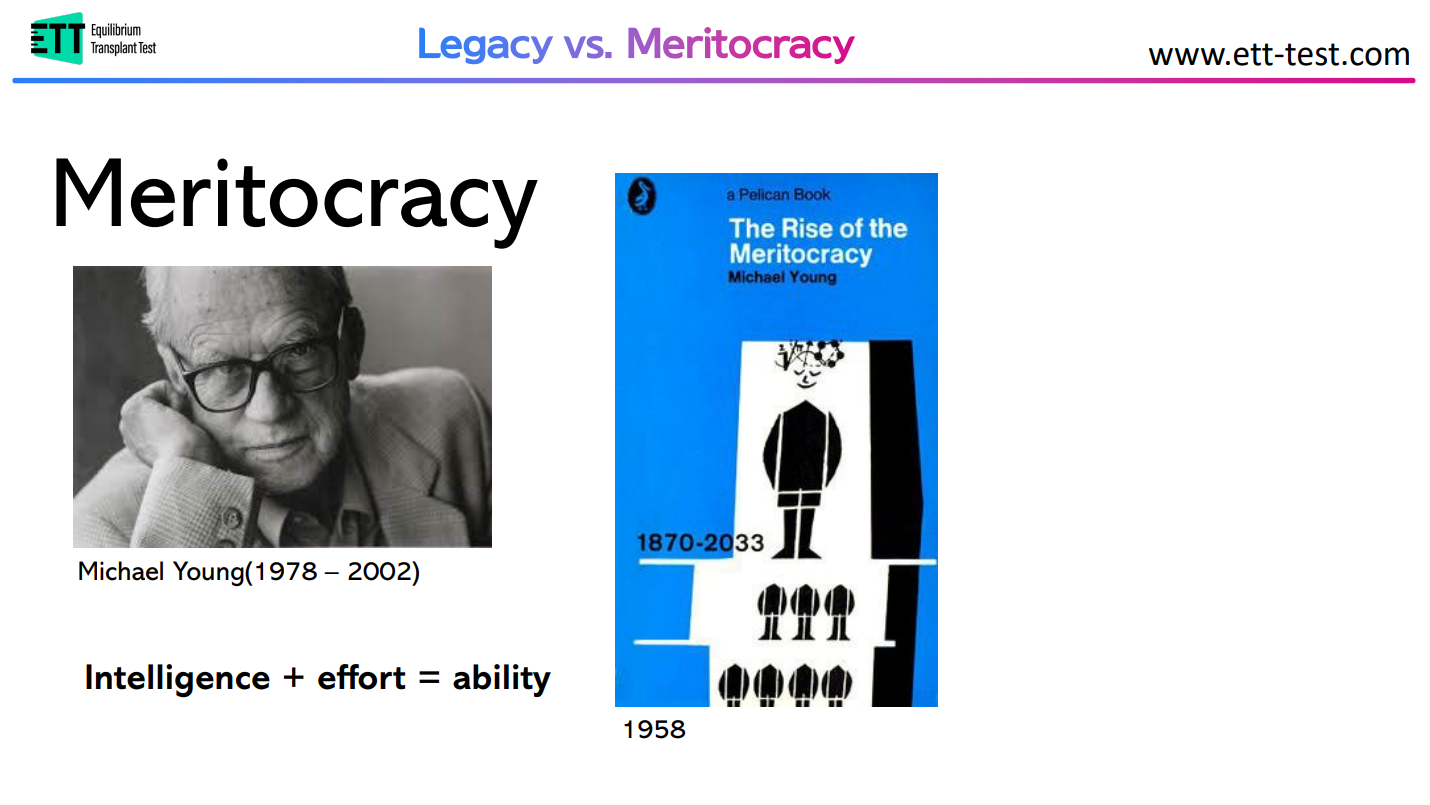
In 1958, a British sociologist named Michael Young wrote a satirical novel in which he coined the word meritocracy — a society governed by the principle that intelligence plus effort equals achievement. Young wasn't celebrating this idea. He was warning against it: a world where a performance-based elite becomes just as entrenched and exclusionary as the aristocracies it replaced. The novel was set in 2033 — a date that's now uncomfortably close.
What's notable is that Young spent the rest of his life frustrated that the word he invented as a warning had been enthusiastically adopted as an aspiration. Meritocracy, he argued, wasn't the opposite of hierarchy — it was just a different justification for it.
That tension is worth sitting with, because it maps directly onto the world students are entering.
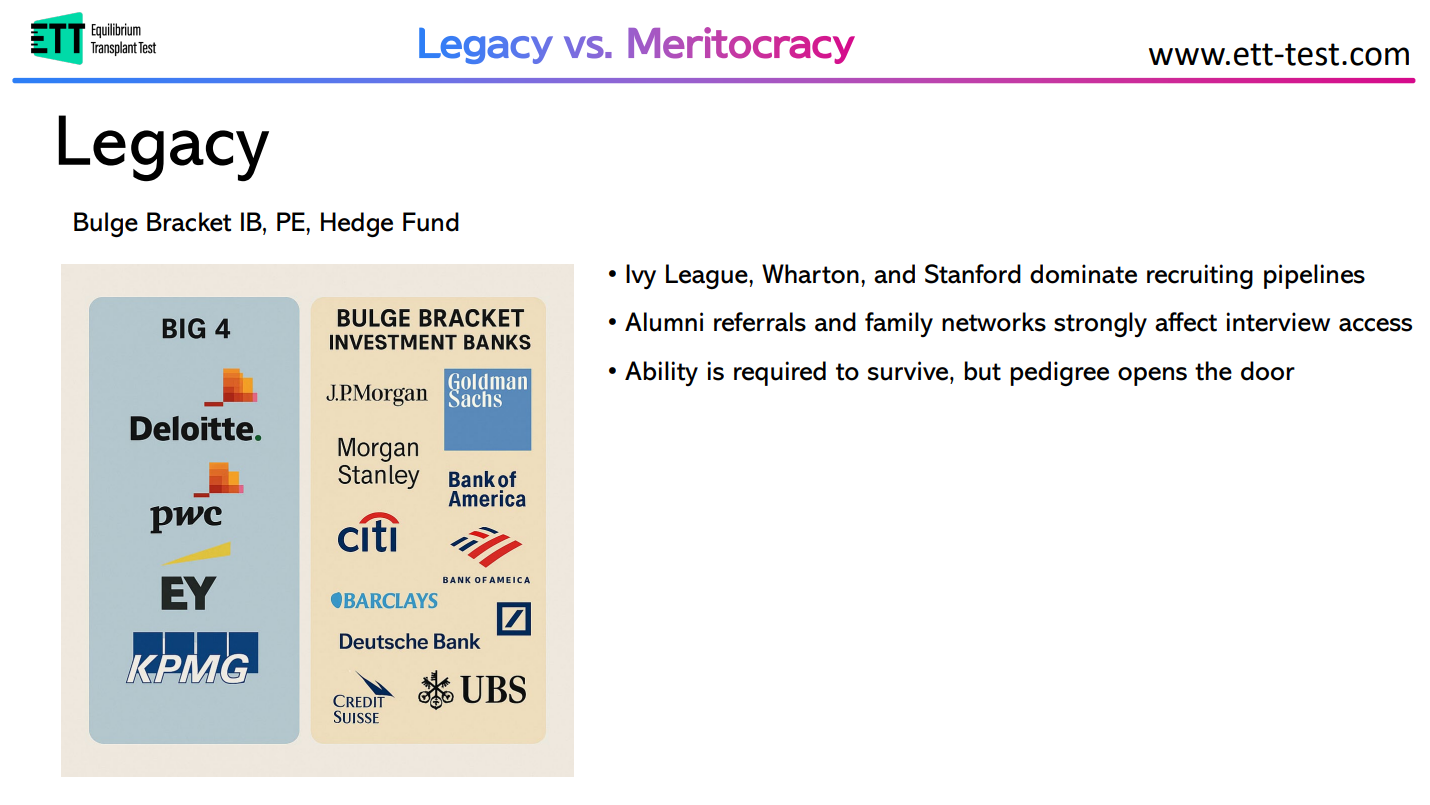
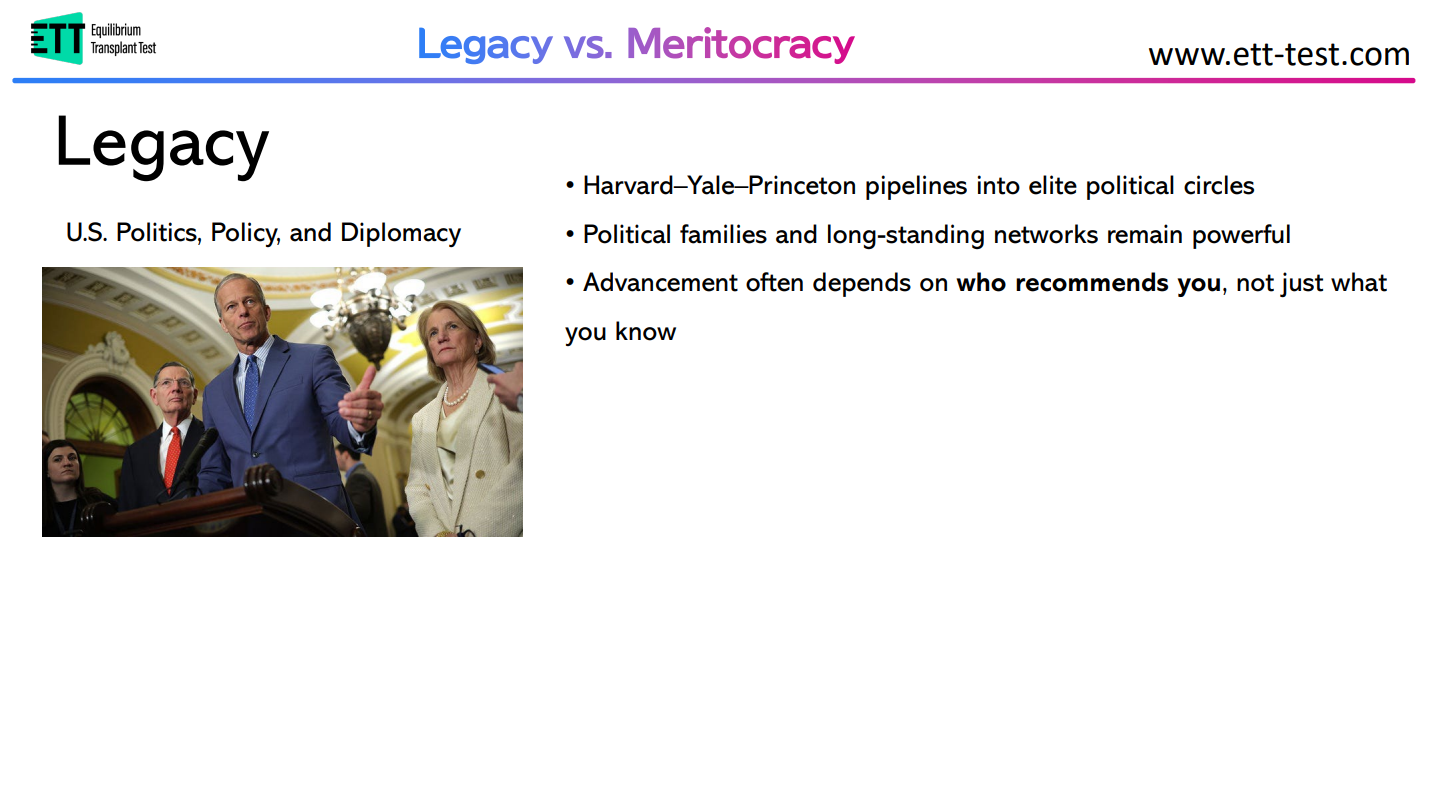
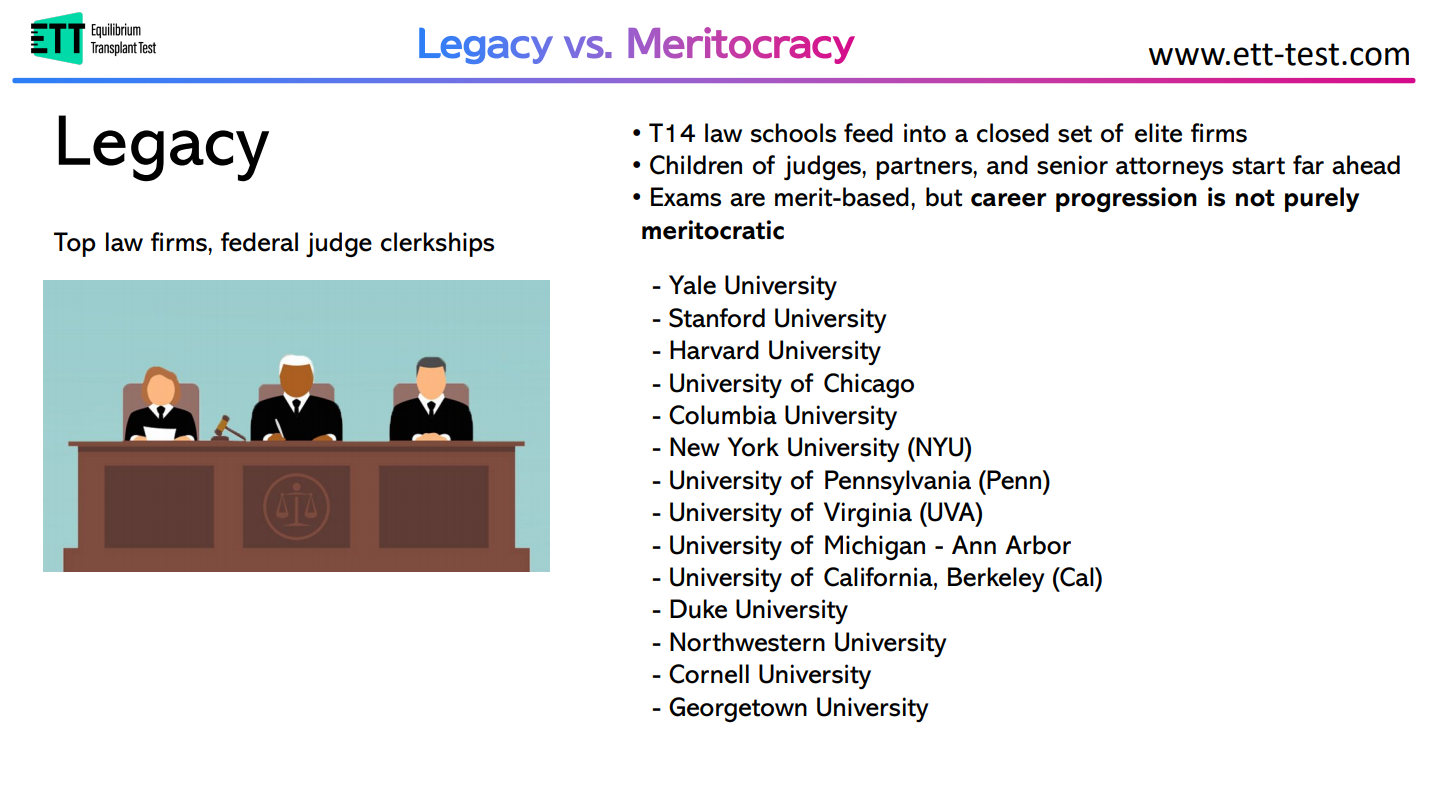
Legacy — the advantage conferred by family background, institutional affiliation, and established networks — remains deeply embedded in the most powerful professional domains. Finance: Ivy League and Wharton networks dominate senior hiring, and alumni referrals carry extraordinary weight. Politics and diplomacy: the Harvard-Yale-Princeton pipeline into government is still operating at full capacity.
Law: the T14 law school hierarchy shapes who gets the best early opportunities, and students with parents in the legal profession start with a different set of doors already open. The arts and classical music: top competition circuits are still deeply attentive to where you studied and who you trained under. Hollywood: the children of established stars continue to enter the industry with structural advantages that are difficult to replicate through talent alone. The term "nepo baby" — a portmanteau of nepotism and baby — has entered mainstream vocabulary precisely because the pattern is so visible.
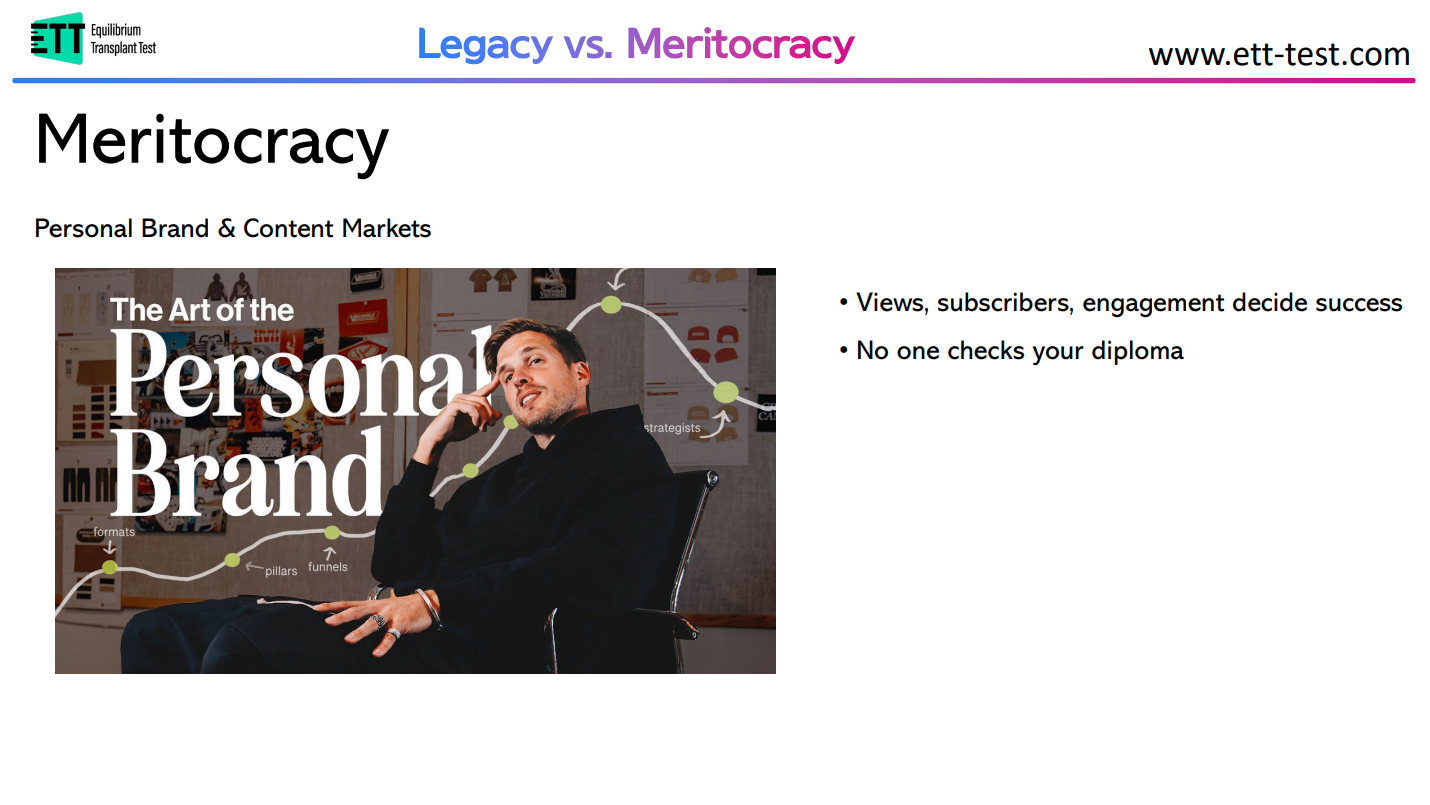
Meritocracy, meanwhile, is genuinely ascendant in specific sectors. Technology rewards demonstrated skill over pedigree in ways that finance and law often don't. The startup ecosystem regularly produces founders whose unconventional backgrounds would have been disqualifying in other fields. And perhaps most visibly: individual content creation — YouTube, podcasting, independent media — operates as close to a pure meritocracy as anything in the current economy. Subscribers don't accumulate because of a famous last name or an elite degree. They accumulate because the content creates genuine value for an audience.
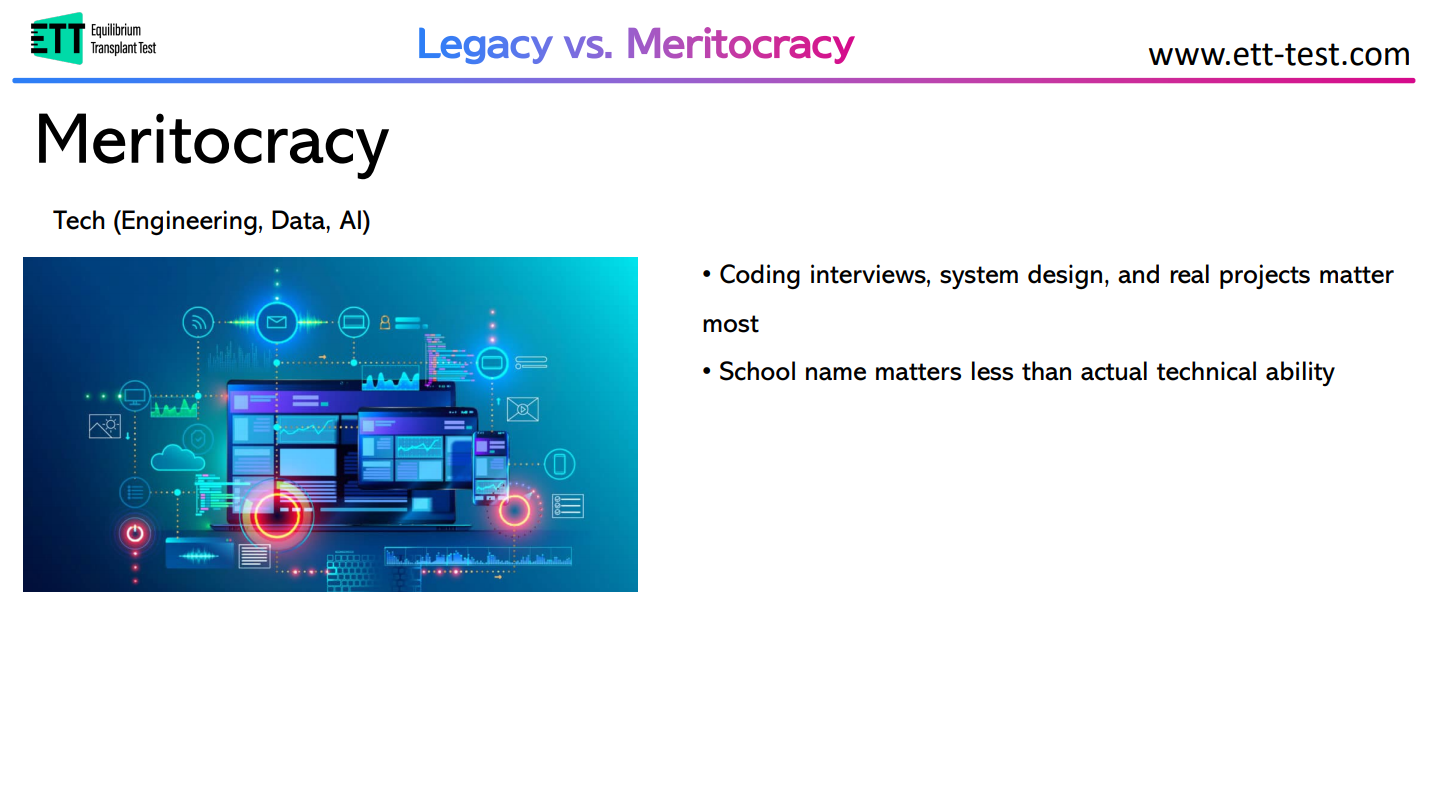
The honest picture isn't that one of these systems is winning. It's that both are operating simultaneously, and the balance between them varies by sector, by decade, and by circumstance.
Why Probabilistic Thinking Is the Right Framework
When parents ask whether legacy networks or raw merit matter more, the instinct is to want a clear answer. But the more useful response is to recognize that the question itself reflects a kind of binary thinking that doesn't serve students well.
The world that today's high school students will enter as professionals — roughly 2036 to 2040 — will be more complex, not less. Legacy networks won't disappear; they've persisted across centuries and aren't going to dissolve in the next decade. Meritocratic pressures won't reverse either; the forces that reward demonstrated skill are structural and accelerating.
What this calls for is probabilistic judgment — not "which of these two things is true" but "how do I position myself to benefit from both, to the extent I can?"
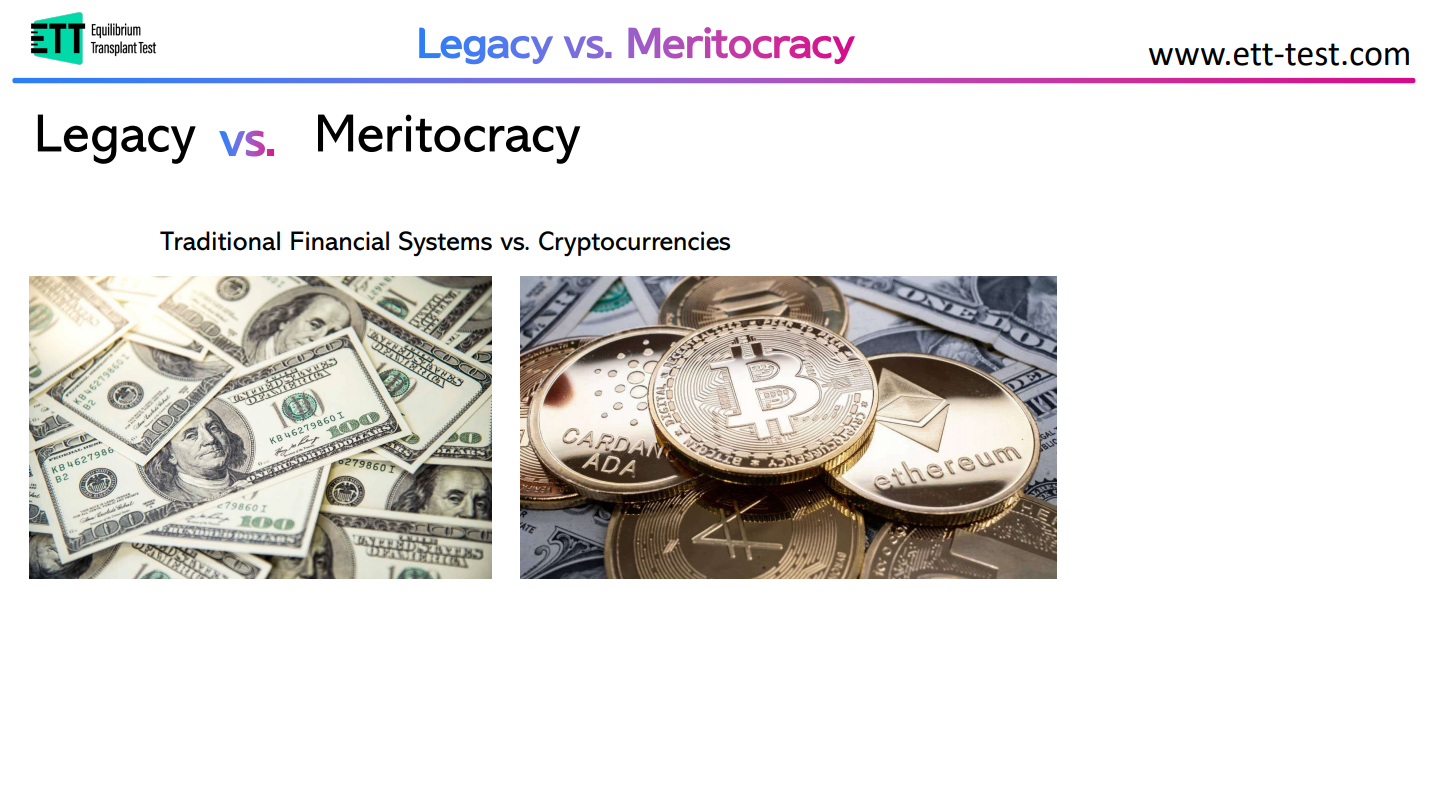
The same kind of thinking, incidentally, applies across many of the most consequential decisions of our era. Bitcoin's early critics who dismissed cryptocurrency entirely weren't wrong to be skeptical — but they were making a deterministic judgment in a domain that required probabilistic thinking. The physicist Heisenberg didn't disprove Newton; he showed that as systems become more complex, deterministic models require probabilistic extensions to remain accurate. Quantum computing is, at its core, an application of this principle: instead of solving for each possibility sequentially, it evaluates probabilities simultaneously — and at scale, the efficiency advantage becomes astronomical.
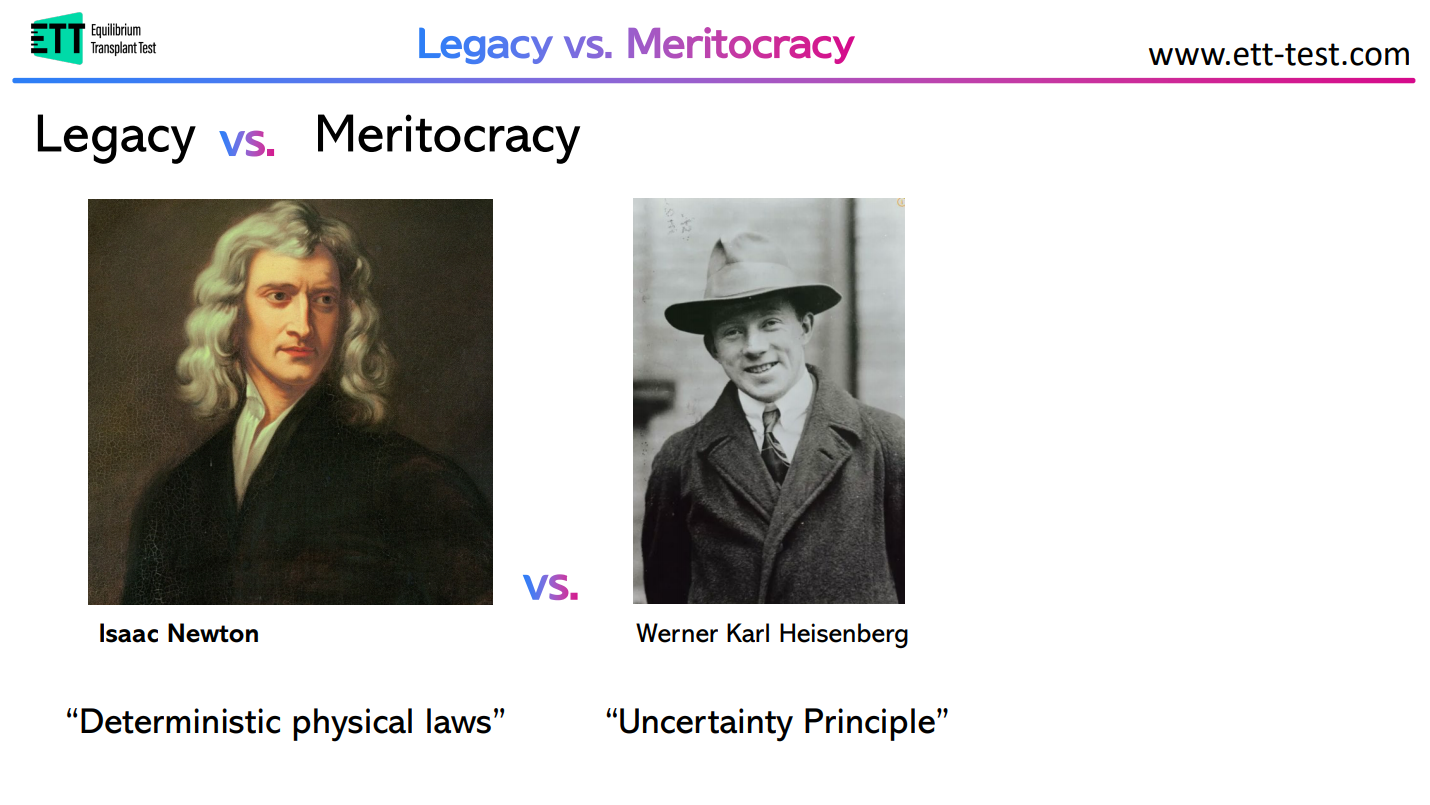
The point isn't to make physics analogies. The point is that the reflex to collapse complex situations into binary choices — legacy OR meritocracy, safety OR challenge, one path OR another — is increasingly the wrong mental model for a complex world.
The Two Things Worth Building — And Why They're Both Necessary
Given that both legacy and meritocracy will be present in the world students are entering, the rational response is to develop assets that serve both.
Legacy: The Case for Aiming Higher Academically
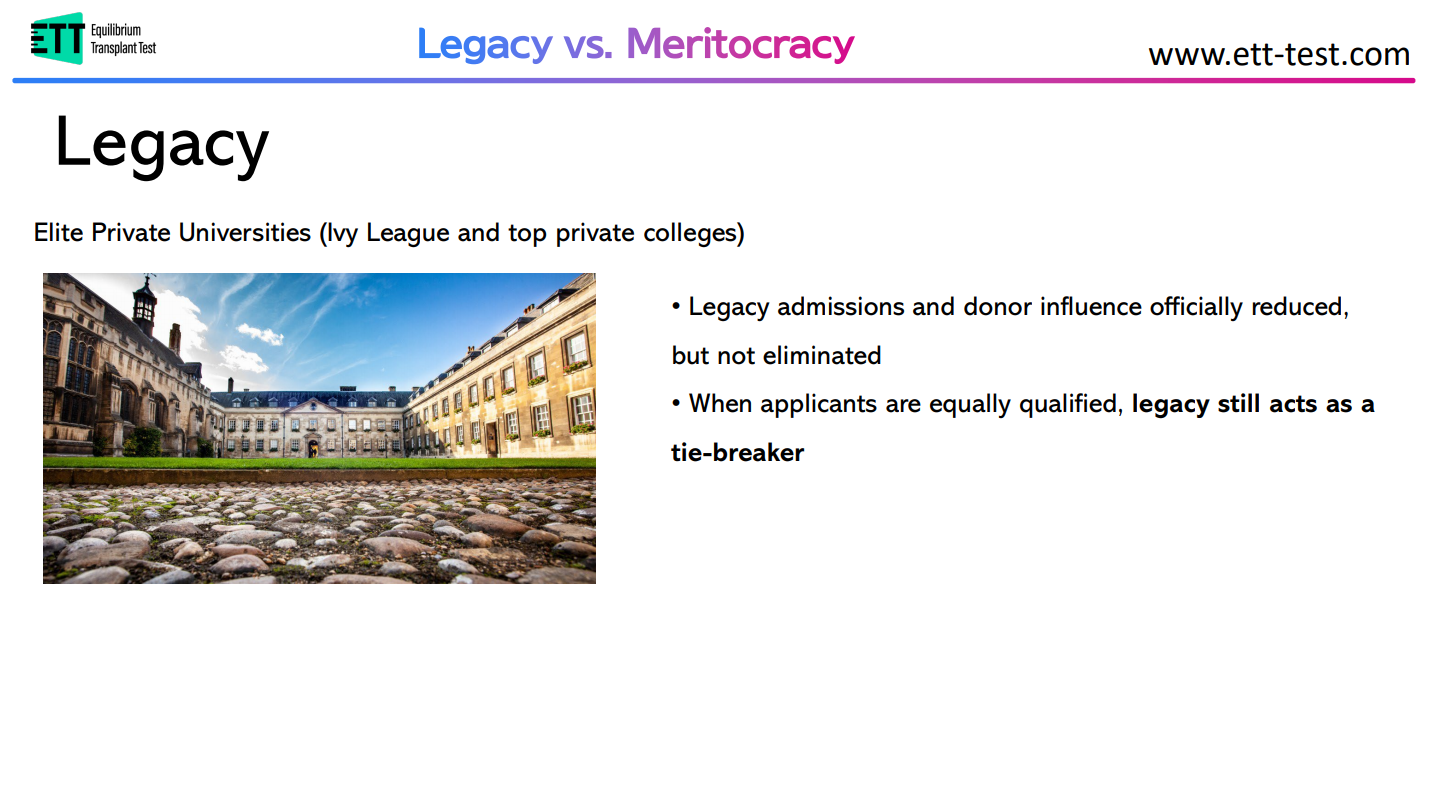
This is the uncomfortable part of the conversation. Legacy — as it functions in professional networks, hiring pipelines, and institutional access — is heavily correlated with where you went to school. That's not a celebration of this fact. It's an observation about how the system currently operates.
For students who don't have family legacy to draw on — no parents who are senior partners, no alumni connections at target institutions, no existing network in their intended field — the most effective way to enter those legacy networks is through educational achievement. A degree from a highly selective institution provides access to alumni networks, recruiting pipelines, and social capital that simply aren't available from most other starting points.
This is why the preparation strategies discussed across A ONE Institute's content — research, GPA management, strategic extracurricular development, strong test scores — aren't arbitrary. They're the inputs that determine which educational legacy, if any, a student can realistically build. The preparation isn't about gaming a system for its own sake. It's about understanding that in a world where legacy still matters, earning access to a strong institutional network is one of the most durable investments a student can make.
Meritocracy: The Skill That's Becoming Non-Negotiable
Now for the part that goes beyond admissions.
The sectors where meritocracy is most operative share a common requirement: the ability to create genuine resonance with an audience. Whether that's a YouTube channel that earns loyal subscribers, a startup pitch that convinces investors, a product that earns repeat customers, or a research argument that persuades a field — the underlying skill is the same. You have to be able to make other people feel understood, compelled, and moved to act.
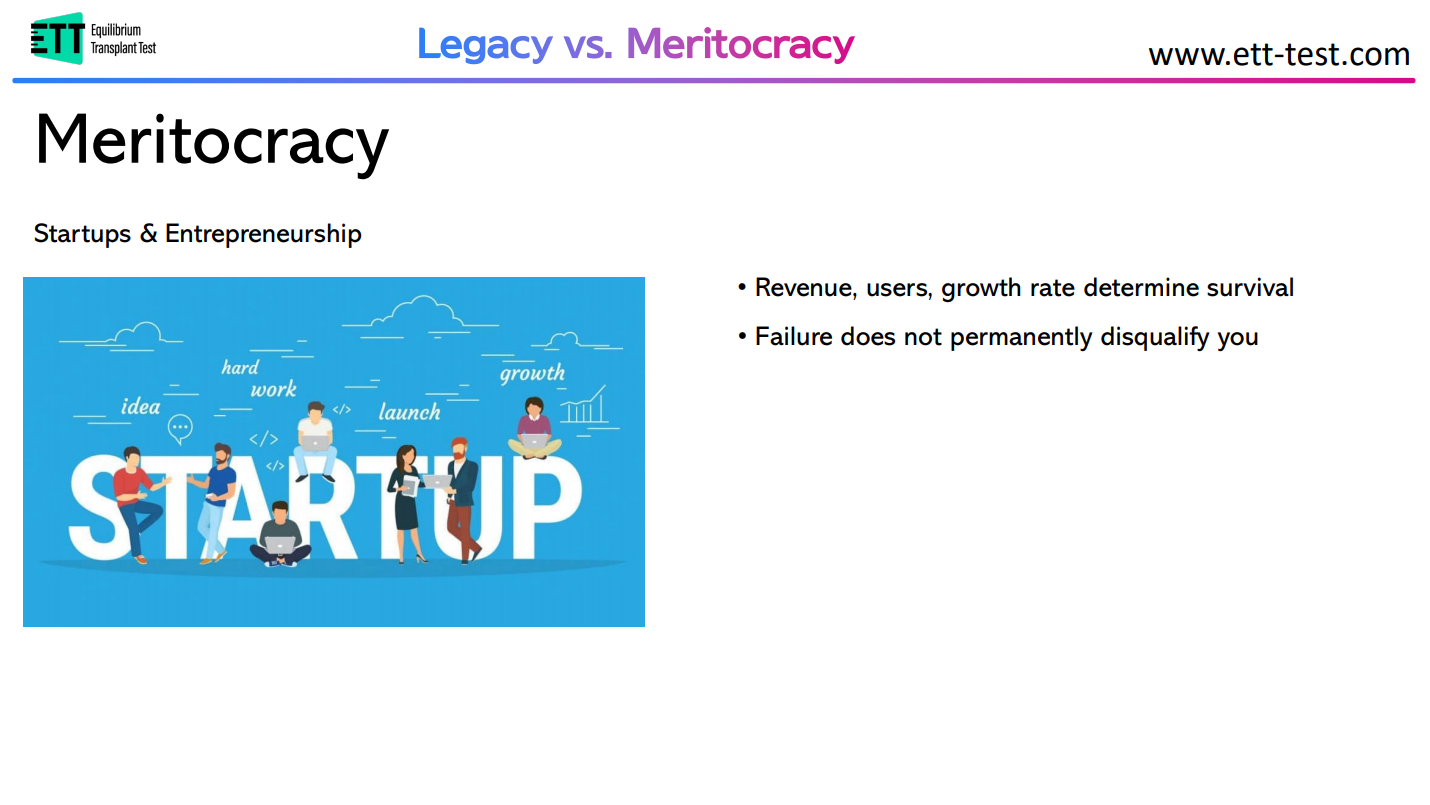
That skill has a name: empathy in action. And it breaks down into three specific capacities:
Perspective-taking. The ability to genuinely inhabit a viewpoint you don't personally hold — to argue for a position you disagree with in a way that would actually be persuasive to someone who holds it. This is harder than it sounds. Most people, when they encounter a position they disagree with, immediately begin formulating their rebuttal. That's not perspective-taking; that's waiting for your turn to speak. Real perspective-taking requires suspending your own position long enough to understand why the other position is coherent and compelling to the person holding it.
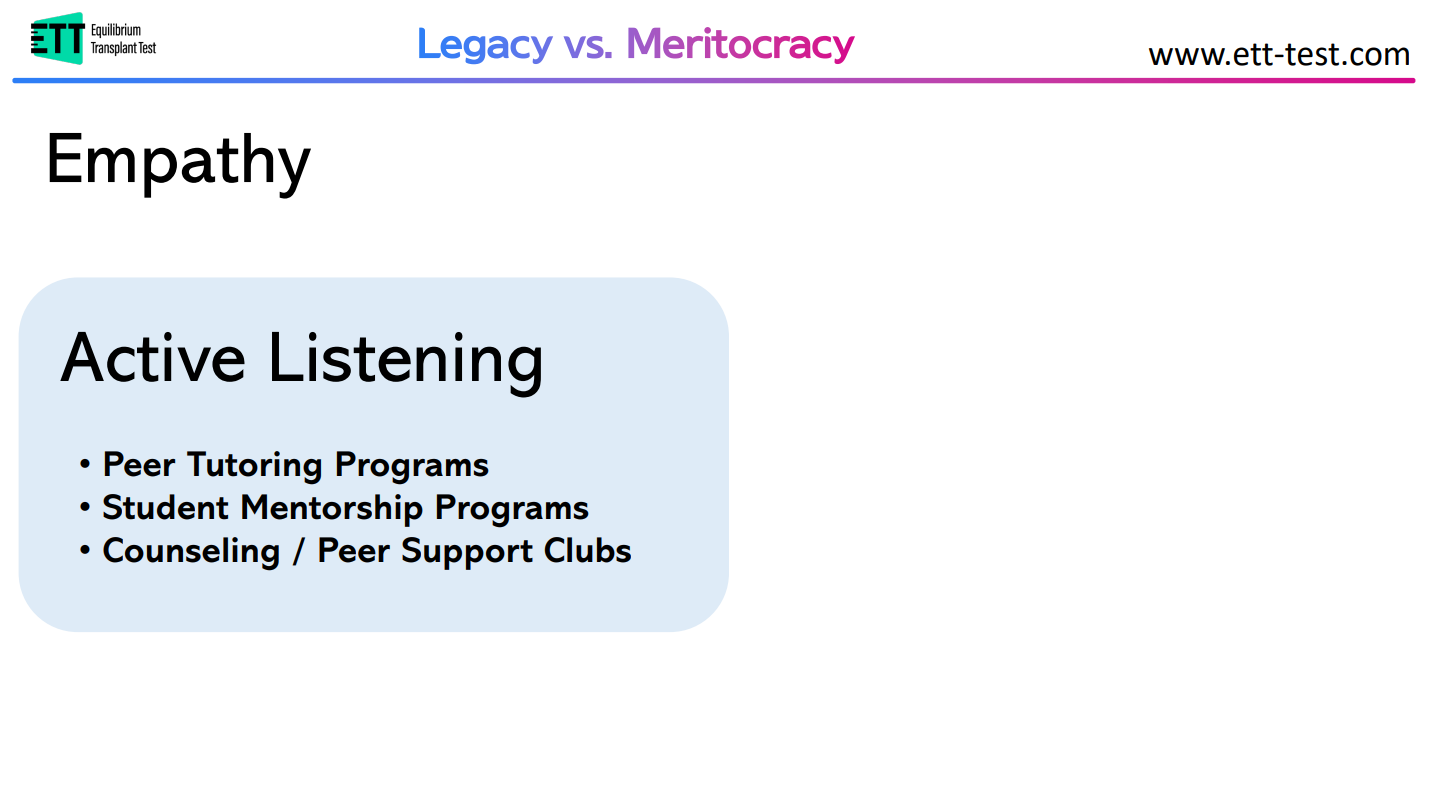
Active listening. The ability to hear what someone is actually saying rather than what you expect them to say. This is distinct from passive listening — sitting quietly while someone talks. Active listening means processing for understanding rather than processing for response. Students who have done meaningful tutoring or mentoring tend to develop this naturally: when you're trying to figure out exactly where a student's understanding breaks down, you have to listen at a level of precision that most people never exercise.
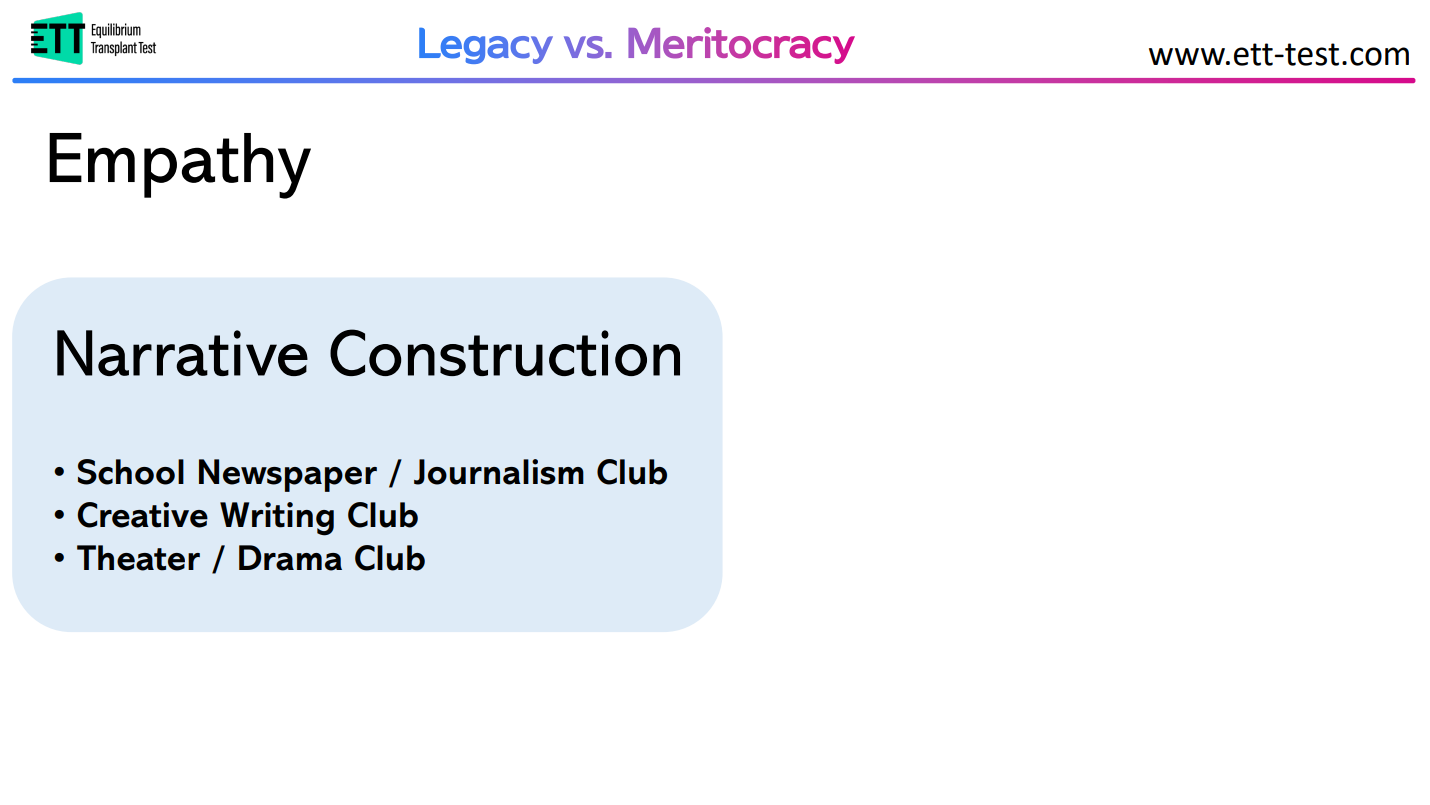
Narrative construction. Even if you understand someone else's perspective and have genuinely listened to their concerns, you still need to be able to translate your own thinking into a form that lands with them. This is the craft of communication — knowing not just what to say, but how to shape it so that it travels from your mind to theirs without significant distortion.
So What Activity Should Students Join Right Now?
Everything above points toward the same answer: any structured activity that requires you to argue, persuade, debate, or represent positions you didn't start with.
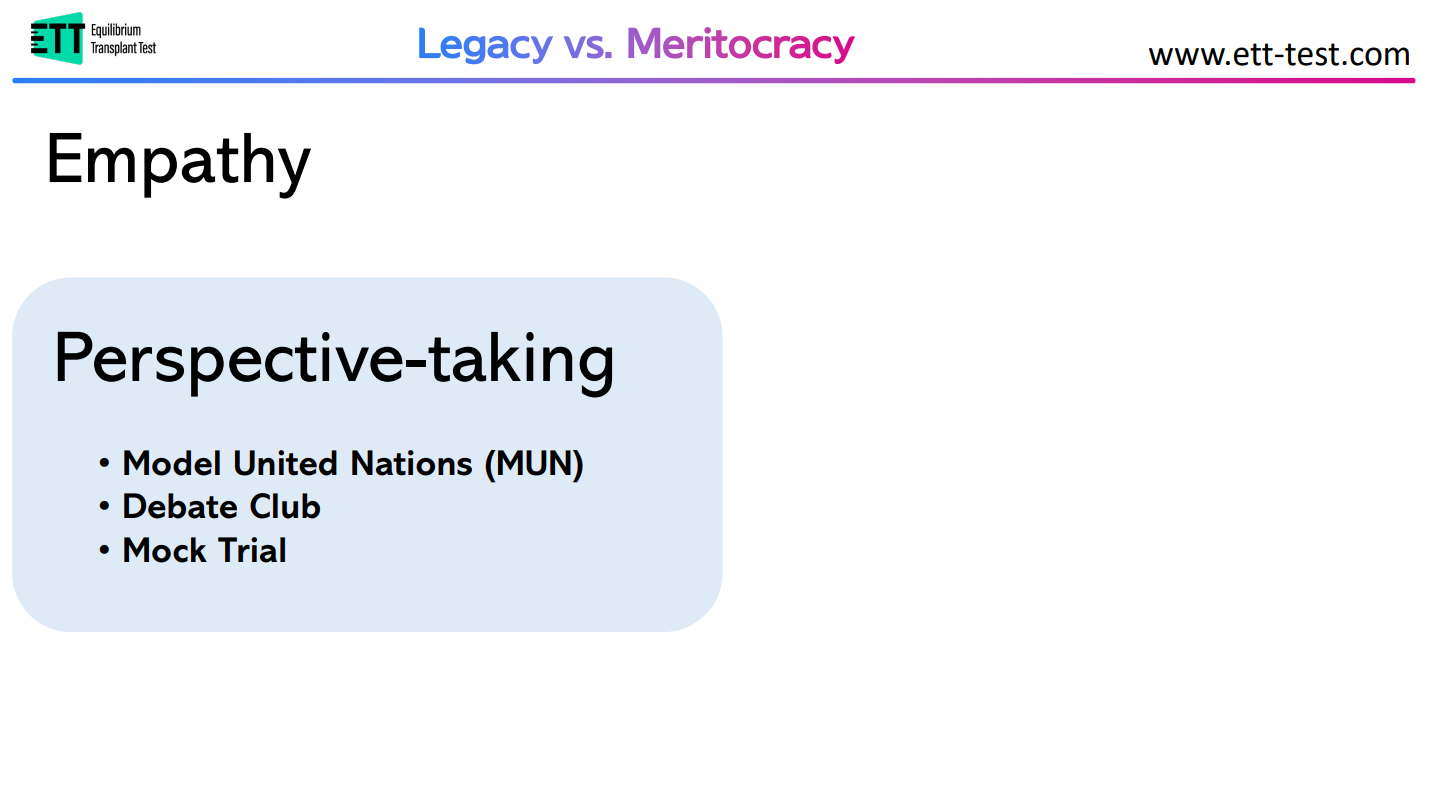
This includes debate — formal competitive debate develops all three of the capacities above simultaneously. It requires you to argue both sides of contested questions, listen carefully to opposing arguments, and construct responses under time pressure.
It also includes Model UN, mock trial, ethics bowl, student government, and any club or organization that involves deliberation, advocacy, or policy discussion.
Tutoring and mentoring count too — specifically for developing active listening — and they have the added benefit of being legible to admissions readers as evidence of genuine leadership rather than title-chasing.
What matters less than the specific format is the underlying structure: regular practice at taking positions you didn't choose, listening to perspectives you didn't already hold, and constructing arguments that actually move people.
This is the activity category that builds the skill set most directly relevant to success in a meritocratic environment — while also demonstrating the kind of intellectual engagement and community contribution that selective colleges consistently say they're looking for.
Students entering the professional world in the mid-2030s will face a landscape where legacy networks are still real and still valuable, where meritocratic pressure is intensifying rather than diminishing, and where the ability to create genuine resonance with other people will be one of the most durable competitive advantages available.
Preparing for that world means developing both: the academic and extracurricular profile that opens access to strong institutional networks, and the interpersonal and communicative skills that allow for genuine influence within whatever environment a student eventually enters.
The activity that most efficiently builds the second of those things — structured debate, deliberation, and perspective-taking — is available in almost every high school. The reason to start now isn't just that it looks good on a Common App. It's that the skill it develops is genuinely harder to build after the habit of thinking in only one direction has solidified.
Start now. The world students are entering will reward people who can hold complexity, argue multiple positions, and create genuine connection with people who see things differently.
At A ONE Institute, we help students build profiles that are competitive for selective admissions — and we try to be honest about why those admissions matter beyond the application itself. If you have questions about how to structure your student's extracurricular development, we're here.
future skills
college admissions strategy
legacy networks
meritocracy
debate club
