
These Questions Come Up Constantly — So Let's Just Settle Them
At A ONE Institute, the questions we get about AP courses this time of year are remarkably consistent. Families aren't confused about the basics — they know AP classes matter. What they're confused about are the edge cases: the situations where the right answer isn't obvious, and where making the wrong call can quietly hurt a student's application in ways that are hard to recover from.
So here are the most common AP questions we've been getting recently, answered directly.
Question 1: School Grade A With AP Exam Score 3, vs. School Grade B With AP Exam Score 5 — Which Is Better?
This one has a clear answer: the school grade wins.
If you isolate just these two variables and nothing else, the student with an A in the class and a 3 on the AP exam is in a stronger position than the student with a B in the class and a 5 on the exam. School GPA is the most important academic signal in a college application — that hasn't changed, and it's not close.
That said, this doesn't mean AP exam scores are irrelevant. Some families have been told that colleges completely ignore AP exam scores, and that's not accurate either. Colleges don't add AP scores into a GPA formula. But they do review them as part of the overall academic picture — and a student with a B in the class and a 5 on the exam is in a meaningfully better position than a student with a B in the class and no score, or a 2.
The practical takeaway for right now: If there's still room to bring a grade up before the semester ends, put energy there first. Once grades are locked, shift focus to AP exam preparation. The priority order is: school grade first, exam score second — but both matter.
Question 2: If You Drop an AP Class, What Actually Happens to Your Transcript?
This is where it gets complicated — because the answer depends entirely on your school's grading policy. There are four possible outcomes, ranging from fine to genuinely damaging.
Scenario 1 — The Clean Exit (Best Case)
Some schools treat a dropped course as if it never existed. The quarter grade from the AP class disappears from the calculation entirely, and only the remaining quarters in the replacement course are factored into GPA. The transcript sent to colleges reflects no evidence of a drop. If your school operates this way, dropping a class you're failing is a reasonable option.
Scenario 2 — Averaged In, But No Record
The more common version: the grade earned before the drop (say, a C in the first quarter) gets averaged into the full-year GPA alongside the grades from the replacement course. A C averaged with three A's isn't ideal, but it's recoverable — and no "W" appears on the transcript. Colleges see the final GPA but not the course-switching history.
Scenario 3 — A "W" Appears on the Transcript
This is where it starts to hurt. Some schools mark a withdrawn course with a "W" on the official transcript — even if the grade itself doesn't count toward GPA. An admissions reader who sees a "W" knows exactly what happened. It's not an automatic rejection, but it's a negative signal that requires explanation, and it raises questions about follow-through and course-load management.
Scenario 4 — A "W" and the Grade Both Appear (Worst Case)
In some schools, the withdrawal notation appears and the grade earned before the drop is also included in the GPA calculation. This is the worst possible outcome: a damaged GPA and visible evidence of the drop. If your school operates this way, do not drop the class under any circumstances. The cost of staying — even with a C — is almost certainly lower than the cost of the W plus the grade hit.
The bottom line: Before making any decision about dropping an AP class, find out exactly which of these four scenarios applies at your school. And if you can avoid dropping at all — finishing with a B rather than a drop — that is almost always the better choice.
Question 3: Does the Total Number of AP Classes Matter, or Is It Relative to Your School?
This is one of the most misunderstood points in AP course strategy, and it's worth being precise about.
Colleges evaluate AP course-load relative to what your school offers — not in absolute terms.
Here's what that means in practice. A student who takes 8 AP courses at a school that offers 8 total has maximized their academic opportunity. A student who takes 9 AP courses at a school that offers 15 has taken more classes in absolute terms — but has left 6 available AP courses untouched.
When admissions readers evaluate transcripts, they do so in the context of the school profile — a document submitted by your high school that describes what courses were available. A student who took all 8 available AP classes at their school scores at the ceiling of what that school made possible. A student who took 9 of 15 available AP classes does not.
The practical implication: Don't focus on hitting a specific number. Focus on how your course selection compares to what was available to you. If your school offers 10 AP courses and you're taking 4, that's a conversation. If your school offers 8 and you're taking 7, you're in strong shape.
The second part of this: take AP courses where you can maintain solid grades. The combination of high course rigor and strong performance is what admissions readers are looking for — not one at the expense of the other.
Question 4: If I'll Probably Get a B in AP, Should I Just Take Honors Instead?
This is the question that sounds simple but carries more strategic weight than most families realize. The short answer: it depends on the full picture — and in most cases, the AP is worth taking even with the risk of a B.
Here's the specific scenario to think through.
Imagine two students at the same school:
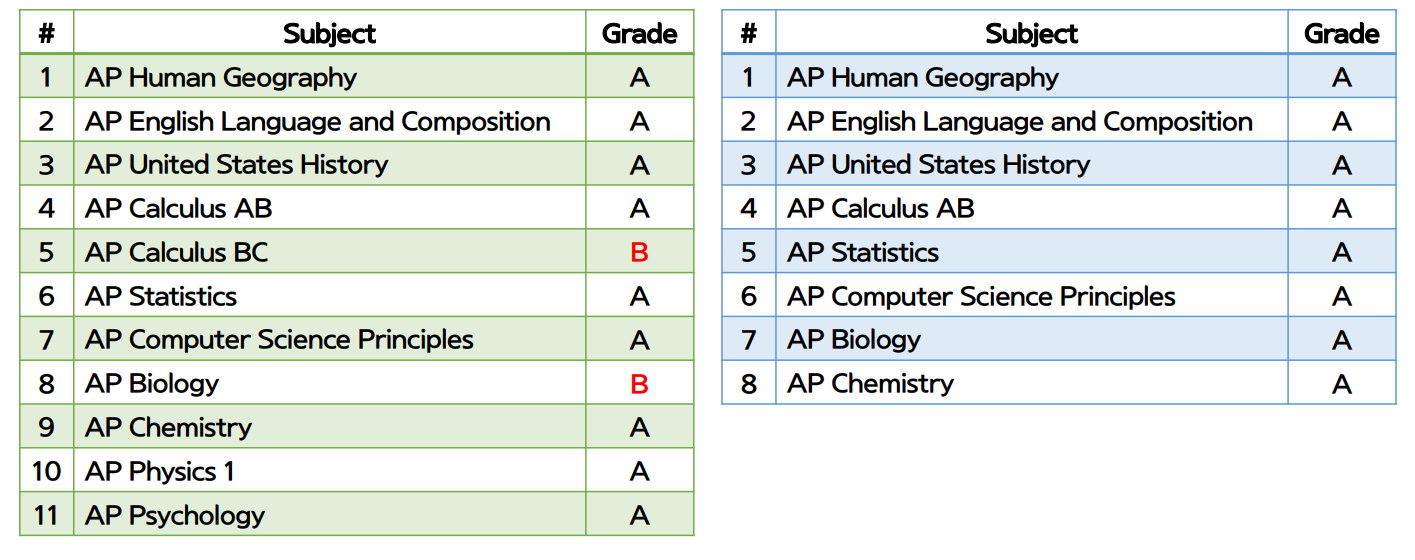
Student A takes 12 AP courses over four years, earns A's in 10 of them, and B's in AP Calculus BC and AP Biology — both core academic subjects.
Student B takes 8 AP courses over four years — specifically the ones where they're confident of earning A's — and earns A's in all 8.
On pure GPA, Student B wins. The numbers are higher. If colleges selected students by GPA alone, Student B would come out ahead.
But colleges don't select by GPA alone. They look at GPA in the context of course rigor. And when an admissions reader compares these two students, what they see is:
Student A attempted more rigorous coursework, including subjects where the risk of a lower grade was real, and still performed well overall. Student B performed flawlessly — within a course load that was calibrated to guarantee that outcome.
At A ONE Institute, across years of working with students applying to Top 20 schools, the pattern is clear: students who play it safe with AP course selection — opting for Honors to protect GPA, taking fewer APs to ensure all A's — consistently struggle to gain admission to highly selective schools. The academic profile may look clean, but it doesn't signal the intellectual risk-taking and rigor that top schools are looking for.
This is not a small effect. It's one of the most consistent patterns we observe.
The practical framework:
Taking an AP course where you might earn a B is worth it if:
- The course is in a core academic subject (math, science, English, history) relevant to your intended area of study
- The B would appear alongside a course load that demonstrates genuine rigor overall
- Dropping the course or switching to Honors would leave a visible gap in your academic narrative
Taking Honors instead of AP is a reasonable choice if:
- The AP course is in a peripheral elective area with no connection to your academic focus
- The risk is a C or lower — not just a B
- Your school's drop policy would result in a transcript W if you needed to withdraw
The C-or-lower threshold is where the math genuinely shifts. A B in AP Calculus BC is defensible in the context of a rigorous course load. A C in AP Calculus BC raises different concerns and may need to be explained.
The bottom line: A course load of all A's in Honors classes and a handful of AP's is not the profile that gets students into Top 20 schools. Selective colleges are looking for students who took the hardest available courses and performed well — not students who managed their GPA by avoiding risk. If the choice is between AP with a likely B and Honors with a guaranteed A, in most cases the AP is still the right call.
The One-Sentence Version of All of This
School grade is king. AP exam scores matter but are secondary. Never drop an AP without knowing your school's exact policy. Evaluate your course load relative to what your school offers, not in absolute numbers. And when in doubt, take the harder class — even if it costs you a fraction of a GPA point. The students who get into the most selective schools are almost never the ones who played it safe.
At A ONE Institute, we help students make these decisions with clear eyes — understanding not just the rules, but how admissions readers actually interpret what they see. If you want to think through your student's specific course selection situation, we're here.
college admissions
GPA strategy
course rigor
AP exam scores
AP courses
