
The Question Every Junior Is Asking Right Now
At A ONE Institute, one question comes up more consistently than any other during individual consultations: I'm in 11th grade — what extracurriculars should I be doing before Early Action?
It's the most common question we hear. And the honest answer is that there's no universal list. There's no specific competition you must enter, no camp you must attend, no single activity that applies to every student regardless of what they've already done. The right answer depends entirely on what's already on your profile, what you're aiming for, and how much time you realistically have left.
The challenge is that most families don't have access to the kind of individualized strategic guidance that would actually answer this question well. Generic advice — "do research," "show leadership," "enter competitions" — isn't actionable without knowing the specific student's situation.
So here's something more useful: a framework for thinking through this, plus a free AI tool specifically built to apply that framework to your student's actual profile.
Why Generic AI Advice on EC Strategy Falls Short
Before getting into the tool itself, it's worth understanding why the standard approach doesn't work.
If you ask ChatGPT, Gemini, or Grok something like "what extracurriculars should I do for Ivy League admissions," you'll get a list. It will probably include research, leadership roles, competitions, community service, and some version of "pursue what you're passionate about." All of that is technically accurate. None of it helps you decide what to do next Tuesday.
The more specific problem is competitions and deadlines. Generic AI tools will suggest activities and programs without any awareness of today's date — which means they'll recommend opportunities whose deadlines have already passed, or programs that won't open applications for another eight months. That's not just unhelpful. It actively wastes the limited time juniors have.
A well-built EC strategy tool needs to know your student's current activities, understand the strategic logic of what makes a profile coherent, and filter recommendations against real current deadlines. That's exactly what the tool described here is designed to do.
Introducing the A ONE EarlyTrack – EC Strategy GPT
To address this directly, A ONE Institute built a custom GPT — available through ChatGPT's GPTs platform — called A ONE EarlyTrack – EC Strategy.
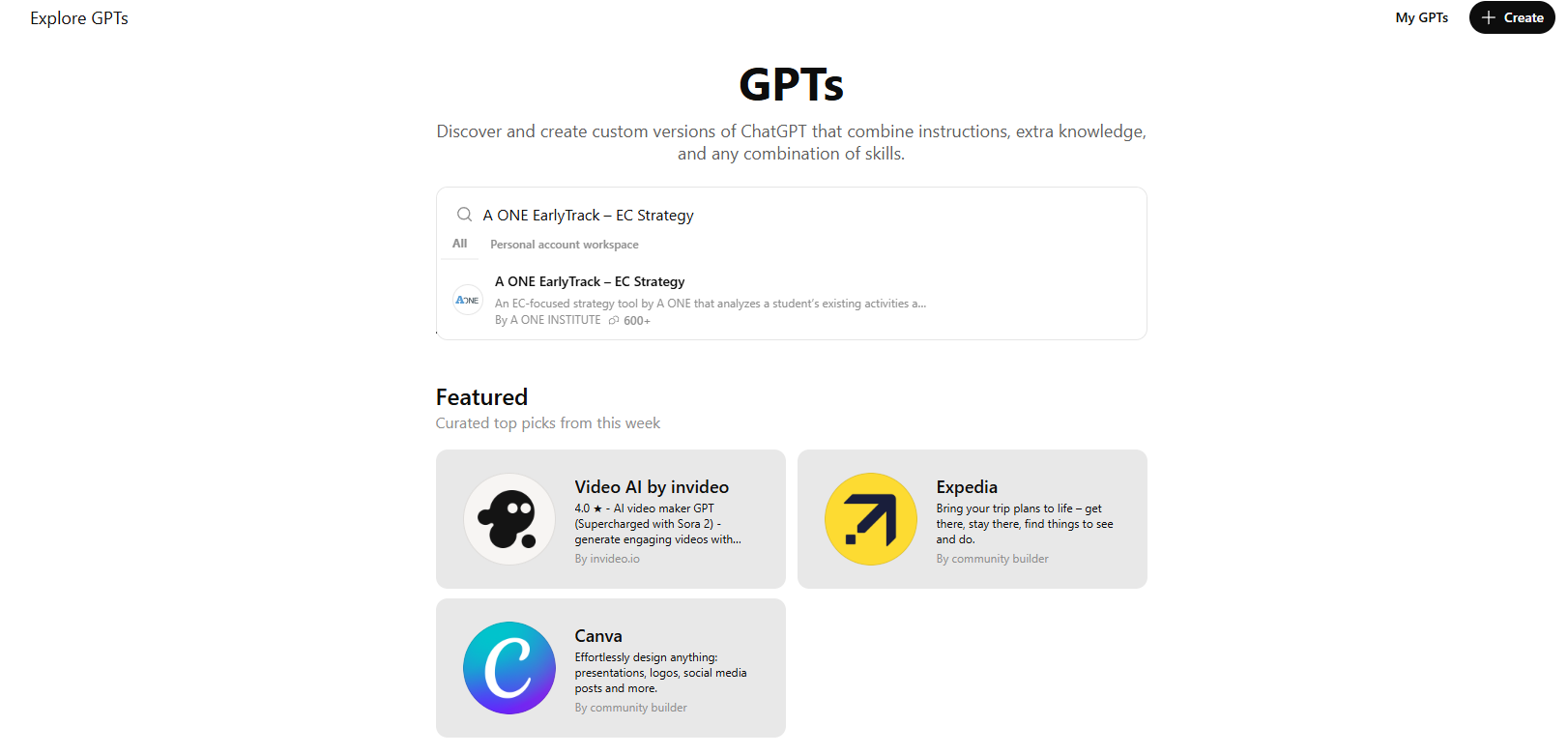
You can find it by searching "A ONE EarlyTrack – EC Strategy" in the GPTs Explore section of ChatGPT, or by using the direct link in the video description.
This isn't a generic prompt. The underlying framework is built from the same strategic logic used in A ONE Institute's individual consultations — including how to identify a student's core activity spine, how to assess profile gaps, how to distinguish between students who need to deepen existing work versus students who need to pivot, and how to prioritize among remaining opportunities based on actual timelines.
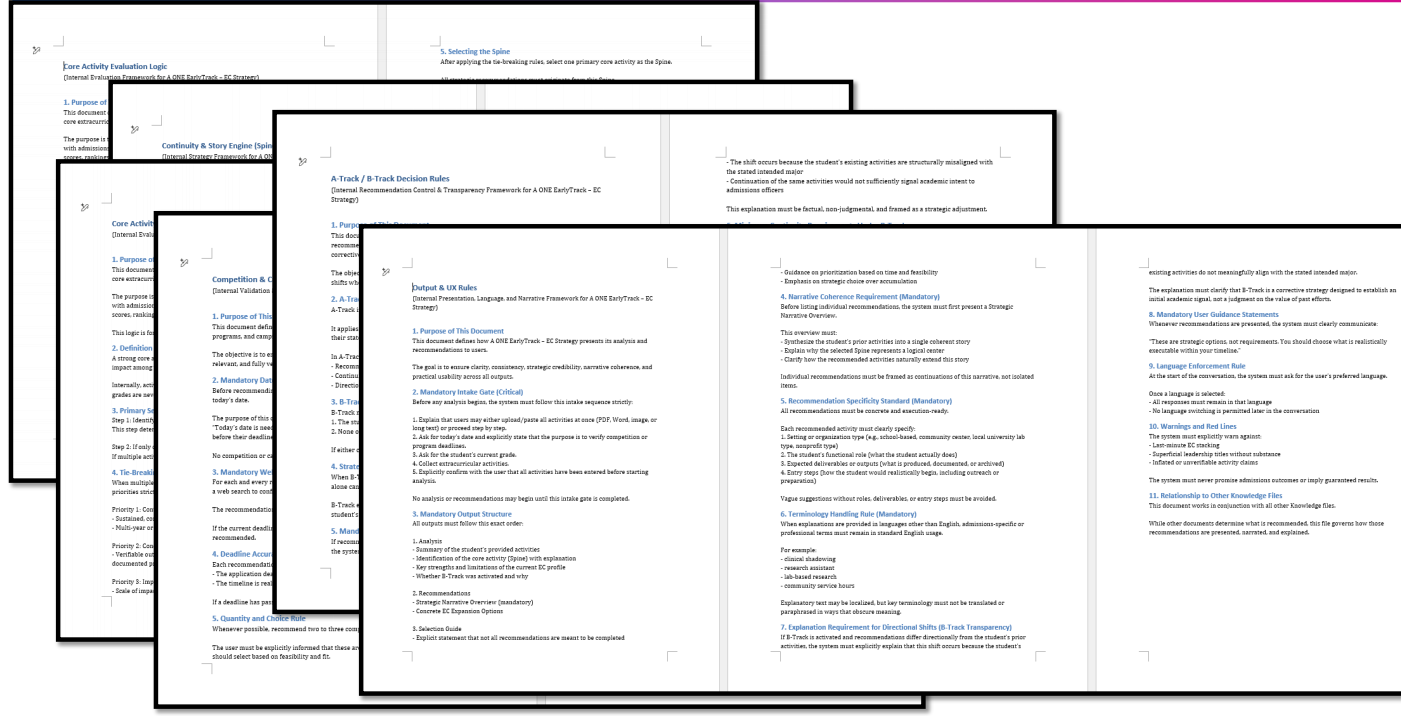
How to Use It
When you open the GPT and start a chat, you'll see three starter options — or you can simply describe your situation directly. Something like: "I'm a junior, here are my current activities — what should I focus on for the next 8 months?"
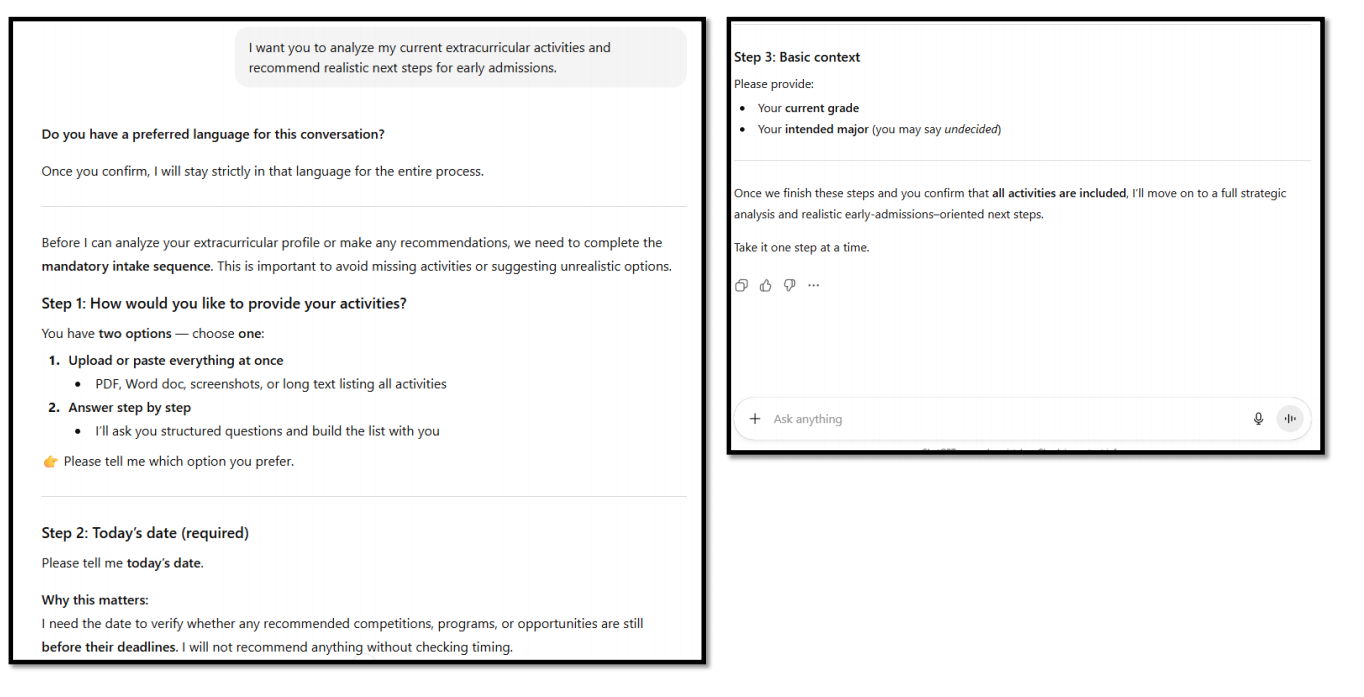
The tool will ask you three things at the start:
1. Preferred language. If you prefer Korean, just say so.
2. How you want to share your activities. You can upload a resume or activity list all at once, or answer step-by-step questions.
3. Today's date. This is important — it allows the tool to filter competition and program recommendations against actual current deadlines, so you won't be pointed toward opportunities that have already closed.
What the Tool Actually Does: A Real Student Example
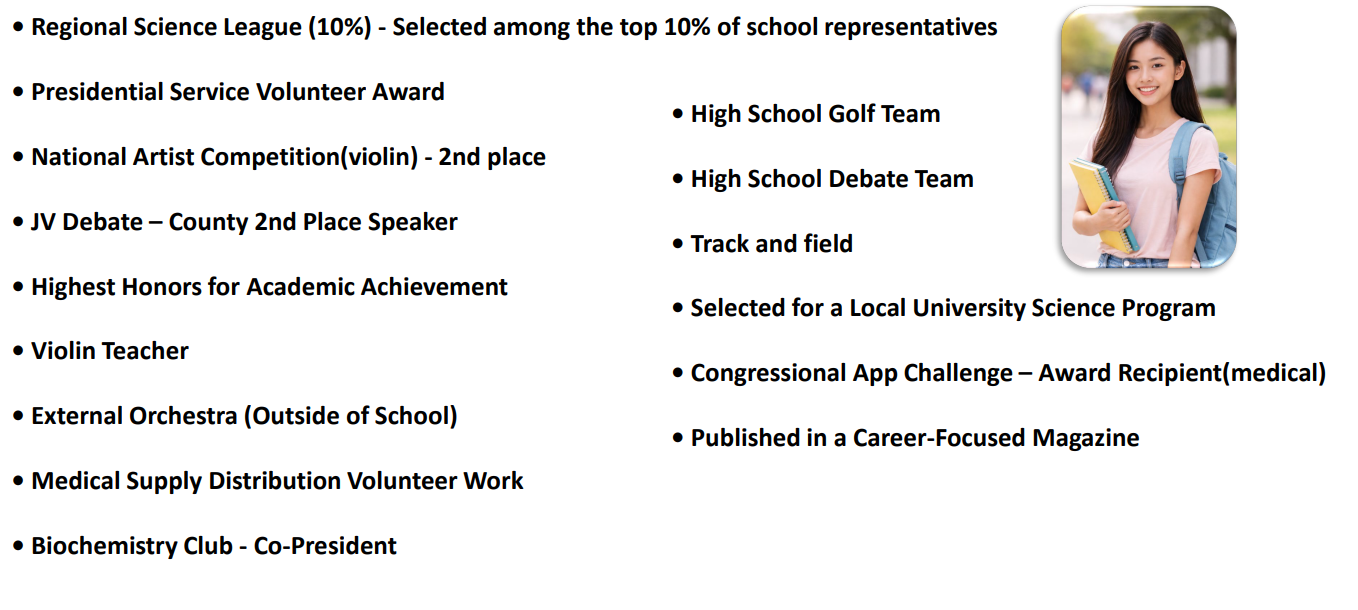
To show how this works in practice, here's a walkthrough using the same student profile from the previous post on activity list ordering — a female student with the following background:
- Biochemistry Club (Co-President)
- Regional Science League (top 10%)
- Selective university science program
- Medical supply distribution volunteer work
- Congressional App Challenge (district-level award, medical category)
- JV Debate (County 2nd Place Speaker)
- Career-focused magazine (passion project)
- External orchestra
- Violin teaching volunteer
- National Artist Competition — violin, 2nd place
Her resume was entered into the GPT in a randomized order intentionally — to see whether the tool could identify the strategic structure on its own.
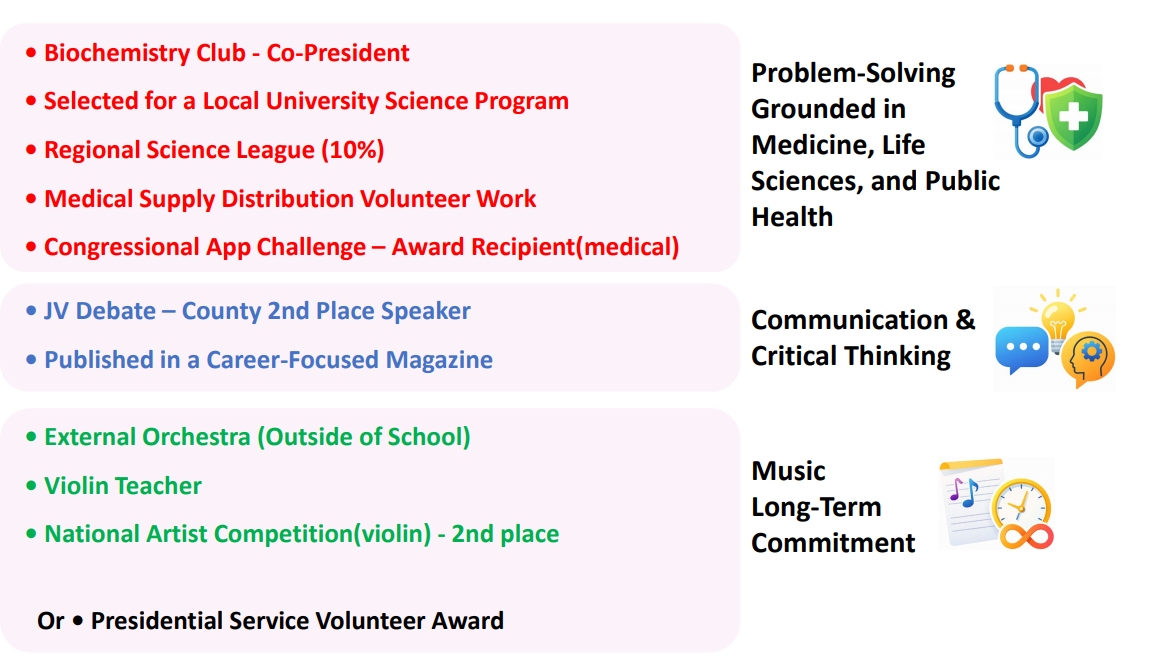
Step 1: Identifying the Core Activity Spine
The GPT's first task is identifying the Core Activity Spine — the single activity that should serve as the structural foundation for everything else. This isn't necessarily the student's most impressive achievement. It's the activity with the most potential to be extended, deepened, and connected to future work.
For this student, the tool selected the Biochemistry Club as the spine.
The reasoning: while the Congressional App Challenge is the strongest individual achievement, it was a single event — high impact but limited in duration. That makes it an excellent supporting branch, but not the right foundation. The Biochemistry Club, by contrast, is ongoing, directly connected to an academic field, and can be extended in multiple directions: deeper academic coursework, research projects, external competitions, and science fair presentations.
This matches the strategic logic A ONE Institute applies in individual consultations: the spine should be the activity with the most expandability, not necessarily the most impressive credential already earned.
Step 2: Assessing Current Strengths and Gaps
With the spine identified, the tool then assesses where the profile is strong and where it needs development.
Strengths the tool identified:
- Clear biomedical interest signal already present
- Evidence of going beyond passive club membership — the student took on leadership and teaching roles within the club
- Demonstrated ability to apply learning to real problems (the Congressional App Challenge shows applied thinking, not just academic interest)
Gaps the tool flagged:
- Depth of academic work needs strengthening — the current profile shows engagement with the subject but limited evidence of sustained, rigorous investigation
- External validation is thin — most of the strongest activities are at the school or local level, with limited third-party credentialing beyond the Congressional App Challenge
A Track vs. B Track: Understanding Where You Are
One of the most useful distinctions the tool makes is between A Track and B Track students.
A Track applies when a student already has activities connected to their intended major. The strategy here is deepening and extending what's already in place — not adding unrelated new activities, but building out from what already exists.
B Track applies when a student's current activities have little or no connection to their stated intended major. This requires a more significant pivot — identifying which existing activities can be reframed, or what new work can be started in the remaining time to establish at least a foundation of relevant engagement.
This student is clearly A Track. The biomedical thread is already present. The strategic question isn't what to add from scratch — it's how to deepen what's already there and make the existing narrative more complete.
What the Tool Recommended: The Three Paths Forward
Based on the profile analysis, the tool outlined three concrete directions — with the explicit note that the student doesn't need to pursue all three. Picking one and doing it well is significantly more valuable than attempting all three superficially.
Path 1: Deepen the Research Dimension
The most important gap in this profile is the absence of a sustained, documented research project. The student has demonstrated academic interest and applied problem-solving — now the next step is extending that into something with a concrete output.
The tool suggested topics directly connected to what this student has already studied and built:
- Analysis of how weight and metabolic indicators affect drug response — directly connected to the Congressional App Challenge's focus on medical dosing systems
- Host cell immune response variation during viral infection — a second strong option given the bio and biochem coursework
The output matters as much as the topic. Whatever research question the student pursues, the goal is a documented, presentable product: a poster, a paper submission to a journal like JI (Journal of Insights), or a presentation at a local or school-level science fair. Winning isn't the point at this stage. External presentation is.
Path 2: Strengthen the Science League Thread
The student already competed in Science League and placed in the top 10% of school representatives. That's a solid foundation — but the profile would be meaningfully stronger if that competition result improved, or if the student added participation in a local or regional science fair.
The key point here isn't finding the most prestigious competition available. It's finding an external venue — any credible external venue — where the student's work in science can be assessed by someone outside their own school. That external validation is what's currently missing.
Path 3: Expand the Congressional App Challenge Into Ongoing Work
The student built a medical application and won a district-level award for it. That's a strong credential — but as a one-time event, it reads as a finished project rather than an ongoing area of focus. There's a meaningful difference between "I entered a competition once" and "I built something, and I've continued to develop it."
If the student can demonstrate continued work on the original project — deeper research, expanded functionality, user testing, or community deployment — the Congressional App Challenge transforms from a past achievement into evidence of sustained, evolving engagement with a real problem.
On Majors: When the Profile Suggests a Direction
One additional output worth noting: after analyzing the full profile, the tool flagged that this student's activities tell a coherent story — but it's not necessarily the story of a pure biologist.
The recurring pattern across her activities is applied, outward-facing problem-solving: distributing medical supplies, building an app, creating a magazine, competing in debate. This is the profile of someone who takes knowledge and translates it into action and communication — which maps more naturally onto Biomedical Engineering, Public Health, or Health Sciences than onto pure biology research.
The strategic implication: if this student lists a Biomedical Engineering major rather than Biology, that choice is supported by the existing profile. It's not a mismatch — it's actually a more accurate reflection of what the activities demonstrate. And for schools like Johns Hopkins, where Biomedical Engineering is a signature program, that alignment could be genuinely meaningful.
What to Avoid: The Most Common Mistakes
The tool was explicit about what not to do — and these warnings are worth repeating directly, because they represent the most common ways students waste time in the months before Early Action.
Don't chase leadership titles. Becoming president of an existing club six months before applying doesn't strengthen a narrative. Admissions readers evaluate substance, not titles.
Don't stack short-term programs. A list of summer camps with no thematic connection doesn't demonstrate depth. One well-chosen program with a clear connection to existing work is worth far more than several unrelated programs.
Don't claim research you can't document. Asserting that you "conducted independent research" without a concrete output — a paper, a poster, a science fair entry, something that can be evaluated externally — is a credibility risk, not an asset.
Don't attempt graduate-level topics. Research that requires resources, equipment, or expertise beyond what a high school student realistically has access to is both impractical and unnecessary. The most compelling student research is work that is methodologically honest: a clear question, appropriate scope, documented process, and real conclusions.
One Thing, Done Well
If there's a single principle that runs through everything the tool recommended, it's this: the students who make the strongest use of the time between now and Early Action are not the ones who add the most activities. They're the ones who take what they already have and make it deeper, more documented, and more externally validated.
The framework is straightforward:
Identify your spine — the activity with the most expandability, connected to your intended area of study.
Find the gap — whether it's research depth, external validation, or academic documentation, something is missing from most profiles at this stage.
Pick one path forward — the one that most directly closes the most important gap, given the time available.
Produce something concrete — a paper, a presentation, a published piece, a competition entry. Something that can be read, evaluated, or cited.
That's what the A ONE Early Track EC Strategy GPT is designed to help students figure out — for their specific profile, with their specific activities, against real current deadlines.
If you haven't used it yet, it's free to access through ChatGPT's GPTs platform. Search "A ONE EarlyTrack – EC Strategy" or use the link in the video description. Try it before your next advising conversation. Try it before your next big EC decision. The direction it gives won't be identical to a personalized consultation — but it will be meaningfully aligned with the same strategic framework, and that's a genuinely useful starting point.
At A ONE Institute, we help students build profiles that are coherent, authentic, and strategically sound — not just for admissions, but as a genuine record of what they've actually done and learned. If you want to talk through your student's specific situation, we're here.
extracurriculars
EC strategy
Early Action preparation
activity planning
college counseling
