
Early Decisions Are In. Here's Something Worth Checking.
At A ONE Institute, December brings a familiar pattern. EA and ED results come out, deferrals pile up, and families start asking what went wrong.
Here's something most students never consider: the order of your activity list may have been part of the problem.
The Common App gives you 10 activity slots. Most students treat the ordering as an afterthought — either random, or vaguely sorted by how impressive something sounds. But admissions officers read those 10 activities before they read your personal statement, before they read your supplemental essays, and before they read your recommendations. The activity list is one of the first real impressions they form of who you are.
And how you sequence those 10 activities — the structure you use to present them — determines whether an admissions reader can easily understand your identity and narrative, or has to work to figure it out on their own.
This applies to seniors still in the Regular Decision round, and equally to juniors who are starting to think about how to design their profile for next year.
Why Sequence Matters More Than Students Think
Before getting into the two main approaches, it helps to understand the context in which your activity list is being read.
According to what Yale's own admissions officers have described, applications are typically read in this order: background and context first, then the activity list, then the personal essay, then any resume, then supplemental essays, and finally recommendation letters.
That sequence is deliberate. By the time a reader reaches your personal essay, they've already formed an impression from your activities. The goal of a well-constructed application is to make that impression coherent — so that each subsequent piece of the application confirms and deepens the same character, rather than introducing a contradictory or confusing picture.
The best applications don't make admissions readers do interpretive work. They present a clear, readable story so that the reader's job is confirmation, not investigation.
Your activity list is where that story either begins clearly or begins with confusion. And the structure you choose — what A ONE Institute calls the Inverted Pyramid versus the Narrative Pyramid — determines which of those two outcomes you're working toward.
The Two Structures: An Overview
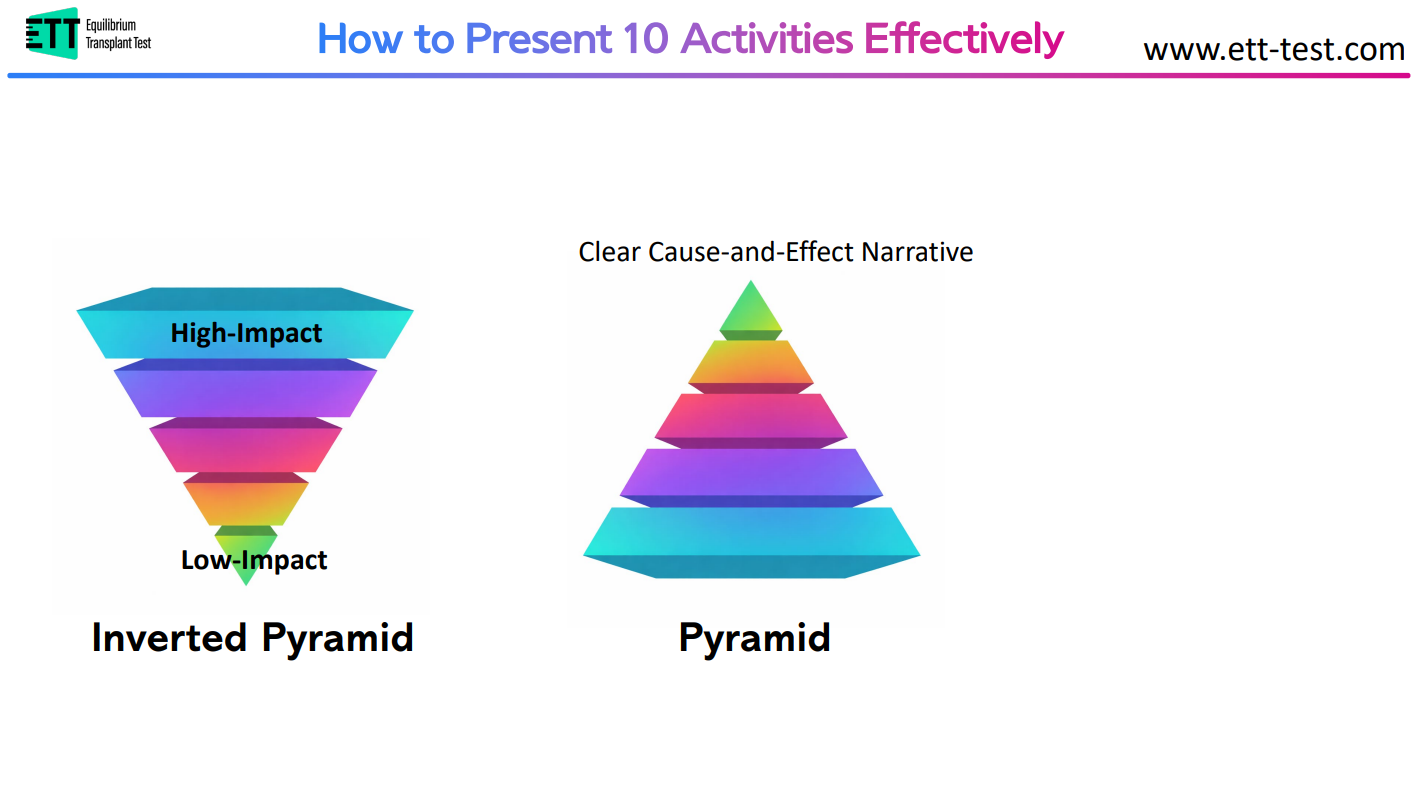
The Inverted Pyramid
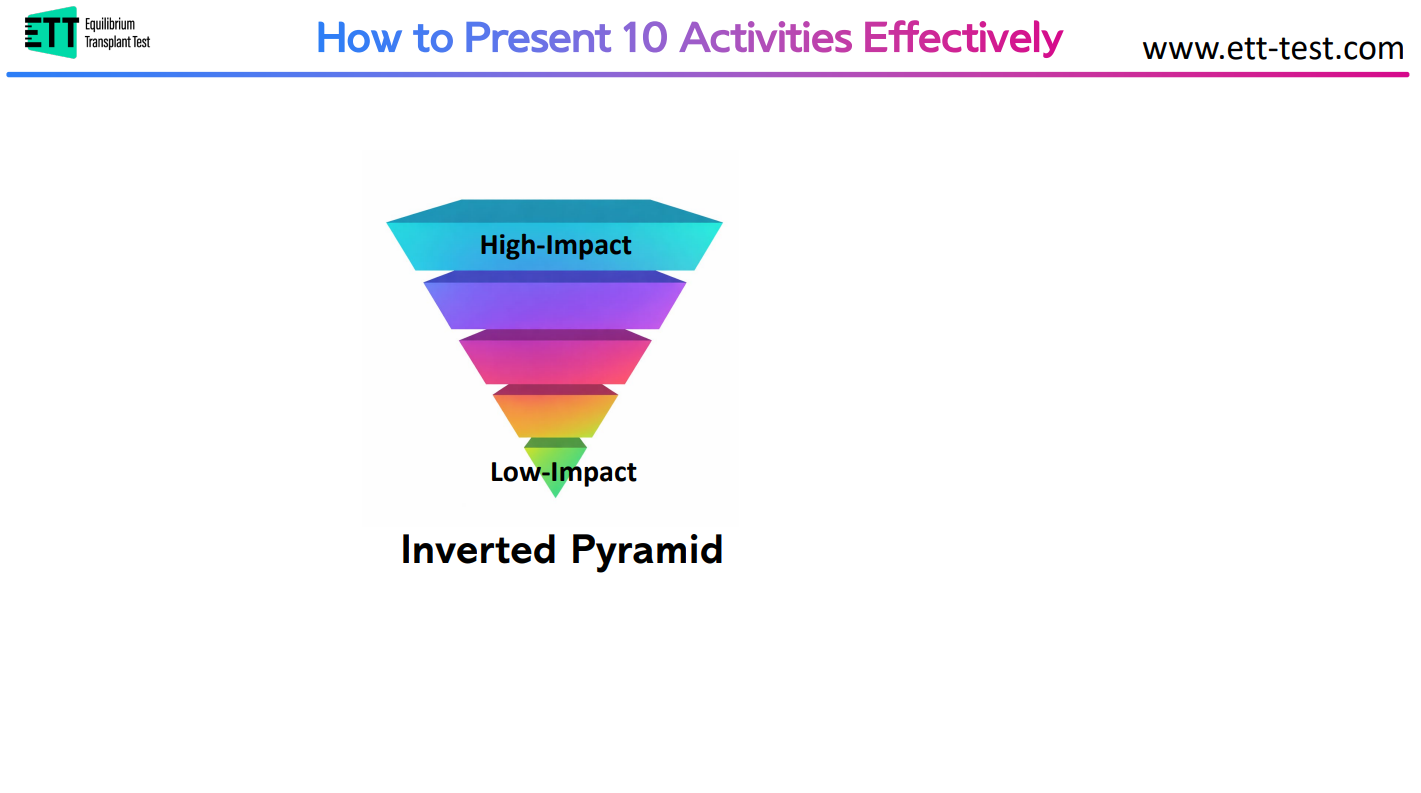
The Inverted Pyramid is the approach most students use instinctively. The logic is simple: put your best, most impressive, highest-impact activity first, then work downward toward lower-impact activities as you go. Your biggest award or achievement at the top. Your most minor involvement at the bottom.
The advantage is that it immediately signals strength. A reader who sees a nationally recognized achievement in slot one knows right away that this student has demonstrated real competitive performance.
The disadvantage is that it puts the burden of narrative interpretation on the reader. An impressive achievement in slot one, followed by unrelated activities in slots two through ten, doesn't tell the reader who you are or why these activities fit together. The reader has to construct that story themselves — which takes energy, and which may not produce the story you intended.
The Narrative Pyramid
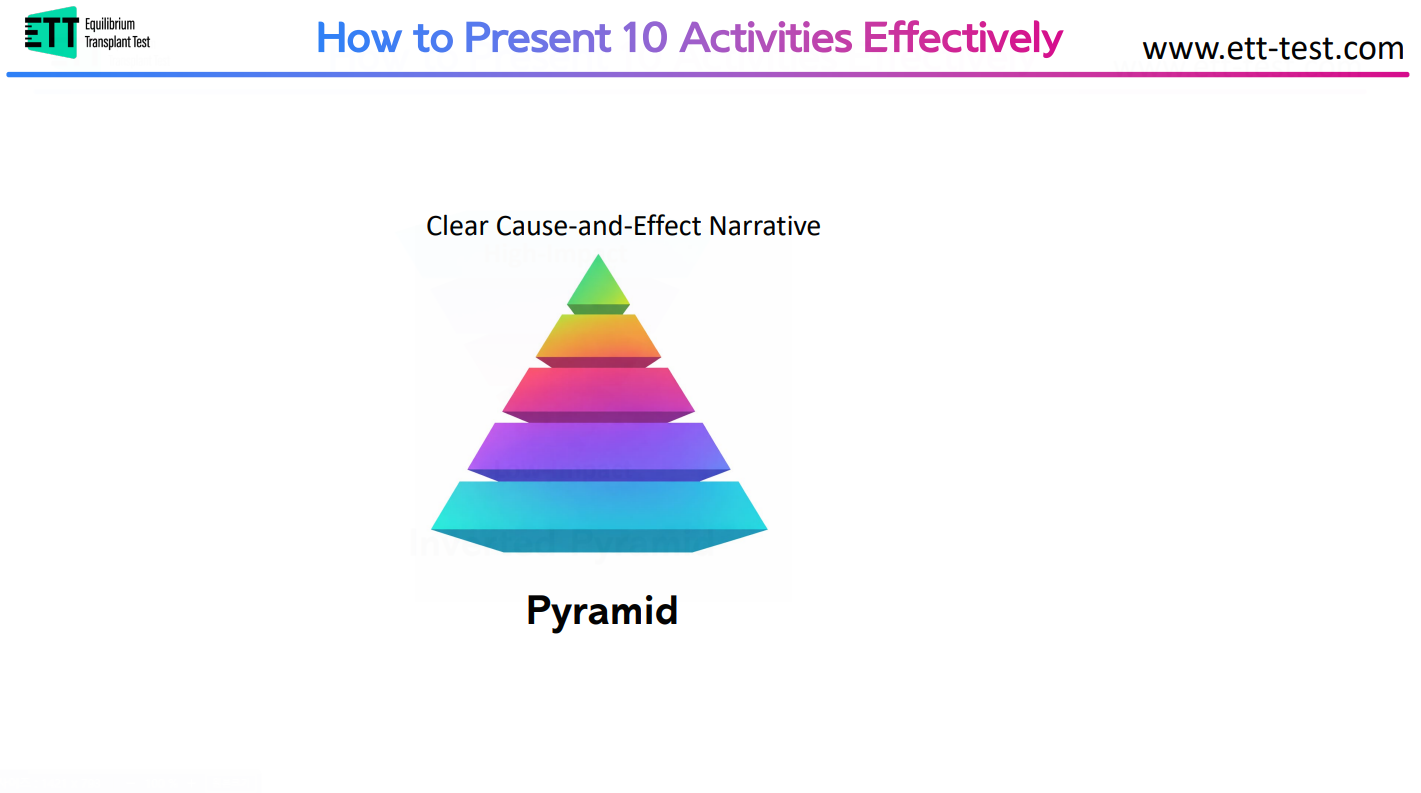
The Narrative Pyramid organizes activities not by impact level but by causal sequence and thematic coherence. The idea is that your activity list tells a story with a through-line: this interest led to this experience, which revealed this problem, which motivated this action, which produced this outcome.
Rather than ranking activities by prestige, you're grouping them by the role they play in a larger narrative — typically two or three thematic clusters, each with its own internal arc.
The advantage is that the reader doesn't have to work. The character, the intellectual interests, the progression of engagement — all of it is legible at a glance. The admissions reader can immediately see who this student is and what drives them.
The disadvantage is that it's harder to execute. If the narrative feels forced or artificially constructed, it can actually read worse than a straightforward Inverted Pyramid. When the Narrative Pyramid works, it can score at the 90+ level. When it's done poorly, it can score below 70. The Inverted Pyramid, by contrast, is lower risk — it rarely scores above 80, but it rarely scores below 70 either.
A Real Student Example — Applied Both Ways
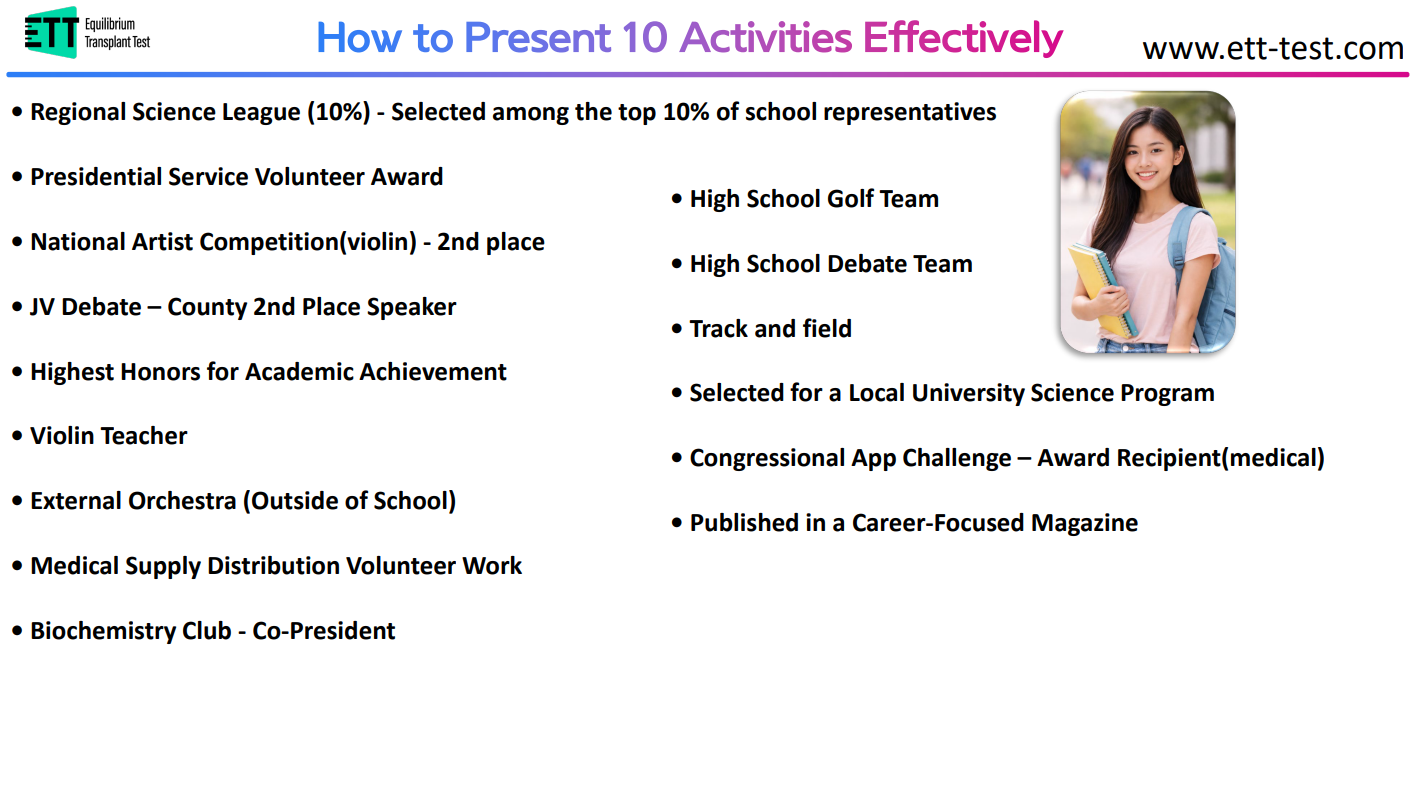
To make this concrete, here's how both structures play out with an actual student profile.
This student — a young woman — had the following activities across her high school years:
- Science League — represented her school at regionals, finished in the top 10%
- Presidential Volunteer Service Award — earned previously, now discontinued
- National Artistic Competition (Violin) — second place, though not at the All-State level; she played in an outside orchestra rather than her school's
- Debate Club — competed at the JV Division level, earned recognition there
- Academic Excellence Award — school-level honor
- Violin Teaching Volunteer — taught younger students as a community service activity
- Outside Orchestra — not All-State caliber, but sustained, long-term participation
- Medical Equipment Volunteer — helped distribute medical devices to underserved communities
- Biochemistry Club — co-founded with a friend because no such club existed at her school; served as president
- Golf and Track & Field — played golf for about two years, then switched to track due to scheduling; neither was sustained throughout all four years
- Selective University Science Program — enrolled in a competitive science program at a nearby university; included coursework and introductory research experience
- Congressional App Challenge — won at the district level; her strongest individual achievement
- Career Magazine Passion Project — created a publication exploring career paths for students; an independent project outside of school
That's a full, varied profile. The question is how to sequence it.
Applying the Inverted Pyramid
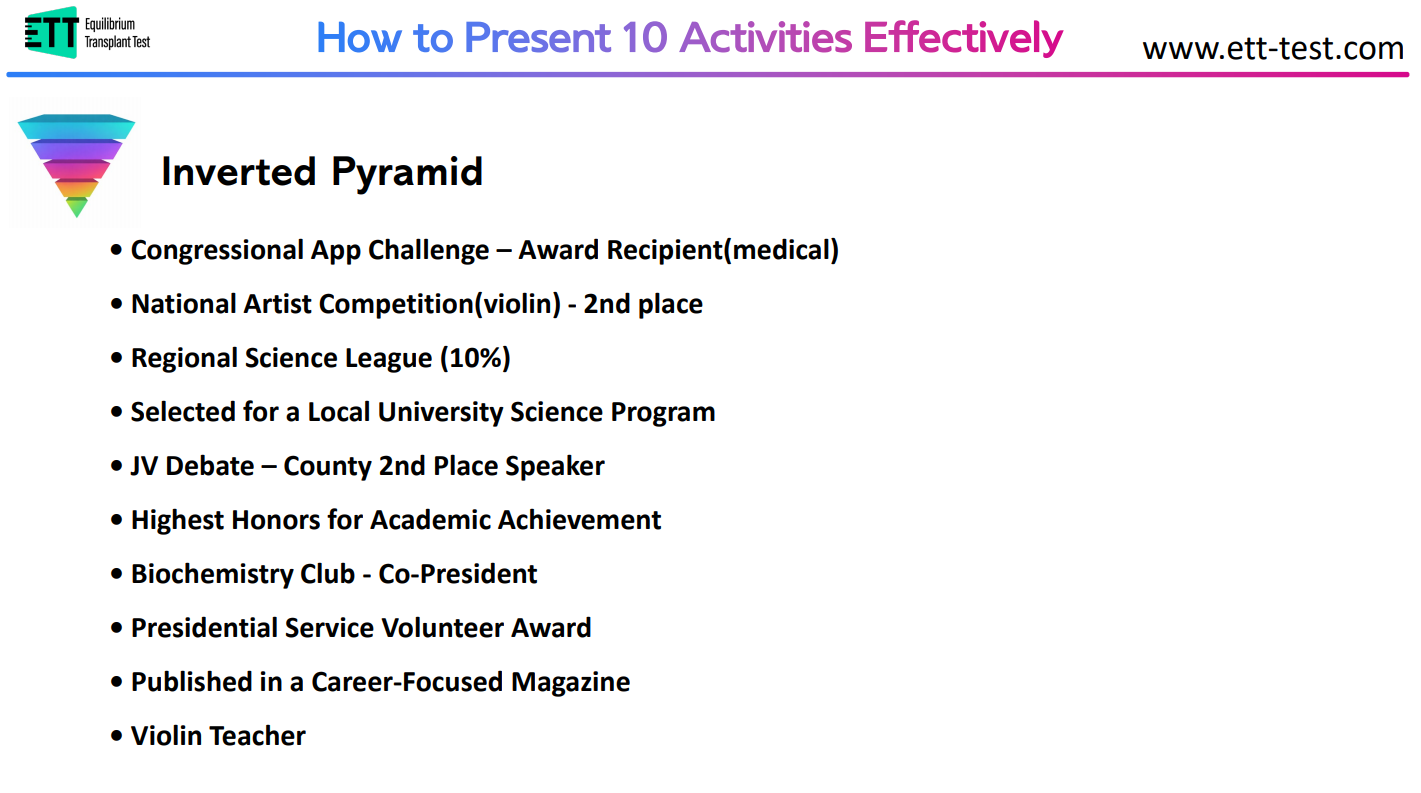
Using the standard impact-first approach, the list would look something like this:
- Congressional App Challenge — district-level winner (strongest individual achievement)
- Violin Competition — second place nationally
- Science League — school representative, top 10% at regionals
- Selective University Science Program — competitive, academically rigorous
- Debate Club — JV Division recognition
- Academic Excellence Award — school honor
- Biochemistry Club — founder and president (shows leadership)
- Presidential Volunteer Service Award
- Career Magazine — passion project
- Violin Teaching Volunteer
Reading this list, an admissions officer would quickly see: this student has competitive achievements, plays violin, and has a science interest. Those impressions are accurate — but they don't connect into a coherent story. The reader still has to do interpretive work to understand who this student is and what drives her.
This structure works best for students who have multiple state-level or national achievements — students whose top activities are strong enough that impact alone communicates the story. For students whose strongest activities are at the school-representative level, with some activities clearly below that tier, the Inverted Pyramid is less effective because the top of the list isn't compelling enough to carry the reader through the rest.
Applying the Narrative Pyramid
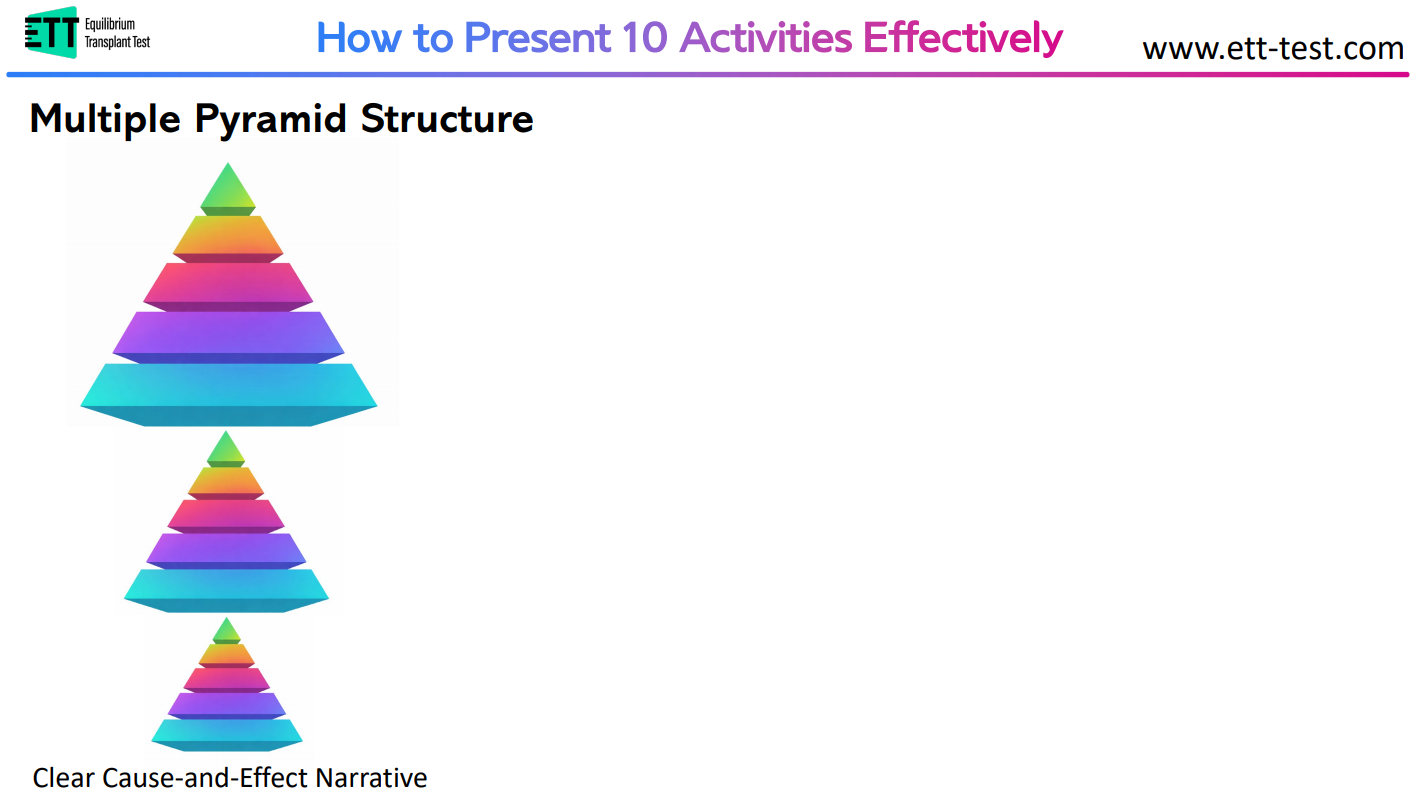
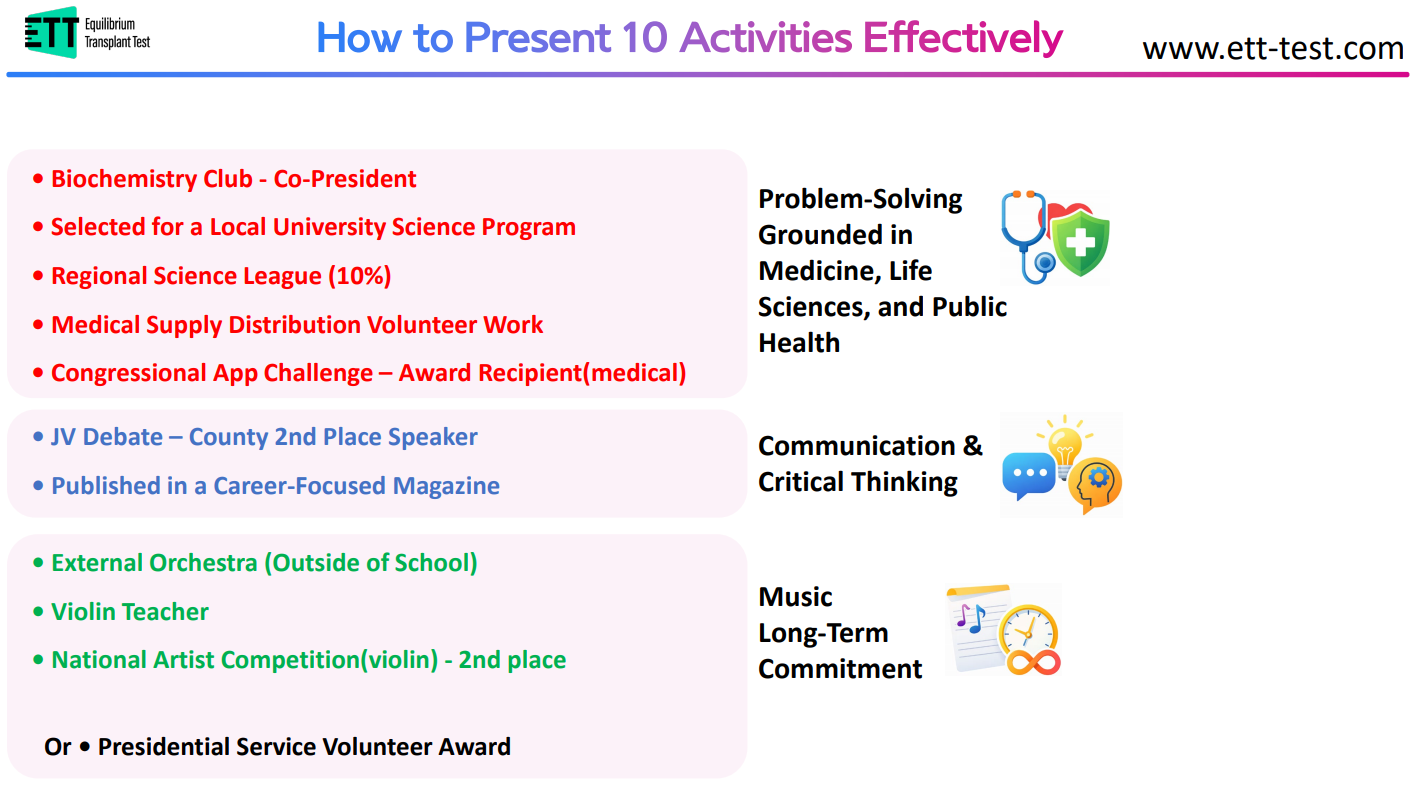
The Narrative Pyramid organizes the same activities into thematic clusters with a causal arc. For this student, the central narrative is: a student who applies biomedical and life science knowledge to real-world problems.
Cluster One — The Core Academic and Applied Science Narrative (Slots 1–5)
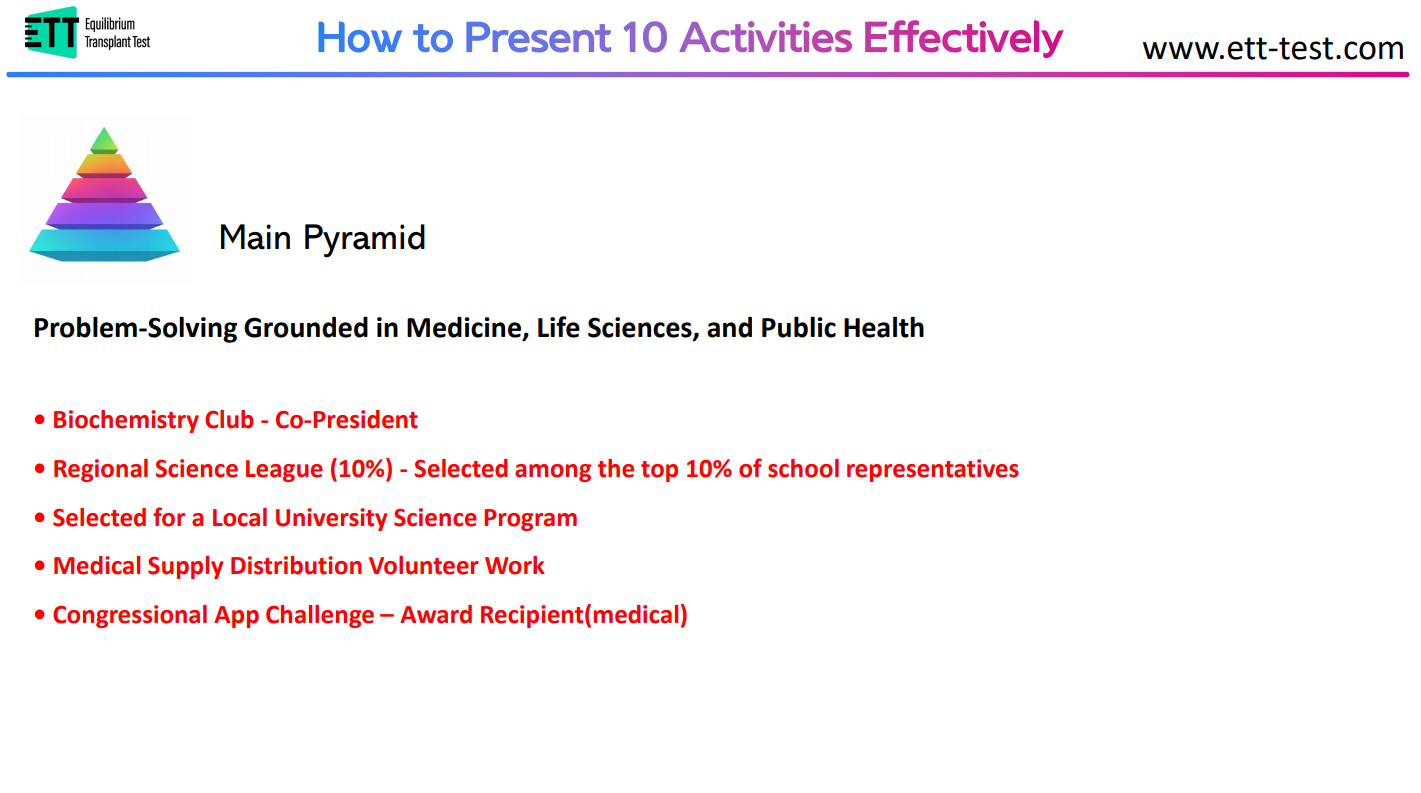
- Biochemistry Club (Founder & President) — her interest in bio and chemistry was strong enough that she created a club when none existed; this is the origin point of the narrative
- Science League — that interest developed into competitive performance; she represented her school and placed in the top 10%
- Selective University Science Program — she pursued learning beyond high school level, demonstrating academic seriousness
- Medical Equipment Volunteer — moving from learning to action, she began engaging with real-world health access problems in her community
- Congressional App Challenge (District Winner) — she identified a problem and built a technological solution, earning recognition for it
Reading these five activities in sequence, a narrative emerges without any effort from the reader: a student whose genuine curiosity about life sciences evolved from classroom interest into competitive achievement, then into academic rigor, then into community-facing action, then into a tech-based solution with recognized impact. That's a complete arc — and it communicates major fit for any STEM or pre-med related program.
Cluster Two — Communication and Leadership (Slots 6–7)
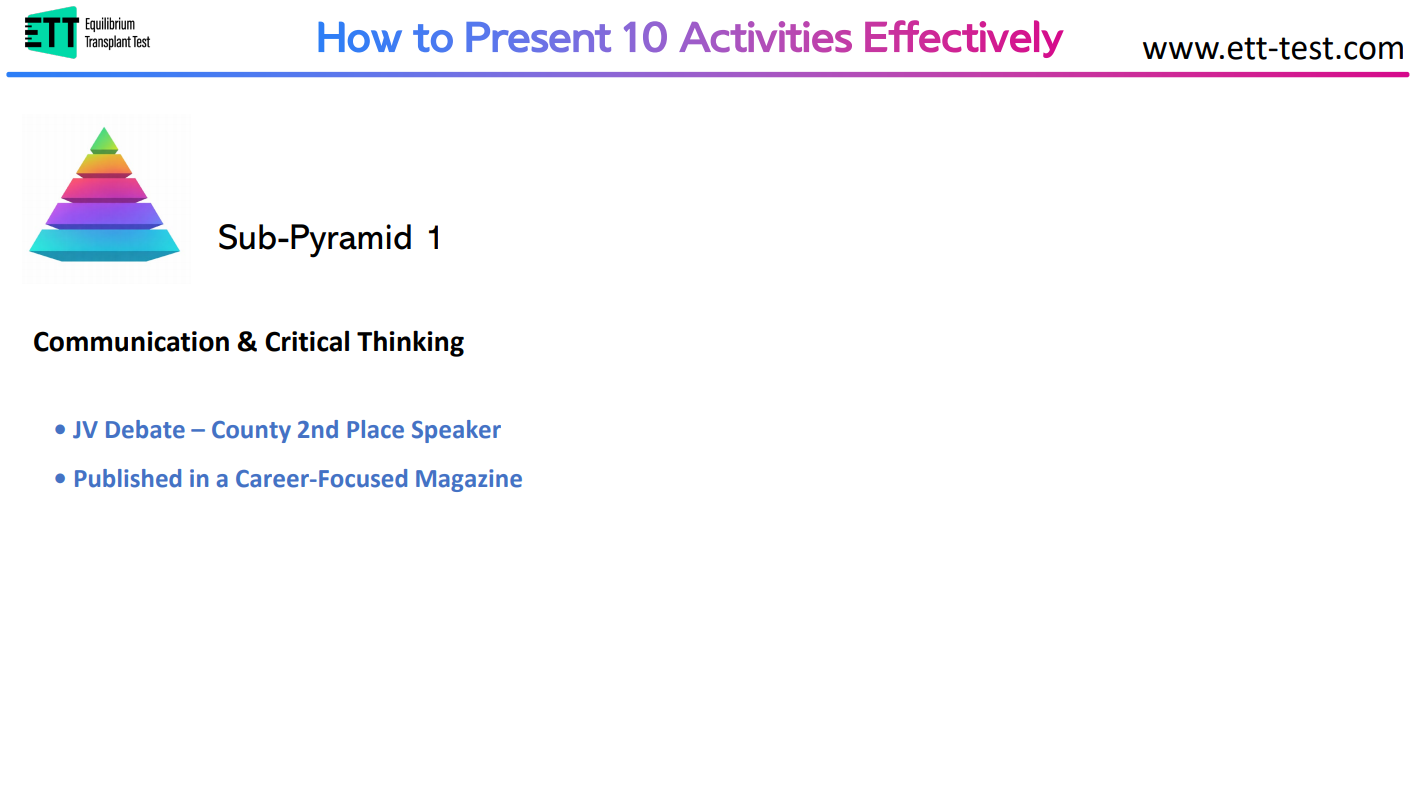
- Debate Club — demonstrates the ability to articulate ideas and argue positions clearly; a natural complement to someone building solutions that require communicating to stakeholders
- Career Magazine — an independent project that shows she extends her thinking into written communication and takes initiative outside of structured programs
Cluster Three — Long-Term Commitment Through Music (Slots 8–10)
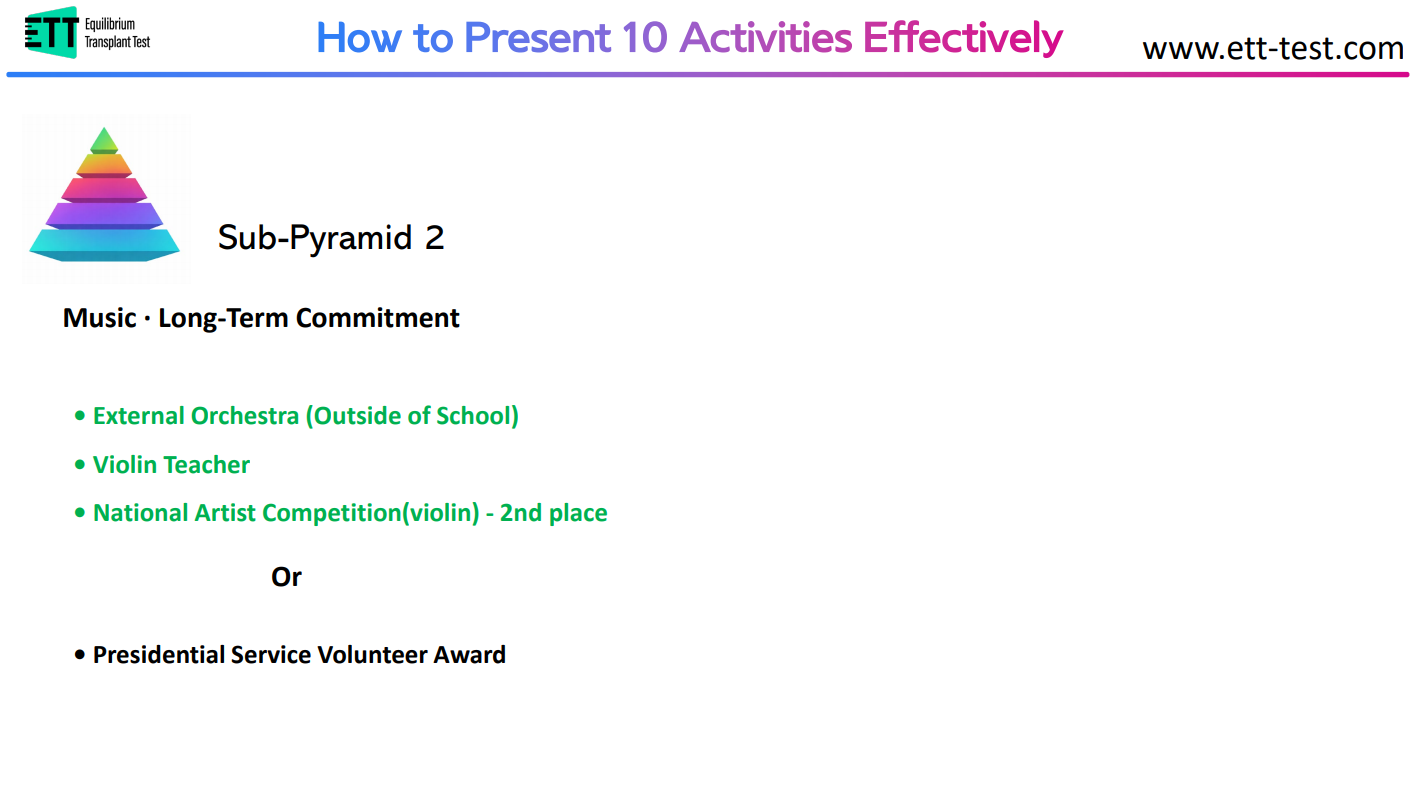
- Outside Orchestra — sustained, multi-year involvement
- Violin Teaching Volunteer — applied her skill in service of others
- Violin Competition — some external validation of skill level
The function of this final cluster isn't primarily to showcase violin talent. Because the violin work isn't at the All-State level, leading with it would invite a comparison this student can't win. Instead, placed at the end, it serves a different purpose: demonstrating long-term commitment. She started violin years ago and continued through graduation. That persistence — the ability to sustain engagement over time — is the message this cluster is designed to send. It's a character trait, not a talent showcase.
Which Approach Should You Use?
The honest answer is that it depends on the student.
The Inverted Pyramid is the right choice when:
- The student has multiple state-level or nationally recognized achievements
- The highest-impact activities are strong enough to immediately signal the student's caliber
- The student's activities naturally cluster around one area of achievement (e.g., a STEM competition specialist or a serious athlete)
The Narrative Pyramid is the right choice when:
- The student's strongest activities are at the school-representative level, with limited national or state recognition
- The student has pursued multiple different types of activities that don't obviously connect on their own
- The student has a clear intended major or area of focus that can serve as the spine of the narrative
At A ONE Institute, the default preference leans toward the Narrative Pyramid — not because it's universally better, but because most students applying to selective schools don't have enough high-impact individual achievements to make the Inverted Pyramid do what it's supposed to do. For those students, leading with impact can actually highlight the absence of top-tier credentials rather than obscuring it.
The Narrative Pyramid, done well, redirects the reader's attention toward coherence, depth, and character — which are often more defensible strengths for the typical competitive applicant.
The risk is real: a poorly executed narrative feels manufactured and works against the applicant. But a well-executed one gives the admissions reader exactly what they're looking for — a clear, complete picture of a student they can imagine contributing to the class.
What to Do Right Now
If you're a senior still in the Regular Decision round, it's worth reviewing your activity list with this framework in mind. Ask yourself:
Does my list have a logical reading order? If someone unfamiliar with you read these 10 activities in sequence, would they form a coherent impression — or would they be left assembling disconnected pieces?
Is my highest-impact activity actually strong enough to lead? If your top activity is a school-level award or a club role without significant external recognition, consider whether impact-first ordering actually serves you.
Are there 3–5 activities that tell a connected story? If so, can they be grouped together at the top of the list to form a core narrative cluster, even if other activities are less clearly related?
Does your narrative feel genuine or forced? The test of a well-constructed Narrative Pyramid is that it reads naturally — as though the activities genuinely unfolded in a purposeful sequence, because they actually did. If you're reverse-engineering a story that doesn't reflect how things actually happened, the reader will often sense that.
If you're a junior, this is the time to be thinking about these questions prospectively — not just doing activities, but thinking about how the activities you're choosing now will read in sequence when you apply next year.
The activity list is ten slots. Used well, it can make the rest of your application significantly easier to read. Used carelessly, it makes your strongest qualities harder to find.
That's a difference worth taking seriously.
At A ONE Institute, we work with students to design activity lists — and full applications — that tell a coherent, compelling story from the first line to the last. If you want a second opinion on how your current list reads, or help thinking through how to sequence what you have, we're here.
Common App activities
extracurricular list
activity order
college application strategy
admissions narrative
