
This Comes Straight From Yale's Own Admissions Officers
At A ONE Institute, we spend a lot of time tracking how top schools describe their own admissions process — and Yale has been unusually transparent about it.

Yale's admissions team — officers Hannah and Mark — produced a podcast series specifically designed to pull back the curtain on how they review applications. Across roughly 35 episodes, each about 20 minutes long, they walk through their philosophy, their process, and the most common misconceptions they see from applicants. The full transcript runs nearly 500 pages and over 219,000 words.
This article distills the most important takeaways from that entire series — organized so you can understand not just what Yale says it does, but what it actually means for how you prepare.
The Holistic Review Process — What It Actually Means (And What It Doesn't)

Yale, like most top schools, describes its process as a holistic review. But what does that actually mean in practice?
According to Yale's admissions officers, holistic review means no single score or algorithm determines the outcome. The goal is to understand the full picture of who a student is — not reduce them to a number. That said, some rating system does exist internally, primarily to help the second reader process an application more efficiently after the first reader has gone through it.

Here's the critical point that Yale's officers emphasize — and that families consistently misunderstand:
Holistic review does not mean academics are de-emphasized. It means the opposite.
Academic performance functions as a threshold. Students who don't clear that threshold — regardless of how impressive their extracurricular activities are — will find it extremely difficult to gain admission to Yale. Holistic review only comes fully into play for students who have already demonstrated strong academic preparation.
Don't let the word "holistic" lead you to underinvest in academics. That's one of the most common and costly mistakes in this process.
How Yale's Application Review Is Actually Structured
The Regional Reader System

Yale assigns approximately 25 full-time admissions officers to specific geographic regions — both within the United States and internationally. These regional readers know their territories well. They understand the schools, the local context, and what it means for a student to perform at a high level within a particular environment.
When an application comes in, the regional reader — who becomes the first reader — goes through the file up to four times. From that process, they produce what Yale calls a work card: a summary of the applicant that also functions as an initial assessment. This work card is then passed to a second reader, who uses it to review the application more efficiently.
Later, in the committee stage, that same first reader becomes the advocate for the applicant — presenting the case and fielding discussion. But being an advocate doesn't mean having the power to determine the outcome.
The Three-Stage Review Process

Yale's review process moves through three distinct stages:
Stage 1 — Reading: The same file may be read two to four times. Officers record observations and assessments on the work card, covering academics, activities, essays, and recommendations. Simple internal ratings like "strong" or "very strong" may be used — but these are descriptive, not mechanically added into a formula.
Stage 2 — Committee: A five-person group — which may include admissions officers, deans, and faculty — presents, discusses, and votes anonymously on each file.
Stage 3 — Final Review: After regional committees finish, the broader class is reviewed again with overall composition in mind — region, intended major, financial aid needs, and broader class-shaping goals.
The Committee Process

Yale's admissions committee typically consists of five people. The regional reader presents each case, and the group discusses and deliberates together. The final decision is made collectively — through group deliberation and anonymous voting.
According to Yale's own officers, the dynamics in that room can be genuinely unpredictable. A student that the first reader strongly championed can ultimately be denied. A student the first reader felt ambivalent about can suddenly gain traction in committee and be admitted.
No single person controls the outcome. That point is emphasized repeatedly throughout Yale's podcast series. The process is designed specifically to prevent individual bias from determining results.
A file that looked like a clear admit at the regional committee stage can still be reversed during Final Review — because the office may need to make adjustments after looking at the entire pool. Region, major distribution, financial aid, and broader class-shaping goals all factor into that final pass.
Applicant Volume — And Why It Matters

Yale's applicant pool has grown substantially over the life of this podcast series — from roughly 35,000 applications mentioned in early episodes to more than 52,000 in 2023. As volume increased, Yale introduced an initial review stage to identify which files need more time and attention. Even so, Yale maintains that all final decisions still go through committee deliberation.
The Role of Luck — And Why It's Real
Yale's officers acknowledge something that most admissions offices won't say out loud: luck plays a role.
If a particular geographic region is already heavily represented in a given cycle, a strong applicant from that same region may be denied simply because there's no room left. The student may be genuinely excellent. The issue is capacity, not quality.
Yale's officers offer this as a word of comfort for students who didn't get in despite strong applications. But they're also honest that it's cold comfort. The point worth taking seriously: a rejection from Yale does not mean you weren't good enough. Sometimes it means the math didn't work out in your favor.
Academics: The Threshold That Everything Else Depends On
The High School Transcript Is the Most Important Document

Yale's admissions officers are unambiguous about this: the high school transcript is the single most important document in the application. GPA functions as a threshold. Cross it, and holistic review applies. Don't cross it, and even exceptional extracurricular achievements are unlikely to be enough.
Admissions officers don't just look at final GPA. They analyze the trajectory from 9th through 12th grade. If a student has a B in their record, it's significantly better to have earned it in 9th grade than in 11th. A consistent upward trend — showing increasing mastery and rigor over time — is meaningfully more favorable than a flat or declining one.
Yale Compares You to Your Own School — Not the School Next Door
This is one of the most important and most misunderstood points in Yale's entire admissions philosophy.
Yale's officers make it explicit: they do not compare a student from a school with 8 AP courses to a student from a school with 16. The evaluation is contextualized to what was available at the student's specific school. The question is: "Did you take full advantage of what your school offered?"
This is why the school profile document — submitted separately by the high school — carries real weight. And it's why regional readers, who understand local school environments, matter so much.
A student from a school without AP or IB is not disadvantaged if they pursued the most challenging curriculum available to them. That said, if you want to strengthen your academic profile beyond what your school offers, taking external college courses or additional coursework can add meaningful depth.
Yale's Test-Flexible Policy

Yale currently operates on a test-flexible model. Students can submit SAT or ACT scores — or, if they prefer not to submit either, they can submit all of their AP or IB scores instead. The core idea is not a return to mandatory testing, but greater flexibility in how academic strength can be demonstrated.
Yale's officers clarify that standardized test scores are not used as a hard cutoff. There's no score below which an application is automatically dismissed — and a perfect score doesn't guarantee admission either.
That said, the data on admitted students tells its own story. Yale admits tend to have very high SAT and ACT scores. And while a strong test score can provide some additional confidence when grades are on the borderline, it usually cannot fully overturn a weak transcript.
The Order Yale Reads Your Application — And Why It Matters
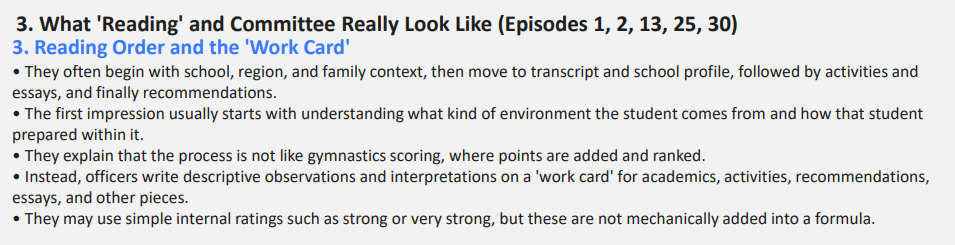
Yale's admissions officers read applications in a specific, fixed order:
- Background information — school, region, family context
- High school transcript and school profile
- Extracurricular activities
- Personal statement (Common App essay)
- Yale-specific supplemental essays
- Letters of recommendation
Understanding this sequence has direct implications for how you approach your application. By the time an admissions reader reaches your essays, they already know your school environment, your grades, and your activities. Your essays need to be coherent with everything that came before them — not introduce a completely different version of who you are.
The reader is building a picture of you from the very first document. Each subsequent piece should deepen and confirm that picture, not contradict it.
Essays: What Yale Is Actually Looking For
The Topic Matters Less Than You Think

Yale's officers are consistent on this: the essay topic is not what makes or breaks an application. What matters is how you process the experience — what it reveals about how you think, what you value, and where you're headed.
A small, quiet topic handled with real depth and genuine reflection can be far more effective than a dramatic topic handled superficially. The goal is for an admissions reader to finish your essay and feel like they understand who you are.
What a Strong Essay Actually Does
According to Yale's admissions officers, a compelling personal statement reveals:
- Intellectual curiosity — what genuinely fascinates you and why
- A sense of humor or warmth, where it fits naturally
- How you treat other people
- How you show up as a member of a community
These qualities should emerge organically from the writing — not be stated directly. Show the scene. Don't summarize it. Specific, concrete detail is what makes an essay feel authentic and distinctly yours. It's also what signals to a reader that you wrote it yourself.
What Yale Explicitly Doesn't Want
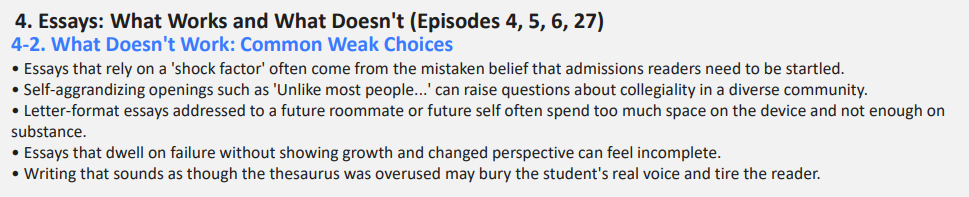

Yale's officers name several specific patterns they find ineffective:
Shock value. Trying to startle or disturb the reader with an extreme topic almost never lands the way students intend.
Positioning yourself as uniquely exceptional. Opening with something like "unlike most people" or framing yourself as fundamentally different from everyone around you raises immediate questions about how you'll function in a collaborative community.
Overused structural devices. Letters to a future roommate, letters to a future self — these formats have been used so often that they tend to dilute rather than strengthen the core content.
Describing failure without showing growth. A long account of a setback followed by a thin reflection on what you learned is not a strong essay. The failure itself is not the point. What you did with it — and how you changed — is.
Thesaurus-driven language. Reaching for impressive vocabulary at the expense of natural voice makes the writing harder to read and less authentic.
Grandparent essays. Yale's officers address this directly and compare it to a Hitchcock-style pattern — when a grandparent appears early, readers can often predict the ending. Many students write about a grandparent's life or death and the result is frequently an essay about the grandparent rather than the student. You must remain the protagonist throughout.
Supplemental Essays
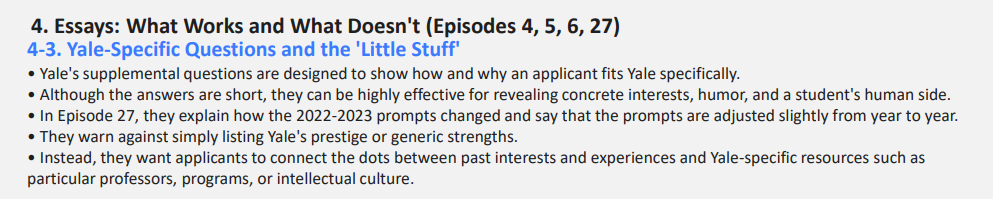
Yale's supplemental questions are designed to assess fit — how specifically your background, interests, and goals connect to what Yale offers. Although the answers are short, they can be highly effective for revealing concrete interests, humor, and a student's human side.
The "Why Yale?" essay is not an invitation to describe Yale's reputation or list general characteristics. It should draw direct, concrete lines between your past academic work and specific resources, programs, faculty, or opportunities at Yale. Generic admiration for Yale's prestige is not a substitute for genuine fit.
Extracurricular Activities: Quality Over Quantity

Yale's admissions officers are clear: filling up the activity list is not the goal. Their actual advice is straightforward: be active, at the right level for you, doing what you genuinely like.
What they're looking for is sustained, meaningful involvement — activities that mattered to the student, pursued with real responsibility and effort over time. Activities don't need to be prestigious to be valued. Yale's officers explicitly note that paid work, family caregiving responsibilities, and religious participation are all taken seriously. These reflect real life, real character, and real priorities.
Because Yale reads the activity list before the personal statement, your activities and essays need to form a coherent picture of the same person. If your activity list describes one kind of student and your essays describe someone else entirely, that inconsistency registers — and not favorably.
Letters of Recommendation: What Makes Them Matter
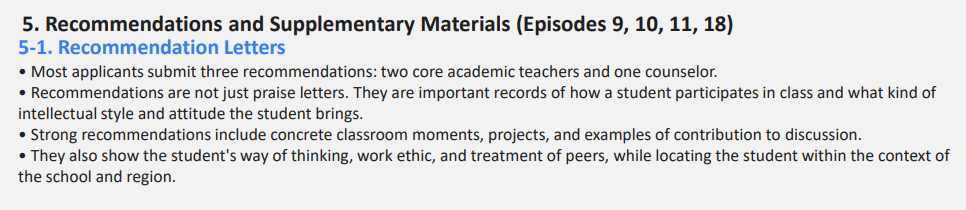
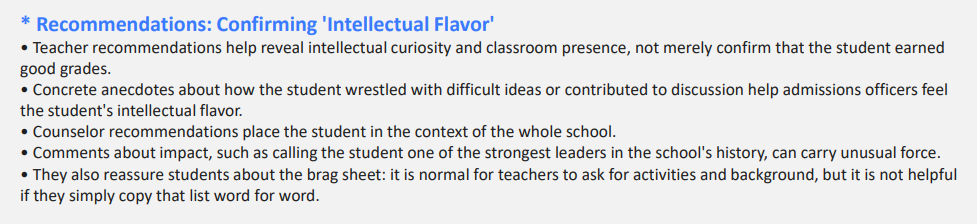
Yale asks for two teacher recommendations and one counselor recommendation.
Teacher letters are not just praise letters. They are important records of how a student participates in class and what kind of intellectual style and attitude the student brings. The most effective teacher letters include concrete classroom moments — a particular project, a discussion where the student demonstrated unusual intellectual engagement, a moment of persistence through difficulty. Abstract praise ("this student works hard") is far less useful than concrete narrative.
What Yale's officers want to see in teacher letters:
- Evidence of intellectual curiosity in action — the student's "intellectual flavor"
- How the student handled challenge or setback
- The student's role in classroom discussion and collaboration
- Treatment of peers and work ethic
Counselor letters serve a different purpose — they provide the broader context of who the student is across their entire school experience. A line like "one of the strongest leaders in our school's history" carries significant weight when it comes from a counselor who has seen hundreds of students. Note that if a teacher simply copies a student's activity list word for word into a recommendation, it adds very little value.
Supplementary Materials: Only Submit If It's Genuinely Strong

Yale's officers are direct: supplementary materials are not extra points. They exist so that students who are already excellent in a particular area — music, art, theater, film, or high-level STEM research — can have that excellence properly evaluated. The evaluation is often done by faculty or specialists in the field rather than by admissions officers alone.
Importantly, most admitted students did not submit a supplement. Students should not submit one merely to add volume. If the material isn't at a genuinely high level, submitting it can work against the applicant by suggesting poor judgment about one's own work.
Common Myths About Yale Admissions — Debunked
[PDF p.24 — Mythbusters]
Myth: Applying early gives you a major advantage. Yale's officers say the stronger Early Action admit rate is mostly a pool-composition effect — early applicants tend to be more prepared and more committed — not a built-in structural bonus.
Myth: You need to show a lot of demonstrated interest. Yale says visits, email frequency, and similar signals are not used directly in admit or deny decisions. Demonstrated interest is not a meaningful factor at Yale.
Myth: Reddit and online forums have reliable insider information. Yale's officers warn that rumors in online spaces become badly distorted very quickly. They recommend relying on official Yale information rather than secondhand accounts from forums.
Interviews: A Conversation, Not a Performance
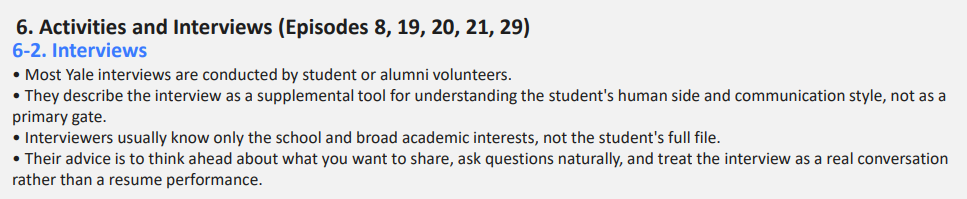
Most Yale interviews are conducted by student or alumni volunteers. Yale's officers describe the interview as a supplemental tool for understanding the student's human side and communication style — not as a primary gate in the admissions decision.
Interviewers typically know only the student's school and broad academic interests, not the full application file. Their advice: think ahead about what you want to share, ask questions naturally, and treat the interview as a real conversation rather than a resume performance. If you haven't been contacted for an interview, it doesn't mean you're out of consideration — alumni interviewer availability varies by region.
Handling Unusual Circumstances in Your Application

If something unusual happened — dropping a course, declining grades, changing schools, difficult family circumstances — Yale's officers are consistent: don't hide it. Explain the context calmly and factually through the counselor report, the additional information section, or the essay itself.
In 12th grade, both cutting back too much on coursework and overloading recklessly can raise questions. What matters is doing your best at a level you can genuinely sustain.
For students considering reapplying or taking a gap year: Yale's officers explicitly caution against making major life decisions solely to improve Yale odds.
Special Pathways: QuestBridge, Transfer, and Non-Traditional Students


QuestBridge connects high-achieving, low-income students with partner colleges. Yale has been a QuestBridge partner for more than a decade. QuestBridge applicants use a different platform, but inside Yale they are evaluated through the same standards and committee process. The purpose is to improve access and equity — not to create an easier route.
Yale also has separate pathways for transfer students, adult learners returning after interruption, and applicants coming back after military service through the Eli Whitney program. Although the evaluative principles are similar, Yale looks much more deeply at adult context — work history, family circumstances, and military experience. These applicants are read through a genuinely different lens from traditional high school seniors.
Financial Aid: Need-Blind and Serious About Affordability
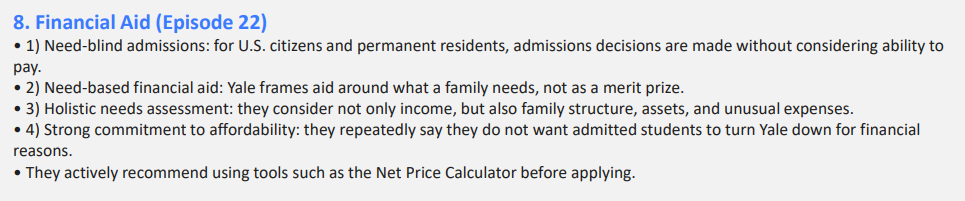
Yale's financial aid philosophy rests on four pillars:
Need-blind admissions: For U.S. citizens and permanent residents, admissions decisions are made without considering a family's ability to pay. Your financial situation does not affect whether you get in.
Need-based financial aid: Yale frames aid around what a family actually needs — not as a merit prize or competitive award.
Holistic needs assessment: Yale considers not only income, but also family structure, assets, and unusual expenses.
Strong commitment to affordability: Yale's officers repeatedly say they do not want admitted students to turn Yale down for financial reasons. They actively recommend using Yale's Net Price Calculator before applying to get a realistic sense of what your family's cost might actually be.
Early Action, Likely Letters, and "Should I Even Apply?"



On Early Action: Yale's Single-Choice Early Action may appear to carry a higher admit rate, but that is largely a statistical effect caused by a self-selected, more prepared applicant pool — not a structural advantage built into the process. Students should apply early because they are genuinely ready and Yale is their clear top choice — not because they think it's an easier path.
On Likely Letters: Likely letters are sent in February to a very small percentage of Regular Decision applicants — well under 10%. They strongly suggest likely admission, but they are not the official admit notice and don't come with major additional benefits. Most admitted students never receive one, so not getting a likely letter means absolutely nothing negative.
On whether to apply at all: Students do need a certain baseline of academic preparation to be in a truly competitive pool — Yale is direct about this. Beyond that point, however, outcomes become significantly unpredictable. Yale's officers explicitly discourage students from twisting their lives into strategically risky shapes simply to improve their odds.
The Bottom Line: What Yale Is Actually Trying to Find
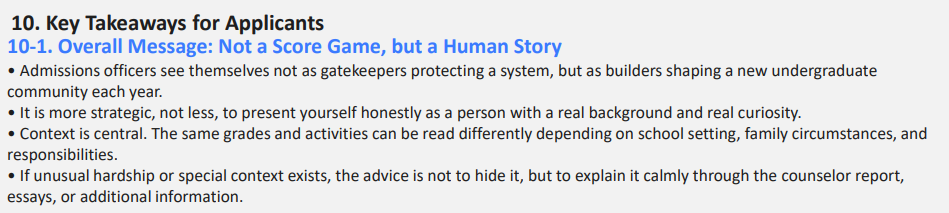


After distilling nearly 220,000 words of Yale admissions guidance, the core message comes down to a few things that are consistent, clear, and worth building around.
Academics come first — always. Yale's holistic review doesn't begin until a student has demonstrated the academic preparation to succeed there. The transcript is the most important document in the file.
Context is everything. Yale isn't comparing you to the student at the most resourced school in your state. It's asking whether you made the most of what was available to you — in your school, your community, your circumstances.
Coherence matters more than coverage. A strong Yale application tells a consistent story across all of its components: activities, essays, recommendations, and supplemental materials. These should all illuminate the same person.
Authenticity is non-negotiable. Genuine student voice — with all its texture and specificity — is more important than ever. Yale's officers are reading for it deliberately.
Rejection is not failure. Yale's own admissions officers acknowledge that strong, qualified students are denied every year simply because there isn't room. As Yale's officers put it directly: "Almost nothing depends on exactly which college admits you. Everything depends on what you decide to do once you get to college."
At A ONE Institute, we help students understand what top schools are actually looking for — and build application profiles that reflect who they genuinely are. If you have questions about how to approach Yale or any other highly selective school, we're here to help.
Yale
College Admissions
