
Most Families Don't Know This Part of the Process Exists
At A ONE Institute, one of the most common things we hear from families after Early Action submissions is some version of: "Wait — there's a portal? What are we supposed to do with it?"
And that's completely understandable. Most of the admissions advice available online focuses on the application itself — essays, test scores, activity lists. Very little explains what happens after you hit submit. But for students applying to the most selective universities in the country, what happens after submission matters more than most families realize.
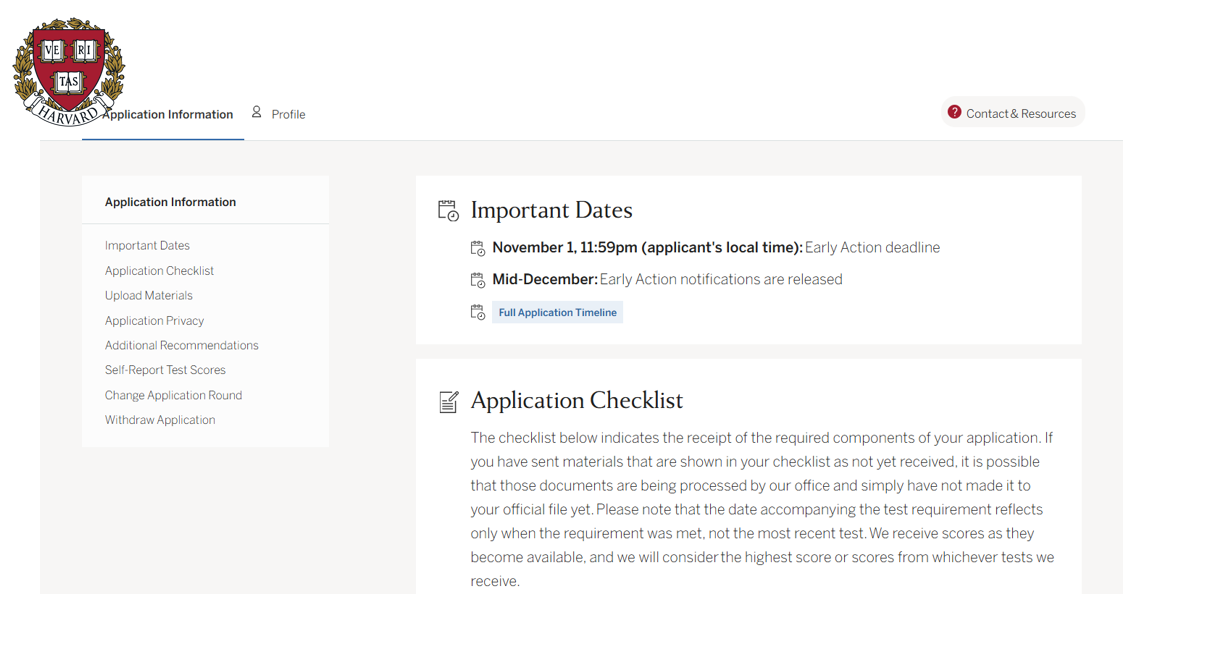
After seniors submit their Early Action or Restrictive Early Action applications, most top colleges open a separate applicant portal. That portal lets students check their application status — and in many cases, submit updates or additional materials that can genuinely affect how the application is read.
This guide walks through how those portals work at Harvard, Princeton, Yale, Stanford, and MIT — what each school allows, what each school is actually asking for, and what the differences between them reveal about where elite admissions is heading.
What Every Applicant Portal Has in Common
Before getting into school-by-school differences, it helps to understand the basic structure — because the foundation is largely the same across all five schools.
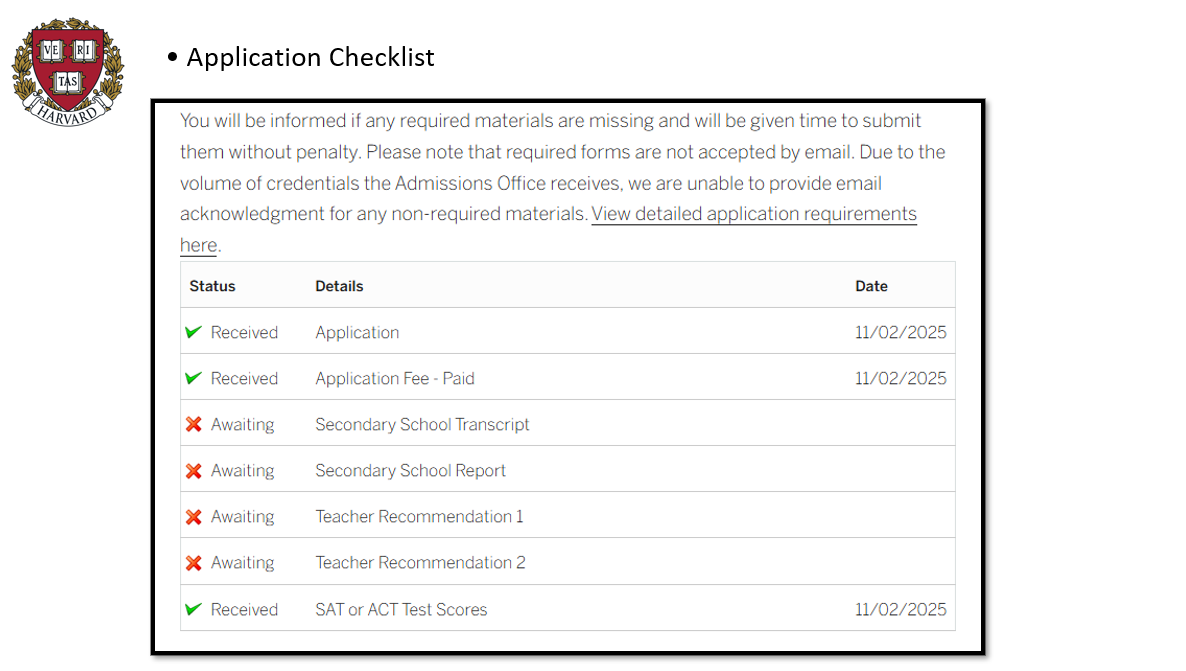
Once a student submits an Early application, they typically receive an email within a few days with instructions for setting up portal access. Once logged in, the portal displays a checklist of required materials. That checklist usually includes:
- The application itself
- The application fee
- The high school transcript and school report
- Teacher recommendation letters
- Standardized test scores, if submitted
The portal's first job is simple: it lets students confirm that everything arrived and flag anything that's missing.
But the portal usually does more than that. At most top schools, it also gives students a formal channel to submit meaningful updates or supplementary materials — and that's where the real strategic decisions begin.
Harvard: The Shift From Full Papers to Abstracts — and What It Signals
How Harvard's Portal Works
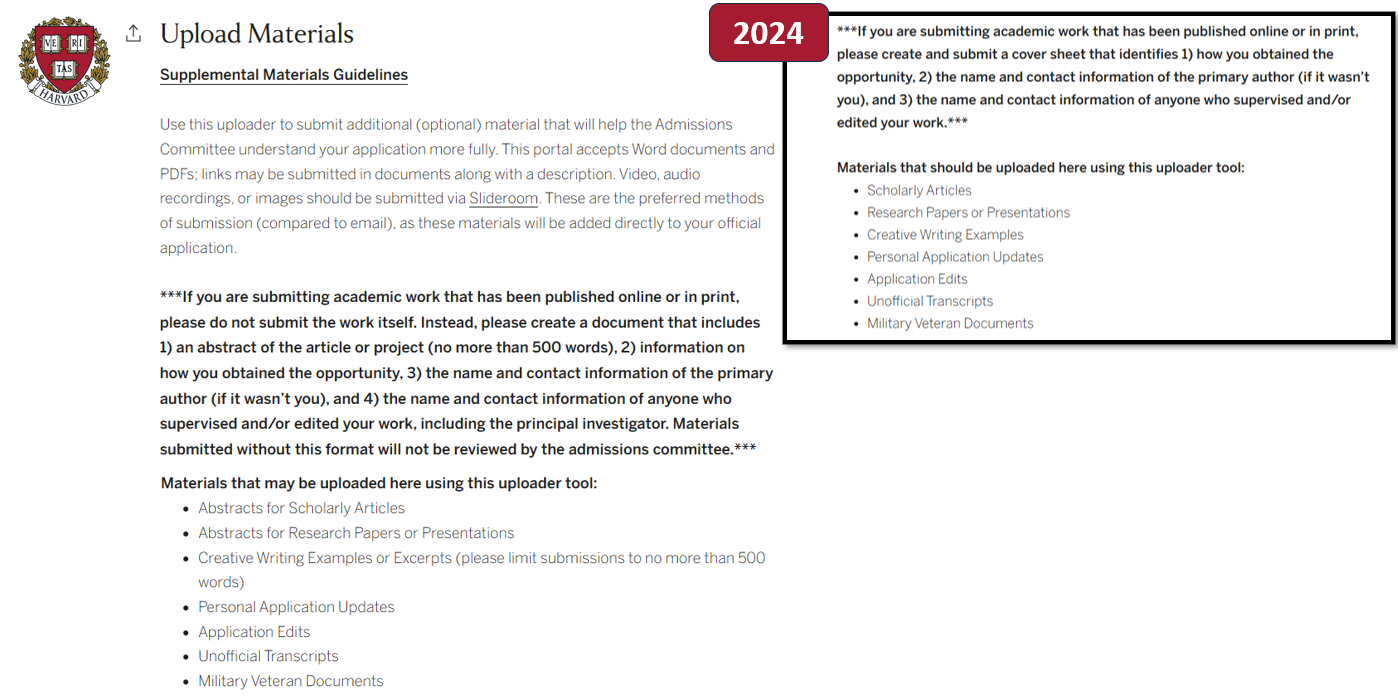
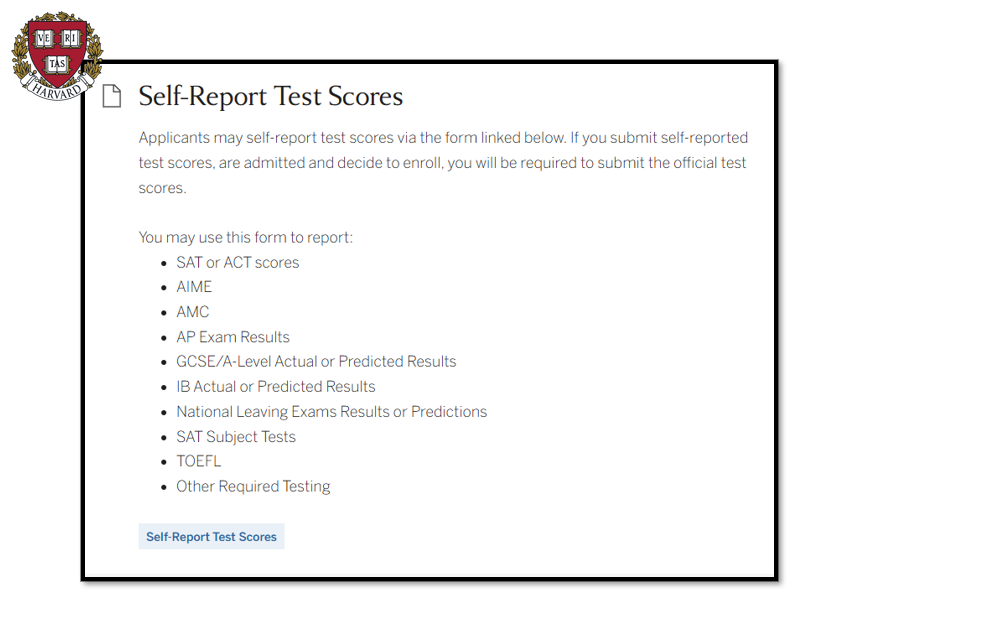
At Harvard, students can upload additional documents directly through the portal as Word files or PDFs. If the material is in another format — video, audio, or images — Harvard directs students to use SlideRoom instead.
But the more important story at Harvard isn't the mechanics of uploading. It's a specific change the school made this year in how it handles research submissions — and what that change tells us about where admissions is going.
Harvard Now Requires a Research Abstract — Not a Full Paper
Last year, students who wanted to submit printed or published academic work were asked to include a cover sheet explaining how they got the opportunity, identifying the primary author, and providing mentor information if applicable.
This year, Harvard changed that requirement in a meaningful way. The university still accepts printed or online academic work — but instead of a cover sheet, Harvard now asks for an abstract of fewer than 500 words. The supporting questions remain similar: how the opportunity arose, whether there was a primary author, and whether a mentor was involved. Harvard also now makes clear that if a student does not follow the required format, the admissions office may not review the submission at all.
That shift is worth paying close attention to.
According to A ONE Institute's analysis of how top schools are evolving their research submission processes, Harvard's move to an abstract-first model reflects a straightforward reality: so many applicants are now submitting research that full papers have become logistically unmanageable at scale. The volume has grown too large. So Harvard is now saying: give us a strong abstract first, and we'll evaluate the work based on that.
What This Means for Students
This change cuts both ways.
The benefit is that students no longer need a polished, full-length paper to have something meaningful to submit. In environments like ISEF, students are already accustomed to presenting work through abstracts and posters — that format now maps more directly onto what Harvard is asking for.
The drawback is that research itself has become significantly more common at this level. Simply having done research is no longer a differentiator on its own. If the topic is generic, the depth is thin, or the abstract doesn't communicate genuine intellectual contribution — the submission will blend into a very large pool.
The quality of the abstract has become the first real gate.
What Else Harvard Allows
Harvard also continues to accept other forms of academic work through the portal — scholarly articles, research papers, and creative writing samples — signaling that it remains open to serious academic supplements in a range of formats.
For Personal Application Updates, students need to exercise real judgment. This section is not for minor tweaks or routine changes. Harvard intends it for genuinely significant developments, such as:
- A major change in course selection
- A change in application plan
- A major status change or other consequential development
The portal is not a place for casual or unnecessary updates.
One additional note: even though Harvard now starts with an abstract, there are situations — particularly when applicants are closely matched in committee — where the school may follow up and ask for the full paper. Students should not assume the full paper has no value. The abstract is the first gate. The full paper may still matter.
Testing Updates Through Harvard's Portal
Harvard also allows optional updates through the portal, including:
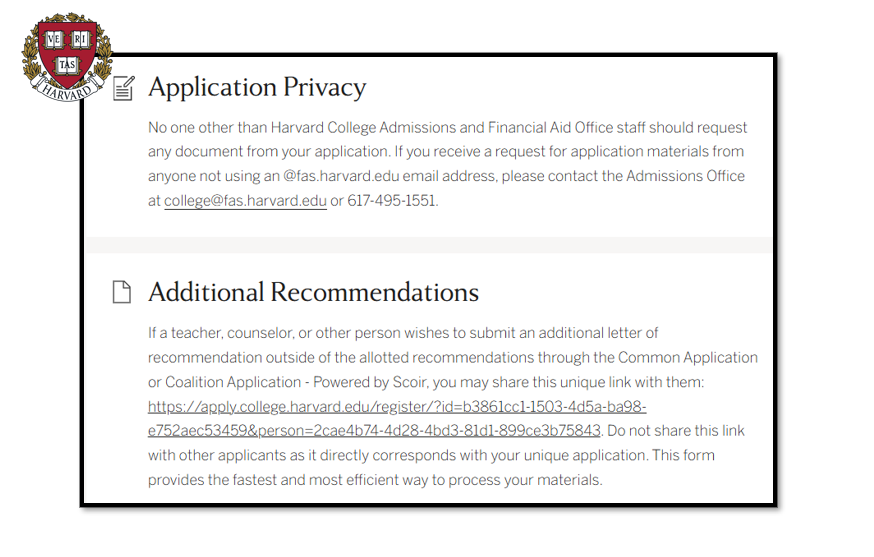
- A fourth recommendation letter, if genuinely necessary
- Updated SAT or ACT scores
- New IB, AMC, or AP results
On timing: for Early applicants, the October ACT is generally the last administration that fits cleanly into that round. For the SAT, October is the main planned cutoff — but November SAT scores often become available before Early decisions are released, which means they can frequently still be reported through the portal and considered.
Princeton: The School That Got There First — and Why That Matters
Princeton's Portal Structure
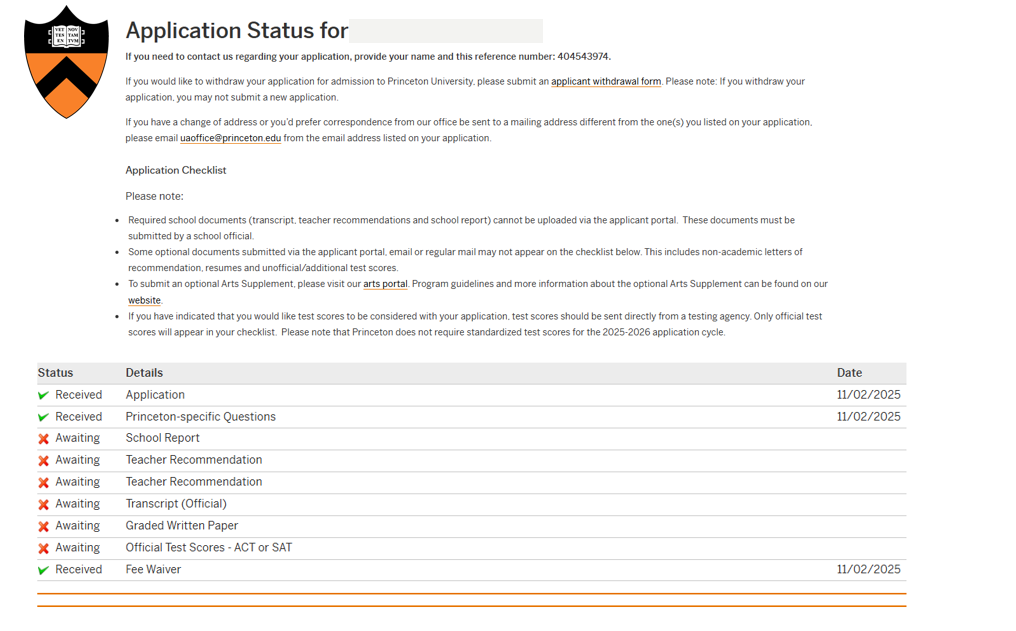
Princeton's portal looks structurally similar to Harvard's. Students receive access, review a checklist, and confirm that required materials have arrived. That checklist typically includes:
- The application
- Princeton-specific questions
- The school report and transcript
- Recommendation letters
- Test scores
- A graded written paper from school
That last item deserves special attention.
Why Princeton Asks for a Graded Writing Sample
Princeton places genuine weight on writing ability — and one of the ways it evaluates that is by asking for a piece of writing the student actually completed in school and received a grade on. This creates an important internal consistency check.
If a student's personal essay reads dramatically stronger than their graded school writing sample, that gap raises obvious concerns. It may suggest significant outside editing, heavy AI involvement, or third-party writing help.
Students applying to Princeton need to understand that their school-based writing doesn't exist in a vacuum. It's being read alongside their personal statement — and the two need to be coherent. Both need to reflect the student's actual writing ability.
Princeton Already Uses the Abstract Model
Princeton also requires a research abstract — and unlike Harvard, Princeton had already implemented this requirement last year. In other words, Princeton adopted the abstract-first model before Harvard made the same shift.
That sequencing is telling. Princeton saw where research submission volume was heading and structured its process accordingly. Harvard has now followed. The direction of travel across top schools is clear.
Yale: One Project, Full Transparency — No Exceptions
Yale's Portal and Research Supplement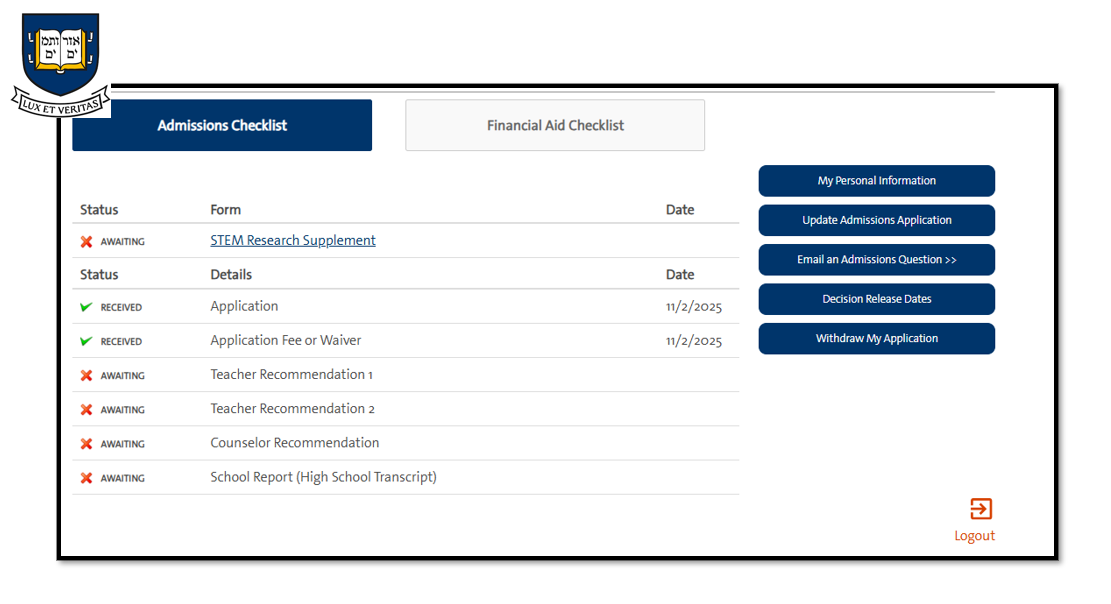
Yale's portal includes the standard checklist, but one of its most distinctive features is that it gives students the option to submit additional materials — including art supplements and STEM research supplements.
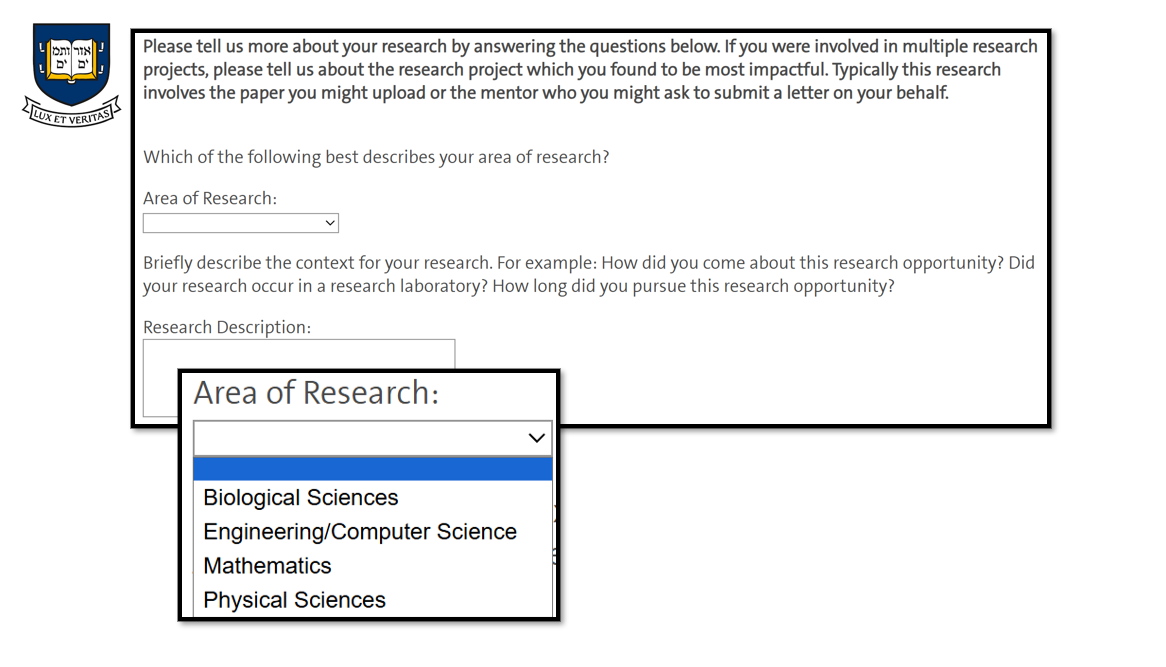
If a student indicates they want to submit a STEM research supplement, Yale opens a more detailed form. And what Yale asks in that form reveals a lot about how it's thinking about research.
Yale Wants Your Single Most Impactful Project
Yale now explicitly instructs students that if they were involved in multiple research projects, they should focus on the single most impactful one.
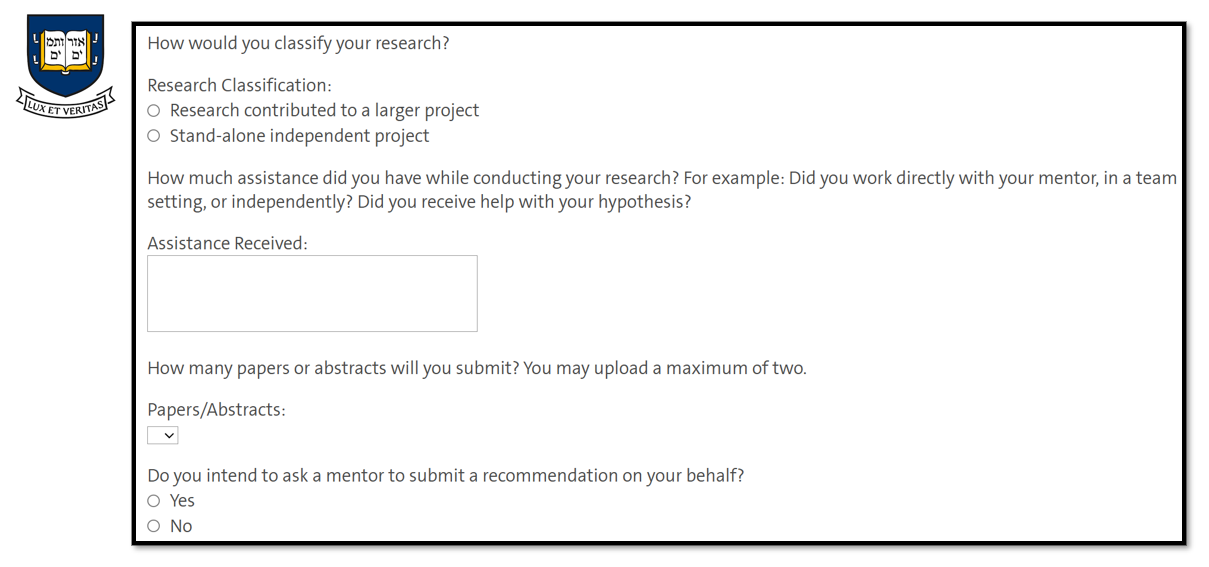
That instruction reflects a reality that would have seemed unusual just a few years ago: many Yale-level applicants are no longer arriving with just one research project. Some have been involved in several. Yale doesn't want a comprehensive upload of everything. It wants students to identify what mattered most — and explain it well.
Yale Asks How the Work Was Done, Not Just What It Was
Beyond the topic itself, Yale asks detailed questions about the structure of the research:
- Was this part of a larger group effort, or conducted independently?
- How much support did the student receive?
- Was a mentor involved?
- Was the student functioning as a participant within a larger lab project?
This is one of the more revealing sets of questions in any top school's portal. Yale isn't just asking what was researched. It's asking how much of it was genuinely the student's — and it's asking that directly.
Students must be completely honest here. If the research was mentor-guided, say so. If it was part of a larger lab effort, say so. This is not a place to overstate independence or minimize the role of outside support. The form must be entirely factual.
What Yale's Portal Is and Isn't For
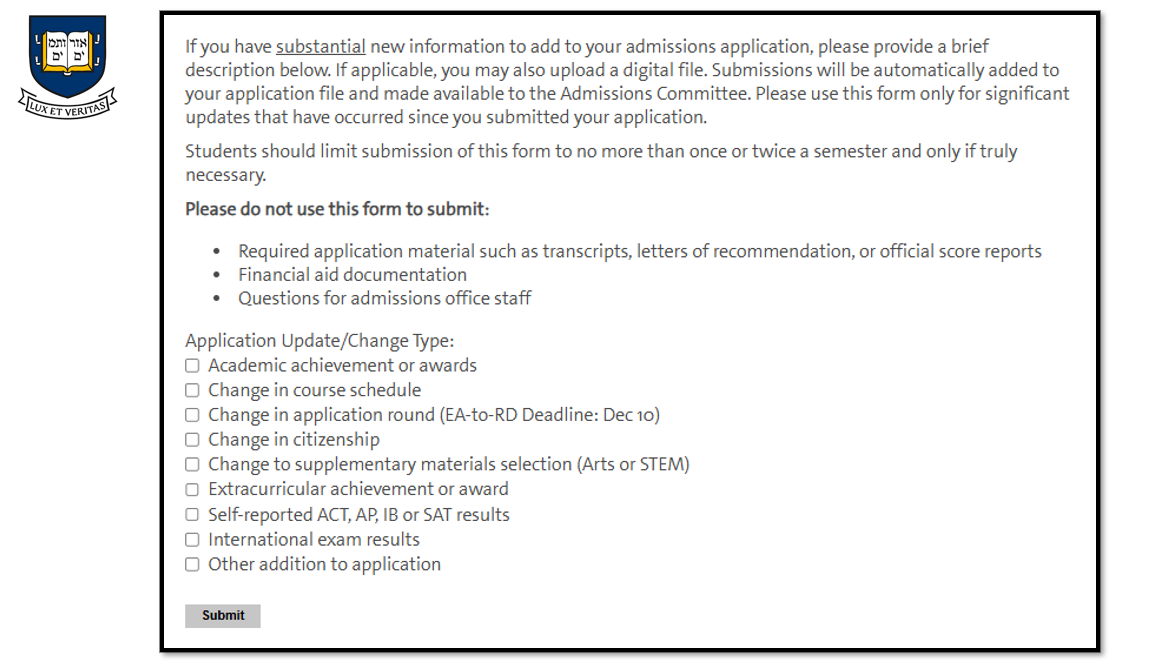
Yale is also explicit about what belongs in the portal update section. Appropriate updates include:
- A new award or significant achievement
- A substantial schedule change
- A change in application round or status
- Submission of art or STEM research supplements
- Updated academic results, extracurricular honors, or self-reported scores
The portal is not for financial aid documents, general questions to staff, or minor information that doesn't rise to the level of a meaningful update. Yale is essentially putting students on notice: use this channel appropriately.
Stanford: Consistent With the Overall Model
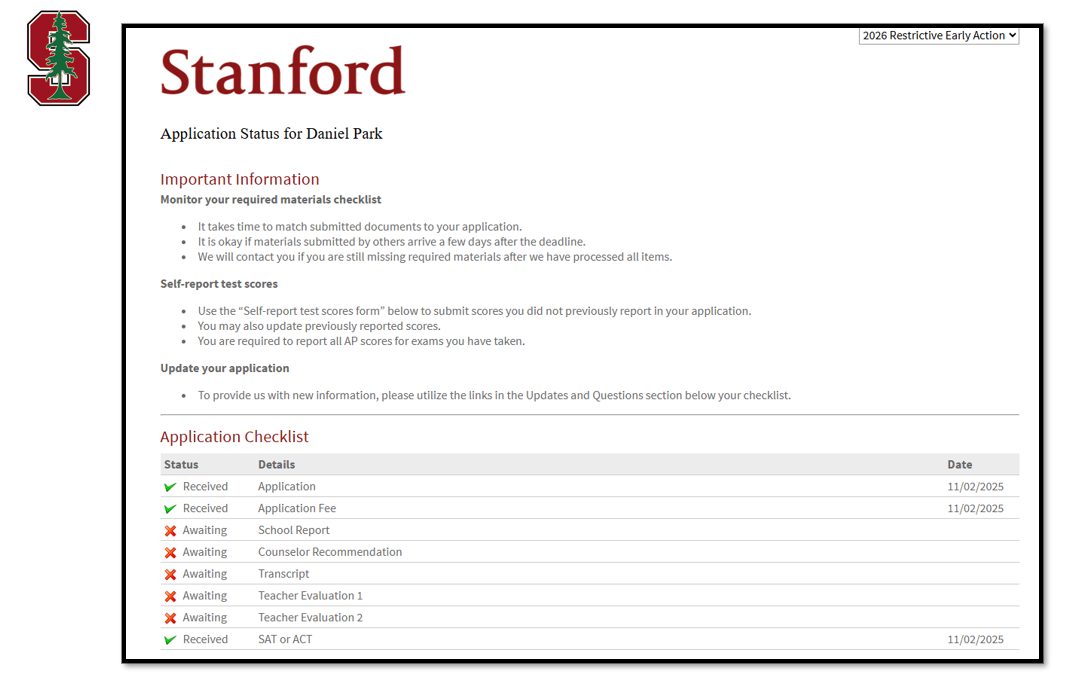
Stanford's portal functions similarly to the others. Students can submit important updates in a short written format — typically within a tight character or word limit — and can self-report updated testing information through the portal.
In broad structure, Stanford follows the same pattern as its peers: a checklist, a limited channel for meaningful updates, and no encouragement for excessive or casual submissions.
What's notable about Stanford isn't structural novelty — it's the consistency. The model that Harvard, Princeton, and Yale are all converging on is essentially the same model Stanford has been running. The standardization across these institutions is itself a signal worth noticing.
MIT: The FUN Form — and Why It's Non-Negotiable
MIT's Separate Application System
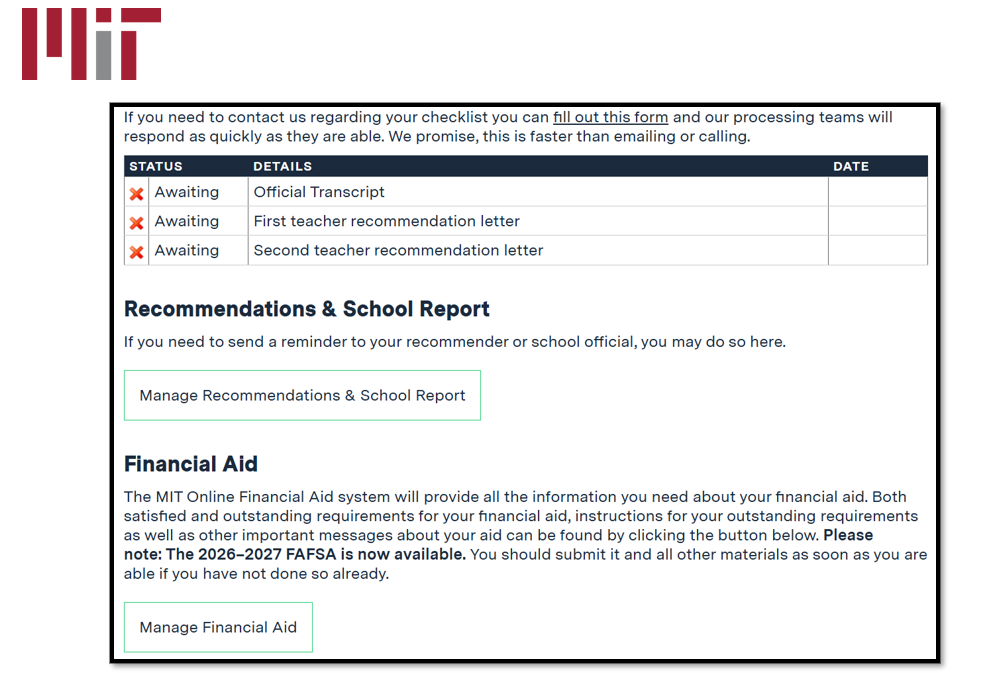
MIT doesn't use the Common App or Coalition in the same way as the other schools on this list — it runs its own application system. But the post-submission logic is similar: students receive portal access by email after applying, and MIT provides its own formal update mechanism.
What the FUN Form Is
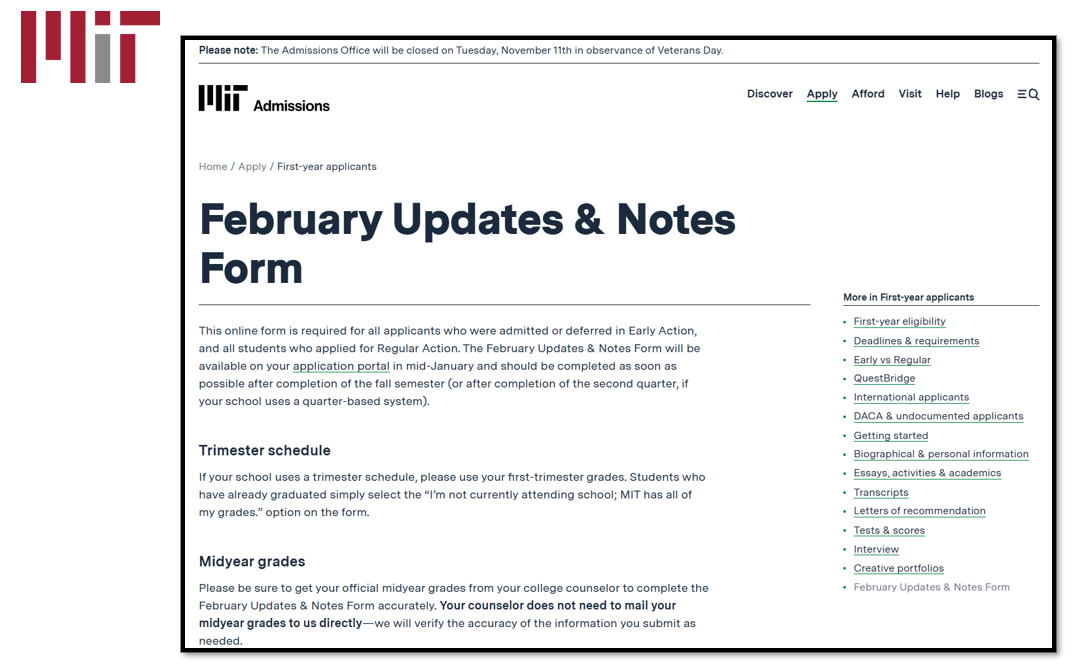
The most important post-submission requirement at MIT is something called the FUN Form — February Updates & Notes.
This form is required for students who were deferred from Early Action and for students applying in the Regular Action round. Its primary purpose is to collect updated information, especially midyear grades, once they become available.
The FUN Form typically opens around mid-January, with a submission deadline of February 5.
MIT's Rules Are Strict — No Exceptions
What makes MIT's approach notable is the level of specificity around who must submit the form. According to MIT's own instructions:
- If grades aren't available by February 5, the student still must submit the form and note that grades are unavailable.
- If the counselor already sent grades separately, the student still must submit the form.
- If the school doesn't officially issue midyear grades, the student still must submit the form.
- If the student is homeschooled, the student still must submit the form.
Everyone required to file the FUN Form must do so — no exceptions, no substitutes.
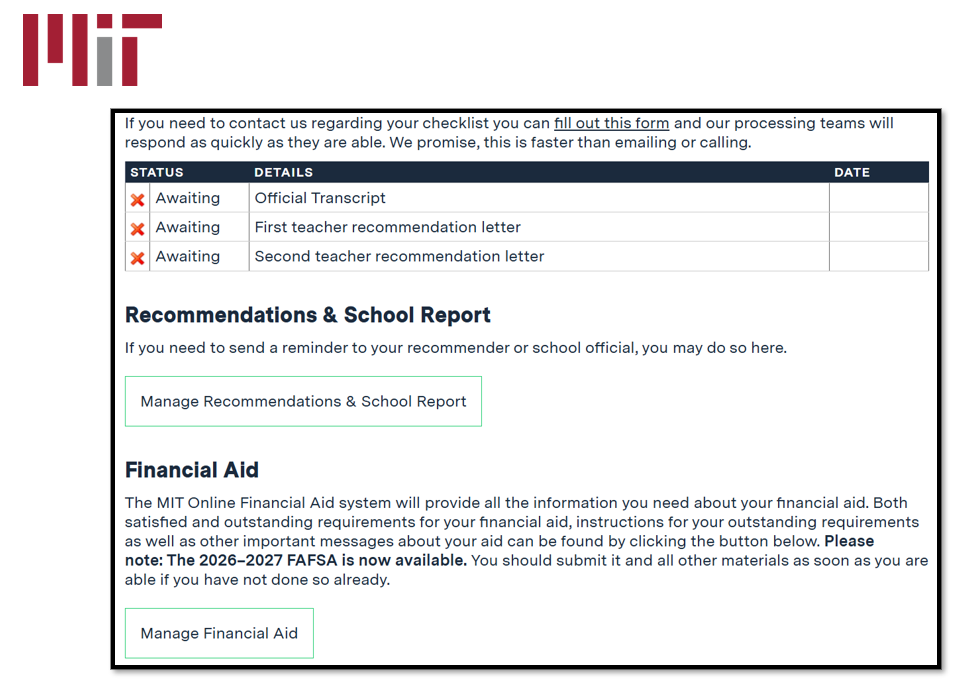
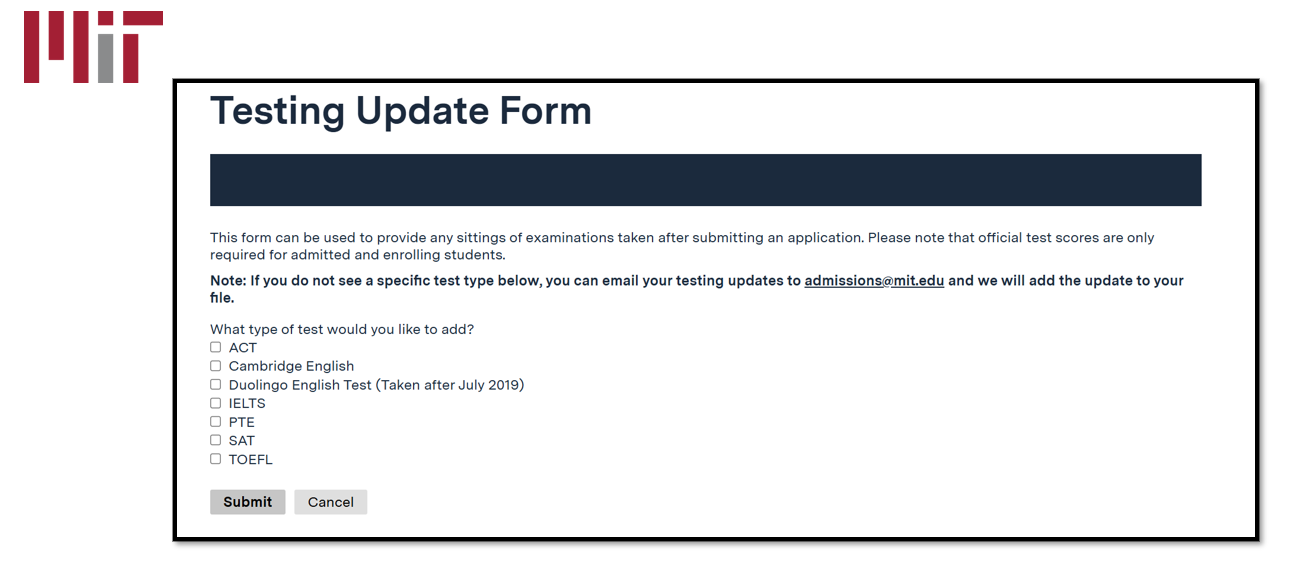
The form also functions as a broader update mechanism. Students can report significant developments — including research-related updates — through it. So while MIT's structure differs from the other schools, the underlying logic is the same: important developments after submission still matter, and the university provides a formal, structured channel for them.
The Bigger Picture: What These Portals Tell Us About Elite Admissions Right Now
Step back and compare all five schools, and one trend stands out with unusual clarity.
Top-tier applicants are submitting research in very large numbers — and these schools are actively redesigning their processes around that reality.
That's why:
- Princeton adopted an abstract-based research submission model early
- Harvard has now shifted from full papers to abstracts as the standard first step
- Yale is narrowing submissions to a single most impactful project and asking pointed questions about independence and mentorship structure
- MIT continues to provide a formal post-submission channel that accommodates meaningful academic updates
As A ONE Institute has observed across multiple admissions cycles, research activity among competitive applicants has crossed a threshold. It's no longer an unusual extra. It's common enough that schools are building administrative infrastructure to manage it efficiently. That's a significant shift — and families should register it as such.
This does not mean every applicant must have research experience to be admitted. But it does mean that among the strongest applicants at these schools, research has become a recurring part of the profile — and these universities are treating it accordingly.
Key Takeaways: What Students and Families Should Do With This Information
The portal is not just a status tracker. At every school on this list, it's an active part of the post-submission process — and how students use it can matter.
Use the portal deliberately, not casually. Every school covered here is explicit: the portal is for meaningful updates, not routine changes, minor achievements, or questions that belong elsewhere.
Research abstracts now matter more than ever. Harvard's shift to an abstract-first model, combined with Princeton's earlier adoption of the same approach and Yale's detailed independence questions, signals a clear direction. Students who have done research need to be able to summarize it clearly, honestly, and compellingly — in 500 words or fewer.
Honesty about research structure is not optional. Yale's detailed questions about mentorship, group involvement, and independence are a direct signal. Schools at this level are paying close attention to how research was actually conducted — not just what it was about.
The full paper still has a role. Even at Harvard, where the abstract is now the first gate, there are moments later in the process — particularly in close committee decisions — where the full paper may be requested. Don't discard it. Just understand where it fits.
At A ONE Institute, we support students through every stage of the admissions process. If you have questions about any aspect of U.S. college admissions, we're here to help.
admissions
