
"It Worked for Their Kid — Why Wouldn't It Work for Mine?"
At A ONE Institute, we hear this all the time.
Maybe you already went through this with an older child. The strategy worked, they got in somewhere great, and now you're thinking: let's just run the same playbook for the younger one. Or maybe you're doing this for the first time, and you've got a neighbor or family friend who navigated admissions a few years back — someone who's become the unofficial expert on your street. Their kid got into a top school. They know what they're talking about. Why not follow their lead?
Both of those instincts make total sense. And both of them can quietly lead you in the wrong direction.
Because here's what most families don't realize until it's too late: the criteria top colleges use to evaluate students have genuinely changed. Not in a small, cosmetic way — in a way that matters for how you build an application from the ground up. And if your student's profile is being designed around what worked in 2018 or 2019, you may be optimizing for a version of admissions that simply doesn't exist anymore.
That's what this article is really about.
Why the Last Six Years Changed Admissions More Than Any Other Period
To understand where things stand today, you have to understand what hit the admissions world between 2020 and now. Three major forces reshaped everything — and each one pushed colleges to quietly rethink what they actually value in applicants.
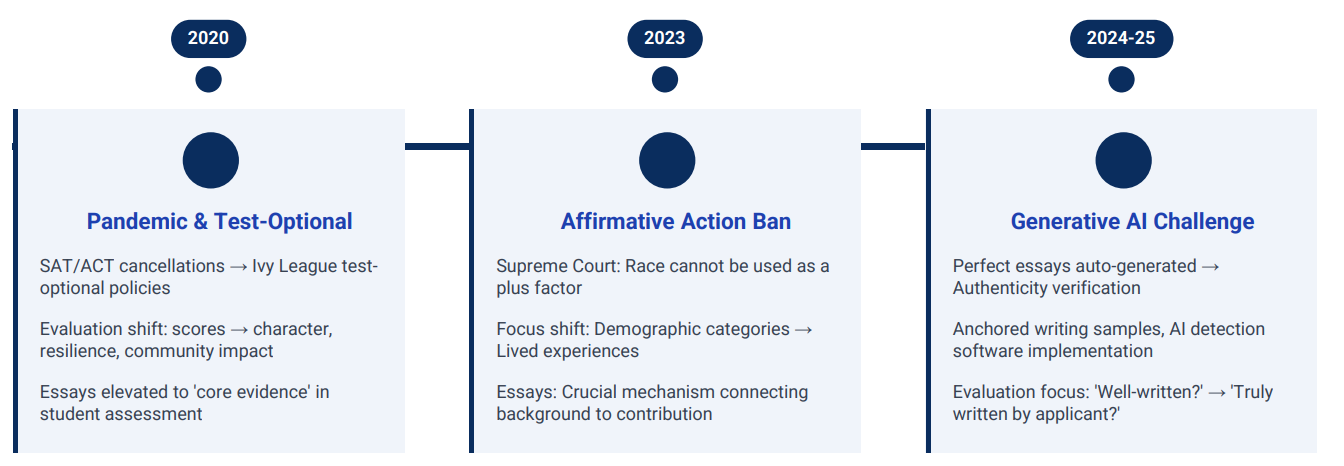
The Pandemic Flipped the Script on Testing
COVID forced nearly every selective school to go test-optional almost overnight. Even now that many schools have brought standardized testing back, the ripple effects are still very much alive. How different application components get weighted shifted during that period — and the ecosystem hasn't fully returned to what it was before.
The End of Affirmative Action Changed the Pool
The Supreme Court's 2023 ruling eliminated race-conscious admissions. In practical terms, that means schools can no longer apply separate evaluation frameworks for different groups of applicants. Everyone now competes under a more uniform standard — and that changes the dynamics for the entire pool, not just the students who were most directly affected by the old policy.
AI Made Authenticity Non-Negotiable
This one doesn't get talked about enough. Admissions offices are now acutely aware that essays and activity descriptions can be AI-generated — and that awareness has made genuine, verifiable, demonstrable authenticity more important than it's ever been. Colleges are scrutinizing applications more carefully for proof that students actually did what they say they did, and actually care about what they claim to care about.
Put all three of those together, and you get a fundamentally different admissions environment than the one that existed before 2020. The schools haven't thrown out their mission statements. But they've quietly adjusted what they're emphasizing — and if you're not tracking those adjustments, you're flying blind.
How the Top Schools Have Actually Shifted — School by School
Harvard: From Individual Excellence to Proven Community Impact
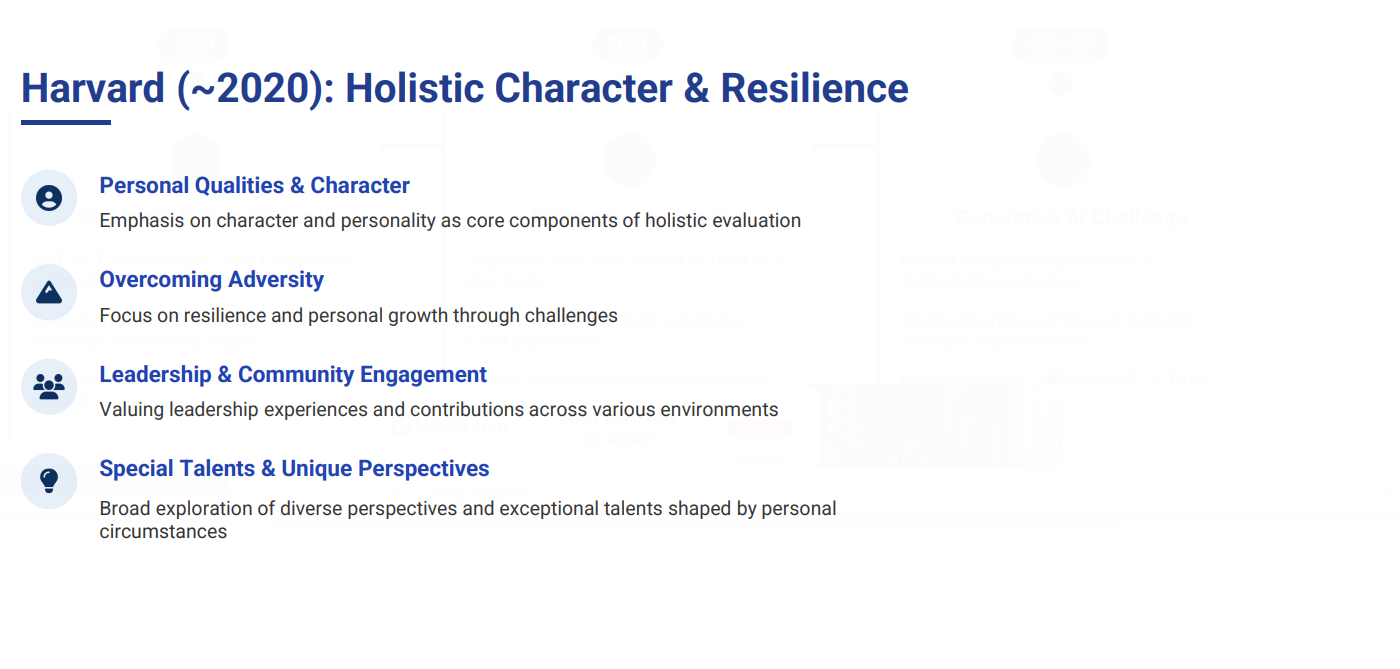
Before 2020, Harvard placed heavy emphasis on who the student was as an individual — personal character, overcoming adversity, personal-level leadership, community involvement, a unique perspective or exceptional talent. The individual was the story.
Today, Harvard still cares about intellectual curiosity and self-driven learning. But the emphasis has shifted toward something more outward-facing. Admissions readers now want concrete evidence of impact — not just impressive qualities in the abstract, but proof of what the student actually contributed to their school or community. Activity count matters less than it used to. Depth and sustainability matter more. And the question running through the whole evaluation is: given what you've already contributed out there, how specifically are you going to contribute here?
The one-sentence version: Harvard used to reward exceptional individual ability. Today, it wants to see what you've done with that ability — and whether you can back it up with real evidence.
MIT: Largely the Same — and That's Actually Useful to Know
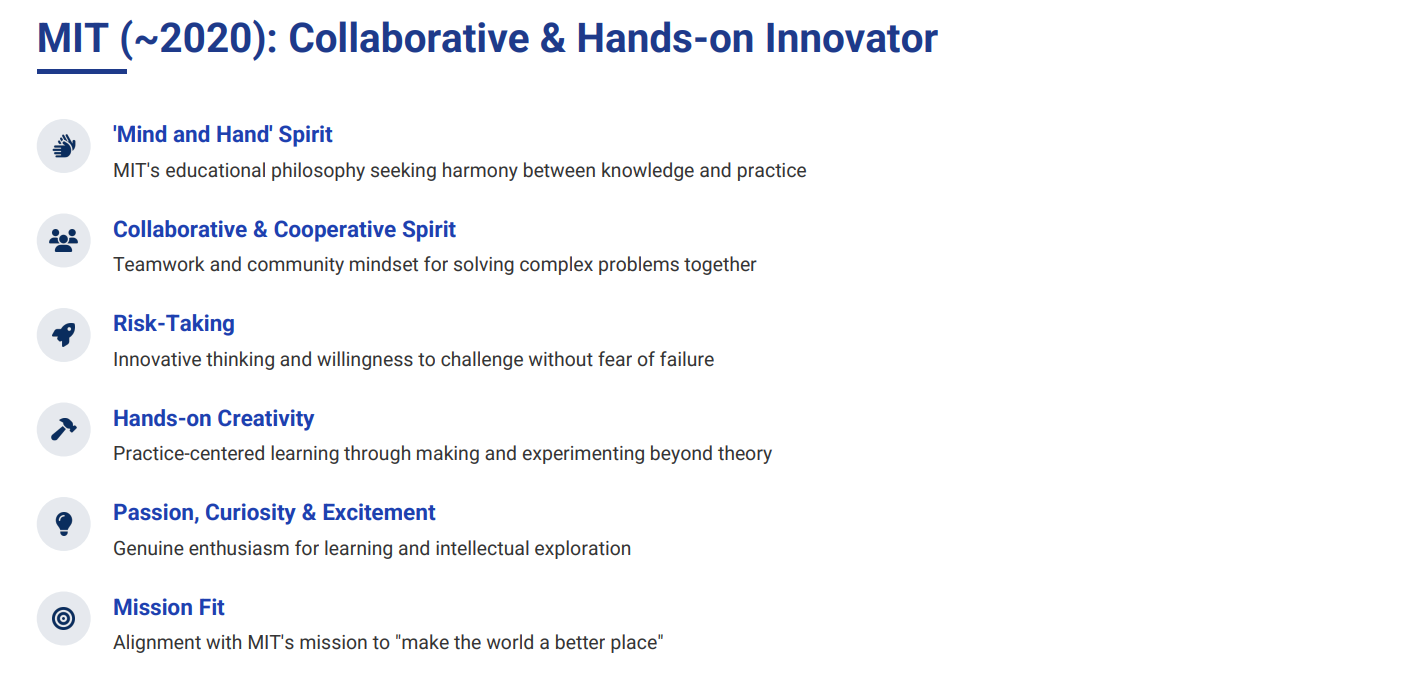
MIT has always been defined by its "mind and hand" philosophy — the conviction that knowing something and doing something have to go together. The ideal MIT applicant doesn't just understand things; they build things, test things, make things happen in the real world. Collaboration is central to that culture, which is why team-based research and group competition results tend to read well at MIT. Risk-taking, hands-on creativity, genuine enthusiasm, and a commitment to making the world better have all been part of the MIT profile for a long time.
Here's the honest assessment: MIT hasn't changed dramatically. The same core qualities that mattered before 2020 still matter now. MIT was also one of the first schools to bring standardized testing back — in 2022 — which signals that quantitative academic preparation remains a real, non-negotiable part of what they're looking for. If you're targeting MIT, the playbook from a few years ago still largely applies. That's actually rare, and worth knowing.
Princeton: The Biggest Shift of Any School on This List
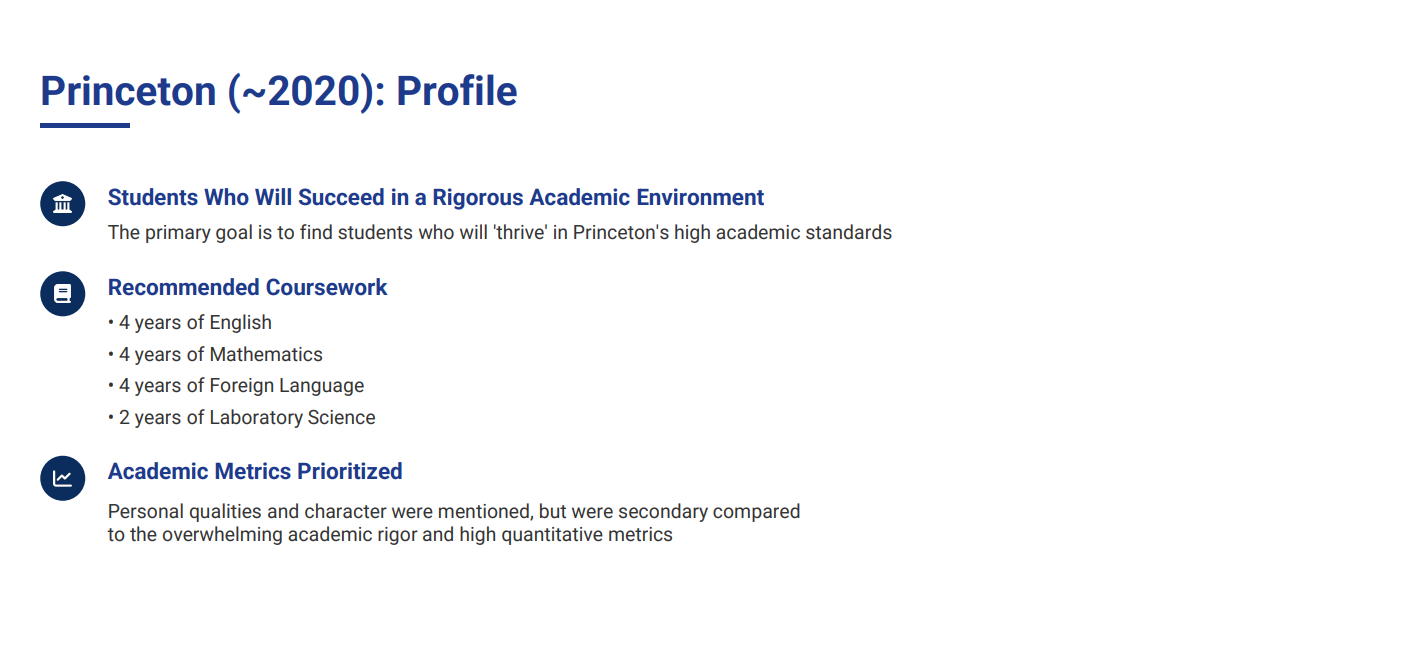
Princeton before 2020 sent a very direct message: this place is academically rigorous, and you need to prove you can handle it. GPA, test scores, and the strength of a student's four-year course load were front and center. Academic excellence wasn't just one factor among many — it was the dominant factor, more so than at almost any peer institution. Bluntly put, if you were a truly exceptional student academically, Princeton was a place where that alone could carry a lot of weight.
That's genuinely changed. Academic strength is still necessary — GPA and intellectual depth absolutely still matter. But Princeton now expects that intellectual firepower to be aimed at something beyond personal achievement. Public purpose now carries real weight in a way it didn't before. Intellectual curiosity connected to the benefit of others, collaborative excellence, and a demonstrated commitment to using knowledge in service of the broader community — these dimensions are now central to what Princeton is evaluating.
What does that mean for how you plan activities? If your student is building a profile designed primarily to showcase individual academic brilliance, you may be building toward what Princeton used to want — not what it's looking for today.
Yale: One of the More Consistent Schools on This List
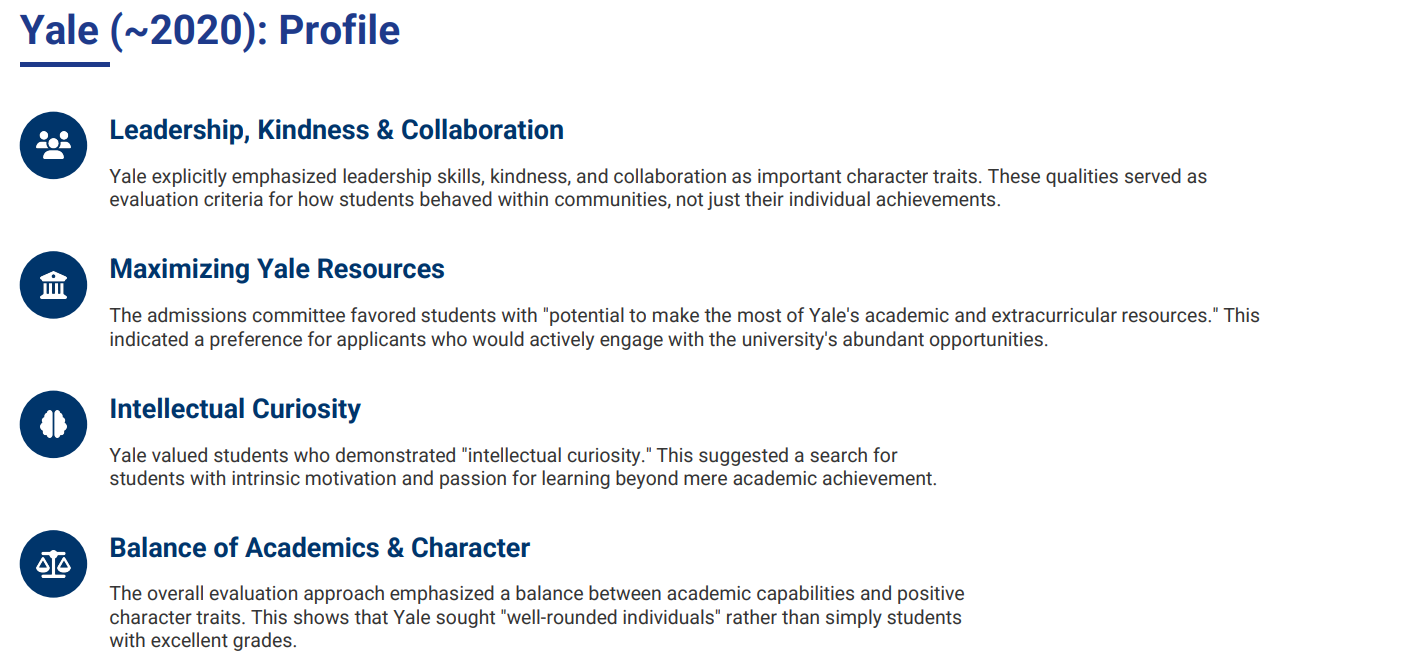
Yale has long had a reputation as the most leadership-focused of the elite universities — and that reputation is still accurate. Before 2020 and today, the core profile Yale seeks looks similar: genuine intellectual curiosity, strong personal character, real leadership ability, the capacity to collaborate, and a demonstrated track record of making the most of whatever environment you're in. Yale wants students who squeeze everything out of what's available to them.
Today's Yale is largely consistent with that picture. There have been structural changes — Yale now accepts AP and IB scores in place of SAT/ACT under a test-flexible policy — but the fundamental profile hasn't shifted the way Harvard's and Princeton's have. Leadership, collaboration, intellectual depth, and personal character are still the pillars.
Quick summary so far: Harvard has shifted noticeably. MIT is largely the same. Princeton has shifted the most. Yale is largely consistent.
Stanford: Same Values, Sharper Language — and Originality Is Non-Negotiable
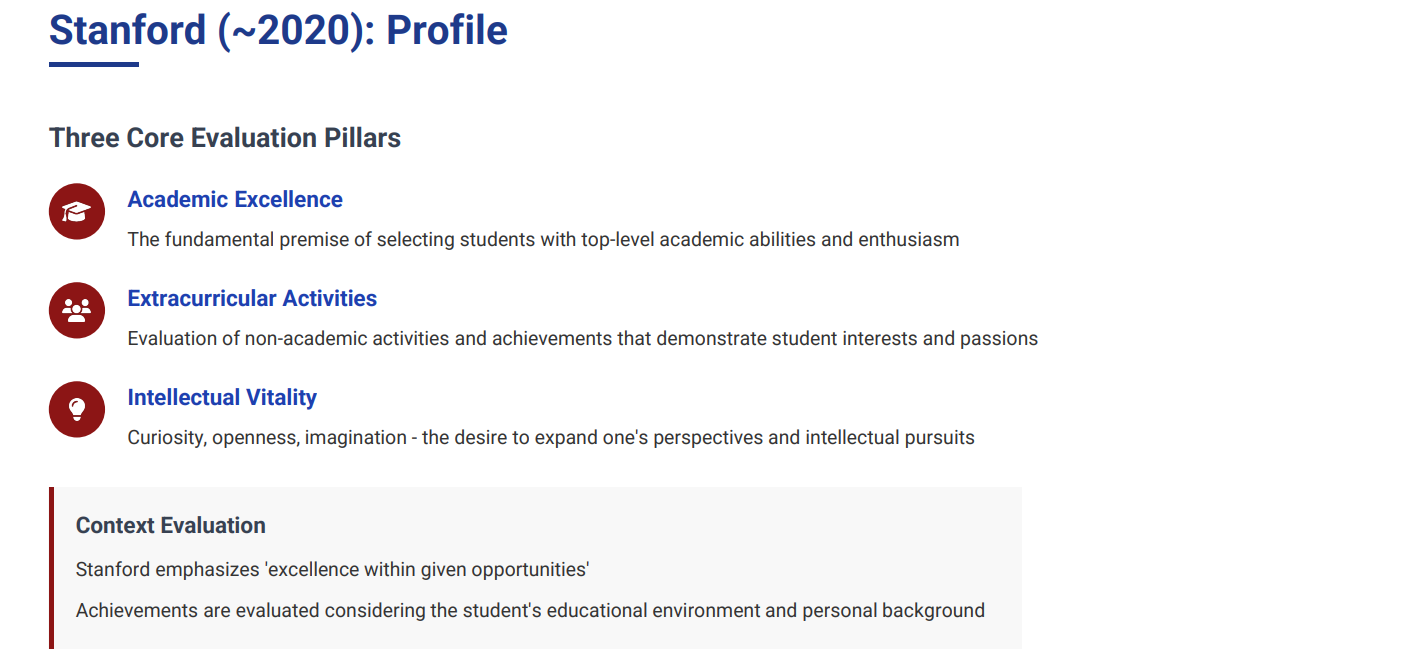
Stanford has always placed a premium on individual qualities — original thinking, intellectual depth, the willingness to go somewhere intellectually that others haven't gone. Compared to where Harvard and Princeton have moved, Stanford remains relatively more focused on the individual. That's not to say Stanford doesn't value public contribution, but the emphasis on genuine originality and independent intellectual identity is more pronounced at Stanford than at most peer institutions.
What's changed isn't so much what Stanford values — it's how specifically they describe it. Before 2020, Stanford's admissions language was somewhat abstract: broad references to "intellectual vitality," contextual evaluation, that kind of thing. Today the language is noticeably sharper. Stanford wants to understand precisely how a student's lived experiences and genuine interests connect to original academic contribution. The supplemental essays are designed to surface exactly that — what makes this student's perspective genuinely distinct, not just impressive.
The practical implication: if Stanford is your target, working harder within a conventional framework is probably not the right move. The more productive path is identifying a research angle, a question, or a perspective that others haven't really explored — and pursuing it with real, documented depth. At Stanford, originality isn't a bonus. It's the whole point.
Two Princeton Applicants, Six Years Apart — Here's What's Different
The shift from individual achievement to public-purpose contribution becomes clearest when you look at real applicants side by side. Let's do that.
The Pre-2020 Princeton Admit: Individual Excellence as the Core Story
This student — a young man — was a genuinely exceptional math student. He was captain of his school's math team, competed in AIME three consecutive years, and advanced to more challenging competitions from there. He held a vice president role in another club. He pursued independent research to deepen his academic credentials, played violin, led his school to award-winning performances, tutored students at a community library, competed in additional math competitions, completed a physics-related internship, and taught younger students.
The structure of his profile is worth noting: individual performance and community leadership were woven together, with a clear academic identity anchoring everything. Competitions, teaching, leadership — all of it tied back to demonstrated STEM excellence.
Here's the honest assessment: this student would still be competitive today. With some additions, the profile could absolutely work under current standards.
But here's the tension. Under today's lens, the public-purpose dimension isn't prominent enough. The profile reads as academically exceptional more than it reads as purposefully engaged with something beyond himself. For today's Princeton specifically, that gap matters. The intellectual talent is evident. The "why does this matter to anyone else" thread is harder to find.
The same profile, submitted unchanged, would land differently in today's admissions environment than it did before 2020. That's the point.
The Recent Princeton Admit: Public Purpose as the Starting Point
This student also did research. But the starting point was completely different — and that difference is everything.
Rather than beginning with a personal interest or an academic passion, this student started with a real-world problem: the chronic sleep deprivation affecting high school students. Research showed that over 70% of students were functioning in a sleep-deprived state. So this student designed a study — collecting data from roughly 50 students in their own school, then expanding to approximately 150 participants across multiple schools — to examine the relationship between sleep deprivation and academic performance.
From that public-purpose foundation, everything else followed organically: founding a student organization, leading it, expanding the research, writing about the findings, hosting a science symposium, running workshops for peers at other schools, collaborating on data analysis across campuses. One core topic, expressed through research, writing, teaching, leadership, and community engagement — multiple application categories, one coherent and outward-facing purpose.
And critically — no USAMO. No earth-shattering individual competition result. Just a profile built around a problem that affected real people, pursued with real depth and real follow-through.
The key difference between these two students isn't talent. It's where the story begins. When the starting point is public — when the driving question is "what's the problem here and how do I help address it?" — every subsequent activity reads as genuine extension of a real commitment. Not a list of strategic additions. Not a résumé. A story with a through-line.
And that's exactly what today's most selective colleges are rewarding.
So Can You Still Use Past Success Stories as a Guide?
Yes — as a reference point. Not as a blueprint.
Here's the clearest way to think about it:
What's still true across both eras: Strong academics are always necessary. GPA, course rigor, and — at most schools — competitive test scores still matter. Leadership still matters. Intellectual depth still matters. None of that has gone away.
What's changed: The weight placed on individual achievement versus outward-facing impact has shifted — meaningfully, at most of the schools families are most focused on. A profile built around personal excellence, competition results, and impressive individual credentials used to be enough to stand out at places like Princeton and Harvard. Today, that same profile can read as incomplete — not because the student isn't impressive, but because the question admissions is now asking has changed.
The question used to be: How exceptional is this student?
The question now is closer to: What has this student actually done for anyone beyond themselves — and can they prove it?
Stop Asking "What Worked Before?" Start Asking "What Does This School Want Right Now?"
"Someone did X and got in" is not a strategy. It's a data point from a different era, evaluated under a different set of criteria, by admissions readers who were asking slightly different questions.
The families who navigate this process most successfully aren't the ones who found the best historical template to copy. They're the ones who understood what each target school is actually looking for right now — and built their student's profile around that, honestly and specifically.
That's the mindset shift that actually moves the needle.
Frequently Asked Questions
Does this mean extracurricular activities focused on personal achievement are now useless? Not at all. Individual achievement — competition results, academic awards, personal research — still carries real weight. The shift is about balance and framing. A profile that only showcases personal achievement, with no clear outward-facing purpose or community impact, is the one that reads as incomplete at schools like Harvard and Princeton today.
Is MIT still a good option for students with strong individual STEM credentials? Yes — MIT is genuinely one of the more consistent schools on this list. If your student has strong quantitative preparation, hands-on project experience, and a collaborative mindset, the MIT profile hasn't changed dramatically. It's one of the few top schools where the pre-2020 playbook still largely holds.
How do I know if my student's activities read as "public purpose" or just look forced? The clearest signal is the starting point. If the activity began because your student noticed a real problem in the world and wanted to do something about it, that reads as authentic. If it began because someone said "colleges like this kind of thing," it usually shows — and admissions readers are better at spotting that than most families expect.
Should we still look at profiles of students who got into our target schools? Yes, but carefully. Use them to understand the general shape of competitive profiles at that school — the depth, the sustained commitment, the integration of activities. Don't use them as a template. The specific activities that read well five years ago may not carry the same weight today.
What's the single biggest mistake families make when planning extracurriculars? Starting with "what looks good" rather than "what does my student actually care about — and what problem can that caring address?" The most competitive profiles at today's top schools aren't the ones that look the most impressive on paper. They're the ones where the student's genuine interest connects to something real, pursued with real depth, over real time.
At A ONE Institute, we track how each university's priorities shift over time — and we help students build profiles that reflect who they genuinely are while aligning with where admissions stands today. If you want a real, honest assessment of where your student's current plan fits against current standards, we're here to help.
Top Colleges
IVY League
