
Hello, this is A ONE Institute.
If your family is already thinking about next summer, this is the right time to start planning.
One of the most common questions we hear from students—especially students who are serious about music—is this: Should I choose a high-level music summer camp or a selective academic summer program?
At first glance, that sounds like a simple choice. In reality, it is a strategic admissions decision.
For many students, both options can look impressive on paper. A strong music program can reinforce artistic excellence and show that the student is already performing at a high level. A strong academic program can expand the student’s profile and demonstrate intellectual depth beyond music. The problem is that the “right” answer depends entirely on the student’s broader admissions story.
So instead of asking which type of camp sounds better in general, the better question is this:
Which option strengthens the student’s profile more clearly and more strategically?
That is the question families should be answering.
How Colleges Really View Summer Programs
Summer programs do matter—but not all summer programs carry the same weight.
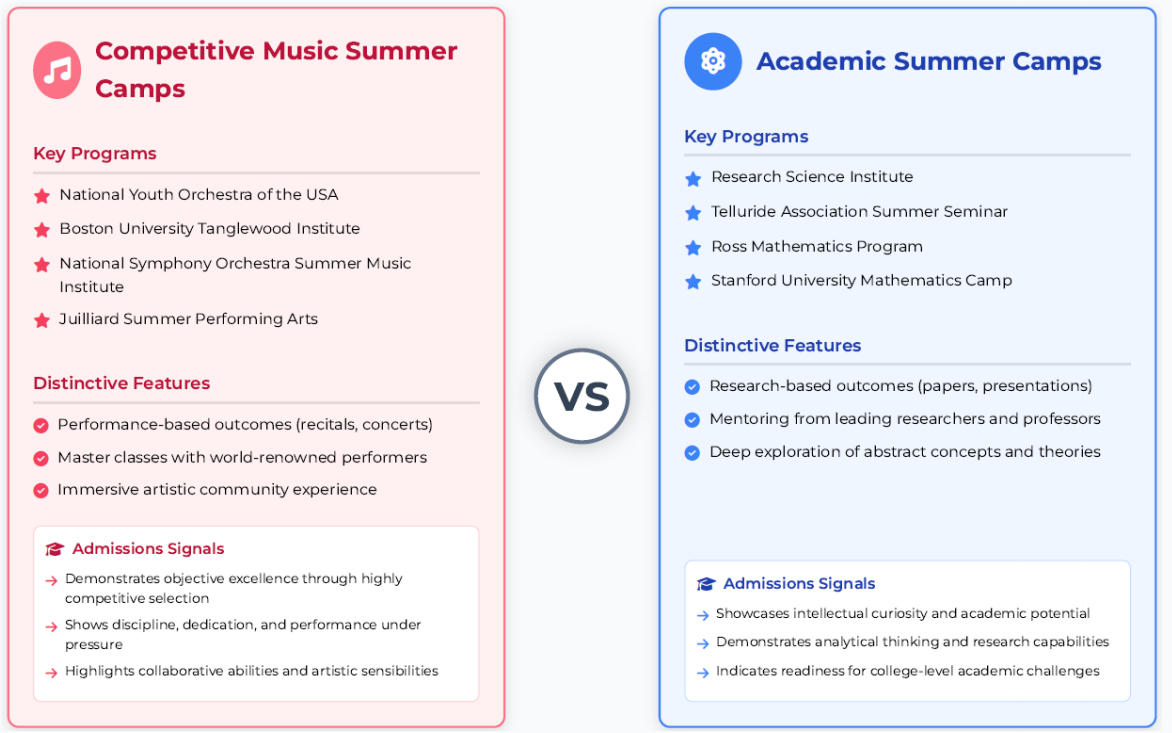
In admissions, the value of a summer camp usually comes from some combination of the following:
- how selective it is
- whether it is nationally recognized
- whether it signals serious skill or advanced ability
- and how well it fits the student’s larger profile
That last point is especially important.
A summer program is rarely powerful on its own. Its value depends on how well it connects to the student’s overall academic and extracurricular narrative. In other words, colleges are not just asking, “Did this student attend a summer camp?” They are asking, “What does this choice reveal about the student’s direction, priorities, and level of development?”
That is why two students can attend strong summer programs and still receive very different admissions value from them.
The Real Admissions Question: Breadth or Depth?
To make the best choice, families need to understand one of the most important ideas in competitive admissions: breadth versus depth.
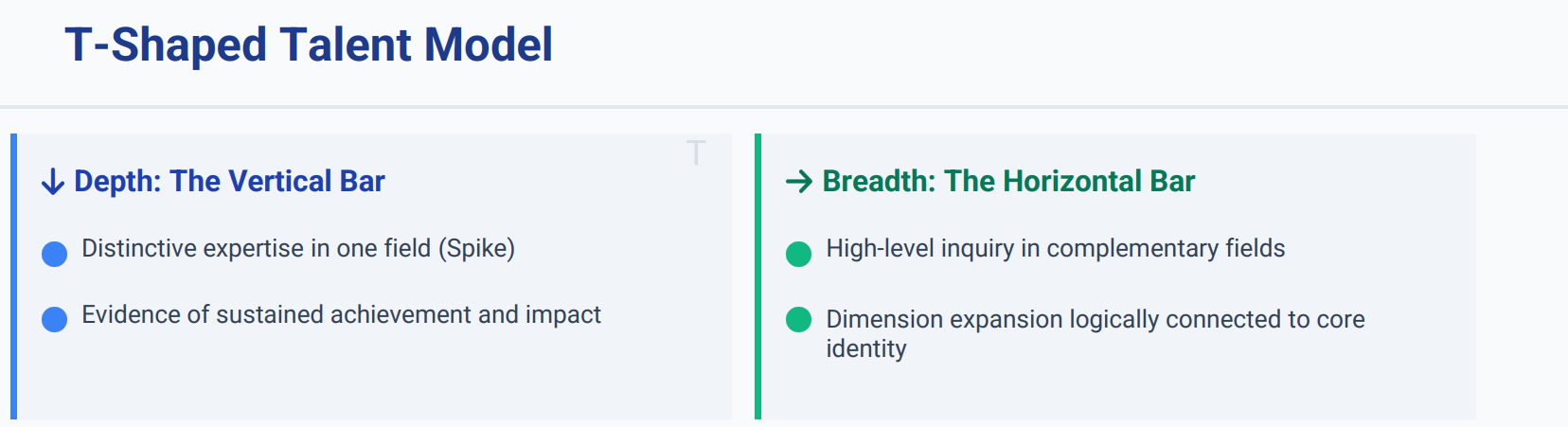
Selective colleges generally like students who show both.
Students should have some range across different interests and experiences, but they should also show meaningful depth in at least one area. This is often described as the T-shaped student model. The horizontal part of the “T” represents broad exposure across multiple interests. The vertical part represents serious depth in one area.
That is often the most attractive balance in admissions.
Some students go even further and develop real depth in two different areas. That begins to look more like a pi-shaped profile, where the student is not just well-rounded, but meaningfully strong in two different directions.
This is exactly why the music-camp-versus-academic-camp question matters.
For a student who already has strong musical training, choosing a summer camp is not just about filling time productively. It is about deciding whether the next step should build more depth in music or more range through academics.
That decision can shape how the entire application feels later on.
Not All Programs Are Equal: Think in Tiers
One of the most useful ways to evaluate summer programs is to think of them in tiers.
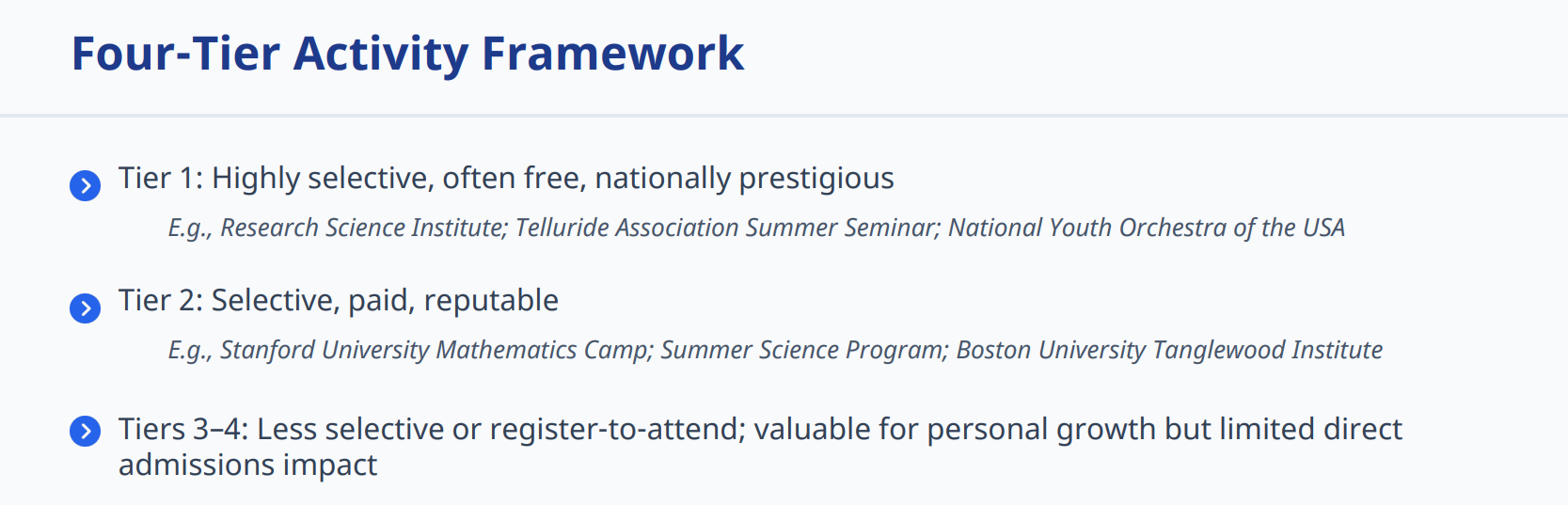
A practical breakdown might look like this:
Tier 1
Highly selective, nationally respected, and often free
Tier 2
Selective and meaningful, but paid
Tier 3
Paid programs with weaker selectivity or less recognized admissions value
This framework is helpful because students often compare programs as if they are all interchangeable when they are not.
A Tier 1 program usually signals something important right away: the student was chosen through a competitive process and is operating at a high level in that field.
That is why Tier 1 programs matter so much.
A top math camp can signal deep intellectual curiosity and comfort with proof-based thinking.
A top science research program can show real research readiness.
A top humanities program can signal advanced reading, writing, and discussion ability.
A top music program can show national-level performance strength and readiness to contribute immediately in a high-level ensemble.
So yes, summer programs matter—but their value depends heavily on the program’s tier and the field it represents.
Why Students Need to Start Planning Early
Many families begin thinking about summer programs too late.
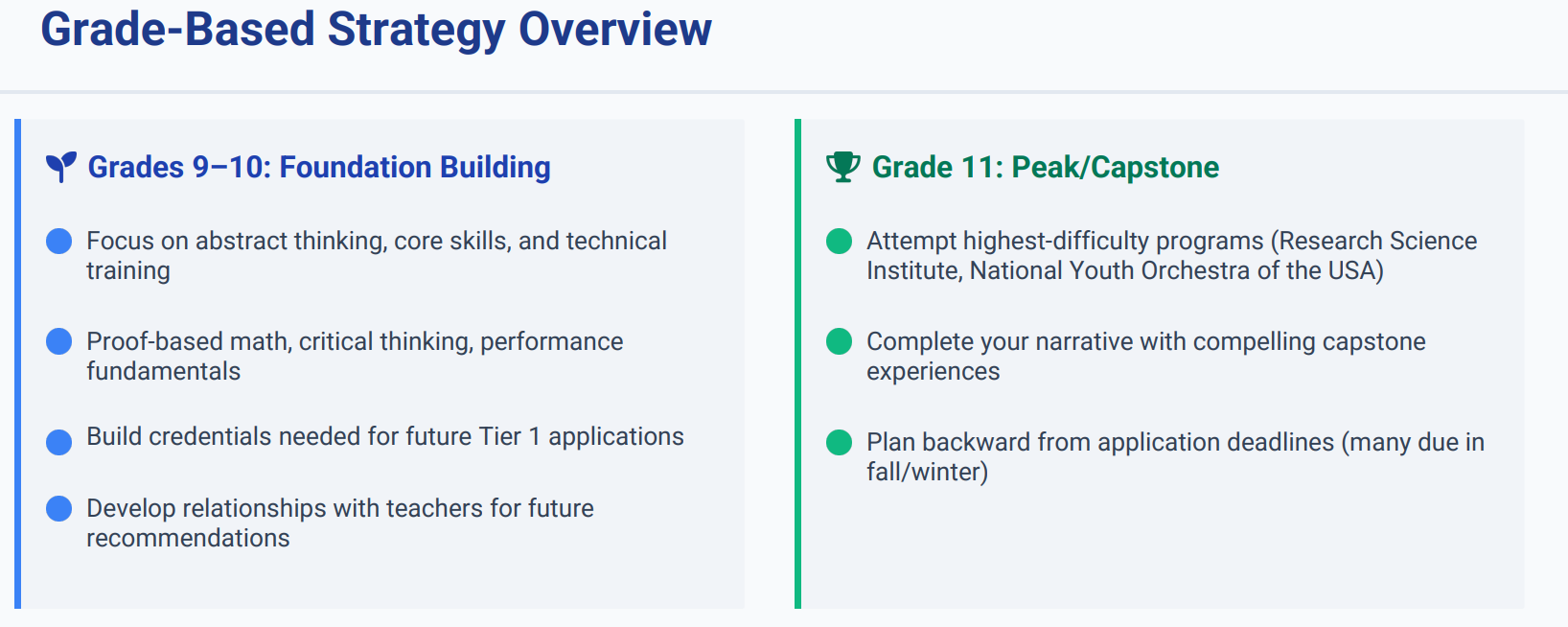
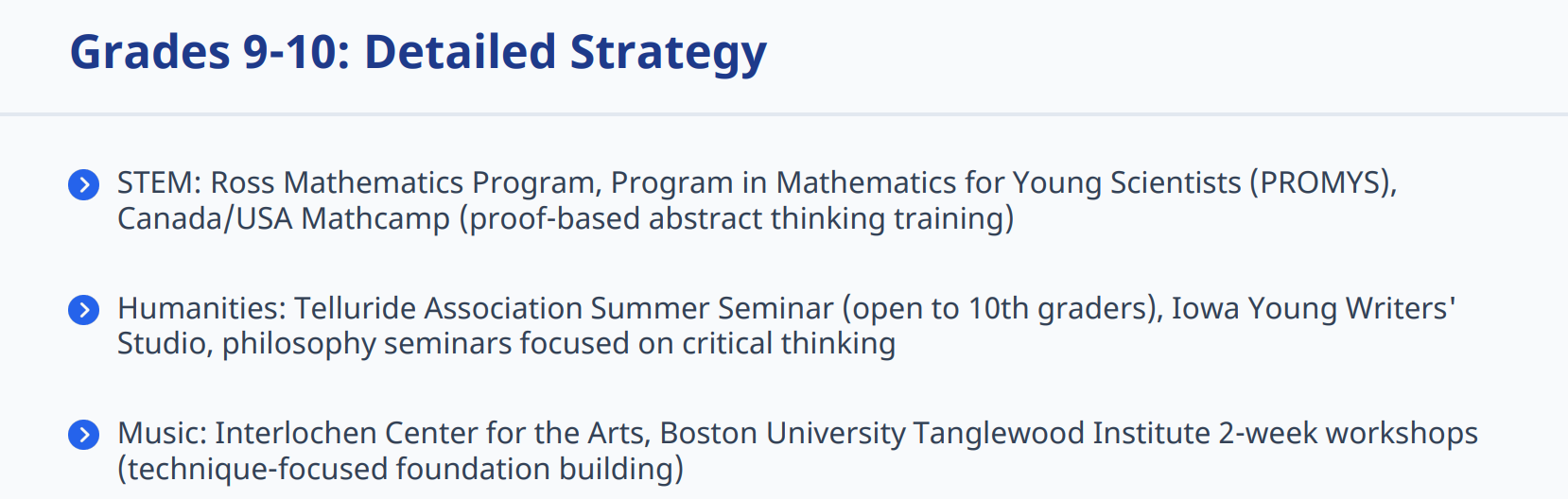
For the most selective programs, preparation often needs to begin in 9th or 10th grade, not in the middle of 11th grade when deadlines are already approaching. Many of the strongest programs close applications in December or February, which means the student’s preparation has to be in place well before then.
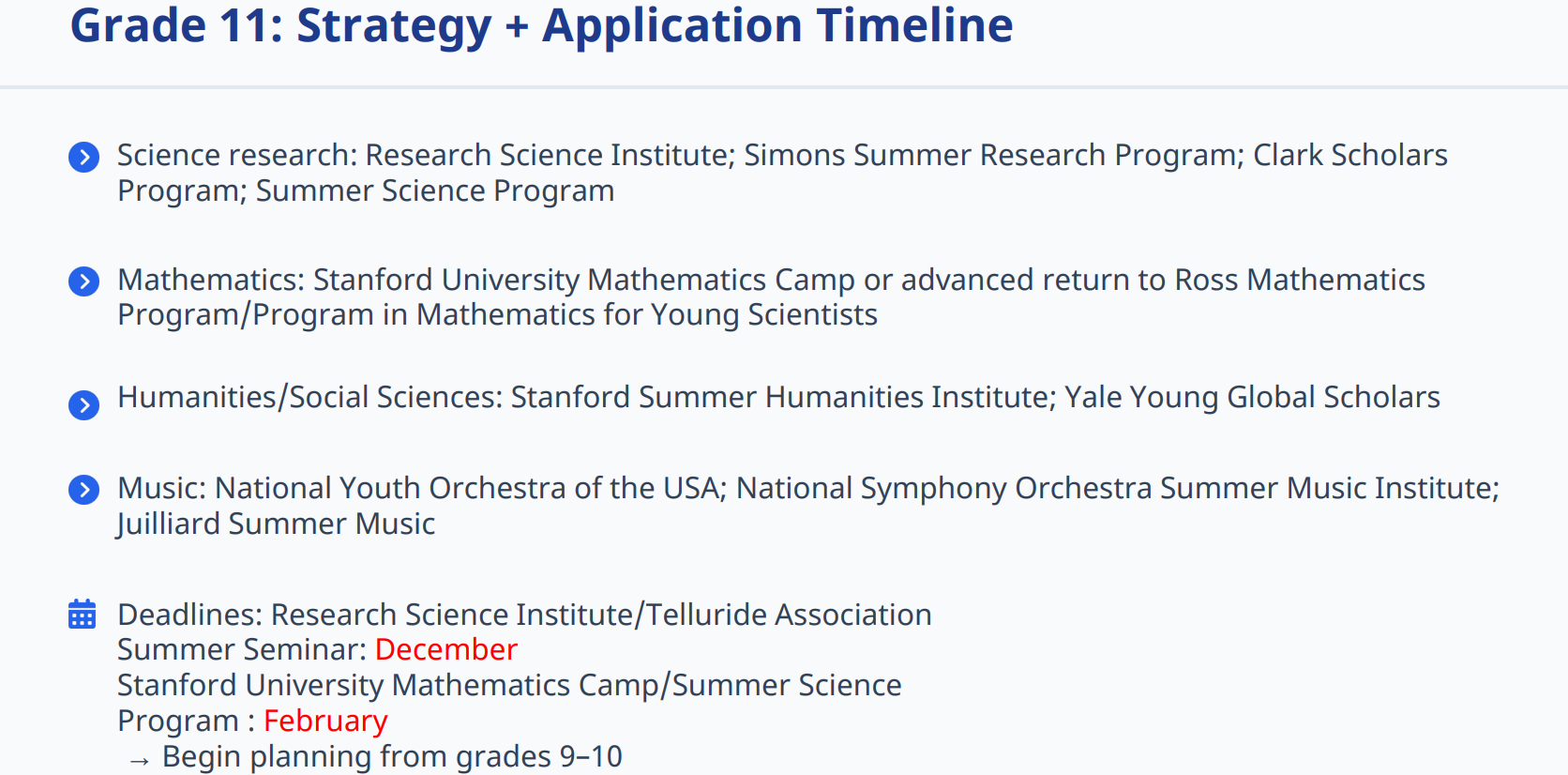
That is why early high school is so important.
In 9th and 10th grade, students may still be exploring multiple interests. That is completely normal. In fact, it is often helpful. Students do not always know right away whether their main spike will be music, math, science, writing, or something else.
But exploration cannot stay shallow forever.
At some point, if a student wants to be competitive for the strongest opportunities, one or two interests need to deepen in a serious way. Summer planning should reflect that transition.
What Strong Academic Camps Actually Signal
Families sometimes assume that all academic camps show the same thing. They do not.
Different programs signal different strengths.
Math Programs
For students interested in elite math programs such as Ross, PROMYS, SUMaC, or Canada/USA Mathcamp, the key is often abstract thinking, not just acceleration.
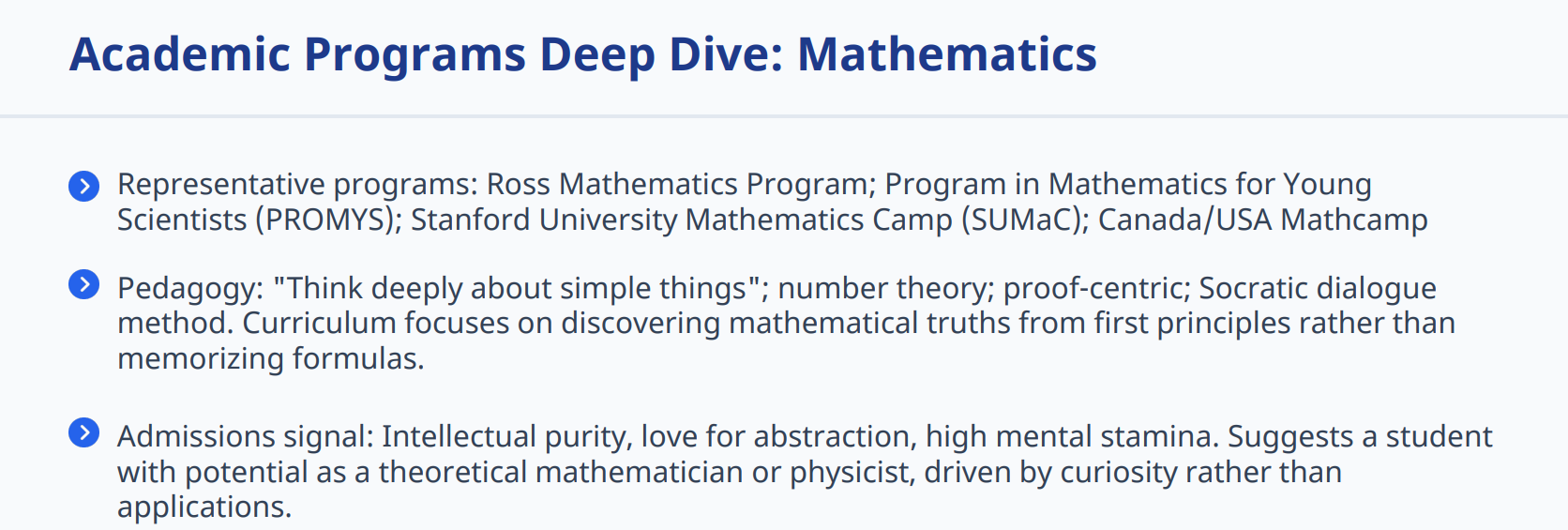
A student who races through calculus is not automatically a strong fit for these programs. What matters more is proof-based thinking and comfort with asking fundamental “why” questions. In many cases, number theory is one of the most valuable preparation areas because it appears so frequently in high-level math enrichment.
These camps tell colleges that the student is not just advanced, but intellectually serious in a deeper, more conceptual way.
Science Research Programs
Programs such as RSI, Simons Summer Research Program, Garcia, SSP, or Jackson Laboratory Summer Student Program tend to signal something else: research maturity.
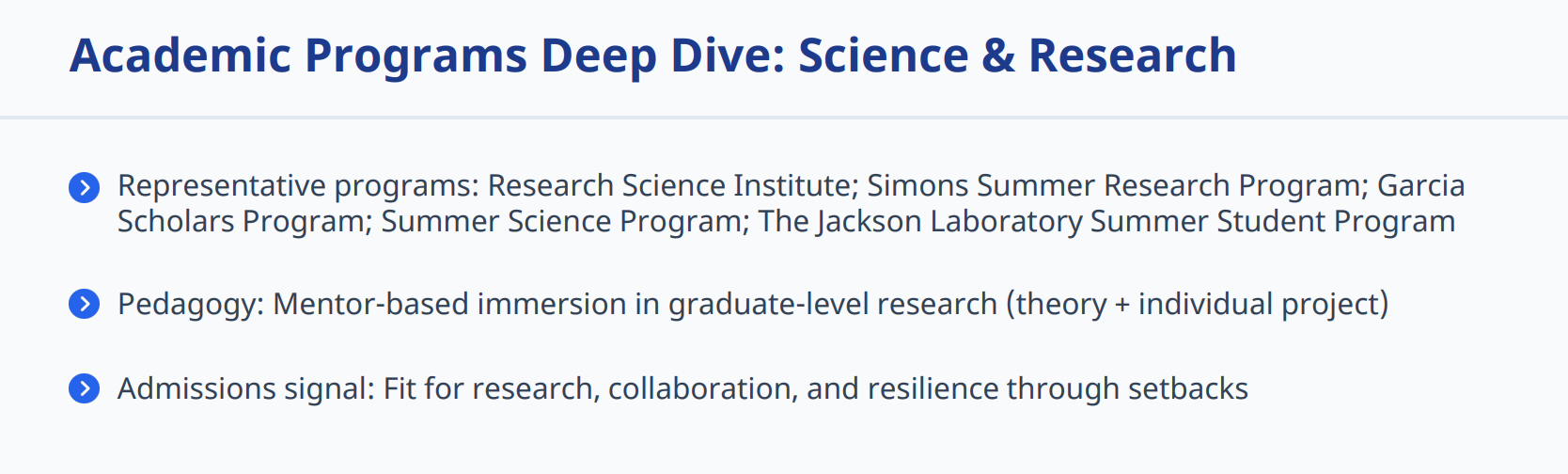
These programs are often mentor-based and immersive. They suggest that the student can work through uncertainty, collaborate with researchers, and stay engaged in a demanding intellectual environment. If the research includes experiments, they can also show resilience and the ability to recover from failure—something colleges value much more than families sometimes realize.
Humanities and Social Science Programs
Programs such as TASS, Stanford Summer Humanities Institute, and Yale Young Global Scholars often signal college-level reading, discussion, and analytical writing.
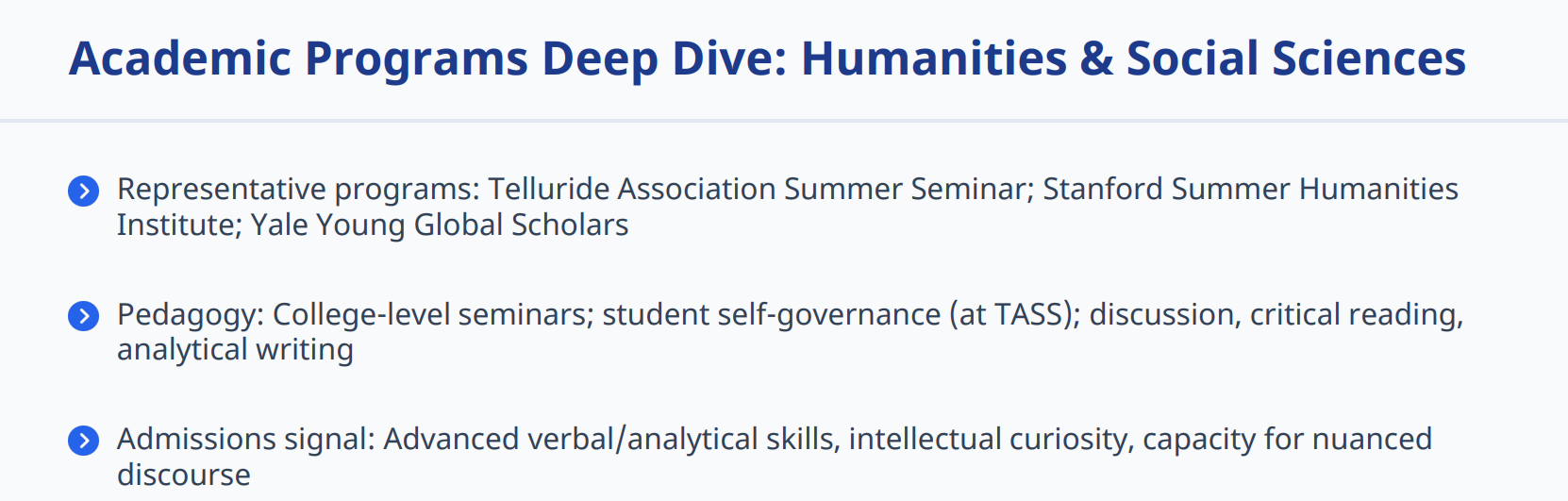
These are especially valuable for students who want to show that they are not just “good at school,” but genuinely capable of engaging with ideas at a high level.
Economics and Business Programs
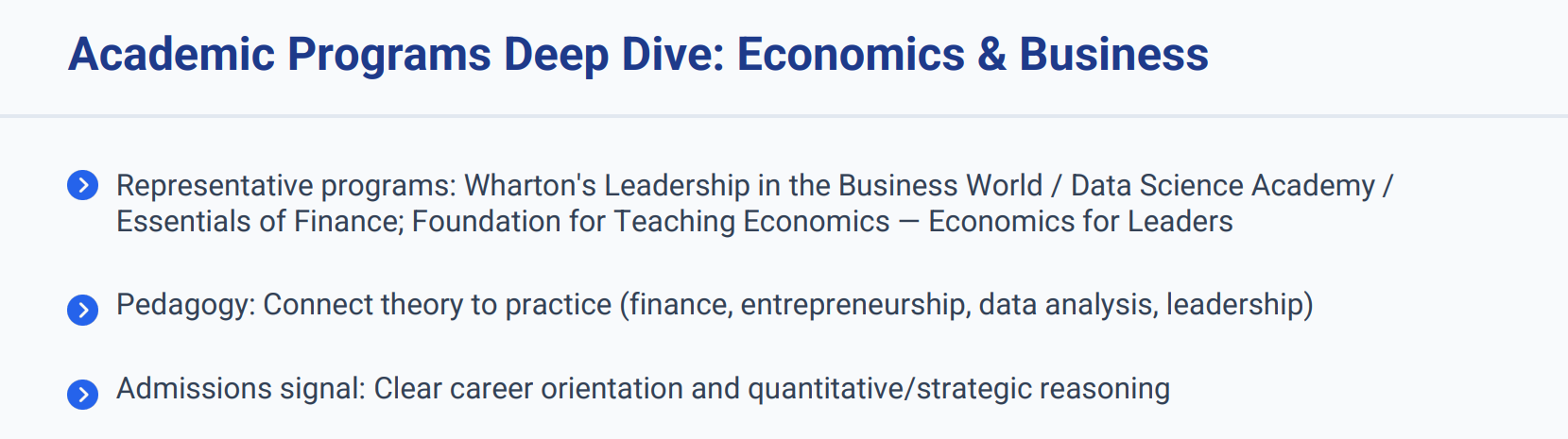
Strong economics or business programs can help validate interest in a field that many students claim but few students explore with depth. The strongest versions of these programs show that the student can connect theory to real-world questions and think beyond surface-level ambition.
What Strong Music Camps Signal
For music students, high-level summer programs can be extremely powerful.
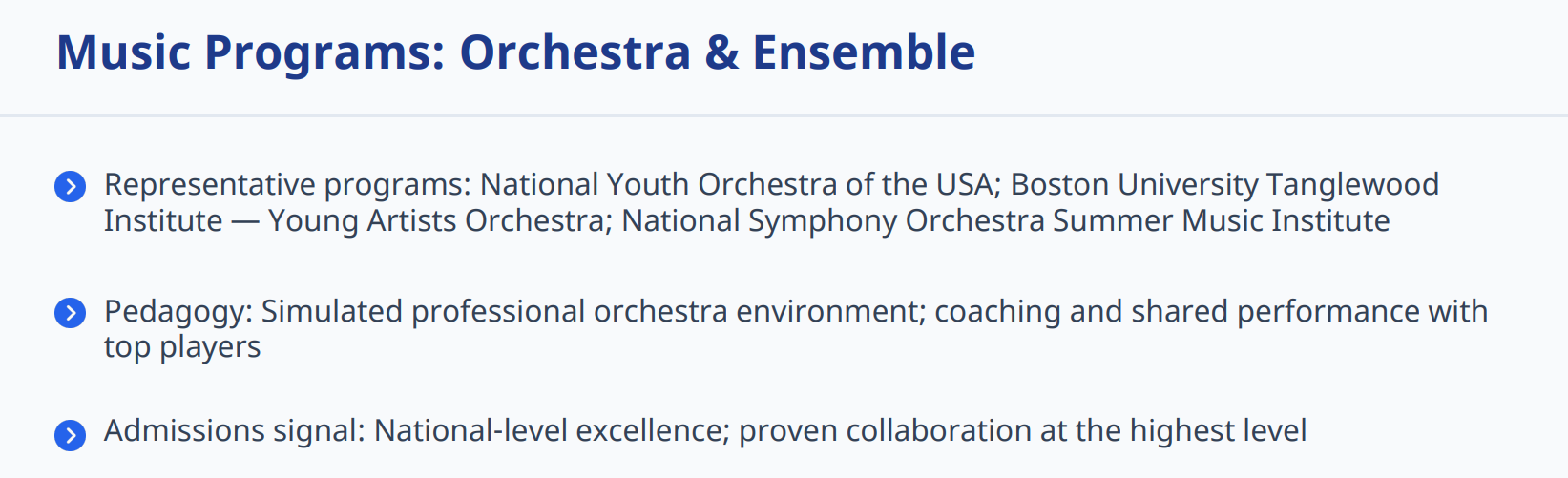
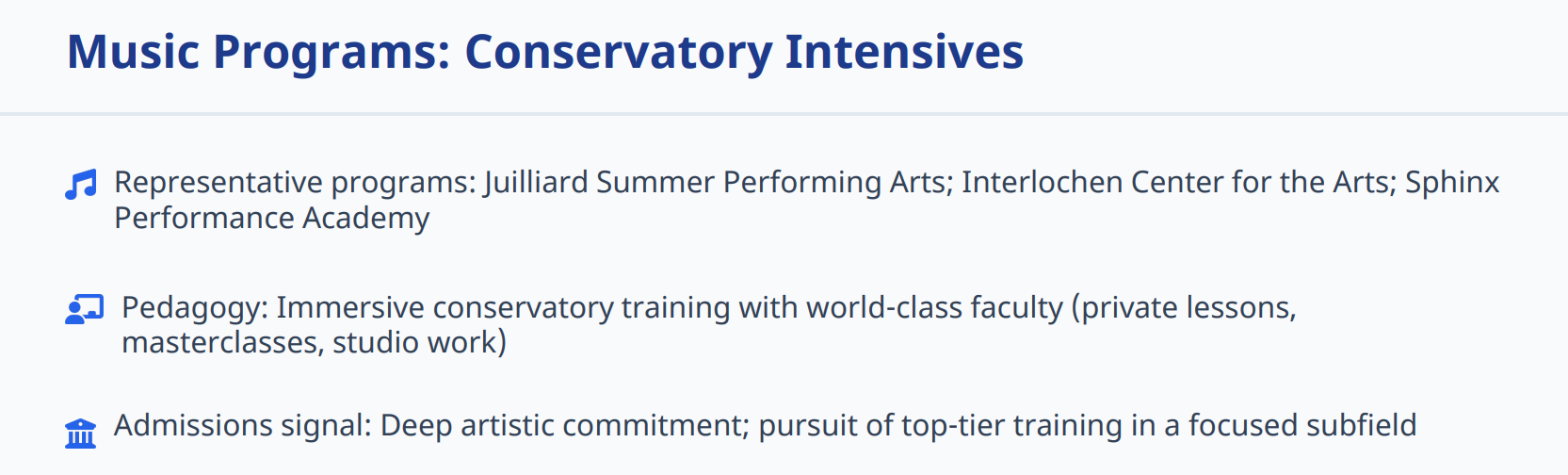
Programs such as NYO, Boston University Tanglewood Institute, National Symphony Orchestra Summer Music Institute, Juilliard Summer, and other respected intensives do more than show participation. They signal that the student can perform at a serious level, collaborate in a demanding artistic environment, and contribute quickly in a high-level ensemble.
That matters a lot in admissions.
A student who attends a top music camp may be signaling:
- national or near-national performance strength
- advanced ensemble awareness
- high-level discipline and preparation
- readiness to contribute artistically on campus without needing much developmental ramp-up
Programs like National Youth Orchestra of the USA, for example, carry weight not just because they are selective, but because they are widely recognized and associated with elite-level youth performance.
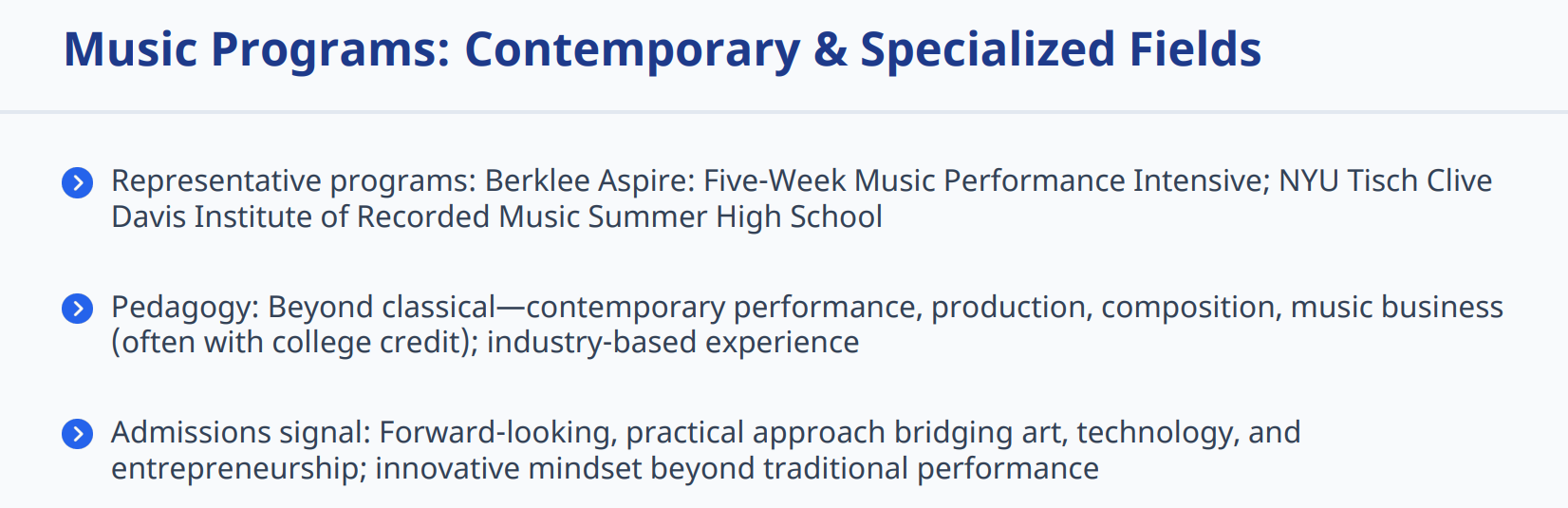
There are also strong options outside the classical path. Programs connected to Berklee or NYU Tisch Clive Davis, for example, can make more sense for students interested in music production, songwriting, or commercial music rather than orchestral performance.
So Which Should a Music Student Choose?
Now we get to the core question.
If a student is already very strong in music, should they still choose an academic summer program?
The answer depends on the tier.
Case 1: Music Tier 1 vs. Academic Tier 2 or 3
If the student is already a serious music student and has been admitted to a Tier 1 music program, but the academic option is only Tier 2 or Tier 3, then the music program is usually the better choice.
Why?
Because the student already has a clear main spike, and the lower-tier academic option usually does not add enough value to justify weakening that focus. In admissions terms, it can dilute the student’s strongest story rather than strengthen it.
In that situation, reinforcing the main spike is usually the smarter strategy.
Case 2: Music Tier 1 vs. Academic Tier 1
This is where things get more interesting.
If a student who is already strong in music is also admitted to a Tier 1 academic program, then the academic option becomes much more meaningful. At that point, the choice is no longer about adding casual breadth. It may be about building genuine second-axis depth.
That can be extremely valuable.
A student in that situation may be moving from a T-shaped profile toward something closer to a pi-shaped one: real strength in music, plus real depth in an academic field.
That kind of combination can be highly compelling in selective admissions.
Case 3: STEM Student Admitted to a Strong Music Program
The same logic works in reverse.
If a student is clearly strongest in STEM but is admitted to a top music intensive, the decision still depends on tier and strategy. If the music opportunity is meaningfully stronger than the academic one, it may deserve serious consideration. If not, the student may be better off strengthening the main academic spike.
So the principle stays the same:
When tiers are different, the stronger tier usually wins.
When tiers are similar, the student’s broader profile should decide.
The Most Important Decision Rule
Here is the clearest way to think about it:
- If one option is clearly a higher tier, that option usually deserves priority.
- If both options are at the same tier, the student should decide based on what the application needs more: breadth or depth.
- If the student’s profile already has enough range, then deeper specialization may be the better move.
- If the student already has a strong spike but lacks intellectual range, then a selective academic program may help more.
That is why this decision cannot be made in isolation.
Families should not ask only:
- Which camp sounds more impressive?
- Which school name looks better?
- Which field feels more prestigious?
They should ask:
- What has this student already built?
- What is the clearest spike right now?
- Does the application need another layer of depth, or more range?
- Will this summer choice strengthen the story, or blur it?
Those are the real admissions questions.
What Younger Students Should Do
For students in 9th and 10th grade, the answer is usually not to specialize too aggressively too early.
At that stage, broader exploration is often healthy. A younger student may still be figuring out whether the deepest long-term commitment will be music, math, science, humanities, or something else. That is okay.
But even then, the student should not approach everything casually.
If a student may want top music programs later, then serious practice has to start now.
If a student may want elite math programs later, then proof and number theory preparation should begin early.
If a student may want research-based science programs later, then they should start learning how to think and work in research-like ways before junior year.
In other words, early exploration is good—but it should still be intentional.
Final Takeaway
So should a serious music student choose a top music camp or a top academic summer program?
There is no universal answer.
If the student’s clearest strength is music and the music option is stronger, then building that spike further often makes the most sense. If the student is strong enough to gain admission to a truly elite academic program as well, then that academic option can become a powerful way to add another dimension of real depth.
The best choice is not the one that sounds most impressive in isolation.
It is the one that makes the student’s overall profile stronger, clearer, and more strategically coherent.
That is how summer camp decisions should be made.
summercamp
academicsummerprogram
