
Hello, this is A ONE Institute.
Today, I want to walk through several admissions questions that come up again and again—from how colleges view lesser-known science fairs to whether international volunteer work, Olympiads, athletics, music, and outside dance training actually strengthen an application.
Many families tend to ask these questions one at a time, but the real value comes from understanding the bigger admissions logic behind them. Colleges are not simply checking whether a student did a certain activity. They are asking how credible it is, how selective it is, how sustained it is, and whether it fits naturally into the student’s broader profile.
With that in mind, let’s go straight into the questions.
Do lesser-known international science fairs still help in college admissions?
Yes, they can—but only if the competition itself has real credibility.
Everyone knows ISEF, so that one is easy. The harder question is what happens when a student wins an award at a science fair that most people in the U.S. have never heard of. In those cases, the value of the award depends on whether the competition holds up under closer review.
Admissions officers are not automatically familiar with every international competition. If they come across something unfamiliar, they may look it up. When they do, several factors can make a big difference.
The first is history. A competition that has been running for years generally carries more weight than one that appeared recently. Longevity suggests that the event has sustained participation and some established reputation. As a rule of thumb, five years is a reasonable minimum, and longer is better.
The second is scale. If the event only attracts a few hundred students, it may not come across as particularly significant. But if thousands of students participate in preliminary rounds and the total applicant pool reaches into the tens of thousands, that looks much more substantial.
The third is the judging panel, and this matters a lot. If the judges are professors, researchers, or officials connected to national institutions, the competition is more likely to be taken seriously. If the judging process is vague or the judges are not clearly identified, that tends to weaken credibility.
The fourth is selectivity. A competition that does not publish acceptance rates or advancement rates may simply not be very selective. More competitive programs are often proud to show how difficult they are. If the admit rate or advancement rate drops below roughly 10%, that starts to signal a genuinely competitive environment.
The fifth is the barrier to entry. Competitions that require recommendations, essays, test scores, or multiple rounds of evaluation tend to carry more weight than competitions with a very casual application process.
And finally, the competition should leave behind some kind of official record. If the website clearly lists past winners, prior years, or public evidence of competitive standards, that helps a great deal.
So yes, a lesser-known international science fair can absolutely help in admissions. But the award becomes much stronger when the competition clearly demonstrates history, scale, strong judging, selectivity, meaningful entry requirements, and publicly verifiable records.
Does volunteering in Southeast Asia every summer help as an extracurricular activity?
That depends almost entirely on the student’s larger profile.
If the volunteer work is disconnected from the rest of the student’s application, it can come across as shallow. In the worst case, it can even create the impression that the student essentially took a trip and framed it as service.
That is where the skepticism comes from.
On the other hand, if the volunteer work grows naturally out of the student’s academic interests or long-term direction, then the same activity can become much more compelling.
For example, imagine a student who is interested in economics or development and has been researching something like how productivity in Southeast Asia affects global supply chains and the U.S. economy. If that student then goes on to do service work in the region, the experience feels connected and purposeful.
Or suppose a student has been studying issues like migrant labor, child labor, or human rights from an academic perspective and then follows that with direct service or field exposure. In that case, the volunteer work shows not just kindness, but also intellectual seriousness and a willingness to connect ideas with action.
That is a very different story.
So the real question is not whether international volunteer work helps in the abstract. The question is whether it fits naturally into the rest of the student’s profile. If it feels isolated, the value is limited. If it feels integrated, the value rises significantly.
If a student does not have a green card, is Olympiad preparation still worth it?
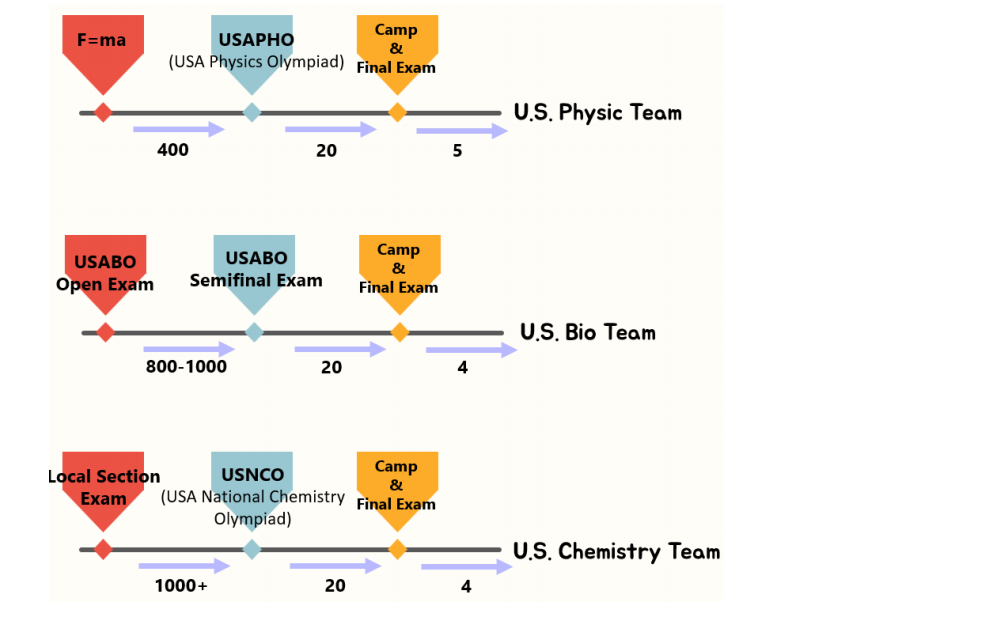
Yes, absolutely.
Many families assume that if a student cannot advance all the way to the final national team stage, there is no point in pursuing Olympiad-level work. That is not true.
In many Olympiad systems, the process happens in stages. For subjects like physics, biology, and chemistry, there is usually an initial round, then a semifinal-level round, and then a final representative stage. In math, a similar progression would be AMC, then AIME, then USAMO or USAJMO.
The key point is that students can often participate meaningfully through the earlier stages even if they are not ultimately eligible for the final team selection because of citizenship or residency rules.
And those earlier stages still matter.
Reaching a semifinal-level benchmark can already be a strong signal in admissions. Colleges do not only care about the final official team. They also recognize the academic strength required to advance meaningfully within the pipeline.
So no, Olympiad preparation is not pointless for students without permanent residency. The value does not begin only at the very top.
Do students have to do sports and music to be competitive in admissions?
No, they do not.
Some families get that impression because colleges often evaluate students across categories like academics, extracurriculars, athletics, personal qualities, and recommendations. In public discussions of admissions, athletics and music often stand out because they are highly visible and easy to understand.
But that does not mean every student needs those areas specifically.
What colleges really care about is not whether the activity is sports or music. What they care about is whether the student shows genuine commitment, long-term consistency, focus, and objective evidence of achievement.
Sports and music often perform well in admissions simply because they naturally generate those kinds of signals. Students may train for years, devote many hours each week, compete in ranked environments, or perform publicly. That makes the activity easier to evaluate.
But other fields can do the same thing.
Research, debate, writing, coding, academic competitions, entrepreneurship, public speaking, and many other activities can be just as valuable when they show the same combination of long-term effort and outside validation.
So the real issue is not category. The real issue is depth.
Can a student pursue golf and academic scholarships at the same time?
Yes. Those two goals can absolutely be pursued together.
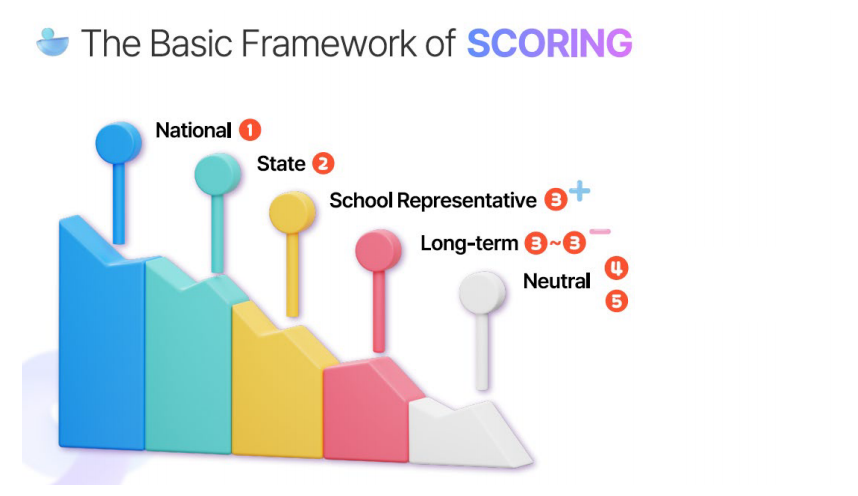
One side of the equation is academic: GPA, coursework, and standardized testing. The other side is athletic: how competitive the student actually is in golf.
The important thing is to evaluate the student’s level honestly.
There is a real difference between being strong on a school team, being competitive at the state level, and being nationally competitive. If a student and coach believe there is a realistic chance to move from one level to the next, then it may make sense to devote more time and energy to making that jump.
Once that next level is reached, the strategy can shift again—maintain the athletic level while rebalancing toward academics.
The point is not to think in vague terms like “do both.” The point is to ask much more specific questions: Where is the student now? What is the next realistic level? How much time would it take to get there? And is that investment justified?
That kind of honest, level-based planning is what makes the dual-track approach work.
If a student does dance outside of school, how can they prove excellence and commitment?
When colleges evaluate extracurricular activities, they are usually looking at four things:
- Level of achievement
- Strength of evidence
- Distinctiveness
- Long-term consistency
If a student trains only at a private studio, then continuity may be easy to show. The student may have done it for years. But the harder part is proving the strength and credibility of the accomplishment.
That is often where outside activities become weaker.
The solution is to build objective validation. That can come through recognized competitions, auditions, selective performances, or reputable organizations that make the student’s level easier to assess.
If the activity happens at school, credibility is often simpler because teachers and school programs naturally provide witnesses and context. But outside of school, the student has to work a little harder to establish that same level of trust.
So if a student is serious about dance outside of school, it is not enough to say, “I have been doing this for a long time.” A much stronger version is: “I have been doing this for a long time, and here is the recognized evidence that I perform at a high level.”
That is what changes the story.
A final point about how colleges evaluate students
Different colleges use different language, but the underlying framework is usually quite similar.
Some schools talk more explicitly about academics, extracurricular achievement, personal qualities, and school support. Others emphasize intellectual vitality, context, leadership, or special circumstances. The labels may vary, but the basic logic is often the same.
Colleges are still asking some version of these questions:
- How strong is this student academically?
- How meaningful and credible are the student’s activities?
- What kind of person is this student?
- Does the full application feel coherent?
That is why every activity should be evaluated not in isolation, but in the context of the whole application.
In the end, the strongest extracurriculars are not necessarily the flashiest ones. They are the ones that are sustained, credible, well-supported, and clearly connected to the student’s larger story.
college admission
