
Hello, this is A ONE Institute.
When students apply to college, recommendation letters matter a great deal. In fact, more students are hurt by weak recommendation letters than most families realize. The frustrating part is that students usually cannot read what their teachers actually write. That makes the entire process feel incredibly uncertain.
So today, I want to talk about a practical question: Is there any way to improve the chances of receiving a stronger recommendation letter?
The answer is yes—but not in the way most people think.
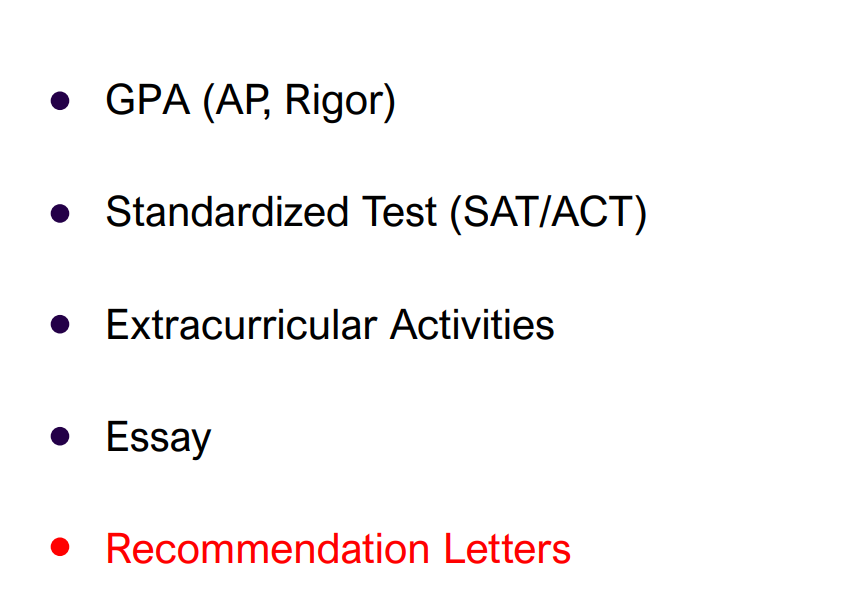
When colleges evaluate applicants, the major factors are usually GPA, SAT or ACT scores, extracurricular activities, essays, and recommendation letters. Of all of those, the essay is the one the student writes directly. The recommendation letter is different. It is written by someone else, and the student has no real control over the final wording. That is exactly why the process feels so uncomfortable.
There is another problem as well. Students often want to ask the most popular or most respected teacher for a recommendation, which is understandable. But those teachers are usually overwhelmed around application deadlines. When that happens, they may have to write a recommendation letter for a student in a very short amount of time, often without much room for reflection or careful crafting.
And when teachers are rushed, they often write very honestly and very directly.
If the student is consistently responsible, kind, hardworking, and well-liked, that may not create a serious issue. But in many cases, the letter ends up being much more literal than families expect. For example, imagine a letter that says something like, “This student sometimes struggles to stay focused in class.” Even if that comment is only one small part of the letter, it can feel devastating.
That is why students need to think in advance about how to reduce the chances of that kind of outcome.
The Basic Recommendation Structure
As most families already know, students usually submit three main recommendation letters:
- one from the school counselor
- two from academic teachers
Sometimes students also submit a supplementary recommendation letter, but in most cases, adding too many extra letters is not a good idea. Admissions readers already have a large volume of material to review, and additional letters can easily become more annoying than helpful. Usually, one extra letter at most is enough, and often none is necessary.
Most colleges follow this basic structure. Some schools, however, have more specific requirements. MIT, for example, typically wants one recommendation from a math or science teacher and another from a teacher in humanities, social science, or language. Other schools are more flexible and simply ask for recommendations from academic-subject teachers, even if the classes are not all core subjects in the strictest sense.
So students need to check each college carefully. Some schools require recommendations from core academic teachers specifically, while others are more open. But in general, the common structure is still the same: one counselor letter and two teacher recommendations.
Why Teachers Need More Help Than Students Realize
Many families assume that if a teacher knows a student reasonably well, that teacher will naturally be able to write a strong and detailed letter. In reality, that is often not true.
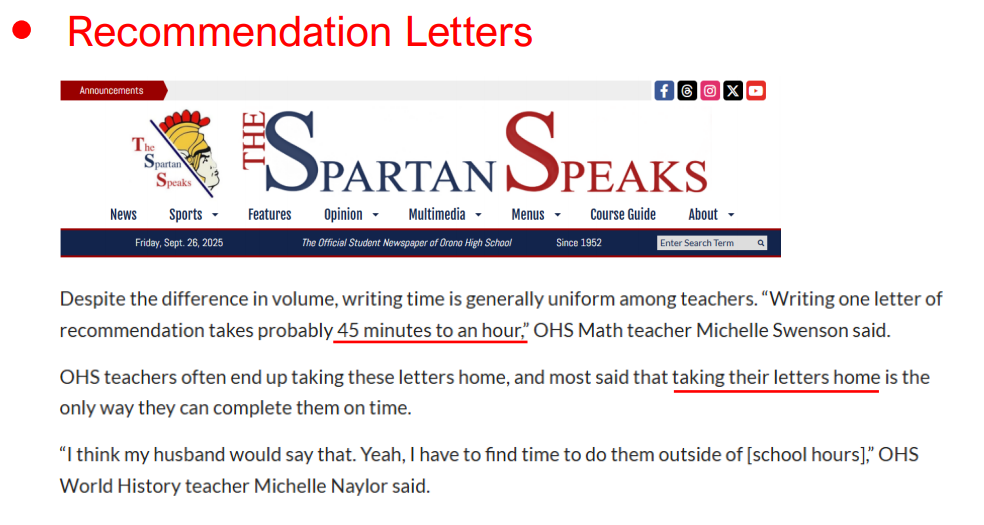
One source cited in the original discussion noted that writing just one recommendation letter can take 45 minutes to an hour. Because teachers are already overloaded, many of them end up taking recommendation work home and writing letters late at night or during personal time. Other reports suggest that a teacher may write 20 to 40 recommendation letters in a single year, sometimes even more.
That means teachers are not working under calm, ideal conditions. They are often writing under serious time pressure.
And that matters.
Knowing a student and writing a vivid, well-structured, persuasive letter about that student are not the same thing. Even if a teacher genuinely likes a student, it is difficult to sit down and generate a strong letter from scratch, especially when they are exhausted and juggling dozens of other responsibilities.
That is why many schools give students and parents some kind of brag sheet, questionnaire, or reflection form to complete. Counselors often use these forms to gather information that helps them write with more detail and more context.
Counselor Letter vs. Teacher Letters
The two teacher recommendations and the counselor recommendation do not serve exactly the same purpose.
The teacher recommendations are meant to help colleges understand who the student is inside the classroom—how the student thinks, contributes, responds to challenge, and engages with learning.
The counselor recommendation, by contrast, usually speaks more to the student’s overall school life, character, leadership, background, family context, and whether the broader application feels consistent as a whole.
That is why many counselor forms overlap naturally with the student’s personal essay. Questions about character, family environment, life circumstances, and relationships often connect directly to what students are already trying to articulate in their personal statement.
So for today, I want to focus primarily on the teacher questionnaire side of the process—because that is where students can often be much more strategic than they realize.
The Real Goal
The goal is simple:
Help the teacher as much as possible, while also guiding the recommendation in the direction you want.
In other words, the ideal questionnaire response is not something vague, short, or generic. It should be detailed enough that the teacher could almost lift portions of it directly and use them in the recommendation letter.
That is the key.
If students give the teacher a well-written, highly specific, usable set of responses, then the teacher’s workload becomes lighter, the letter becomes easier to write, and the final recommendation is more likely to reflect the student’s intended message.
That is the real strategic opportunity.
What Teacher Questionnaires Usually Ask
After reviewing many recommendation questionnaires from different schools, it becomes clear that, even though the wording changes, the major categories are surprisingly similar.
Most questionnaires are effectively asking some version of the following:
- How do you know me, and why did you choose me to write your recommendation?
- What did you value about my class?
- What happened in my class specifically?
- Did you face any challenges in my class?
- How did you grow or improve?
- What else should I know about you outside of class?
Some schools also ask more detailed follow-up questions, such as:
- How would you describe yourself in a few adjectives?
- How did those traits show up in class?
- What AP score did you receive?
- What SAT score did you earn in this subject area?
- Have you received any awards connected to this field?
Those details matter, of course, but the larger pattern is more important.
If you step back, the questionnaires usually create a kind of narrative arc:
Why this teacher? → What was valuable about the class? → What happened in class? → What challenge did you face? → How did you grow? → What does this show about you beyond the classroom?
That tells us something very important: teachers do not just want isolated facts.
They seem to want a story they can write.
And that means the recommendation letter itself will often take shape in roughly this kind of form:
This student was like this in my classroom.
Their general character is also like this.
They approached a certain challenge in this way.
They responded with maturity, growth, or initiative.
Outside the classroom, they showed a related side of themselves in other activities.
Because of those qualities, I believe they will thrive in college.
That is the kind of structure teachers often seem to be aiming for, whether consciously or not.
Why the “Bridge” Matters So Much
If students fill out the questionnaire thoughtfully, teachers can pull from each section more easily: classroom character, challenge, growth, outside activities, future potential.
But one part is still difficult even for experienced writers: the bridge.
The hardest part of writing is often not listing the individual points. It is connecting one paragraph to the next in a way that feels natural and persuasive. Teachers likely struggle with that too.
So one of the smartest things a student can do is make those transitions easier.
In other words, students should not just hand teachers isolated facts like these:
- I was a good student.
- I struggled once.
- I improved.
- I also did activities outside school.
- I will do well in college.
Instead, students should structure their answers so that the teacher can move naturally from one idea to the next. If that bridge is already built, the teacher can write more smoothly, and the recommendation is more likely to sound coherent and intentional.
That is exactly what students should be trying to do.
How to Answer the Questionnaire More Strategically
1. “Why did you choose me?”
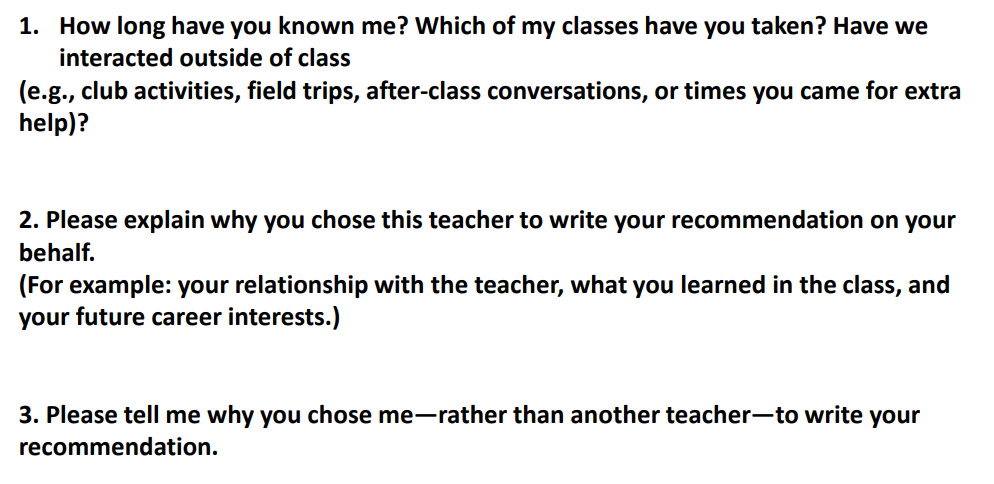
Almost nobody answers this question well.
A weak version sounds like this:
I want to major in biology, so I asked my AP Biology teacher because I took AP Biology in 11th grade and learned a lot.
That answer is not wrong. It is just painfully obvious.
Students should think much more deeply than that.
In general, people feel more positive when they can clearly see the value they had in someone else’s life. If a teacher reads your questionnaire and feels, “What I did truly mattered to this student,” they are much more likely to respond warmly.
So instead of giving a generic answer, students should identify a real connection between that teacher and something meaningful they later achieved.
For example, imagine a student interested in the humanities who later won awards in National History Day or a writing competition. Suppose the teacher writing the recommendation is the student’s World History teacher.
A stronger answer might look something like this:
Before taking your class, I was not especially interested in world history. If anything, it was one of the subjects I found harder to connect with. But the way you taught a specific unit—perhaps through visual material, a particularly memorable handout, or a story that added life to the historical moment—changed that for me. That classroom experience sparked a deeper interest, which later pushed me to explore history more seriously and eventually led me to pursue opportunities like National History Day. Looking back, I honestly do not think I would have attempted that work without first taking your class.
That kind of answer does several things at once:
- it gives the teacher credit without sounding fake
- it includes concrete detail
- it connects the class to later outcomes
- it makes the teacher feel that their teaching had real impact
Because the answer is grounded in specifics, it does not sound like empty flattery.
2. “What did you like about my class?”
This is another area where students tend to give generic praise.
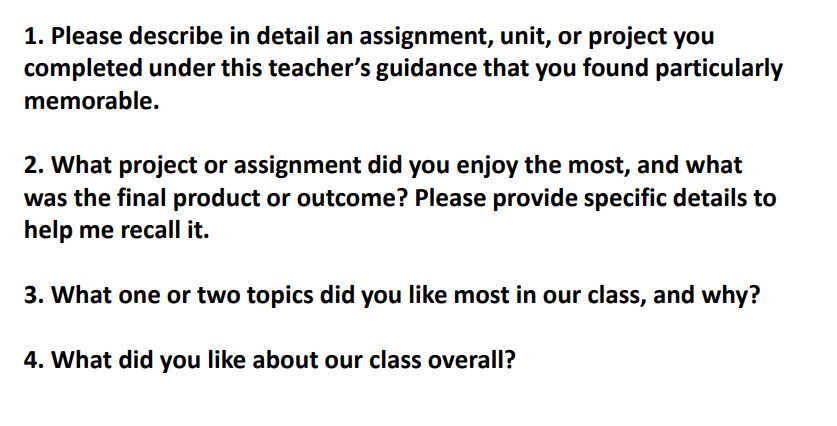
Answers like this are too vague:
- Your class was engaging.
- You made students participate.
- I stayed focused in your class.
- I learned a lot.
None of those are persuasive unless they are attached to a specific example.
Suppose the class was geometry. A more effective answer would describe a real classroom moment:
I had always struggled with certain geometry concepts until the day you brought in physical shapes and had us cut, move, and reassemble them to understand the logic visually. That moment made the concept click for me in a way that abstract explanation never had.
The more specific the memory, the better. If the student can even remember when it happened—what unit, roughly what time of year, what the classroom atmosphere was like—that makes the answer even more usable.
The key is this: even though the student is technically talking about their own growth, the structure should make it easy for the teacher to feel that their teaching helped make that growth possible.
3. Classroom Detail Should Not Be Treated Casually
Some questionnaire items ask for details specific to the class, and those questions may differ by subject.
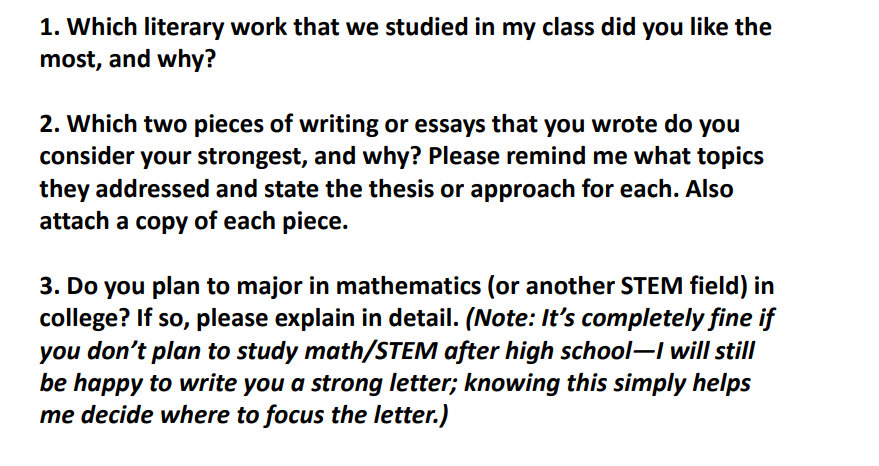
For an English teacher, the questionnaire might ask:
- Which essay from class stood out to you most?
- What did you write about?
- What did that writing process teach you?
For a math teacher, the question might be more like:
- If you plan to major in STEM, what kind of problems or subjects do you hope to study in the future?
- How did this class connect to that direction?
Students should answer these honestly, but also thoughtfully. These questions are not filler. They help the teacher build classroom-specific credibility into the letter.
4. The “Challenge” Section Matters More Than Students Think
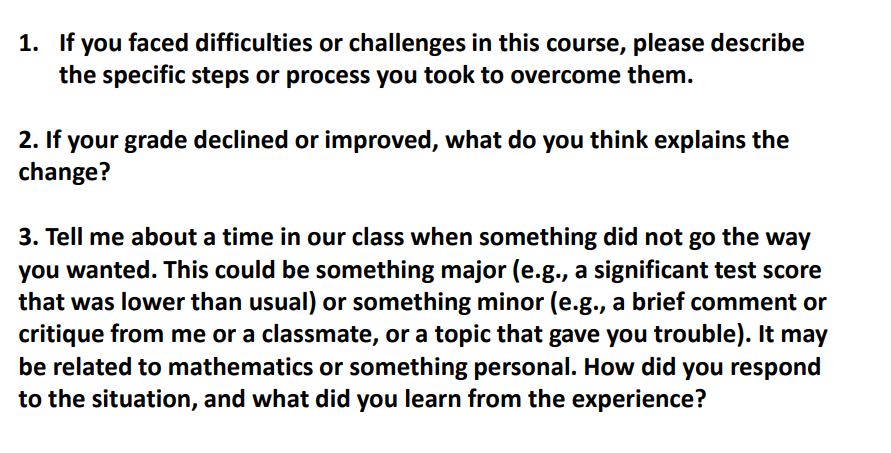
Many questionnaires ask some version of:
- Did you face any difficulty in my class?
- Did your grade ever drop?
- Did you struggle with a concept, presentation, or assignment?
- Did you encounter a challenging situation?
At first, students often feel like they do not have much to say here. Most classroom difficulties are not dramatic. Usually, they involve a grade drop, a bad presentation, confusion about a concept, poor time management, or a period of low confidence.
That is okay.
What matters is not the size of the problem.
What matters is how the student frames the response.
A challenge becomes meaningful when it leads naturally into the next part of the story: growth.
5. Growth Should Lead Somewhere
After the challenge section, the next question is often some version of:
- How did you improve?
- What did you learn?
- How did you grow as a student?
This is where students should show more than recovery. They should show pattern.
For example, imagine a student served as a TA or peer tutor in class and discovered that helping someone else understand a concept was harder than expected. A strong answer might explain:
I initially assumed that if I understood the concept myself, I could explain it easily to someone else. But when I tried helping classmates, I realized that understanding and teaching are not the same skill. So I started trying different methods—walking through examples step by step, using visual models, even showing Khan Academy videos when I thought a different presentation style might help. Eventually I found ways to communicate the material more clearly, and that changed the way I thought about problem-solving and teaching.
That gives the teacher something important: not just “the student improved,” but how the student approaches difficulty.
6. Outside Activities Should Connect Back to the Same Trait
This is where many students accidentally weaken their own recommendation.
If the teacher questionnaire presents the student as quiet, thoughtful, and steady in class, but then the outside-activities section suddenly jumps to something that feels unrelated and disconnected, the letter loses coherence.
Students should try to connect their outside activities to the same underlying quality already shown in class.
For example, in the classroom, the student may have demonstrated persistence in trying multiple ways to help a peer understand material. Outside the classroom, maybe that same student worked through a community project—such as pushing through administrative barriers to get outdoor seating installed in a neighborhood space.
Those two examples can be connected by the same core trait:
problem-solving persistence.
Once that thread is clear, the teacher does not have to struggle with the transition. The bridge is already there.
Another example might involve public speaking fear.
Suppose a student froze during a class presentation and had to work through serious anxiety. A thoughtful questionnaire response could describe how the student dealt with that through preparation, repetition, and over-practice until they could function confidently under pressure.
Then, in the outside-activities section, the student might mention having served behind the scenes in a performance setting but later stepping in unexpectedly as a replacement actor or speaker and succeeding through that same habit of over-preparation.
Again, the point is not the activity itself.
The point is the consistent growth pattern.
When students do this well, the teacher no longer has to invent coherence. The coherence is already built into the questionnaire.
The Best Mindset
At the end of the day, students should think of the questionnaire almost the way they think about an essay.
Not in the sense of being theatrical or overly polished, but in the sense of building a clear narrative:
- who I was in class
- what I valued in this teacher
- what challenge I faced
- how I responded
- what pattern of growth this reveals
- how the same quality appears outside the classroom
- why that suggests I will do well in college
If students organize their answers this way, then unless there is a serious problem in the teacher-student relationship, the teacher is much more likely to produce a recommendation letter that is strong, coherent, and aligned with the student’s intended message.
That is the real goal.
The goal is to make the questionnaire so detailed and so usable that the teacher could almost copy and adapt parts of it directly—and in doing so, produce a recommendation letter that sounds both authentic and strategically helpful.
Recommendation
