
Hello, this is A ONE Institute.
When students put together a college list, the first priority is obvious: they need to apply to schools that genuinely match their academic profile and overall level of competitiveness. But once a student is choosing among several similarly selective colleges, the conversation shifts. At that point, strategy starts to matter—and when strategy matters, it is far better to rely on actual admissions data than on general impressions or brand name alone.
That is exactly what I want to focus on here.
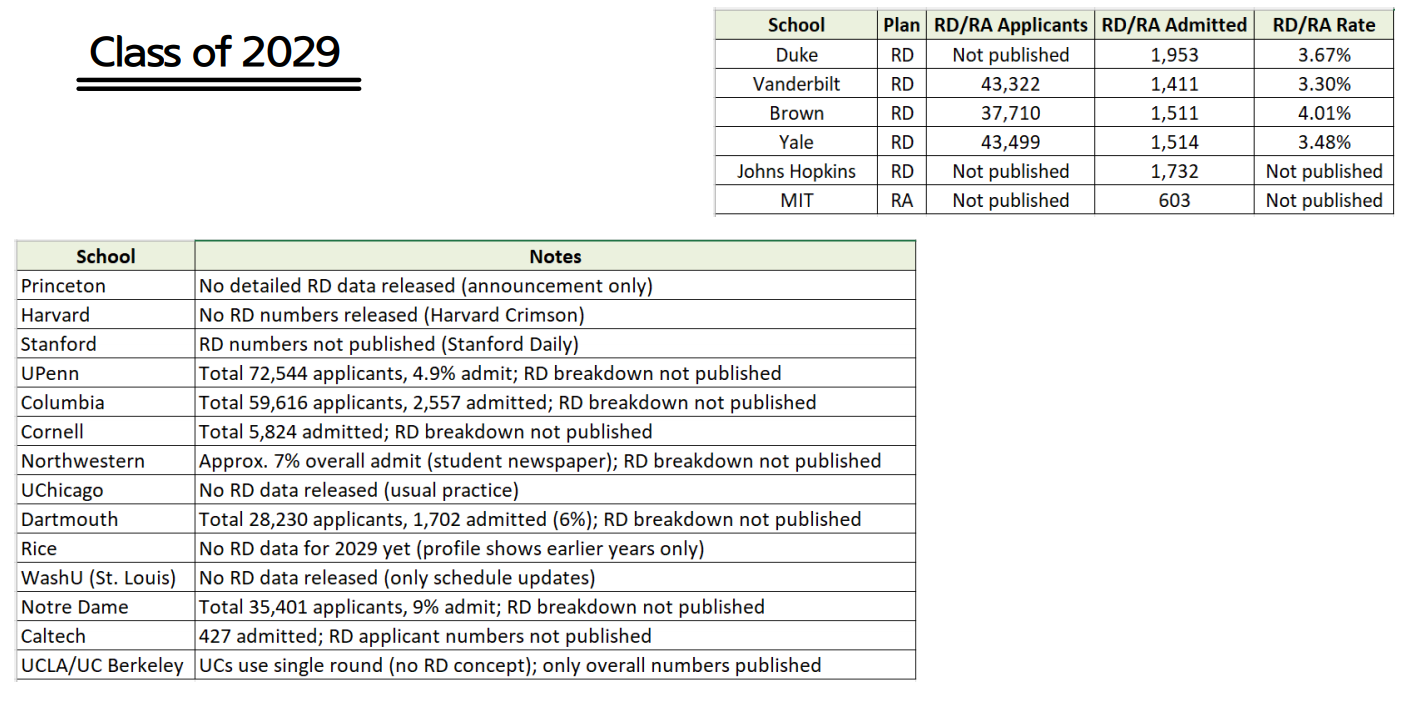
Instead of treating all top colleges as if they operate the same way, students should look carefully at the difference between Early and Regular admissions outcomes and use that information strategically. If a student has only one Early application to use, the question should not simply be, “Which school sounds the most impressive?” The more important question is, “Where does that Early application actually create the greatest advantage?”
Before getting into school-by-school strategy, it is important to understand the kind of data we are using.
The table we work from includes a range of colleges and multiple admissions cycles—Class of 2025, 2024, 2023, and earlier. For each school, we look at Early Decision or Early Action admit rates, Regular Decision admit rates, the difference between the two, overall admit rates, and when available, the numbers of applicants and admitted students. The goal is not to memorize every single figure. The goal is to understand how to use broad, comparable data to make smarter admissions decisions.
And that matters because this kind of comparison is surprisingly difficult to build from public sources alone. Many colleges release only partial information, and some provide almost nothing at all. So while families often assume they can simply “look up the numbers,” the reality is much messier.
We are currently in the 2025–26 application cycle, which corresponds to the Class of 2030. The Class of 2029 data comes from last year’s cycle. The challenge is that many highly selective colleges have become increasingly reluctant to publish complete admissions data. Princeton has long released very little. Harvard became even more restrictive after the legal scrutiny surrounding admissions disclosure. Other Ivy League schools have moved in the same direction. That means historical data remains extremely valuable, because in many cases it is the only way to identify patterns over time and make reasonable strategic estimates.
So what should students focus on?
When I think about Early strategy, I care less about the absolute admit rate and more about the relative advantage of applying Early instead of Regular. In other words, I want to know: How much more favorable is the Early round at this school compared with Regular Decision? If a school’s Regular Decision rate is already relatively generous, then using an Early application there may not be especially valuable. But when the gap between Early and Regular is substantial, the expected value of that one Early application rises significantly.
Viewed through that lens, some clear patterns begin to emerge.
MIT
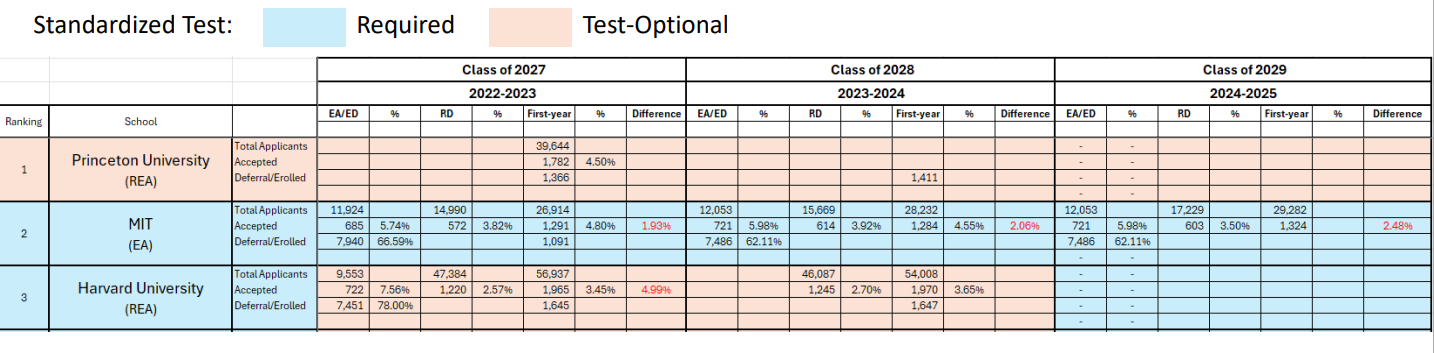
MIT shows only a very small gap between Early and Regular admit rates—roughly 1.9%, then 2.06%, then 2.48% across recent cycles. That is extremely small compared with many peer institutions. In practical terms, that means MIT’s Early Action round does not offer much of a strategic boost unless the applicant is already exceptionally strong. For most students, MIT is not the clearest place to maximize the value of an Early application.
Harvard
Harvard’s publicly available data is limited, but based on past numbers, the Early–Regular gap also appears to be relatively small. In other words, Harvard is not typically the kind of school where we would say, “Apply Early here because it gives you a major statistical edge.” The benefit exists, but it is more modest than many families expect.
Stanford and Caltech
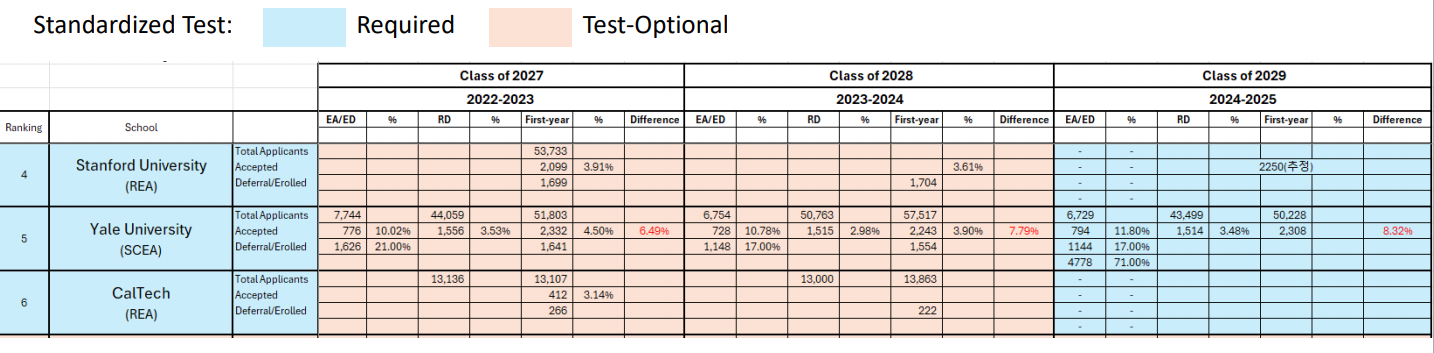
At schools like Stanford and Caltech, the lack of public data makes it difficult to draw strong conclusions. Because the information is incomplete, these schools are harder to prioritize from a purely strategic standpoint. If we are ranking colleges based on how clearly the data supports an Early advantage, they usually fall lower simply because the evidence is too limited.
Yale
Yale has shown a better Early–Regular gap than MIT or Harvard, with recent figures around 6.49%, 7.79%, and 8.32%. That is meaningful, but it is still not what I would consider exceptionally large. So Yale can offer some strategic value in the Early round, but it is not necessarily at the very top of the list when compared with schools that show a much stronger Early advantage.
Duke
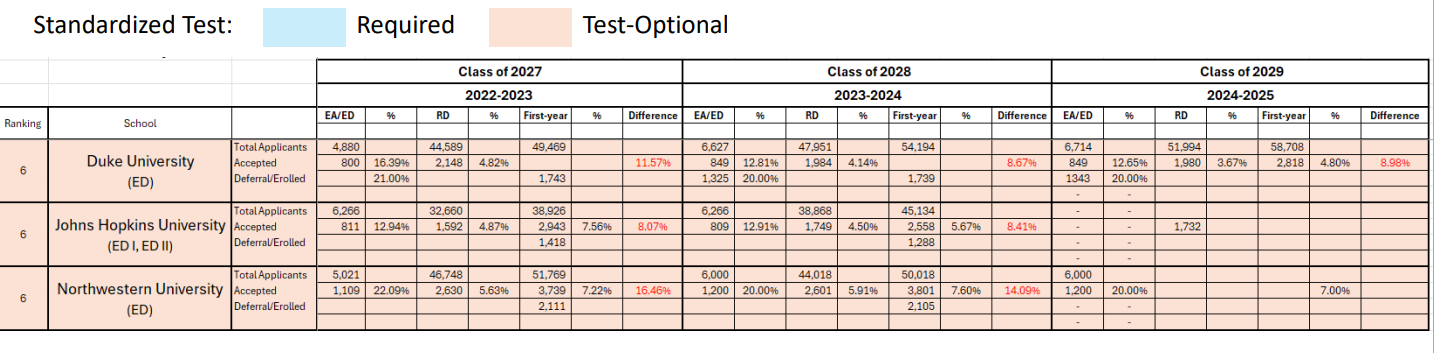
Duke’s gap has been around 11.57%, then 8.67%, then 8.98%, which puts it in a solid range. The Early advantage is definitely real. It is not the most dramatic in the group, but it is strong enough to matter and can absolutely be worth using strategically for the right student.
Johns Hopkins
Johns Hopkins provides only partial data. Based on the available numbers and long-term patterns, it is generally viewed as a school with a moderate Early advantage—not weak, but not among the most extreme examples either.
Northwestern
Northwestern is one of the clearest strategic standouts. Its Early–Regular gap has been around 16.46% and then 14.09% in recent cycles. That is very large. If a student is comparing similarly ranked schools and wants to maximize the impact of one Early application, Northwestern belongs near the top of the list.
UPenn
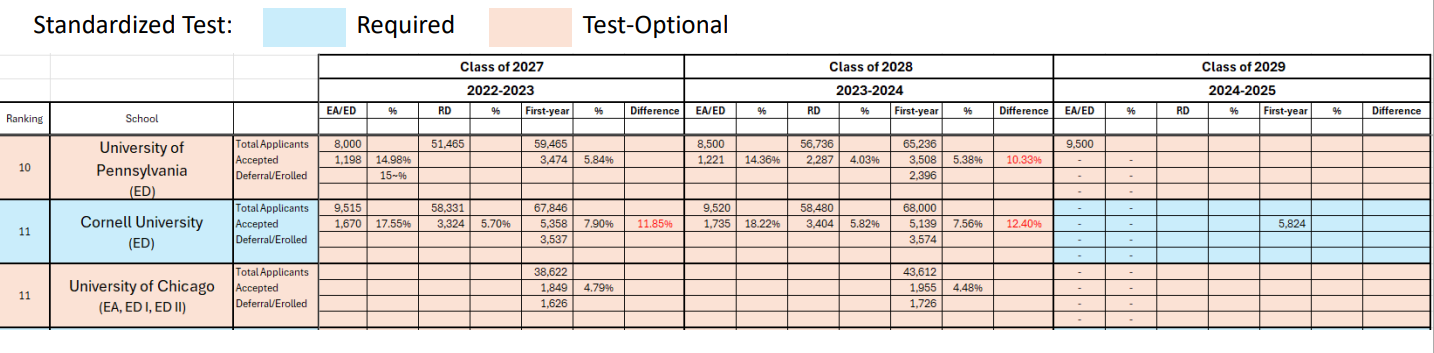
UPenn has also shown a consistently strong Early advantage, often in the 10% range or higher. That makes Early strategy highly relevant here. This is not a marginal bump. It is a meaningful difference that should absolutely factor into a student’s decision.
Cornell
Cornell has shown gaps around 12.40% and 11.85%, which already makes it attractive from an Early strategy standpoint. Cornell becomes even more interesting when we consider the return of SAT/ACT requirements. If testing requirements reduce the size of the Early applicant pool, admit rates may rise slightly, which could make Cornell even more favorable in the current cycle.
Brown
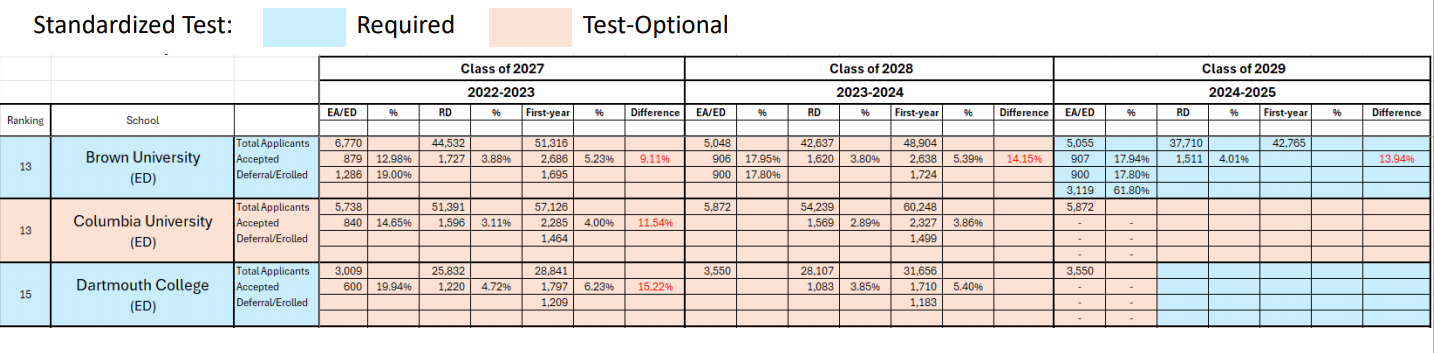
Brown has been trending in roughly the 13–14% range, placing it firmly among the schools where Early can provide a substantial advantage.
Columbia
Columbia has had some stronger years—one prior cycle was around 11.54%—but overall, it is probably best described as a school with an upper-middle-tier Early advantage rather than one of the very strongest in this framework.
Dartmouth
Dartmouth is one of the strongest schools in the entire group from an Early strategy perspective. The gap has been around 15%, and in some earlier cycles even closer to 16%. That makes Dartmouth one of the clearest examples of a school where applying Early can meaningfully improve the odds.
Rice
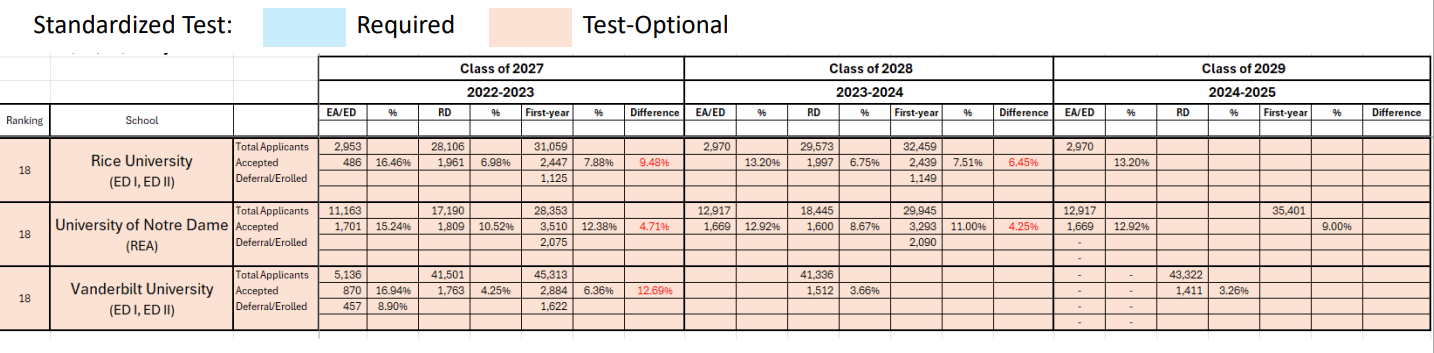
Rice falls on the lower end, with an Early–Regular gap generally below 10%. That does not mean Early is unhelpful, but it does make Rice less compelling than schools where the statistical advantage is more pronounced.
Notre Dame
Notre Dame stands out because its Early advantage is relatively small. That means it is usually not one of the first schools I would prioritize if the goal is to maximize the strategic value of an Early application.
Vanderbilt
Vanderbilt has generally been in the 12% range, which makes it another school where Early clearly carries real value.
If we rank schools primarily by the size of the Early–Regular gap across recent cycles, the strongest group would include Dartmouth and Northwestern near the top, followed by Brown, Cornell, UPenn, and Vanderbilt. But even that is not enough on its own.
We also have to look at how many students a school actually admits in the Early round.
This is what makes the analysis more practical. Northwestern, for example, is attractive not only because the percentage gap is large, but also because it enrolls roughly 1,200 students through Early. Cornell is similarly compelling: the gap is strong, and the school admits around 1,700 students in the Early round. So when students ask, “Where should I use my one Early application among similarly selective schools?” the best candidates are often the schools where both the Early advantage and the Early admit volume are substantial.
Now let’s turn to another critical question: What happens if a student is deferred in the Early round and reconsidered in Regular Decision?
This is an area where many families misread the numbers.
A defer is not the same thing at every school. At some colleges, a deferral still leaves the door meaningfully open. At others, it functions more like a soft rejection. One useful way to think about this is to compare the school’s Early admit rate with its defer rate. If the defer rate is dramatically higher than the admit rate, that often means the school is pushing a very large number of students into the Regular pool with extremely low odds of eventual admission.
MIT
MIT is one of the clearest examples of a difficult deferral outcome. Its Early admit rate may fall in the 5–7% range, while the defer rate has often been in the 60% range, and sometimes even the 70% range. In practical terms, MIT defers a huge number of applicants. So a defer there often looks far more hopeful than it actually is.
Harvard
Harvard shows a similar pattern. With an Early admit rate around 7% and deferrals often near 80%, a defer from Harvard typically does not leave the student in a particularly favorable position.
Yale
Yale historically deferred many applicants as well, though in recent years it has reduced that share to something closer to the 20% range in some cycles. That may be somewhat better than before, but it still does not make Yale a school where a deferral should be interpreted optimistically.
Duke
Duke has shown a more mixed pattern. In earlier years, something like 21% admitted Early versus 18% deferred suggested that a defer still left room for real hope. More recently, however, deferrals have increased while the Early admit rate has declined. Even so, Duke remains a school where a deferred student may still have a somewhat more realistic path than at places like MIT or Harvard.
Johns Hopkins and Northwestern
These schools tend to reject more aggressively in the Early round rather than deferring enormous numbers of students. As a result, the defer pool is smaller. That means if a student is actually deferred at Johns Hopkins or Northwestern, there may be relatively more room to compete in Regular Decision than at schools that defer nearly everyone.
UPenn
UPenn has often kept its Early admit rate and defer share in a somewhat comparable range. Because of that, it is generally seen as a school where a deferred student may still have a relatively meaningful chance later, especially with a strong post-deferral update strategy.
Cornell
Cornell’s recent data is less transparent, but historically there have been years when the admit and defer shares were close enough that deferred applicants still had real opportunities. That is why a strong letter of continued interest and a well-managed update strategy can still matter there.
Brown
Brown used to be viewed as a school where deferred students had relatively weak odds. More recently, however, it appears to be deferring more students while narrowing the gap somewhat. That does not make Brown especially favorable after a defer, but it does suggest that a deferral there may no longer be an automatic dead end.
Columbia
Columbia belongs more on the low-probability side after defer. Families should be cautious about reading too much into a deferral there.
Notre Dame
Notre Dame is one of the schools where the proportions appear relatively balanced, which means some cautious optimism after a defer may still be reasonable.
Vanderbilt
Vanderbilt is especially interesting. In earlier cycles, it gave out very few deferrals and rejected more aggressively. That meant that when a student was actually deferred, the defer carried relatively stronger value. More recently, Vanderbilt has deferred somewhat more students, but it still remains one of the better-known examples of a school where a defer can leave room for a later turnaround.
So if we summarize the schools where a deferred applicant may still have relatively better odds in Regular Decision, the list would include Duke, UPenn, Johns Hopkins, Northwestern, and Vanderbilt. By contrast, at schools like MIT, Harvard, and Columbia, families are often better off treating a defer as a very low-probability outcome.
The last major factor is the return of standardized testing requirements.
As more colleges reinstate the SAT or ACT, the applicant pool—especially in the Early round—may shrink somewhat. When that happens, admit rates can rise slightly simply because fewer marginal applicants decide to apply. Several top schools had already moved in this direction in the previous cycle, and others are now reinstating testing more recently. Schools like UPenn and Johns Hopkins, for example, become especially interesting under this lens.
If a school combines all three of the following factors—
- a large Early–Regular gap,
- a meaningful number of Early admits, and
- a testing-policy change that may reduce the size of the Early applicant pool,
—then that school deserves even stronger strategic consideration.
Using that framework, Northwestern, Cornell, and UPenn stand out particularly clearly.
So what is the practical takeaway?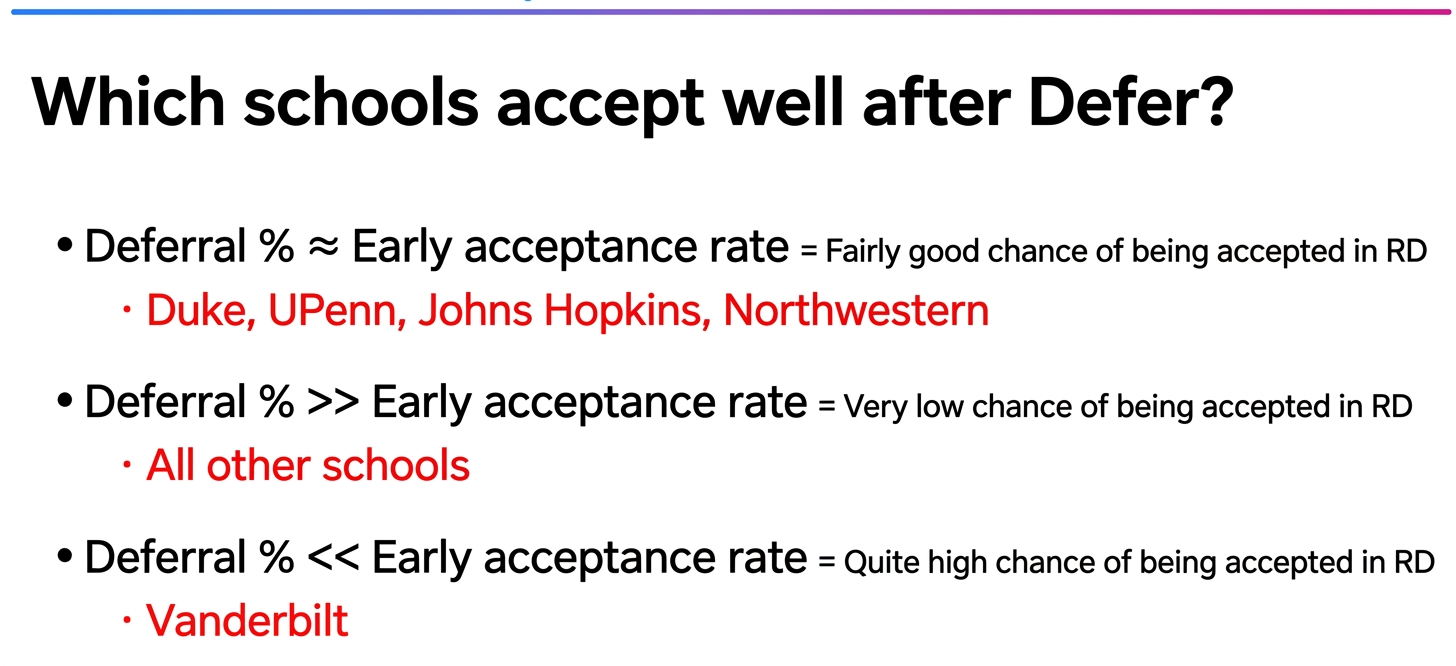
If a school has a large Early–Regular admit gap and also admits a substantial number of students in the Early round, then one Early application carries real strategic value. In that sense, schools like Dartmouth, Northwestern, Cornell, Brown, UPenn, and Vanderbilt are especially attractive.
If a school also gives deferred students at least some realistic path back into contention—schools such as Duke, UPenn, Johns Hopkins, Northwestern, and Vanderbilt—then there is additional strategic value, because even an imperfect Early result may still leave something to work with.
And if the school is also reinstating standardized testing in a way that may reduce applicant volume, there may be a small but meaningful additional edge in the current cycle, especially at places like UPenn and Johns Hopkins.
Today, I focused broadly on the Top 20 range and the main pressure points in Early strategy. But the larger lesson is simple: when students decide where to apply Early, they should not ask only, “Which school do I like most?” They should also ask, “Where does my one Early application create the most realistic strategic value?”
At the very top of the admissions landscape, those are not always the same question.
And when schools are similarly selective, that distinction can matter a great deal.
admission
